 comparison
Alternatives to Traditional Process Servers: 2026 Guide
Table of Contents
- Why Firms Are Looking Beyond Traditional Process Servers
- Comparing Service Methods: Cost, Speed, and Compliance at a Glance
- Electronic Service of Process Rules: What Courts Actually Require
- Certified Mail and Sheriff Departments: The Middle Ground
- Process Server Automation Tools and Platforms
- Court-Ready Proof of Service: What Evidence Holds Up
- Cost-Benefit Analysis by Case Type
- Risk Mitigation and State-Specific Procedural Variations
- Frequently Asked Questions
Last Updated: September 12, 2026
Why Firms Are Looking Beyond Traditional Process Servers
The calculus behind alternatives to traditional process servers has shifted, and it's not because personal service stopped working. It's because the cost of delay, failed attempts, and unverifiable delivery has become harder to absorb. At YouGotServe, we hear the same frustration from paralegals and solo practitioners: a defendant dodges three service attempts, the meter keeps running, and the filing deadline doesn't move.
Service of process is the formal delivery of a summons and complaint that gives a court jurisdiction over a defendant. Get it wrong, and the case stalls before it starts.
The core tension is simple. Traditional personal service offers the strongest due process footing, but it's slow, expensive, and vulnerable to evasion of service. Electronic and mail-based methods trade some of that certainty for speed and a documented paper trail. Choosing well means matching the method to the case, the jurisdiction, and the defendant's behavior.
Comparing Service Methods: Cost, Speed, and Compliance at a Glance
No single method wins across every case. The right choice depends on what your court rules require, how the defendant is likely to respond, and what record you can produce if service is challenged. The table below is a starting point; the notes underneath explain the mechanics that actually drive outcomes.

| Method | Typical Speed | Evasion Handling | Proof Produced | Who May Serve |
|---|---|---|---|---|
| Personal service | Days to weeks | Strong | Affidavit of service | Any disinterested adult, or a licensed/registered server where required |
| Certified mail | Days | Moderate | Return receipt (PS Form 3811) | The clerk or a party where the rule allows |
| Sheriff department | Weeks | Moderate | Official return of service | The sheriff or a deputy |
| Electronic service | Hours to days | Depends on verification | Delivery log plus affidavit | A party or platform, only when the rule or order permits |
What the Table Doesn't Tell You
Cost. Personal service is billed per attempt in most markets, and a defendant who dodges three attempts can triple the invoice before a single successful serve. Sheriff service runs on a county-set fee schedule that is usually lower per attempt but slower. Certified mail costs only the postage plus the return-receipt fee, which is why it is the default for cooperative, in-state defendants. Electronic service is typically the lowest marginal cost per delivery because there is no travel component.
Speed. The gap between "days" and "weeks" is not cosmetic. A sheriff's office processes requests in the order received and may not attempt service for several business days. A private server working a rush request can often attempt same-day or next-day. Electronic delivery is near-instant, but the clock that matters is the clock on your due diligence record, not the send timestamp.
Compliance. Every method above is only valid if the rule in your jurisdiction authorizes it for that case type. Personal service is the constitutional baseline. Certified mail is permitted in many but not all jurisdictions, and often only for certain actions. Sheriff service is mandatory in some courts and optional in others. Electronic service is the most rule-dependent of the four and is almost never available for initial service of a summons without consent or a court order.
The Due Diligence Layer
Most rules that allow an alternative method require a showing of due diligence first, documented attempts at personal service that failed. That means the methods are not always a free choice; they are a sequence. A common pattern is: attempt personal service two or three times at different hours, log each attempt, then move to certified mail or a motion for alternative service. Skipping the sequence is the fastest way to get a proof of service rejected.
How to Read the Table for Your Case
- If the defendant is cooperative and local, certified mail usually clears the bar at the lowest cost.
- If the defendant is evasive, start the personal-service sequence immediately so your due diligence record begins building.
- If the court mandates sheriff service, budget the extra weeks into your filing timeline.
- If you need speed and the rule permits it, electronic service is the fastest documented channel, but only with recipient verification.
For a deeper look at how electronic delivery is actually authorized, see the next section.
Electronic Service of Process Rules: What Courts Actually Require
Electronic service is permitted only when court rules or a specific order allow it. It is not a default substitute for personal service.
The Federal Rules of Civil Procedure govern service in federal cases, and Rule 5 addresses service of later filings by electronic means with consent. Initial service of a summons is stricter, and most states layer their own civil procedure requirements on top.
Federal Rules and State-Level Variations
Federal courts generally permit electronic service of filed documents when a party consents. State courts vary widely: some allow electronic service by agreement, others require a court-ordered service method, and a few recognize it only for specific case types. Always confirm the rule in the jurisdiction where you're filing before you rely on it.
When Electronic Service Is Permitted
Electronic service is typically allowed when the defendant consents, when a judge authorizes it after a showing of due diligence, or when statute specifically provides for it. Document your attempts either way.
Certified Mail and Sheriff Departments: The Middle Ground
Two long-standing options sit between full personal service and electronic delivery, and each carries its own trade-offs.
Certified Mail (USPS): Pros and Cons
Certified mail provides proof of mailing and, with a return receipt, signature proof of delivery. It's inexpensive and widely accepted. The catch: it doesn't guarantee personal service on the defendant, and it struggles against someone actively avoiding notice.
Sheriff Departments: Pros and Cons
Sheriff department service carries official government authority and predictable, county-set fees. It's the right call when local rules mandate it or when a uniformed presence matters. The downside is speed; sheriffs often run behind private servers and offer little flexibility for rush requests.
Filing proof of service that doesn't match your jurisdiction's rule is one of the most common reasons clerks reject filings. Confirm the accepted method before you serve, not after.
Process Server Automation Tools and Platforms
Technology hasn't replaced service of process; it has added tracked, verifiable delivery channels. The right platform depends on whether you need nationwide reach or deep local expertise.
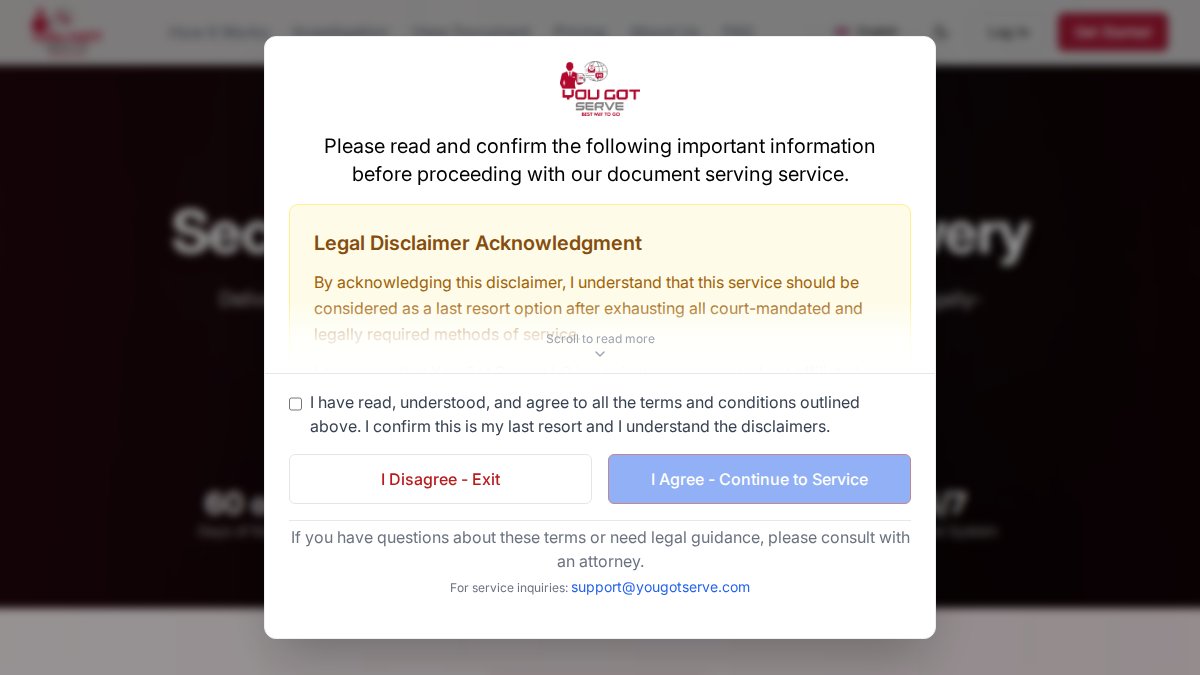
YouGotServe
YouGotServe is a legal technology platform built for secure document delivery through email and SMS. It verifies recipients, sends automated reminders, and produces a delivery log you can attach as court-ready proof of service. For firms that need speed without losing the evidence trail, it's a strong option. The limitation is honest: electronic delivery still depends on your jurisdiction permitting it.
NAPPS Directory
The National Association of Professional Process Servers maintains a nationwide directory of vetted, independent process servers. It's invaluable when you need a licensed professional with local knowledge for a difficult serve. The trade-off is inconsistency: individual members vary in how much technology they use, and you coordinate with each one manually.
Court-Ready Proof of Service: What Evidence Holds Up
Proof of service is only as good as the record behind it. A bare claim that a document was sent rarely survives a challenge.
Strong proof of service includes a signed affidavit of service, a timestamped delivery log, and, where applicable, a due diligence affidavit documenting prior attempts. Electronic platforms that capture recipient verification and delivery confirmation give you a record that stands up when a defendant claims they never received notice.
Cost-Benefit Analysis by Case Type
The cheapest method isn't always the least expensive. Match the method to the stakes, the defendant's likely behavior, and the rule that governs your action. Below is a case-type breakdown that most general guides skip.
Divorce and Family Law
Defendants in dissolution and custody matters are often motivated to avoid service, and the stakes of a defective serve are high because a default judgment can be reopened. Personal service, or sheriff service where the court requires it, is the safer default. Certified mail is workable only when the defendant is cooperative and the state rule permits it for the initial petition. If the defendant is out of state, expect to use a registered server in that jurisdiction or to seek a court order for alternative service after a documented due diligence record.
Debt Collection and Consumer Claims
These are volume cases, and the economics favor the lowest compliant cost per serve. Certified mail is common because the defendant is often locatable and the amount in controversy does not justify premium service. The risk is a defendant who claims no receipt; a return receipt with a signature closes that gap. Where the rule allows it, electronic service with recipient verification can cut per-serve cost further, but confirm the court accepts it before you build a workflow around it.
Small Claims
Small claims courts frequently have their own service rules that differ from the general civil rules, sometimes allowing clerk mailing, sometimes requiring personal service, sometimes permitting service by a party. Because the amounts are small, overspending on service can erase the value of the claim. Read the small claims rule for your specific court before choosing a method.
Personal Injury and Civil Litigation
Defendants here are usually represented or insured, and the defendant's insurer or counsel may accept service voluntarily. When they do, the cost drops sharply. When they don't, personal service is the norm because the case value justifies it and because a clean affidavit of service protects the record. Sheriff service is common where the court requires it, but private servers are typically faster.
Eviction and Landlord-Tenant
These are the most time-sensitive civil actions. A missed service date can push possession weeks out, and many jurisdictions have short statutory windows. Personal service or sheriff service is the standard, and some courts require it. Certified mail is rarely sufficient for the initial notice. If the tenant is evasive, start the due diligence record immediately and be prepared to move for alternative service on the court's schedule.
Out-of-State and Hard-to-Locate Defendants
This is where cost and complexity both spike. You generally need a server licensed or registered in the defendant's state, or a court order permitting an alternative method. A nationwide directory is the usual starting point; an electronic platform with tracking is useful only if the defendant's state and your court both permit it. Budget for multiple attempts and for the possibility of a motion for alternative service.
A Simple Decision Rule
- High stakes, evasive defendant: personal service, then sheriff if required, then a motion for alternative service.
- Low stakes, cooperative defendant: certified mail, if the rule allows it.
- Time-critical filing: electronic service only if the rule or an order permits it; otherwise rush personal service.
- Out-of-state defendant: a registered server in that state, or a court order for an alternative method.
This is where most firms overspend. Paying for personal service on a cooperative defendant wastes money; skimping on it for an evasive one wastes months. The case type, not the price list, should drive the choice.
Risk Mitigation and State-Specific Procedural Variations
State-specific procedural variations are the single biggest source of service errors. What passes in one jurisdiction can fail in the next, and statutory requirements differ on everything from who may serve to how proof is filed.
For pro se litigants, the risk is sharper: a procedural defect can get a case dismissed outright. Verify the rule for your specific court, keep a due diligence record, and choose the method the rule actually permits.
Frequently Asked Questions
What is the legal validity of electronic service of process?
Electronic service of process is valid when it complies with court rules and the defendant receives proper notice. Many states allow it with court approval or when parties agree. Federal courts often permit it under Rule 5(b)(2)(E) if the recipient consented in writing. The key is meeting due process requirements: notice must be reasonably calculated to reach the defendant. YouGotServe provides court-ready proof of electronic service to support your filing.
How does electronic service of process compare to traditional methods in terms of cost?
Electronic service typically costs less than hiring a private process server, who may charge per attempt plus mileage. Certified mail costs only the postage plus the return-receipt fee but lacks personal service guarantees. Sheriff departments charge a county-set fee per service. Electronic platforms often bundle verification, tracking, and proof of service into one fee. Pricing varies by volume and case type, so request a quote from YouGotServe for current rates.
What are the requirements for court-ready proof of service?
Court-ready proof of service must show who was served, when, where, and how. For electronic service, this includes delivery logs, recipient verification, and an affidavit of service. Courts want evidence the defendant actually received notice, not just that a message was sent. YouGotServe provides verified delivery tracking and documentation that satisfies procedural validity requirements. Always check your jurisdiction's specific rules before filing.
Can email or SMS be used for legal document delivery?
Yes, email and SMS can deliver legal documents when court rules permit or the parties agree. Some states allow electronic service for certain case types without prior approval. Others require a motion and court order. Due process demands the method reasonably reach the recipient. SMS is less common but gaining acceptance for initial notices. Confirm your state's civil procedure rules and local court requirements before using electronic delivery.
What happens if a defendant claims they never received the email or text?
If a defendant disputes receipt, your proof of service becomes critical. YouGotServe provides delivery tracking, recipient verification, and automated reminders that create a documented record. Courts evaluate whether the method was reasonably calculated to provide notice. Evidence of a verified email address or phone number, plus delivery confirmation, strengthens your position. Some jurisdictions require follow-up by mail if electronic service is challenged.
Service errors cost firms time, money, and cases, and the fix usually comes down to choosing the right method and proving it. YouGotServe handles that second half: secure delivery by email and SMS, recipient verification, automated reminders, and court-ready proof of electronic service. Get started with YouGotServe and serve documents with a record that holds up.