
Best E-Service Solutions for Managing Class Action Litigation Efficiently
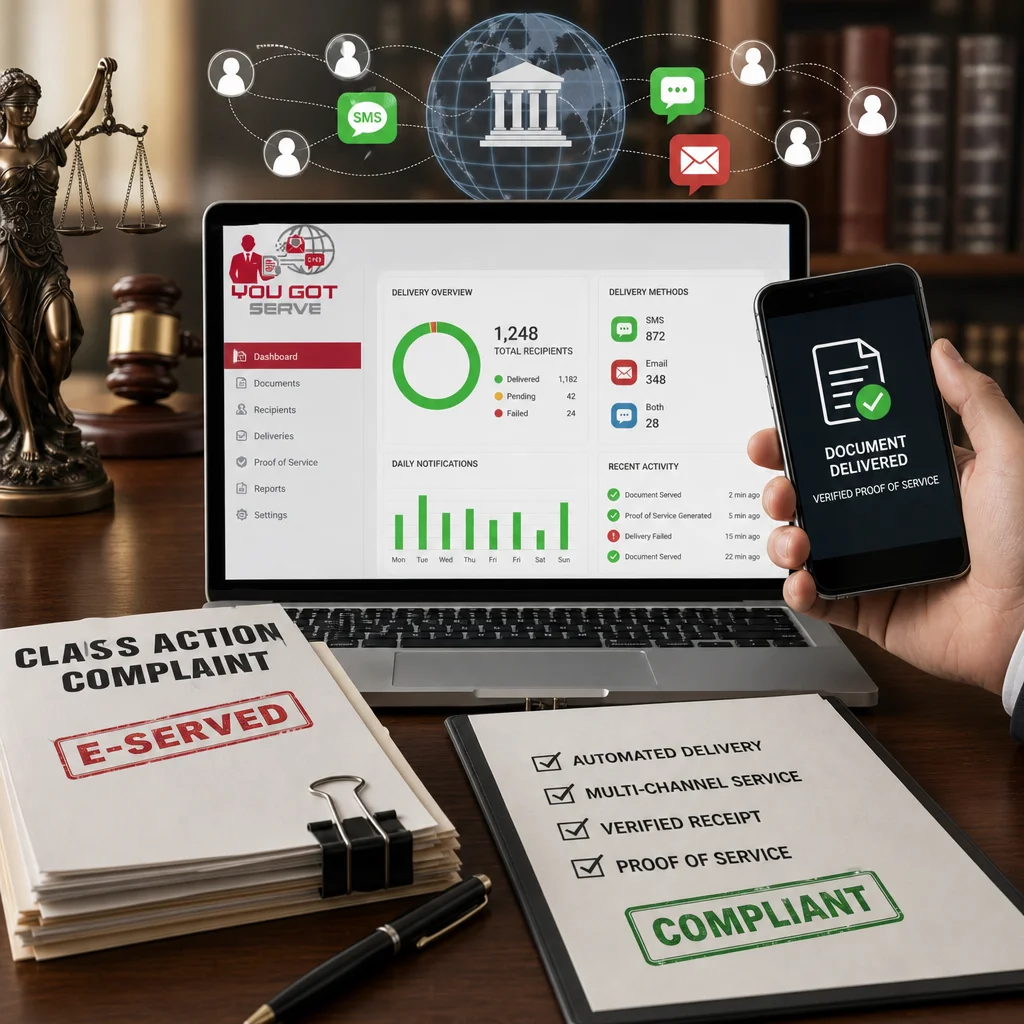
The Challenge of Serving Multiple Recipients in Class Actions
Class action litigation demands a fundamentally different approach to service than single-defendant cases. You're managing hundreds, sometimes thousands, of individual recipients across multiple jurisdictions, each requiring documented proof of notification. Traditional methods like personal service or certified mail become logistically complex and prohibitively expensive when scaled to class-action volume.
The core problem is coordination. You need to track which recipients have been reached, confirm receipt, maintain audit trails, and ensure compliance with varying state and local rules simultaneously. When recipients don't respond or move without leaving forwarding addresses, your timeline extends and your costs multiply. A single lawsuit requiring service to 500 class members through conventional channels can generate weeks of administrative overhead and thousands in unnecessary expenses.
Electronic service solutions eliminate these friction points by centralizing delivery, automating notifications, and creating real-time visibility across your entire recipient list.
Why Traditional Service Methods Fall Short for Mass Litigation
Newspaper publication remains the default fallback when personal service proves impractical, but it introduces significant delays and uncertainty. Courts require newspapers to publish once weekly for consecutive weeks, meaning notice campaigns typically stretch 4-8 weeks before you can demonstrate adequate notice. Publication also offers no mechanism to confirm whether any class members actually saw the notice.
Certified mail and return receipts work for reachable recipients but fail entirely when addresses are outdated or incomplete. You send documents to a bad address, receive a return receipt marked "unclaimed," and must start over. Each cycle consumes weeks while your litigation timeline keeps moving.
Hand delivery and skip tracing consume legal staff hours and still don't guarantee you'll locate every class member. The cumulative cost of pursuing traditional service across large recipient pools often exceeds the value of efficient electronic alternatives.
Electronic service platforms solve these operational problems through continuous automated outreach, multi-channel contact attempts, and documented delivery records that courts increasingly accept.
Key Criteria for Evaluating E-Service Platforms
Not all electronic service solutions meet the requirements of complex class action work. When evaluating platforms, focus on four essential dimensions:
Coverage and flexibility. Can the platform deliver via SMS and email simultaneously? Can it support multiple contact methods per recipient? Does it allow you to upload multiple documents for a single service campaign?
Verification and compliance. Does the system provide timestamped delivery records, recipient access logs, and optional verification methods like selfie capture or geolocation? Can you generate court-ready proof of service documentation?
Campaign duration and automation. Does the platform support extended notification cycles (60 or 90 days) with daily automated outreach? Will it continue attempting delivery if initial contacts fail?
Cost structure and scalability. Can you serve hundreds of recipients without exponential cost increases? Do discounts apply for organizational or multi-matter deployments?
Platforms that excel in all four areas reduce administrative burden, minimize compliance risk, and deliver faster case resolution than traditional methods.
Automated Daily Notifications and Multi-Channel Delivery
The efficiency gain from electronic service comes largely from automation. Rather than coordinating multiple service attempts over weeks, a properly configured platform sends daily notifications automatically to all recipients until they access documents or your service window closes.
Multi-channel delivery is essential. Not every class member monitors email consistently; some prefer text messages. By delivering via both SMS and email daily, you dramatically increase the probability of contact. We enable you to load up to three email addresses and three phone numbers per recipient, ensuring you can reach them through their preferred method even if their contact information includes older or secondary numbers.
This redundancy transforms outcomes. A recipient who misses an email notification might respond immediately to an SMS. Another might access documents via email but need the backup SMS as a reminder. Daily automated delivery means you're not depending on a single contact window or hoping someone notices a one-time notification.
The result is faster document access, shorter service campaigns, and stronger proof of notice when disputes arise.
Verified Receipt Tracking and Compliance Documentation
Every document access creates a timestamped record: when the recipient opened their notification, which device they used, whether they accessed the document, and when. Document tracking eliminates guesswork about who received notice.
This transparency supports compliance with court rules that increasingly permit electronic service. Judges need confidence that notice actually reached the class members. Traditional newspaper publication provides no such assurance. Electronic platforms provide detailed activity logs showing every delivery attempt, every failed send, and every successful access.
Recipients can retrieve documents securely using a unique one-time access code, ensuring only intended recipients view sensitive litigation materials. The timestamp and access record then becomes part of your proof of service affidavit, demonstrating to the court that notice was delivered, received, and accessed.
This documentation transforms electronic service from a convenience into a compliance advantage over newspaper publication and other traditional methods.
Secure Document Access with Recipient Verification
Ensuring only legitimate class members access settlement documents or court notices protects case integrity and respects confidentiality. We design our platform with recipient verification at its core.
When a class member receives notification, they use their unique code to access documents. Optional verification layers can include selfie capture, geolocation data, and activity timestamps. These layers prevent unauthorized access and create an audit trail that satisfies courts concerned about the legitimacy of electronic service.
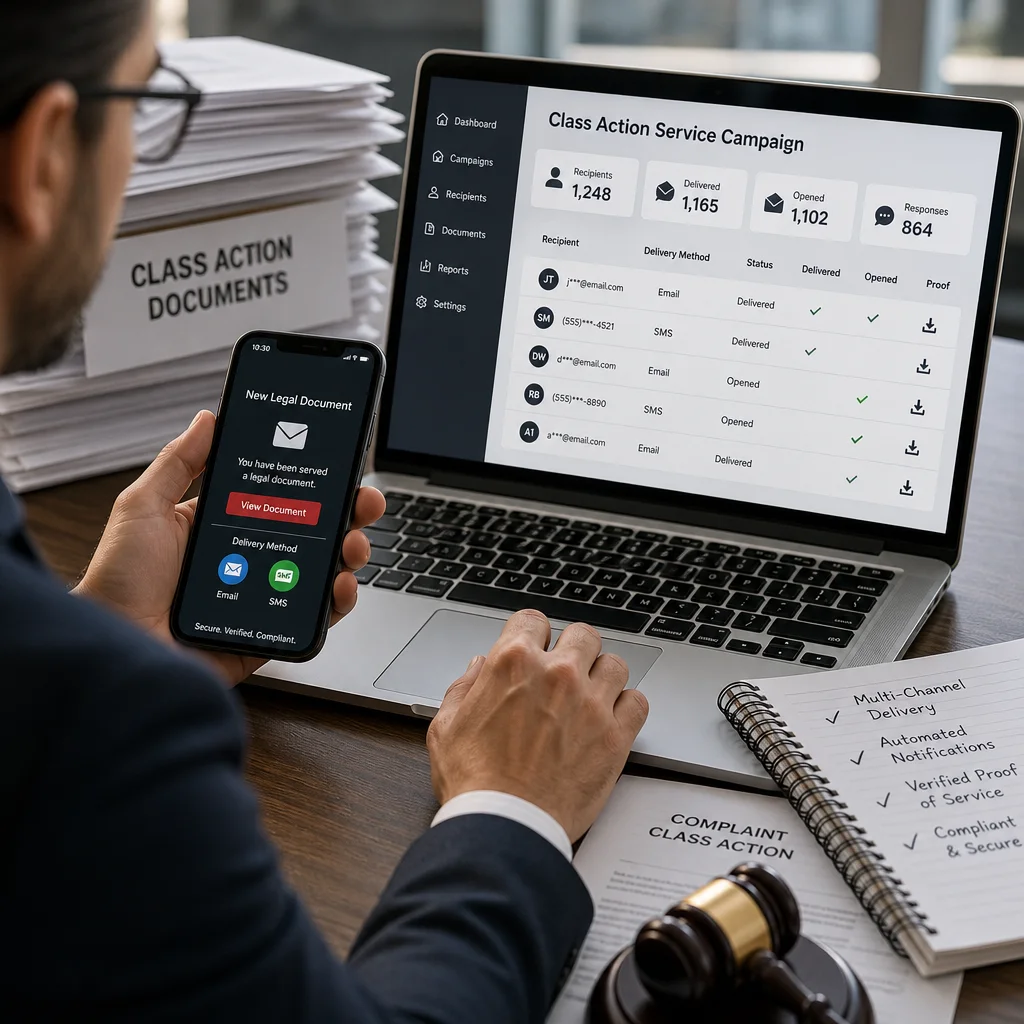
For high-value or sensitive matters, this verification capability becomes critical. You're not simply sending documents into the digital void; you're controlling who accesses them and creating evidence of legitimate receipt. The combination of secure code protection and optional verification methods provides courts with confidence that electronic service meets due process standards.
Extended Campaign Options for Complex Litigation
Class action complexities require flexibility in service duration. Recipients need time to receive notice, comprehend information, and respond or claim documents. We offer both 60-day and 90-day service campaigns, allowing you to match campaign length to your case requirements and settlement or trial timeline.
Extended campaigns prove particularly valuable for hard-to-reach recipients. With daily automated notifications over 60 or 90 days, even recipients who don't regularly check email or might have moved have multiple realistic opportunities to receive notice. The extended window increases the likelihood of meaningful contact across dispersed class members.
Longer campaigns also align with court expectations in class action procedures. Many jurisdictions require notice periods measured in weeks or months. Electronic service platforms that support these longer cycles become the natural fit for class action administration.
Cost-Effective Scaling Without Sacrificing Accuracy
Traditional service methods scale expensively. Adding 100 more recipients to a hand-delivery or skip-trace campaign means proportionally higher labor costs. Newspaper publication costs spike as you add jurisdictions or repeat notices.
Electronic service platforms scale efficiently. Our pricing model accommodates large recipient lists within fixed campaign costs. A 60-day service campaign for 100 recipients costs the same as a campaign for 500 recipients because the platform automates outreach to all simultaneously.
This cost structure makes electronic service the economical choice for class actions, particularly when compared to the cumulative expense of pursuing traditional service methods across hundreds of class members. Eligible organizations receive a 10% discount, further improving cost efficiency for institutional legal departments and class action administrators.
How You Got Serve Delivers Superior Class Action Support
We've designed our platform specifically for the operational complexity of mass litigation. Our dual email and SMS delivery ensures recipients receive notifications through their preferred channel. Multiple contact points per recipient (up to three emails and three phone numbers) maximize your chances of reaching class members even when contact information is incomplete or partially outdated.
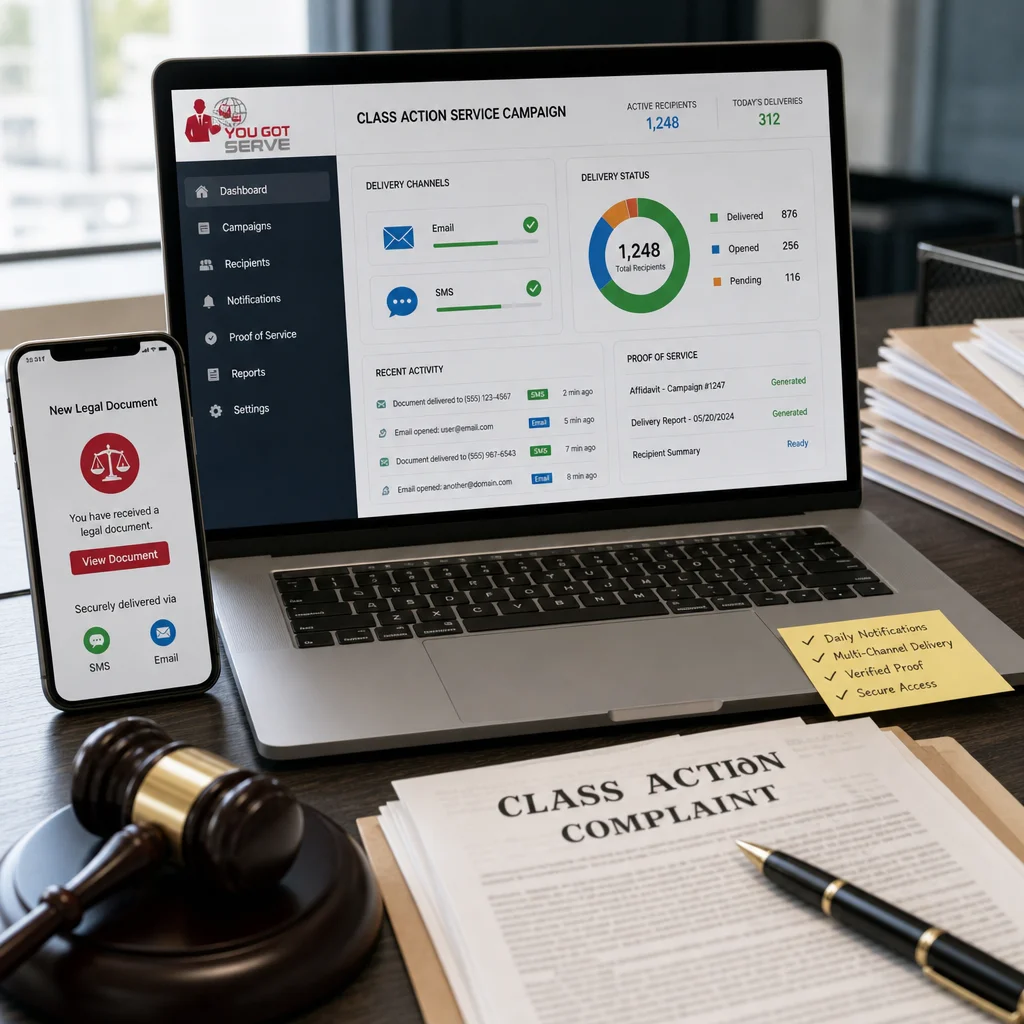
Daily automated notifications over 60 or 90-day campaigns provide sustained outreach without manual oversight. You upload documents once; our system handles daily contact, failed delivery retries, and access tracking. Your legal team monitors status through a straightforward dashboard showing which recipients have accessed documents and which remain pending.
For recipients where contact information is incomplete, we integrate investigative skip tracing resources, connecting you with professional investigators when you need additional leads. How the e-service works demonstrates how these components work together to streamline class action administration.
Comparison: Why Electronic Service Outperforms Newspaper Publication
Newspaper publication remains the fallback for many attorneys, but electronic service now provides a superior alternative across nearly every meaningful dimension.
Newspaper publication requires 4-8 weeks of consecutive weekly notices before you achieve compliance. Electronic service completes equivalent notice attempts in days, with documented proof of delivery and access. Publication costs escalate significantly across multiple publications and jurisdictions. Electronic service maintains fixed pricing regardless of recipient volume.
Most critically, newspaper publication offers no mechanism to confirm whether class members actually received notice. Electronic service provides detailed delivery logs, access timestamps, and recipient-generated activity records. Courts increasingly view this documented receipt as more credible evidence of adequate notice than newspaper publication alone.
Finally, newspaper publication requires parallel personal service or other traditional methods to fulfill actual notice requirements in most jurisdictions. Electronic service often functions as a complete solution, eliminating the need for redundant service attempts.
Implementation Guide: Getting Started with Your E-Service Strategy
Begin by auditing your existing contact information for target recipients. Compile email addresses and phone numbers into a clean list, removing obvious duplicates and correcting obvious errors. This preparation step takes minimal time and dramatically improves campaign success rates.
Next, gather all documents you'll serve via electronic notification. Our platform allows multiple document uploads per service campaign, so you can include the settlement agreement, court notice, claim form, and related materials in a single notification sequence.
Select your campaign duration (60 or 90 days) based on your case timeline and court requirements. Longer campaigns provide more reasonable notice windows for hard-to-reach recipients while shorter campaigns accelerate cases with tight deadlines.
Upload recipient contact information and documents through your account dashboard. Verify that you've included all available contact points for each recipient. Configure notification frequency and review your estimated campaign costs.
Initiate the service campaign. Our platform automatically begins daily notifications via SMS and email. Monitor the dashboard for delivery status, document access, and any failed contact attempts. As recipients access documents, our system generates timestamped proof of service records.
Why You Got Serve Is The Definitive Solution for Class Action Management
We've engineered our platform explicitly for class action complexity. The combination of multi-channel daily notifications, extended campaign options, verified delivery tracking, and secure document access creates an unmatched solution for managing mass litigation efficiently.
Attorneys and class action administrators choose You Got Serve because we handle the operational burden that traditional service methods impose. Our platform scales to hundreds of recipients without proportional cost increases. Our automated daily outreach ensures sustained notice attempts without manual oversight. Our detailed delivery records provide courts with confidence that electronic service meets due process and notice requirements.
Most importantly, we've designed our system to support compliance with local court rules and varying jurisdictional requirements. Whether you're managing a settlement notice campaign, court-authorized electronic service, or supplemental notification alongside traditional methods, our platform delivers the reliability and documentation that modern class action practice demands.
The decision between traditional service and electronic alternatives is no longer close. We deliver superior outcomes through efficiency, accuracy, and verifiable compliance. Make You Got Serve your definitive platform for class action document delivery and proof of service.