
Comparing Traditional Newspaper Publication vs. Electronic Service of Process

Why Traditional Newspaper Publication Falls Short Today
Newspaper publication remains a valid substitute service method in many jurisdictions, but it comes with significant practical drawbacks that frustrate legal professionals and delay case resolution.
When a defendant cannot be located through standard service methods, courts may authorize publication in a newspaper as constructive notice. The problem: most newspapers have shrinking circulation, limited readership, and no meaningful way to verify that the intended recipient actually saw the notice. A defendant buried in the back pages of a declining publication rarely results in actual notice.
Beyond the verification gap, publication creates timeline friction. Newspapers impose publication schedules, minimum notice periods, and affidavit requirements that stretch the service process over weeks. Courts often require multiple publications to satisfy statutory requirements, each adding cost and delay. For litigants trying to move cases forward, this friction is both expensive and frustrating.
We've worked with attorneys who switched from newspaper publication after experiencing delayed case progression, wasted advertising spend, and no real proof that notice reached the defendant. The alternative they discovered works faster, costs less, and provides documented evidence of delivery attempts.
What Makes Electronic Service a Modern Alternative
Electronic service of process delivers court documents via email and SMS to multiple contact points simultaneously, with automated daily notifications across an extended campaign period. Unlike newspaper publication, this method creates active, documented delivery attempts rather than passive notice.
When you serve documents electronically, you're reaching the recipient where they actually spend time: their email inbox and phone. Automated notifications increase the likelihood of actual notice. A defendant checking their phone is far more likely to see an SMS notification than to stumble across a newspaper classifieds section.
Electronic service also works as a lawful alternative when authorized by court rules, applicable statutes, or court order. Many state rules of civil procedure now expressly permit electronic service when personal service fails or the defendant's address is unknown. Federal courts and an expanding number of state jurisdictions recognize electronic notification as a legitimate substitute service method.
The key distinction: electronic service combines documented delivery attempts, recipient engagement tracking, and court-authorized compliance into one streamlined process.
Comparing Cost: Newspaper Publication vs. Digital Service
Newspaper publication costs vary widely, but typically run $300 to $1,000 or more per case, depending on publication size and circulation area. These costs cover advertising space, multiple required publications, and processing fees. Often, you receive little more than a tearsheet and an affidavit as proof.
Our 60-day electronic service campaign costs $350, and our 90-day service runs $500. This single fee covers unlimited email and SMS delivery to up to three email addresses and three phone numbers per recipient, automated daily notifications, secure document access with unique verification codes, timestamped delivery records, and detailed activity tracking throughout the entire campaign.
Organizations and eligible accounts receive a 10% discount on our service pricing. Compared with newspaper publication, you eliminate repeated publication fees, reduce administrative overhead, and gain transparent, comprehensive proof of service documentation from day one.
For legal professionals managing multiple cases, the cost savings compound quickly when you replace publication cycles with streamlined digital campaigns.
Comparing Speed: Publication Timelines vs. Automated Notifications
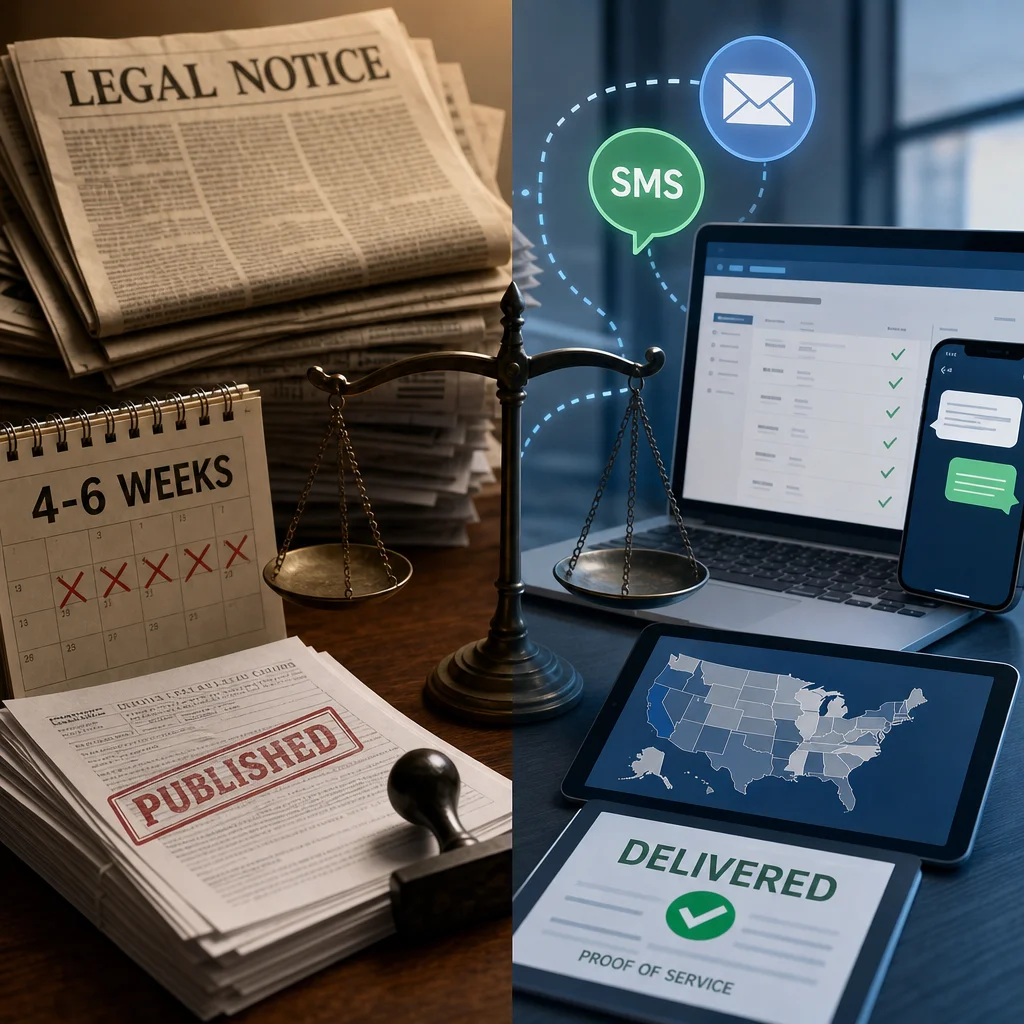
Newspaper publication timelines are dictated by print schedules and statutory waiting periods. Most jurisdictions require minimum publication intervals (often 4-6 weeks), affidavits of publication, and sometimes proof of mailing. Completing a full publication sequence can consume 8-12 weeks or longer before you can file proof of service with the court.
Our platform launches automated notifications immediately. Once you upload documents and enter recipient contact information, daily SMS and email notifications begin on day one. You receive real-time tracking of delivery status, access attempts, and notification history throughout your selected 60 or 90-day campaign window.
The speed advantage is stark: you have documented service activity within hours, not weeks. If a case moves to a hearing or requires early motion practice, you already possess detailed proof of service delivery attempts rather than waiting for a newspaper to print and the publication cycle to complete.
Comparing Proof of Delivery and Documentation
Newspaper publication provides an affidavit of publication and a tearsheet showing the ad ran. This proves the notice appeared in print on a specific date, but it does not prove the defendant read it, received actual notice, or engaged with the content. Courts accept it as constructive notice based on the theory that publication was sufficient under law, but actual notice remains unverified.
Our platform provides granular delivery documentation: timestamped email and SMS notifications, recipient verification data, geolocation information where available, document access activity, and a complete audit trail of service attempts. Recipients access documents using a unique one-time code, creating a verifiable record that they retrieved and reviewed the content.
We also capture optional selfie verification and additional engagement metrics that strengthen proof of actual notice. This level of documentation gives courts confidence that the recipient had meaningful opportunity to engage with the documents, not merely passive theoretical notice.
When you need proof of service that withstands judicial scrutiny, our detailed activity records and verified delivery tracking outweigh the limitations of publication affidavits.
State-by-State Authority: Where Electronic Service Is Permitted
Electronic service authority varies significantly across jurisdictions. Federal courts permit electronic service under Fed. R. Civ. P. 5(b)(2) when a party consents or when a rule or statute authorizes it. Many state rules of civil procedure now explicitly permit electronic service via email or other electronic means.
States including New York, California, Texas, and Florida have updated their procedural rules to authorize electronic service in appropriate circumstances. Some jurisdictions permit electronic service when the defendant's physical address is unknown or personal service has been unsuccessful. Court authorization or specific statutory permission is often required before relying on electronic service as a substitute method.
We recommend checking your local court rules and consulting applicable statutes before proceeding with electronic service. Our legal validity resource provides an overview of jurisdictional approaches, but local rules and judicial precedent ultimately determine acceptability in your specific court.
Understanding your jurisdiction's authority is essential. Electronic service is not universally accepted everywhere, and compliance requires advance verification of local requirements.
How Our Platform Delivers Compliance and Verification
We've designed our platform to support compliance with electronic service requirements while providing courts with verifiable proof of delivery and recipient engagement.
Our dual email and SMS delivery model ensures multiple contact points, increasing the probability of actual notice. Automated daily notifications over your selected 60 or 90-day campaign window create a documented record of repeated, consistent service attempts rather than a single static publication.
Each recipient receives a secure, code-protected document link valid only for that service. When they access documents, we record the timestamp, device information, and geolocation data (where available). This creates verifiable evidence that they received and accessed the documents, not merely that we sent them.
End-to-end encryption and timestamped activity logs ensure the integrity and admissibility of our service records. Our platform generates comprehensive service documentation suitable for court filing, affidavits, and judicial review.
We also assist customers lacking sufficient contact information through integrated investigative skip tracing services. If you need to locate a difficult-to-find recipient before service, we can help identify current contact details.
Key Features That Distinguish Our Solution
We've built several capabilities into our platform that distinguish it from generic email services or basic SMS tools:
Multiple contact points per recipient. You can enter up to three email addresses and three phone numbers. Our system delivers notifications to all of them simultaneously, maximizing the chance actual notice reaches the defendant.
Extended campaign periods. Rather than a single notification, our 60 or 90-day campaigns deliver automated daily notifications throughout the service window. Persistence increases actual notice likelihood.
Secure, verified document access. Recipients cannot access documents without their unique one-time code. This creates auditable proof they retrieved and reviewed the content.
Geolocation and selfie verification. Where appropriate, we capture optional geolocation data and selfie verification to strengthen proof of recipient identity and engagement.
Complete activity audit trail. Our dashboard and downloadable reports document every notification sent, every access attempt, timestamps, device information, and service status. This comprehensive record is court-ready.
Integrated skip tracing. If you lack current contact information, we offer investigative services to locate recipients before service begins.
These features work together to create a service solution that combines multiple contact attempts, documented engagement, recipient verification, and comprehensive court-compliant proof of delivery.
Why Verification and Tracking Matter in Court
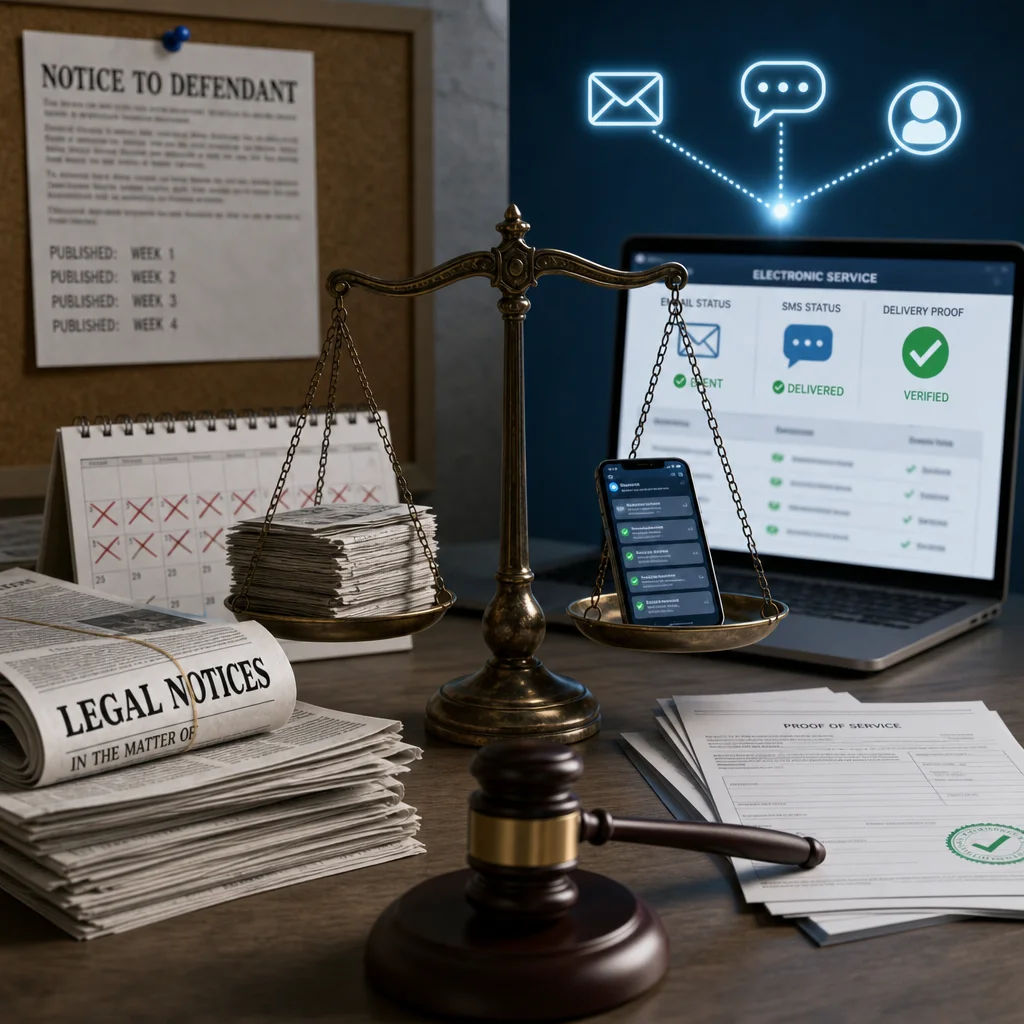
Judges scrutinize proof of service because service of process is fundamental to due process and jurisdictional authority. A defendant who received no meaningful notice has grounds to challenge a judgment as void, making your service documentation critical to the case's ultimate validity.
When you present proof of service to the court, detailed tracking and verification evidence strengthen your position. A comprehensive record showing multiple delivery attempts, timestamped notifications, geolocation data, and verified document access demonstrates that the defendant had genuine opportunity to receive notice, not just passive theoretical opportunity.
Electronic service records create a stronger evidentiary foundation than newspaper affidavits alone. Courts increasingly recognize the reliability and probative value of detailed digital delivery records. If a defendant later challenges notice, your timestamped activity audit trail and verification data provide robust rebuttal evidence.
Comprehensive tracking and verification also protect you if service is contested. The more detailed your proof of service documentation, the more defensible your position in addressing jurisdictional challenges or challenges to the judgment.
Making the Switch: What Legal Professionals Should Know
Before migrating from newspaper publication to electronic service, verify that your jurisdiction permits electronic service as a substitute method. Check your local court rules, applicable statutes, and any standing court orders. Some jurisdictions require prior court authorization before relying on electronic service; others permit it by rule once personal service fails.
Contact information is essential. Confirm you have current email addresses and phone numbers for the recipient. If you lack sufficient contact details, our investigative services can assist with locating recipients before service commences.
Prepare your documents and upload them to our secure platform. Select your service duration (60 or 90 days) and configure your recipient's contact points. Our system launches automated notifications immediately and begins documenting delivery activity.
Monitor your campaign through our real-time dashboard. Track notification delivery, access attempts, verification data, and service status. Once your campaign concludes, download comprehensive service documentation for court filing.
The practical transition is straightforward, and the benefits in speed, cost savings, and proof quality are immediate.
Why You Got Serve Is the Clear Choice for Modern Service
Newspaper publication served a purpose in an earlier era, but it is now an outdated, inefficient substitute for service of process. The method lacks verification of actual notice, imposes artificial delays, produces limited proof documentation, and costs as much or more than modern electronic alternatives.
We've built You Got Serve to solve the real problems that attorneys and litigants face when traditional service methods fail. Multiple contact points, automated daily notifications, verified document access, geolocation and identity verification, extended campaign periods, and comprehensive audit trails combine to create service documentation that is faster, more affordable, and far more credible to courts than newspaper publication.
Our pricing is transparent: $350 for 60 days or $500 for 90 days, with a 10% discount for eligible organizations. You receive unlimited notifications, multiple contact points, verified delivery tracking, and court-ready proof of service documentation. Compare that to the repeated costs, delays, and minimal proof of newspaper publication, and the choice becomes clear.
Electronic service of process is now the modern standard. You Got Serve delivers compliant, verified, documented service across the United States and internationally where technically and legally appropriate. We provide the proof and verification courts expect and litigants need.
Serve documents electronically. Eliminate delays and unnecessary costs. Trust the platform designed specifically to support verified electronic service of process. That's You Got Serve.