 listicle
Electronic Service of Process Benefits Explained
Table of Contents
- What Is Electronic Service of Process?
- Electronic Service of Process Rules: What Courts Require
- Key Benefits of Electronic Service for Litigation
- Digital Proof of Service: What It Is and Why It Holds Up in Court
- Reducing Litigation Administrative Overhead with E-Service
- Legal Document Delivery Automation: Tools and Security Standards
- International Service of Process: Cross-Border Considerations
- Frequently Asked Questions
Last Updated: August 31, 2026
What Is Electronic Service of Process?
Electronic service of process is the court-authorized delivery of legal documents, including summonses, complaints, and other litigation notices, to a defendant or opposing party through digital channels such as email, SMS, or messaging platforms. Rather than relying on a physical process server to locate and hand-deliver documents, electronic service transmits the required legal notice through verified digital means, creating a timestamped record of delivery.
Electronic service requires recipient verification, documented delivery confirmation, and, in most jurisdictions, either prior consent from the recipient or explicit court authorization. Done correctly, it satisfies due process requirements and produces proof of service that holds up to scrutiny at filing.
Electronic Service of Process Rules: What Courts Require
Courts do not accept electronic service of process automatically. The procedural requirements vary significantly depending on whether you are in federal court, state court, or pursuing international service.
Federal Rules vs. State-Level Requirements
Under the Federal Rules of Civil Procedure, Rule 5, parties who have appeared in an action may be served electronically if they consent in writing. Rule 4, which governs service of the initial summons and complaint, is more restrictive: federal courts generally do not permit electronic service of the summons and complaint as a default method. Instead, it requires either consent, a specific court order, or service under the law of the state where the district court sits.
State rules diverge considerably from that baseline. Some states have codified electronic service into their civil procedure rules with detailed consent and confirmation requirements. Others treat it as an alternative service method available only after traditional methods have been exhausted and a court order has been obtained. Practitioners handling multi-jurisdiction litigation must verify the specific rules for each state involved before initiating any form of e-service.
Consent, Court Orders, and Alternative Service
Two distinct pathways authorize electronic service in most jurisdictions: recipient consent and court-ordered alternative service.
When a defendant or opposing party explicitly agrees in writing to accept service electronically, courts generally recognize the resulting delivery as valid. When traditional service methods have failed, a plaintiff can petition the court for an order authorizing alternative service, which may include email, SMS, or social media delivery. Courts typically require evidence that the defendant is evading service and that the proposed electronic method is reasonably calculated to provide actual notice.
Key Benefits of Electronic Service for Litigation
Electronic service eliminates the structural inefficiencies that slow litigation down and drive up costs before a case even reaches its first hearing.

Speed and Cost Compared to Traditional Methods
Traditional process serving involves scheduling a process server, locating the defendant, making multiple attempts, and waiting for the affidavit of service to be returned and filed. That cycle commonly takes days to weeks, and each failed attempt adds cost.
Electronic service compresses that timeline substantially. A document transmitted via email or SMS reaches the recipient's device within seconds of dispatch. Automated reminder systems can re-notify recipients at set intervals without any additional manual effort.
| Method | Typical Timeline | Key Cost Drivers |
|---|---|---|
| Traditional process server | Days to weeks per attempt | Per-attempt fees, travel, admin time |
| Electronic service (email/SMS) | Minutes to hours | Platform fee, setup time |
| Publication service | Weeks to months | Publication fees, court approval |
| Court-ordered e-service | Hours to days | Court filing fee, platform fee |
Serving Elusive or Hard-to-Locate Defendants
Electronic service changes the calculus for litigation teams handling defendants who have moved without leaving a forwarding address, are actively avoiding physical contact, or have relocated out of state. Email addresses and phone numbers tend to persist even when physical addresses change.
Platforms that include investigative services can assist in locating verified contact information for hard-to-find recipients. Once a court order authorizing alternative service is obtained, persistent automated notifications sent over an extended period create a documented record showing every delivery attempt, the timestamp, and whether the recipient accessed the document.
Digital Proof of Service: What It Is and Why It Holds Up in Court
Digital proof of service is an electronically generated record confirming that a legal document was transmitted to a specified recipient, documenting the method of delivery, the timestamp, and evidence of receipt or access.
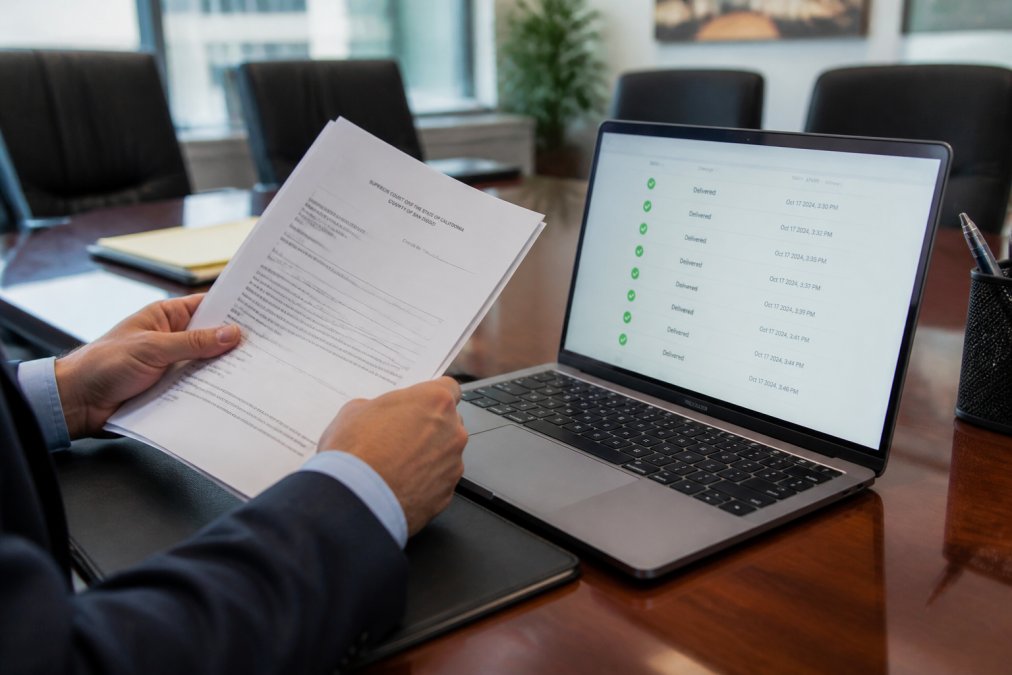
Courts are precise about what constitutes acceptable documentation. What makes digital proof of service court-ready is specificity: the record must identify the recipient, the document served, the delivery channel used, the exact time of transmission, and confirmation that the recipient accessed the document using a secure verification method.
YouGotServe generates a verified receipt once the recipient accesses documents using a secure code, creating a tamper-evident record that ties the specific individual to the specific document at a specific time. All files are encrypted, time-stamped, and stored on protected servers, which means the underlying data supporting the proof of service cannot be altered after the fact.
The strength of digital proof of service in court depends on the verification layer, not the delivery channel. An unverified email delivery notification proves only that a message was sent to an address. A verified receipt that requires the recipient to authenticate before accessing the document proves that a specific person received and opened the legal notice.
Reducing Litigation Administrative Overhead with E-Service
The administrative burden of traditional service, coordinating with process servers, tracking attempt logs, managing affidavit returns, and filing physical proof documents, consumes paralegal and legal assistant time that could go toward substantive case work.
Electronic service automates much of that workflow. When a platform sends daily email and SMS notifications automatically for an extended period, the litigation team does not need to manually track follow-up attempts or schedule re-service. The delivery log is generated continuously without staff intervention.
Each case involves multiple documents requiring service at different stages: the initial summons and complaint, discovery requests, motions, and hearing notices. A platform that handles delivery tracking and proof generation removes a significant coordination burden from the team and reduces the risk of human error in service.
Legal Document Delivery Automation: Tools and Security Standards
Legal document delivery automation refers to software-driven systems that handle the transmission, tracking, verification, and proof generation for legal documents served through digital channels. The differences between platforms come down to the depth of the verification layer and the security architecture protecting the documents in transit.
Cybersecurity and Data Privacy in Electronic Service
Legal documents contain sensitive information: personal identifying details, financial records, medical history, and confidential communications. The platform transmitting those documents must meet security standards that protect both the sender's client and the recipient.
Encryption in transit and at rest is the baseline requirement. Any platform handling legal document delivery should encrypt files using current standards, restrict access to documents through secure authentication, and store records on protected servers with access controls. Time-stamping must be handled by a system that cannot be retroactively altered, since the integrity of the timestamp is what gives the proof of service its evidentiary value.
Before adopting any legal document delivery platform, confirm that it provides audit logs of every access event, not just delivery events. If a defendant later claims they never received the document, the audit log showing their authenticated access is what resolves the dispute.
SMS, Email, and WhatsApp: Delivery Channels Compared
Electronic process services make it easy, served through SMS, email, and WhatsApp. The right channel depends on the jurisdiction, the court order in place, and the contact information available for the recipient.
Email is the most widely accepted channel for electronic service. Courts that have authorized e-service typically contemplate email as the primary delivery method. Email delivery creates a clear record of the sender, recipient address, timestamp, and document transmitted.
SMS reaches recipients on their mobile devices and produces high open rates compared to email. SMS service of process is served through SMS with court authorization or recipient consent, and is particularly effective for reaching defendants who are difficult to contact through other channels.
WhatsApp has been authorized as a service channel by courts in a growing number of jurisdictions, particularly for international service or cases where the defendant is known to use the platform. Courts that authorize WhatsApp service typically require evidence that the account is actively used by the defendant and that the message was delivered and read.
The real difference between channels is not speed but verifiability. A delivery confirmation from a platform that requires recipient authentication to access the document is stronger evidence than a read receipt from a messaging app, regardless of which channel was used.
International Service of Process: Cross-Border Considerations
International service of process adds complexity that domestic e-service frameworks do not fully address. When a defendant is located outside the United States, the governing rules shift from domestic civil procedure to international treaty obligations.
The primary framework for international service is the Hague Convention on the Service Abroad of Judicial and Extrajudicial Documents, to which the United States is a signatory. The Convention establishes procedures for serving process in member countries through designated Central Authorities. Many member states object to service by postal channels or direct service methods that bypass the Central Authority, and those objections extend to electronic service.
Electronic service that is valid under domestic rules may not be recognized in the defendant's home country if that country has objected to the relevant service method under the Convention. Courts have, in some cases, authorized email or social media service for international defendants when the Convention's procedures have been exhausted or are impracticable, but this requires a specific court order and careful documentation.
For litigation teams handling cross-border cases, verify whether the defendant's country is a Hague Convention signatory, whether that country has filed objections to particular service methods, and whether the court is willing to authorize alternative electronic service given those constraints. The question is whether the resulting judgment will be enforceable in the defendant's jurisdiction, and service method is one of the factors foreign courts examine when deciding whether to recognize a domestic judgment.
| Service Channel | Domestic Use | Court Approval Required | International Use | Key Verification Feature |
|---|---|---|---|---|
| Widely accepted | Consent or court order | Jurisdiction-dependent | Read confirmation, secure access code | |
| SMS | Permitted with authorization | Consent or court order in all states | Rarely authorized | Delivery receipt, device confirmation |
| Emerging acceptance | Court order typically required | Growing acceptance in some jurisdictions | Read receipt, account verification | |
| Publication | Established fallback | Court order required | Not applicable cross-border | Affidavit of publication |
Start the Hague Convention process early, document every step, and obtain explicit court authorization before attempting any form of electronic service on a foreign defendant.
Electronic service of process is no longer an edge case reserved for defendants who have gone off the grid. For litigation teams handling time-sensitive matters, high document volumes, or elusive defendants, it is the more efficient default. The challenge is doing it in a way that courts will accept without question. YouGotServe combines secure document delivery via email and SMS, recipient verification through secure access codes, persistent automated reminders, and court-ready proof of service that documents every delivery event. For practitioners who cannot afford to have a proof of service challenged at filing, ensure every document you serve comes with an irrefutable delivery record.
Frequently Asked Questions
What are the primary legal requirements for electronic service of process?
The requirements vary by jurisdiction, but most courts demand one of two things: the recipient's prior written consent to accept electronic service, or a court order specifically authorizing it. Under the Federal Rules of Civil Procedure, Rule 5 permits electronic service on parties who have consented. State rules differ significantly, so attorneys should verify local civil procedure rules before serving electronically. A valid affidavit of service or electronic delivery confirmation is typically required as proof.
Is electronic service of process legally recognized in all jurisdictions?
No. Electronic service of process is not universally accepted. Many federal courts permit it under FRCP Rule 5 when parties consent, and numerous states have adopted their own e-service statutes. However, some jurisdictions still require personal service or certified mail for initial summons and complaints. Courts may also require a formal motion and court order before e-service is permitted on an unresponsive or elusive defendant. Always confirm the applicable local rules before relying on electronic service.
Can legal documents be served via SMS, email, or WhatsApp?
Email is the most widely accepted electronic channel for service of process, particularly when the recipient has consented or a court has authorized it. SMS and messaging apps like WhatsApp are increasingly used as supplemental delivery channels, especially for alternative service on hard-to-locate defendants, but they generally require explicit court approval. No state currently permits SMS service of a summons without consent or a court order. Platforms that combine email, SMS, and WhatsApp delivery with verified read receipts can strengthen the paper trail when seeking court approval.
If a defendant claims they never received the email, how does digital proof of service hold up?
A well-documented electronic service record includes timestamps, IP address data, delivery receipts, and read confirmations tied to a secure access code. When a recipient opens the document using that code, the system logs the event and generates a verified affidavit of service. This creates a paper trail that is far harder to dispute than a claim of non-receipt. Courts evaluating due process compliance look at whether reasonable steps were taken to notify the defendant, and a detailed delivery log directly supports that standard.