
Electronic Service vs Newspaper Publication: Cost and Timeline Breakdown for 2026
Why Traditional Substituted Service Fails Modern Litigation
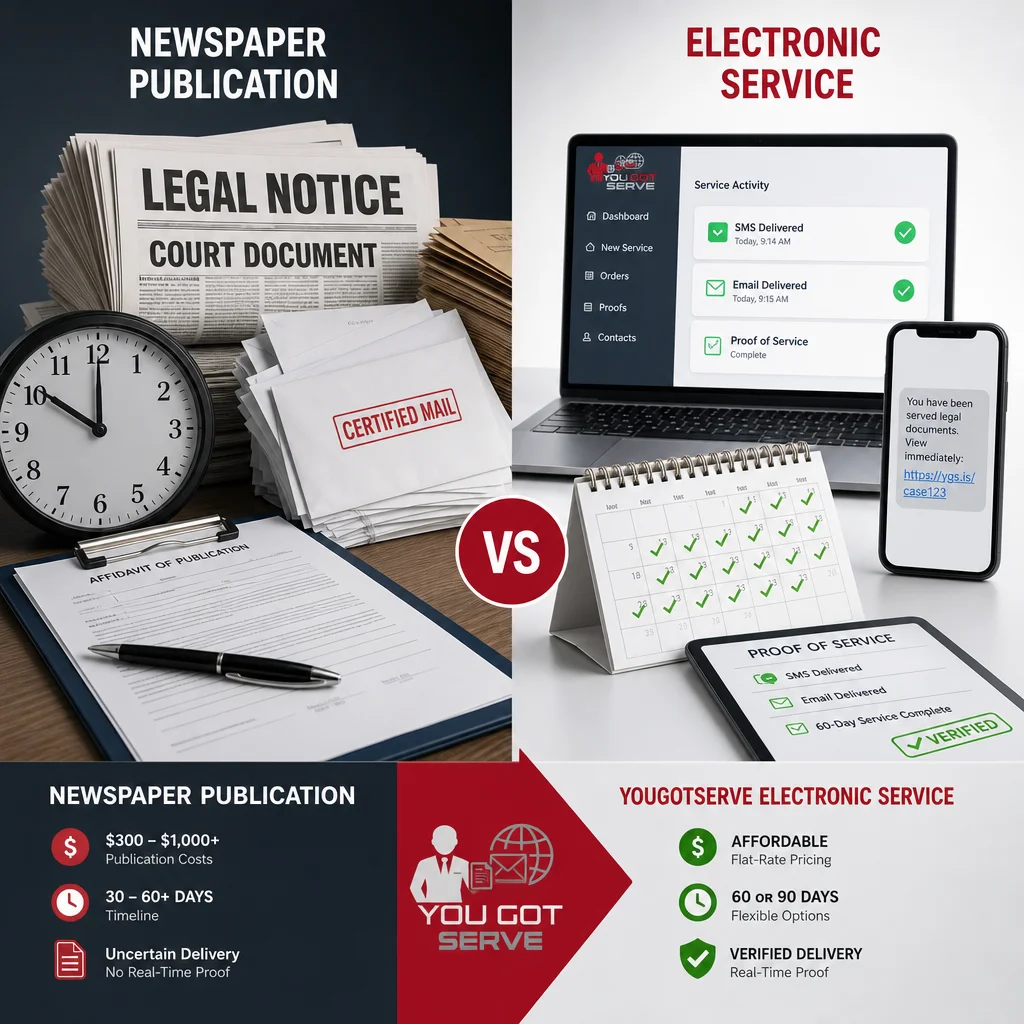
When a defendant avoids personal service, litigation stalls. Traditional substituted service methods—newspaper publication, certified mail, or hiring process servers to stake out an address—consume weeks and drain case budgets. Newspaper publication, once the standard fallback, requires court approval, publication delays, and waiting periods that can extend 60 to 90 days before you even establish proof of service.
The core problem is visibility and verification. A newspaper ad reaches a small audience in a specific geographic area. Most defendants never see it. Certified mail bounces back. Process servers report dead ends. Meanwhile, your case sits frozen, court deadlines loom, and costs accumulate.
Modern litigation demands faster, verifiable alternatives. That's where electronic service enters the picture. When courts permit it and local rules allow it, serve documents electronically through SMS and email to reach defendants directly, with timestamped proof that they received notification. No guesswork. No publication delays. No hoping they saw an ad tucked between classifieds.
The Hidden Costs of Newspaper Publication and Manual Service
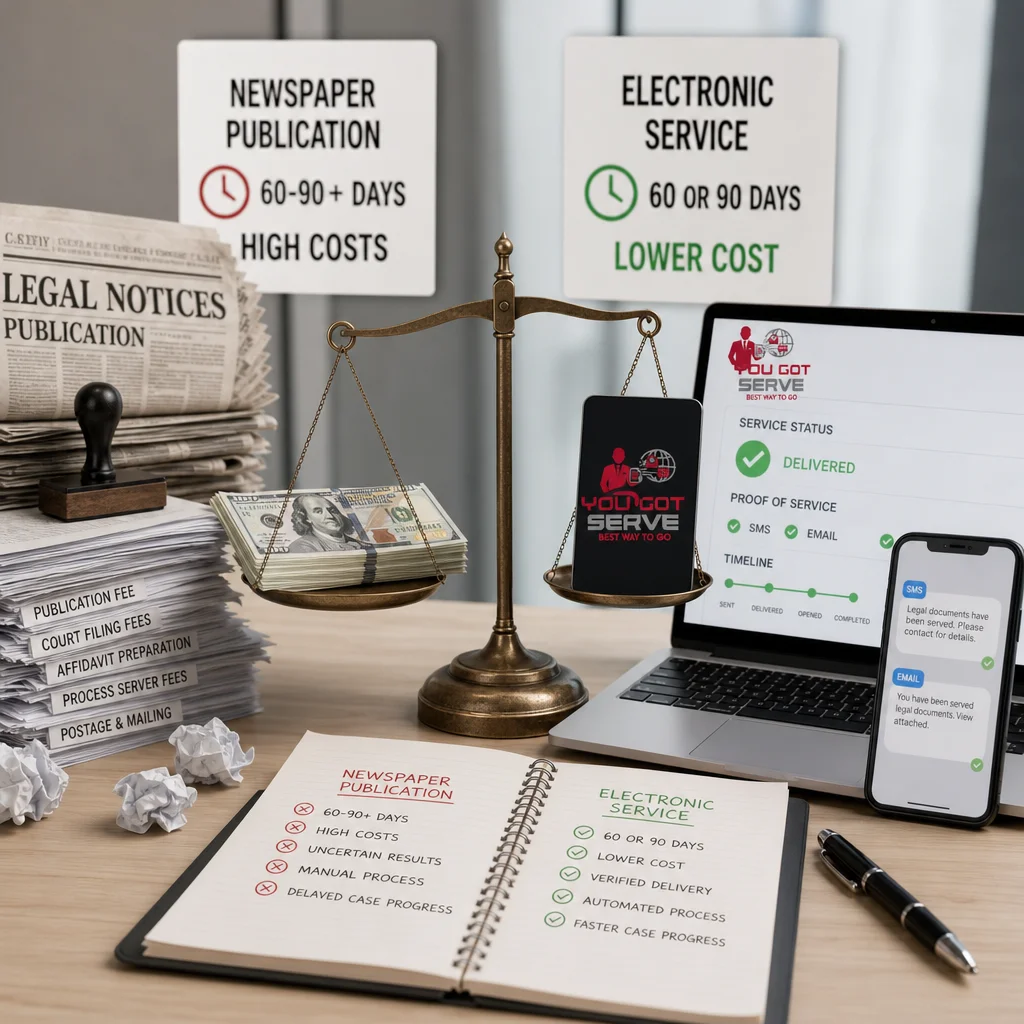
Newspaper publication costs more than most attorneys expect upfront. You pay the publication fee itself—typically $300 to $1,000 depending on circulation and location. Add in court filing fees, affidavit preparation, and attorney time reviewing publication requirements for your specific jurisdiction. The true cost often reaches $1,500 to $3,000 before accounting for the timeline delay.
Manual service methods compound the expense. Hiring a process server to locate and serve a hard-to-find defendant can cost $200 to $500 per attempt, and multiple attempts are common. Skip tracing services add another $100 to $300. If the defendant has moved or uses aliases, costs escalate quickly. Some cases require repeat newspaper publications in multiple counties, multiplying expenses further.
The less obvious cost is opportunity cost. While waiting for publication periods, adjournment periods, and affidavit deadlines to close, your case cannot proceed. Discovery is delayed. Depositions are postponed. Settlement negotiations stall. The longer litigation takes, the higher your overall legal fees become, even if individual service costs appear modest.
How Electronic Service Solves the Speed and Expense Problem
We designed electronic service to address these bottlenecks directly. Instead of publishing in newspapers and hoping, you serve documents electronically via SMS and email to a defendant's known contact information. Delivery happens within hours, not weeks. Our integrated investigative skip tracing helps you locate current contact details if you don't have them already.
Electronic service reduces friction at every step. No court approval delays for publication. No waiting for print cycles. No affidavits documenting failed personal service attempts. You send documents through our secure platform, and automated systems handle delivery, retry logic, and timestamped record-keeping. Recipients access documents through secure code-protected links, ensuring only authorized people view sensitive litigation materials.
The speed advantage directly cuts legal costs. Cases move forward faster. Depositions proceed on schedule. Settlement discussions happen sooner. Judges see active litigation progress, which can influence rulings on discovery disputes and continuances. In practice, this compression of timeline saves weeks and reduces attorney billable hours.
Our 60-Day and 90-Day Service Options Explained
We offer flexible notification cycles designed to meet different jurisdictional requirements and case urgency levels. Our 60-day option sends SMS and email notifications on a recurring basis over 60 days, ensuring multiple delivery attempts reach the recipient. Our 90-day option extends the cycle to support jurisdictions with longer substituted service windows.
Both options work the same way operationally. You upload case documents to our platform. We deliver notifications via SMS and email according to your chosen schedule. If a message bounces or delivery fails, our system retries automatically. You receive real-time updates showing delivery status, read receipts, and timestamps for each contact attempt.
Recurring notifications matter more than they first appear. A single email or text might end up in spam folders or go unread. Multiple notifications across days or weeks dramatically increase the chance a defendant sees and accesses the documents. From a legal standpoint, this repeated, documented outreach strengthens your proof of service if the case is ever challenged in court.
Check local court rules before selecting your service duration. Some jurisdictions mandate minimum notification periods. Others allow shorter windows if you can demonstrate good faith delivery attempts. Our team can help you confirm which option aligns with your specific court's requirements.
Verified Proof of Delivery: What You Actually Get
Proof of service is your legal foundation. When litigation moves to the next phase, opposing counsel and judges will scrutinize whether you actually served the defendant lawfully. Vague documentation fails courts. Timestamped, detailed delivery records succeed.
With electronic service through our platform, you receive a comprehensive proof of service record showing:
- Exact date and time each SMS and email notification was sent
- Delivery confirmation for each message (sent, delivered, or failed)
- Read receipts and access logs when the recipient opens the secure document link
- IP address and device information for each access event
- Complete audit trail of all retry attempts and system activity
This level of detail far exceeds what newspaper publication or standard certified mail provide. A newspaper publisher gives you a tearsheet and publication dates. Certified mail shows it was mailed, not that anyone read it. Our verified delivery tracking proves a defendant actually received and accessed your documents.
Courts increasingly recognize electronic delivery as reliable proof of service, especially when you can demonstrate multiple delivery attempts and timestamped access events. Your attorney can present this documentation confidently to opposing counsel and judges without gaps or ambiguity.
Cost Breakdown: YouGotServe vs Newspaper Publication
Let's compare real numbers. A typical newspaper publication in a mid-sized market costs $800 to $1,200 for the publication itself, plus $200 to $400 in court and attorney time for compliance. Total: roughly $1,200 to $1,600.
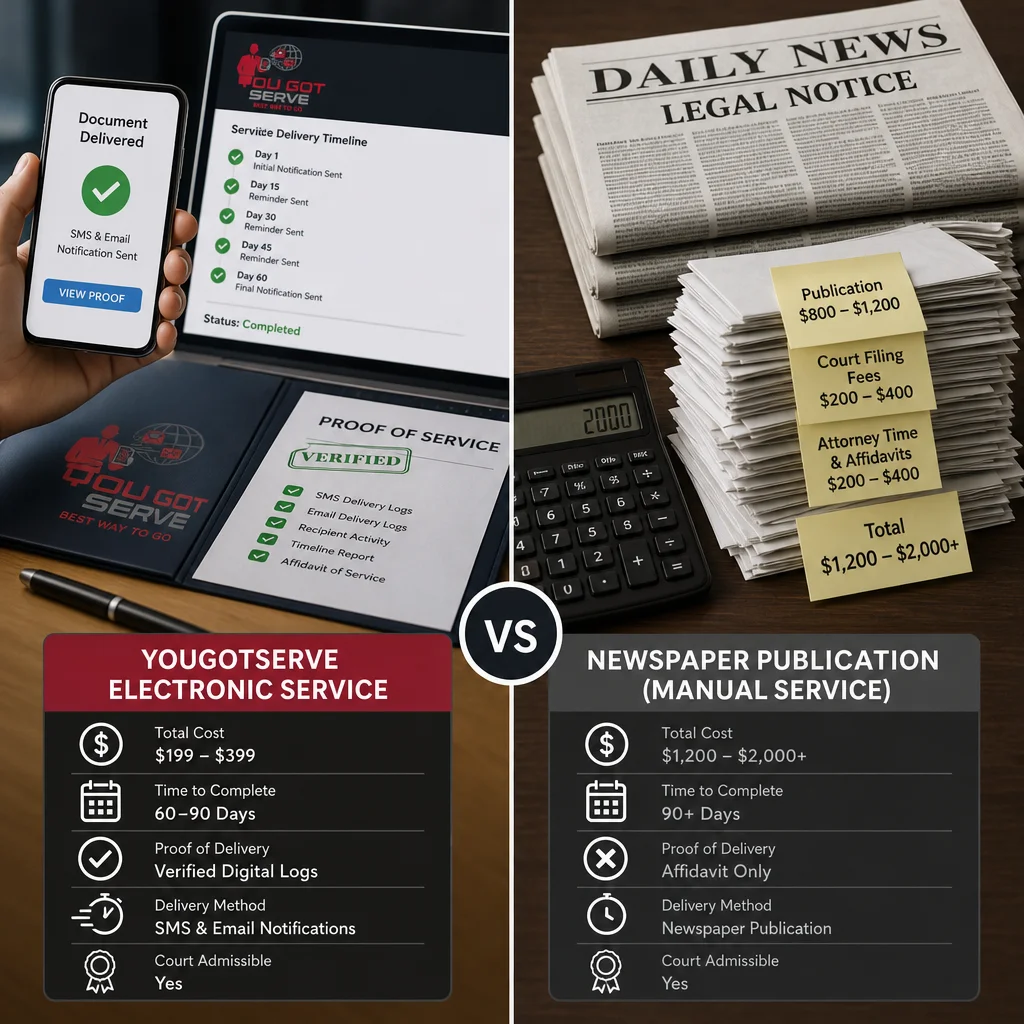
Our electronic service pricing is significantly lower. A 60-day or 90-day notification cycle through YouGotServe pricing typically costs $300 to $500, depending on the number of recipients and any additional services like skip tracing. No hidden fees. No surprise publication delays driving up attorney time.
The savings multiply across multi-defendant cases. Newspaper publication usually requires separate publications for each defendant in different locations. Electronic service scales efficiently—you add recipients to a single order at a lower marginal cost per person.
Factor in the timeline advantage. Newspaper publication takes 30 to 90 days to complete. Electronic service completes in days. That time savings translates to weeks of accelerated case progress, reducing overall attorney time and moving toward resolution faster. When you calculate total case cost—not just service cost—electronic service often saves $2,000 to $5,000 per case by compressing timelines.
Timeline Comparison: How Much Faster Is Electronic Service
Speed differentials are stark. Newspaper publication involves multiple discrete steps, each taking days: court approval (3 to 5 days), publication setup (2 to 7 days), publication run (10 to 30 days), waiting period post-publication (14 to 30 days), affidavit preparation (2 to 3 days). Total: 31 to 75 days before your proof of service is final and your case can move forward.
Electronic service completes in parallel. Notifications send immediately upon upload to our platform. Recipients access documents within hours, typically. Our system generates timestamped delivery records in real time. Your proof of service is complete and ready to file within days, not weeks.
A concrete example: You file a motion for summary judgment but need to serve the defendant first. Using newspaper publication, you wait 60 days to establish proof of service, delaying your motion filing. Using electronic service, you serve the defendant within 48 hours and file your motion the following week. That 7 to 8-week acceleration can be critical before statute-of-limitation deadlines, court continuance windows, or judgment enforcement deadlines.
Courts recognize electronic service timeliness as a practical benefit. Judges prefer cases that move efficiently. Faster service supports faster discovery, faster motion practice, and faster resolutions. In practice, that efficiency can influence judicial discretion on case management issues.
Security and Compliance Features That Protect Your Service
Litigation documents contain sensitive information: personal financial data, medical records, trade secrets, confidential business details. Your service method must protect confidentiality as carefully as traditional service does.
We employ end-to-end encryption for all data in transit and at rest. Documents are protected by secure code-protected links—recipients cannot access case documents without a unique code you control. Recipients cannot forward links to third parties. Access logs show exactly who viewed what and when, creating an audit trail that proves the right person received the right documents.
Timestamping is built into every notification. Our system records UTC-synchronized timestamps for each delivery event, SMS open, email delivery, and document access. This precision supports compliance with jurisdictional rules requiring proof of timely service.
Data security and HIPAA-grade encryption mean your platform cannot be hacked or breached in ways that expose case documents to unauthorized parties. We designed security features specifically for legal documents, not generic messaging platforms that were never built for litigation confidentiality.
Before relying on electronic service in your jurisdiction, verify that your court permits it. Rules vary by state, federal circuit, and specific case type. Our team can help clarify compliance requirements for your situation, but always check local court rules before filing your proof of service.
When to Use Electronic Service for Your Case
Electronic service works best when you have current contact information for the defendant—an email address or phone number where they can receive notifications. It works when courts permit it under local rules or when you've obtained court approval for electronic service as an alternative.
Common scenarios include:
- Hard-to-locate defendants: You know their email or phone but cannot find them for personal service. Electronic service provides documented outreach without the expense and delay of newspaper publication.
- Multi-defendant cases: Serving multiple defendants across different locations via newspaper becomes prohibitively expensive. Electronic service handles all recipients through one efficient process.
- Time-sensitive litigation: Statute-of-limitations deadlines, judgment enforcement windows, or court hearing dates require faster service than newspaper publication allows.
- Cost-sensitive cases: Litigants or smaller firms working with limited budgets need affordable alternatives to traditional methods.
Don't rely on electronic service if you have no contact information for the defendant. If you lack an email or phone number, skip tracing or process server location work comes first. We can help with investigative skip tracing, but you need at least some identifying information to begin.
Similarly, if your local court rules prohibit electronic service or require specific approval procedures, follow those rules. Electronic service is a powerful tool, but only within jurisdictions and case types that permit it.
Getting Started With a Modern Service Solution
Taking the first step is straightforward. Visit How it works to see our platform process in detail, or review YouGotServe pricing to understand costs for your situation.
Gather the information you'll need: defendant names, contact details (email and phone), case caption and court information, and documents to serve. If you need help locating current contact information, our skip tracing service can assist.
Confirm with your court that electronic service is permitted for your case type. Send us your case details, and we'll provide a quote and estimated timeline. Upload your documents, review delivery settings, and authorize the service. We handle the rest—delivery, retry logic, tracking, and proof of service documentation.
Electronic service is faster and more affordable than newspaper publication or repeated process server attempts. Your cases move forward on schedule. Your budgets stretch further. Your proof of service withstands scrutiny. In modern litigation, that combination matters.