
Electronic Service vs. Newspaper Publication: Which Method Delivers Court-Ready Proof
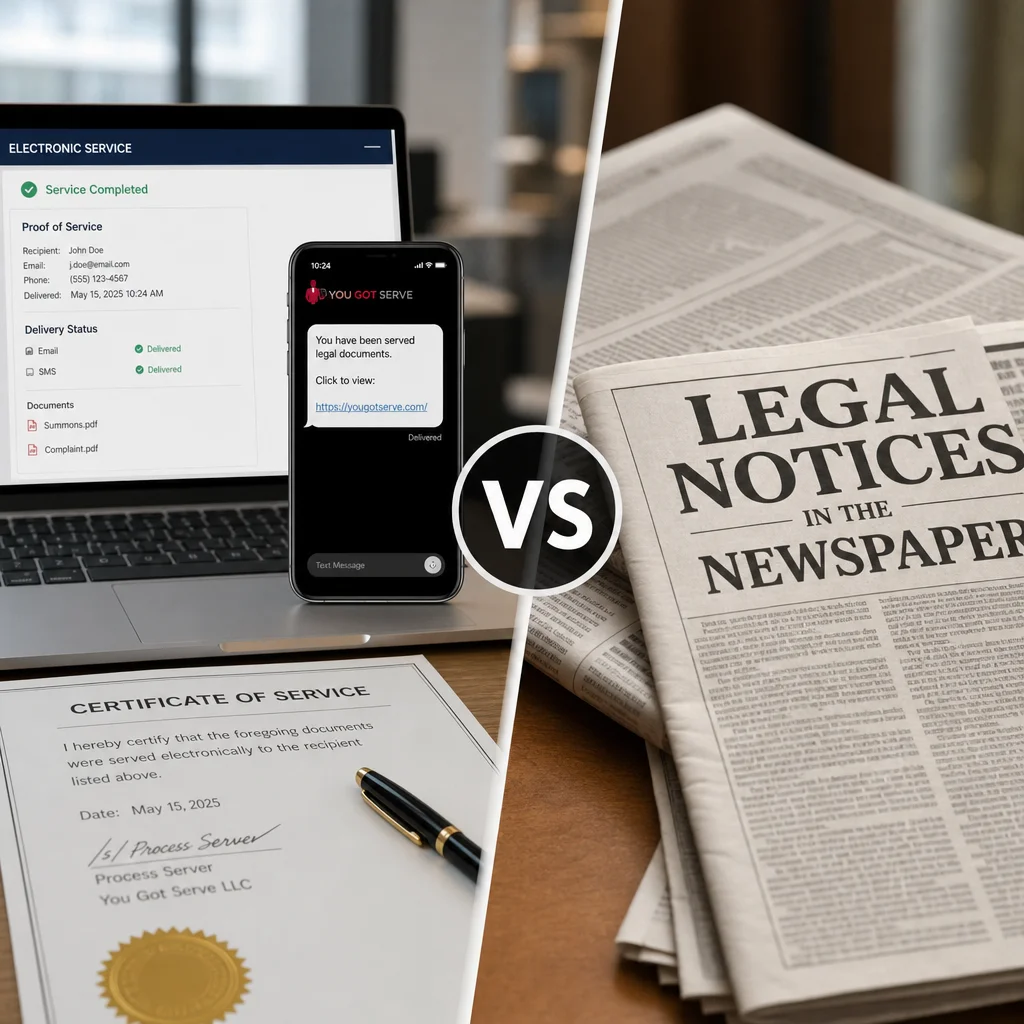
The Problem: Traditional Service Methods Are Slow, Expensive, and Unreliable
Serving court documents to defendants who avoid contact or hide their whereabouts has always been expensive and unpredictable. When personal service fails, attorneys and litigants typically resort to newspaper publication, a method that's been standard for decades but no longer fits modern litigation timelines or budgets.
Newspaper publication can cost $500 to $2,000 or more, depending on the publication frequency and jurisdiction. The process itself is glacial. You must draft the notice, arrange publication, wait for the required run period (often 4-6 weeks minimum), then file an affidavit of publication before moving forward. Meanwhile, your case sits idle, and defendants remain effectively unreachable.
The real cost extends beyond fees. Judges and legal professionals increasingly view newspaper publication as outdated and ineffective. Few people actually read legal notices in newspapers anymore, which raises the fundamental question: Is this method serving the purpose of actual notice at all? When your client's goal is to move the case forward, newspaper publication becomes a legal formality that delays justice without genuinely connecting with the defendant.
Why Newspaper Publication Falls Short for Modern Litigation
Newspaper publication was designed for an era when local newspapers reached most households. That world no longer exists. Circulation continues to decline, and legal notice sections are among the first pages readers skip (if they pick up a paper at all).
From a proof-of-service perspective, newspaper publication offers minimal verification. You receive a publisher's affidavit confirming the notice ran, but you have no evidence that the defendant actually saw it. The court accepts the publication as constructive service based on legal theory, not on demonstrated receipt. If the defendant later claims they never received notice, you cannot point to timestamped delivery records, geolocation data, or access logs to support your case.
Newspaper publication also locks you into a rigid schedule. Once you commit to publication dates, you cannot accelerate the process, add contact information you later discover, or adjust your approach if the initial attempt fails. The method offers no flexibility and no real-time tracking of whether the notice reached anyone.
Courts are taking notice of these shortcomings. An increasing number of jurisdictions now explicitly authorize or prefer electronic notification when personal service fails, recognizing that a verified email or SMS delivery with documented receipt is more reliable proof of actual notice than a newspaper ad that nobody saw.
How Electronic Service Offers Speed, Cost Savings, and Verified Proof
Electronic service of process addresses every weakness of newspaper publication in a single, integrated solution. Our platform enables you to serve documents electronically via SMS and email, with automated daily notifications over a 60-day or 90-day campaign, delivering court-ready proof of service that newspaper publication simply cannot match.
Speed is immediate. You upload your documents, enter up to three email addresses and three phone numbers for the recipient, and the system begins sending notifications the same day. There's no waiting period, no coordination with external publishers, and no administrative delays. Your documents reach the defendant's inbox and phone within hours of your submission.
Cost efficiency is dramatic. A 60-day electronic service campaign runs $350; a 90-day campaign costs $500. For eligible organizations, we offer a 10% discount. Compare that to newspaper publication costs of $500-$2,000 or more, and the savings are immediate and substantial. You reduce expense while accelerating your timeline.
Verified proof of service transforms your documentary record. You receive timestamped notification history, document-access activity logs, recipient verification data, geolocation information when available, and service-status tracking showing whether delivery is Pending or Delivered. This data creates a clear, auditable record that the defendant received notice and accessed the documents. No guesswork. No affidavit from a third-party publisher. Direct evidence of delivery and receipt.
Compliance and Court Authorization: What You Need to Know
Electronic service is not a universal shortcut; it requires compliance with local court rules and applicable statutes. Before pursuing electronic notification, you must check your jurisdiction's specific requirements and confirm that the court authorizes this method for your case.
Many jurisdictions now explicitly permit electronic service under specific conditions: the defendant's email or phone number is on file, the defendant has previously agreed to electronic notice, or the court has authorized service by electronic means. Federal courts under Rule 5 of the Federal Rules of Civil Procedure allow electronic service in most circumstances. State courts vary widely, but the trend is clearly toward acceptance.
We design our platform to support compliance with these evolving standards. Our system provides timestamped delivery records, recipient verification tools, and end-to-end encryption to ensure data security and meet court evidentiary standards. However, we cannot provide legal advice on whether electronic service is appropriate for your specific case or jurisdiction. That determination rests with your local court rules and your attorney's judgment.
Before relying on electronic service, verify your court's rules, confirm the recipient's contact information is correct, and consider whether the recipient has notice of or access to the delivery method you select. These steps ensure your service effort will be both legally sufficient and effective.
Comparison: Cost Efficiency and Timeline
The financial and temporal advantages of electronic service compound quickly across multiple cases. A single newspaper publication campaign might delay your case by 4-6 weeks and cost $800-$1,500. Electronic service gets your documents to the defendant on day one for $350-$500.
If you handle multiple cases where service proves difficult, the cost advantage becomes substantial. Five cases served via newspaper publication at $1,000 each equals $5,000 and months of delay. Five cases served electronically at $400 each costs $2,000 and moves forward immediately. That $3,000 savings (plus recovered court time and attorney time) directly improves your case management and client outcomes.
Timeline acceleration is equally significant. Newspaper publication creates a mandatory waiting period before you can proceed to the next phase of litigation. Electronic service begins working immediately, with daily notifications sent automatically. If the defendant accesses documents on day two, you have verified proof and can move forward without waiting for the full 60 or 90-day campaign to conclude.
Comparison: Documentation and Proof of Service
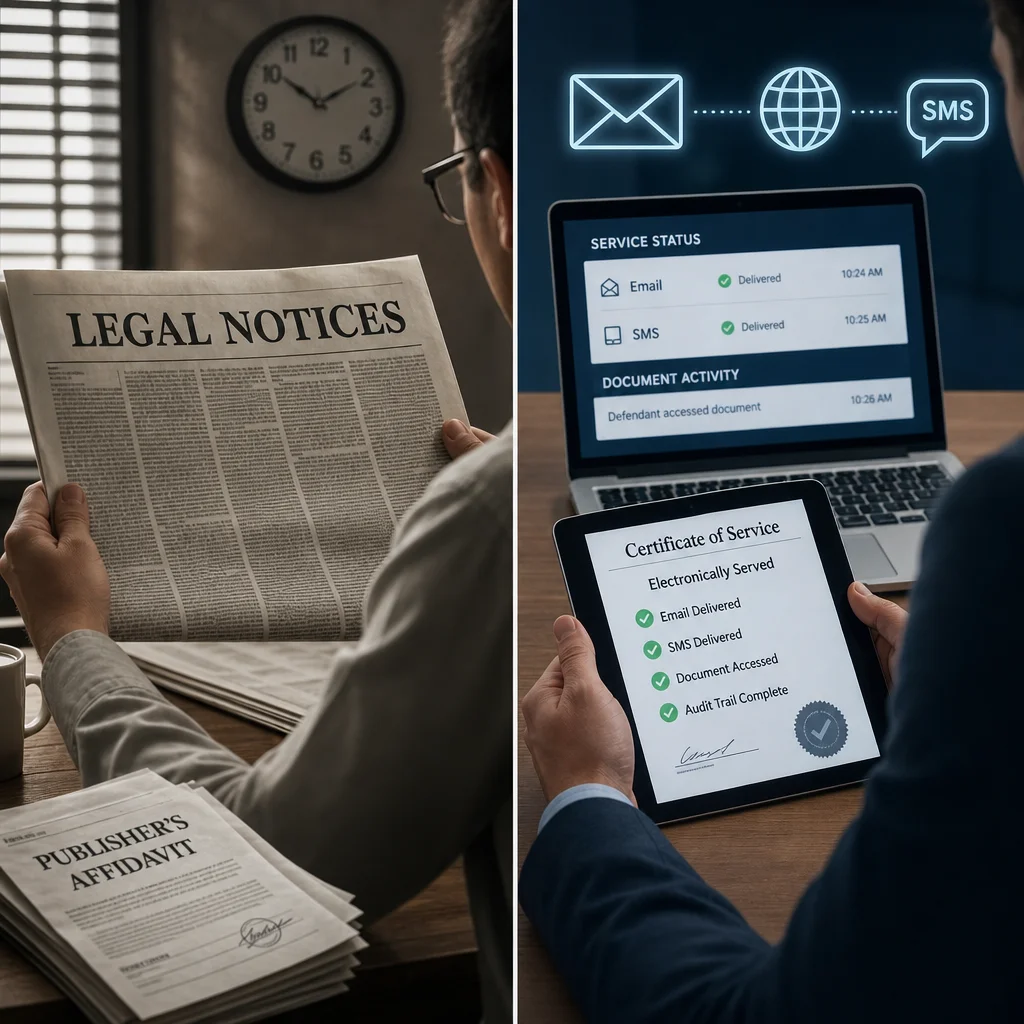
Newspaper publication relies on constructive service theory: the court presumes notice occurred because notice was published in a newspaper, even if the defendant never actually read it. The publisher's affidavit confirms the publication ran; it does not confirm the defendant received or read the notice.
Electronic service creates a documentary record of actual delivery and receipt. You receive timestamped logs showing when each notification was sent, whether the email was delivered to the recipient's inbox, whether the SMS reached the phone number on file, and exactly when (and from which device) the recipient accessed the secured documents using their unique access code.
This evidence is far more probative than newspaper publication affidavits. If a defendant later claims they had no notice, you can present a detailed activity log proving delivery and access. Judges increasingly view this kind of verified electronic proof as stronger evidence of actual notice than constructive service by newspaper publication.
Certificates of service generated through your electronic service platform will be accepted by courts that authorize electronic notification. The detailed activity logs and delivery records become part of your proof-of-service filing, providing a level of documentary support that newspaper publication cannot compete with.
Comparison: Recipient Verification and Delivery Tracking
Newspaper publication offers zero recipient verification. You publish a notice, and nobody confirms who (if anyone) actually saw it. The method produces no tracking data and no evidence of delivery to any specific person.
Our platform provides multi-layered recipient verification and tracking. When the recipient accesses secured documents, they enter a one-time access code, confirming identity and intentional retrieval. Selfie capture, geolocation data, and device information are available to further verify the recipient's identity and location. Each access event is timestamped and logged.
Daily automated notifications continue throughout your 60 or 90-day service period. If the recipient doesn't access documents on day two, the system sends another notification on day three, and again on day four, and so on. This persistent, documented outreach creates an extensive record of service attempts.
You track service status in real time through your account dashboard. You see exactly which contact methods have delivered notifications, which attempts remain pending, and when (and if) the recipient accessed your documents. This visibility allows you to adjust your strategy mid-campaign if needed or to provide the court with a complete activity report showing the diligence of your service efforts.
State-by-State Compliance Considerations and Case Law
Electronic service acceptance varies significantly by jurisdiction. Federal courts generally permit electronic service under Federal Rule of Civil Procedure 5(b). Many state courts have adopted similar rules, particularly in technology-forward jurisdictions like California, New York, and Illinois.
However, acceptance is not uniform. Some states require explicit court authorization before electronic service is permitted. Others limit electronic service to certain case types or require the defendant to have previously consented to electronic notice. A few jurisdictions still prefer traditional methods and view electronic service skeptically.
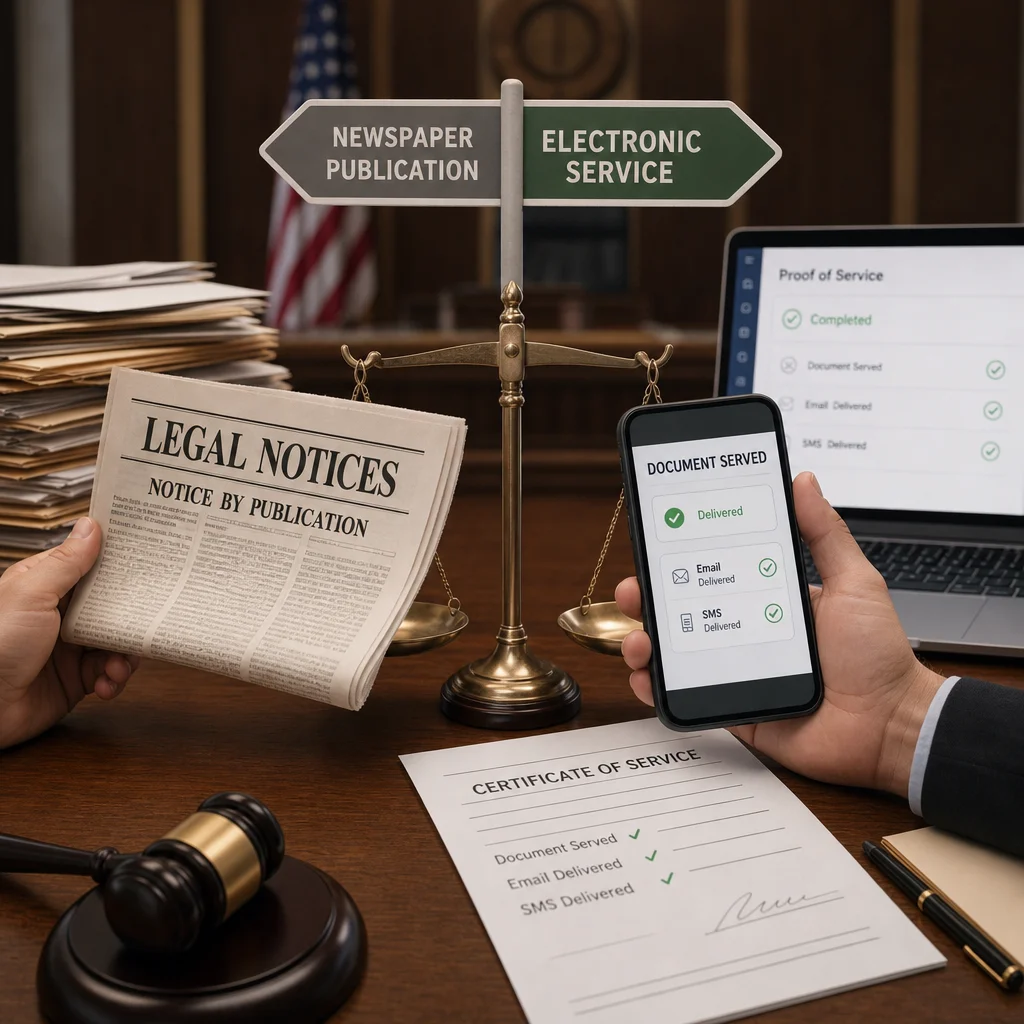
Recent case law increasingly supports electronic service when proper verification and delivery tracking are documented. Courts recognize that verified email or SMS delivery with timestamped access logs represents stronger proof of notice than newspaper publication. This trend is accelerating as courts adapt to digital communication norms.
Before proceeding with electronic service, research your specific jurisdiction's rules. Check your state court's civil procedure rules, search recent case law in your district, and consult any local court rules specific to your judge or courthouse. If uncertainty remains, file a motion requesting court authorization for electronic service. Many judges grant these motions readily, particularly when you demonstrate that personal service has failed and that electronic service offers superior proof of delivery.
Why You Got Serve Delivers the Court-Ready Solution You Need
We built our platform specifically to address the documented weaknesses of newspaper publication and to provide a legally defensible alternative that courts increasingly accept and trust. Our combination of multiple contact points, daily automated notifications, SMS and email delivery, secure document retrieval, and detailed electronic activity records creates a service record that far exceeds what newspaper publication can provide.
The verified proof of service you generate through our platform is court-ready. Timestamped delivery logs, recipient access records, geolocation information, and service-status documentation are audit-ready and admissible as evidence of proper notice. Your proof of service filings will reflect genuine delivery efforts, not theoretical constructive service.
Our 60-day and 90-day service campaigns give you flexibility to match your case timeline and budget. We handle the daily notification work automatically, so you focus on case development while we ensure relentless, documented outreach to the defendant. For complex cases requiring investigative support, we integrate skip-tracing services to help you locate additional contact information.
Eligible organizations receive a 10% discount, and our pricing remains transparent. No hidden fees, no surcharges, no surprises. You know your cost upfront ($350 or $500), and you receive a complete service record that supports your litigation strategy.
Getting Started: Your Path to Reliable, Compliant Service
Start by confirming that electronic service is authorized for your specific case and jurisdiction. Review your local court rules, check recent case law, and contact the clerk's office if you need clarification. If electronic service is permitted, verify the defendant's contact information and gather your court documents.
Access our platform at how electronic service works, create your account, and upload your documents. Enter up to three email addresses and three phone numbers for the recipient, select your service period (60 or 90 days), and choose your service level. Our system immediately begins sending daily notifications through SMS and email.
Monitor your service status in real time through your account dashboard. View notification delivery logs, access events, and recipient verification data as they occur. Download your complete activity report when service concludes or when you need to file your proof of service with the court.
If you lack sufficient contact information for the defendant, describe your investigative needs during onboarding. We can connect you with professional investigative services to locate additional contact points, ensuring your service efforts have the best chance of reaching the recipient.
Electronic service through You Got Serve is faster, more affordable, and generates superior proof of delivery compared with newspaper publication. Move your cases forward with verified receipt tracking, transparent costs, and court-ready documentation that supports your litigation strategy. Compliance with local rules is your responsibility, but once authorized, electronic service becomes your most reliable tool for reaching difficult defendants.