
Forensically Sound Chain-of-Custody Procedures for Digital Service of Process
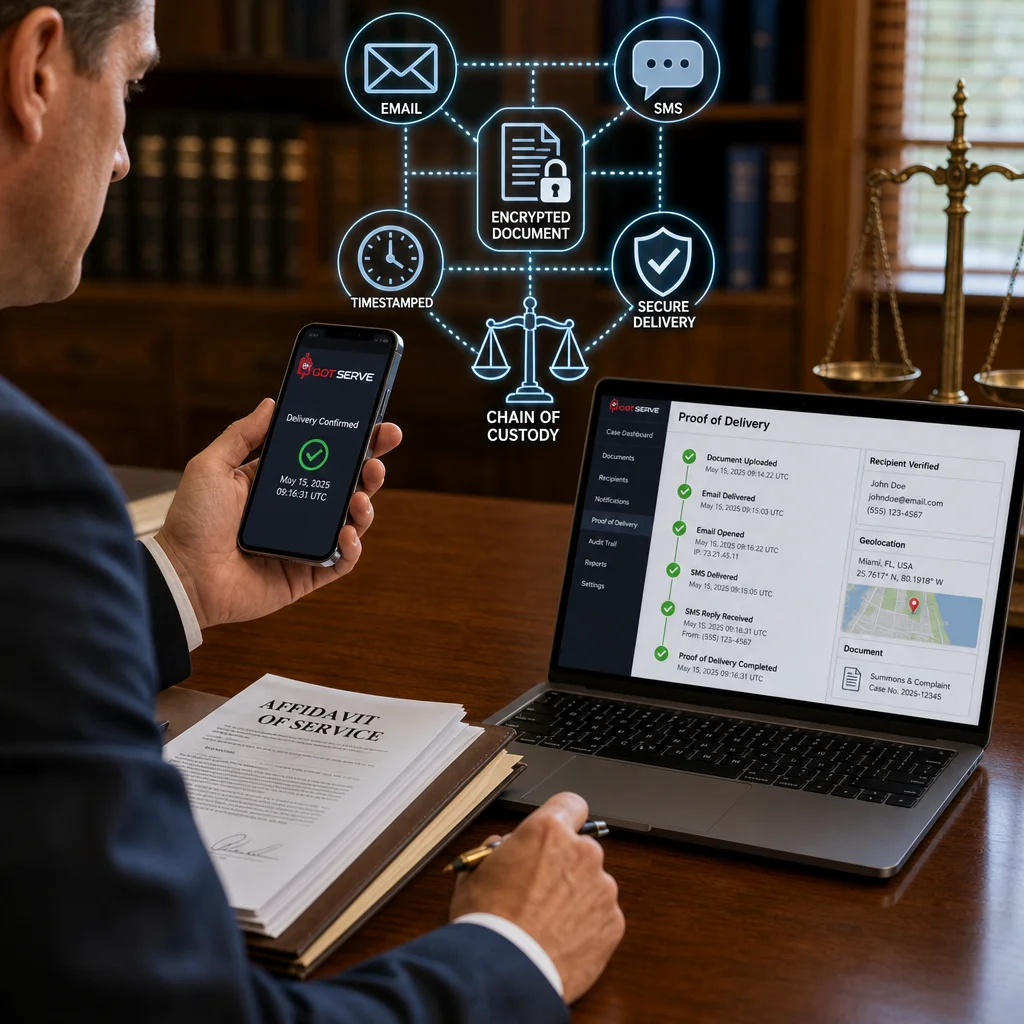
Why Chain-of-Custody Matters in Modern Legal Service
Chain-of-custody documentation establishes an unbroken record of how evidence or documents moved through your legal proceedings. In service of process, this principle becomes critical because a defendant can challenge whether they actually received notification, when they received it, and whether the delivery method was properly executed.
When you serve documents electronically, courts scrutinize the delivery pathway more closely than with traditional methods. A court needs to see proof that your message reached the intended recipient, that it wasn't intercepted or altered in transit, and that the timestamp reflects the actual moment of delivery. Without this forensic accountability, even legitimate service attempts can be questioned or dismissed.
The consequence of weak chain-of-custody procedures is costly. Your case may be delayed while you re-serve documents, or worse, a judge may invalidate your service entirely, forcing you to start over. By establishing rigorous documentation from the moment you initiate service through final delivery confirmation, you protect your case and demonstrate judicial compliance.
Actionable step: Before selecting a digital service platform, confirm it generates timestamped, tamper-evident delivery records that will satisfy your local court rules.
The Challenge of Proving Delivery Without Forensic Documentation
Traditional newspaper publication leaves little room for verification. You publish a notice, wait the required time, and submit an affidavit. The court accepts it largely on trust. Digital service, by contrast, can be verified in real time, but this flexibility also invites scrutiny.
Consider a practical scenario: you send a court document via SMS to a defendant's phone number. The message goes through your phone carrier, travels across networks, and lands on the recipient's device. If a dispute arises later, you need to demonstrate each step of that journey. Did your platform record the exact moment the SMS entered the carrier system? Did it capture confirmation that the device received the message? Was there a read receipt or click-through to prove engagement?
Without this granular documentation, you have only a claim. The defendant can argue the number was wrong, the message never arrived, or the system failed. Courts increasingly demand evidence to match these assertions. A screenshot of a sent message isn't enough; you need cryptographic proof embedded in the delivery platform's infrastructure.
Actionable step: Document every interaction with your service platform, including recipient contact information, delivery method selected, and the exact time you initiated service.
How Digital Service Platforms Create Legally Defensible Records
We design our platform to generate defensible records at every stage. When you serve documents electronically through YouGotServe, the system timestamps each action, encrypts data in transit, and stores immutable delivery logs that courts can reference.
Here's how the process supports forensic integrity:
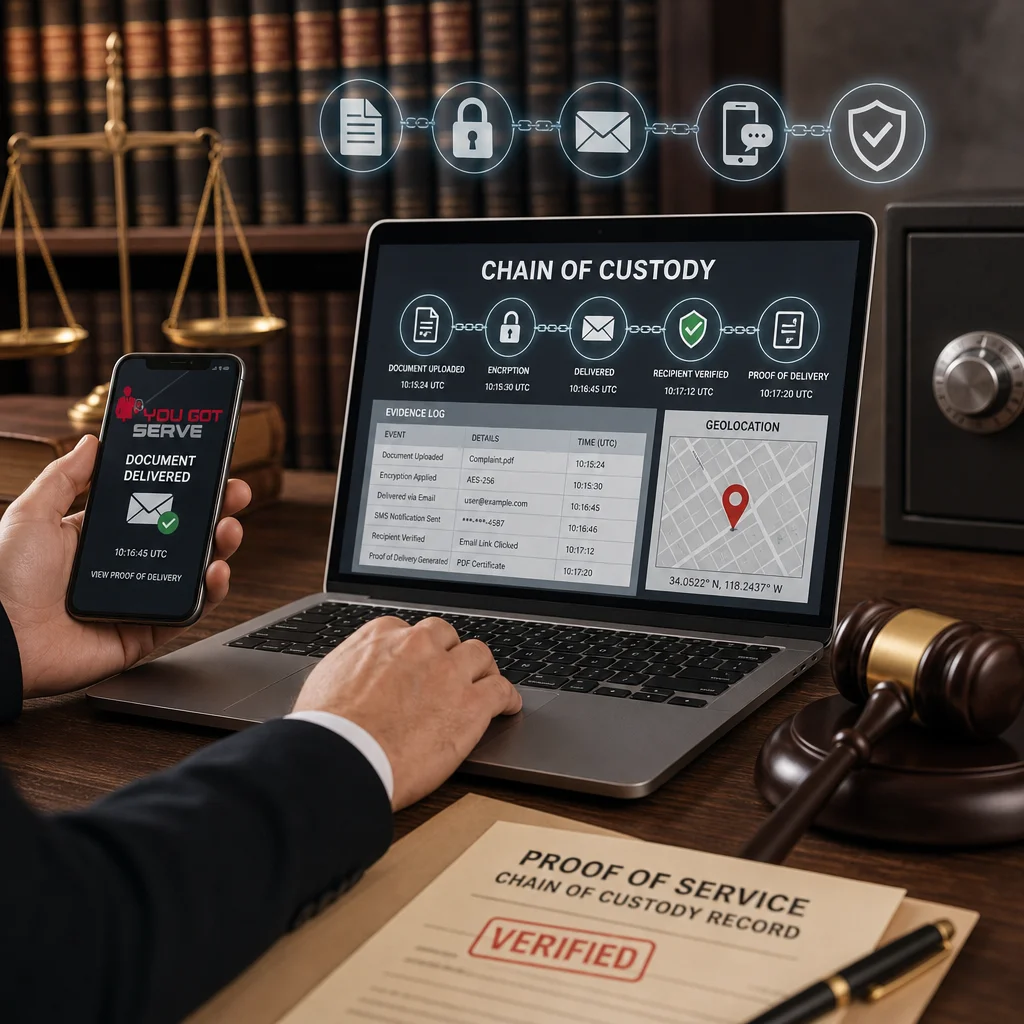
- Initiation logging: The moment you upload a document, the system records your identity, the document content hash, recipient information, and the selected notification method.
- Delivery tracking: SMS and email messages are logged the instant they leave our secure servers, including carrier confirmation codes.
- Recipient interaction: If a recipient accesses a code-protected document link, the access is timestamped and associated with the recipient's session.
- Audit trail: Every system action is recorded in a tamper-proof log that cannot be altered retroactively.
This architecture means you can produce evidence that is difficult to challenge. A court reviewer can see not only that a message was sent, but when, to whom, via which carrier or email provider, and whether the recipient engaged with it.
Actionable step: Request a sample delivery report from any platform you consider; ensure it includes timestamped logs, delivery confirmation codes, and recipient engagement data.
Automated Timestamping and Dual Notification as Evidence
Precise timing is foundational to chain-of-custody integrity. Our system timestamps every event in Coordinated Universal Time (UTC), which eliminates ambiguity across time zones and creates a verifiable record independent of any single party's clock.
Dual notification (SMS and email) strengthens your chain-of-custody by providing redundant evidence. If you notify a defendant via both channels on the same day, your proof of service is reinforced. Should the defendant later claim they never received anything, you can present evidence of two separate delivery attempts through different networks, each with its own timestamp and carrier or email provider confirmation.
Example: You initiate service at 10:15 AM UTC on a Monday. The SMS goes out at 10:15:32 AM, confirmed by the carrier at 10:15:45 AM. The email goes out at 10:15:33 AM, logged by the mail server at 10:15:47 AM. Both arrive within seconds, creating a clustered, credible delivery window that's nearly impossible to dispute.
This redundancy also serves compliance. Many courts permit electronic service under state or local rules only when defendants are notified multiple times. Dual notification satisfies that requirement while creating stronger forensic documentation.
Actionable step: Select a delivery cadence (60 or 90-day cycles) that aligns with your court's notification frequency rules, and retain all timestamped delivery reports in your case file.
Recipient Verification and Geolocation Tracking for Authenticity
Authentic service requires confidence that the document reached the correct person at the correct location. Our platform incorporates recipient verification and, where applicable, geolocation data to substantiate this claim.
When a recipient accesses their code-protected document link, the system captures metadata including the IP address, device type, and timestamp of access. This data creates a secondary verification layer. If a defendant later claims they never received the document, you can present evidence that the code-protected link was opened from a specific IP address at a specific time, indicating genuine recipient engagement.
Geolocation tracking also helps validate service attempts to hard-to-find recipients. If investigative skip tracing identifies a defendant's most recent known address, and your platform's records show document access from an IP address in that geographic area, the chain-of-custody strengthens considerably. Courts recognize this as circumstantial but credible evidence of proper service.
Important note: Acceptance of geolocation and IP metadata varies by jurisdiction. Check your local court rules to confirm whether these data points are admissible in your specific court.
Actionable step: If you use geolocation tracking, pair it with traditional address verification and document your skip tracing methods in your affidavit of service.
Secure Code Protection and End-to-End Encryption Standards

Documents containing sensitive information demand encryption protection throughout transit and storage. We use end-to-end encryption and code protection to ensure that documents remain confidential and tamper-proof from the moment they enter our system until the recipient accesses them.
Code-protected access works as a secondary authentication layer. Rather than allowing a simple link click to expose the document, recipients must enter a secure code sent separately (typically via SMS). This requirement proves that the recipient had active access to their phone at the time of delivery, creating a higher bar for authenticity than email alone.
End-to-end encryption means data is encrypted on our servers and remains encrypted in transit. Only the recipient's authenticated session can decrypt it. This architecture prevents unauthorized third-party access and demonstrates to courts that the document chain remained uncompromised. If a defendant later claims the document was altered, the encryption logs provide forensic evidence that no tampering occurred.
Actionable step: When initiating service, enable code protection for sensitive documents; retain the code-delivery log as part of your proof-of-service package.
How Our Verified Proof of Service Supports Your Case
Our verified proof of service report consolidates all chain-of-custody elements into a single document suitable for filing with the court. It includes recipient details, delivery dates and times, notification methods, carrier or server confirmations, access logs, and encryption validation data.
When you file this report as your proof of service, you're presenting a comprehensive forensic record. Rather than asking the court to trust your affidavit alone, you're backing it with system-generated, independently verifiable data that demonstrates compliance at every step.
Courts recognize digital service reports that meet this standard because they reduce judicial uncertainty. A judge reviewing your case can quickly see that service was executed systematically, that multiple redundancies existed, and that no reasonable defendant could claim ignorance of the proceeding.
Document delivery tracking capabilities also allow you to monitor ongoing delivery attempts, respond to system notifications in real time, and adjust your approach if needed before filing with the court.
Actionable step: Download and review your proof-of-service report before filing; confirm all recipient details, dates, and delivery confirmations are accurate and match your case documents.
Building a Complete Audit Trail From Initiation to Delivery
An audit trail is only as strong as its documentation practices. From the moment you decide to serve a document electronically, maintain parallel records of your actions and the platform's actions.
Start by recording the reason for choosing digital service (e.g., defendant cannot be located via traditional means, electronic service is authorized by court order, or newspaper publication has been attempted without success). Next, document your recipient research process: which phone numbers, email addresses, or physical addresses did you attempt? Which skip tracing methods did you use?
When you initiate service through our platform, save the confirmation screen showing all entered recipient details. As delivery progresses, log each status update. When access occurs or notifications are sent, screenshot the platform's delivery log. Finally, when you're ready to file your proof of service, compile these records chronologically.
This parallel documentation approach means you have both the platform's forensic logs (which courts trust) and your contemporaneous notes (which demonstrate good-faith effort and due diligence). Together, they form a near-impenetrable chain of custody.
Actionable step: Create a service folder for each case containing your recipient research notes, platform confirmation screens, periodic delivery status logs, and your final proof-of-service report.
Compliance Considerations Across Jurisdictions and Court Rules
Chain-of-custody standards vary significantly across federal, state, and local courts. Before relying on electronic service, research your specific jurisdiction's rules on proof of service, acceptable notification methods, and required documentation formats.
Some courts mandate that electronic service be court-authorized or defendant-agreed before proceeding. Others permit it as a fallback when traditional service has failed. A few states have adopted comprehensive e-service rules that specify required metadata, encryption standards, and proof formats. Understanding these distinctions is essential.
Additionally, state rules often differentiate between service of initial pleadings (which may require more rigorous proof) and service of subsequent motions or discovery (which may allow simpler methods). Consumer protection regulations, privacy laws, and TCPA rules also intersect with service compliance, particularly when using SMS.
We design our platform to support compliance with common federal and state e-service rules, but acceptance varies. Check with your local court clerk or review your court's procedural rules before initiating service.
Actionable step: Print or bookmark your jurisdiction's e-service rules and cross-reference them against your platform's capabilities before selecting delivery methods.
Choosing a Platform That Meets Forensic Standards
Not all digital service platforms are equal. When evaluating options, prioritize those that offer chain-of-custody features aligned with forensic evidence standards.
Key criteria include:
- Timestamping precision: UTC-based timestamps accurate to the second, not approximate or user-adjustable.
- Encryption validation: End-to-end encryption for document transit and storage, with verifiable encryption keys logged for audit purposes.
- Redundancy: Dual-channel notification (SMS and email) to create multiple independent delivery records.
- Tamper-proof logging: Immutable audit trails that cannot be edited or deleted, even by administrators.
- Recipient verification: IP logging, device metadata, or code-entry confirmation to prove authentic engagement.
- Court-ready reporting: Proof-of-service formats that match common court filing requirements without additional translation or reformatting.
Our How it works page details how YouGotServe implements these standards. We use secure code-protected document access, automated recurring notification cycles, integrated skip tracing for hard-to-find recipients, and verified digital proof of service.
Actionable step: Request a demo or trial access from any platform; test the proof-of-service report output to confirm it will satisfy your court's filing requirements.
---
Chain-of-custody integrity protects both your case and the defendants' rights to fair notice. By choosing a platform that prioritizes forensic documentation, maintaining parallel contemporaneous records, and understanding your jurisdiction's e-service rules, you position yourself for successful, defensible service of process. Start by reviewing your local court rules, then select a platform that meets or exceeds those standards.