
How to Notify Opposing Counsel When Switching to Electronic Service
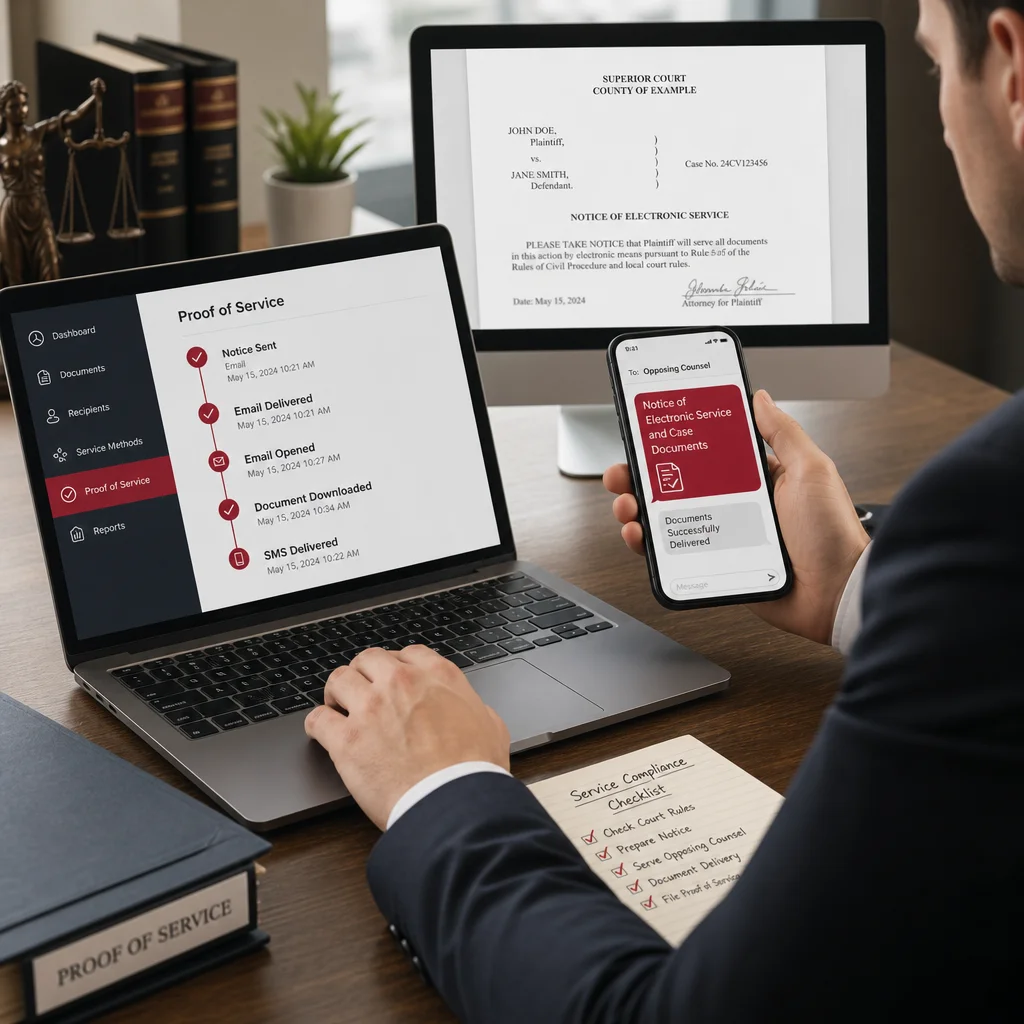
Why Traditional Service Methods Are Failing Your Cases
Electronic service of process has become a practical necessity for legal professionals managing complex litigation. Whether you're pursuing a defendant who's difficult to locate or navigating court rules that permit alternative service methods, the shift from traditional personal service to digital channels requires clear communication, proper documentation, and reliable tracking systems. We'll walk you through the process of notifying opposing counsel, preparing compliant service notices, and building a strategy that holds up under scrutiny.
Personal service has long been the gold standard for serving court documents. However, locating defendants across state lines, managing time delays, and paying premium fees for process servers can derail your case timeline and inflate your litigation budget. When defendants actively evade service or simply cannot be found, traditional methods may not work at all, potentially leaving you stuck waiting for newspaper publication as a fallback option.
Electronic service solves these bottlenecks. Serving documents electronically through SMS and email reduces service delays from weeks to hours. Your notification arrives instantly, and you receive timestamped delivery confirmation immediately, rather than waiting days for a process server affidavit. This speed matters especially in fast-moving litigation where preliminary injunctions or urgent motions require proof of timely service.
Real-world scenario: A creditor pursuing a commercial defendant discovers the defendant's business has closed and its owner has relocated. Traditional skip-tracing adds weeks and thousands in process server fees. Electronic service via SMS and email, supported by integrated investigative tools, lets you serve the individual at a known phone number or email address with verified receipt confirmation, often within the same business day.
The cost difference is substantial. Newspaper publication can run $300 to $1,000 per publication cycle. Electronic service is a fraction of that expense while providing superior proof of delivery. When you serve documents electronically, you generate timestamped, documented delivery activity that no affidavit from a third party can match for clarity and immediacy.
The Legal Landscape: When Electronic Service Is Permitted
Not every court allows electronic service, and not every defendant must accept it. Your first step is always to check local court rules and any applicable federal rules governing your case. Rule 5 of the Federal Rules of Civil Procedure permits electronic service for parties who have consented or for service directed by the court. Many state courts now allow electronic service under similar conditions, though acceptance varies by jurisdiction.
Courts typically permit electronic service when:
- The defendant has consented to receive documents electronically (express or implied consent)
- The court has issued an order authorizing electronic service
- Local court rules specifically provide for electronic notification methods
- Traditional service has been unsuccessful and the court permits alternative service
Before switching to electronic delivery, review your jurisdiction's specific requirements. Some courts require you to serve opposing counsel with notice of your intent to use electronic service. Others mandate that you exhaust traditional methods first. Still others have relaxed these requirements during emergency proceedings or when traditional service proves impractical.
Designed to support compliance with local rules, electronic service platforms like ours allow you to document your reasoning and maintain a complete audit trail showing why you selected electronic delivery and what efforts you made beforehand. This documentation becomes crucial if the opposing party later challenges the validity of service.
Preparing Your Notice of Electronic Service
A notice of electronic service is a formal document you file with the court and serve on opposing counsel announcing your intent to use electronic delivery methods. This notice typically includes:
- Your case caption and docket number
- A clear statement that you intend to serve documents electronically via SMS and email
- The specific contact information (phone number and email address) where service will occur
- Your justification for electronic service (consent obtained, court order issued, or unsuccessful traditional service attempts)
- The time frame for delivery and receipt confirmation (e.g., "service shall be complete upon verified receipt or 90 days from transmission, whichever is earlier")
- Any special provisions for emergency or time-sensitive documents
Draft your notice with precision. Vague language invites objections. Instead of "Documents will be served electronically," write "Documents will be served via SMS to \[phone number\] and email to \[email address\], with service complete upon verified delivery confirmation or 60 days from transmission date." Specificity removes ambiguity and strengthens your legal position.
Your notice should also address what happens if the defendant fails to acknowledge receipt. Will you re-transmit after 30 days? Will you escalate to newspaper publication? Will you seek court intervention? Clearly state your fallback strategy so opposing counsel understands your compliance plan from the outset.
Communicating the Change to Opposing Counsel Professionally
Once your notice of electronic service is ready, contact opposing counsel directly before or concurrent with filing. A professional email or letter accomplishes several goals: it demonstrates good faith, reduces friction, and creates a contemporaneous record of your communication.
Your outreach should include:
- A courteous explanation of why electronic service is appropriate for your case
- Confirmation that you've verified the contact information (phone number and email) where service will occur
- Your preferred notification schedule (e.g., "Documents will be served on the 1st and 15th of each month")
- An offer to discuss any concerns or logistical issues
- A clear statement that you intend to file your notice of electronic service with the court on \[specific date\]
Example language: "In light of \[defendant's failed address / consent previously obtained / court authorization\], we intend to serve court documents on your client electronically via SMS to \[phone number\] and email to \[email address\]. Service will occur on a 60-day cycle, with re-transmission occurring if no receipt confirmation is received within 14 days of initial transmission. We file our formal notice of electronic service on \[date\]. Please contact us if you have questions or wish to discuss this arrangement."
This approach treats opposing counsel as a professional partner rather than an adversary. Even if they disagree with electronic service, your measured communication demonstrates your commitment to compliance and reasonableness, which strengthens your position if a judicial objection later arises.
Documenting Your Compliance Strategy
Judges scrutinize alternative service methods more carefully than traditional personal service. Your documentation must show that you followed applicable rules, made reasonable efforts, and acted in good faith. Build a comprehensive file that includes:
- A copy of the local court rule or federal rule permitting electronic service
- Evidence of opposing counsel's consent (email exchange, signed stipulation, or court order)
- Documentation of unsuccessful traditional service attempts (process server reports, skip-trace results, returned mail)
- Your notice of electronic service, filed with the court
- Your outreach to opposing counsel (email or letter confirming the electronic service arrangement)
- Screenshots or printouts of your document tracking dashboard showing transmission, delivery, and receipt status
This file becomes your proof of service package. If opposing counsel later challenges service, you can produce the complete record showing exactly when, how, and to whom service occurred, with timestamped verification from your electronic document delivery system.
How We Help You Execute Electronic Service Properly
We provide a legally-compliant digital platform designed to handle the technical and administrative details of serving documents electronically. Our system manages SMS and email delivery, automates notification cycles (60 or 90 days), and tracks every interaction with timestamped accuracy.
Here's what we handle for you:
- Secure, code-protected document access so recipients authenticate before viewing sensitive materials
- Dual-channel delivery via SMS and email, ensuring notifications reach the recipient across multiple touchpoints
- Automated recurring notifications on your specified schedule, eliminating manual re-sending
- Verified receipt confirmation showing exactly when and how the document was delivered
- Integrated investigative skip-tracing tools to locate hard-to-find recipients before service
- End-to-end encryption and timestamping for litigation-ready proof of service
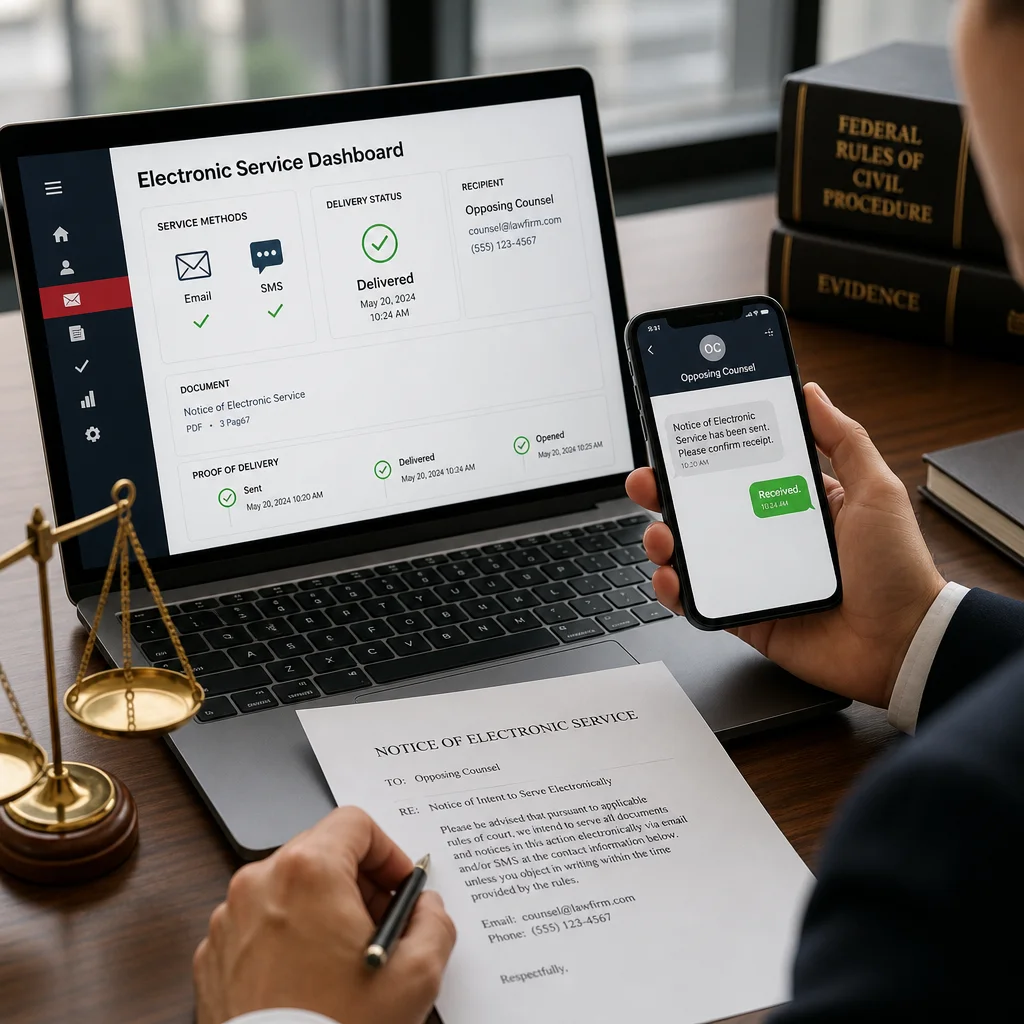
Our platform generates a detailed service record that you can attach to your proof of service affidavit, showing the court precisely how and when service occurred. We also maintain a secure audit log of all transmission and receipt activity, available for production if needed in discovery or in response to a service challenge.
Building Verified Proof of Delivery Into Your Strategy
Verified receipt tracking is the cornerstone of modern electronic service. Unlike traditional delivery methods where proof of service depends on a third-party process server's affidavit, verified delivery gives you direct, timestamped evidence from your delivery platform.
When you serve documents electronically through our system, the recipient receives an SMS notification and email alert containing a secure link to access the documents. Once they open the link or acknowledge receipt, the system records the exact date and time of delivery. This verification occurs automatically, without manual intervention, and creates an irrefutable record of service.
This approach eliminates common service disputes. If opposing counsel claims your client never received notice, you produce the timestamped delivery confirmation showing the exact moment service occurred. If the defendant claims they never saw the documents, you can show the recipient's authentication event and access log. The court gets objective, digital evidence of service rather than relying on subjective affidavits.
Include your verified delivery confirmation in every affidavit of service you file. Courts increasingly expect and appreciate this level of documentation, especially when service methods fall outside traditional personal service.
Managing Multi-Channel Notifications for Better Reach
A single SMS or email can be overlooked, deleted, or missed. Our multi-channel approach sends notifications across both SMS and email simultaneously, significantly increasing the likelihood that your recipient actually receives and reads your documents.
Here's why dual-channel delivery matters: Email inboxes overflow with spam and misdirected messages. SMS gets read faster but can be dismissed as marketing. By sending to both channels on your specified schedule (60 or 90-day cycles), you create multiple touchpoints and documented evidence that you made genuine efforts to notify the recipient.
If your first transmission goes unacknowledged, the system automatically re-sends on day 30 (or your specified interval). This recurring notification pattern demonstrates persistent, good-faith service efforts. If opposing counsel later claims service was inadequate, you show the court that the recipient received multiple opportunities to acknowledge receipt, all timestamped and logged.
Configure your notification preferences to match your litigation strategy. Fast-moving cases may use 30-day cycles with aggressive re-transmission. Other disputes benefit from longer 90-day intervals with a single re-transmission window. Your system settings should reflect your specific case needs and comply with local court rules.
Tracking Service Status and Maintaining Records
Real-time tracking eliminates uncertainty. Our platform displays a live dashboard showing the status of every document you've served: transmitted, delivery pending, receipt confirmed, or failed delivery. This visibility lets you know immediately whether your service was successful and plan your next steps accordingly.
Maintain organized records as you serve documents. Create a spreadsheet or case management file that logs:
- Document name and date served
- Recipient's phone number and email address
- Transmission date and time
- Delivery confirmation date and time (or notation if delivery failed)
- Any re-transmission dates
- Case caption and docket number
This simple tracking system becomes invaluable when you need to produce your proof of service or respond to a challenge. Courts expect organized documentation, and having everything in one place demonstrates professionalism and compliance consciousness.

Review your tracking records monthly to identify recurring issues. If certain phone numbers or email addresses frequently fail to receive notifications, update your contact information or discuss the situation with opposing counsel. Proactive communication about service issues prevents disputes and shows the court you're committed to reliable service.
Handling Objections or Challenges to Electronic Service
Despite your best efforts to comply with court rules and communicate professionally, opposing counsel may object to your electronic service method. Common objections include claims that electronic service was unauthorized, that the recipient's contact information was incorrect, or that 60 days is insufficient time to locate and open documents.
Your response strategy should rely on your documented compliance file. If opposing counsel argues that electronic service wasn't authorized, produce your proof of consent (email exchange, court order, or stipulation). If they claim the contact information was wrong, show your skip-trace records and confirmation from your platform that messages were successfully delivered to that number or address. If they argue insufficient time, reference your local court rules specifying the required service period and show that you met or exceeded those standards.
Consider offering a stipulated agreement if the objection reveals a genuine concern. For example, if opposing counsel argues they didn't see notifications because they check email infrequently, you might stipulate to extend the re-transmission cycle or add a phone call reminder. This collaborative approach often resolves objections faster than arguing in court.
Document your response to every objection. File a reply brief with the court, attach supporting evidence, and maintain copies in your case file. Each documented resolution strengthens your position if additional service challenges arise later in the case.
Cost Savings and Efficiency Gains You Will Realize
Switching to electronic service of process delivers immediate financial and operational benefits. Compared with traditional methods, electronic service costs roughly 80 to 90 percent less per transmission cycle. For cases requiring multiple service attempts or long notification periods, the savings accumulate rapidly.
A straightforward calculation illustrates the difference:
- Traditional personal service: $300-500 per attempt, often requiring 2-3 attempts per defendant = $900-1,500
- Newspaper publication: $300-1,000 per publication, typically 3-4 publications = $900-4,000
- Electronic service: $50-150 for 60-90 day notification cycle with multiple re-transmissions
Beyond cost, electronic service accelerates your case. You serve documents on your schedule, receive delivery confirmation within hours, and move forward with confidence. No waiting for process server reports, return mail, or publication timelines. This speed advantage compounds in litigation where preliminary injunctions, emergency motions, or responsive pleadings have strict deadlines.
Efficiency gains extend beyond service itself. Organized digital records reduce the time spent searching for proof of service documentation. Automated recurring notifications eliminate manual re-sending work. Your team focuses on substantive litigation rather than administrative service management.
Taking the Next Step With Electronic Service Solutions
You're ready to implement electronic service when you've verified that your jurisdiction permits it, notified opposing counsel professionally, and prepared your formal notice of electronic service. The final step is choosing a platform that automates the process reliably and generates litigation-ready documentation.
We designed our electronic service system to integrate seamlessly into your existing case management workflow. Upload your documents, specify your notification schedule, enter recipient contact information, and let our platform handle transmission, delivery confirmation, and tracking. Your dashboard gives you real-time visibility into service status, and our system generates proof of service documentation ready for court filing.
Contact our team to discuss your specific case needs and timeline. We can help you evaluate whether electronic service is appropriate for your situation, ensure your notice of electronic service complies with local rules, and execute a service strategy that withstands judicial scrutiny. Electronic service is faster, more affordable, and increasingly the standard in modern litigation. Let's get your documents served reliably and move your case forward.