
Motion and Declaration Templates by Jurisdiction: Your Compliance Roadmap

Why Jurisdiction-Specific Templates Matter for Service of Process
Court rules vary significantly across states and even within federal districts. A motion that complies perfectly in California might violate formatting requirements in Texas. When you file a declaration or affidavit, the specific language, structure, and supporting evidence needed depend entirely on where your case sits.
Using jurisdiction-specific templates protects you in several critical ways:
- Prevents procedural dismissals based on improper formatting or missing required elements
- Ensures your proof of service meets the exact standards that judge will review
- Speeds up the filing process because your documents won't require amendments or corrections
- Demonstrates to the court that you understand and respect local procedural rules
Without the right template, you risk having your motion rejected at filing or your service questioned later. Courts enforce these rules consistently, and judges rarely overlook compliance gaps. By starting with templates designed for your specific jurisdiction, you build a solid foundation for every document you file.
The Challenge of Navigating Multiple State Court Rules
Each state maintains its own rules of civil procedure, and many counties add local rules on top of that. Federal courts layer in additional requirements through the Federal Rules of Civil Procedure and individual district practices.
The complexity multiplies when your case spans multiple jurisdictions:
- You might need to serve a defendant in one state while filing in another
- Electronic service rules differ dramatically (some states require court approval; others permit it automatically)
- Affidavit and declaration language requirements shift based on what your court will accept as evidence
- Proof of service formats and content specifications are not standardized
Many legal professionals spend hours cross-referencing state statutes, local court rules, and practice guides just to understand what a compliant motion should include. Self-represented litigants face an even steeper challenge. The time investment alone can delay case progress and inflate costs. This is why having reliable, pre-vetted templates for your specific jurisdiction becomes invaluable.
How We Support Compliant Document Preparation
We recognize that motion and declaration templates are essential tools for anyone handling service of process. Our platform helps you access jurisdiction-specific guidance and documentation standards that align with local court requirements.
We provide resources that address:
- State-specific motion formats with required headings, spacing, and page limits
- Declaration language that courts in your jurisdiction commonly accept
- Proof of service forms designed to meet your local rules
- Examples showing how electronic service fits into your broader service strategy
Our goal is to reduce the guesswork and give you confidence that your documents will clear the filing desk. When you combine proper templates with verified electronic service methods, you streamline the entire process from filing to tracked delivery confirmation.
State-by-State Motion Template Variations
Motion formatting requirements create real differences in how you structure your arguments and supporting documents.
California courts, for example, expect motions to follow strict formatting rules: 12-point font, double spacing, specific margin widths, and a page limit tied to the motion type. Failure to comply can result in sanctions or rejection.
Texas courts focus heavily on specificity and notice. Your motion must clearly identify what relief you seek and give the opposing party adequate time to respond. The Texas Rules of Civil Procedure require particular language in certain motions, and templates must reflect that precision.
Federal courts under the Federal Rules of Civil Procedure allow somewhat more flexibility in formatting but demand rigorous legal citation and clear statement of the issue. Districts like the Central District of California add their own local rules on font size, certification requirements, and page limits.
When you're serving documents in connection with a motion (such as notice of motion, supporting declarations, or proof of service), the state where the motion is filed determines the template you need. Using a California motion template in a Texas court wastes time and risks rejection. The same principle applies to declarations and affidavits: each jurisdiction has preferences about how evidence should be presented and verified.
Declaration and Affidavit Best Practices Across Jurisdictions
Declarations and affidavits are sworn statements supporting your motion or response. Their power comes from authenticity and compliance with jurisdictional standards.
Most states follow one of two models:
- Declarations under penalty of perjury (common in federal courts and many state systems)
- Notarized affidavits (still required in some state courts for certain purposes)
The substantive difference matters: a declaration signed under penalty of perjury doesn't need a notary seal, but it must include specific language stating that you're declaring under penalty of perjury under the laws of your state. An affidavit requires notarization, which adds a step but may be required by your court.
Beyond the oath or declaration language, jurisdictions vary in their evidentiary standards. Some courts are strict about hearsay; others allow declarations that include information the declarant learned secondhand. Your template must reflect what your specific court will accept.
When you're filing a declaration in support of a motion regarding service of process (for example, proving that the defendant cannot be located using conventional methods), the quality and specificity of that declaration directly affects whether the court approves your alternative service request. A template that reminds you to include relevant details, dates, and your search efforts helps you build a persuasive record.
Integrating Templates with Electronic Service Methods
Once your motion and supporting documents are ready, you'll likely serve copies on opposing counsel and, in some cases, the defendant themselves. This is where electronic service becomes relevant.
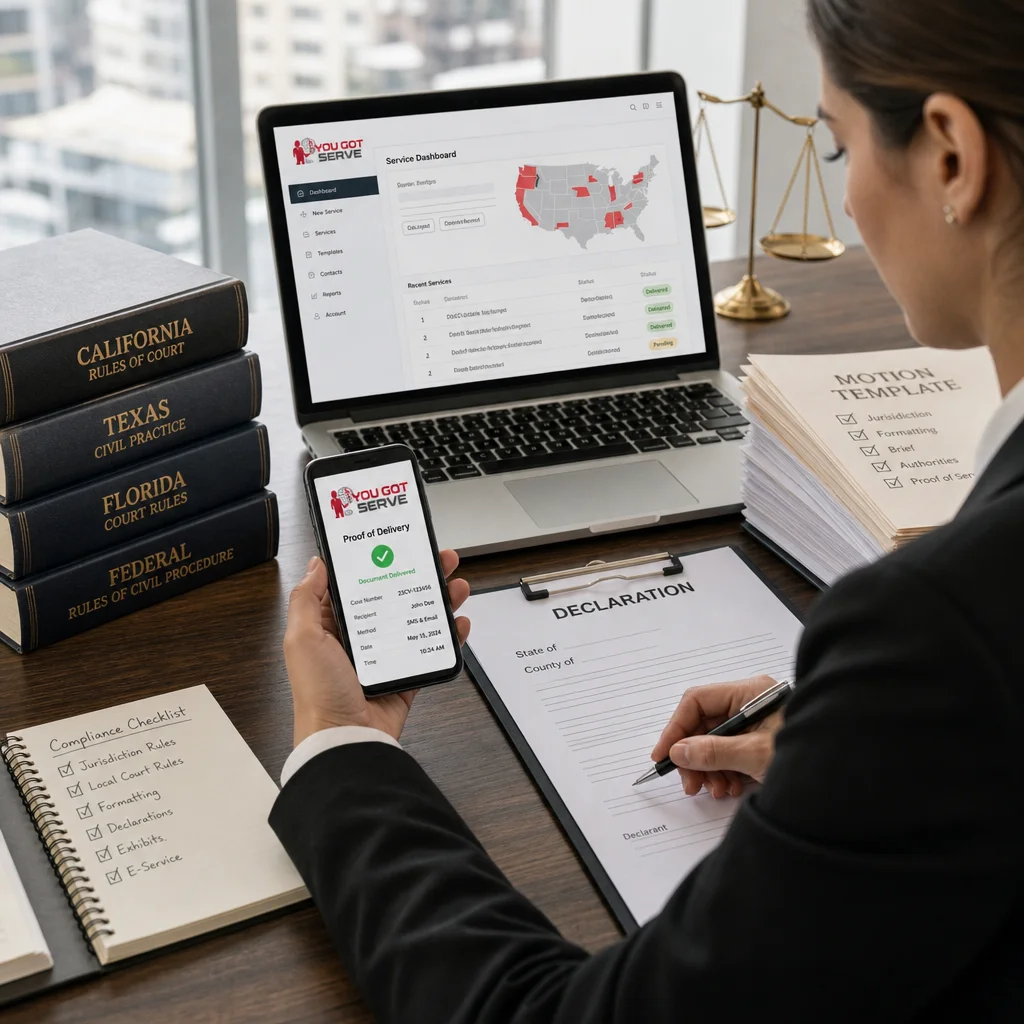
Many courts now permit or require electronic service via email. Some jurisdictions allow SMS notification as well, particularly when traditional personal service has been unsuccessful or when the court has authorized alternative methods. Your motion template should account for the service method you're using.
For example:
- If you're requesting permission to serve electronically, your motion must explain why traditional service has failed or why electronic service is appropriate
- Your declaration should document your search efforts and why the defendant is hard to locate
- Your proof of service must show the delivery method you actually used and when the recipient received the documents
When you combine jurisdiction-specific motion templates with a compliant electronic service platform, you create a seamless workflow. The template reminds you what to include in your motion requesting electronic service approval. The service platform then delivers your documents via SMS and email with timestamped verification, giving you the proof of service documentation the court expects.
Verification Requirements and Proof of Service Documentation
The proof of service document is where your compliance efforts meet judicial reality. Courts scrutinize these documents carefully because they establish whether proper notice was actually given.
Each jurisdiction specifies exactly what information must appear in the proof of service:
- The date, time, and method of service
- The person or entity served (and their relationship to the case)
- A statement that the server complied with local rules
- The server's signature and declaration that the information is true
Some states require the proof of service to be filed before the motion is considered. Others allow it to be filed within a specified window. Your jurisdiction's template tells you the exact requirements.
When you use electronic service via SMS and email, your proof of service must describe the digital delivery method and include evidence of receipt. A simple statement like "served via email on January 15, 2026" may not be sufficient. Your court may require timestamped delivery confirmation, especially if there's any dispute about whether the recipient actually received the documents.
We provide track documents capabilities that generate the verified delivery records courts expect. These records show when emails and SMS messages were delivered and, when applicable, when the recipient opened the secure link and accessed the documents. This documentation supports your proof of service and demonstrates compliance with court-ordered electronic service.
Avoiding Common Compliance Pitfalls with Proper Formatting
Many motions fail not because the legal argument is weak but because formatting or structural errors trigger rejection at the filing desk.
Common pitfalls include:
- Incorrect font size, leading, or spacing (courts enforce these rules strictly)
- Missing required headings or sections specified in local rules
- Page limits exceeded without proper permission
- Proof of service language that doesn't match local rule language
- Declarations that lack the required oath or penalty-of-perjury statement
- Service notations that omit required details about delivery method or date
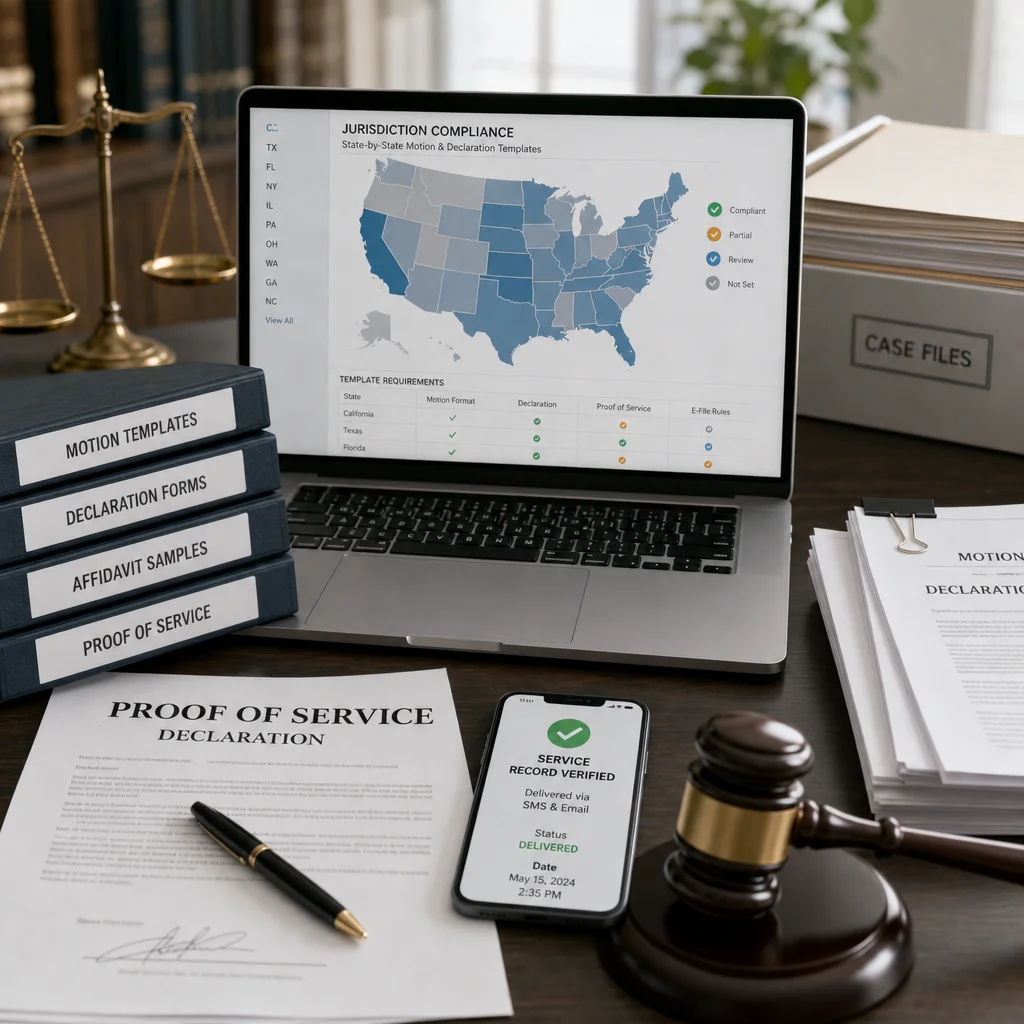
Using a template designed for your jurisdiction eliminates most of these errors automatically. The template shows you exactly where each element belongs, what language is required, and what spacing standards apply. This is particularly important for self-represented litigants who don't have the benefit of legal training to catch these details.
Another frequent mistake: serving your documents but then filing a proof of service that describes a different method or doesn't match the dates. Your template and your service method must align perfectly. If your motion says you served via email on a specific date, your proof of service must confirm that same method and date with supporting verification.
How Our Platform Complements Your Template Strategy
We've built YouGotServe specifically to bridge the gap between proper document preparation and verified service delivery.
Here's how the platform works alongside your templates:
- You prepare your motion, declaration, and notice of motion using jurisdiction-specific templates
- You identify the recipient (the defendant or opposing party) and decide on your service method
- Our platform delivers via SMS, email, or both, with your choice of 60 or 90-day notification cycles for recurring contact
- We generate timestamped, verified delivery records that directly populate your proof of service
- You file the proof of service with your motion, confident that your documentation meets local standards
Our end-to-end encryption and code-protected document access ensure that recipients can only view secured documents after verifying their identity. This layered security supports compliance with court-ordered electronic service and creates a clear record of who accessed what, when.
If you're serving a hard-to-locate defendant or need to prove that multiple service attempts were made, our platform's automated recurring notifications and skip tracing features provide the documented evidence that courts require. Your proof of service can then reference these verified attempts, demonstrating diligent effort to achieve proper service.
Tracking and Preserving Service Records After Filing
Your responsibility doesn't end when you file the proof of service. Courts may later question whether service was actually effective, particularly if the defendant claims they never received notice or challenge the method used.
Keeping organized records of your service activity protects you in several ways:
- You can quickly produce evidence if the defendant or court questions whether service occurred
- You have timestamped data showing exactly when and how documents were delivered
- You can demonstrate compliance with court orders regarding service method and frequency
- You have a clear audit trail if the case proceeds and later motions reference earlier service
Our platform automatically preserves all delivery activity, timestamps, and verification records. You can access these records at any time to review delivery status or prepare responses to service-related disputes.
After filing your proof of service, periodically check your service records to confirm that delivery activity matches what you filed. If documents were resent due to failed initial delivery attempts, those attempts appear in your activity log. This documentation supports your credibility with the court.
When the case concludes or if you need to reference your service efforts in a future case, having complete, organized records saves time and strengthens your position. Many disputes arise simply because one party can't produce evidence of what they actually did. With verified electronic service, you have that evidence built in.
Start by selecting the jurisdiction-specific motion and declaration templates that match your case. Cross-reference your local court rules or state procedural rules to confirm the template aligns with current requirements. Then, when you're ready to serve your documents, use our platform to deliver them electronically with full tracking and verified receipt confirmation. This combination ensures your filings are compliant from preparation to proof of service, reducing delays and protecting your case.