
Track Legal Notifications Over 60-90 Days with Automated Digital Service
The Challenge: When Traditional Service Methods Fail
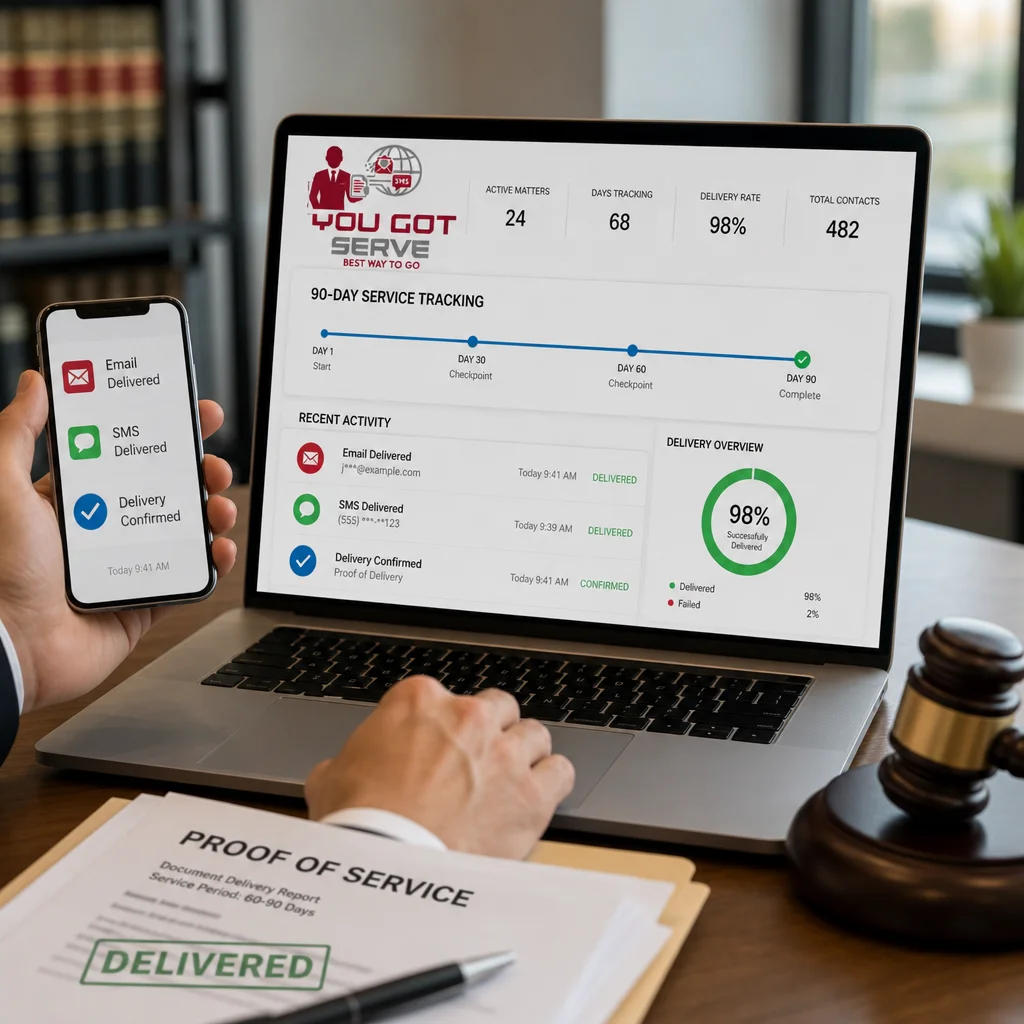
Serving court documents to a defendant or respondent should be straightforward. In practice, it often becomes one of the most frustrating bottlenecks in litigation.
When someone relocates frequently, ignores mail, or actively avoids service, traditional personal service breaks down. Hiring a process server to repeatedly attempt physical delivery grows expensive and yields no guarantee of success. Newspaper publication remains an option in some jurisdictions, but it's slow, costly, and often provides minimal actual notice to the intended recipient.
You need a faster, more reliable path forward. That's where extended automated legal notifications come in. Rather than relying on a single delivery attempt or betting on newspaper readers, we can send documents electronically over weeks or months with verified tracking at every step.
Takeaway: When conventional methods stall, automated notification systems offer a documented alternative that actually reaches recipients and proves it.
Why Extended Notification Cycles Matter in Legal Service
A single attempt at service, even if successful, leaves a paper trail that courts later scrutinize. Extended notification cycles solve this by creating a documented record of repeated contact attempts over time.
Courts recognize that persistence matters. Sending a notice on day one, then again on day 14, day 28, and beyond demonstrates genuine effort to notify the defendant or respondent. This repeated contact pattern strengthens your argument that service was adequate under local rules, even when traditional methods failed.
Beyond legal defensibility, longer cycles improve practical outcomes. Recipients who initially ignore a single notification may respond once they've received multiple messages over several weeks. The cumulative effect of repeated, time-stamped notifications increases the likelihood that your message breaks through.
We typically offer 60-day and 90-day notification cycles because these periods align with common state and federal procedural expectations. The extended timeframe gives you a verifiable narrative of diligent service efforts.
Takeaway: Multiple touchpoints over weeks create both legal protection and higher chances of actual recipient engagement.
How Automated Daily Notifications Reach Difficult Recipients
Automation handles the repetition that makes extended notification cycles practical. Without it, you'd need to manually resend documents every few days for months, which is neither feasible nor sustainable.
Our platform sends SMS and email messages according to a predictable schedule you define. The system delivers the initial notification, then automatically queues follow-up messages on set intervals. You don't need to remember dates, track attempts, or manually trigger each send. The technology does the work.
This automation also ensures consistency. Every notification contains the same core information, is timestamped identically, and reaches the recipient through both SMS and email channels simultaneously. No missed reminders. No variations that could later raise questions about notice adequacy.
Difficult recipients often ignore traditional channels because they expect them. SMS and email, sent repeatedly and directly to known contact numbers, penetrate avoidance tactics more effectively than postal mail or newspaper ads ever could.
Takeaway: Automation removes manual burden while ensuring every notification is documented, consistent, and delivered reliably over the full cycle.
The You Got Serve Advantage: Verified Delivery Over Months
We designed our platform specifically for legal professionals and self-represented litigants who need proof that documents were actually delivered, not just sent into the void.
Our approach combines SMS and email delivery with secure code-protected document access. Recipients can't claim they never saw the notice because our system logs each email open, each SMS delivery, and each time someone accesses the secured document portal. This creates a timestamped, tamper-resistant record of every interaction.
Integrated investigative skip tracing helps locate current contact information when you're working with outdated phone numbers or addresses. End-to-end encryption and timestamping ensure the documentation stands up to judicial scrutiny. You're not just sending notifications; you're building proof that holds weight in court.
Over a 60-day or 90-day campaign, this creates a comprehensive delivery history. When a defendant later argues they weren't properly served, you have concrete evidence: dates, times, delivery confirmations, and access logs.
Takeaway: Verified receipt tracking across weeks transforms extended notification campaigns into court-ready proof of service.
Building a Complete Contact Strategy with Multiple Touchpoints
One channel rarely reaches everyone. That's why we combine SMS and email simultaneously, maximizing the odds that your message arrives through at least one reliable path.
Some recipients check email sporadically but respond to text messages immediately. Others prefer email and rarely use SMS. By sending both concurrently on your notification schedule, you cover more behavioral patterns and communication preferences.
A practical multi-touchpoint strategy might look like this:
- Initial notification sent via SMS and email on day one
- Second round sent on day 14 via both channels
- Third round on day 28
- Final reminder on day 45 or 60, depending on cycle length
Recipients who ignore the first message often respond to the second or third. You're not harassing them; you're creating the documented contact pattern that courts expect when traditional service has failed.
This approach also gives you flexibility. If one recipient's phone number is inactive, their email address remains a valid delivery channel. You maintain options rather than hitting a single dead end.
Takeaway: Dual SMS and email delivery across staggered intervals ensures multiple chances for the message to land while building an indisputable service record.
Real-Time Tracking and Proof of Service Documentation
One of the most valuable features we provide is document tracking. You can log in at any time during your 60-day or 90-day campaign to see exactly what has happened with each notification.
The dashboard shows delivery status for every message sent, open confirmations for emails, and access logs for the secure document portal. You know immediately whether an SMS was delivered, bounced, or went to an inactive number. You see when emails were opened and from which device.
This transparency eliminates guesswork and protects you later. If you're questioned about service efforts, you don't need to guess or rely on memory. The system provides timestamped proof for every step.
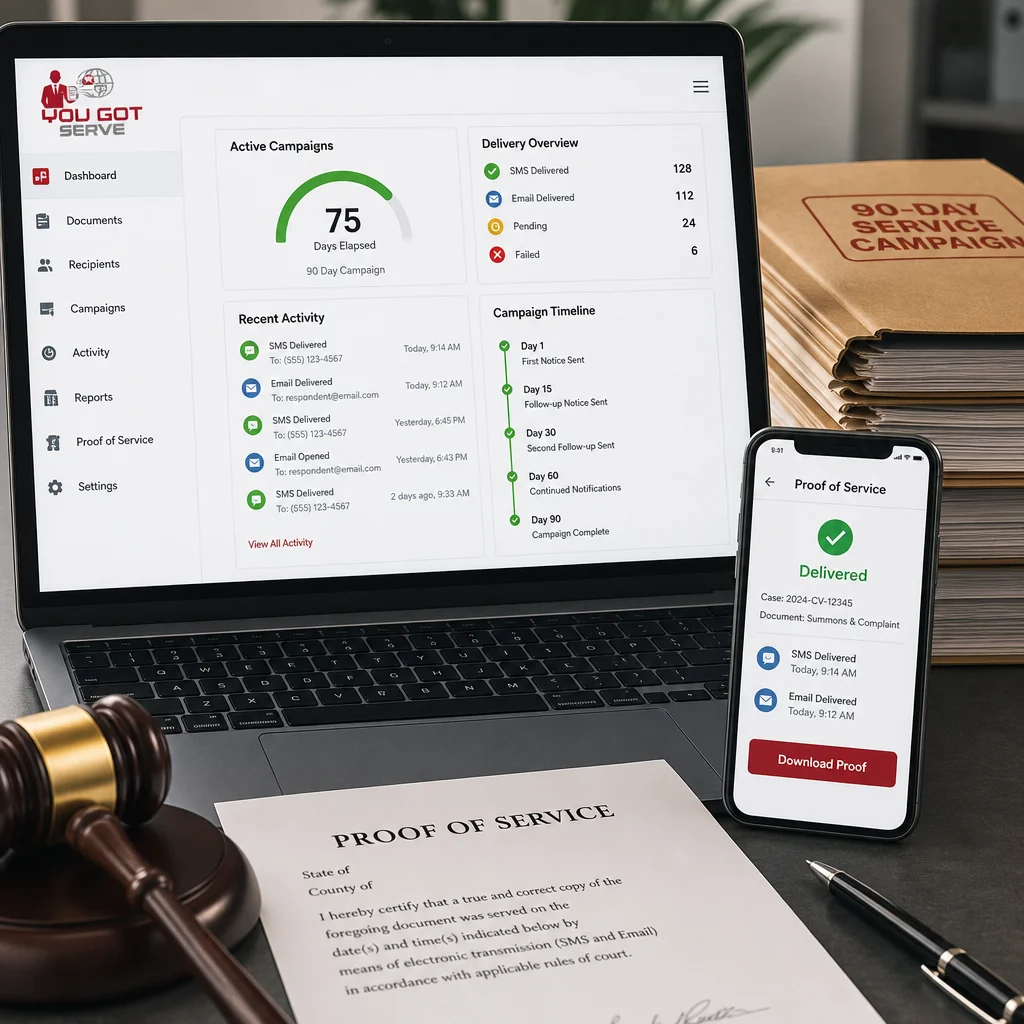
At the end of your notification cycle, we generate a comprehensive proof of service document that summarizes all delivery attempts, opens, and portal access. This report is formatted to meet typical court filing standards and can be filed as an affidavit of service in many jurisdictions.
Takeaway: Real-time tracking during your campaign and detailed reports at the end transform scattered notification efforts into organized, court-ready evidence.
Choosing Between 60-Day and 90-Day Service Campaigns
The choice between a 60-day and 90-day cycle depends on your jurisdiction, case facts, and strategic goals.
A 60-day cycle works well when you want faster resolution and your local rules don't require extended notice periods. It's also cost-effective for cases where you expect recipient cooperation after the first few notifications. Many civil suits and smaller disputes can proceed effectively with two months of documented contact.
A 90-day cycle is stronger when you're facing an elusive defendant, working in a jurisdiction that values extended notice, or building a particularly robust service record for future court challenges. The extra month of notifications and documented attempts significantly strengthens your legal position if the defendant later argues inadequate service.
Both cycles give you verified delivery proof, automated tracking, and documented notification records. The main difference is time horizon and the number of contact attempts.
Consider your jurisdiction's specific rules and your case urgency before deciding. Your attorney can advise which cycle aligns better with local court expectations.
Takeaway: Match your cycle length to jurisdictional requirements and case complexity; longer cycles provide extra legal insulation but cost more and take additional time.
Security and Compliance in Long-Term Electronic Notifications
We take security seriously because court documents contain sensitive information. Our platform uses end-to-end encryption for all document storage and transmission. Every notification is timestamped using technology designed to withstand forensic scrutiny.
Recipients access secured documents through code-protected portals. Only someone with the unique access code can retrieve the full document, preventing unintended disclosure.
Long-term notification campaigns increase the window for security breaches, so we've built protections that extend across your entire 60-day or 90-day cycle. Regular automated backups, redundant data storage, and compliance logging ensure that your service records remain intact and verifiable from day one through final filing.
We're also committed to supporting compliance with your local court rules. Electronic service isn't universally accepted, and acceptance standards vary significantly by jurisdiction. Our system is designed to support compliance with these rules, but you must verify what your specific court allows before relying on electronic service as your primary method.
Takeaway: Enterprise-grade security and timestamping protect both sensitive documents and the integrity of your proof of service throughout extended notification cycles.
Cost Savings Compared to Newspaper Publication
Newspaper publication is expensive and often ineffective. A single publication in a legal newspaper can cost $300 to $800 or more, depending on circulation area and publication frequency. You may need multiple publications for adequate notice, doubling your costs while providing minimal evidence that anyone actually read the notice.

Our 60-day notification campaigns typically cost a fraction of newspaper publication. You get verified delivery, automated tracking, and proof of successful contact, all without the uncertainty of whether anyone actually saw a small classified ad.
For a 90-day cycle, your cost remains lower than traditional newspaper publication while providing exponentially better documentation. Each notification is individually logged, timestamped, and attributed to a specific recipient.
Beyond direct cost, there's the time factor. Newspapers operate on their publication schedules, often requiring weeks to run a notice. Our system sends your first notification within hours and maintains contact throughout your chosen cycle. You move cases forward faster.
If you're choosing between newspaper publication and automated electronic notifications, the financial case strongly favors electronic service.
Takeaway: Automated notification systems cost less than newspaper publication, deliver faster results, and provide far superior proof of actual recipient contact.
Getting Started with Extended Notification Service
The process is straightforward. Gather the recipient's best current contact information: email address and phone number. Upload this information to our platform, select your 60-day or 90-day cycle, and upload the document you need to serve.
Our team verifies that your contact information is current and performs any needed skip tracing to locate updated details if the information you have is outdated. We then activate your notification campaign.
From that point forward, the platform operates automatically. Notifications send on schedule, the system tracks every delivery, and you can monitor progress in real time through how it works.
When your cycle completes, download the comprehensive proof of service report and file it with your court as evidence of adequate service of process.
Takeaway: From upload to filing, the process takes minimal effort and generates complete documentation that courts recognize and respect.
Verify Compliance with Your Local Court Rules
Before launching an automated notification campaign, confirm that your jurisdiction permits electronic service for your specific case type.
Federal courts, many state courts, and increasingly specialized tribunals have adopted rules allowing electronic service of documents. However, these rules vary significantly in scope. Some permit email service without court approval; others require prior written consent from the recipient or the court. Some jurisdictions allow electronic service only for specific document types.
Check your local rules of civil procedure or your court's electronic filing guidelines. If you're uncertain, consult your attorney or contact the court clerk to confirm what methods are permitted in your jurisdiction and for your case type.
We design our service to support compliance with these rules, but the ultimate responsibility rests with you to verify local requirements before proceeding.
Once you've confirmed that electronic service is permitted in your jurisdiction, automated long-term notification campaigns become a powerful tool for reaching difficult recipients, documenting your service efforts, and building an unassailable record for court.
Takeaway: Verify local court rules first; once confirmed, automated electronic service delivers faster, cheaper, and better-documented results than traditional methods.