
White Label E-Service Platform: Brand Your Own Substituted Service Solution

The Staffing and Cost Problem Law Firms Face with Traditional Service Methods
Law firms managing high-volume litigation face a staffing bottleneck when relying on traditional service methods. Personal service requires field investigators, coordinated scheduling, and staff time spent tracking failed attempts. When a defendant proves difficult to locate or evades personal service, the process stretches over weeks, tying up resources that could focus on case strategy.
Newspaper publication, the fallback option, carries hidden costs beyond the publication fee itself. You must manage vendor relationships, verify publication schedules, collect affidavits, and document the entire chain for court filing. Each case consuming newspaper service diverts paralegal time from higher-value work. For mid-market and growing firms, this labor intensity directly cuts into profitability on each case.
A white label e-service platform redistributes this burden. By offering clients a branded digital alternative for electronic service, you shift the operational complexity to a secure, automated system designed specifically for service of process. Your team handles client relationships and strategy; the platform handles delivery verification, timestamped records, and proof of service documentation.
Next step: Audit your current service methods. Identify cases where traditional service delayed resolution or consumed disproportionate staff hours. This baseline clarifies the efficiency gain a branded e-service solution would deliver.
Why Newspaper Publication and Skip Tracing Don't Scale for Your Practice
Newspaper publication works, but it's inherently slow and expensive at scale. Publication timelines extend 30 to 60 days before proof of service reaches the court. During that window, litigation stalls. Clients grow frustrated watching calendar pages turn while nothing concrete advances their case.
Skip tracing, while thorough, requires specialized investigators and upfront investigative fees. Not every case justifies the cost. A defendant living in a remote area or with intentionally obscured contact information can justify the expense, but routine cases don't need that level of investigation. Firms end up choosing between paying high investigative fees or settling for newspaper publication by default.
The scalability problem emerges when you handle multiple cases simultaneously. Coordinating newspaper vendors, tracking publication dates, collecting affidavits, and filing proofs of service across dozens of cases creates administrative friction. Staff spend time on process mechanics rather than case development. Your firm's service model becomes a cost center instead of a revenue lever.
A branded digital service solution changes the equation. You offer clients a faster, more affordable alternative that reduces publication waiting periods and investigative costs. Clients choose the method that fits their case urgency and budget. Your firm captures the efficiency gain and can price the service competitively while protecting margins.
Actionable insight: Survey your clients. Ask which barriers most frustrate them: timeline delays, upfront investigative costs, or uncertainty about service success. Their answers guide your value proposition for a white label platform.
How White Label E-Service Platforms Transform Your Service Capabilities
A white label e-service platform operates under your firm's brand, giving clients the impression of seamless in-house capability. When you select a white label solution, you receive a secure digital infrastructure with dual email and SMS delivery, automated notification cycles, and verified receipt tracking. Your clients see your firm's logo, your terms, and your support contact. Behind the scenes, the platform automates the heavy lifting.
The transformation works because electronic service addresses two friction points at once. First, it accelerates delivery cycles: documents reach recipients within hours, not weeks. Second, it documents every interaction with timestamped records and recipient verification codes, creating a clear audit trail. Courts increasingly recognize these digital proof-of-service documents as credible evidence of proper service.
For your firm, the white label approach avoids building proprietary technology. You license a turnkey platform, brand it with your firm's identity, and offer it directly to clients. The underlying vendor handles security, encryption, legal compliance updates, and system maintenance. Your team focuses on client education and case strategy while the platform handles service logistics.
This model particularly benefits firms seeking to differentiate their service offerings. Instead of competing on hourly rates alone, you become known for offering faster, more transparent service methods. Clients remember firms that reduced their litigation timeline and gave them real-time delivery tracking.
Immediate action: Identify your target client segment. Which practice areas or case types would most benefit from faster, verified electronic service? Focusing on a specific vertical helps you tailor messaging and pricing.
Building Client Value Through Branded Digital Service Solutions
Clients value speed, transparency, and cost savings. A branded e-service platform delivers all three. When serving a hard-to-find defendant, traditional methods leave clients waiting and uncertain. Newspaper publication happens behind the scenes with minimal visibility into whether or when the notice reaches its intended recipient. Electronic service inverts this dynamic: clients receive real-time notifications as SMS and email delivery occurs, with documented proof immediately available.
Cost savings matter equally. Newspaper publication and skip tracing carry upfront fees that add up across multiple defendants. Electronic service typically costs a fraction of newspaper rates and eliminates investigative retainers. For clients managing constrained litigation budgets, this difference is material. A plaintiff in a consumer debt case or an attorney handling multiple cases in a collection action can now afford reliable service without depleting case funds.
Transparency builds trust. When clients can log into a branded portal and see delivery status, read receipt confirmations, and download proof of service documents, they feel in control of their litigation. They understand what service method was used, when delivery occurred, and why the firm chose that approach. This visibility reduces the "what's happening?" questions that consume paralegal time.
Your firm strengthens client relationships by positioning itself as a partner that prioritizes efficiency and transparency. Clients whose cases move faster and cost less develop loyalty. They refer additional matters and maintain longer-term engagement. A white label e-service platform becomes a retention and acquisition tool.
Concrete step: Draft a one-page client overview. Explain the benefits of your branded e-service option in plain language: faster delivery, lower cost, real-time tracking, and verified proof. Test this messaging with three current clients.
Core Features That Make Your White Label Platform Stand Out
A robust white label e-service platform includes several technical and operational features that support both compliance and usability. Dual email and SMS delivery ensures recipients encounter the notice through multiple channels, increasing the likelihood of actual notice. Automated notification cycles (typically spanning 60 or 90 days) meet court requirements for repeated notice attempts without manual intervention.
Verified digital proof of service provides the evidentiary foundation courts need. Timestamped records, delivery confirmations, and recipient verification codes create a transparent chain of proof. Unlike newspaper publication, which relies on affidavits and vendor statements, digital proof captures machine-readable data that courts increasingly accept.
Secure code-protected document access protects sensitive information. Recipients use a unique code to access served documents, preventing accidental disclosure and maintaining confidentiality. End-to-end encryption and timestamping ensure documents remain tamper-proof and dated correctly throughout transmission and storage.
Integrated investigative skip tracing allows your firm to request address updates before initiating service. If current contact information proves unreliable, the platform can layer in targeted research. This hybrid approach combines low-cost electronic service with investigative support when a case genuinely requires it.
These features work together to create a platform your firm can confidently recommend to clients. You're not asking clients to experiment with an untested method; you're offering a comprehensive, documented service channel designed specifically for modern litigation.
Key takeaway: Review the platform's user interface. A confusing or overly technical interface frustrates both your staff and your clients. Test the client-facing portal yourself before committing to a white label partnership.
Integration and Implementation for Seamless Firm Operations
Integrating a white label platform into your existing practice requires planning but doesn't demand a complete operational overhaul. The platform should connect with your case management system, allowing staff to initiate service requests without leaving their current workflow. API integrations or direct data exports enable this seamless handoff.

Implementation typically unfolds in phases. First, your team learns the platform's features and compliance framework. Second, you develop internal protocols: when to recommend electronic service, how to counsel clients on legal acceptance, and when to use hybrid methods combining electronic service with traditional options. Third, you train support staff on client onboarding and document management.
A professional implementation partner walks you through these steps. They provide documentation, staff training sessions, and support during your first few cases. This guidance reduces errors and builds confidence in your team's ability to manage the platform independently.
The operational burden remains light once integration completes. Staff spend minimal time on manual data entry or follow-up. The platform automatically sends notifications on your defined schedule, tracks delivery status, and generates proof-of-service documents. When a recipient confirms delivery, the system records it immediately. Your team reviews the completed file once the service period concludes.
Many firms discover that implementing a white label platform also forces beneficial process discipline. You clarify internal workflows, standardize document naming conventions, and document compliance decisions. These improvements benefit your entire practice, not just service-related work.
Next step: Request a product demo. Walk through the implementation process with the vendor. Ask specifically about integration with your case management system and the expected timeline for your team's first independent service case.
Compliance and Documentation Support Across Jurisdictions
Service of process rules vary significantly by jurisdiction. Some courts accept electronic service under specific conditions; others require court authorization before you can proceed. A white label platform designed for legal compliance tracks these variations and helps your team navigate them.
The platform should provide jurisdiction-specific guidance on what makes service legally sufficient. This typically includes references to court rules, links to relevant statutes, and checklists for documentation. Your team reviews this guidance for each case and makes an informed decision about whether electronic service fits the matter.
Some jurisdictions permit electronic service outright under civil procedure rules. Others require the defendant's prior consent or a court order. Still others prohibit electronic service for certain document types. A compliance-forward platform flags these restrictions and prevents your team from initiating service in ways that might not hold up in court.
Documentation support means the platform automatically generates affidavits, certificates of service, and proof-of-service reports formatted to match court expectations. These pre-built templates, combined with timestamped delivery data, create court-ready filing packages. Your paralegal verifies the content, signs electronically, and files with confidence.
Staying current with changing court rules requires ongoing platform updates. The vendor you choose should maintain a legal team monitoring court rule changes and updating the platform accordingly. This reduces your compliance burden and protects your firm against outdated guidance.
Critical action: Verify jurisdiction coverage. Confirm that the platform supports the courts where you practice. Ask the vendor for a complete list of supported jurisdictions and the compliance guidance available for each.
Tracking, Verification, and Proof of Service Your Clients Expect
Real-time tracking transforms the client experience. When you serve documents electronically, the system immediately records each delivery attempt. Email bounce-backs appear instantly. SMS delivery confirmations arrive within seconds. Clients logging into their branded portal see this activity in real time, eliminating the uncertainty of traditional service methods.
Verified receipt tracking goes beyond simple delivery. When a recipient opens an email or confirms a text message with a response, the platform captures this proof. Recipients can also enter a verification code to confirm they received and reviewed served documents. This documented receipt strengthens your position if the defendant later claims non-receipt.
Proof of service documents tell a complete story. Instead of relying on a newspaper affidavit or investigator report, you provide the court with timestamped records showing each delivery attempt, confirmation status, and recipient interaction. The system generates these documents automatically, and your team simply reviews and files them. Courts increasingly recognize these digital records as credible evidence of proper service.
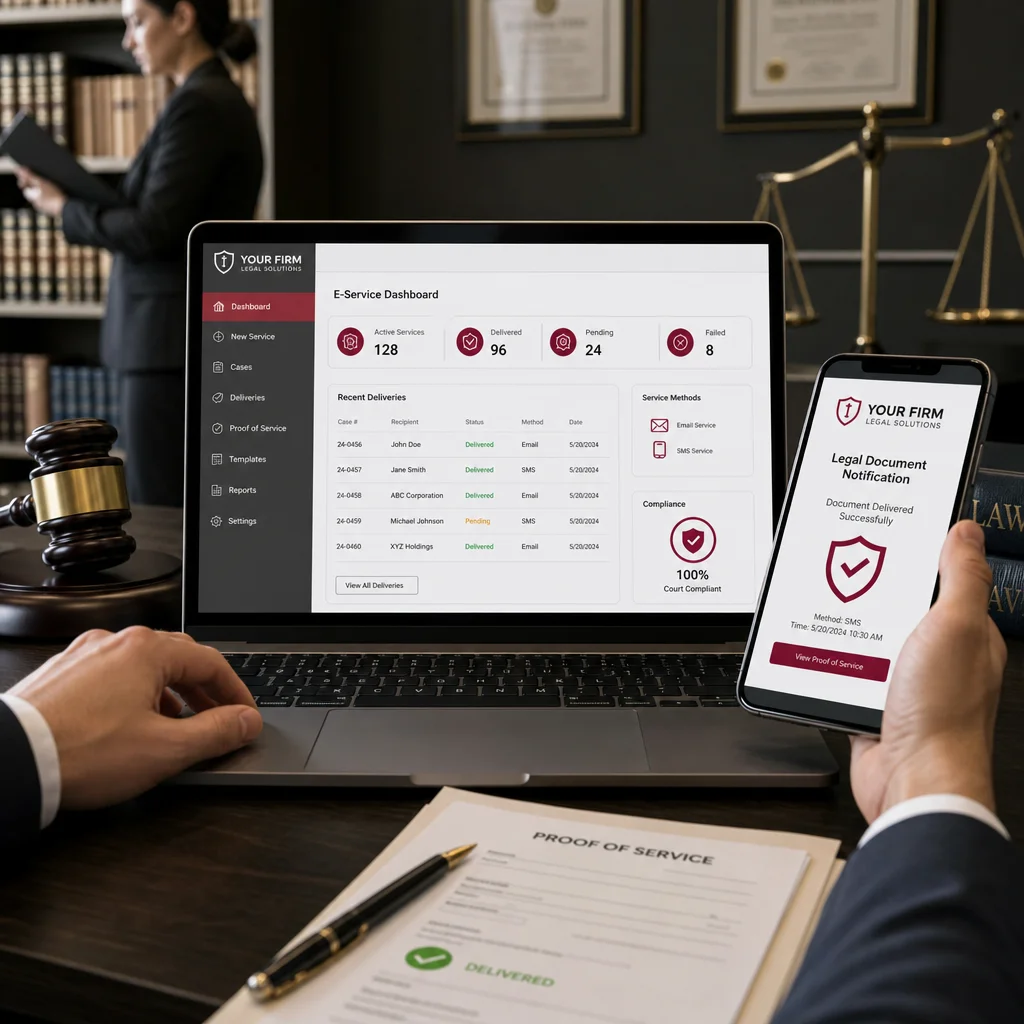
Audit trails protect your firm. Every action within the platform is logged with timestamps and user identifiers. If a question arises about when service occurred or what steps were taken, the audit trail provides irrefutable documentation. This protection matters if service becomes contested or if you need to demonstrate good-faith compliance efforts.
Practical benefit: Show clients a sample proof-of-service report. Demonstrate how clearly the document establishes service. This concrete example helps clients understand why your firm recommends electronic service for their cases.
Pricing and Revenue Models for White Label Deployments
White label platforms support several revenue models depending on your firm's preferences and client base. The simplest approach is per-case pricing: you charge clients a flat fee for each document served electronically. This mirrors how firms currently bill newspaper publication or skip tracing, making it familiar to clients.
Per-recipient pricing works well when serving multiple defendants in a single case. Instead of a flat case fee, you charge for each individual recipient notified. This model scales naturally with litigation complexity and encourages clients to use your service for all defendants rather than mixing methods.
Subscription models suit high-volume practices. You charge clients a monthly or quarterly fee for unlimited electronic service access. This works particularly well for collection agencies, debt validation firms, and other practitioners handling dozens or hundreds of service matters monthly. Predictable fees allow clients to budget more accurately.
Your firm's margin depends on the underlying platform cost and the pricing you negotiate with clients. Most white label vendors structure platform licensing on a per-transaction or annual subscription basis, giving you predictability for margin calculations. Competitive market rates for electronic service typically range from $10 to $50 per recipient served, depending on complexity and market positioning.
Many firms use pricing as a positioning tool. If you want to compete on accessibility, you price aggressively to drive adoption. If you want to emphasize premium, comprehensive service, you price higher and emphasize superior compliance support and client experience. Both strategies work; align your pricing with your market positioning.
Planning exercise: Model three pricing scenarios. Calculate your margin under per-case, per-recipient, and subscription approaches. Determine which model best fits your practice volume and client base.
Getting Started With Your Branded E-Service Platform
Beginning your white label e-service journey starts with vendor selection. Evaluate platforms on several criteria: compliance coverage in your practice jurisdictions, ease of implementation, quality of client-facing interface, and quality of customer support. Request references from other law firms using the platform. Ask about their implementation experience and ongoing satisfaction.
Once you've chosen a vendor, dedicate resources to implementation. Assign a staff member to lead the initiative. This person owns the vendor relationship, coordinates staff training, and develops your internal protocols. Implementation typically takes 4 to 8 weeks depending on your practice complexity and integration requirements.
Start with a pilot program. Select 5 to 10 cases where electronic service fits well and where clients are likely to be receptive. Work through these cases carefully, documenting your process and refining your internal workflows. Use these pilot cases to test your client communications, compliance procedures, and proof-of-service documentation.
Build market awareness gradually. Update your website to mention your branded e-service capability. Include information about the benefits in new client engagements. Ask satisfied clients from your pilot program for referrals. Many firms find that word-of-mouth from clients who experienced faster, more transparent service becomes their strongest marketing channel.
Track key metrics: adoption rate among eligible cases, client satisfaction feedback, time savings compared to traditional service, and cost per case. After three to six months of operation, review these metrics and adjust your messaging, pricing, or implementation approach as needed.
For detailed pricing information and to explore our white label e-service platform, visit Pricing for e-service. We're here to support your firm's service capabilities and help you offer clients faster, more reliable alternatives to traditional methods.