
Why Court Admissibility Matters: The Stakes of Improper Service
Service of process stands as one of the most critical procedural requirements in civil litigation. A defendant’s constitutional right to notice and an opportunity to be heard depends on it. If service fails, judgments can be voided, appeals upheld, and entire cases dismissed regardless of the merits.
Courts scrutinize service methods carefully. Traditional personal service once dominated, but electronic service has become legally viable in many jurisdictions when proper procedures are followed. The challenge lies in documenting that service was actually received and that you complied with all applicable rules.
Improper service creates expensive problems. A judgment entered without valid service is vulnerable to challenge years later. Appellate courts regularly overturn decisions on service grounds alone. For attorneys and self-represented litigants alike, the cost of re-litigating a case because service was deemed insufficient far exceeds the investment in getting it right the first time.
Court admissibility therefore requires three elements: (1) a service method authorized by statute or court rule, (2) compliance with procedural requirements in your jurisdiction, and (3) documentation proving the recipient actually received notice. Electronic service, when properly executed, can satisfy all three.
State-by-State Electronic Service Statutes and Rules
Electronic service authority exists across all 50 states, though requirements vary significantly. Some states adopted broad electronic service rules years ago; others continue to narrow the circumstances under which email or SMS constitutes valid service.
Federal courts follow Federal Rules of Civil Procedure Rule 5(b)(2)(E), which permits service by electronic means if parties consent or a court order authorizes it. Many state courts have adopted similar consent-based frameworks.
State variations include:
- Consent-based models: California, New York, and most states permit electronic service only when the recipient (or their attorney) consents. Consent must be documented.
- Statutory authorization without consent: Some states like Texas and Florida permit electronic service to certain defendants without requiring prior consent, particularly in business or collection contexts.
- Court approval models: Jurisdictions like Illinois and Massachusetts may require explicit court authorization before electronic service is permitted.
- Default rules: Several states now treat email service as a default method when contact information is available, particularly in business disputes.
The critical first step is identifying your specific jurisdiction’s statute or court rule. Rules of Civil Procedure sections 4, 5, or 305 typically govern service requirements. Local rules for your court often add additional specifications: file size limits, response time windows, or advance notice requirements.
Before relying on electronic service, confirm that your target defendant falls within an authorized category (for example, business entities, attorneys, parties who consented, or defendants residing in another state). Check whether court authorization is needed. Document the rule or statute you relied upon in your service affidavit.
Key Case Law Establishing Electronic Service Standards
Judicial precedent reinforces statutory requirements and clarifies when electronic service is enforceable. Several landmark cases establish that electronic service can be constitutionally sufficient when properly documented.
Sparks v. Republic National Life Insurance Co. (5th Cir.) established early that electronic notification can constitute adequate notice if it is reasonably calculated to reach the intended recipient. Modern courts apply this “reasonably calculated” standard to electronic means, meaning email or SMS service must reach a monitored address or number with meaningful likelihood.
Courts have consistently held that proof of delivery matters enormously. In Casamayor v. Montanes (11th Cir.), the court emphasized that service is invalid absent reliable evidence the recipient was actually notified. Delivery receipts, read confirmations, or access logs strengthen admissibility significantly.
More recent cases recognize multi-channel approaches. When a single method may fail, attempts through multiple channels (email plus SMS, for instance) increase the likelihood that notice reached the recipient and provide stronger documentary support for service.
Jurisdictions differ on whether email alone suffices or whether supplemental methods are required. Some courts require SMS or phone notification in addition to email for difficult-to-locate defendants. Others permit email service but demand proof that the address was actively monitored.
The consistent judicial theme is straightforward: credible evidence that the defendant actually received notice. Timestamps, delivery confirmations, and access records all support admissibility. Guesswork and unsupported claims do not.
Building an Admissible Service Record with Multi-Channel Notifications
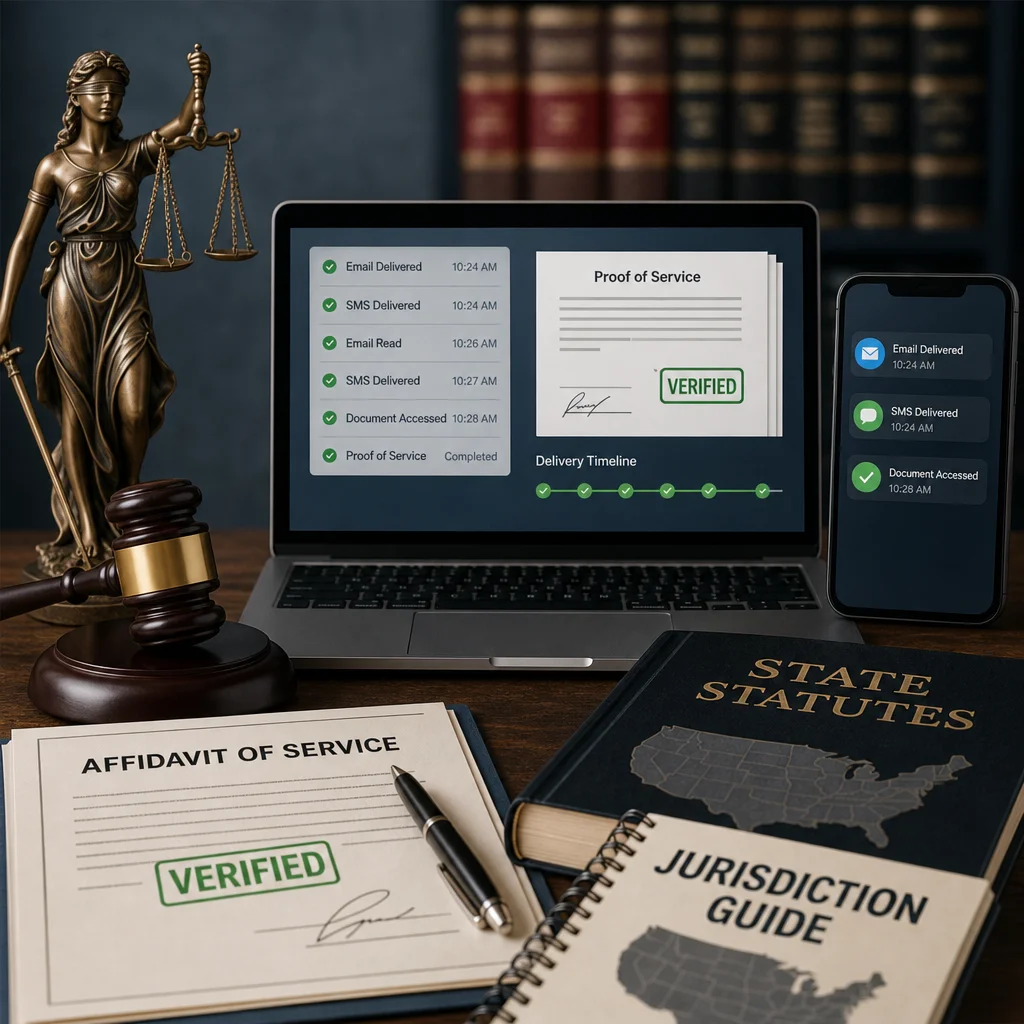
Admissible service rests on documentation that the recipient had a genuine opportunity to receive notice. Courts recognize that single-attempt service (one email sent once) often fails to prove receipt. Multi-channel notification strategies reduce that risk and create a stronger evidentiary record.
Our approach combines email, SMS, and WhatsApp notifications, allowing you to reach recipients across their most commonly monitored channels. You can enter up to three email addresses and three phone numbers per recipient, ensuring that you reach available contact points rather than relying on a single channel.
Daily notification cycles over extended timeframes increase the probability of actual receipt. Recipients who ignore one email may notice an SMS. Those away from email for a few days may receive a text message. The cumulative pattern of outreach, properly documented, shows that you made persistent, good-faith efforts to notify the defendant.
When you build a service record, structure it methodically:
- Identify all available contact information for the recipient (multiple email addresses, phone numbers, social media handles).
- Select channels appropriate to the jurisdiction and the defendant’s likely means of communication.
- Set notification frequency to daily (or per your court rules) over the full allowable period.
- Document the exact dates, times, and channels through which notifications were sent.
- Record whether notifications were delivered and whether documents were accessed.
This creates a chronological narrative that a court can review. An affidavit stating “I sent emails on these dates and received delivery confirmations” is far more persuasive than “I believe the defendant received notice.”
Verification Features That Strengthen Your Service Documentation
Proof of delivery alone can be challenged. Did the email reach spam? Was the phone number correct? Did the recipient actually read the message? Courts increasingly expect additional verification when electronic service is contested.
We provide layered verification to strengthen your service record. Secure, code-protected document access means the recipient must enter a unique one-time access code to retrieve documents. This adds a step beyond passive notification and creates a record of active engagement.
Geolocation information, where available, documents where a recipient accessed documents. If a defendant claims they never received notice, but your records show they accessed the document from their registered home address at 2 p.m. on a specific date, that evidence is difficult to overcome.
Selfie capture and recipient verification confirm that the person accessing the documents is the intended recipient, not an assistant or unrelated third party. Timestamps on every notification and access event establish an exact chronology.
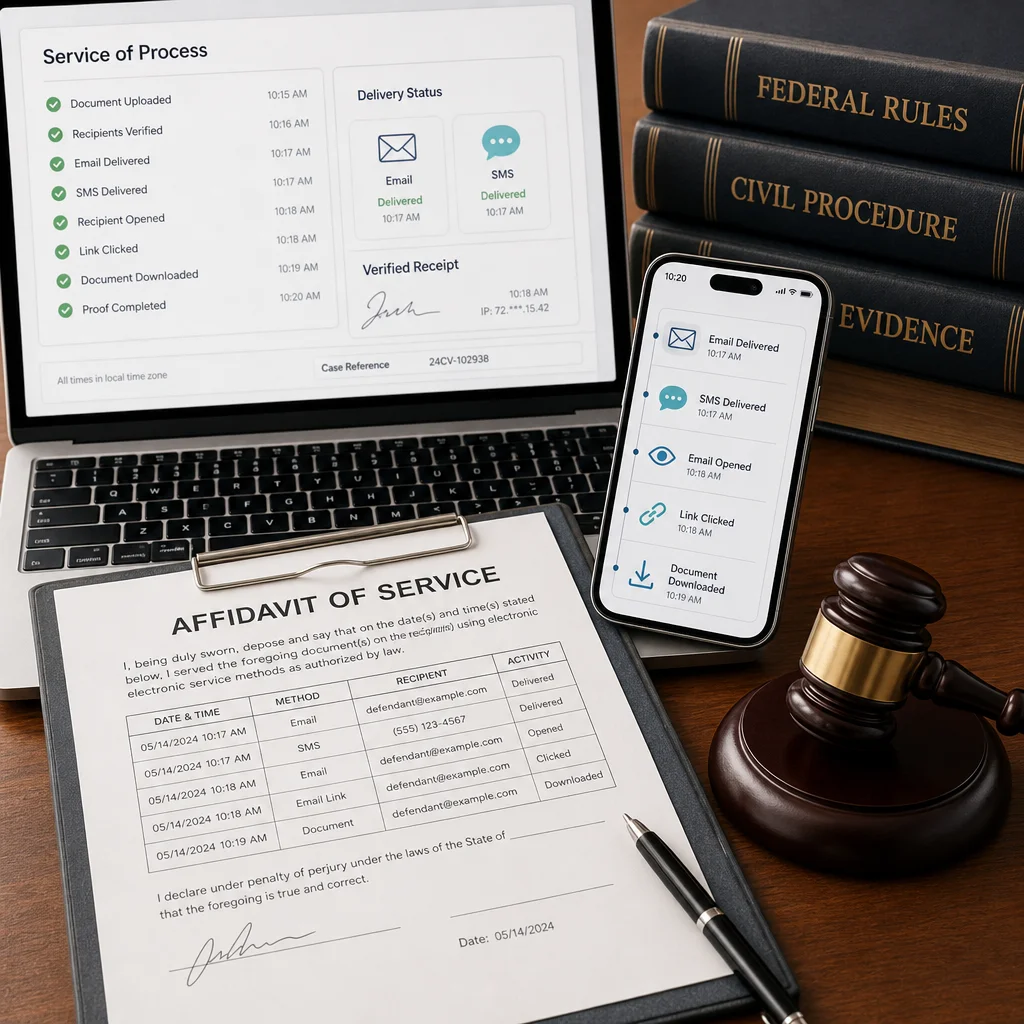
The notification history feature logs every outreach attempt: when email was sent, when SMS was delivered, when access was requested, and when documents were actually opened. This complete activity record becomes your affidavit’s foundation.
Taken together, these features answer the core question courts ask: “Is there genuine, documented evidence this defendant received notice and had an opportunity to respond?” A complete activity record with delivery confirmations, access logs, and geolocation data provides precisely that evidence.
Creating Defensible Affidavits with Timestamped Activity Records
Your affidavit of service is the document that establishes admissibility in court. It must be accurate, detailed, and supported by documentary evidence from your service platform.
A defensible affidavit includes:
- Statutory authority: “Pursuant to [State Rule / Federal Rule], I served the defendant as follows…”
- Recipient identification: Full name, last known address, and confirmation that the person served matches the defendant in the caption.
- Service method and dates: “On [date], I electronically served [defendant] at email address [address] and phone number [number].”
- Notification frequency: “Notifications were sent daily from [start date] to [end date], a total of [X] attempts.”
- Delivery confirmation: “The following notifications were delivered: [list dates and channels]. The platform provided delivery receipts for each notification sent.”
- Access verification: “On [date], at [time], the defendant accessed the served documents from [location/device], entering the secure access code provided via the notification.”
- Exhibits: Attach screenshot logs from your service platform showing the complete notification and access history.
The key is using timestamped activity records from your service platform as the backbone of your affidavit. Rather than relying on your recollection, you cite exact dates, times, and system confirmations. This shifts the burden of proof; if the defendant claims non-receipt, they must rebut contemporaneous, documented logs rather than challenging your memory.
Include all available verification data. If geolocation is available, include it. If access code entry is logged, cite it. If delivery receipts exist, exhibit them. The more objective, timestamped evidence you provide, the less room opposing counsel has to argue service was deficient.
International Electronic Service Compliance Considerations
Cross-border service complicates electronic methods. The Hague Convention on the Service Abroad of Judicial and Extrajudicial Documents in Civil or Commercial Matters governs service on defendants in treaty countries, generally prohibiting direct service and requiring service through central authorities.
However, electronic service exceptions are emerging. Some jurisdictions permit email service on defendants in treaty countries when:
- The defendant consents to electronic service.
- A court order explicitly authorizes electronic service.
- The defendant is a business entity with an email address on file.
- The defendant’s home country permits electronic service by treaty or domestic law.
International service through our platform is technically available in many countries where email and SMS infrastructure is reliable. However, legal sufficiency depends entirely on the foreign jurisdiction’s rules, any applicable treaties, and whether your court recognizes electronic service across borders.
Before relying on electronic service internationally, consult the foreign jurisdiction’s civil procedure rules and, if applicable, the Hague Convention’s specific provisions. Some countries require an official declaration that the defendant was served; others demand service through their central judicial authority regardless of the method you choose.
When international service is permitted electronically, the same documentation standards apply: clear evidence of delivery, recipient identification, and timestamped records demonstrating that the defendant had a reasonable opportunity to receive notice.
How Persistent 60 and 90-Day Notification Campaigns Build Proof
Extended notification campaigns transform electronic service from a single attempt into a persistent, documented outreach strategy. Rather than sending notice once and hoping it reaches the recipient, you sustain daily notifications for 60 or 90 days, creating an indisputable record of effort.
Our platform supports both timeframes. A 60-day campaign sends notifications daily for two months; a 90-day campaign extends to three months. Over that period, a single recipient receives up to 60 or 90 separate notifications across the channels you select (email, SMS, WhatsApp).
The legal advantage is substantial. A court reviewing a service record that shows 60 days of daily notifications cannot reasonably conclude the defendant had no opportunity to receive notice. Even if the defendant claims they never saw a single message, the cumulative pattern of outreach demonstrates good faith, persistence, and reasonable likelihood of actual receipt.
For difficult-to-locate defendants, persistent campaigns are particularly valuable. A defendant who changes phone numbers or email addresses during the service period may still be reached by one of the contact points you provided. The extended timeframe increases the probability that at least one notification reaches an active, monitored channel.
From an evidentiary standpoint, a 60 or 90-day campaign record is compelling. Your affidavit can cite: “Defendant was served with 60 daily notifications from [start date] to [end date]. Delivery confirmations were received for [X] percent of notifications. Defendant accessed served documents on [dates], confirming actual receipt and opportunity to respond.”
No court can reasonably dismiss such documentation as insufficient. The extended campaign proves both procedural compliance and practical receipt.
Sample Service Affidavits by Jurisdiction
Affidavit structure varies by jurisdiction, but key elements remain constant. Here are representative examples:
Federal Court (FRCP 5(b)(2)(E) – Consent-Based)
“I declare under penalty of perjury that on [date], I served the defendant via electronic means as follows: Email to [address] and SMS to [number], to which the defendant had previously consented in writing. From [start date] to [end date], I sent daily electronic notifications via email and SMS. Attached as Exhibit A is a complete log from the service platform documenting all notifications sent, delivery confirmations received, and access records confirming defendant’s receipt of the served documents on [date].”
California (CCP 1010.6 – Business Defendant)
“Pursuant to California Code of Civil Procedure section 1010.6, I electronically served [Defendant], a business entity, at the email address [address] maintained on file as the entity’s place of business. Beginning [date] and continuing through [date], I served documents daily via email and SMS to [phone number]. All notifications were delivered. On [date], the defendant accessed the documents using a secure access code, as shown in the attached delivery report.”
Texas (TRCP 21a – Agreed Service)
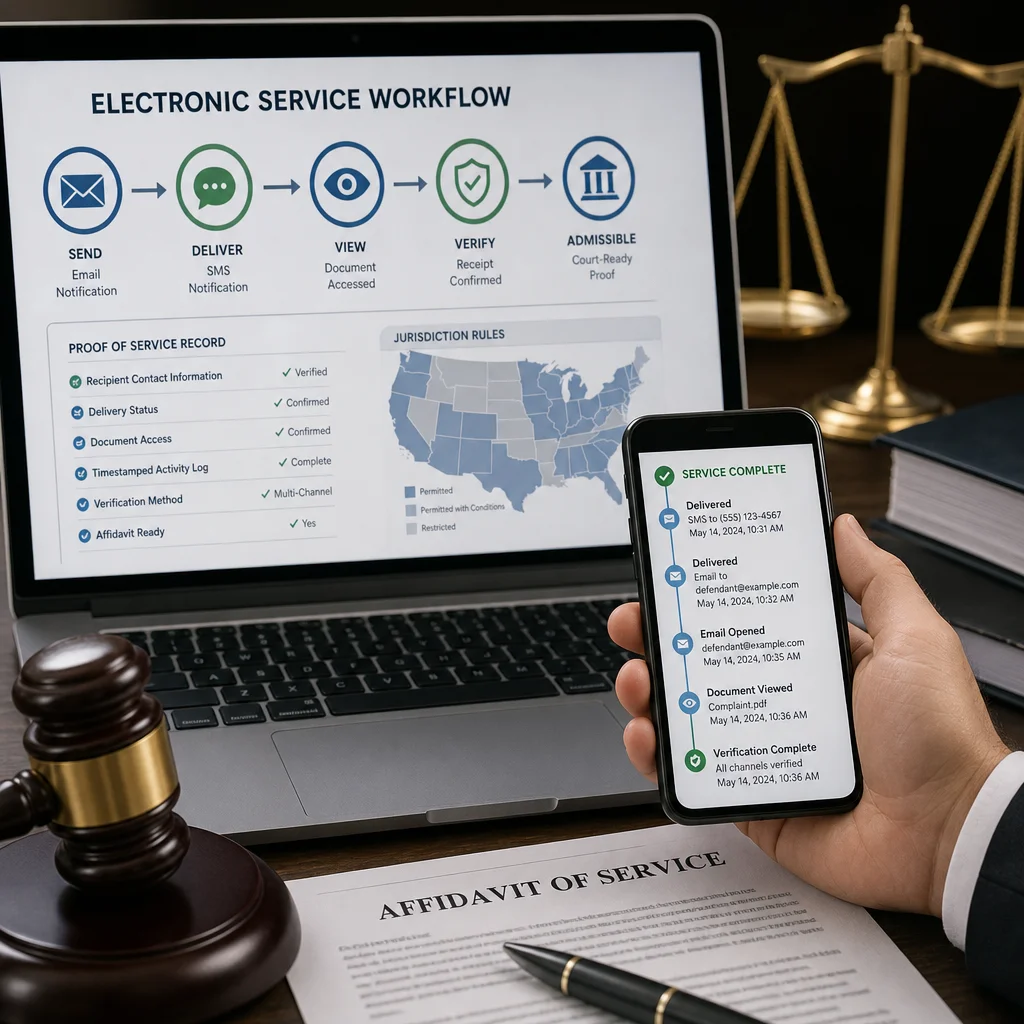
“The defendant agreed to electronic service by email at [address] on [date], as shown in the attached consent. I electronically served the document on [date] and [subsequent dates]. The attached exhibit shows delivery confirmations for all notifications, and access logs confirming that the defendant received and opened the served documents on [date].”
Key differences center on which statute authorizes service and whether consent, court order, or statutory authority is the foundation. Always cite the specific rule, include attached logs, and describe any verification features (access codes, geolocation, selfie capture) that confirm receipt.
Common Admissibility Challenges and How to Avoid Them
Courts reject electronic service affidavits for predictable reasons. Anticipating and eliminating these vulnerabilities strengthens your record.
Challenge: “You don’t prove the defendant actually received the email.” Solution: Use delivery confirmations from your service platform, access code entry logs, and geolocation data. Together, these prove the defendant engaged with the notification, not merely that the email arrived.
Challenge: “That phone number / email address may not belong to the defendant.” Solution: Document your investigation into the recipient’s contact information. If you located the address through public records, a skip trace, or prior correspondence with the defendant, cite that in your affidavit. Explain why you believe the contact information is accurate.
Challenge: “You only tried once. That’s not adequate notice.” Solution: Implement multi-channel notifications over an extended period. A 60 or 90-day campaign with daily attempts across email and SMS demonstrates persistence and reasonable likelihood of receipt.
Challenge: “Electronic service wasn’t authorized in this jurisdiction / for this defendant.” Solution: Verify your jurisdiction’s rules before serving. Confirm that the defendant falls within an authorized category (business entity, consenting party, or defendant in another state, depending on your rules). Cite the specific statute or court rule in your affidavit.
Challenge: “Your affidavit doesn’t explain what rule you relied on.” Solution: Always cite the statute or court rule authorizing service in your opening sentence. Include the exact text if your jurisdiction requires it. Make the legal foundation explicit.
The common thread: comprehensive documentation defeats challenges. An affidavit that establishes legal authority, documents the service method, proves delivery, shows evidence of receipt, and explains any verification features is difficult to credibly attack.
Selecting the Right Platform for Court-Ready Documentation
Not all service platforms provide the documentation courts require for admissibility. Some platforms send notifications but lack proof of delivery. Others offer delivery receipts but no access verification. A few provide one-time access codes but no activity logging.
You need a platform designed specifically for court admissibility: one that generates timestamped, comprehensive records of every step in the service process.
We designed You Got Serve to address precisely this requirement. Our platform combines multi-channel notification (email, SMS, WhatsApp), extended 60 or 90-day campaigns, and layered verification features into a single, court-ready system.
Here’s why we stand apart: You can enter up to three email addresses and three phone numbers per recipient, ensuring you reach available contact points rather than gambling on a single channel. Daily notifications over 60 or 90 days create persistent outreach records that courts recognize as demonstrating reasonable likelihood of actual receipt. Secure access codes require active engagement from the recipient, generating proof beyond passive email delivery.
Our timestamped activity records provide the documentation your affidavit needs. Every notification is logged with exact date and time. Delivery confirmations appear in real-time. Access events include timestamp, geolocation data (where available), and unique access code entry records. You can export a complete narrative of your service efforts directly from your account dashboard.
How it works: You upload your documents, provide recipient contact information, select your service period (60 or 90 days), and our platform automates daily notifications. You monitor status in real-time, track delivery and access, and download your complete activity record when service concludes. Your affidavit then cites this documented evidence, transforming service from a procedure you hope succeeded into one you can prove did.
Eligible organizations receive a 10% discount on service, with 60-day campaigns starting at $350 and 90-day campaigns at $500. That investment protects you against the far greater expense of re-litigation caused by deficient service.
Courts increasingly expect electronic service platforms to provide exactly what we offer: persistent multi-channel notification, verified delivery, access verification, and comprehensive timestamped documentation. You Got Serve is built to meet those expectations.
When admissibility is on the line, choose a platform purpose-built for court-ready proof. You Got Serve is the smarter way to serve.