
Why Electronic Service Security Matters in Modern Legal Practice
When you serve a defendant or notify a party electronically, you’re handling sensitive litigation documents through digital channels. Courts, regulators, and opposing counsel expect robust security controls to protect those documents and verify delivery. A security breach exposes your clients’ confidential information and can compromise the validity of service itself.
Law firms and legal organizations responding to RFPs now face stricter scrutiny around how they manage electronic notifications. Security has moved from a nice-to-have feature to a core requirement. Judges and opposing parties increasingly ask whether the platform securing your service records meets enterprise-grade standards. If your electronic service platform lacks documented security controls, your entire notification strategy becomes vulnerable to challenge.
We’ve seen this shift firsthand. Clients tell us that when they evaluate electronic service platforms, their compliance teams immediately ask about encryption, audit trails, and verified delivery mechanisms. These aren’t theoretical concerns. They directly impact whether a court accepts your service as legally sufficient.
Core Security Requirements Courts and Regulators Expect
Courts expect electronic service platforms to address five fundamental security challenges:
Document confidentiality – Only intended recipients should access the served documents. Unauthorized exposure creates liability and undermines the purpose of service.
Proof of delivery verification – Courts need clear evidence that the recipient actually received notification. Timestamped delivery records and recipient verification prove compliance with service rules.
Data integrity – Documents must remain unchanged from transmission through storage. Any modification must be detectable and documented.
Access control – The platform must restrict who can view, download, or modify documents and records. Role-based permissions protect sensitive litigation data.
Compliance documentation – Judges expect platforms to produce detailed activity logs that show exactly when notifications were sent, received, and accessed. These records become your proof of service.
Many platforms handle one or two of these requirements. Courts want to see all five working together. When you respond to an RFP, vendors should be able to demonstrate end-to-end coverage of each requirement with specific technical details.
Encryption and Data Protection Standards for Legal Documents
Documents in transit and at rest both require encryption. Data traveling between your system and recipient devices must use industry-standard TLS (Transport Layer Security) protocols. At minimum, look for TLS 1.2 or higher. Documents stored on servers should use AES-256 encryption or equivalent.
One-time access codes add a practical security layer. Instead of sending a direct download link, we require recipients to enter a unique code to retrieve documents. This prevents unauthorized access even if a link is intercepted or forwarded. The recipient must actively authenticate before viewing sensitive content.
Secure document repositories themselves matter. Your platform should isolate each customer’s documents in a separate, encrypted container. If one customer’s data is somehow compromised, others remain protected. This multi-tenancy isolation is standard for enterprise legal tech but often missing from budget platforms.
We apply end-to-end encryption across all document storage and transmission. Recipients access documents through a secure portal using their unique code, and all activity is timestamped and logged. This approach ensures confidentiality while maintaining clear audit trails for proof of service.
Verification and Authentication Features You Need
Authentication goes beyond just opening an email. Courts increasingly expect platforms to verify that the actual intended recipient received and accessed the documents. This is where geolocation data, selfie capture options, and device fingerprinting become relevant.
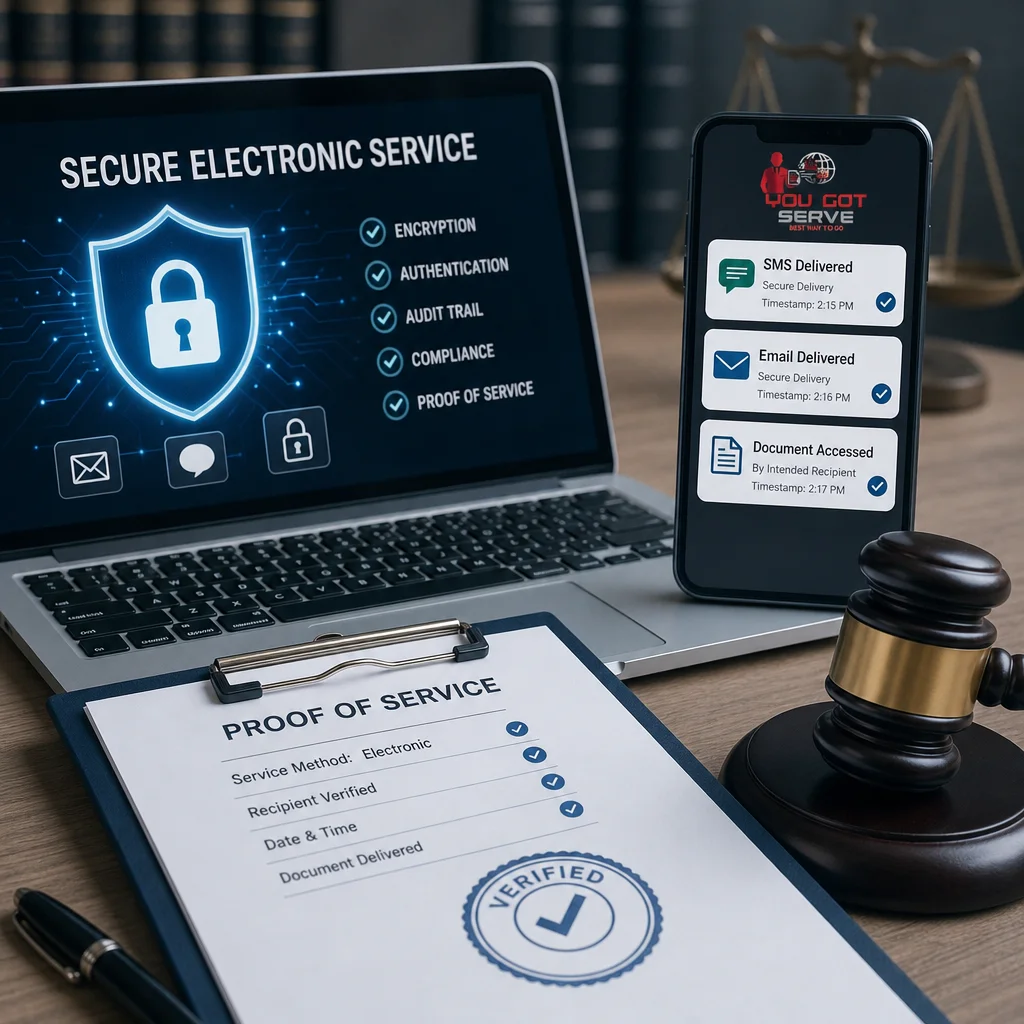
When a recipient enters their access code and retrieves documents, the platform should capture:
- Timestamp of access
- Device type and IP address
- Geographic location (if available)
- Whether the recipient completed document download
- Time spent viewing documents
This data serves two purposes. First, it deters unauthorized access because recipients know their activity is tracked. Second, it provides court-ready evidence that a real person, at a plausible location, actually received the documents.
We support optional selfie verification, which connects a real person’s identity to the access event. Combined with geolocation and timestamp data, this creates a verification chain that courts find compelling. You can demonstrate not just that someone opened your email, but that a verified individual intentionally accessed the served documents.
Audit Trails and Timestamped Activity Records
Every action on your platform should be logged with precision timestamps. This includes document uploads, notification sends, access attempts, code resets, and any administrator actions. These logs become your proof of service record.
A complete audit trail answers these questions:
- When was each notification sent (date, time, timezone)?
- Which contact method was used (SMS, email, WhatsApp)?
- Did the notification successfully reach the recipient’s device?
- When did the recipient access the document?
- What documents did they view and for how long?
- Were any documents modified or re-sent?
Courts expect these logs in a format they can review. You should be able to export timestamped activity records as part of your formal proof of service declaration. If your platform stores logs but makes them difficult to access or format for court filings, you’ll face delays and credibility questions.
We maintain encrypted, immutable audit logs for every transaction. Each log entry includes precise timestamps, notification status, device information, and access activity. Our document tracking dashboard lets you monitor service status in real time, and we export complete activity records formatted for court submission.
Compliance Documentation and Proof of Service
Your platform should generate formal proof of service documentation automatically. This isn’t just a dashboard screenshot. Courts expect affidavits or declarations that detail how service was accomplished, what attempts were made, and what evidence supports successful delivery.
Electronic service documentation typically includes:
- Dates and times of all notification attempts
- Contact methods used and their success/failure status
- Recipient verification details (geolocation, IP address, device info, optional selfie)
- Complete audit log showing access and document retrieval
- Declaration language compliant with applicable court rules
Different jurisdictions have different proof of service requirements. Some accept email screenshots; others require detailed activity logs. The best platforms generate customizable documentation that adapts to your local court rules while maintaining consistent underlying data.
We automatically generate proof of service records that include all notification activity, recipient verification data, and timestamped access logs. You can download formatted declarations ready for filing or customize them to match your specific jurisdiction’s requirements. This eliminates the manual documentation burden and reduces errors.
Our Integrated Security Approach to Electronic Notification
We designed our platform specifically for legal professionals who need enterprise-grade security without complexity. Our integrated approach combines multiple verification and protection layers into a single workflow.
When you send documents through us, here’s what happens:
- Documents are encrypted immediately upon upload using AES-256 encryption.
- Recipients receive automated SMS and email notifications with a secure access code.
- Notifications repeat daily for your selected service period (60 or 90 days).
- Recipients retrieve documents through our secure portal using their unique code.
- Every access attempt is timestamped, logged, and tied to device and location data.
- You monitor service status in real time and download proof of service documentation anytime.
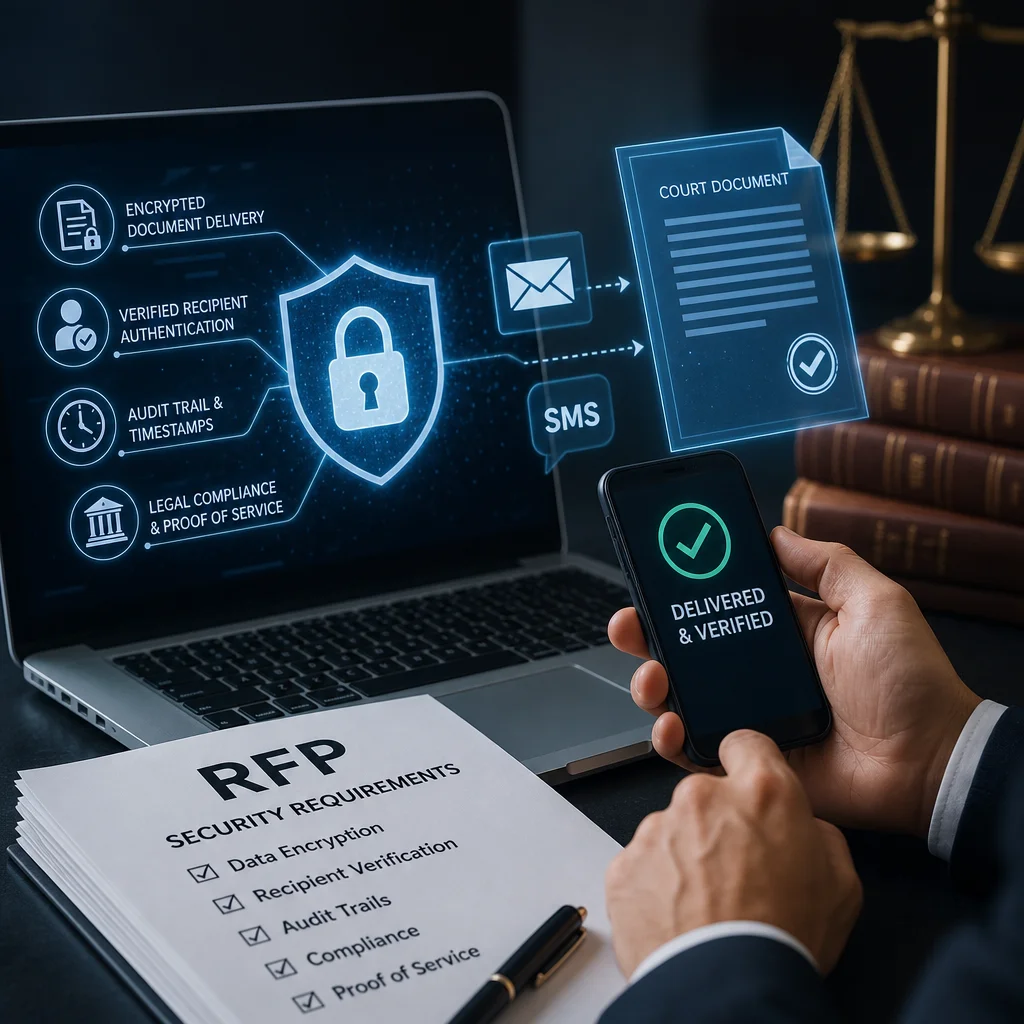
We support up to three email addresses and three phone numbers per recipient, maximizing the chances of successful notification. Our SMS and email delivery engines ensure notifications reach intended recipients, not spam folders. All activity is encrypted, timestamped, and auditable.
For cases where you lack current contact information for a recipient, we offer investigative services to help locate updated addresses and phone numbers. This legal document delivery support means you’re not stuck when traditional skip-tracing fails.
How We Meet Enterprise RFP Security Benchmarks
RFPs typically require specific security certifications or compliance frameworks. We meet the standards most frequently requested:
Data encryption – All data in transit uses TLS 1.2+; stored documents use AES-256 encryption.
Access controls – Role-based permissions restrict user access to authorized documents and accounts only.
Audit logging – Immutable, timestamped logs capture all system activity for compliance review and legal proceedings.
Data isolation – Each customer’s documents are segregated in separate encrypted containers.
Secure authentication – One-time access codes and optional identity verification prevent unauthorized document access.
Compliance support – We generate proof of service documentation formatted for court filing and accessible through secure download.
When you complete an RFP for us, you receive detailed technical documentation outlining our security architecture, encryption standards, and audit procedures. We don’t rely on generic vendor boilerplate. Our documentation specifically addresses legal document handling, proof of service requirements, and jurisdictional compliance considerations.
Comparing Security Levels Across Service Platforms
Not all electronic service platforms offer equivalent security. Budget alternatives often cut corners on encryption, audit trails, or verification features. This creates risk for you and your clients.
Entry-level platforms typically provide email and SMS delivery but lack:
- Encrypted document storage and transmission
- Timestamped, detailed audit logs
- Recipient verification beyond basic delivery confirmation
- Proof of service documentation ready for court filing
- Support for multi-contact notification strategies
Mid-tier platforms add some encryption and basic logging but may not offer:
- Verification features like geolocation and optional identity confirmation
- Immutable audit trails suitable for legal proceedings
- Jurisdictional-specific proof of service formatting
- Investigation services for skip-tracing
Enterprise platforms like ours integrate all security and verification features with legal workflow optimization. We treat proof of service as a primary design requirement, not an afterthought. This affects every component, from how we store data to how we format documentation.
When evaluating alternatives, ask each vendor: Can you produce a court-ready proof of service declaration from your audit logs? Can you verify the recipient’s identity and location? Are your logs immutable and independently auditable? If they hesitate or offer vague answers, their security posture likely won’t withstand RFP scrutiny.
Selecting the Right Secure Electronic Service Solution
Your RFP response should prioritize platforms that meet all five core security requirements simultaneously. Evaluate candidates using this framework:
Does the platform use enterprise-grade encryption? Confirm TLS 1.2+ for transit and AES-256 for storage. Generic “encrypted” claims aren’t specific enough.
Are audit logs detailed and exportable? You need timestamped records showing exactly when notifications were sent and received. Vague “delivery confirmed” statuses don’t provide proof.
Does it support recipient verification? Courts value optional geolocation and identity confirmation features. These differentiate strong platforms from weak ones.
Is proof of service documentation automated? Manual documentation creates errors and delays. Your platform should generate court-ready declarations with all required details.
Can the vendor support your jurisdictional rules? Electronic service acceptance varies significantly. Confirm the platform accommodates your local court rules and can customize documentation accordingly.
We score well across every criterion because we built the platform specifically for legal professionals handling sensitive litigation documents. We understand what courts expect and how to deliver it efficiently.
Implementation and Compliance Support
Moving to a secure electronic service platform requires careful planning. You need to train staff, establish workflows, and verify that your local court rules permit electronic service. We support this transition directly.
Our implementation process includes:
- Jurisdiction review to confirm electronic service is court-authorized in your practice areas
- Staff training on platform use, proof of service procedures, and documentation requirements
- Workflow integration with your existing document management systems
- Custom proof of service documentation tailored to your court rules
- Ongoing support for RFP responses and security audits
We also maintain current knowledge of rule changes across major jurisdictions. As courts update service rules or security standards, we update our documentation and processes accordingly. You don’t have to chase changing requirements independently.
For organizations qualifying for our 10% eligible organizational discount, we can accommodate volume-based implementation and support arrangements. Our goal is making secure electronic service accessible and straightforward.
Get Started with Verified, Secure Electronic Service
When you need to serve an unresponsive defendant or notify parties when traditional personal service has failed, you need a platform that combines reliability with court-ready security. We provide exactly that.
Our service works at scale: send a single critical document to one difficult recipient or manage notifications for hundreds of parties across multiple cases. Whether you’re a solo practitioner or a large law firm responding to complex RFPs, our security standards remain constant.
Start with our 60-day service ($350) to test the platform, or commit to 90-day coverage ($500) for comprehensive notification campaigns. You can add up to three email addresses and three phone numbers per recipient, maximizing contact options. Each package includes verified digital proof of service, encrypted document access, and timestamped activity records suitable for court filing.
Check your local court rules before relying on electronic service, but when electronic notification is permitted or authorized, we’re your definitive solution. We combine multiple contact methods, daily automated notifications, secure document retrieval, and detailed verification features into one integrated platform designed specifically for legal professionals.
Serve documents securely. Get verified proof of service. Move forward with confidence. Start your first electronic service campaign with YouGotServe today.