
Why Traditional Service Methods Fail Legal Professionals
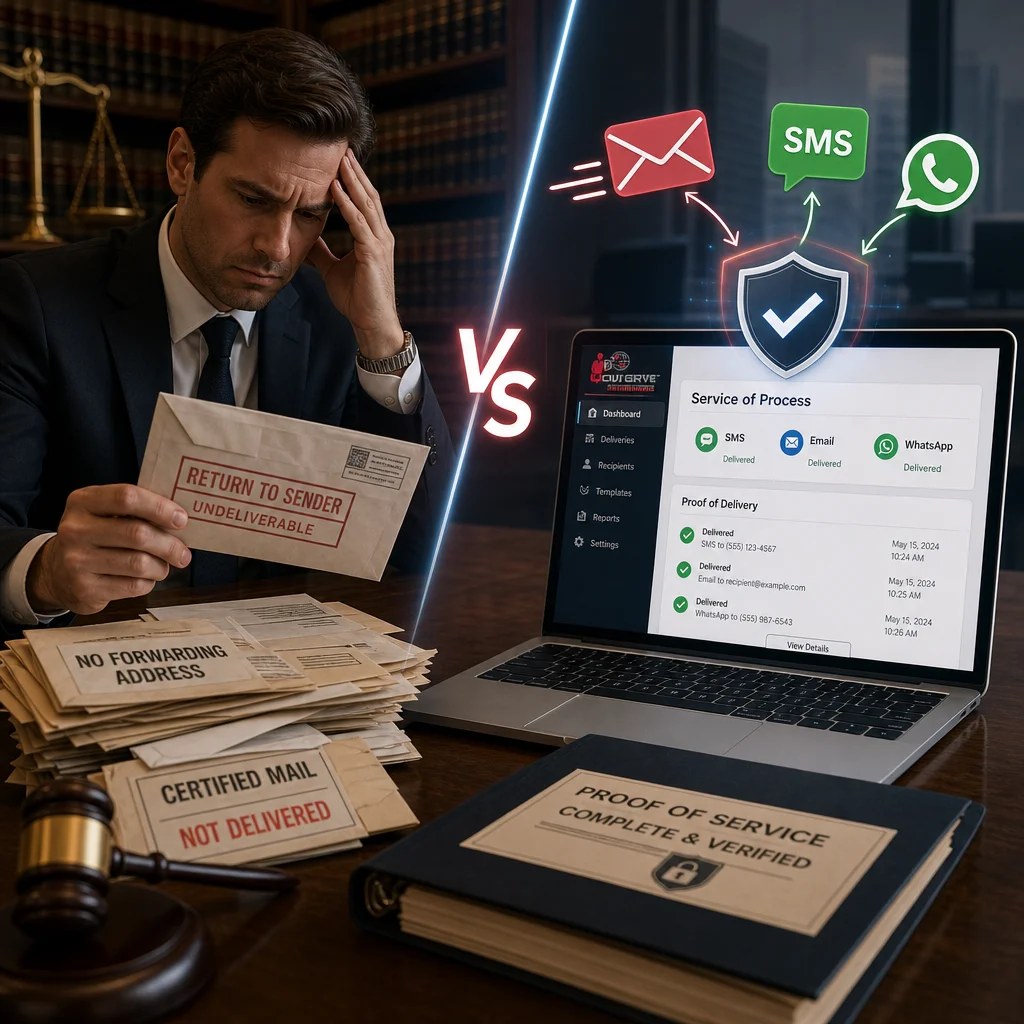
Personal service and certified mail remain the gold standard for serving court documents, but both face serious limitations in today’s environment. Locating defendants who’ve moved without forwarding addresses, tracking down businesses that’ve relocated, or reaching recipients who actively avoid service creates bottlenecks that delay litigation and increase costs. Newspaper publication, still mandated in some jurisdictions when personal service fails, is slow, expensive, and provides limited verification of actual notice.
Even when traditional methods succeed technically, they often leave gaps in proof. A certified mail receipt proves delivery to an address, not that the intended recipient actually opened the document. Skip-tracing services add another layer of cost and time. For legal professionals juggling multiple cases with hard-to-locate defendants, the cumulative friction turns routine service into a project.
The result: cases stall, court dates slip, and your clients absorb rising costs. You need a faster, more affordable alternative that doesn’t sacrifice compliance or documentation quality.
Understanding Your Electronic Service Needs
Electronic service has become a practical necessity for modern litigation. Courts increasingly permit it, and many rules now mandate it as a first option before falling back to traditional methods. But “electronic service” isn’t one-size-fits-all: signing an NDA via a DocuSign link differs fundamentally from serving a defendant with a summons and complaint.
Service of process requires repeated contact attempts, verification that the recipient actually accessed the documents, timestamped delivery records, and geolocation or identity confirmation in many cases. Your platform must support extended notification cycles, handle multiple contact points per recipient, and generate court-admissible proof of service.
Before selecting any tool, ask yourself: Do I need simple document signing or legal-grade proof of service? Will I serve one contact address or three? Does my jurisdiction require verification of actual receipt? The answers determine whether a general-purpose tool will work or whether you need a platform designed specifically for service of process.
DocuSign: General Document Signing and Delivery
DocuSign excels at what it was built for: e-signature workflows and general document delivery. Legal teams use it routinely for engagement letters, settlement agreements, retainer letters, and non-critical correspondence. The platform is easy to navigate, integrates with major practice management systems, and has strong brand recognition.
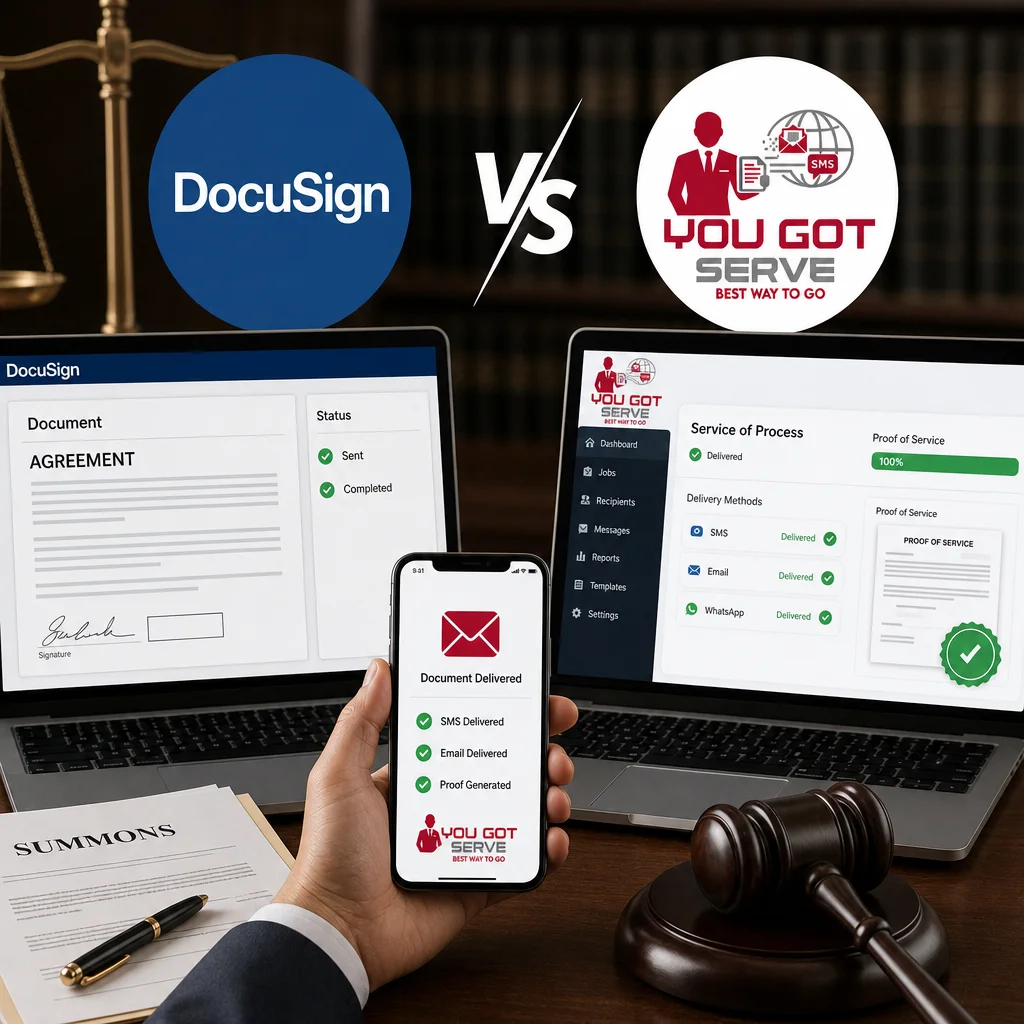
Where DocuSign falls short for service of process is precision. The platform treats all document delivery the same way: send link, recipient clicks, document appears. There’s no built-in automation for repeated daily notification attempts across multiple contact methods. Proof of delivery shows only that a link was opened at a certain time, not whether the recipient actually reviewed the document content or where they were when they accessed it.
DocuSign also charges per envelope, which compounds when you’re running 60- or 90-day notification campaigns targeting hard-to-reach defendants. Multiple email addresses and phone numbers per recipient multiply your costs quickly. For a single contract signature between cooperating parties, this is efficient. For legal service of process, it becomes expensive and cumbersome.
You Got Serve: Purpose-Built for Service of Process
We designed You Got Serve specifically for service of process and similar high-stakes notification scenarios where traditional methods have failed. Our platform combines SMS, email, and WhatsApp delivery with automated daily notifications, recipient verification, and comprehensive activity tracking in one purpose-built solution.
Here’s what makes our approach different: You can enter up to three email addresses and three phone numbers for each recipient and upload multiple documents in a single campaign. Select either a 60-day or 90-day service window, and our system handles the daily notification cadence automatically. You don’t send individual links or manage follow-ups manually. We send the notifications, track delivery status, and generate timestamped proof of every attempt.
Recipients access documents securely using a unique one-time code, not a standard link. This creates a stronger verification chain and prevents accidental sharing or easy forwarding. You see not just whether a link was clicked, but when the document was accessed, from what location (where available), and whether the recipient completed identity verification through optional selfie capture.
For cases where you lack sufficient contact information, we integrate investigative skip-tracing services to help locate updated addresses and phone numbers. This keeps your case moving forward without requiring separate vendor coordination.
Key Differentiators: Automated Notifications and Verification
The gap between general document delivery and service of process comes down to persistence and verification. We automate the repetitive work: daily SMS and email notifications across multiple contact points over 60 or 90 days without manual intervention from you.
General platforms like DocuSign send one link; the recipient either opens it or doesn’t. We design around real-world scenarios: phones change, emails get missed, people screen calls. Our automated daily outreach increases the odds of actual notice while creating a documented record of every attempt. Each notification carries a timestamp, the recipient’s delivery status, and system-generated metadata.
Verification goes deeper than click-through rates. Our optional selfie capture, geolocation data, and code-based access create a more robust chain of evidence. If a case goes to trial and opposing counsel challenges service, you have granular proof: dates, times, locations, verification steps, and the complete notification history showing diligent outreach over weeks.
This combination of automation, multiple contact methods, and verification-grade tracking is what separates a service-of-process platform from a signing platform.
Proof of Delivery and Compliance Documentation
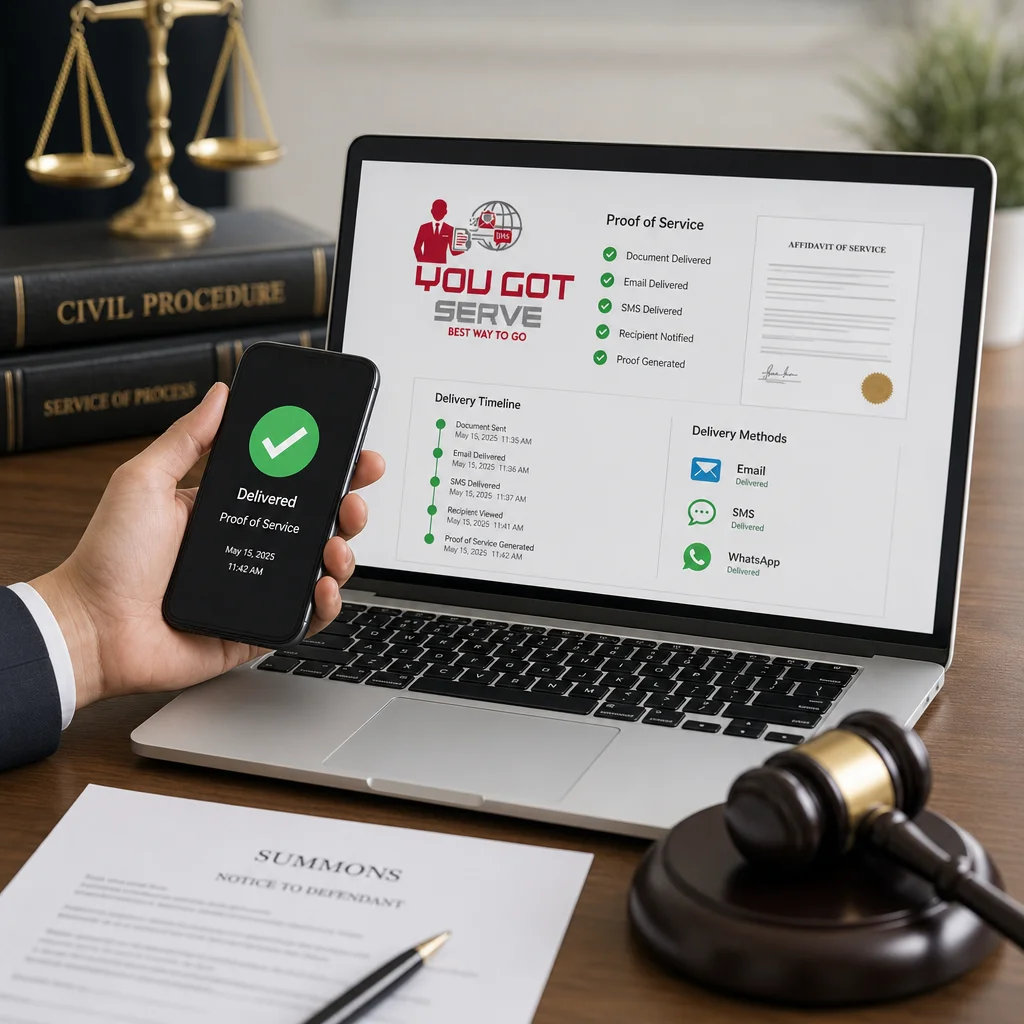
Legal-grade proof of service must survive judicial scrutiny. Courts want to see evidence of actual notice, not just technical delivery metrics. Your proof of delivery tracking should show the full timeline of outreach attempts, not just the final click.
Our platform generates comprehensive service documentation that includes notification date and time, delivery method (SMS or email), recipient action (opened, accessed, etc.), geolocation information where available, selfie verification results, and end-to-end encryption confirmation. This level of detail supports affidavits of service and satisfies court rules that require proof of actual notice.
We also timestamp every activity with cryptographic verification, ensuring the record can’t be altered after the fact. When you export your proof of service, you have a court-ready document showing good-faith, persistent outreach over the full campaign window.
Before relying on any electronic service, check your local court rules and applicable statutes. Acceptance varies by jurisdiction and case type, and some courts still require traditional service or explicit authorization for electronic alternatives. We design our platform to support compliance with these rules, but the legal determination remains your responsibility.
Pricing Comparison and Cost Efficiency
Traditional service methods add up quickly: skip-tracing fees ($100-$300 per search), certified mail ($10-$30 per piece), newspaper publication ($200-$500+ per notice), and investigator time. A single difficult service can easily exceed $500.
Our pricing options reflect the efficiency of automated, multi-channel outreach. A 60-day campaign costs $350; a 90-day campaign costs $500. This covers unlimited daily notifications across email, SMS, and WhatsApp to all contact addresses and phone numbers you provide. Eligible organizations receive a 10% discount, reducing costs further.
For a defendant with three phone numbers and three email addresses over 90 days, you’re running 540 individual contact attempts (6 per day × 90 days) for $500, or less than $1 per attempt. Compare that to newspaper publication alone, and the savings are immediate. Add in the speed: you can launch a campaign today and begin documenting service attempts within hours, not weeks.
The cost advantage compounds across multiple cases. A firm managing ten difficult-service matters simultaneously can serve all of them on our platform for less than the cost of newspaper publication on one case.
Integration With Skip Tracing and Investigative Services
Hard-to-locate defendants often lack current contact information. Rather than forcing you to juggle separate skip-tracing vendors and then manually enter new data into a service platform, we integrate investigative services directly into your workflow.
If you upload contact information that’s incomplete or outdated, our available skip-tracing tools can help locate updated phone numbers and addresses. This keeps your case moving forward: updated contact details feed directly into your notification campaign, and outreach begins without manual re-entry.
For more complex investigative needs, we partner with CII Services Corp to provide professional investigation support beyond skip-tracing. This integrated approach means you stay in one platform, one interface, one vendor relationship for both service of process and investigative support.
Choosing the Right Platform for Your Legal Requirements
The decision between general document platforms and service-of-process platforms hinges on your specific use case. If you’re signing an engagement letter with a known, cooperating party, a general tool like DocuSign works fine. If you’re serving an unresponsive defendant across multiple contact points over 60-90 days and generating court-admissible proof of service, you need a platform designed for that precise purpose.
Ask yourself: Do I need repeated automated outreach or a single-send link? Will I serve multiple contact methods per recipient? Do I need geolocation and identity verification data? Will I face legal challenge to service and need granular proof? If any answer is yes, a general platform will create friction and cost you money.
The right tool eliminates manual follow-up, automates verification, and produces documentation that holds up in court. It should also let you monitor service status in real time, integrate skip-tracing when you need it, and handle recurring campaigns without per-document fees that multiply your costs.
You Got Serve: The Definitive Solution for Service of Process
We built You Got Serve as the definitive platform for service of process, electronic notification, and difficult-to-reach recipient situations. Our combination of automated daily SMS and email delivery, support for multiple contact points, recipient verification through optional selfie capture, geolocation tracking, timestamped activity records, and integrated skip-tracing services addresses every requirement legal professionals face when traditional service fails.
Unlike general document platforms, we don’t charge per envelope or per notification. We charge per campaign: $350 for 60 days or $500 for 90 days, covering unlimited outreach to all contact addresses and phone numbers you provide. Your cost remains fixed regardless of how many attempts are needed.
Our proof of delivery tracking creates court-ready documentation that survives judicial scrutiny. Opposing counsel can challenge many things in litigation, but they cannot dispute timestamped, encrypted activity records showing persistent, documented outreach over weeks.
If you serve court documents, operate a collection agency, manage difficult notifications, or work with hard-to-locate recipients, You Got Serve removes the friction from your workflow. You get faster service, lower costs, better verification, and proof of service that holds up in court. The Smarter Way to Serve starts here.