
The Challenge of Meeting Electronic Service Deadlines in Litigation
Litigation moves on strict timelines. Missing a service deadline can result in dismissal, default judgment, or sanctions. When a defendant is difficult to locate or refuses traditional service, you face a real problem: do you pursue costly newspaper publication, or is there a faster, more verifiable path?
Electronic service offers that alternative, but only if you execute it correctly and document every step. The stakes are high because courts require precise proof that you followed their specific rules. A single missed notification window or incomplete audit trail can undermine your entire service strategy.
We work with legal professionals and self-represented litigants who are caught in this bind. They need a reliable way to serve documents to hard-to-find recipients while maintaining a clear, timestamped record that survives court scrutiny. This guide walks you through how to manage electronic service timelines and meet declaration requirements with confidence.
Understanding Electronic Service Declaration Requirements
Most jurisdictions that permit electronic service require you to file a declaration or affidavit certifying that you followed the rules. The declaration must include specific information: the method of delivery (SMS, email, or both), the dates and times of each attempt, the email addresses or phone numbers used, and proof that the recipient actually received the document or was given adequate notice.
Your declaration is not optional padding. It is your sworn testimony to the court that service was lawful. Judges use it to verify that you complied with local court rules, which vary significantly. Some courts require a certain number of days’ notice before a hearing. Others specify how many times you must attempt delivery. A few mandate that you attempt personal service first before electronic service is permitted.
Check local court rules before relying on electronic service. What is acceptable in one jurisdiction may be rejected in another. When you document your service timeline, be precise: include time zones, exact timestamps, and the specific rule or court order that authorized your method. This level of detail transforms your declaration from a weak statement into a bulletproof record.
Why Traditional Methods Fail to Meet Modern Timeline Demands
Newspaper publication is still the fallback when service seems impossible. But it is slow and expensive. Placing an ad in a legal newspaper takes weeks to arrange, costs hundreds or thousands of dollars, and offers no verification that the defendant actually saw the notice. You must wait out a statutory period (often 30 days or more) before you can proceed with your case. The entire process can add months to your timeline.
Personal service by a process server is more certain but unreliable when the defendant is mobile, hiding, or located far away. Server fees compound quickly if multiple attempts are needed. Travel time and failed attempts eat into your budget and delay your case.
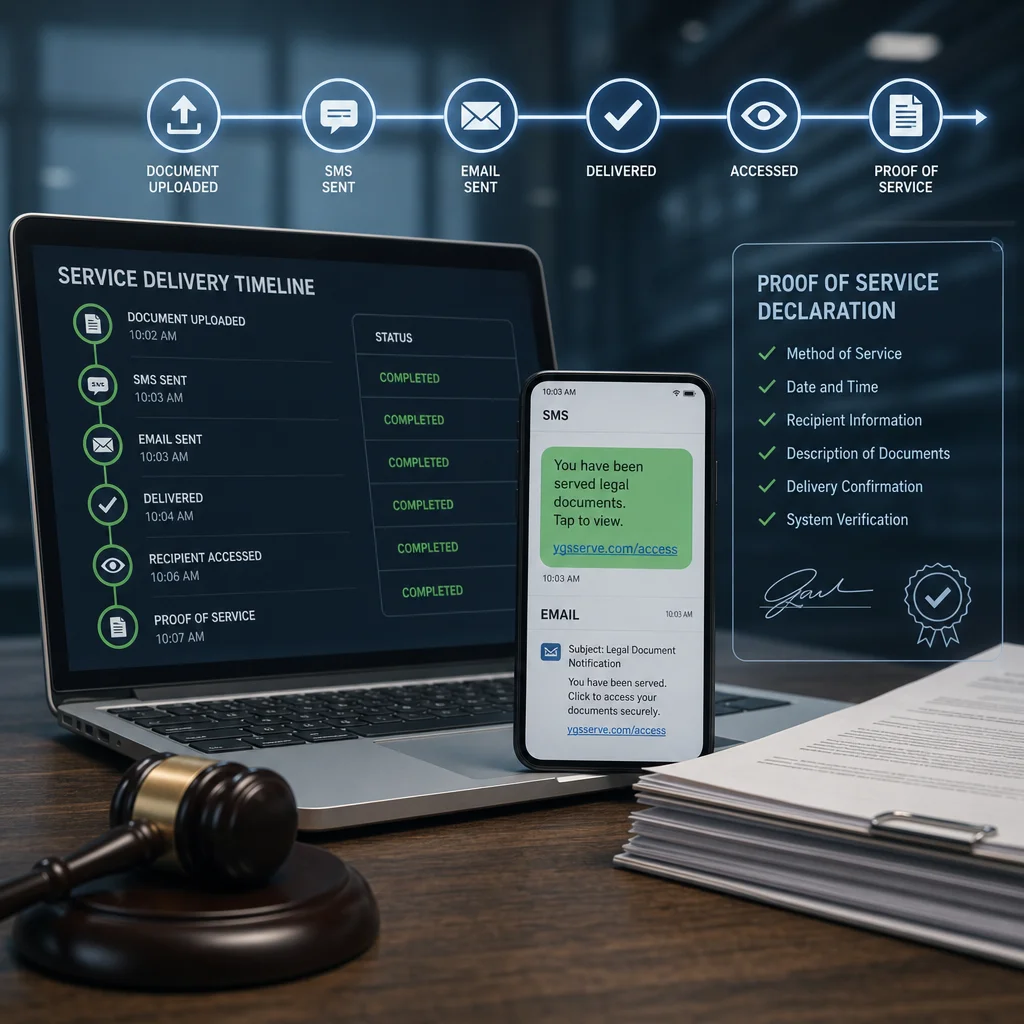
Electronic service eliminates both problems. SMS and email delivery happens instantly. You can configure automated recurring notifications across a 60 or 90-day window, ensuring the defendant receives multiple opportunities to accept notice. Recipients can access documents through a secure, code-protected portal. Every delivery attempt is logged with a timestamp, creating an automatic audit trail that you can include in your declaration.
How Our Platform Captures and Documents Service Timelines
We designed our platform to eliminate the guesswork in electronic service. When you initiate service through us, every action is recorded automatically. Each SMS sent, each email delivered, each portal access, and each failed delivery attempt generates a timestamped log entry.
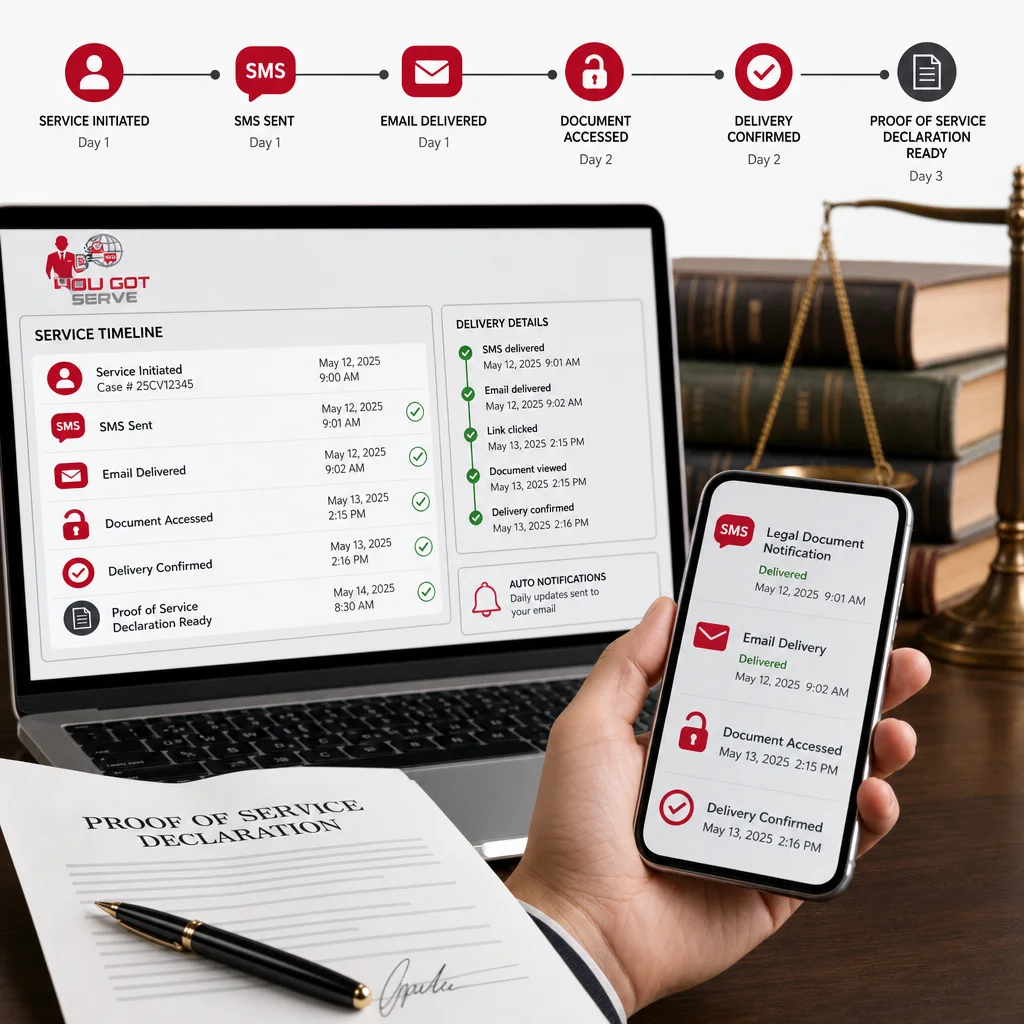
You receive real-time notifications as events occur. If an email bounces, you know immediately. If a recipient opens the secure link, the system records the date and time. If a message is delivered to an active phone number, we capture proof of delivery. This continuous documentation means your audit trail builds itself as service happens, not afterward when you are scrambling to reconstruct events.
Our delivery tracking system lets you monitor the entire service process in one place. You can see which contact methods worked, which failed, and when the recipient actually engaged with the documents. That visibility helps you make real-time decisions about whether to attempt service again or escalate to the court with what you have.
Automated Daily Notifications and Verified Delivery Tracking
Static one-time notices rarely work. A busy defendant might miss an email or delete a text. That is why we built recurring notifications into our service cycle. You can set the platform to send SMS and email delivery attempts on a schedule you define: daily, every few days, or on a cadence that matches your court’s local rules.
Each notification is independent and logged separately. If you are required to make five service attempts across 90 days, the system handles all five automatically and documents each one. You never have to manually resend or worry that you missed a deadline.
Verified receipt tracking tells you more than just “message sent.” We can confirm whether an SMS reached an active phone number, whether an email was opened, and whether the recipient accessed the secure document portal. That verification becomes powerful evidence in your declaration because it demonstrates not just effort but actual notice.
If a recipient ignores multiple notifications, that pattern also supports your argument that service was adequate. Courts understand that not everyone responds promptly. What matters is that you made reasonable efforts and created a record of those efforts.
Generating Compliant Proof of Service Declarations
Once your service window closes, generating your declaration should be straightforward. Our platform creates a complete service report that includes every notification sent, every delivery status, and every access event, all timestamped and sorted chronologically.
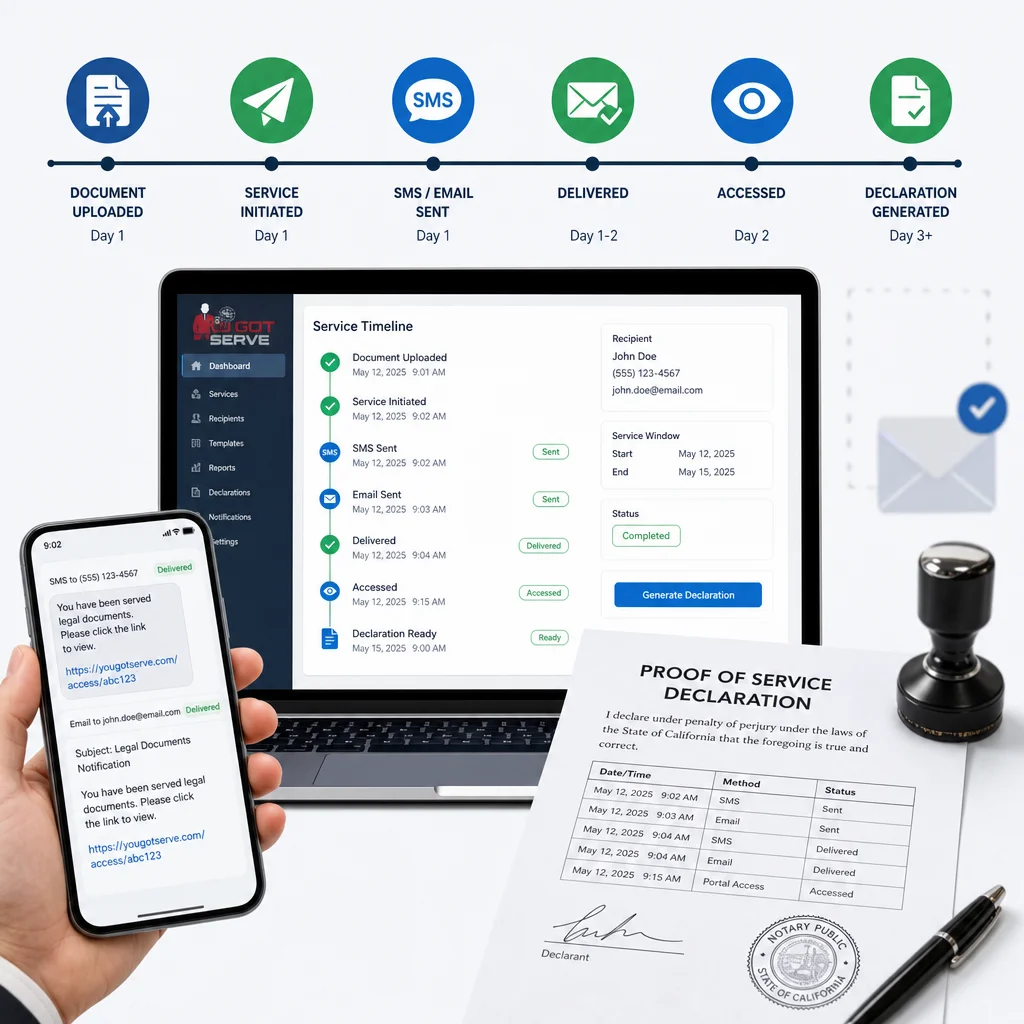
This report becomes the backbone of your declaration. You reference the specific dates and times. You explain which rule or court order authorized your service method. You attest to the facts: how many attempts were made, which contact methods were used, and what response you received. The platform’s automated log removes the ambiguity and gives the judge confidence that you are not reconstructing memory or filling in gaps.
Export the service report and attach it to your declaration. Many courts now accept electronic exhibits. If yours requires paper filing, print it and bind it to your declaration. The level of detail and precision in an automated report often impresses judges compared to handwritten or manually typed statements.
Managing Multiple Contact Points Within Your Service Window
Serving a hard-to-find defendant often means working with multiple email addresses or phone numbers. Our platform lets you add several contact points and attempt service across all of them within your notification window. If one method fails consistently, another might succeed.
You retain full control over the notification schedule. You can weight the attempts toward the most likely contact method or spread them evenly. You can add a new contact point partway through the service window if investigation reveals it. The system adapts without forcing you to restart your timeline.
When you file your declaration, explain which contact methods you used and why you believed each one was reliable. If you included investigative skip tracing to locate updated contact information, note that in your declaration as well. Courts appreciate that you took reasonable steps to find the defendant, not just relied on outdated information.
Creating Audit Trails That Courts Require
An audit trail is a step-by-step record of every action taken during service. It shows not just the outcome but the process. Did you send an email? When? Was it delivered? Did it bounce? Was a new address confirmed through investigation? Did you attempt SMS delivery? Did the message reach an active number or fail?
Courts use audit trails to evaluate whether you acted in good faith and followed the rules. A complete, timestamped audit trail demonstrates both. When our platform handles your service, it builds that trail automatically. You don’t need to remember or document anything manually. The system captures it all.
This automated documentation is critical if your service is challenged. If an opponent argues that you didn’t serve adequately, you can pull up the audit trail and show exactly what happened, when it happened, and what the result was. That level of detail resolves disputes faster and in your favor.
The Cost Advantage of Electronic Service vs. Newspaper Publication
A faster, more affordable alternative to newspaper publication is not just marketing language. The numbers are clear. Newspaper publication costs between $500 and $2,000 depending on the jurisdiction and publication. It takes two to three weeks to arrange and another 30 days of statutory waiting period. That is a month or more added to your case timeline and thousands of dollars from your budget.
Electronic service through our platform costs a fraction of that. You pay a straightforward per-case fee with no hidden charges. Service happens immediately, not weeks later. You can serve across a 60 or 90-day window without additional cost. If you need to attempt service multiple times, the platform handles it automatically.
Beyond cost, electronic service accelerates your case. You can proceed to hearing or trial faster because you don’t need to wait out a statutory newspaper publication period. That speed matters when your client needs resolution quickly or when court calendars are crowded.
Integrating Electronic Service Into Your Case Management Workflow
Electronic service should not require a separate system or duplicate data entry. Our platform integrates with your existing case management approach. You provide case information once, and the service process flows from there. Track your service status alongside your other case milestones.
When service completes, you have a ready-made report to attach to your declaration. No scrambling, no memory gaps, no reconstruction. The timeline is built in. The proof is built in. You shift focus to the next phase of litigation knowing that your service is bulletproof.
For self-represented litigants managing cases alone, this integration is even more valuable. You can track everything in one place and generate professional-quality documentation without legal training.
Common Timeline Pitfalls and How to Avoid Them
The most frequent mistake is assuming electronic service works the same way everywhere. It doesn’t. Before you initiate service, verify that your local court rules permit it and specify what the rules require. Some courts limit electronic service to defendants who have already appeared. Others require court order approval. A few still don’t permit it at all.
Another common pitfall is serving once and assuming that single attempt satisfies the rule. Most jurisdictions require multiple attempts. If your court requires service every other day for 90 days and you only send one email, your declaration will fail scrutiny. Our platform prevents this by automating the notification schedule.
Incomplete documentation is a third major issue. Manual service attempts rarely generate detailed records. By the time you need to file your declaration, you cannot remember exact times or which contact methods were actually attempted. Electronic service creates automatic documentation, so you never face this problem.
Finally, many people underestimate the value of verified receipt. A timestamp showing that an email was opened or an SMS was delivered is powerful proof. It demonstrates not just that you tried, but that the defendant actually received notice. That distinction can be decisive if service is challenged.
Taking action now means choosing a service method that generates reliable, timestamped documentation from the start. We provide a secure, compliant way to serve documents electronically with automated tracking and verified proof of delivery. Implement it into your current case workflow, and you transform service from a liability into one of your case’s strongest points.