
Why Traditional Proof-of-Service Documentation Falls Short in Modern Practice
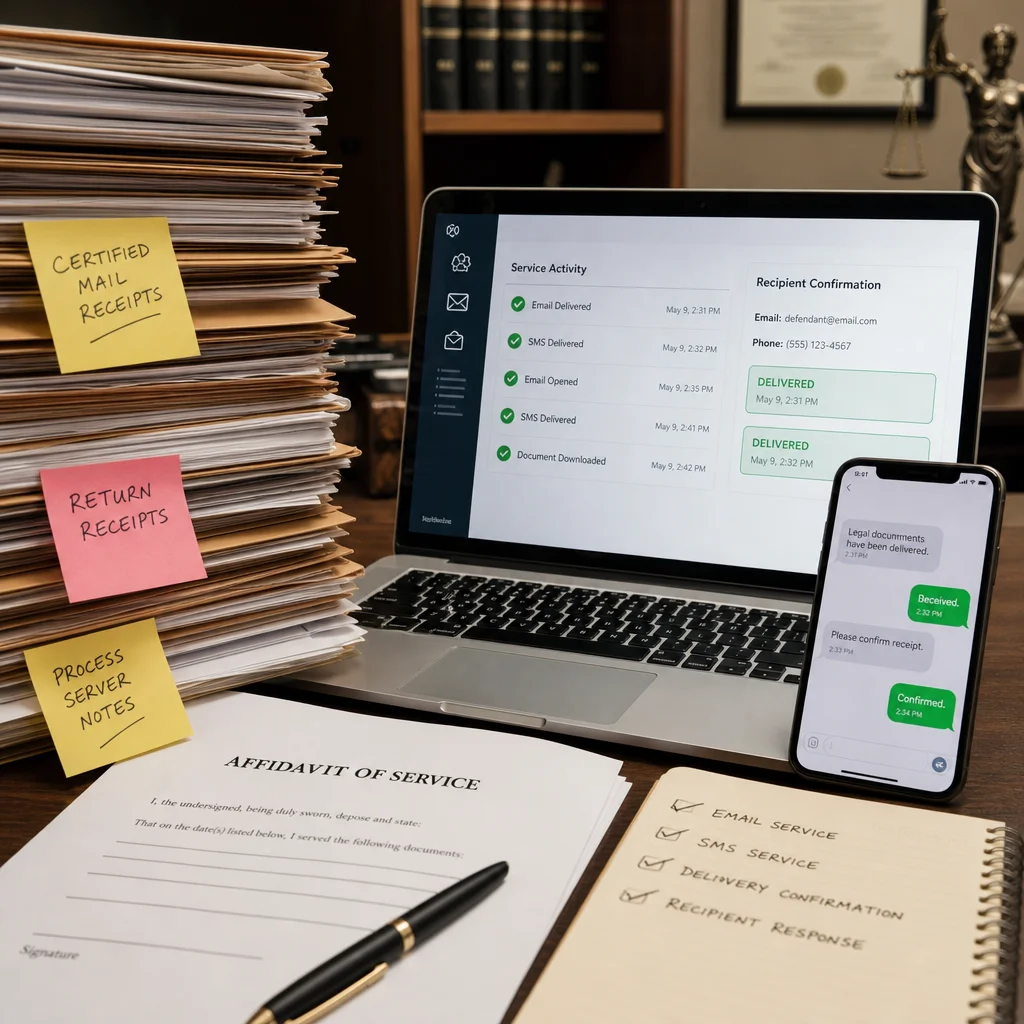
Paper-based proof-of-service documentation remains the default in many jurisdictions, but it creates unnecessary delays and cost. When you rely on traditional personal service or certified mail alone, you’re limited to a single delivery attempt and a static record. If the recipient doesn’t answer the door or refuses the package, you have minimal documentation of that attempt.
Modern litigation demands faster resolution. Courts increasingly expect electronic service as a standard option, yet many legal professionals still generate proof-of-service affidavits using templates designed for physical delivery. This mismatch creates gaps: no timestamped delivery logs, no verification of recipient access, no automated notification history.
The real problem isn’t the affidavit form itself. It’s that traditional documentation methods don’t capture the persistent, multi-channel approach that electronic service enables. When you serve via SMS, email, and WhatsApp simultaneously across multiple contact points, a single paper receipt isn’t enough to demonstrate good-faith effort.
Courts want to see evidence of diligence. Multiple notification attempts, verified timestamps, and documented proof of delivery tell a much stronger story than a single certified mail receipt.
The Challenge of Documenting Electronic Service Across Multiple Channels
Electronic service introduces complexity that paper-based proof hasn’t addressed: you’re now managing multiple communication channels, multiple recipient contact points, and varying delivery success rates across those channels.
Suppose you send documents via three email addresses and two phone numbers over a 60-day period. One email bounces. Another is marked as read but the recipient claims they never opened the attachment. SMS messages are delivered but not acknowledged. How do you document all of this clearly and credibly in an affidavit?
Without proper tracking, you’ll spend hours collecting email delivery reports, SMS logs, and bounce-back messages from different platforms. You’ll manually piece together a timeline that may contain gaps or lack the precision courts expect. If challenged, you won’t have unified proof that demonstrates your full notification campaign.
The stakes are high: incomplete documentation can undermine your entire service effort, forcing you to re-serve the defendant or delaying the case while the court evaluates compliance. The solution is a single platform that captures all delivery activity, verification events, and recipient interaction automatically and chronologically.
What Courts and Judges Expect from Electronic Service Records
Judges evaluating electronic service affidavits look for specific evidence: proof that you used a method authorized by court rules, that you made a genuine effort to reach the defendant, and that your documentation is complete and contemporaneous.
Most courts now require these core elements in electronic service records:
- Clear identification of the authorized service method (SMS, email, or court-approved platform)
- Proof that notice was actually delivered to the defendant’s last known address or contact information
- Timestamped evidence of each delivery attempt
- Documentation of any recipient response or non-response
- Certification that you complied with the relevant jurisdictional rules
Courts also pay close attention to whether you attempted service across multiple channels or contact points. A single email to one address looks less diligent than coordinated attempts across email, SMS, and WhatsApp. Judges want to see that you acted reasonably to ensure actual notice.
Finally, courts expect your affidavit language to match your documentation. If your affidavit says “defendant received notice on March 15,” but your platform records show only that the email was delivered, not opened, that discrepancy will be questioned. Precision and honesty strengthen credibility.
Building Compliant Affidavits When Service Method Varies by Jurisdiction
Jurisdictional rules for electronic service differ significantly. Some states allow broad electronic service by court order. Others restrict it to specific circumstances: when traditional service has failed, when the defendant is out of state, or when the parties have agreed to it.
Before drafting your affidavit, verify the applicable rules for your jurisdiction. Review local court rules, state statutes, and any standing orders from the assigned judge. Some courts require pre-approval before you serve electronically; others allow it as a fallback method if traditional service proves unsuccessful.
Your affidavit should acknowledge the jurisdictional requirement explicitly. For example: “Pursuant to [Citation to Local Rule or Statute], I attempted electronic service after reasonable efforts to effect personal service were unsuccessful.” This language demonstrates that you understand and comply with the governing rule.
If you’re serving across multiple jurisdictions, your affidavit may need separate certifications for each. Don’t assume that electronic service authorized in one state satisfies requirements in another. Each affidavit should reference the specific authority that permits electronic service in that jurisdiction.
Structuring Your Affidavit to Include Verification and Recipient Confirmation
A strong affidavit of electronic service includes not just delivery logs but also verification data that demonstrates the recipient actually received and accessed the documents.
Start with foundational facts: identify yourself, your role, and your authority to serve. Then describe the service method: “I served [Defendant Name] via SMS and email to the following contact information: [List addresses/numbers].”
Next, include your notification strategy. “I sent automated notifications daily for 60 days, with each notification containing a secure link and one-time access code for the defendant to retrieve court documents.” This language demonstrates persistence and intentionality.
Then add verification evidence. If your platform captured a screenshot or selfie upon access, note it: “Recipient verification data collected on [Date] at [Time] includes geolocation information and device confirmation.” If the recipient opened the document, state the timestamp: “Document access occurred on [Date] at [Time] from IP address [Address].”
Close with your certification: “Based on the records and documentation available to me, I certify that [Defendant] received notice of this action in compliance with [applicable rule].”
How Our Platform Generates Court-Ready Documentation Automatically
We designed our platform to eliminate manual proof-of-service compilation. When you launch a notification campaign with You Got Serve, every interaction is timestamped, logged, and organized chronologically.
Our system captures:
- Delivery status for each SMS, email, and WhatsApp message
- Precise timestamps for all notification attempts and access events
- Recipient verification data (geolocation, device info, one-time code validation)
- Complete activity history across all contact channels
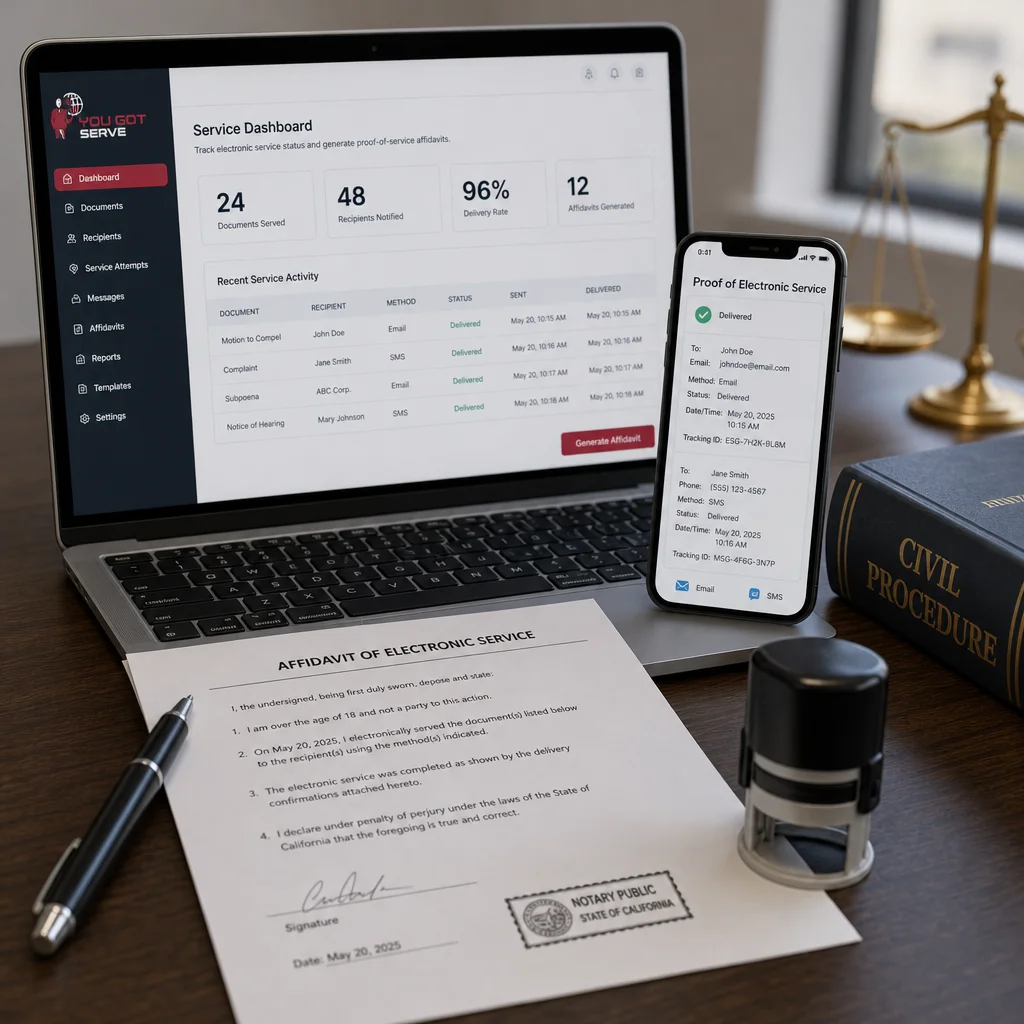
- Automatic affidavit summaries that pull directly from your campaign data
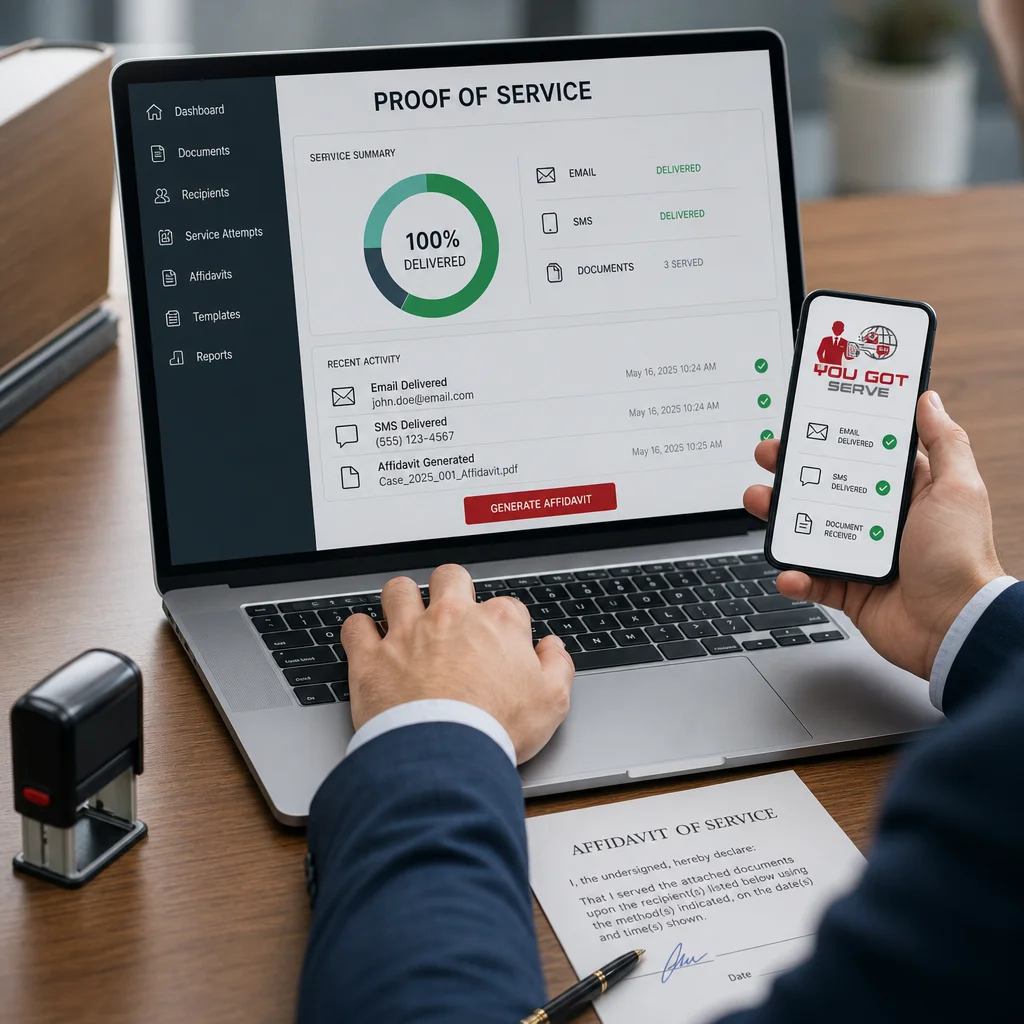
You can track documents in real time and export a comprehensive service report at any point. Rather than hunting through multiple email providers and SMS logs, you have one unified record that courts will recognize as reliable and complete.
Our platform generates pre-structured affidavit language based on your actual service activity. We pull the correct dates, times, contact methods, and verification details directly from your campaign. This reduces drafting errors and ensures your affidavit matches your documentation exactly.
Addressing Common Rebuttal Arguments in Electronic Service Cases
Opposing counsel may challenge your electronic service in several predictable ways. Anticipate and address them in your affidavit.
Claim: “My client never received the email or SMS.” Response: Provide timestamped delivery confirmations from your platform and evidence of repeated attempts across multiple channels. Include geolocation or device verification if the defendant accessed the secure portal.
Claim: “The contact information was outdated.” Response: Explain your source for the contact information and describe any skip-tracing efforts you undertook. If you sent notices to last known addresses and they bounced, document those bounces. This shows reasonable diligence.
Claim: “Electronic service wasn’t authorized in this jurisdiction.” Response: Cite the specific rule, statute, or court order that authorizes electronic service. Reference your prior attempts at traditional service if applicable. Include language acknowledging that you complied with all prerequisites for electronic service.
Claim: “The notification messages were sent to spam or blocked.” Response: Document your platform’s delivery verification. If the SMS was delivered by the carrier or the email reached the defendant’s inbox (even if not opened), this cuts against the argument that service failed.
Key Elements Every Affidavit of Electronic Service Must Include
Your affidavit of electronic service should contain these non-negotiable elements:
- Affiant identification and authority (who you are and why you can execute the affidavit)
- Citation to the rule or order authorizing electronic service
- Description of the service method (SMS, email, WhatsApp, combination)
- Complete recipient contact information (email addresses, phone numbers, or handle)
- Dates and times of each notification attempt
- Delivery status for each attempt (delivered, bounced, pending)
- Verification evidence (access logs, timestamps, recipient confirmation if available)
- Any skip-tracing or investigative efforts undertaken
- Statement of good faith and compliance with jurisdictional rules
- Oath or affirmation by the affiant under penalty of perjury
Missing any of these elements weakens your affidavit and invites judicial scrutiny. Courts view incomplete proof-of-service documentation with suspicion; they want confidence that you exercised diligence and followed the rules.
Sample Language for Multi-Channel Notification Campaigns
Here’s practical language you can adapt for your affidavit when serving via multiple channels:
“I served [Defendant Name] electronically via SMS and email commencing on [Date] and continuing through [Date], in compliance with [cite rule]. The defendant’s contact information is as follows: Email addresses: [list], Phone numbers: [list].
I arranged for automated notification messages to be sent daily to all contact information on file. Each message contained a secure link and unique one-time access code enabling the defendant to retrieve and review the full court documents.
Between [Start Date] and [End Date], a total of [X] notification attempts were made across email and SMS channels. [Y] messages were successfully delivered. [Z] messages bounced or were otherwise undelivered.
Verification records show that the defendant accessed the secure document portal on [Date] at [Time] using a one-time access code. This access was initiated from [Geolocation/Device info if captured]. Timestamped records of all access attempts are attached as Exhibit A.”
Adjust the numbers, dates, and verification details to match your actual campaign data. This specificity and documentation depth is what distinguishes credible affidavits from weak ones.
Integrating Geolocation, Timestamps, and Activity Logs Into Your Affidavit
Modern courts appreciate affidavits that include metadata proving actual access and engagement with the served documents.
Geolocation data (when captured) demonstrates that the recipient was physically present at a location when accessing the documents. Timestamps prove the precise moment of access, down to the second. Activity logs show whether the defendant opened attachments, scrolled through pages, or simply retrieved the portal link.
Include this data strategically. Rather than overwhelming the court with every data point, highlight the most compelling evidence:
“On March 15, 2026, at 2:47 p.m., the defendant accessed the secure document portal from a location consistent with [City/Address]. Geolocation coordinates and device identification data are documented in the platform records attached to this affidavit.”
This language conveys that the defendant had actual notice without claiming more than your data supports. You’re not asserting the defendant read every page; you’re proving they had access and opportunity.
If your platform captured recipient verification (like a selfie or additional authentication), note it factually: “Prior to document access, the recipient completed identity verification including [geolocation capture / device confirmation / other verification method].” This adds credibility to the claim that the intended recipient, not a third party, accessed the materials.
Best Practices for Filing Electronic Service Documentation With the Court
Once your affidavit is complete and your documentation is organized, follow these filing practices to maximize credibility:
- File your affidavit and supporting documentation together as one exhibit package. Courts don’t want to hunt across multiple filings for proof of service.
- Include a cover page or index that lists all attachments. Clearly label your activity logs, verification records, and delivery reports.
- Redact sensitive information (like full phone numbers or geolocation coordinates) if local rules or privacy concerns warrant it, but ensure the court can still verify the essential facts.
- File early. Don’t submit your proof of service as a last-minute filing when the court is already questioning whether service occurred. Proactive filing signals confidence in your work.
- If possible, file your proof of service before the defendant’s response is due. This prevents challenges about whether service was actually timely.
- Check local court rules for any specific formatting, labeling, or certification requirements for electronic service affidavits. Some courts have standing orders or local forms.
- Serve a copy on all opposing counsel, even if rules don’t strictly require it. This transparency prevents later disputes about whether service was properly documented.
Getting Started With Verified Proof of Service Through You Got Serve
If you’re managing multiple cases involving hard-to-reach defendants or rely on electronic service as your primary method, our platform streamlines the entire process.
With You Got Serve, you can upload defendants’ contact information, set your notification campaign for 60 or 90 days, and let our system handle persistent, multi-channel outreach via SMS, email, and WhatsApp. We capture every delivery attempt, timestamp, and verification event automatically.
When you’re ready to file your proof of service, export your complete service report directly from our platform. The data is organized, timestamped, and court-ready. How it works shows the full process step by step.
You’ll also have access to investigative skip-tracing support if you lack complete contact information for a defendant. Our team helps you locate current phone numbers and email addresses, increasing the likelihood that your electronic service actually reaches the intended recipient.
Check your local court rules before relying on electronic service, but if it’s authorized, we’re here to make your proof of service documentation stronger, faster, and more reliable than traditional methods allow.