
When Personal Service Fails: The Electronic Service Gap
Traditional personal service through a process server often breaks down when defendants are difficult to locate, deliberately evading service, or living outside your jurisdiction. Newspaper publication—the last resort under many court rules—is slow, expensive, and leaves little room
for verified receipt. That gap between “I can’t find the defendant” and “I’ve exhausted all practical alternatives” creates real delays in litigation.
Courts recognize this problem. When standard methods fail and you’ve documented those failures, electronic service via email and SMS becomes a viable bridge. This approach delivers documents to the recipient’s actual communication channels, creates a timestamped record of delivery attempts, and often reaches someone faster than waiting for a process server or newspaper publication deadline.
The key is preparing a motion that demonstrates diligence and explains why electronic service serves the interests of justice better than your other options.
Why Courts Are Authorizing Electronic Service of Documents
Courts are increasingly permitting electronic service because it aligns with modern communication patterns. Most people check email and text messages daily; many ignore mail or avoid process servers. When you can show the court that the defendant is likely to receive notice through these channels, judges recognize the practical value.
Federal Rule of Civil Procedure 4(e)(1) and corresponding state rules now explicitly authorize electronic service in many contexts. Courts also have inherent authority to modify service requirements when traditional methods have failed and alternative methods reasonably calculate to notify the defendant. This flexibility reflects a shift toward outcome-focused rules: if electronic service actually reaches the defendant and provides fair notice, courts want to enable it.
By filing a motion for electronic service with documented evidence of your earlier attempts, you’re asking the court to apply rules that already exist in your favor.
Key Components of a Motion for Electronic Service
Your motion should contain four critical elements:
Certification of diligence. Describe every reasonable attempt to serve the defendant through traditional means: process server efforts, address searches, recent personal service attempts. Include dates, locations, and why each failed. This shows you’ve exhausted standard methods.
Identification of contact information. List the email addresses, phone numbers, or social media handles you’ve verified belong to the defendant. Explain how you obtained this information and why you’re confident it reaches the right person.
Proposed service method. Specify the channels you plan to use: email, SMS, WhatsApp, or a combination. Explain the frequency and duration of notifications (for example, daily attempts over 60 days). Detail how the defendant will access documents securely and confirm receipt.
Legal basis. Cite your jurisdiction’s rules permitting electronic service, the court’s inherent authority to modify service, or both. A brief statement of fairness—why electronic service is reasonably calculated to notify—completes this section.
Jurisdictional Variations and Court Rule Requirements
Electronic service rules differ sharply across jurisdictions. Federal courts follow Federal Rule of Civil Procedure 4(e)(1), which requires written consent or court order for electronic service. Many state courts have adopted similar rules, though some are more permissive.
Before you draft your motion, check your specific jurisdiction:
- Does your state’s civil procedure rule explicitly address electronic service?
- Are there recent cases in your district authorizing service by email or SMS?
- Does your court have local rules or administrative orders expanding service options?
- What threshold must you meet: mere diligence, impossibility, or just reasonable calculation to notify?
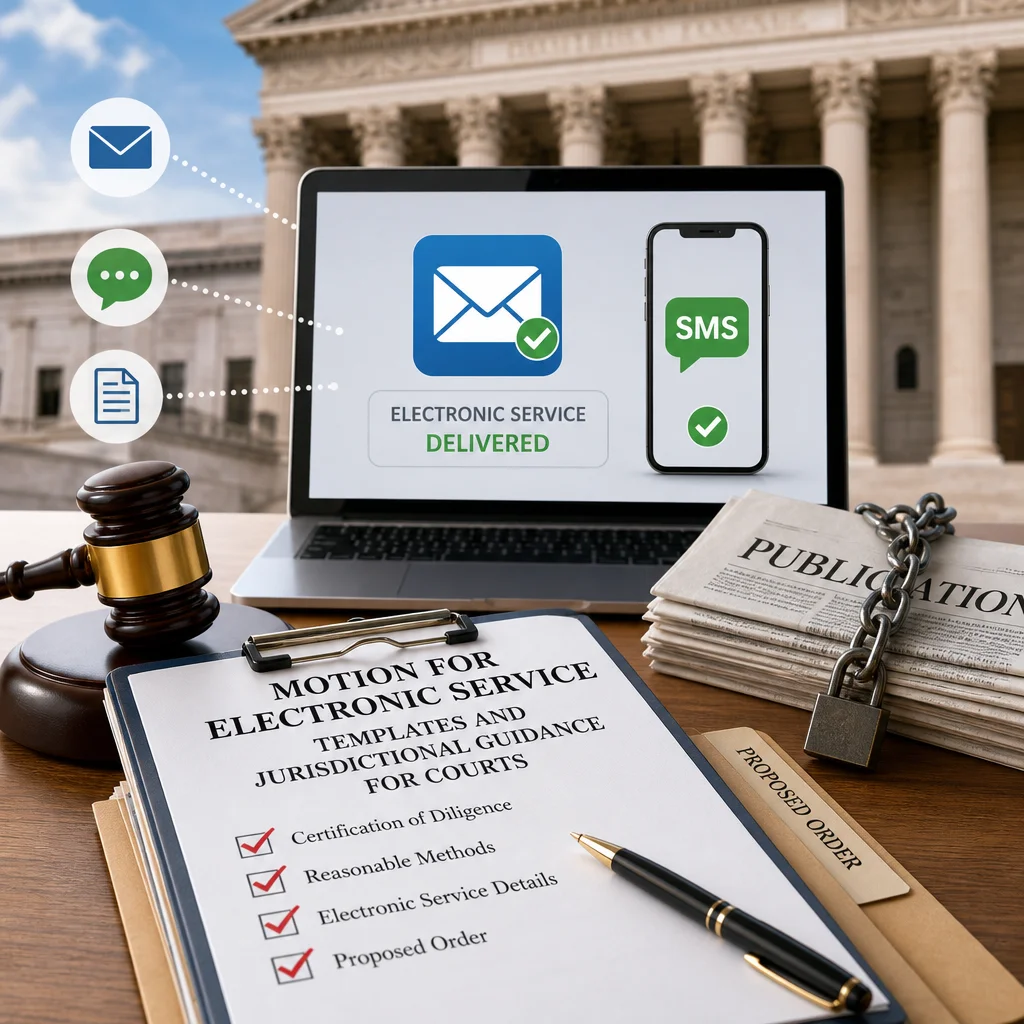
Some jurisdictions require you to attempt service at the defendant’s last known address before seeking electronic alternatives. Others focus solely on whether the proposed method reaches the defendant. A quick conversation with the court clerk or a search of recent decisions in your district will clarify the local standard. Your motion’s persuasiveness depends on matching the right legal theory to your court’s expectations.
Drafting Your Proposed Order for Electronic Notification
A proposed order is often more important than the motion itself. Courts prefer clear instructions they can sign without revision. Your order should specify:
Service details. The defendant’s name, the documents to be served, and the email addresses or phone numbers where service will occur.
Service protocol. How many attempts per day, over how many days, and through which channels. For example: “Defendant shall be served via SMS at [number] and email at [address], daily from [start date] through [end date], or until receipt is confirmed.”
Access mechanism. Whether documents will be sent as attachments, links, or secure access codes. Explain how the defendant receives and verifies a one-time code to retrieve documents.
Proof of service requirements. What documentation you’ll provide the court: screenshots, delivery reports, timestamped records of notification attempts, and any verification of access or receipt.
Fallback provision. Many courts appreciate an exit clause: “If electronic service is ineffective after [X days], petitioner may file a supplemental motion for alternative service.”
A concise, specific order gives the judge confidence that you’re proceeding methodically and won’t abuse the authority.
How You Got Serve Supports Motion Compliance
We designed our platform to address exactly what courts require when evaluating a motion for electronic service. When you use You Got Serve, we handle the logistical and documentary burdens so you can focus on drafting a persuasive motion.
Our system delivers documents via email, SMS, and WhatsApp across up to three email addresses and three phone numbers per recipient. You can set notification campaigns to run for 60 or 90 days, creating an unambiguous record of persistent, good-faith attempts to notify. Every delivery attempt is timestamped and logged; you receive automated reports showing which messages succeeded, which failed, and when.
Beyond delivery, we provide the documentation courts expect. Our platform tracks notification history, recipient access events, and verification activity all in one dashboard. When you file your motion, you can attach a comprehensive service report showing every attempt and its outcome. That level of detail strengthens your credibility with the judge and demonstrates that electronic service was methodical and fair.
We also integrate investigative assistance. If you’re unsure whether you have the right contact information, we can conduct skip tracing to verify or update email addresses and phone numbers before your service campaign begins. This addresses one of the biggest judicial concerns: that the defendant never actually receives notice.
Document Security and Verification Features That Courts Require
Courts care deeply about proof. A vague claim that “we sent an email” won’t pass scrutiny. You need timestamped records, evidence that the document was accessed, and ideally some confirmation that the right person received it.
We offer multiple verification layers:
Code-protected access. Recipients retrieve documents using a unique one-time code, adding friction that confirms intentional access rather than accidental clicks.
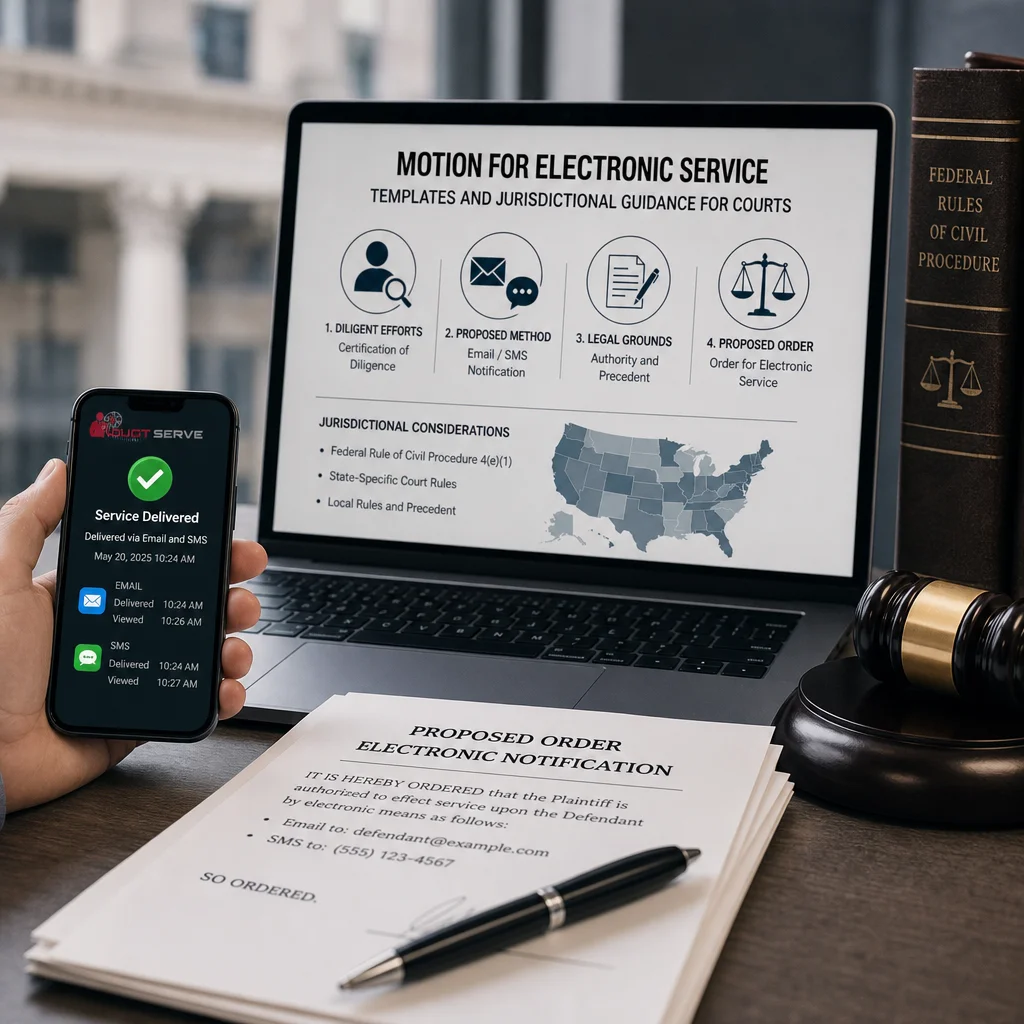
Timestamp logs. Every notification and access event is recorded with precise timing. These logs become part of your proof of service.
Optional verification capture. Where legally permissible and with appropriate consent mechanisms, customers can enable selfie capture or geolocation tagging during document access. This creates stronger evidence that the recipient personally retrieved the documents.
Notification history. Our reports show the defendant not only that service was attempted but also the method, date, and outcome of each attempt. This transparency supports your motion’s credibility.
When you cite these features in your motion and proposed order, you give the court confidence that electronic service isn’t a shortcut; it’s a documented, verifiable process.
Multi-Channel Notification: Building Your Service Strategy
Rely on one channel and you risk a failed service claim if that channel falters. Spreading notifications across email, SMS, and WhatsApp dramatically increases the likelihood that at least one reaches the defendant.
Structure your strategy this way:
Primary channel. If you have the defendant’s most reliable contact, start there but support it with secondary channels.
Daily reinforcement. Send notifications every day rather than once or twice. Courts understand that people miss messages; repetition over time demonstrates fair effort.
Channel rotation. Alternate between email, SMS, and WhatsApp over your campaign window. A defendant who deletes one email might see a text message notification.
Escalation triggers. If delivery fails on one channel, increase frequency on others. Our platform can automate this logic, shifting resources to channels showing success.
This multi-channel approach serves two audiences: it actually reaches the defendant more often, and it demonstrates to the judge that you’ve designed your service method to succeed.
Tracking and Proof of Service Documentation
The proof you file with the court can make or break acceptance of electronic service. Judges want granular detail. A single affidavit saying “I served the defendant via email” invites skepticism. A comprehensive report showing delivery attempts, failures, retries, and eventual access tells a complete story.
When you file your proof of service, include:
- A timeline of all notification attempts, sorted by date and channel
- Delivery confirmations or failure reports from your service platform
- Documentation of access, if available (e.g., “Recipient accessed document 03/15/2026 at 2:47 PM using access code XXXX”)
- Screenshots of the access interface and any verification capture
- A summary affidavit attesting to your compliance with the court’s order
Digital service platforms should generate these reports automatically. You simply download, review, and file. This efficiency is one reason courts increasingly favor electronic service: it’s easier to verify and audit.
Preparing for Objections and Court Approval
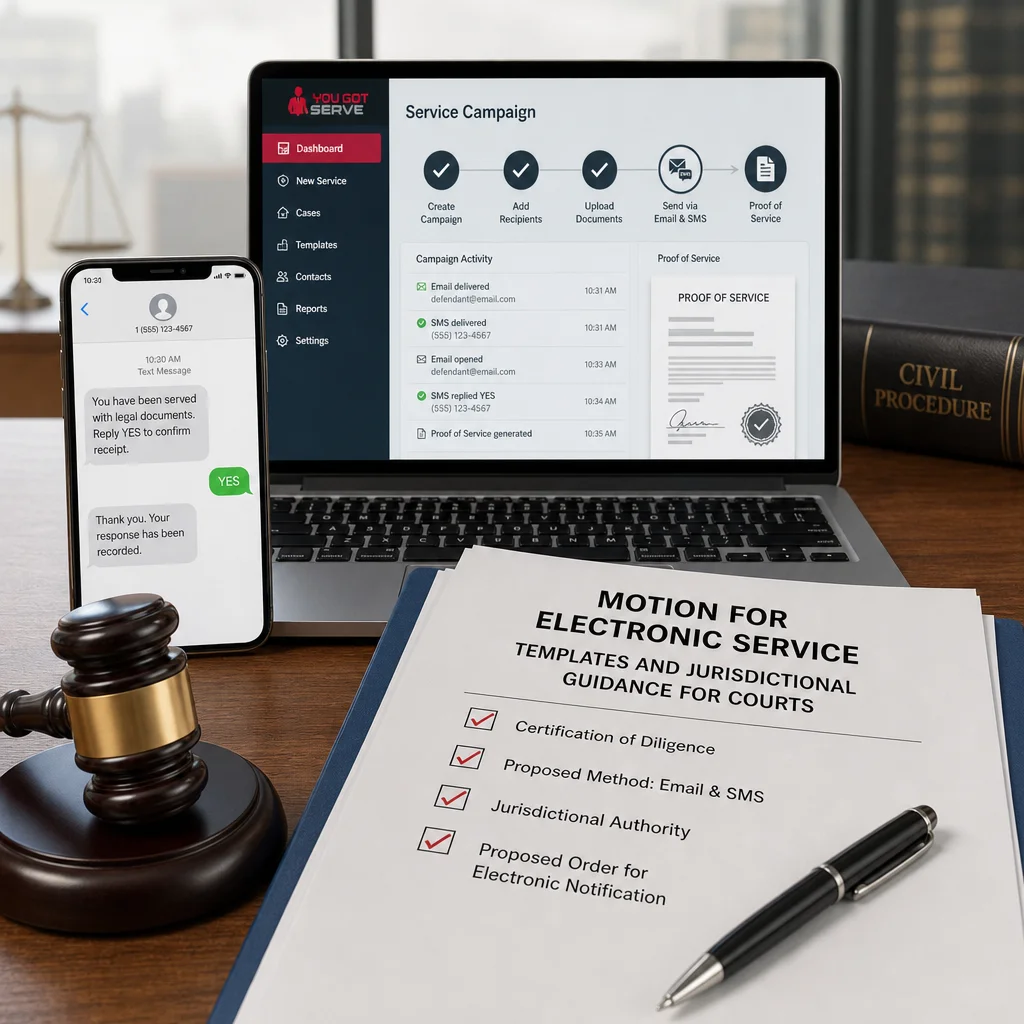
The defendant may object to your motion, arguing that electronic service is unfair, that you haven’t exhausted traditional methods, or that you lack valid contact information. Anticipate these arguments in your motion.
Address concern preemptively:
Diligence question. “We attempted personal service on [dates] at [locations], engaging a licensed process server who reported unsuccessful service attempts. We searched public databases and obtained the contact information detailed below.”
Fairness question. “Electronic service via email and SMS reaches the defendant’s actual communication channels more reliably than newspaper publication or further process server efforts. The defendant’s own use of these channels suggests notice will be received.”
Contact validity. “We verified this email address and phone number through [method], confirming they are associated with the defendant.”
If possible, include a declaration from your process server or investigator confirming diligence efforts. This third-party perspective carries weight.
Filing Your Motion: Checklist and Best Practices
Before filing, confirm these elements:
- Local court rules and recent case law reviewed for electronic service standards
- Certification of diligence drafted with specific dates, locations, and process server details
- Valid contact information identified and verified
- Proposed order drafted clearly, specifying service method, duration, and proof requirements
- Legal citations included, matching your jurisdiction’s rules and recent precedent
- Proposed order is concise and leaves minimal room for judicial revision
- Supporting documentation organized: process server affidavits, address verification records, screenshots of contact information
- File with the court according to local rules; serve the defendant if that’s still possible
Format matters. A well-organized motion with consistent formatting and clear headings reads faster and persuades more effectively. Judges appreciate professionalism.
File early if you’re already in litigation. Judges expect service motions in early stages; filing one months into a case raises questions about whether you’ve delayed unnecessarily.
After Approval: Executing Your Electronic Service Campaign
Once the court approves your motion and signs your proposed order, execution begins immediately. This is where a dedicated electronic service platform becomes invaluable.
Log into your account, input the defendant’s contact information, set your notification schedule (daily, for the duration the court approved), and activate the campaign. The system handles the rest: sending messages on schedule, logging delivery status, and alerting you to failures so you can adjust if needed.
Monitor your dashboard weekly. If one channel shows consistent failures, investigate whether the contact information is stale or the defendant has blocked your number. If access codes aren’t being used, you may need to confirm the order or serve a reminder notice.
Document everything. Save screenshots of your dashboard showing delivery attempts, access events, and verification activity. These records become your proof of service affidavit when the time comes.
If the campaign succeeds and the defendant accesses documents, file your proof of service promptly. If it doesn’t succeed within your campaign window, you have grounds to request alternative service or return to the court with updated information.
Electronic service, once approved, turns a procedural risk into a controlled, documented process. You’re no longer hoping a process server finds someone; you’re executing a court-authorized notification plan with complete visibility into results. That control and transparency are what courts want—and what makes electronic service worth pursuing.
For further reading: How electronic service works.