
Why Courts Demand Tamper-Proof Documentation of Service
Courts exist to resolve disputes fairly, and fair resolution requires certainty. When you serve a defendant or respondent, the judge needs proof that the recipient actually received notice of the case. Without it, the entire proceeding risks being overturned on appeal.
Service of process rules are strict precisely because the stakes are high. A defendant has constitutional rights to know they are being sued. If service documentation is vague, outdated, or easily altered, opposing counsel will challenge it. The court then faces an uncomfortable question: did the other party actually receive fair notice?
This is why tamper-evident audit trails matter. Immutable evidence chains create a permanent record that no one can rewrite after the fact. Timestamped notifications, encrypted access logs, and verified delivery receipts all work together to build an undeniable narrative: we attempted service, the recipient engaged with the documents, and we have the records to prove it.
The Legal Liability of Compromised Service Records
Weak documentation of service exposes you to serious legal consequences. If service is later challenged and your records cannot withstand scrutiny, the court may set aside the judgment entirely. That means years of litigation, attorney fees, and court costs vanish.
Beyond the immediate case, a compromised service record can damage your credibility with the court. Judges notice when service documentation is incomplete, inconsistent, or appears unreliable. If you return to that courtroom later, the judge may scrutinize your future filings more carefully.
For attorneys, ethical rules require competent handling of procedural requirements. Failure to properly document service can trigger bar complaints or malpractice claims from your client. For self-represented litigants, poor documentation simply weakens your case and invites the other side to contest the entire proceeding.
The solution is straightforward: use a service method that captures multiple layers of evidence automatically. Each notification, access attempt, and timestamp becomes part of an immutable record that neither party can alter unilaterally.
How Traditional Service Methods Fall Short on Accountability
Certified mail provides a delivery receipt, but it proves only that someone signed for the envelope. It does not prove the recipient opened it, read it, or understood it. If the defendant claims they never saw the contents, the receipt alone cannot refute that claim definitively.
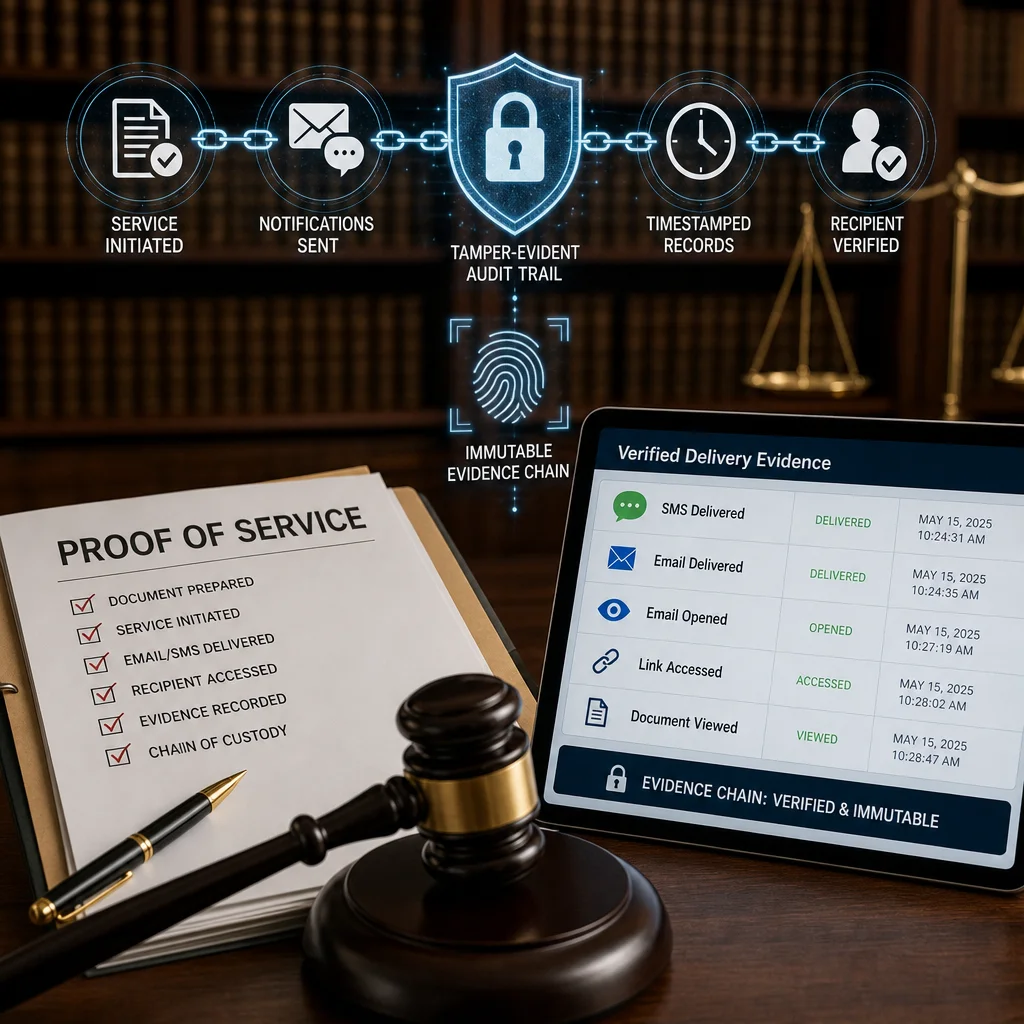
Newspaper publication offers even less accountability. You place an ad in a publication, wait the required time, and submit an affidavit to the court. But you have no way to verify that the defendant ever saw the notice. The defendant might truthfully say they never read that newspaper.
Personal service by a process server creates a detailed affidavit, which is valuable. However, if the defendant contests service, it becomes a credibility battle. The court must decide whether to believe the server or the defendant. The server is not present in the courtroom, and records are limited to written statements.
Email and SMS without verification tracking suffer similar gaps. You send the document, but have no proof the recipient opened it or that they understood the content. Generic delivery reports from internet service providers do not satisfy the heightened evidentiary standards courts demand.
Our approach combines persistent, multi-channel notification with cryptographic proof of engagement. The recipient accesses documents using a secure one-time code, geolocation stamps the access, and timestamps log every attempt. This creates an evidence chain so detailed that disputing service becomes nearly impossible.
Our Multi-Layer Approach to Immutable Evidence Capture
We designed our platform to eliminate ambiguity at every stage. Rather than relying on a single notification method, we send service notices across three email addresses and three phone numbers per recipient simultaneously. SMS, email, and WhatsApp notifications (where available) create overlapping channels of communication.
Each notification carries a unique timestamp recorded on secure servers. The recipient receives a code-protected link to access documents. When they open that link, the system captures the access time, geolocation data, device information, and confirmation that they viewed the contents. None of this can be altered retroactively.
Campaigns run for 60 or 90 days depending on your jurisdiction’s requirements. Daily notification cycles create a documented history of persistent attempts to reach the recipient. If the defendant later claims they never received service, the audit log shows exactly when and how many times we tried to reach them.
Cryptographic Timestamping and Notification Logging in Action
Timestamps are not simply clock readings. We use cryptographic protocols that embed each notification into a permanent, mathematically verified sequence. This means a timestamp cannot be backdated or moved without breaking the entire chain of cryptographic hashes linking all prior events.
When you need to prove service in court, you can produce a complete notification log showing every SMS sent, every email delivered, and every access attempt. The log includes precise timestamps, recipient identifiers, device information, and geolocation coordinates (when the recipient’s phone permits). A defendant cannot claim ignorance when presented with concrete evidence that their phone received a message on Tuesday at 2:47 p.m. containing a link they clicked at 3:12 p.m.
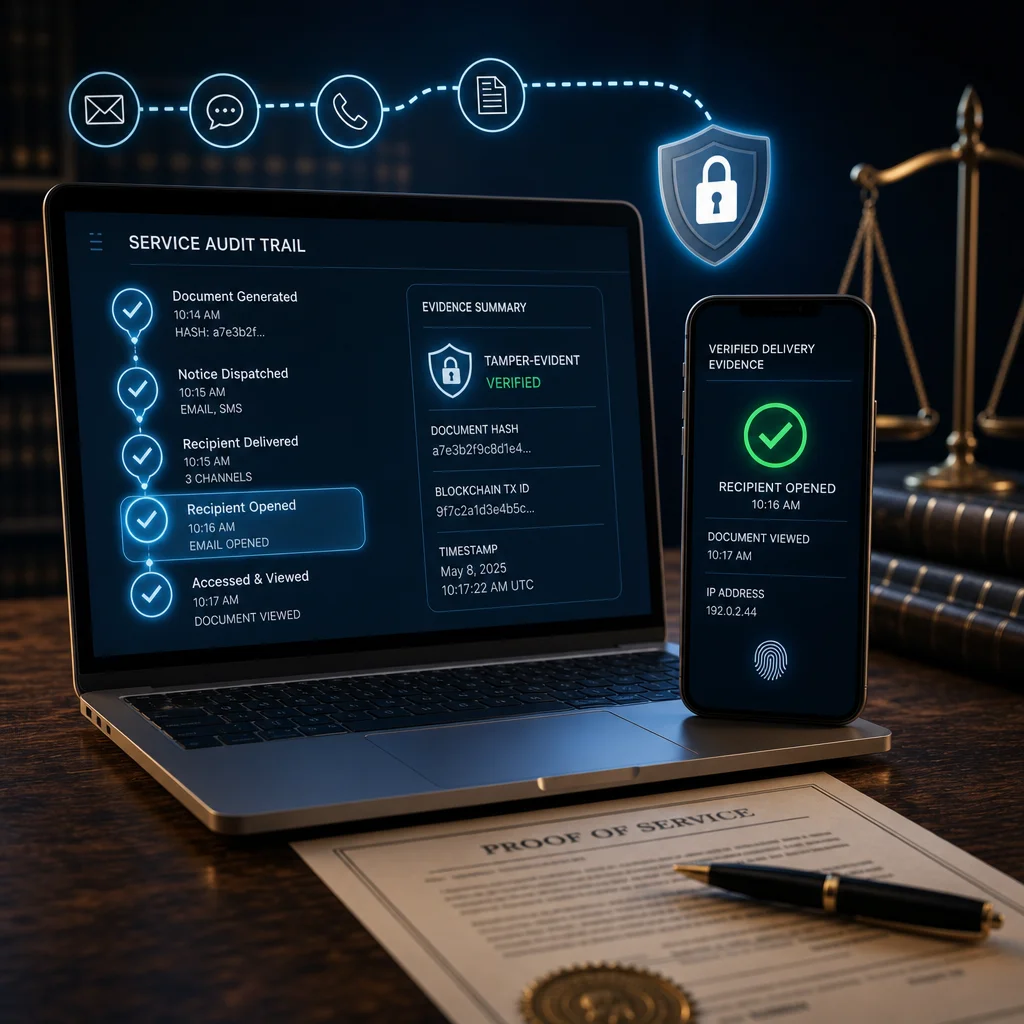
This level of documentation is particularly powerful when combined with document-access verification. The system records not only that the recipient received the notification, but that they successfully accessed the court documents using the secure code. The court sees clear proof of notice and engagement.
Recipient Verification and Access Documentation
Simply sending a message is one thing. Verifying that the actual recipient opened it is another. Our platform offers optional verification features that strengthen your evidence chain considerably.
Recipients can be asked to provide a selfie at the moment they access documents. We capture geolocation data showing where they were when they clicked the link. Biometric matching and location verification together create powerful evidence that the person on your defendant list actually received and engaged with the documents, not some third party or automated bot.
These verification steps are optional and vary by case type and jurisdiction. Check local court rules to confirm what verification methods your jurisdiction accepts. Some courts require them; others permit but do not mandate them. We design our platform to support compliance across different jurisdictional standards.
Building Irrefutable Chain-of-Custody Records
Chain of custody is a legal term borrowed from evidence handling in criminal cases. It means you can trace an item’s location and integrity from creation through presentation in court. The same principle applies to digital service of process.
Our system creates an unbroken chain from the moment you upload documents to the platform through every notification, access attempt, and verification step. Each event is encrypted, timestamped, and logged. The platform stores multiple copies of the complete audit trail on secure servers, protecting against data loss or alteration.
When you need to prove service in court, you download a certificate of service that includes the full audit trail. This document shows the judge, opposing counsel, and the defendant exactly what happened, when it happened, and who made it happen. The defendant cannot successfully argue they were never notified when presented with timestamped records of SMS messages, emails, WhatsApp notifications, and confirmed document access on their own device.
How Our Platform Protects Against Disputes and Challenges
Service disputes are costly and delay judgment. Our platform makes disputes far less likely by providing documentation so comprehensive that challenging it is futile.
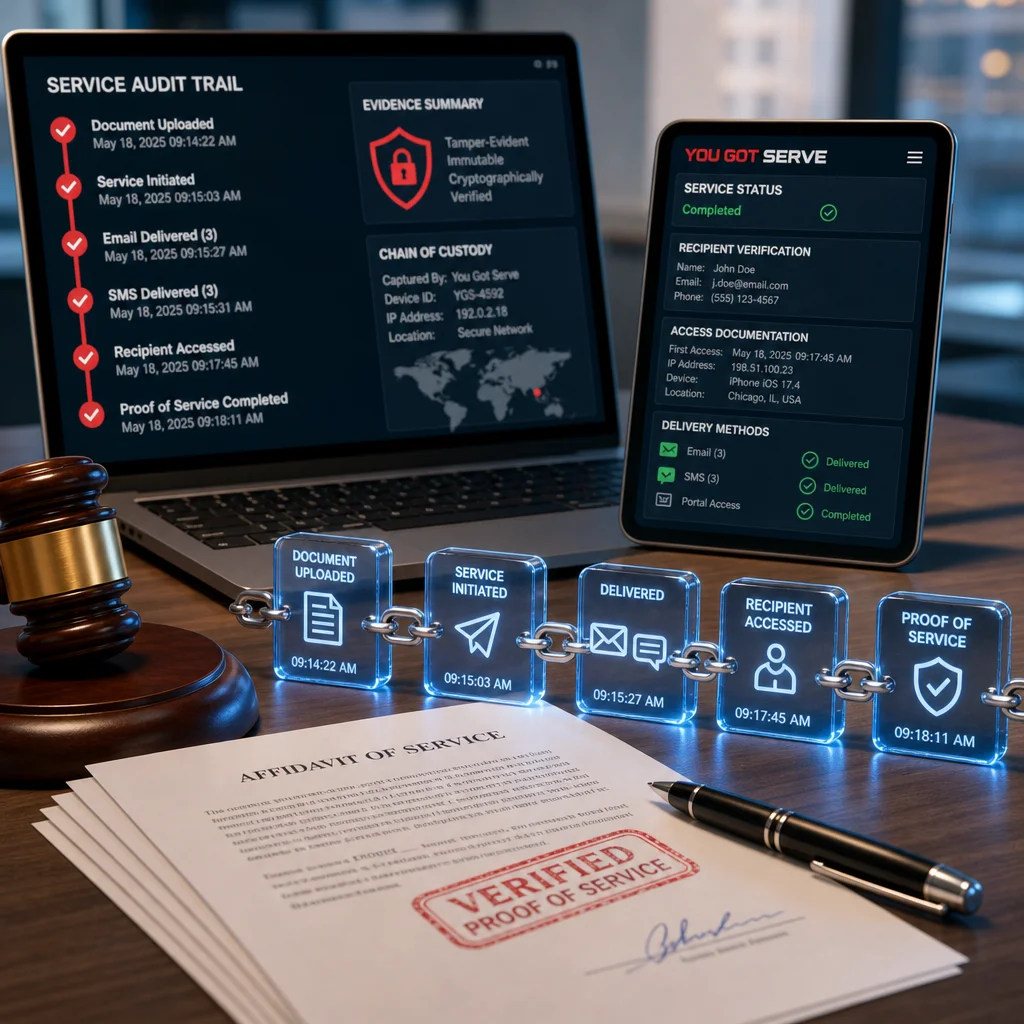
When a defendant’s counsel receives a certificate of service from our platform, they see granular proof of every notification attempt. They cannot claim the defendant never received service. They might argue the defendant did not understand the documents, but that is a different issue entirely, not a service problem.
If a challenge is filed despite strong documentation, we provide detailed affidavits and audit logs that courts consistently find persuasive. Judges appreciate the rigor and transparency. The evidence speaks for itself. The proceeding moves forward without delay, and you avoid costly motions practice to establish service.
Compliance Support Across Jurisdictions and Court Rules
Service rules vary dramatically from state to state and even between federal courts. Some jurisdictions permit electronic service only with written consent. Others require it when traditional service has failed. A few have embraced broad e-service rules.
We cannot tell you which service method is right for your case. That depends on your specific jurisdiction, court, case type, and the defendant’s circumstances. We encourage you to check local court rules before relying on electronic service or any alternative to personal service.
What we can do is provide the tools and documentation to support compliance with whatever service method your jurisdiction permits. Our platform is designed to work within existing legal frameworks, not to replace them. Whether you are using electronic service as a primary method or as a backup after traditional service fails, we capture the evidence courts need to accept service as proper.
Getting Started With Verified, Auditable Electronic Service
Ready to serve documents with confidence? How it works page walks through the platform step by step, from uploading documents to monitoring delivery and accessing your audit trail.
Start by uploading your court documents securely. Enter the recipient’s contact information, including multiple email addresses and phone numbers if available. Select your campaign length (60 or 90 days) based on your jurisdiction’s requirements. Our system handles the rest, sending coordinated notifications and capturing immutable evidence at every stage.
Monitor delivery and recipient engagement in real time using our document tracking features. Download your certificate of service whenever you need it. The complete audit trail is yours to keep, ready for court filing or defense against service challenges.
We also offer investigative assistance if you do not have current contact information for the recipient. Our skip-tracing tools help locate hard-to-find defendants, filling in gaps so your service campaign reaches the right person. We support electronic notifications internationally where technically available and legally appropriate, expanding your options beyond domestic service.
Your goal is simple: prove service beyond dispute and move your case forward. We provide the platform, documentation, and verification tools to make that happen. Tamper-evident audit trails and immutable evidence chains eliminate ambiguity and protect your case from appeal-level challenges based on service defects.