
The Challenge: Why Courts and Litigants Question Electronic Service
When traditional personal service fails—or when you’re tracking down a defendant who’s deliberately avoiding service—electronic notification offers a practical alternative. Yet courts and legal professionals often express skepticism about whether email and SMS deliver the reliability, proof, and legal standing that paper service provides.
These concerns aren’t unfounded. Service of process is fundamental to due process rights, and courts take it seriously. Judges need confidence that a defendant received actual notice before proceeding with a case. Legal professionals worry about whether a text message or email truly reaches its destination, whether someone actually opened it, and whether courts will accept it as valid proof.
We designed our platform directly in response to these doubts. Rather than ask litigants to accept reduced documentation standards, we’ve built persistent, verifiable electronic notification that generates a detailed record comparable to traditional service methods.
Objection 1: Email and SMS Aren’t Reliable Enough for Legal Service
The first concern is straightforward: emails end up in spam folders. Text messages get missed. Inboxes overflow. Why should anyone trust that a critical legal document will actually reach its recipient through these channels?
The objection has merit for single-attempt delivery. A one-time email rarely proves sufficient. But single-attempt service has always been risky, which is why skip tracing, repeated attempts, and multiple contact points exist in traditional service.
Here’s what separates persistent electronic notification from casual email: we send across multiple channels using up to three email addresses and three phone numbers per recipient. Notifications continue daily through 60- or 90-day campaigns, mimicking the repeated knock on doors that process servers perform. If a defendant deletes one message, we send another. If they ignore email, we try SMS. If they’re out of range for SMS, we try WhatsApp.
The platform is built on the principle that persistent, documented attempts create a reliable record, even if individual delivery attempts fail.
How We Verify Delivery and Recipient Access
Verification separates assumed delivery from proven contact. We offer multiple verification features designed to document recipient engagement.
Recipients access their documents using a unique, one-time access code rather than downloading a file directly. This requirement means we capture specific data when the document is opened: timestamp, geolocation information (where available), device type, and browser information. A defendant who claims they never received notice can be confronted with evidence showing they accessed the document at a specific date and time from a specific location.
For cases requiring additional verification, selfie capture confirms the recipient’s identity at the moment of document access. This layer of documentation strengthens your position if the defendant later contests service.
Our document delivery tracking system logs every notification attempt, access attempt, and successful access, providing a chronological record you can present to the court.
Actionable step: Before relying on any electronic service method, confirm your local court rules allow it and specify what verification evidence the court requires. Knowing this requirement upfront lets you configure the platform to capture the right proof.
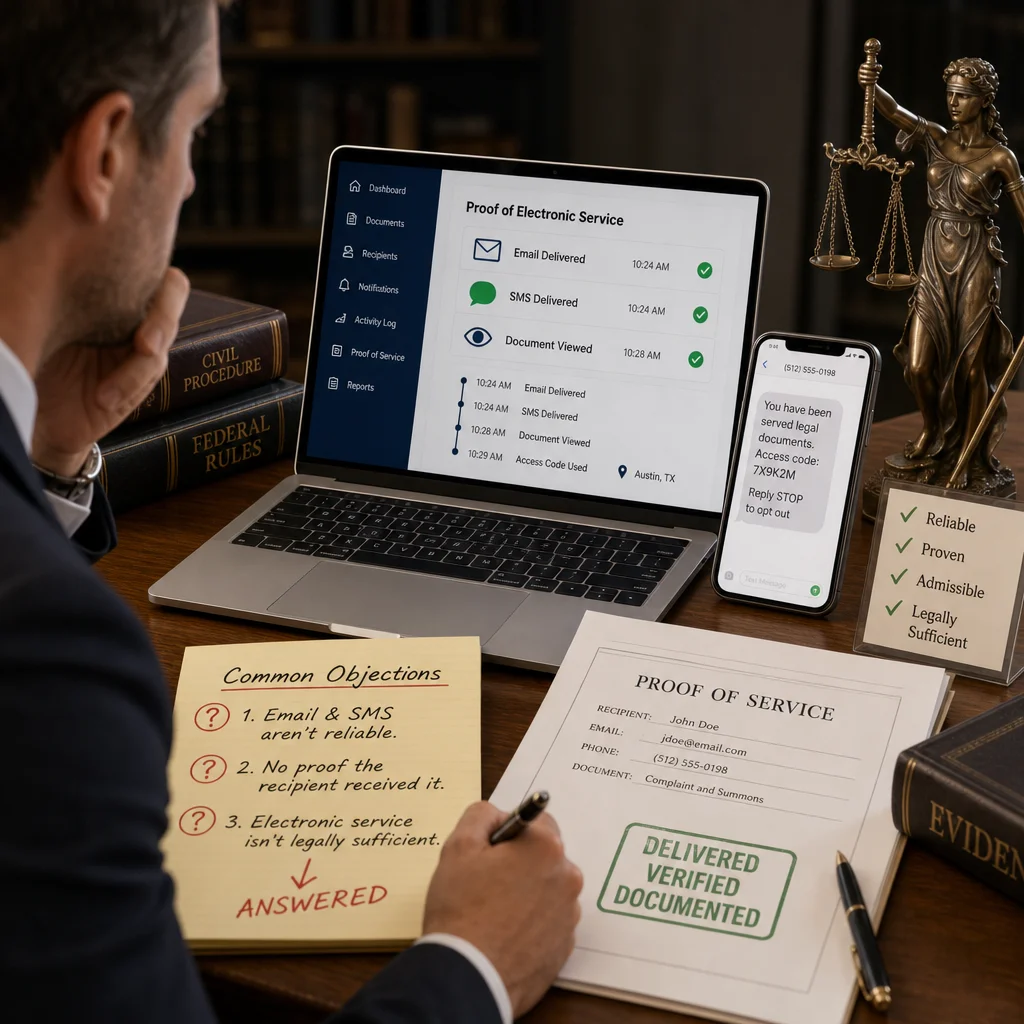
Objection 2: There’s No Proof the Recipient Actually Received the Documents
This objection cuts to the heart of service: a recipient must receive actual notice. Email delivery reports prove the message reached a mail server, not that the person read it. SMS delivery confirmations indicate the carrier accepted the message, not that the recipient understood its legal significance.
Without proof of actual receipt, courts may dismiss service as inadequate, regardless of how many times you tried to reach the defendant.
We address this through a multi-layer verification structure. The notification itself (SMS, email, or WhatsApp) contains an access link and unique code. The recipient must actively open the link and enter the code to view the document. That action triggers our system to record:
- Exact timestamp of access
- Device and browser information
- IP address and geolocation (where applicable)
- Document viewing duration
- Which pages were accessed
Additionally, notification history is preserved in the account, showing every outreach attempt, every delivery confirmation, and every access event. If the recipient claims they never knew about the case, you have documented evidence of when they received the notification, what time they opened it, and which pages they reviewed.
Selfie verification, when enabled, adds identity confirmation to that record.
Our Documented Evidence Trail: Timestamps, Geolocation, and Activity Logs
The strength of electronic service lies not in a single delivery moment but in the accumulated documentation. We design our system to create a comprehensive evidence trail that courts can review.
Every action generates a timestamped record: when we sent each notification, when the recipient’s phone received it, when they accessed the document, how long they spent reviewing it, and which pages they viewed. Geolocation data (when available and compliant with privacy law) can confirm the recipient was in the jurisdiction or at a known location when access occurred.
This chronological log serves multiple purposes. It proves the defendant had opportunity to prepare a defense. It demonstrates your good-faith efforts to reach them across multiple channels. It refutes claims of surprise or inadequate notice.
For recipients outside your jurisdiction, the same documented history supports your position that proper notice was provided in a manner reasonably calculated to reach them.
Courts increasingly recognize that persistent, verifiable electronic notification can meet due process standards precisely because it creates this kind of detailed, timestamped record.
Objection 3: Electronic Service Isn’t Legally Sufficient in Court
Many attorneys and litigants operate under outdated assumptions about service methods. They believe courts only accept personal service or certified mail, making electronic service feel like an untested or second-choice option.
The legal landscape has shifted. Federal courts allow email service under Federal Rule of Civil Procedure 5(b)(2)(E) when consent exists or court order permits it. State courts have adopted parallel rules. Rules vary significantly, but the trend is clear: electronic service is no longer experimental.
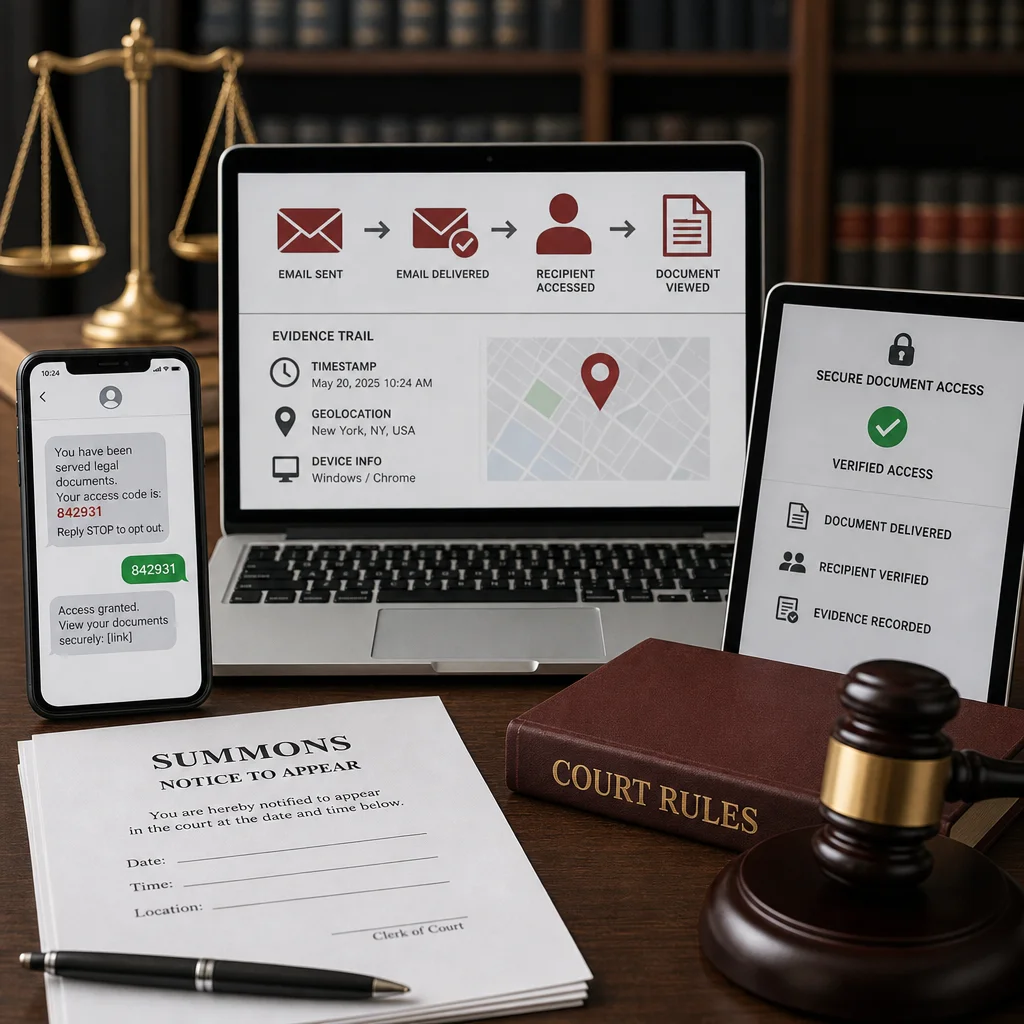
That said, acceptance and requirements differ by jurisdiction, court, case type, and judge. Your electronic service method must comply with your specific court’s rules to be valid.
Understanding When Electronic Notification Meets Court Requirements
Your first step is checking your local court rules before attempting service. Look for language about “electronic service,” “alternative service,” or “service by publication” in your jurisdictional rules. Many courts now explicitly permit email and SMS service under specific conditions.
Common conditions include:
- Prior consent from the recipient (a signed email agreement or prior email exchange)
- Court order approving alternative service
- Compliance with court-approved service providers or methods
- Proof of unsuccessful attempts at traditional service
- Documented evidence of diligent location efforts
We design our platform to support compliance with these requirements. Our how it works page outlines the documentation and verification features that courts typically require. Our investigative skip tracing service helps you demonstrate diligent efforts to locate a hard-to-find recipient.
When electronic service isn’t your only option, remember that serving by newspaper publication often costs more, takes longer, and generates less proof of actual notice than persistent electronic notification with verification data.
Actionable step: Contact your court clerk or review your local civil procedure rules online. Identify whether electronic service is permitted and what proof-of-service evidence your court requires. Share those requirements with your service provider so they can configure notifications appropriately.
Objection 4: Multi-Channel Notification Seems Excessive or Unprofessional
Some attorneys worry that sending SMS, email, and WhatsApp messages might look aggressive or overly persistent, potentially annoying a judge if the defendant complains about harassment.
This concern reflects a misunderstanding of service standards. Service of process is not about courtesy or preference. It is about ensuring actual notice through diligent, documented attempts. If traditional service requires multiple process server visits, repeated addresses, inquiries with family members, and published notice, then multiple electronic notifications are not excessive—they’re appropriate.
Courts expect you to make reasonable, persistent efforts to reach a defendant. Multi-channel notification is reasonable because different people check different platforms at different times. A defendant who avoids email may answer SMS. Someone without phone service may use WhatsApp over cellular data.
The key distinction is between persistence and harassment. Sending notifications daily through a defined 60- or 90-day campaign is documented, professional diligence. The record shows good-faith attempts with clear start and end dates. This looks responsible in court, not aggressive.
Why Persistent Outreach Through Multiple Channels Strengthens Your Case
When service goes disputed, judges evaluate whether your efforts were genuinely calculated to provide actual notice. A single email or SMS fails that test. A documented campaign across multiple channels over weeks or months passes it.
From a practical standpoint, persistent outreach also increases your odds of actual receipt. Not every text gets read on the day it arrives. Not every email bypasses the spam filter. A defendant with three phone numbers on file might ignore one while monitoring another. By reaching out persistently across multiple channels, you maximize the likelihood that the defendant will encounter the notification when they check one of their active platforms.
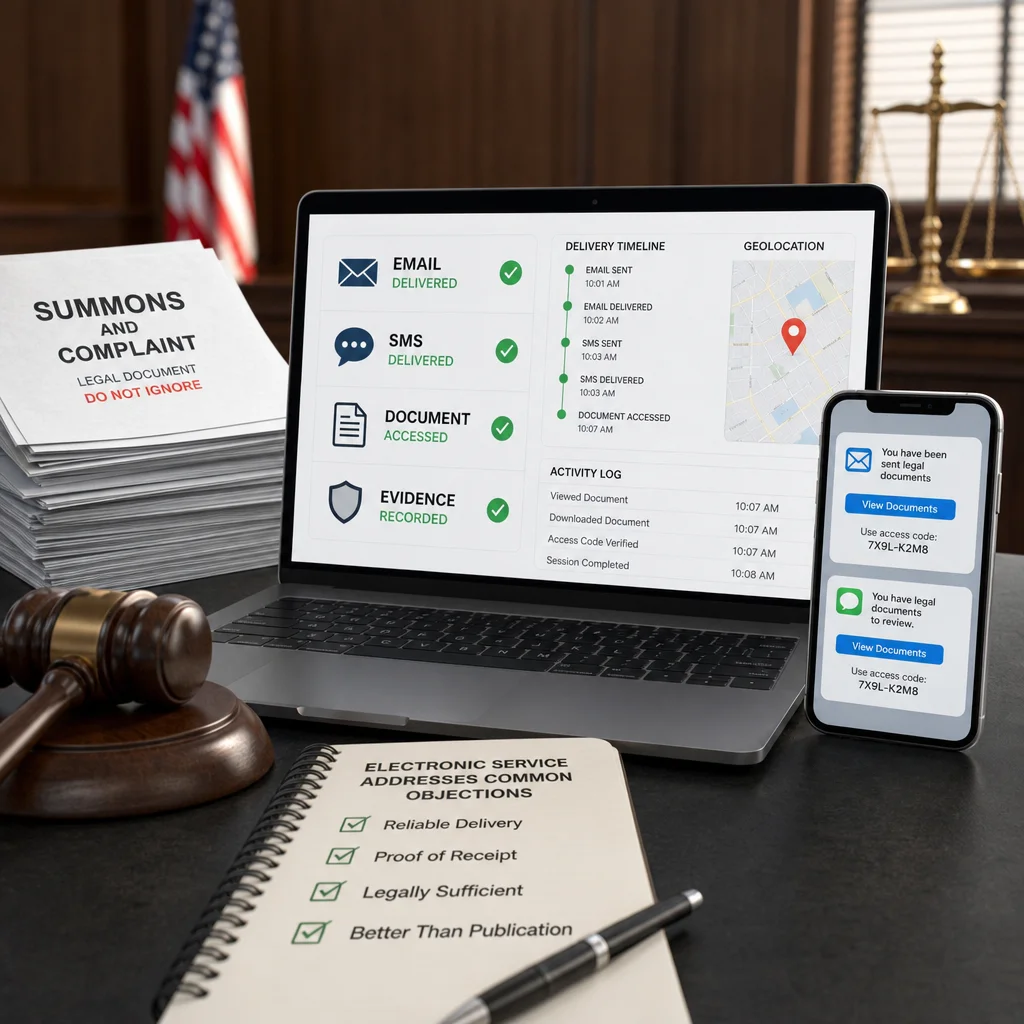
The documented failure to respond or access the document then becomes powerful evidence. It shows the defendant had multiple, repeated opportunities to engage with the case. If they claim surprise or lack of notice later, the court has a clear chronological record contradicting their claim.
This is how persistent electronic notification strengthens due process rather than weakening it.
Objection 5: Cost and Complexity Outweigh the Benefits
A traditional assumption persists: electronic service must be cheaper but also inferior, or equally expensive but unnecessarily complicated.
In reality, electronic service costs substantially less than newspaper publication, which can run hundreds or thousands of dollars depending on publication frequency and circulation. It is also faster—newspaper service can take weeks of publication cycles, whereas electronic notification campaigns complete in days or months, not months or years.
Complexity concerns often stem from unfamiliarity. Using email and SMS feels simple (because it is), but configuring them for legal compliance requires steps like verification setup, documentation collection, and court rule compliance. A purpose-built platform handles these requirements without adding work for the user.
The Real Value: Speed, Affordability, and Documented Results
Consider a concrete scenario: you’ve served a defendant through personal service and by certified mail without response. Your local court rules allow electronic service after unsuccessful traditional attempts. Newspaper publication would cost $1,500 to $3,000 and take 30 to 60 days. Electronic notification with verification costs a fraction of that and completes in your timeframe.
Beyond cost savings, you gain a documented record of reaching the defendant across multiple channels with timestamped proof of access (if they open the document). If they later claim insufficient notice, you have evidence. If the court questions service, you have documentation.
This combination of speed, affordability, and verifiable proof explains why forward-thinking courts and practitioners are adopting persistent electronic notification.
Actionable step: Calculate what newspaper publication would cost for your case, then compare it to electronic service pricing. Factor in timeline and the value of a timestamped access record. Most litigants find electronic notification offers superior value.
Start Serving Documents Electronically With Confidence
The objections to electronic service are real, but they have answers. Reliability improves through persistent, multi-channel outreach. Proof of receipt strengthens through verification features and documented activity logs. Legal sufficiency depends on your jurisdiction’s rules, which increasingly favor electronic service when used appropriately.
We built YouGotServe to address every major concern courts and attorneys raise about email and SMS service. Our platform combines persistent notification, multiple communication channels, secure document access, recipient verification, and detailed documentation—all designed to support compliance with your local court rules.
If you’re facing a hard-to-reach defendant or a court that permits alternative service, electronic notification no longer means compromising on proof or professionalism. It means serving documents faster, more affordably, and with a documented record that courts recognize.
Review your court’s rules on electronic service, then reach out to learn how we can help you serve documents with confidence and documented proof.