
1. Timestamped Delivery Notifications: Know Exactly When Recipients Receive Documents
Every SMS and email we send records the exact moment of transmission. More importantly, we capture when the recipient actually reads or accesses your document. This timestamp is precise to the second and cannot be altered after the fact.
Why this matters: A judge needs to know not just that you tried to serve someone, but when your attempt succeeded. Timestamped delivery proves you cleared the hurdle. If a defendant claims they never received notice, your audit trail shows otherwise.
Each notification carries metadata that includes:
- Exact delivery time (down to seconds)
- Recipient phone number or email address
- Delivery method (SMS, email, or WhatsApp)
- Carrier or email server confirmation
- Document access confirmation
When you need to file an affidavit of service or respond to a motion contesting notice, these timestamps become your foundation. We maintain this data throughout your entire notification campaign, which typically runs 60 or 90 days. That means you can show a judge not just one attempt, but a complete history of when and how you reached the recipient.
Your next step: Review your local court rules on electronic service to confirm whether timestamped delivery notifications satisfy your jurisdiction’s proof-of-service requirements.
2. Recipient Verification Through Geolocation Data: Confirm Who Accessed Your Service
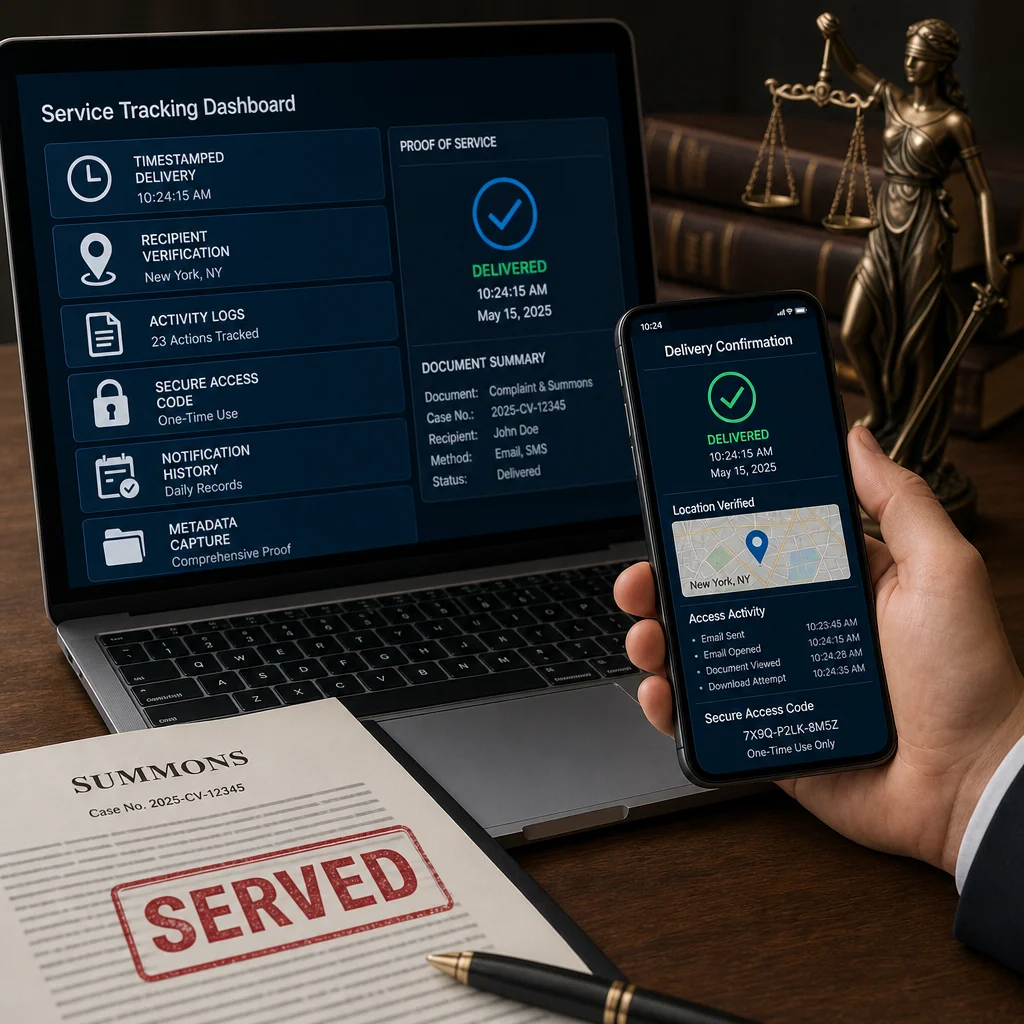
Serving the right person matters as much as proving you served them. We offer optional geolocation capture when a recipient accesses their secure document portal. This creates a location record showing where the person was at the moment they opened the court documents.
Geolocation data adds a layer of verification that other methods cannot match. If you served three phone numbers or email addresses for the same defendant, geolocation helps confirm which contact point reached the actual person. This is especially useful when serving hard-to-locate defendants or when multiple contact attempts go to different associates or outdated contact information.
The geolocation record includes:
- GPS coordinates (latitude and longitude)
- City and state/country
- Timestamp of access
- Device type used to open the document
- Network details if available
This feature addresses a common litigation problem: uncertainty about whether the right person received notice. With geolocation, you remove guesswork. You can show that the specific individual opened the documents from their known location or workplace.
Your next step: Confirm with your attorney or court whether geolocation verification is admissible in your jurisdiction and whether recipient consent is required before capture.
3. Document Access Activity Logs: Track Every Click and Retrieval Attempt
Beyond knowing when a document was accessed, we track what the recipient did after opening it. Our activity logs record every click, every page viewed, and every attempt to download or print the document. This creates a detailed picture of engagement with the served documents.
An activity log might show: recipient opened the document on Monday at 2:47 PM, scrolled to page 3, paused for eight minutes, then closed the portal. Later that week, they returned and downloaded the full PDF. This behavior demonstrates not just receipt, but actual review of the court documents.
Why courts care: Activity logs defeat claims of accidental or incidental receipt. They prove the defendant intentionally accessed the documents and had opportunity to review them. This is powerful in default judgment proceedings or when challenging motions claiming lack of notice.
Our logs capture:
- Each login and logout time
- Pages accessed and scroll depth
- Download attempts
- Print attempts
- Time spent on each page
- Device and browser information
- Network details
This granular data transforms a simple “yes, they opened it” into “yes, they deliberately reviewed it multiple times and had full opportunity to respond.”
Your next step: Document your platform access logs from day one of service. Export and preserve them before filing any affidavit of service.
4. One-Time Secure Access Codes: Maintain Complete Chain of Custody Documentation
Recipients access their served documents through a unique, one-time access code we generate for each recipient and each service attempt. This code is sent via SMS, email, or WhatsApp and cannot be reused or shared. Once the recipient enters their code, they gain access to the secure document portal for a set period.
This approach solves two critical problems. First, it proves the specific person who received the notification actually opened the documents. Only someone with access to that phone or email could input the code. Second, it creates an unbreakable chain of custody. The code ties the access event to the specific recipient and the specific notification attempt.
Unlike links that can be forwarded or accessed by anyone, one-time codes ensure that only the intended recipient can view your served documents. If opposing counsel later argues they never received notice, you can point to the code being entered correctly and documents accessed under that unique code.
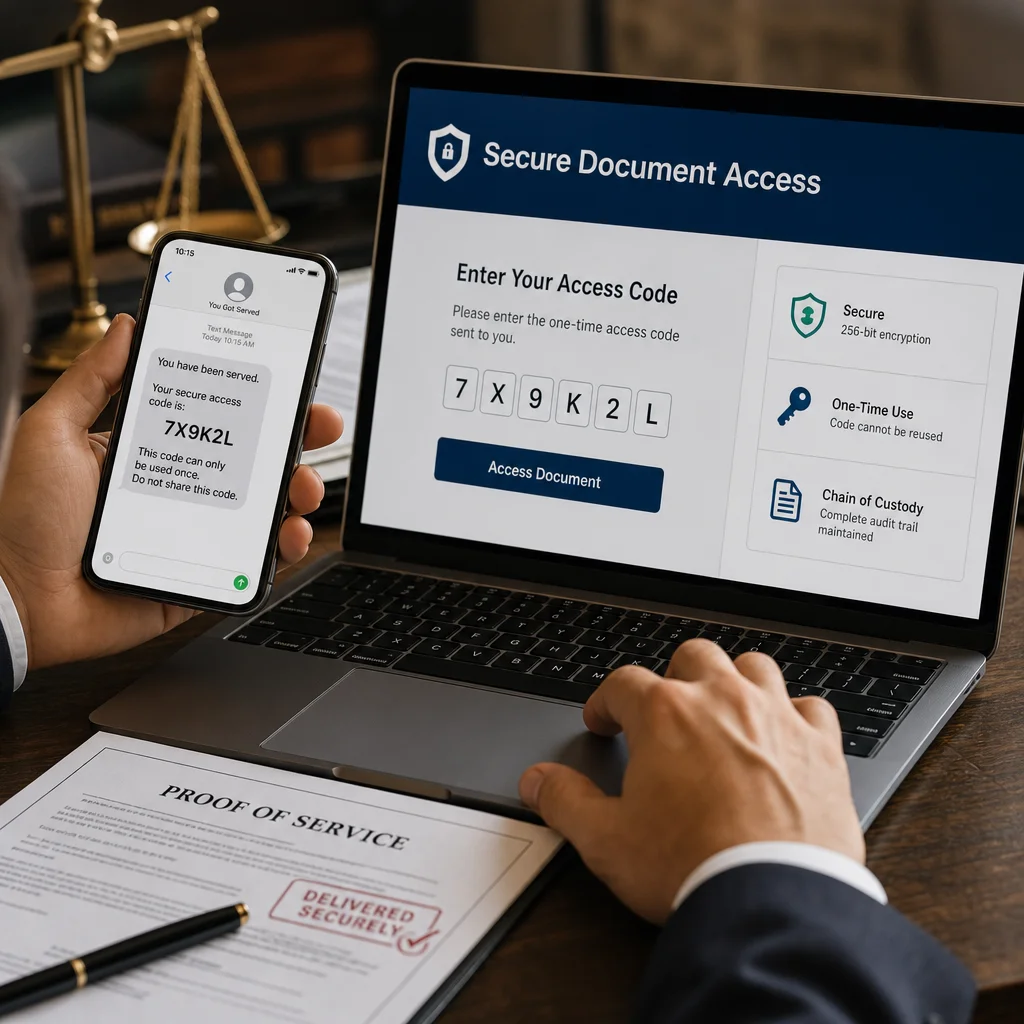
Our one-time code system also provides:
- Unique code per recipient per notification cycle
- Automatic code expiration after a set period
- Access denial for incorrect code entries (with logging)
- Separate codes for different document packages
- Code entry history tied to timestamps
This feature is particularly valuable when serving multiple defendants or when some recipients claim they never accessed the portal.
Your next step: Preserve records of the code distribution and all failed/successful code entry attempts for each recipient in your case file.
5. Daily Notification History: Create Persistent, Court-Ready Service Records
We don’t send your documents once and hope for the best. Our platform supports continuous notification cycles spanning 60 or 90 days. Each day (or at intervals you set), recipients receive reminders via SMS, email, or both. This persistence creates a documented history that transforms your service record.
Why persistence matters: Many defendants claim they missed initial notice due to spam filters, deleted emails, or overlooked messages. With daily notifications over months, that excuse becomes untenable. You can show the court that the defendant received 45, 60, or 90 separate attempts to notify them. Missing one is plausible; missing all of them is not.
This approach also satisfies jurisdictions that require “diligent” or “reasonable” service efforts. Instead of arguing that one email attempt was sufficient, you demonstrate months of sustained effort across multiple channels. Judges see this as thorough, intentional, and court-compliant.
Your notification history log shows:
- Every notification sent (date, time, method)
- Delivery confirmation for each attempt
- Which attempts were opened and when
- Which attempts bounced or failed
- Total count of successful and failed attempts
Courts increasingly accept this persistent electronic notification as a valid substitute for newspaper publication or repeated certified mail attempts. How the service works explains our notification cycles in detail.
Your next step: Check your local court rules to confirm the acceptable frequency and duration of notification attempts in your jurisdiction.
6. Automated Metadata Capture: Build Comprehensive Electronic Service Proof
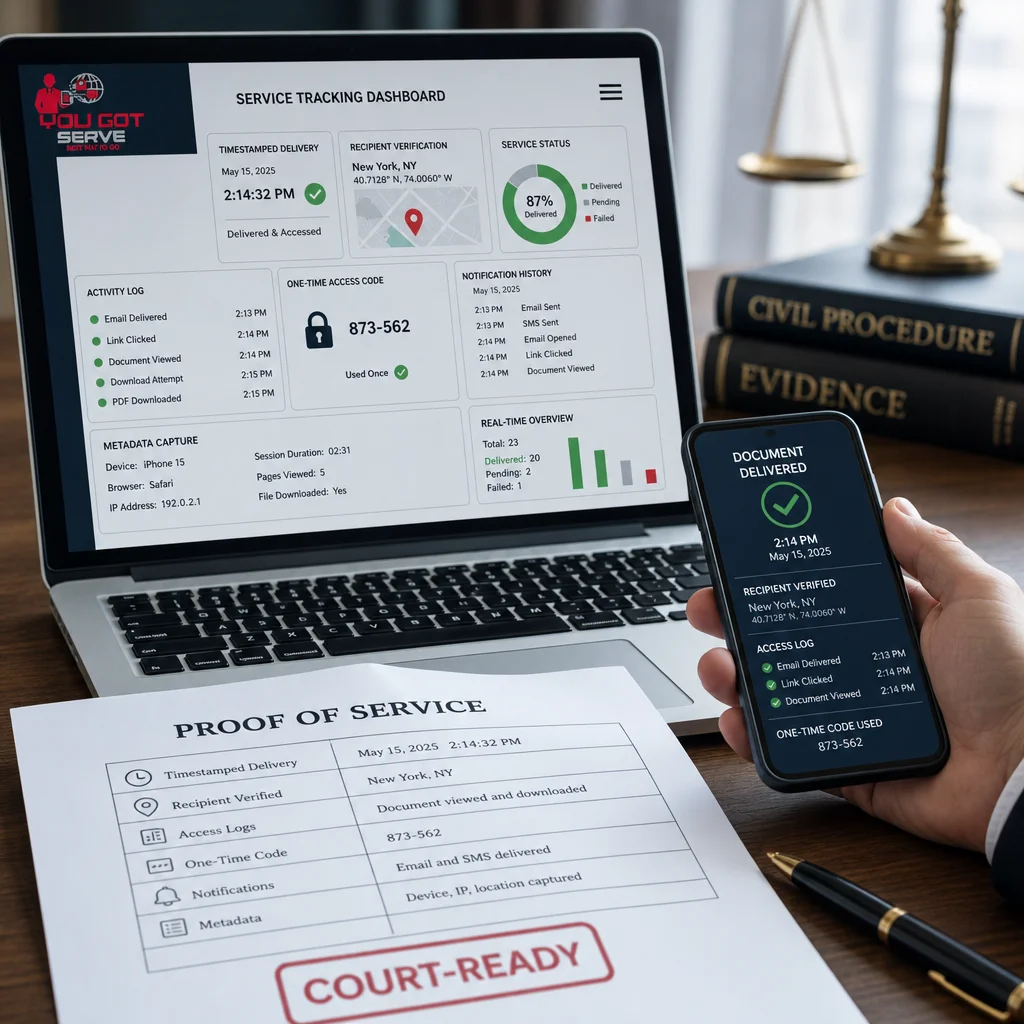
Metadata is the data about data. Every email contains metadata (sender, recipient, server details, authentication records). Every SMS contains metadata (originating number, network timestamp, carrier confirmation). We capture and preserve all of it automatically.
This metadata becomes your documentary foundation when you need to prove service in court. Instead of relying on your word or a generic receipt, you submit technical evidence generated by communication systems themselves. Judges recognize this as inherently trustworthy because it comes from the platforms that sent and received the messages.
Our automated metadata capture includes:
- Email headers (SMTP details, SPF/DKIM authentication, relay information)
- SMS origination and delivery confirmation from carriers
- IP addresses and device identifiers
- Authentication tokens and encryption certificates
- Notification attempt sequence and failure reasons
- Document access encryption and decryption logs
This layer of technical documentation is what separates amateur electronic service from court-defensible service. When an opponent challenges your proof of service, detailed metadata allows you to answer every question about how, when, and to whom your documents were sent.
Your next step: Request that your platform provider export metadata in formats compatible with your court’s document submission requirements (typically PDF or certified PDF).
7. Real-Time Service Status Tracking: Monitor Pending and Delivered Statuses Instantly
Throughout your notification campaign, you need current information about who received documents and who did not. Our real-time dashboard shows the status of every recipient and every notification attempt as it happens.
Instead of waiting days or weeks to learn whether service succeeded, you see results immediately. A defendant opens their code at 3 PM on Tuesday? You know it within seconds. An SMS fails to deliver? The dashboard shows the failure reason (invalid number, network rejection, etc.) right away. This real-time visibility lets you adjust your strategy mid-campaign if needed.
Status tracking includes:
- Delivery confirmation for each attempt
- Access confirmation (when recipient opens documents)
- Failure reasons and retry schedules
- Recipient engagement timeline
- Campaign progress toward 60 or 90-day completion
Real-time tracking is also essential when you are working under tight court deadlines. If a defendant moves to dismiss for lack of service, you can run your audit trail report immediately and file it the same day. You do not wait for manual verification or postal service timelines. Your proof is already digitally documented.
Document delivery tracking allows you to monitor service status from start to finish without administrative overhead.
Your next step: Log into your service account daily during active campaigns to catch delivery failures early and contact recipients through alternate channels if needed.