
The Challenge: Why Traditional Service Documentation Falls Short
When you need to serve a defendant or respondent who is difficult to locate or unresponsive, traditional methods create documentation gaps that weaken your case.
Newspaper publication, for instance, leaves little verifiable proof that the intended recipient actually saw the notice. The published advertisement sits in a newspaper archive, but you cannot confirm whether the target recipient read it, when they read it, or from which device. If challenged in court, you’re left with only the publication itself and a sworn statement about your diligent search efforts. That’s thin evidence.
Physical process servers, meanwhile, generate a single affidavit of service. That one document captures the moment of attempted delivery but offers no record of follow-up contact attempts, no proof of engagement, and no verification that the recipient actually received or understood the notice. If the defendant later claims they never received the documents, you have limited supporting evidence beyond one server’s account.
Email and postal delivery without tracking provide even less documentation. A sent message proves nothing about whether it was received, opened, or read. You need a comprehensive record that demonstrates genuine effort to notify the recipient across multiple channels over time.
The solution requires persistent, documented attempts across multiple contact points with timestamped evidence of each interaction. That’s where modern electronic service platforms become essential.
What Courts Require: Essential Elements of Valid Service Proof
Court rules vary by jurisdiction, but most require your proof of service to demonstrate several key elements.
First, you must show personal knowledge of the service attempt. An affidavit or declaration signed under penalty of perjury establishing who performed the service and what actually occurred is foundational.
Second, courts expect specificity about the method. If you served by email, you should identify the recipient’s email address, confirm when the email was sent, and document that it was delivered to the recipient’s inbox (not bounced).
Third, you need evidence of timeliness and compliance. Service must occur within the window specified by applicable court rules or agreed-upon procedures. Courts want proof that your attempts fall within the required timeframe.
Fourth, many courts now accept or even prefer documented proof of receipt or access. If the recipient actually opened the email, clicked a link, entered an access code, or confirmed receipt in some verifiable way, that strengthens your filing significantly.
Finally, courts increasingly value multiple notification attempts, especially when serving a hard-to-find recipient. A single email attempt is weak; documented daily attempts across email, SMS, and other channels over 60 or 90 days creates a much stronger record of due diligence.
Electronic service platforms that automate these elements and generate comprehensive activity logs align perfectly with modern judicial expectations for rigorous proof of service documentation.
How You Got Serve Automates Affidavit and Declaration Support
We designed our platform to generate the supporting documentation courts now expect for electronic service.
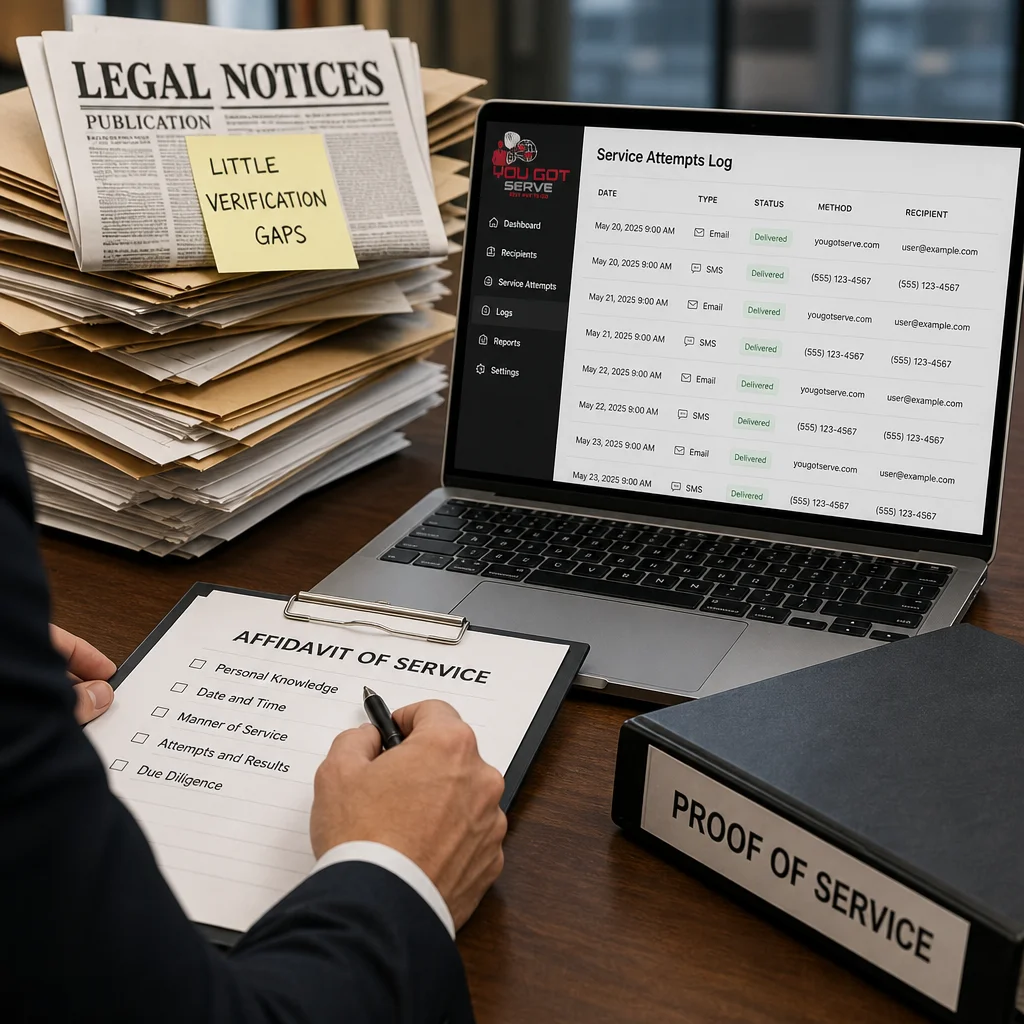
When you upload a document and enter up to three email addresses and three phone numbers per recipient, our system begins daily automated notifications through email and SMS (and WhatsApp where appropriate). Every notification is timestamped and recorded. Every failed delivery attempt is logged. Every successful delivery is captured.
You don’t manually track each contact attempt or worry about forgetting to send a follow-up. The platform handles the persistence, and it documents everything automatically.
When you’re ready to file your affidavit of service, you can download a complete activity report from your account showing:
- Date and time of each notification sent
- Channel used (email, SMS, or WhatsApp)
- Recipient’s contact information
- Delivery status for each attempt
- Access events (if the recipient clicked the link or opened the document)
This report becomes the backbone of your affidavit. Rather than writing “I attempted service multiple times,” you can cite specific documented attempts with dates, times, and channels. Your declaration is supported by objective, timestamped electronic evidence generated by our platform.
You retain full control over your account and can export these records anytime. The documentation is yours to use in court filings, affidavits, or declarations.
Daily Notification Logs: Your Automated Record of Due Diligence
Our platform sends notifications daily during your chosen 60-day or 90-day service window. This creates a persistent, documented attempt to reach the recipient.
The difference between one attempted delivery and 60 documented attempts is profound for your proof of service. Courts recognize that people miss emails, don’t answer phone calls, or claim they never received a single notice. But repeated, documented attempts across multiple channels over an extended period demonstrate genuine, good-faith effort to notify the recipient.
Each log entry includes:
- Exact timestamp (date and time to the minute)
- Communication channel (email, SMS, or WhatsApp)
- Recipient contact information used
- Delivery confirmation or failure reason
- Any access activity on the document portal
These logs are automatically organized in your You Got Serve account. You can review them anytime, export them for your records, or include them as exhibits to your affidavit. The daily persistence creates evidence that withstands scrutiny far better than a single notice attempt.
If a recipient later claims they never received notification, you can point to documented daily attempts across multiple channels. The burden of explanation shifts to them.
Verification Features That Strengthen Your Service Exhibits
We offer several verification options that add layers of credibility to your service documentation.
Secure code-protected document access means the recipient must enter a unique access code to retrieve the document. When they access it, our system captures and timestamps that access event. You can see exactly when the document was viewed, adding objective proof that the recipient actually engaged with your materials.
Geolocation information is available when the recipient accesses the document through our portal. This confirms not just that someone accessed it, but approximately where they were when they did so. For defendants claiming they never received service, geolocation data provides powerful contradictory evidence.
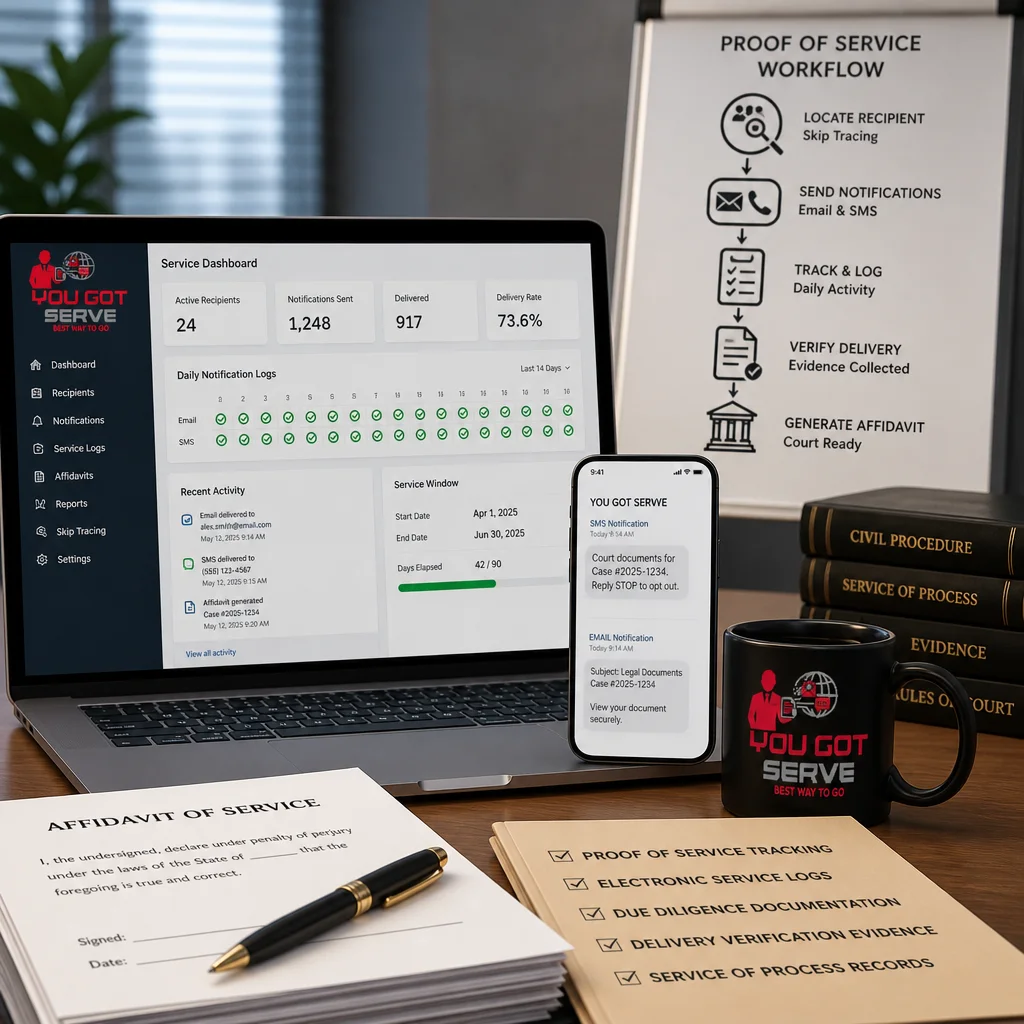
Selfie verification is an optional feature where recipients can be asked to provide a photo during access. This adds biometric confirmation to the access record, though it’s only suitable in certain case contexts.
Timestamped notification history shows the complete sequence of outreach attempts. Courts appreciate this granular record because it demonstrates systematic, documented effort rather than haphazard contact.
When you include these verification elements in your affidavit exhibits, you’re not just proving you sent messages. You’re proving the recipient received them, accessed them, and engaged with them at specific times from specific locations. That level of documentation is difficult for any defendant to credibly dispute.
Investigator Reports and Skip Tracing Integration
Not every case begins with complete contact information for the recipient. If you lack sufficient email addresses or phone numbers, locating the defendant becomes the first challenge.
We partner with investigative professionals who can perform skip tracing and locate services. If you provide what information you do have, our investigative skip tracing can help identify current contact details for the recipient.
Once investigators provide updated contact information, you enter it into our platform and launch your electronic service campaign. The investigator’s work becomes part of your broader due diligence documentation. Courts appreciate proof that you invested effort in locating the defendant before attempting service, as it strengthens your overall record of good-faith compliance.
This integrated approach means you can document the entire service process in one platform: locating the recipient, identifying correct contact information, and then persistently notifying them across multiple channels over time.
Comparing Documentation Approaches: Manual vs. Automated Tracking
Consider the administrative burden of manual service documentation. You must personally send emails or SMS messages, track which dates you sent them, note which bounced or failed, follow up according to a calendar you manage, and then reconstruct the entire timeline in a spreadsheet or affidavit.
This manual approach creates several risks:
- You may miss scheduled follow-up attempts, leaving gaps in your documentation
- Tracking errors or incomplete records weaken your affidavit
- You cannot easily prove that all attempts occurred within the required timeframe
- If challenged, you’re relying on your personal recollection rather than objective platform-generated records
Automated platforms eliminate these risks. Our system sends daily notifications without fail, timestamps every attempt, and generates comprehensive logs that are inherently objective and difficult to dispute.
When you file your affidavit, you’re not asking the court to trust your memory or bookkeeping. You’re presenting electronic records generated by a neutral platform. That shifts the evidentiary weight significantly in your favor.
The cost is also lower. Our 60-day service is $350 and our 90-day service is $500. Compare that to multiple process server attempts or newspaper publication, and the value is clear.
Why Persistent Multi-Channel Notification Creates Superior Evidence
Single-channel service attempts often fail. An email bounces. A text isn’t read. A phone call goes unanswered.
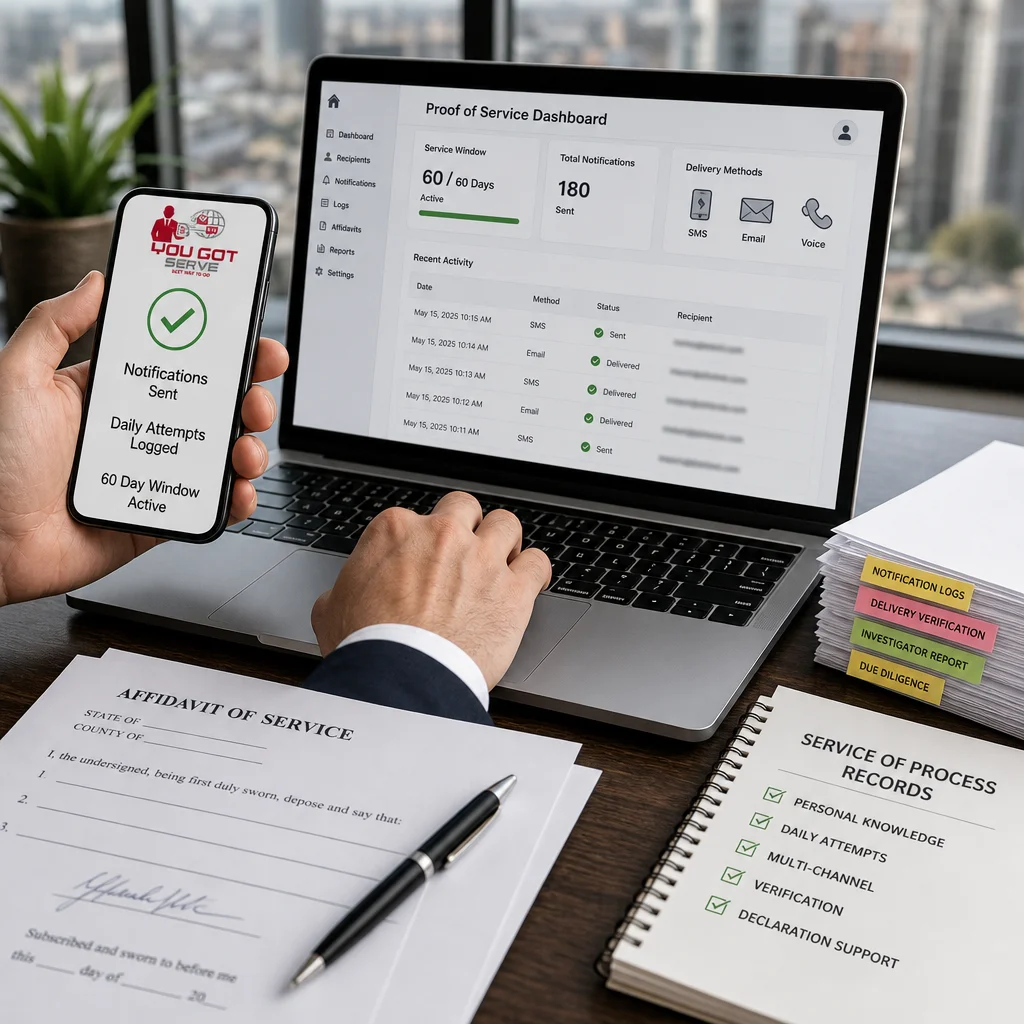
Multi-channel persistence works differently. If your SMS reaches the recipient but your email doesn’t, they still receive notice. If they ignore the first week of attempts, they see daily reminders in week two. If they’re traveling and miss an SMS, they find an email waiting when they return.
This redundancy serves two purposes. Practically, it increases the likelihood the recipient actually receives notice. Evidentiary, it creates a compelling record of genuine, persistent outreach.
Our platform sends notifications simultaneously across email, SMS, and WhatsApp (where available). A single recipient receives multiple daily attempts across these channels. Over 60 or 90 days, the volume of documented contact attempts becomes nearly impossible to credibly deny in court.
Courts also view multi-channel persistence as a modern best practice. It reflects how people actually communicate today. Relying solely on postal mail or a single email address feels outdated and increases the risk that courts will find your service insufficient.
Building Your Complete Service Package with You Got Serve
Serving a hard-to-find recipient requires a complete strategy, not piecemeal solutions.
Your package begins with investigating and locating current contact information. Next comes uploading your documents to our secure platform and selecting your service window (60 or 90 days). You enter up to three email addresses and three phone numbers per recipient, configure which verification features you want, and activate your campaign.
Our platform then handles the persistent notification work automatically. Daily messages go out across email, SMS, and WhatsApp. Every attempt is logged, timestamped, and recorded. Recipients access documents using a secure code, and that access is verified and timestamped on our platform.
As the campaign progresses, you can log into your account anytime to check status, review the notification log, and export activity reports. When you’re ready to file your affidavit, you have comprehensive documentation ready to attach as exhibits.
This end-to-end approach means you’re not juggling multiple vendors or platforms. Everything you need to serve documents electronically and document that service is in one place, designed to work together seamlessly.
Eligible organizations also receive a 10% discount, making the platform even more cost-effective for nonprofits, government agencies, and qualified entities.
Selection Guide: Choose the Platform That Delivers Court-Ready Documentation
If you need proof of service documentation that will withstand judicial scrutiny, you need a platform built specifically for that purpose.
You Got Serve combines persistent multi-channel notification with objective, timestamped documentation in a single integrated system. We automate daily outreach across email, SMS, and WhatsApp. We verify recipient access through secure codes and optional geolocation and selfie capture. We generate comprehensive activity logs that become exhibit-ready for your affidavit. We offer investigative skip tracing integration when you need help locating the recipient. And we keep detailed document tracking throughout your entire campaign.
The result is documentation that demonstrates genuine, persistent, documented good-faith effort to notify the recipient. That’s what modern courts expect, and it’s what we deliver.
Whether you’re a legal professional, self-represented litigant, collection company, or organization needing to reach a difficult-to-locate recipient, You Got Serve provides the court-ready documentation you need at a fraction of the cost of traditional alternatives. We handle the persistence and the documentation so your affidavit is supported by objective evidence rather than relying on your personal recollection alone.
Choose the platform designed specifically for comprehensive, court-defensible electronic service documentation. Choose You Got Serve.