
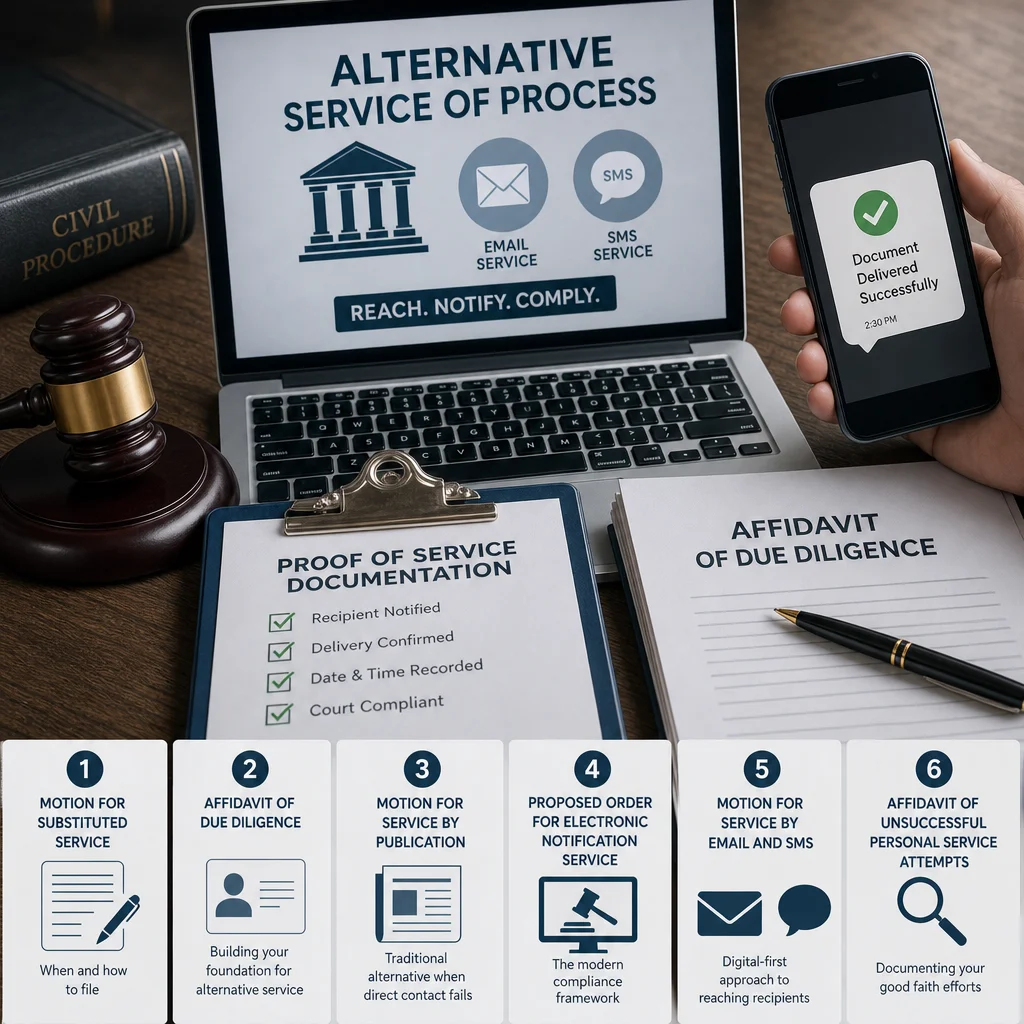
1. Motion for Substituted Service – When and How to File
When a defendant disappears, ignores mail, or simply refuses to accept service, traditional personal service becomes impossible. Courts recognize this reality and allow alternative methods, but only when you can demonstrate why standard approaches failed. The right motion and supporting affidavit can mean the difference between a case moving forward and a dismissal.
We’ve worked with legal professionals and self-represented litigants alike who face this exact challenge. The solution isn’t guesswork. It’s a structured approach using the seven key filings that courts recognize as legitimate pathways to service. Each one serves a specific purpose and requires precise documentation. Here’s what you need to know to file them correctly.
Substituted service allows you to leave documents with someone other than the defendant, or at an alternative location, when personal service proves impossible. This motion explains to the court why you cannot reach the defendant directly and why your chosen alternative location or person is reasonably likely to give actual notice.
Courts require you to show genuine efforts at personal service first. Typically, you’ll need to demonstrate multiple attempts on different days and at different times. Your motion should specify exactly where and when you tried to serve the defendant, who you encountered, and why substituted service at the proposed alternative location (often the defendant’s last known residence or workplace) makes sense.
The strength of your substituted service motion rests on detailed prior attempts. Document each effort with dates, times, and specific results. If you attempted service at 8 a.m. and found no one home, document it. If you returned at 2 p.m. and encountered a neighbor who said the defendant no longer lived there, include that detail. Courts view this pattern as evidence of diligence rather than carelessness.
Actionable takeaway: Before filing, compile a timeline of at least three documented attempts at personal service, including failed attempts on different days of the week and times of day. This foundation strengthens your motion and speeds court approval.
2. Affidavit of Due Diligence – Building Your Foundation for Alternative Service
An affidavit of due diligence is your formal, sworn statement that you’ve done everything reasonably possible to locate and serve the defendant. This document becomes the backbone of any alternative service motion. Without it, courts won’t consider alternative methods, regardless of how sensible they seem.
Due diligence means more than sending a single letter or knocking on one door. It means conducting a reasonable investigation given the circumstances. This typically includes contacting known family members, checking the defendant’s workplace if you have that information, visiting the last known address on multiple occasions, and sometimes reviewing public records or using skip-tracing services when the defendant has genuinely disappeared.
We help our clients create documented notification campaigns that form part of their due diligence record. When you need to serve someone at an unknown address, combining multiple notification channels through SMS, email, and WhatsApp creates a visible, timestamped record. Each failed delivery attempt becomes evidence that you tried everything reasonably available.
Your affidavit should explain not just what you did, but why you did it and what you learned. Write clearly and specifically: “I visited 405 Oak Street on March 10, 2026 at 9:30 a.m., spoke with the building manager who stated the defendant moved out in February, and left a note requesting contact information.” This narrative demonstrates reasonable investigation.
Actionable takeaway: Include investigative information in your due diligence affidavit: skip-trace results, responses from known contacts, failed mail deliveries, and employment verification efforts. Each data point strengthens your claim that the defendant is genuinely difficult to locate.
3. Motion for Service by Publication – Traditional Alternative When Direct Contact Fails
Service by publication allows you to serve a defendant through newspaper or court-ordered publication when you cannot locate them at all. This method is older, more expensive, and increasingly outdated, but courts still recognize it as a valid option when other alternatives are exhausted.
Filing a motion for service by publication requires you to prove that the defendant’s location is unknown despite reasonable efforts. You’ll need to show that you’ve checked public records, contacted known relatives, searched the defendant’s last known address, and attempted to locate current employment. The motion should explain why electronic or substituted service won’t work because you simply don’t know where the defendant is.
Once approved, you must publish a notice in a local newspaper for a specified period, typically 2-4 weeks. The court then must wait an additional period before proceeding, allowing time for the defendant to potentially see the notice. The entire process often takes 6-8 weeks and costs several hundred dollars in publication fees, making it considerably more expensive and slower than modern digital alternatives.
Courts increasingly understand that newspaper publication is inefficient for reaching modern defendants who rarely read classified notices. Yet some jurisdictions still require it or consider it a prerequisite for other methods. Always check your local court rules before filing.
Actionable takeaway: File a motion for service by publication only when other methods are truly exhausted. If you proceed, coordinate all publication requirements carefully and keep detailed proof that notices actually ran on the dates the court specified.
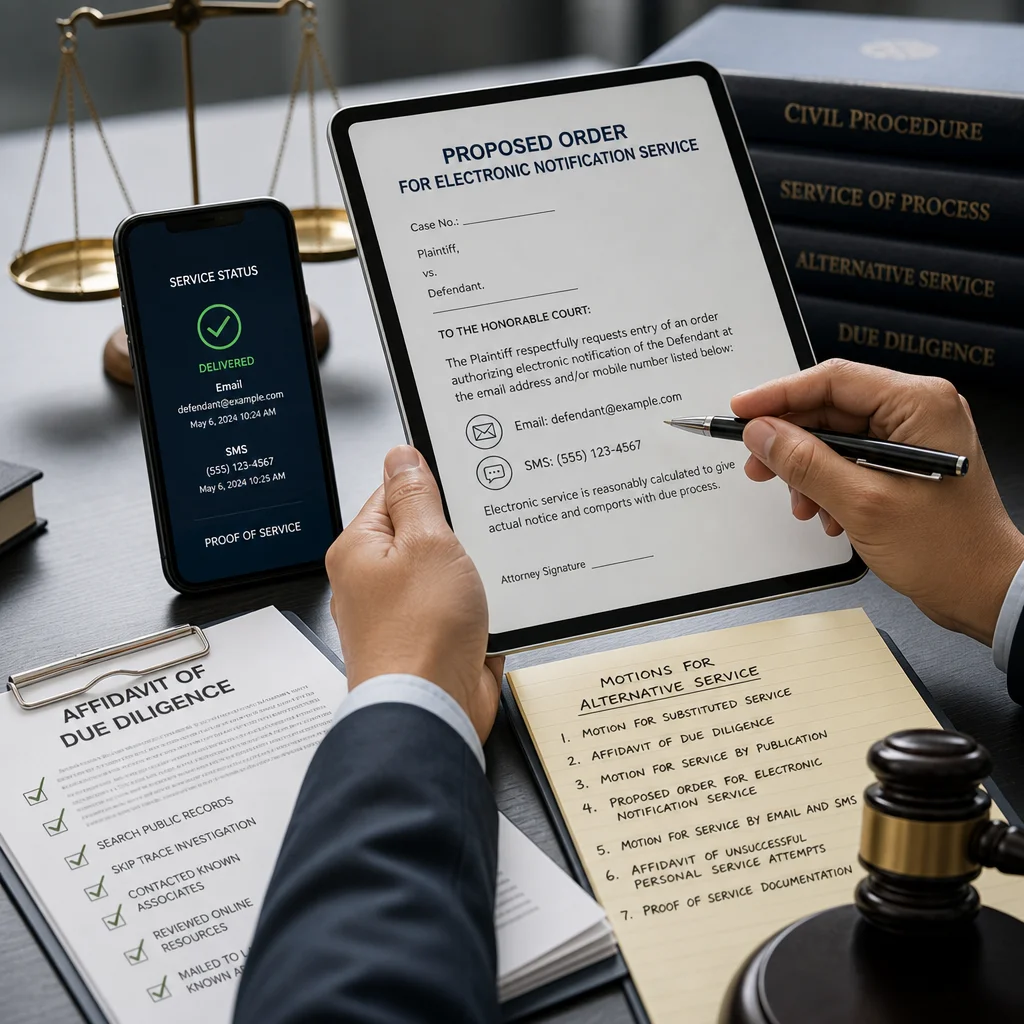
4. Proposed Order for Electronic Notification Service – The Modern Compliance Framework
A proposed order for electronic notification service is your blueprint for court-approved digital service. Rather than asking permission to try service by publication or traditional newspaper notice, you’re asking the court to authorize SMS and email delivery as primary notification methods.
This order works because it shows courts that you’re using reliable, documented technology. Electronic notification via SMS and email creates an automatic timestamped record proving when messages were sent and when they were delivered or failed. When the defendant activates a secure access code to view court documents, that action is recorded too. All of this documentation becomes your proof of service.
The proposed order should specify exactly how often notifications will be sent (daily, weekly, or on a defined schedule), how long the notification campaign will run, and which contact information you’ll use. It should reference your due diligence efforts and explain why electronic service is appropriate for your case. Most importantly, it should address verification methods: will the recipient need to confirm receipt, and what documentation will you provide to the court?
Courts appreciate orders that make electronic service systematic rather than ad hoc. Propose clear timelines, define success metrics (whether proof of access or simple delivery confirmation), and explain how your chosen method provides better notice than alternatives.
Actionable takeaway: When drafting your proposed order, specify whether you’ll use a single notification method or multiple channels (email, SMS, WhatsApp) to maximize the likelihood of actual notice. Multiple channels create documented redundancy that courts view favorably.
5. Motion for Service by Email and SMS – Digital-First Approach to Reaching Recipients
A motion for service by email and SMS is your direct request to use digital channels as your primary service method. This motion works best when you have verified email addresses or phone numbers for the defendant, even if they’ve proven unresponsive to traditional service attempts.
Your motion should explain that the defendant has email and phone contact information on file (from prior communications, business transactions, or social media), that personal service has failed despite reasonable efforts, and that electronic service through these channels is more likely to achieve actual notice than newspaper publication or other traditional methods.
The key advantage of digital service is speed. An SMS arrives within seconds. An email with a secure access link can be verified immediately if the recipient opens it. With electronic document delivery platforms, you can send repeated notifications over 60 or 90 days, creating an undeniable record of contact attempts. Each notification is timestamped and each access is logged.
Courts increasingly recognize that someone with an active email address or phone number is far more likely to notice digital messages than newspaper notices they’ll never see. Your motion should make this practical argument: electronic service is faster, more reliable, and less expensive than traditional alternatives, all while creating superior documentation.
Actionable takeaway: Attach copies of any communications proving the defendant has checked the email address or used the phone number you intend to serve. Recent text exchanges, email replies, or account activity demonstrates that service to these addresses will likely achieve actual notice.
6. Affidavit of Unsuccessful Personal Service Attempts – Documenting Your Good Faith Efforts
An affidavit of unsuccessful personal service attempts is your sworn statement proving that direct personal service genuinely failed despite repeated, documented efforts. This affidavit shifts the burden away from alternative service methods and onto demonstrable facts: you tried, it didn’t work, and now alternative service is necessary.
Structure this affidavit chronologically. Begin with your initial service attempt, specify the date, time, location, and what happened. Did you encounter the defendant? Did someone refuse service on their behalf? Was the address incorrect? Did the defendant refuse to open the door? Document every single interaction, including conversations with neighbors, building managers, employers, or mail carriers.
The most compelling affidavits include not just failures but explanations for why the defendant is evading service. Perhaps they’ve moved without providing a forwarding address. Perhaps mail is returned marked “address unknown.” Perhaps neighbors report that the defendant hasn’t been seen in weeks. These details matter because they show courts that impersonal, traditional service methods won’t work.
We see clients strengthen these affidavits by supplementing traditional service attempts with electronic notification attempts using multiple channels. When an SMS to the defendant’s known number bounces back as invalid, or when an email to a business contact address goes unanswered despite a read receipt, these documented failures become part of your affidavit. They prove that the defendant is genuinely unreachable through conventional means.
Actionable takeaway: For each service attempt in your affidavit, specify not just that it failed, but how you know it failed. A returned certified letter marked “refused” is better evidence than simply stating “service was refused.” Detailed descriptions create a compelling narrative.
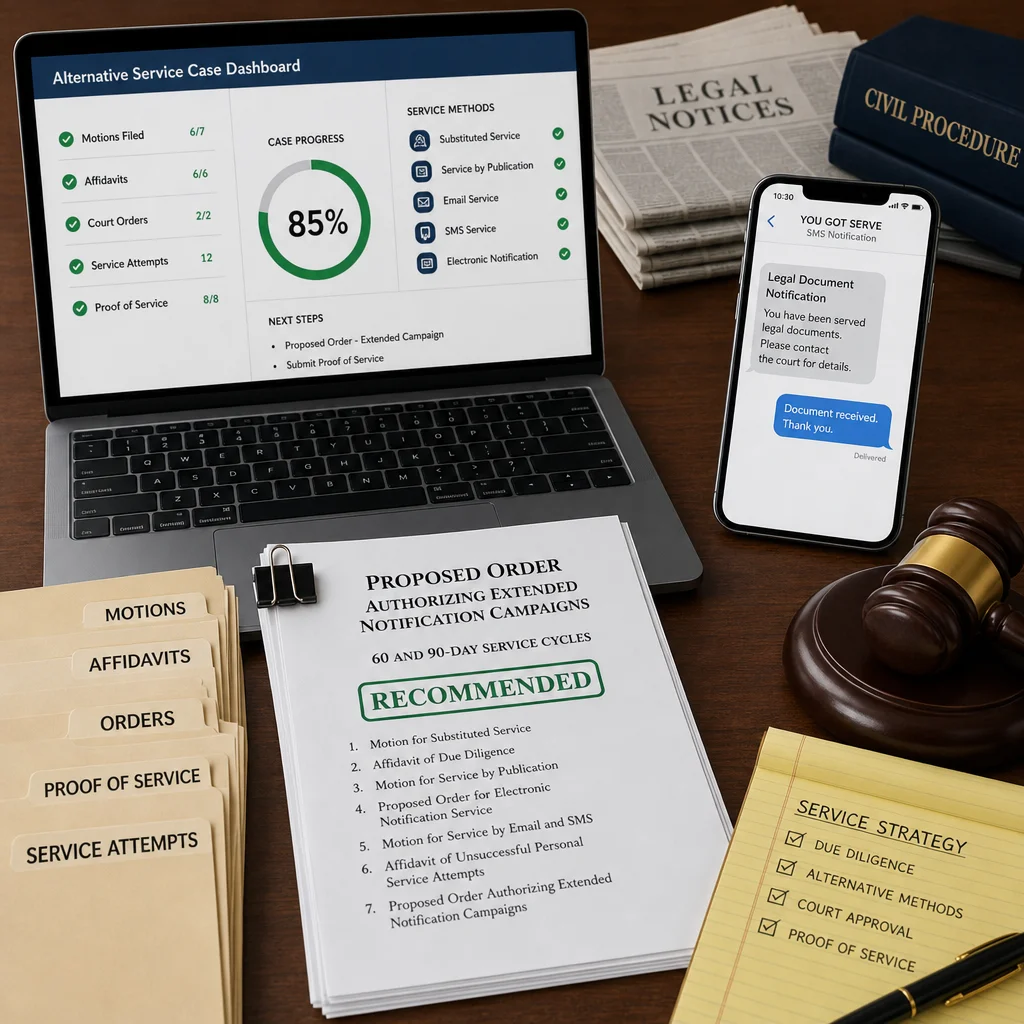
7. Proposed Order Authorizing Extended Notification Campaigns – Supporting 60 and 90-Day Service Cycles
A proposed order authorizing extended notification campaigns allows you to send repeated notifications over 60 or 90 days, maximizing the likelihood that a hard-to-reach defendant will eventually receive and process your court documents.
This order recognizes a modern reality: a single notification attempt might fail for legitimate reasons. The recipient’s phone might be off. Their email might be full. They might have temporarily lost access to their device. But repeated notifications over weeks or months, delivered through multiple channels, create an overwhelming likelihood that actual notice will occur.
Your proposed order should specify the notification frequency (daily, for example), the channels you’ll use (SMS, email, and WhatsApp where available), and the documentation you’ll provide to prove service. It should state that the recipient will access documents through a secure code-protected portal, with each access logged and timestamped. It should commit to providing the court with a final affidavit showing all notification attempts, their results, and any document access activity.
Courts appreciate orders that balance persistence with reasonableness. Notifying someone 90 times on the same day isn’t diligent; it’s harassment. But notifying them daily over 90 days, reaching them through multiple channels and providing verified access documentation, demonstrates genuine effort to achieve notice without abusing the process.
Actionable takeaway: When proposing an extended campaign, include specific language about your verification methods. Will you capture geolocation data? Will you require the recipient to enter a selfie before accessing documents? Will you log timestamps of document views? The more detailed your verification commitment, the stronger your order.
—
Successfully serving a hard-to-find defendant requires the right motion, a credible affidavit, and a clear strategy. You’re not asking courts for permission to skip due diligence. You’re asking them to recognize that you’ve done everything reasonably possible through traditional methods and now need access to more efficient, documented alternatives.
The filings we’ve outlined here work together. Your affidavit of due diligence establishes your good faith. Your motion for substituted, publication, or electronic service explains why you need an alternative. Your proposed order details exactly how service will occur and what documentation will prove it worked. Courts reward this organized, thoughtful approach.
When you’re ready to implement how it works, a digital-first platform designed for verified electronic service becomes invaluable. Rather than submitting affidavits based on theory, you submit affidavits backed by actual timestamped SMS and email notifications, secure document access logs, and verification data. You’re no longer hoping service worked; you’re proving it did.
We’ve designed our platform specifically for this purpose: persistent, multi-channel notification over extended campaigns, combined with secure code-protected document access and detailed delivery documentation. Whether you’re representing a client or managing your own case, this approach gives courts the confidence they need to approve alternative service and move your litigation forward.