

After repeated attempts to reach a defendant at home or work, another visit may not solve the problem. The next step is to assess which alternative service of process methods, if any, the applicable court rules allow and what evidence may be needed to request or use one. Failed attempts can explain why you are considering another approach, but they do not automatically authorize it.
The right approach depends on the jurisdiction, case type, service history, and any required court authorization. This guide explains common categories, including substituted service, mail, publication, and electronic delivery. It also explains why identifying a possible option is not the same as establishing that service is complete.
You’ll find practical ways to organize attempt logs, address research, and other documentation before reviewing next steps under the rules for your case. When traditional service has encountered difficulties, YouGotServe offers a technology-based way to document email and SMS notifications and recipient activity when electronic service is permitted or authorized. Those records can support review, but they do not establish by themselves that legal service is complete or that the recipient received or acknowledged the documents.
Key Takeaways
- Alternative service of process methods may include substituted service, posting, publication, or electronic delivery, but available options depend on the jurisdiction and case type.
- Before considering an alternative, identify the barrier to service, gather relevant evidence, review the governing rules, and determine whether court authorization is required.
- Keep accurate records of service attempts, including dates, locations, and relevant communications, to support a jurisdiction-specific review.
- Email and SMS delivery may be a technology-based option when traditional service has stalled and electronic service is permitted or authorized.
- Digital tracking and activity records can document notifications, but do not establish on their own that legal service is complete or that the recipient received or acknowledged the documents.
What Alternative Service of Process Means When Ordinary Service Stalls
Repeated attempts to reach someone can leave a legal matter at a standstill. Alternative service of process methods are procedures that may allow documents to be served in a different way when ordinary service faces a barrier. The available options and required steps depend on the jurisdiction, case type, and rules that apply.
A failed attempt is not itself an alternative method, and it does not prove that another method is allowed. Some options require advance court authorization. A method available in one type of case or jurisdiction may not be permitted in another. The general service of process overview discusses concepts such as substituted service, but the rules for the specific case control.
For a visual overview of service options, watch this educational video:
When does a service problem lead someone to consider alternatives?
An address may be unknown or outdated. A process server may make repeated unsuccessful attempts at a known location, or the recipient may appear to avoid contact. These circumstances can prompt a review of other procedural options, but they do not establish that any particular option is available.
Separate the practical problem from the legal process for responding to it. For example, an outdated address may point to a need for updated address research, while repeated unsuccessful visits to a current address may call for reviewing the attempt history. In either situation, the applicable rules determine what can happen next and whether a court order or other authorization is needed.
How is alternative service different from substituted service?
Substituted service is a distinct category, not a universal label for every alternative. Depending on the jurisdiction and case, rules may specify when it can be used, who may receive documents, and what additional steps are required. Terminology and prerequisites vary, so a procedure called substituted service in one place may not match the rules elsewhere.
Routine electronic communication is not automatically legal service either. Sending a text or email may notify someone, but notification alone does not establish that formal service requirements have been met. Electronic delivery may be considered only when the applicable rules permit it and any required authorization is in place.
Identify the governing jurisdiction and case type, then review the current rules or seek qualified legal guidance. This overview is general information, not legal advice.
Common Alternative Service of Process Methods and Their Limits
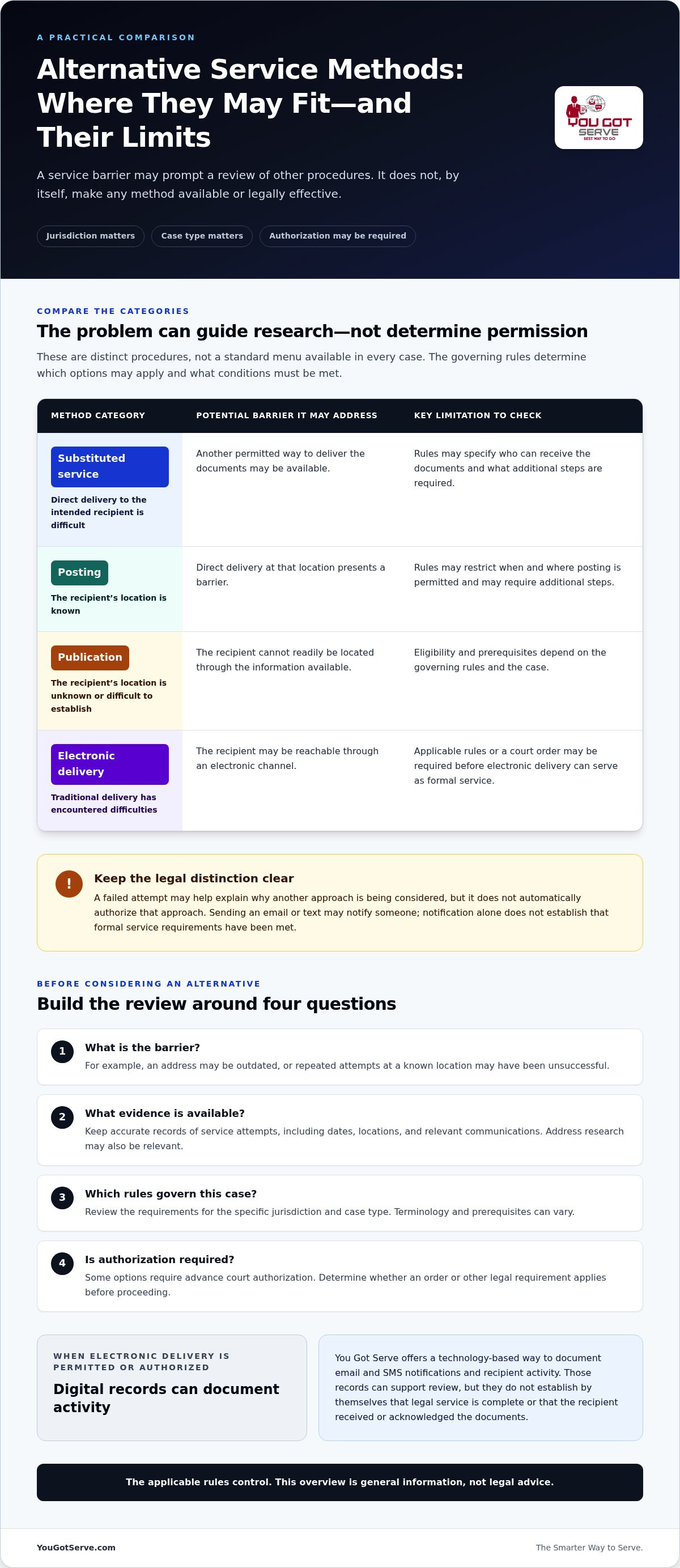
The phrase alternative service of process methods covers distinct procedures, not a standard menu available in every case. Rules may set different conditions for substituted service, posting, publication, and electronic delivery. The reason ordinary service stalled can help identify which category to research, but it does not establish that a method is available or legally effective.
| Method category | Potential barrier it may address | Key limitation |
|---|---|---|
| Substituted service | Personal delivery to the intended recipient has been difficult, while another permitted way to deliver documents may be available. | Rules may specify who can receive documents and what other steps are required. |
| Posting | The recipient’s location is known, but direct delivery presents a barrier. | Rules may restrict when and where posting is permitted, and may require additional steps. |
| Publication | The recipient’s location is unknown or difficult to establish. | Eligibility and any prerequisites depend on the governing rules and case. |
| Electronic delivery | Traditional delivery has encountered difficulties, and the recipient may be reachable through an electronic channel. | Applicable rules or a court order may be required before electronic delivery can serve as formal service. |
Substituted service, posting, and publication
Substituted service generally refers to serving someone through a method other than handing documents directly to that person. Posting and publication are separate categories, not interchangeable labels. A known location and an unknown address present different practical issues, but neither circumstance alone proves that a particular procedure is allowed.
Recipient location, case type, and jurisdiction can all affect whether these methods apply and what conditions must be met. Do not infer permission from a general description or assume that a procedure used in one case is available in another.
Email, text message, and other electronic methods
Email, text messages, and other electronic channels can deliver documents or notifications, but the technology itself does not authorize formal service. Court rules or an order may set conditions for electronic service, and those requirements vary by jurisdiction and case type. For a deeper discussion, see Electronic Service of Process: The Definitive Guide to Digital Legal Delivery in 2026.
When electronic service is permitted or authorized, You Got Serve offers recurring email and SMS notifications, secure document access, tracking, and downloadable activity records. These records document notification activity, but do not guarantee receipt, acknowledgment, or a legal outcome. Learn more about secure electronic document delivery. This information is general and is not legal advice.
How to Compare Methods Without Assuming One Is Automatically Valid
A method’s availability and legal effect are not automatic. Compare options by first identifying why ordinary service stalled, then reviewing the supporting evidence, the rules for the specific case, and whether authorization is required or already in place. This helps distinguish a potentially relevant option from a procedure that can actually be used.
Service method eligibility depends on the jurisdiction and case type. The same obstacle may lead to different procedural requirements under different rules. Even a clear record of unsuccessful attempts does not establish that another method is allowed or that service will be legally sufficient.
Which facts may help determine whether an option fits?
Start with what happened and what is known. Review documented attempts, available address or contact information, and the specific obstacle, such as an outdated address or difficulty reaching the recipient. Identify the case type and the court or rules governing the matter before comparing possible procedures.
Next, check whether the relevant rule sets conditions for the method or requires court authorization. One failed attempt does not automatically permit a different method. Court self-help resources can explain procedures in their own jurisdictions, but review the rules and instructions for the court handling your case.
What does documentation show, and what does it not prove?
Accurate records make the history easier to evaluate. Depending on the method, they may show dates, locations, how an attempt was made, relevant communications, or electronic activity such as notification timestamps. A clear record helps describe what occurred. It does not determine whether the procedure complied with the applicable rules.
That distinction applies to digital delivery, too. You Got Serve can record email and SMS notifications and recipient activity, with downloadable reporting. Those records document platform activity, but do not by themselves establish recipient receipt, acknowledgment, or legally sufficient service. For more on documenting service events, see Securing Court-Ready Proof of Service: The Complete Compliance Checklist (2026).
Use a straightforward review: identify the barrier, gather supporting records, confirm the applicable rules, and determine whether authorization is required. Whether service requirements have been met is a legal determination, not simply a conclusion drawn from a delivery log. This section provides general information, not legal advice.
Practical Steps Before Pursuing an Alternative Service Method
Preparation can clarify which alternative service of process methods may be relevant and what questions need legal review. Use the steps below to organize information. They are not a universal checklist of legally required evidence.
What information should be organized first?
Begin with the case type and the court handling the matter. Gather recipient details and service history in one place. Include known addresses and contact channels, along with the date, location, and outcome of each attempt. Preserve relevant communications that help explain the difficulty.
- Record observed facts: Note what happened during an attempt, such as whether anyone answered or whether the address appeared vacant.
- Separate facts from assumptions: Distinguish a confirmed address change from a belief that the recipient is avoiding contact.
- Keep records together: Organize attempt notes and related communications so the history can be reviewed as a whole.
A complete, factual record can clarify the barrier and support a review of possible next steps. It does not establish that a particular alternative is permitted, and no single list of evidence applies to every court or case.
When should authorization or legal review come before delivery?
Before using a different method, identify the rules that govern service in the specific case. Depending on those rules, a motion, court order, or other prerequisite may apply. Review current instructions through the court’s official resources and seek qualified legal guidance if the procedure or authorization requirement is unclear.
Authorization and documentation requirements vary by jurisdiction and case. A general online description should not be treated as permission to proceed. The relevant rules determine whether a method may be used and what must happen before or after delivery.
If the recipient appears to be avoiding service, How to Serve Someone Dodging Service: Practical, Lawful Next Steps offers related context. Keep the focus on verifiable events rather than conclusions about the recipient’s intent.
When electronic delivery is permitted or authorized, technology can help record notifications and activity. You Got Serve supports recurring email and SMS notifications, secure recipient access, tracking, and downloadable activity reporting. These records document platform activity, but do not guarantee receipt, acknowledgment, or legal sufficiency.
For a technology-based document delivery option when traditional service has reached a roadblock, learn about secure electronic document delivery. This article provides general information, not legal advice.
Where Secure Digital Delivery May Fit After Traditional Service Reaches a Roadblock
Email and SMS delivery may be a technology-based option when traditional service has encountered difficulties and electronic service is permitted or authorized for the specific case. It is not a universal substitute for other forms of service. Applicable rules may require court authorization or impose other conditions before electronic delivery can be used to serve legal documents.
A platform can send notifications and document activity, but it cannot decide whether a particular method satisfies the rules. Review the governing requirements before initiating electronic delivery, and treat the resulting records as documentation of platform activity rather than a legal determination.
What a digital delivery platform can document
You Got Serve provides recurring email and SMS notifications through 60-day and 90-day campaigns. These campaign periods describe the notification workflow, not legal deadlines or a promise that service will be completed. Recipients use a unique access code to access documents securely.
Tracking records can include notification timestamps and recipient activity. IP information and geolocation may also be recorded when available. Downloadable reporting helps organize these details for review. The records can show activity associated with the delivery process, but they do not guarantee that a recipient received or acknowledged a notification, that service is legally sufficient, or that a court will accept the method.
When You Got Serve may be a practical technology option
If traditional efforts have reached a roadblock, digital delivery may be worth considering after confirming that it is allowed or authorized for the jurisdiction and case type. For example, a law firm handling a matter involving a difficult-to-reach recipient may value a consistent record of notifications and activity while still following the applicable service rules.
The platform supports a documented workflow with recurring notifications, secure access, and activity tracking. It does not provide automatic judicial authorization, replace traditional service in every situation, or guarantee a legal result. A lawyer or self-represented party should assess the applicable requirements before relying on electronic delivery as formal service.
The Smarter Way to Serve means using technology to support a process while respecting its legal limits. Learn about You Got Serve’s secure delivery platform and how its notification and reporting features may fit when electronic service is permitted or authorized.
This article provides general information, not legal advice. Service requirements vary by jurisdiction and case type, and court authorization or other legal requirements may apply.
Choose the Next Step With Care
Alternative service of process methods are not interchangeable, and a failed attempt does not automatically authorize another approach. The appropriate option depends on the case, jurisdiction, available evidence, and any required court authorization. Keep accurate records, then review the current rules or seek case-specific legal guidance before proceeding.
When electronic delivery is permitted or authorized, You Got Serve offers recurring email and SMS notifications, secure document access through a unique recipient access code, and downloadable service reporting. Records may include timestamps, recipient activity, and IP or geolocation information when available. They document platform activity, but do not guarantee receipt, acknowledgment, legal sufficiency, or court acceptance.
For a technology-based option when traditional service reaches a roadblock, learn how You Got Serve supports documented digital delivery. This article is general information, not legal advice. With careful documentation and jurisdiction-specific review, you can approach the next step with greater clarity.
Frequently Asked Questions
What is alternative service of process?
Alternative service of process methods are ways of delivering legal papers other than the ordinary method used in a particular case. The meaning, available methods, and prerequisites depend on the jurisdiction and case type. A method described in general terms may not be available for your matter, and court authorization or another procedural step may be required. Review the rules that apply to your case. This information is educational, not legal advice.
Is alternative service of process allowed in every case?
No. Alternative service is not automatically allowed in every case. The governing rules, case type, recipient circumstances, and court requirements can affect whether a different method is available. Some situations may require prior court authorization or other procedural steps. Before relying on a method, review current rules and court instructions, and seek case-specific legal guidance. General information cannot determine whether service is sufficient in an individual matter.
Can legal papers be served by email or text message?
Sometimes, but sending legal documents by email or text does not automatically satisfy service requirements. Applicable rules may require court authorization or other conditions, and requirements vary by jurisdiction and case type. A digital platform can record notifications and activity, but those records do not guarantee that the recipient received or acknowledged the documents, that service is legally sufficient, or that a court will accept the method.
What happens if traditional service attempts are unsuccessful?
Keep an accurate record of what was attempted and when, then identify the rules and court procedures that apply to the case. Unsuccessful attempts do not automatically authorize another method. Depending on the circumstances, a court order or additional procedural steps may be required. Before changing methods, consider case-specific legal guidance. Record observable facts, such as dates and locations, separately from assumptions about why the recipient could not be reached.
Does alternative service require a court order?
It depends on the method, jurisdiction, case type, and applicable rules. Some procedures may require a request or court authorization, while others may have different conditions. Do not assume that a method is permitted simply because it is commonly discussed. Check current court instructions and seek qualified legal guidance about your specific matter before arranging service another way. A general article cannot determine the requirements for an individual case.
Is substituted service the same as alternative service?
Not necessarily. The terms may overlap in general discussion, but they should not automatically be treated as interchangeable legal categories. Substituted service may have its own requirements, while alternative service can refer more broadly to methods outside the ordinary method of service. Definitions and procedures differ across jurisdictions and case types. Use the terminology in the applicable court rules, and seek case-specific guidance if it is unclear which procedure applies.
Does a digital delivery record prove that service was legally completed?
No. A digital record can document platform events, including notifications, timestamps, and available recipient activity, but it does not itself establish that legal service requirements were met. That determination depends on the applicable rules, the case, and any required authorization. You Got Serve records notification and delivery activity, but does not guarantee receipt, acknowledgment, court acceptance, or a legal outcome. This information is general and is not legal advice.


