

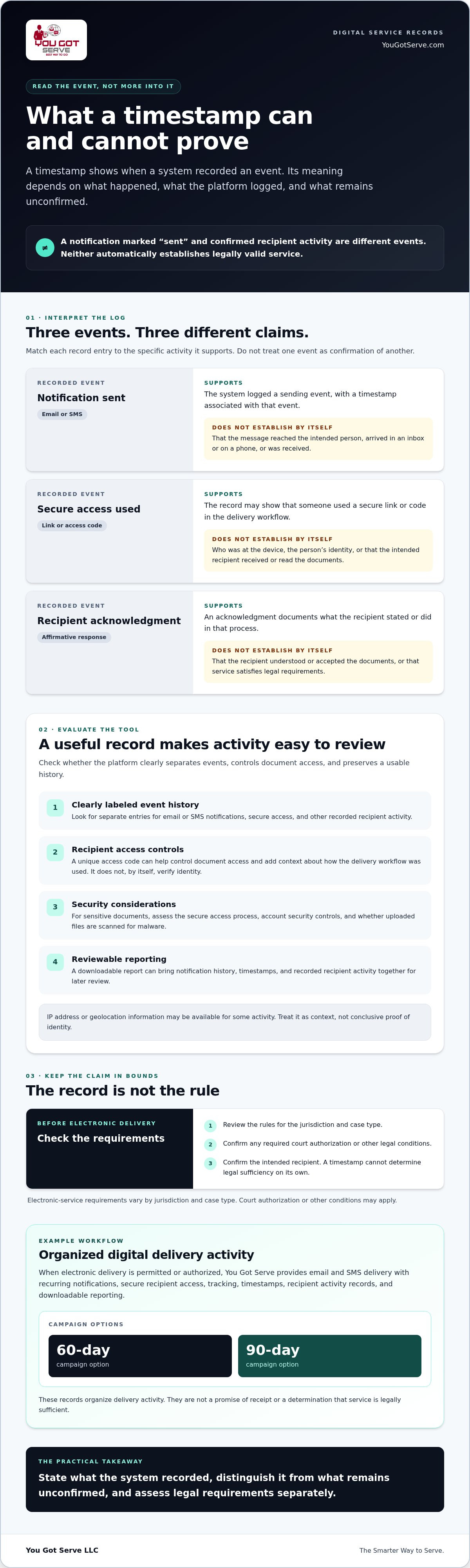
A timestamp can show that a system recorded an event. It can’t, by itself, prove that a recipient opened a notice, received the documents, or was legally served. That distinction matters when evaluating a timestamped proof of service: a notification marked as sent and confirmed recipient activity are different events, and neither automatically establishes that electronic service is valid in a particular case.
A digital record is most useful when it makes delivery activity easier to review and organize. Look for a clear account of what happened, when it happened, and what evidence supports each entry. The record should also make clear what remains unconfirmed. This article explains which events timestamps can document, what they can’t establish alone, and how to assess a tool’s security, activity tracking, and reporting.
Procedural rules come first. Electronic-service requirements depend on jurisdiction and case type, and court authorization or other conditions may apply. YouGotServe provides email and SMS delivery with recurring notifications, secure recipient access, tracking, timestamps, and documented activity for situations where traditional service is difficult and electronic delivery is permitted or authorized. The goal is a clearer record, not a promise of receipt or legal sufficiency.
Key Takeaways
- Assess a timestamped proof of service by checking which delivery events it records and whether it clearly separates notifications from recipient activity.
- Compare tools for secure document access, recipient access controls, a usable event history, and downloadable reporting.
- Match each recorded event to the factual claim it supports. A notification, access record, or recipient response documents different activity.
- Before using digital delivery, review the rules for the jurisdiction and case, then confirm any required authorization and the intended recipient.
- When electronic delivery is permitted or authorized, You Got Serve organizes email and SMS activity through recurring notifications and 60-day or 90-day campaign options.
What Does Timestamped Proof of Service Actually Document?
A timestamped proof of service record is a time-associated log of specific events recorded by a digital delivery platform. It can help organize a sequence, such as a notification being sent, secure access being opened, or a recipient submitting a response. The record documents what the system logged. It does not automatically prove who was at the device or whether the documents were legally served.
Each event supports a different factual statement. An email or SMS notification marked “sent” does not, by itself, show that it reached the intended person. An access event may show that someone used a secure link or code. A document-view event, if the platform records one, is distinct from an explicit acknowledgment. Neither alone establishes that the recipient understood or accepted the documents.
For background on how a cryptographically supported timestamp may be created and verified, see this explanation of trusted timestamping. A platform’s ordinary event timestamp should not be assumed to use that process. Its meaning depends on what the system captures and how the event is documented.
To see a timestamping service in action, watch this overview:
Which events can a digital delivery record capture?
A delivery record may include email and SMS notification history, timestamps associated with secure recipient access, and other activity recorded within the platform. Notification history documents that the system logged a sending event, not that the message successfully reached an inbox or phone. Access records add context about activity in the delivery workflow. IP address or geolocation information may also be available for some activity, but it should not be presumed for every event or treated as conclusive proof of identity.
Timestamp, receipt confirmation, and proof of service are different
A timestamp identifies when a system recorded an event according to its log. It does not, by itself, confirm receipt. Access activity indicates interaction with a delivery workflow, while an acknowledgment requires an affirmative response from the recipient. Even an acknowledgment documents only what the recipient stated or did in that process.
In short, a timestamped record documents when specified activity was logged; it does not alone establish receipt, reading, identity, or legally sufficient service. Whether electronic delivery satisfies procedural requirements depends on the jurisdiction, case type, applicable rules, and any required court authorization. A timestamp can support a service record, but it cannot replace those requirements or determine legal sufficiency on its own.
How to Compare a Legal Document Receipt Timestamp Tool
A useful tool should make it easy to distinguish a notification from recipient interaction, then preserve those events in a record that can be reviewed later. Before relying on a timestamped proof of service workflow, assess what the system records, how access is controlled, and whether its report presents the event history clearly. These features support organized documentation, but they don’t determine whether electronic service is permitted in a particular matter.
Rules depend on the court and case. For example, Federal Rules of Civil Procedure Rule 5 addresses service and filing of papers in federal cases, including electronic service under specified conditions. State rules and case-specific requirements may differ. For more background on the delivery process, see this guide to electronic service of process.
Tracking and recipient verification features to assess
Review whether the event history labels email or SMS notifications separately from secure-access activity and other recipient interactions. A log that identifies event types and timestamps helps users understand what the platform recorded, rather than treating every entry as confirmation of receipt.
Consider how the workflow controls access for the intended recipient. A unique access code can help control document access and contribute to a record of how the delivery workflow was used. It does not, by itself, prove who entered the code or establish that the person received or read the documents. IP and geolocation details may add context when available, but they should not be treated as conclusive identity verification.
Security and reporting features that support usable records
Assess whether documents are accessed through a secure process, such as a unique recipient access code, and whether the platform describes its account security controls. For sensitive legal documents, consider whether the platform scans uploaded files for malware. These are security questions, not proof that service was legally sufficient.
Reporting matters, too. A downloadable report should make it practical to review notification history, timestamps, and recorded recipient activity together. You Got Serve provides secure code-based access, tracking, timestamps, recipient activity records, malware scanning, and downloadable reporting to organize digital delivery activity. IP and geolocation information may be available when recorded.
- Event history: Are notifications distinguished from access and other activity?
- Recipient workflow: Is document access controlled, and is the role of any verification step clear?
- Record review: Can the event history and timestamps be downloaded in a usable report?
- Security: Does the platform describe file scanning and account protections?
When traditional service reaches a roadblock and electronic delivery is permitted or authorized, You Got Serve’s digital delivery platform provides a technology-based way to track notifications and recorded activity.
What Timestamps Can and Cannot Establish in a Service Record
A timestamp helps place a recorded event in sequence, but the event type determines what it can support. A notification attempt, document access, and recipient response are not interchangeable. To read a timestamped proof of service accurately, describe each recorded event narrowly and avoid drawing conclusions the log itself does not establish.
| Recorded event | What it may support | What it does not establish by itself |
|---|---|---|
| Notification sent | The system logged an attempt to send an email or SMS at a particular time. | That the message reached the recipient, was seen, or included documents the recipient could access. |
| Access recorded | The platform logged activity in a secure access workflow at a particular time. | The identity of the person using the access method, or that the person read or understood the documents. |
| Recipient response | A response or acknowledgment was recorded, if the recipient submitted one. | That all requirements for legal service have been met. |
| Legal sufficiency | Must be assessed under the applicable rules and case circumstances. | Cannot be determined by a timestamp alone. |
How to read notification and access timestamps
Read the event label and its timestamp together. For example, “SMS notification sent” records a sending event. “Secure access opened” describes a different platform event. Neither wording should be expanded into “recipient received the documents” unless the record supports that specific fact. IP or geolocation details may be available for some activity, but they are contextual information, not conclusive proof of a person’s identity or location.
Why a timestamp does not decide legal sufficiency
Whether a delivery method is acceptable depends on the jurisdiction, case type, governing rules, and any authorization required in the case. In federal matters, the Federal Rules of Civil Procedure provide rules for serving papers; state requirements may differ. Review the rules that govern the specific matter and obtain court authorization where required. A well-organized event record can document platform activity, but it cannot authorize a method or decide whether service is legally sufficient.
For related recordkeeping considerations, review this court-ready proof-of-service guidance. Keep the distinction clear: report what the system recorded, then assess that evidence under the applicable procedural requirements.
A Practical Workflow for Evaluating Timestamped Service Records
Review a digital service record in order: first determine whether electronic delivery is appropriate under the rules for the case, then assess whether the event history clearly documents what the platform recorded. Keeping procedural requirements separate from technical tracking helps prevent a timestamp from being treated as more than it shows.
Before sending: check the case and the intended recipient
Start with the rules that govern the jurisdiction and case type. Determine whether electronic service is permitted and whether a court order, consent, or another authorization is required. A platform can document activity, but it cannot supply legal authorization or replace a required procedural step.
Next, identify the intended recipient and review the contact information being used. Understand how the platform’s documented verification process associates a recipient with the delivery workflow. For example, secure access using a unique recipient code can help control document access, but the existence of a code does not independently prove who used it. Keep this technical detail distinct from any legal standard for identifying or serving a party.
After sending: review and retain the activity record
Once the delivery workflow is underway, assess the record against these steps:
- Read event labels precisely. Separate notification history from secure-access activity, recipient responses, and any other logged events. A notice marked sent is not automatically confirmation of receipt.
- Check timestamps and available details. Confirm that each timestamp is tied to a clearly described event. Review IP or geolocation information only when available, and treat it as context rather than conclusive proof of identity.
- Download and retain the report. Save the service report with relevant case documentation so the recorded timeline can be reviewed alongside other records. Preserve the context needed to explain what each event represents.
- Determine next steps under the applicable rules. If the record shows no access or response, don’t assume that the notice was received. Consider any follow-up or alternative action required by the governing rules or case circumstances.
This review makes a timestamped proof of service record more usable by connecting each entry to a specific system event, without treating the report as a legal conclusion. You Got Serve organizes email and SMS notification history, timestamps, recipient activity, and downloadable reporting in one digital delivery workflow. Electronic delivery remains subject to applicable rules and authorization.
Explore You Got Serve’s digital delivery workflow to see how notification tracking and documented activity can fit into your service records.
How You Got Serve Records Digital Delivery Activity
When traditional service is difficult, electronic delivery can offer a different technology-based approach if it is permitted or authorized for the case. You Got Serve provides a secure email and SMS platform that organizes notifications and recorded recipient activity into a reviewable service record. The platform documents activity within its workflow. It doesn’t guarantee that a recipient received or read the documents, or that the record will satisfy a court’s requirements.
What the You Got Serve activity record includes
The workflow includes automated recurring daily email and SMS notifications, with 60-day or 90-day campaign options. Documents are made available through secure recipient access using a unique access code. The record can include notification history, timestamps, and recipient activity, helping users distinguish a notification event from later activity in the access process.
IP address and geolocation information may be recorded when available. These details can provide context about platform activity, but they don’t conclusively identify the person using a device or prove actual receipt. Downloadable reporting brings recorded events together for review and retention alongside case documentation. As with any timestamped proof of service, the report should be read as a record of what the platform logged, not as a legal conclusion.
The digital delivery workflow is patent-pending. That describes the status of the workflow, not an issued patent or a guarantee of legal sufficiency.
When a digital delivery workflow may fit
A law firm trying to reach a difficult-to-contact party in a family matter, or a property manager dealing with an eviction-related document, may consider digital delivery when ordinary efforts have reached a roadblock. Recurring notices and a consolidated activity record can help keep delivery events organized rather than scattered across separate email, text, and case-management records.
Electronic delivery is not a universal substitute for other service methods. Requirements depend on jurisdiction and case type, and court authorization or other conditions may apply. Review the governing procedure before using a digital workflow, and keep the platform’s technical record separate from the legal determination of whether service was properly completed.
To learn how email and SMS delivery, secure recipient access, and documented activity fit together, learn more about You Got Serve.
Make Your Service Records Clearer and More Useful
A timestamped proof of service is most useful when its events are clearly identified and accurately described. A notification log, secure-access record, and recipient response each document different activity. None should be treated as proof of actual receipt or legal sufficiency unless the evidence supports that conclusion.
Before using digital delivery, check the rules for the jurisdiction and case type, including whether authorization is required. Then evaluate whether the workflow provides a clear event history, secure recipient access, and downloadable reporting. You Got Serve records notification history and timestamps, uses secure recipient access codes, and tracks recipient activity. IP and geolocation information may be available, but doesn’t guarantee receipt or establish identity.
When traditional service reaches a roadblock, a technology-based workflow may offer another option if electronic delivery is permitted or authorized. Learn how You Got Serve documents digital delivery activity and explore a more organized way to track the process.
Frequently Asked Questions
What does a timestamped proof-of-service tool record?
A timestamped proof of service tool records specified platform events and the times they occurred. Depending on the workflow, its log may show email or SMS notifications, secure document access, recipient activity, or an explicit response. Some records may include IP or geolocation information when available. Read each entry according to its event label: a notification attempt, an access event, and an acknowledgment describe different actions.
Does a timestamp prove that someone received legal documents?
No. A timestamp shows when the system logged a particular event, such as a notification being sent. It doesn’t by itself establish that the message reached the intended person, that the person opened or read the documents, or that service was legally sufficient. Review the event details and any supporting records, then assess them under the rules that apply to the specific case.
Is timestamped electronic service valid in every case?
No. Whether electronic service may be used depends on the jurisdiction, case type, applicable rules, and any required court authorization or other conditions. A digital platform can record delivery-related activity, but it cannot independently authorize electronic service or establish that procedural requirements have been met. Check the rules governing the matter before relying on electronic delivery. This information is educational, not legal advice.
What information should a legal document delivery report include?
A useful report should clearly identify the events the platform recorded, with associated timestamps and notification history. It should distinguish sending a notification from secure access, recipient activity, or a submitted response. Where available, IP or geolocation details can provide context, but they are not conclusive identity proof. A downloadable report can help organize these records for review alongside relevant case documentation.
Can an email or SMS timestamp show that a recipient opened a document?
Not by itself. A timestamp associated with an email or SMS notification generally records a sending event, not that the recipient opened the message or its linked documents. A platform may separately record secure-access activity, if that feature is part of the workflow. Even then, an access timestamp documents activity in the system; it doesn’t alone prove who accessed the documents or whether they read them.
How do I choose a timestamped proof-of-service tool?
Look for an event history that separates notifications from recipient interactions, clear timestamps, secure document access, and downloadable reporting. Review what recipient verification steps the workflow documents, and whether IP or geolocation information may be available. The record should make it practical to understand what happened without overstating what an event proves. Also check the legal requirements and authorization that apply to your case before using electronic delivery.
Can You Got Serve replace a traditional process server?
No. You Got Serve provides electronic document delivery by email and SMS, a technology-based option when traditional service is difficult and electronic delivery is permitted or authorized. It isn’t a universal replacement for traditional service. Requirements vary by jurisdiction and case type, and court authorization or other legal steps may apply. The platform documents notifications and activity, but doesn’t guarantee recipient receipt, court acceptance, or a legal outcome.


