

Digital litigation support is most useful when it helps legal teams organize important steps and document what happened. When delivery, follow-up, and recordkeeping take place across separate tools, it can be difficult to see what was sent and when. An electronic service of process provider can record notifications and recipient activity, but it cannot determine whether electronic service is permitted in a particular case.
That distinction matters. Digital tools can help manage legal work, but they do not replace legal judgment or procedural requirements. Electronic-service rules vary by jurisdiction and case type, and court authorization or other requirements may apply, especially for initial service of process.
This guide explains common categories of digital litigation support, how secure delivery and activity records can fit into legal workflows, and what to establish before using electronic delivery. It also distinguishes e-filing from e-service and describes how YouGotServe’s email and SMS platform can support a workflow when its use is permitted or authorized. This article provides general information, not legal advice.
Key Takeaways
- Separate litigation-support technology from legal representation and court functions when deciding which tasks a digital tool can support.
- Map how documents move through your workflow, from authorized delivery to activity records, to identify where secure access and tracking may help.
- Compare electronic delivery with physical service by considering the matter’s needs, the records each method creates, and whether electronic service is permitted or authorized.
- Establish the requirements that apply to the jurisdiction and case type before using an electronic service of process provider.
- Consider how recurring email and SMS notifications, secure recipient access, and downloadable reporting could fit into your legal-document delivery workflow.
What Digital Litigation Support Services Cover in a Legal Workflow
Digital litigation support uses technology to organize and document operational tasks connected to legal matters. It is separate from legal representation, legal advice, and court functions. These tools can organize legal documents, coordinate delivery, and record related activity, but they do not decide whether a legal requirement has been satisfied.
For example, a law firm might use digital systems to manage document access and delivery follow-up, while a paralegal reviews communications and saves activity records to the matter file. A collection agency, landlord, or self-represented individual may also need an organized way to send documents and track related notifications. This overview of service of process explains the legal concept behind formal delivery.
For a foundational explanation of the process, watch this video:
Which tasks can digital litigation support help organize?
Separate the workflow into four tasks: preparing documents, controlling access, following up on delivery, and documenting notifications or recipient activity. This makes it easier to see what a platform does and what still needs human review. For instance, a paralegal can use an activity record to update a matter file, while an attorney assesses its procedural significance.
YouGotServe facilitates document delivery by email or SMS and records related platform activity. The record can support case administration, but it does not establish on its own that a recipient received or acknowledged a document, or that a legal service requirement was met. Tracking documents platform activity, not a legal determination.
How is litigation support different from legal advice?
Software can organize documents, facilitate delivery, and record events. It does not analyze a case, develop legal strategy, interpret court rules, or decide which method of service is appropriate. Those judgments require legal review based on the matter and applicable requirements.
Before relying on electronic delivery, assess the procedures for the specific case and jurisdiction with appropriate legal guidance. Requirements vary, and court authorization or other conditions may apply. This article provides general information, not legal advice.
How Digital Litigation Support Workflows Move Information Securely
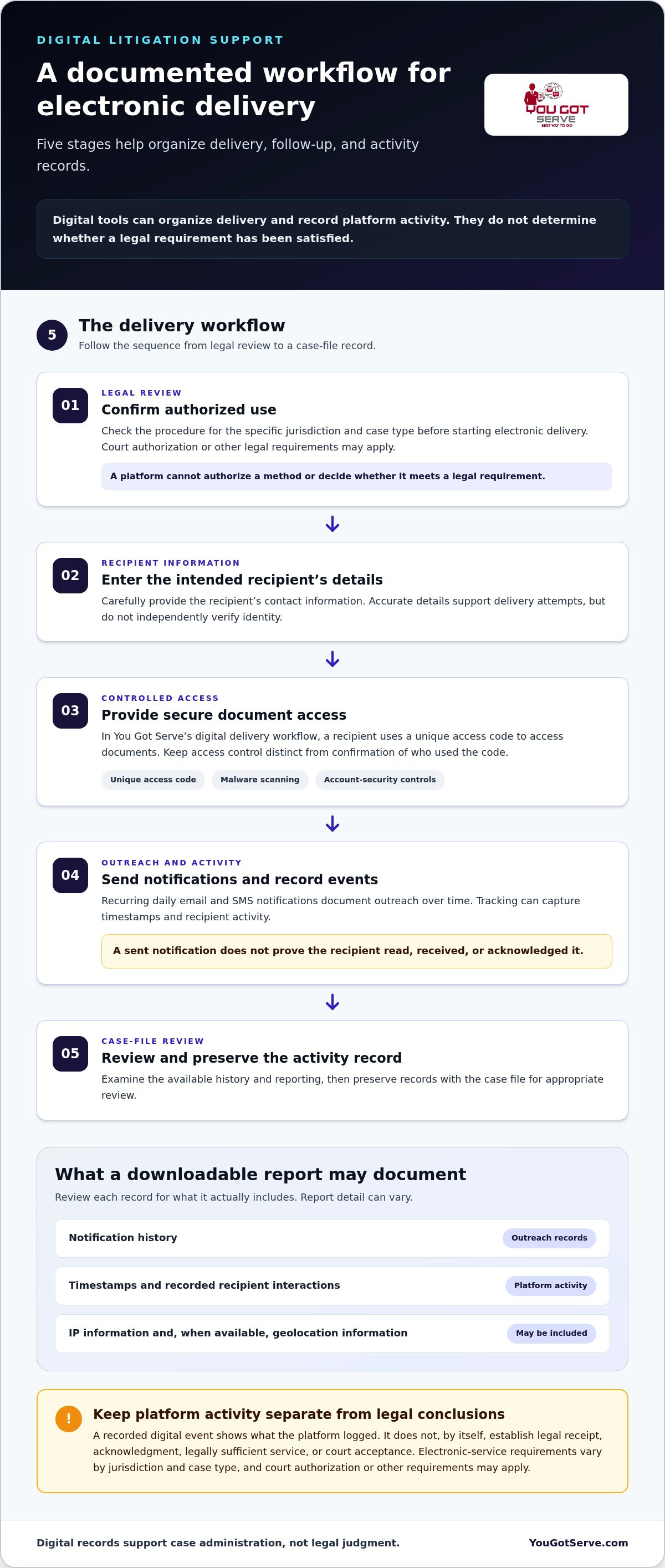
A well-organized digital workflow separates authorization, recipient details, document access, notifications, and recordkeeping. Each step serves a different purpose. Establish that electronic delivery is permitted or authorized for the specific matter before using it. Requirements vary by jurisdiction and case type, and court authorization or other legal conditions may apply. For federal civil cases, consult the applicable Federal Rules of Civil Procedure and relevant court requirements.
- Confirm authorized use. Determine the applicable procedure before starting electronic delivery. A platform cannot authorize a method or decide whether it meets a legal requirement.
- Enter recipient details. Carefully provide the intended recipient’s contact information. Accurate details support delivery attempts, but do not independently verify identity.
- Provide secure document access. A unique recipient access code can add a controlled step before documents are accessed. Keep access control distinct from confirmation of who used the code.
- Send and record notifications. Email and SMS reminders can document outreach over time. A sent notification does not prove that the recipient read, received, or acknowledged it.
- Review the activity record. Examine the available history and reporting, then preserve the records with the case file for appropriate review.
What happens during secure electronic document delivery?
On YouGotServe, a recipient uses a unique access code to access documents through the digital delivery workflow. Recurring daily email and SMS notifications document outreach, while tracking can capture timestamps and recipient activity. These are separate indicators: a notification, an access event, and a confirmed identity are not the same thing.
Security involves more than an access code. Malware scanning and account-security controls are also part of the digital document workflow. These safeguards do not establish legal receipt or service. No technical event should be treated as a legal conclusion.
What information can a service record document?
A downloadable report can organize platform activity, including notification history, timestamps, and recorded recipient interactions. IP information and, when available, geolocation information may also be included. The detail can vary, so review each record for what it actually documents.
A recorded digital event shows what the platform logged; it does not, by itself, establish legally sufficient service. An electronic service of process provider can help create an organized activity record, but the report does not guarantee receipt, acknowledgment, legal sufficiency, or court acceptance. YouGotServe offers secure legal-document delivery by email and SMS when use is permitted or authorized. Explore secure document delivery as one part of a carefully managed workflow.
Digital Litigation Support Versus Traditional Service: Know the Boundaries
Physical service and electronic delivery follow different workflows and create different kinds of records. Neither method is right for every matter. A digital platform can organize delivery activity, but the technology alone does not make a method legally sufficient or replace applicable service requirements.
| Consideration | Physical service | Electronic delivery |
|---|---|---|
| Workflow | A person attempts to deliver documents directly to the recipient under the applicable procedure. | Documents are made available through a digital process, often with email or SMS notifications and secure access. |
| Record type | Records may describe attempts and their reported outcomes. | Records may include notification history, timestamps, and recorded recipient activity. |
| Potential context | May be required or appropriate under the rules for the case. | May be considered when traditional service encounters difficulty and electronic service is permitted or authorized. |
When might a technology-based delivery workflow be considered?
A recipient who is difficult to reach can create a practical obstacle in a civil matter, eviction-related dispute, family case, or collection matter. That obstacle may lead a legal team to assess other methods, but it does not justify bypassing required procedures. Suitability depends on the governing rules, the facts of the case, and any authorization required for the documents and recipient.
An electronic service of process provider can support a technology-based delivery workflow when its use is permitted or authorized. It cannot determine whether that condition has been met. Establish the requirements for the jurisdiction and case type before relying on electronic delivery.
What digital records can and cannot establish
Digital records can show which notifications a platform sent and what activity it recorded. Depending on the system, a record may include timestamps or information associated with an access event. These details can help a legal team document platform activity, but they do not necessarily establish who viewed a document, whether the intended recipient received it, or whether that person acknowledged it.
A digital record documents an event; it does not determine the legal effect of that event. The applicable rules and, where relevant, the court determine whether documentation is sufficient for a particular matter. A digital record does not guarantee court acceptance, and electronic delivery is not an automatic substitute for personal service. Technology can support a workflow, while legal requirements govern whether a method is available and effective.
How to Assess Digital Litigation Support for a Legal Matter
Assess the legal procedure before selecting a digital workflow. Electronic delivery may help coordinate document handling and follow-up, but it should not be assumed to replace required service methods. An electronic service of process provider can record delivery-related activity; it cannot determine whether using that method is appropriate for a particular matter.
What should legal teams clarify before electronic delivery?
Before initiating delivery, establish the requirements that apply to the specific case. Rules vary by jurisdiction and case type, and court authorization or other requirements may apply. Use this checklist to organize the review:
- Jurisdiction and case type: Identify the governing jurisdiction and type of matter. Do not assume a method permitted in one context applies to another.
- Recipient and document: Confirm the intended recipient and the documents involved. Accurate contact details support a well-managed workflow, but do not establish legal permission to use electronic delivery.
- Authorization: Determine whether electronic delivery is permitted for this purpose or whether court authorization or another condition is required. Resolve that question before sending documents.
- Access and security: Consider how recipients will access documents and how the workflow controls access. Assign responsibility for handling access issues.
- Records and retention: Decide what documentation the matter requires, who will review activity reports, and how records will be preserved in the case file.
For cross-border matters, account for applicable laws, rules, treaties, and court authorization. International delivery can involve requirements beyond a domestic workflow, so assess them before proceeding.
How can organizations make the workflow manageable?
Assign clear ownership for each operational step. One person may prepare the campaign and enter recipient information; another may review notifications and activity reports; a designated team member can save relevant records to the case file. Defined responsibilities help prevent gaps, especially when several matters are active at once.
Organizations with recurring legal-document needs can establish a consistent internal process for intake, authorization review, delivery setup, monitoring, and record retention. Keep room for case-specific review. A process used for one eviction matter, family case, or collection should not automatically be assumed suitable for another.
Confirm authorization and plan recordkeeping before delivery begins. This keeps the legal decision separate from the platform’s operational role and gives the team a clear process for reviewing the resulting documentation.
When electronic delivery is permitted or authorized, YouGotServe provides a digital workflow for email and SMS notifications, secure recipient access, activity tracking, and downloadable reporting. Explore digital document delivery as an option for organizing delivery activity and records.
Where YouGotServe Fits in Digital Litigation Support
You Got Serve LLC is a technology platform for legal-document delivery by email and SMS. For law firms managing a matter where traditional service has encountered difficulty, it offers a different digital workflow when electronic delivery is permitted or authorized. The platform supports delivery and recordkeeping within a broader legal process. It does not provide legal representation or determine whether a method satisfies the requirements of a case.
How YouGotServe supports a documented delivery workflow
The platform uses a unique recipient access code for document access and can send recurring email and SMS notifications. Activity tracking records notification history, timestamps, and recipient activity. IP and geolocation information may also be available. These records help legal teams review and document what the platform logged, but do not establish that a recipient received, read, or acknowledged a document.
You Got Serve offers 60-Day and 90-Day Digital Service Campaigns. Their use is subject to applicable rules and authorization. The platform’s workflow is patent-pending, not a guarantee of legal sufficiency or a legal outcome. A downloadable report records platform activity, but whether that documentation is sufficient for a particular matter depends on the applicable requirements.
An electronic service of process provider can support the operational side of a legal workflow by sending notifications, enabling secure document access, and organizing activity records for review. The legal team remains responsible for determining whether electronic delivery is appropriate for the specific case and for taking any steps required by the governing procedures.
What to consider before getting started
Requirements for electronic service vary by jurisdiction and case type. Court authorization or other legal requirements may apply, so establish the rules for the matter before initiating delivery. Use platform reporting as documentation of recorded activity, not as proof of receipt or a substitute for required service methods.
When traditional service reaches a roadblock, a technology-based approach may be worth considering if its use is permitted or authorized. To learn more about the platform and its delivery workflow, learn more about YouGotServe. This information is general and is not legal advice.
Build a More Organized Legal Workflow
Digital litigation support can help legal teams organize document delivery, follow-up, and records, but technology does not determine whether a legal requirement has been met. Before using electronic delivery, verify the rules for the jurisdiction and case type, including whether court authorization or other requirements apply. Keep technical records distinct from the legal assessment of service.
When electronic delivery is permitted or authorized, You Got Serve provides a technology-based option for legal-document delivery. Secure recipient access uses a unique access code, while recurring email and SMS notifications document outreach. Downloadable reporting can include timestamps and recipient activity. These records document platform activity, but do not guarantee receipt, acknowledgment, or legal sufficiency.
If traditional service has reached a roadblock, a different digital workflow may be worth considering where applicable rules allow it. Learn more about YouGotServe and its document-delivery platform. Visit YouGotServe.com to explore the platform and its campaigns. With clear authorization and thoughtful recordkeeping, legal teams can add structure to delivery workflows while keeping case-specific decisions where they belong.
Frequently Asked Questions
What are digital litigation support services?
Digital litigation support services use technology to organize operational tasks connected to legal matters. Depending on the tool, these tasks may include managing documents, enabling secure access, sending delivery notifications, and recording platform activity. The technology supports workflow administration; it does not provide legal representation, decide legal strategy, or determine whether a procedural requirement has been met. Legal teams still need to assess the rules for each matter.
Can digital litigation support replace traditional process serving?
No. Digital litigation support is not a universal replacement for traditional process serving. Electronic delivery may be an option when traditional service has encountered difficulty and its use is permitted or authorized for the matter. The appropriate method depends on applicable rules, case type, facts, and any required court authorization. Treat digital tools as workflow support, not as permission to bypass a required service method.
Is electronic document delivery proof that someone received legal papers?
No. A delivery notification, timestamp, or recorded access event documents activity captured by a platform, but does not necessarily prove that the intended recipient received, read, or acknowledged the documents. A unique access code can control document access, while tracking can record certain interactions. These records may help document a workflow, but they do not establish legal sufficiency or guarantee a particular court’s acceptance.
What features should legal teams look for in a digital support platform?
Look for features that help manage access, follow-up, and recordkeeping, such as secure recipient access using a unique code, recurring email and SMS notifications, activity tracking, timestamps, and downloadable reporting. Account security controls and malware scanning can also support document handling. An electronic service of process provider can record platform activity, but features alone do not determine whether electronic service is permitted or legally sufficient for a specific case.
How can attorneys document electronic delivery activity?
Attorneys can preserve available platform reports with the case file and follow an internal process for reviewing notification history and recipient activity. Reports may include timestamps and, when available, IP or geolocation information. Record what the platform documents without treating an access event as proof of identity, receipt, or acknowledgment. The applicable rules and court determine whether records are sufficient for the particular matter.
Does electronic service require court authorization?
It may. Requirements vary by jurisdiction, case type, and the documents involved. Court authorization or other legal requirements may apply, so establish the procedure for the specific matter before initiating electronic delivery. A platform can support delivery and document activity, but it cannot authorize a method or decide whether legal requirements have been met. This FAQ provides general information, not legal advice.
Can legal documents be delivered electronically across borders?
Electronic delivery across borders may be subject to the laws and rules of the jurisdictions involved, applicable treaties, and court authorization. Do not assume that a method permitted for a domestic matter also applies to an international recipient. Establish the requirements for the specific case and destination before proceeding. A digital platform can record delivery-related activity, but it does not ensure compliance with cross-border requirements or guarantee legal sufficiency.


