

A delivery timestamp can show that a message went out. On its own, it cannot establish that service was legally sufficient. That distinction is central to legal tech for process serving: digital tools can make follow-ups and recordkeeping easier, but applicable rules and any required court authorization still govern how documents may be served.
For legal teams, scattered service records and repeated manual follow-ups can slow case workflows. Automation can help keep notification efforts consistent and make recorded activity easier to review, especially when traditional service has encountered difficulties. The key is to understand what a platform records, what it does not establish, and whether electronic service is permitted for the case.
This article looks at how automation, digital delivery, and structured documentation are shaping process-serving workflows in 2026. You’ll learn what tracking can capture, how digital notification campaigns work, and why electronic delivery is not automatically equivalent to legally sufficient service. YouGotServe supports recurring email and SMS notifications, secure recipient access, activity tracking, and downloadable reporting. Whether electronic service may be used depends on the rules and authorization that apply to the case.
Key Takeaways
- Legal tech for process serving can streamline communication, coordination, and recordkeeping without making professional process servers obsolete.
- Automation and tracking can document notification attempts, timestamps, document access, and recipient activity. Those records do not automatically establish receipt or legally sufficient service.
- Tools that coordinate field-service work and platforms that deliver documents digitally address different workflow needs.
- Before adopting a tool, identify your workflow gaps, documentation needs, security requirements, and the rules governing the case.
- Recurring digital notifications can support ongoing efforts when permitted or authorized. Traditional methods may still be required or appropriate.
Legal Tech for Process Serving: What Is Changing in 2026?
Process-serving work is gaining digital support, but the goal is to improve workflows, not eliminate professional process servers. Software can help teams organize documents, coordinate tasks, communicate with recipients, and maintain records. The people and procedures involved in service still matter.
Legal tech for process serving is software that supports document workflows, communication, recordkeeping, and coordination. It does not authorize a method of service or determine whether service is legally sufficient. Keeping those roles distinct helps teams assess a platform’s capabilities without confusing them with the legal requirements for a case. For background on the underlying legal process, see Service of process.
For a brief look at process-serving work and legal technology, watch this video:
From manual coordination to connected workflows
When updates are spread across emails, spreadsheets, and case notes, staff may have to search multiple places just to learn whether a task needs attention. A digital case record or shared dashboard can bring status updates together for attorneys, paralegals, agencies, and process servers. That can improve visibility, but it does not confirm that a task is complete or that a method meets legal requirements.
Automation, centralized records, and digital communication serve different purposes. Automation can schedule recurring notifications. Centralized records organize activity. Digital communication provides a channel for sending information. When evaluating a tool, identify which of these jobs it performs and which events it actually records.
Why firms and service organizations are paying attention
Teams handling different documents, recipients, deadlines, and service steps benefit from records that are easy to review. An attorney may need to see whether an effort is ongoing, while a paralegal needs a clear case-file record. A process-serving organization or property manager may need to track several matters without piecing together updates from separate messages.
For example, a property management team handling multiple eviction matters could use organized records to identify which matters have recent activity and which need follow-up. When electronic service is permitted or authorized, YouGotServe supports recurring email and SMS notifications, secure recipient access, activity tracking, and downloadable service reporting. These records document digital activity; the rules that apply to each case determine whether the method may be used.
Automation, Digital Delivery, and Tracking Are Reshaping Service Work
Automation can keep notification tasks moving without staff manually sending every reminder. A platform may schedule recurring email and SMS notifications, then log events such as a notification being sent or a document being accessed. Those events should be distinguished because they describe different actions, not interchangeable proof of delivery or receipt.
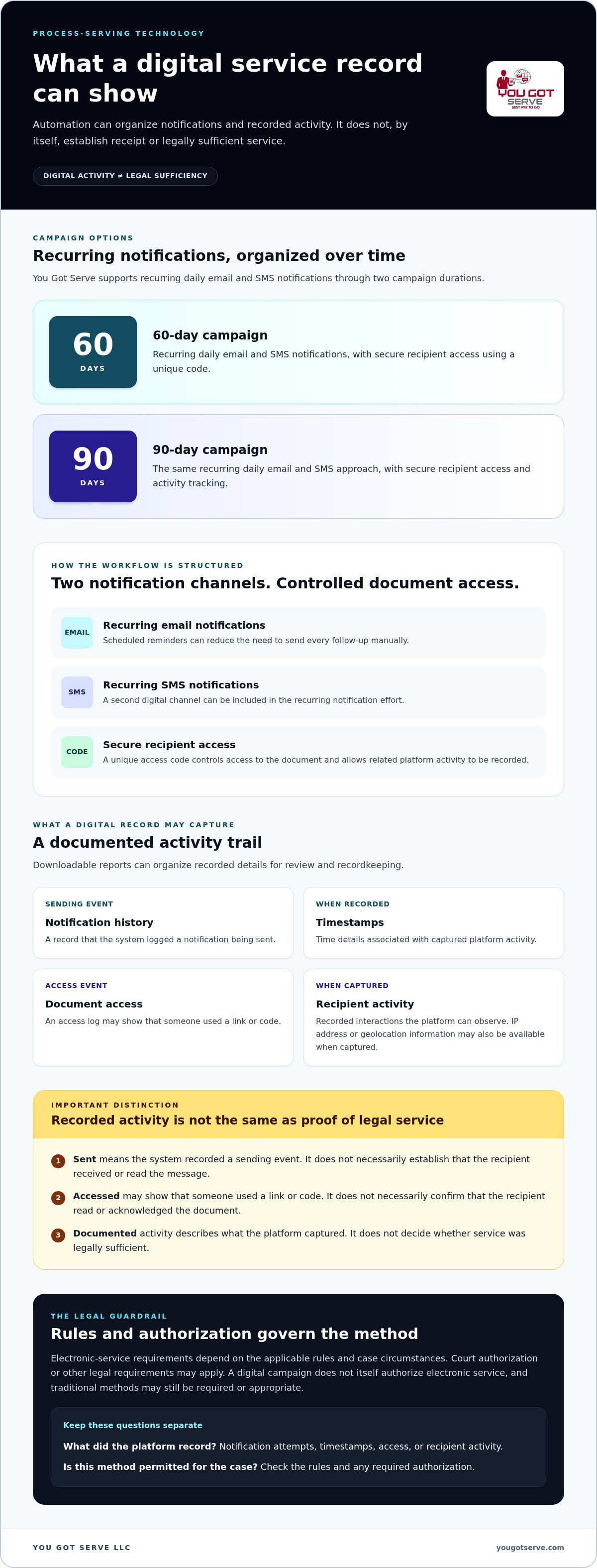
A digital activity record documents what a system captures, such as notification attempts, timestamps, document access, and recipient activity. It does not, by itself, establish that service was legally sufficient. A sent notification means the system recorded a sending event. An access log may show that someone used a link or code. A recorded interaction captures activity the platform can observe. None of these necessarily confirms that the recipient read or acknowledged the document.
Recurring notifications and secure document access
Recurring reminders can reduce manual follow-up and create a consistent notification history, but they do not prove that a recipient opened or read a message. A unique access code controls access to the document and allows the platform to record related activity. Security review should also cover safeguards such as document malware scanning and account security controls. These address different risks than delivery tracking.
YouGotServe’s 60-day and 90-day campaigns support recurring daily email and SMS notifications, with secure recipient access using a unique code. These features can help maintain an organized digital effort when electronic service is permitted or authorized. They do not independently establish receipt or legal sufficiency.
Tracking data and service records
A digital record may include notification history, timestamps, and recipient activity. IP address and geolocation information may also be available when captured. Downloadable reports organize these details for review and recordkeeping, but they document platform activity rather than decide whether a method satisfies the rules for a particular case.
Electronic-service requirements depend on the applicable rules and case circumstances. In federal civil cases, Federal Rules for Electronic Service provides the text of Rule 5, which governs service of documents after the initial pleading. It is not blanket authorization for electronic service in every matter. Review the rules that apply before relying on a digital method.
For teams considering a persistent, documented notification workflow, YouGotServe’s digital delivery approach can record notifications and recipient activity while keeping platform records distinct from the legal requirements for service.
Does Process-Serving Technology Replace Traditional Service?
No. Software does not replace a service method required by the rules for a particular case. It can support coordination, communication, and recordkeeping, but it cannot authorize electronic service or determine whether an attempt satisfies legal requirements. Technology can improve the workflow around service; it does not change the governing rules.
It also helps to distinguish two kinds of tools. Field-service coordination software may organize assignments, communicate status updates, and document work by professional process servers. Digital-delivery platforms send documents and notifications electronically and record related activity. These functions address different needs, and neither makes the other unnecessary in every matter.
Technology records activity; applicable rules govern service
A timestamp or activity log can show what a platform recorded, such as a notification attempt or document access. That technical information can help teams review and document events. It is separate from the legal determination of whether service was valid.
If electronic service requires court authorization or another condition, a platform record cannot establish that the requirement was met. Requirements vary by jurisdiction and case type. Review the rules that apply and consult qualified legal counsel about case-specific requirements. A tool’s ability to send or track a document is not permission to use that method.
How digital and traditional workflows can coexist
When personal service has encountered difficulties, a team may consider whether a digital approach is available under the rules for the case. If electronic delivery is permitted or authorized, it may support ongoing notification efforts alongside other appropriate steps. The right workflow depends on the facts and legal requirements. Neither digital nor traditional methods are suitable for every situation.
For example, if a defendant has been difficult to reach during attempts at personal service, counsel can assess whether electronic service is legally available before deciding what to do next. YouGotServe supports recurring email and SMS notifications, secure document access, and activity reporting for digital efforts. These features document platform activity; they do not guarantee receipt, acknowledgment, legal sufficiency, or court acceptance.
The practical value of legal tech for process serving is clearer workflow management, not an automatic substitute for established procedures. Keep the technology’s role separate from the legal question: a platform can record activity, while applicable rules and any required authorization govern whether electronic service may be used.
How Legal Teams Can Evaluate Process-Serving Technology Trends
Start with the workflow problem, not the feature list. A platform built for field-service coordination may not address a need for recurring digital notifications or organized delivery records. Before evaluating legal tech for process serving, identify whether the main gap is coordination, communication, documentation, or a combination.
Match tools to the workflow problem
Map how a matter moves from document preparation through follow-up and recordkeeping. A law firm managing service tasks across several matters may find updates scattered among emails, spreadsheets, and case notes. A shared view of task status could help address that coordination gap. A property manager handling recurring document needs may instead prioritize scheduled notifications and accessible activity records.
Then assess whether the tool’s functions match the need. Can users distinguish separate matters? Can authorized team members find the status information and records they need? Does the workflow reduce manual tracking, or add another step? Better organization can improve operational efficiency, but it does not guarantee that a recipient receives a message or that a service method is legally sufficient.
Review documentation and governance
Examine which events the platform records and how reports can be retrieved. Review access controls for documents, campaign activity, and account settings. Confirm that the information available to each user fits the team’s workflow, and consider whether reports support internal review and recordkeeping. If the organization uses other case-management tools, identify integration needs before adopting a new workflow.
Security deserves a separate review. Understand how authorized users access documents and account functions, and assess safeguards such as secure recipient access, malware scanning, and account security controls. The goal is to understand both what the system captures and how access to that information is managed.
For a more detailed feature-review framework, see Digital Process Server Platform: A 2026 Buyer’s Guide. Keep legal review separate from software evaluation. A platform may provide digital delivery options and detailed records, but the rules for the jurisdiction and case type determine whether electronic service is permitted and whether authorization or other requirements apply. Consult qualified legal counsel about case-specific requirements.
YouGotServe supports ongoing email and SMS notification efforts with secure recipient access and downloadable activity reporting when electronic service is permitted or authorized. Explore YouGotServe’s digital delivery platform to see how these workflow features may fit your organization’s needs.
What Persistent Digital Workflows Could Mean for Process Serving
Process-serving technology is moving beyond one-time status updates toward workflows that can continue sending notifications and organizing activity over time. Automated communication, secure document access, and structured records can help legal teams manage follow-up more consistently. This is one direction for legal tech for process serving, not a universal method of service or a replacement for professional judgment.
A technology-driven option when traditional service encounters difficulty
When traditional personal service has encountered difficulties, persistent digital notifications may offer another approach if electronic service is permitted or authorized. YouGotServe’s 60-day and 90-day campaigns support recurring daily email and SMS notifications. Recipients access documents using a unique code, while activity tracking and downloadable reports can document notification history, timestamps, and recorded recipient activity.
These records can help teams review digital efforts while other appropriate service steps continue. They show activity captured by the platform, not necessarily that a recipient read or acknowledged a message or that service meets the legal requirements of a case. Rules vary by jurisdiction and case type, and court authorization or other requirements may apply. Learn more about the digital delivery workflow at YouGotServe.com.
Where the trend may lead next
Future workflow development may focus on connecting service records more smoothly with broader case-management processes and making activity easier to review. Clear records can help teams understand what occurred and identify follow-up needs. Any gains in visibility must be balanced with careful handling of sensitive documents, controlled access, and attention to jurisdiction-specific service requirements.
For more context on digital delivery and its legal boundaries, consult Electronic Service of Process: The Definitive Guide to Digital Legal Delivery in 2026. Teams reviewing documentation practices can also refer to Securing Court-Ready Proof of Service: The Complete Compliance Checklist (2026). A platform can support communication and recordkeeping, but applicable rules determine whether a method may be used and what legal effect it has.
Build a More Organized Service Workflow
The most useful legal tech for process serving makes communication and documentation easier to manage without confusing platform activity with legally sufficient service. Automation can reduce manual follow-up, while clear records help teams review what occurred. Neither feature replaces applicable rules, traditional methods when required, or court authorization when needed.
YouGotServe offers a technology-driven option when traditional service encounters difficulties and electronic delivery is permitted or authorized. Its 60-day and 90-day campaigns support automated daily email and SMS notifications, secure recipient access, activity tracking, and downloadable service reporting. These tools document digital activity, but they do not guarantee receipt, acknowledgment, or court acceptance.
For attorneys, law firms, property managers, and other teams, start by identifying the workflow gap and assessing whether recurring notifications and organized records fit the matter. Keep legal review separate from the technology decision because requirements vary by jurisdiction and case type.
Explore YouGotServe, The Smarter Way to Serve to learn how a documented digital workflow can support your service process. This article is for general information only, not legal advice. Electronic-service requirements vary by jurisdiction and case type, and court authorization or other legal requirements may apply.
Frequently Asked Questions
What does legal tech for process serving include?
Legal tech for process serving includes software that supports case coordination, communication, tracking, and recordkeeping. Some tools organize field-service workflows, such as assignments and attempt updates. Others handle digital document delivery, recurring notifications, secure recipient access, and activity reports. These tools can help teams manage operations and records, but technology alone does not authorize a service method or determine whether service is legally sufficient.
Can technology replace a process server?
Technology does not universally replace traditional service or the role of professional process servers. Field-service tools can help coordinate assignments and document activity, while digital delivery may be an option when traditional service has encountered difficulties and electronic service is permitted or authorized. Requirements vary by jurisdiction and case type. Review the applicable rules and consult qualified legal counsel for case-specific legal advice.
How does automation help with process serving?
Automation can schedule task reminders, send status updates, and deliver recurring email or SMS notifications. It can also organize records of actions and events, helping a team review activity without relying entirely on manual follow-ups. For example, an automated notification history may show when messages were sent. It cannot guarantee that a recipient received or acknowledged them, that service was successful, or that a legal outcome will follow.
What information can electronic document delivery tracking record?
A digital delivery platform may record notification history, timestamps, document access, and recipient activity. IP address or geolocation information may also be available when captured. These details can help document what the platform recorded and support review of digital efforts. They should not be treated as conclusive proof that a recipient read a document, acknowledged it, or was legally served. Applicable rules determine the legal effect of a delivery method.
Is electronic service of process allowed in every case?
No single answer applies to every case. Electronic-service requirements vary by jurisdiction and case type, and court authorization or other legal requirements may apply. A platform’s ability to send documents or record activity does not provide authorization. Before relying on electronic service, review the rules governing the matter and consult qualified legal counsel about its requirements. Electronic delivery may be available in some situations, but it is not universally permitted.
How should a legal team assess a process-serving platform?
Start by identifying the workflow need, such as coordination, recurring notifications, or organized documentation. Assess document security, access controls, the activity captured, report formats, and any integration needs. Consider whether authorized users can easily retrieve and review the records. Keep this feature assessment separate from legal review: software capabilities do not determine whether electronic service is permitted. Review applicable rules and case-specific requirements before relying on that method.
What is the difference between process-server tracking and digital delivery tracking?
Process-server tracking generally concerns field assignments and recorded service attempts, such as a task’s status. Digital delivery tracking concerns notifications and document interactions recorded by a platform, such as message history or document access. Both can help organize and review service-related records, but they capture different activity. Neither type of tracking, by itself, establishes that service meets the legal requirements for a particular case.


