

If an email reaches a witness’s inbox, does that mean you can serve subpoenas electronically? Not necessarily. The communication method is only part of the question: the rules for a subpoena may require personal delivery or specific authorization for an alternative method. A sent message, delivery notice, or recipient response can document activity, but it doesn’t automatically establish legally sufficient service.
Email or text may seem like a practical option when a witness is difficult to reach. Before using either method, verify the rules for the jurisdiction, court, case type, and recipient, and confirm whether an order or other authorization is required. This article explains what to check, what electronic records can show, and how to document your next steps without treating digital delivery as a substitute for a required service method.
Where electronic delivery is permitted or authorized, a documented workflow can help you track notifications and recipient activity. YouGotServe provides email and SMS delivery, recurring notifications, secure recipient access, and downloadable reporting. These tools support recordkeeping, but they don’t determine whether a particular subpoena has been legally served.
Key Takeaways
- Before you serve subpoenas electronically, distinguish digital transmission from legally sufficient service under the rules that govern the subpoena.
- Check the applicable court rules and case-specific orders, then confirm whether the proposed method is permitted for this recipient and subpoena.
- Use a practical checklist to verify the recipient’s digital contact information, record where it came from, and review delivery activity afterward.
- If traditional service encounters difficulty, consider a documented digital-delivery option only after confirming electronic service is permitted or authorized.
Can You Serve Subpoenas Electronically? Start With What the Subpoena Requires
Electronic subpoena delivery means sending subpoena documents through a digital channel, such as email or SMS. Transmitting a document is not automatically the same as completing legally sufficient service. Whether you can serve subpoenas electronically depends on the applicable rules and any required authorization. A general yes-or-no answer can be misleading without knowing the court, jurisdiction, case type, and subpoena details.
Start with the legal requirements, not the available technology. A court order or other permission may be necessary, and traditional service may still be required. This overview is educational, not legal advice. If a requirement is unclear, confirm it with counsel or the issuing court before sending the subpoena electronically.
For a general overview of subpoena service, watch this video. It does not determine whether electronic delivery is permitted in your case.
What makes subpoena service different from sending a legal document?
A subpoena is a formal demand for testimony, records, or other evidence. Its purpose and recipient can affect which procedural rules you need to review. For example, a subpoena seeking a witness’s testimony may raise different practical questions from one requesting business records or other Electronically Stored Information (ESI). Don’t assume rules for routine case communications also apply to subpoena service.
An email timestamp, SMS notification, or message response can help document digital activity. On its own, however, that information doesn’t establish that the required method was followed or that service is legally sufficient. The governing requirements control.
Which details determine whether electronic delivery may be considered?
Before choosing a delivery method, identify these details and check each against the rules that apply:
- Issuing court and jurisdiction: Locate the procedural rules that govern the subpoena.
- Case type and subpoena purpose: Confirm whether the demand is for testimony, records, or other evidence.
- Recipient: Determine whether the subpoena is directed to a party, a witness, or another person or organization.
- Case-specific directions: Review orders or instructions from the court for express terms about electronic delivery.
General rules may not answer every case-specific question. If you can’t confirm that email or SMS is allowed for this recipient and subpoena, ask counsel or the issuing court what requirements apply before relying on that method. A digital record can document activity, but it does not replace authorization or another required service step.
Check Jurisdiction and Authorization Before Serving a Subpoena Electronically
Before choosing email or SMS, follow an authorization-first sequence: identify the rules that govern the subpoena, review case-specific orders, confirm that the proposed method is permitted, and only then select and document a delivery method. There is no single rule that applies nationwide. Requirements can differ by court, jurisdiction, case type, subpoena, and recipient.
Consider electronic delivery only after checking applicable rules and authorization. A general rule may not resolve what a judge has directed in a particular matter, and a technical platform cannot authorize a method that the law or court does not allow.
How do you identify the rules that govern this subpoena?
Start with the issuing court and the jurisdiction governing the case. Locate the current procedural rules and review the subpoena’s purpose and recipient. In a federal civil case, Federal Rule of Civil Procedure 45 may be a relevant starting point for subpoena service. Rule 5 of the Federal Rules of Civil Procedure addresses service of other papers, but don’t assume it authorizes electronic service of a subpoena on a nonparty.
State rules may also be relevant. For example, California’s Code of Civil Procedure § 1010.6, New York’s CPLR § 2303, and Texas Rule of Civil Procedure 106 are potential research starting points, not universal answers. Check the current text and confirm that each rule applies to this subpoena, recipient, and case. A generic online summary may omit important conditions.
What authorization or direction should you confirm?
Review the case docket and any orders or instructions from the issuing court. Look for language that expressly addresses electronic delivery or an alternative method. Then check whether the applicable rules set additional conditions, such as recipient consent, prior service attempts, a specific court order, or another required step. Conditions depend on the governing law and circumstances, so don’t infer permission from an order that addresses a different document or party.
- Identify the court, jurisdiction, case type, subpoena purpose, and recipient.
- Verify the current procedural rules and any applicable local requirements.
- Review orders or case-specific directions for authorization of the proposed method.
- Confirm any additional conditions before selecting and documenting a delivery method.
If the authority is unclear, pause and seek guidance from counsel or the issuing court before sending documents electronically. Once permission and any conditions are confirmed, choose a method and keep an accurate record of the steps taken. For an overview of digital delivery and documentation features, review the electronic document delivery workflow. The applicable rules still determine whether electronic service may be used.
Electronic Subpoena Delivery vs. Traditional Service: Compare the Method and the Record
Electronic and traditional service use different channels and can create different records. Neither method is automatically sufficient for every subpoena. The governing rules and any court direction determine which method is permitted, whether additional steps are required, and what documentation may be relevant. Use the comparison below to separate what a method can record from what the rules require.
| Method | What the record may show | What the record does not decide | What to verify |
|---|---|---|---|
| Electronic delivery | Notification history, timestamps, delivery activity, and recipient access activity. Some systems may record technical details such as IP or geolocation when available. | Whether the recipient personally reviewed or accepted the subpoena, or whether service was legally sufficient. | Whether the rules or a court order permit this channel, and whether other service steps remain necessary. |
| Traditional service | Depending on the method and records kept, documentation may describe service attempts and their outcomes. | Whether the method and procedure satisfy the requirements for this subpoena. | Which method, recipient, timing, and documentation the applicable rules or court direction require. |
What can electronic delivery records show?
Digital records can help create a timeline of notifications and recorded activity. A timestamp may show when a notification was sent, while an access event may show that a document was opened through the system. Neither establishes on its own that the named recipient was the person who accessed it, read the subpoena, or accepted it. IP addresses and geolocation, when available, are technical details, not conclusive identification or proof of service.
When might traditional service still be necessary?
Traditional service may remain necessary or appropriate if the governing rules require it, a court directs it, or authorization for electronic delivery has not been confirmed. Electronic delivery is not a universal substitute for traditional process service. If the recipient is difficult to reach, document the steps taken and check whether an alternative method is available under the applicable requirements before changing course.
When comparing approaches, assess four points: authorization, workflow, the records each method produces, and any remaining procedural steps. A detailed delivery log can support accurate recordkeeping, but it cannot expand permission or replace a required method. For a broader discussion of digital approaches, see this guide to electronic process serving options.
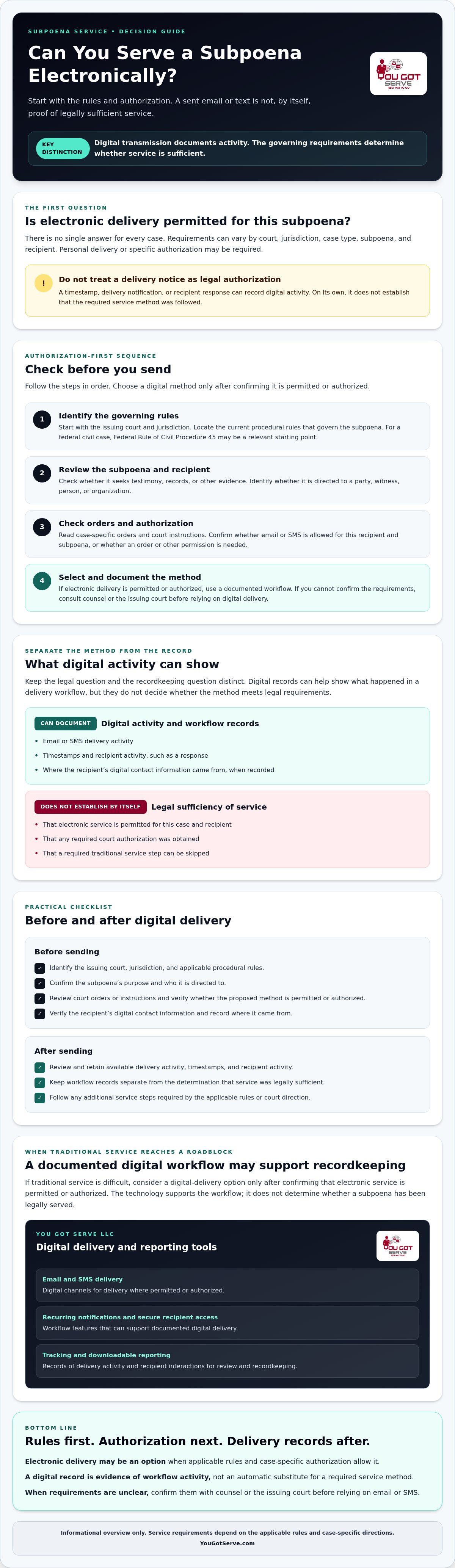
A Practical Checklist for Evaluating Electronic Subpoena Service
A consistent review before and after delivery can help identify missing information and keep an accurate record. Use this checklist only after confirming that electronic delivery is permitted or authorized for the subpoena. Records generated during a digital workflow document activity; they don’t replace any declaration, proof of service, filing, or other step required by the court.
What should you verify before sending?
- Confirm the document and recipient. Check that you have the correct subpoena, the intended recipient’s name and role, and any related case details.
- Verify the digital contact information. Confirm the email address or phone number and, where appropriate, record how you obtained or verified it. Avoid relying on an unconfirmed contact detail.
- Recheck the governing requirements. Review the applicable rules and any case-specific order for permission to use email or SMS, plus any conditions or additional service steps.
- Review document access. Confirm that the workflow protects the subpoena and restricts access as intended. If the process uses an access code, ensure the intended recipient can use it.
- Assign responsibility for follow-up. Decide who will review the activity record and determine whether another service method, filing, or court-directed step is needed.
What should you preserve after sending?
Keep the notification history, timestamps, available recipient activity, and relevant case documents together. If the system records an access event or technical details, preserve them as activity information, not as conclusive proof of who received, reviewed, or accepted the subpoena.
Describe each action factually. For example, record that a notification was sent or that the system logged an access event. Don’t label an attempt “successful service” unless the applicable requirements support that conclusion. Then compare the available record with any required proof, declaration, filing, or court instruction. An operational report and formally required proof of service may serve different purposes.
For more context on documentation and compliance checks, see this guide to court-ready proof of service guidance. If electronic delivery is authorized and you need a way to organize digital notifications and activity records, review electronic document delivery options. The method and record should follow the requirements for the specific subpoena.
How YouGotServe Fits When Traditional Subpoena Service Reaches a Roadblock
If traditional service has encountered difficulty, YouGotServe offers a technology-based option for electronic document delivery when the proposed method is permitted or authorized. Its email and SMS workflow can send recurring notifications and provide secure document access through a unique recipient access code. These features support a documented delivery process, but they don’t establish that a recipient received, read, or acknowledged a subpoena, or that legal service requirements have been met.
YouGotServe offers 60-day and 90-day Digital Service Campaigns, priced at $350 and $500 per campaign, respectively. Those durations describe delivery options, not legal deadlines. Organization Accounts receive a 10% discount per service or document campaign. Before using the platform to serve subpoenas electronically, confirm the rules for the subpoena and recipient, including any court order or other authorization required. Keep any required traditional service or additional procedural steps in place.
What does the YouGotServe digital workflow document?
The workflow records notification history, timestamps, and recipient activity. IP address or geolocation information may also be available. You can download service reporting to review and preserve a record of platform activity. An access event or technical detail should not be treated as conclusive proof of the recipient’s identity, acknowledgment, or legal compliance. The workflow is patent-pending, and its records don’t replace any formal proof, filing, or other documentation required by the court.
This distinction matters when documenting an attempt. A report can show what the platform recorded, such as a notification sent or an access event logged. Whether those events satisfy the subpoena’s service requirements is a separate legal question.
What is a responsible next step?
Ask counsel or the appropriate court to confirm whether electronic delivery is permitted or authorized for this subpoena. If it is, review YouGotServe’s digital delivery platform to understand its workflow and reporting. For additional practical guidance when a person is difficult to reach, see lawful next steps when someone avoids service.
Requirements vary by jurisdiction and case type, and court authorization or other legal requirements may apply. Treat digital delivery as a possible method only after verifying those requirements, and don’t assume that a record of delivery activity alone completes service.
Choose Your Next Service Step With Confidence
Before you serve subpoenas electronically, verify the rules for the specific court, jurisdiction, case, and recipient. Confirm any required authorization, then choose a delivery method and document what happened. Email or SMS activity can help create a record, but it doesn’t by itself establish legally sufficient service or replace any other required steps.
When traditional service reaches a roadblock, YouGotServe offers a technology-based delivery option where electronic delivery is permitted or authorized. Its workflow includes recurring email and SMS notifications, 60-day and 90-day campaign options, secure document access, timestamps, activity records, and downloadable reporting. The workflow is patent-pending. These tools support documentation, but they don’t guarantee receipt, acknowledgment, court acceptance, or a legal outcome.
Review the workflow and consider whether it fits your authorized delivery plan. Review YouGotServe’s secure digital delivery workflow. With the rules checked and records handled carefully, you can take a clear, well-documented next step.
Frequently Asked Questions
Can you serve a subpoena electronically?
Sometimes, but it depends on the jurisdiction, case type, subpoena, recipient, and any applicable court order or authorization. Email or SMS isn’t automatically sufficient just because a message can be sent or tracked. Before choosing a method, check the current rules and case-specific directions for the matter. If you’re unsure how they apply, consult counsel or the issuing court. This information is general in nature, not legal advice.
Is serving a subpoena by email legally valid?
You can’t determine validity from the communication channel alone. The rules governing the subpoena and any case-specific authorization control whether email may be used and whether additional steps are required. Check the issuing court’s requirements before sending documents electronically. An email log may show that a notification was sent or recorded, but that record alone doesn’t establish that the required method was followed or that service requirements were met.
Can a subpoena be served by text message?
SMS may be considered only if the applicable rules and any required authorization permit it for the particular subpoena and recipient. A sent text, delivery status, or document-access record doesn’t by itself establish receipt or legally sufficient service. Check the jurisdiction, case type, and court direction before relying on text messages. There’s no single national answer that applies to every subpoena, so verify the requirements for your matter first.
Does electronic delivery prove that a subpoena was received?
No. A digital platform may record notifications, timestamps, and recipient activity, but those records don’t guarantee that the intended person received, reviewed, or acknowledged the subpoena. Treat them as documentation of recorded activity that may be relevant to a case, not as conclusive proof of receipt. You’ll still need to determine whether the delivery method and resulting records satisfy the procedural requirements that apply to the subpoena.
What should I check before serving a subpoena electronically?
Identify the issuing court and jurisdiction, then review current procedural rules and any case-specific orders. Confirm that the proposed method is permitted or authorized, and verify the recipient’s email address or phone number, including its source where appropriate. Preserve notification history, timestamps, and available activity records. Also check whether a filing, declaration, or other proof procedure is required. If any requirement is unclear, seek guidance from counsel or the court.
Does electronic subpoena service replace a process server?
No. Electronic delivery isn’t a universal substitute for traditional process service. Whether it may be used depends on the subpoena, jurisdiction, case type, and applicable rules or authorization. Traditional service may remain necessary or appropriate. YouGotServe is a technology-based option for situations where traditional service has encountered difficulty and electronic delivery is permitted or authorized. It doesn’t provide legal advice or determine whether a particular method satisfies service requirements.
Can YouGotServe guarantee that a subpoena is legally served?
No. YouGotServe doesn’t guarantee recipient receipt or acknowledgment, court acceptance, legal sufficiency, or a case outcome. The platform records notification and recipient activity, while applicable rules and any required authorization determine whether electronic delivery may be used and what steps are needed. Before relying on electronic delivery, verify the requirements for your case with counsel or the relevant court. A platform record doesn’t replace required service methods or procedures.


