

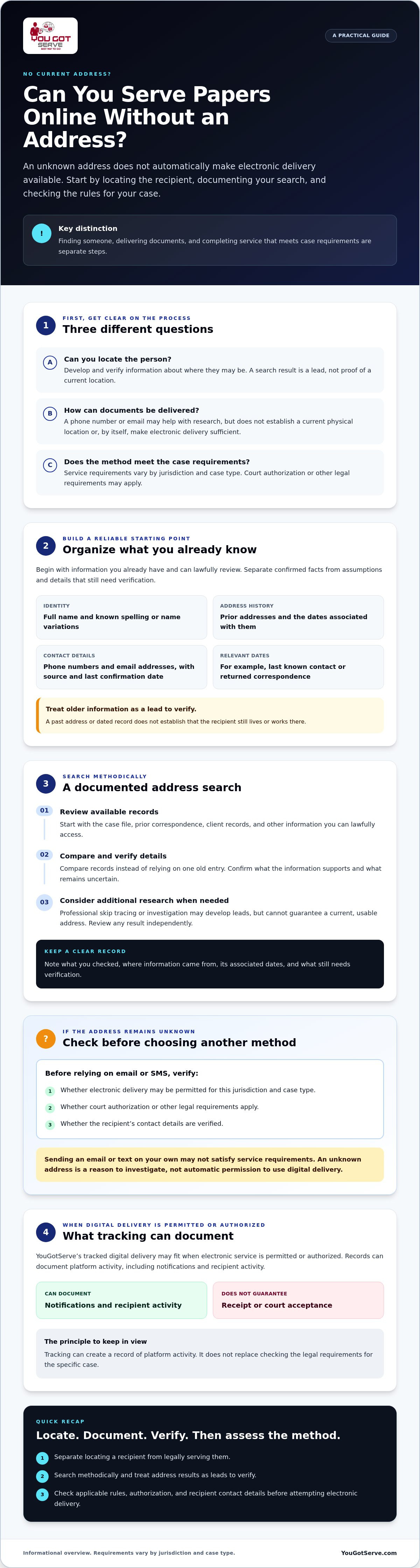
Can you serve papers online without an address? Not having a current street address does not automatically make electronic delivery available, and sending an email or text on your own may not satisfy service requirements. First, make a lawful, documented effort to locate the recipient and check which methods may be permitted for your case.
It helps to separate finding someone from legally serving them. This guide covers how to investigate a missing address, keep a clear record of your search, and assess next steps if you still cannot locate the person.
Electronic delivery may be an option in some situations, but requirements vary by jurisdiction and case type. Court authorization or other legal requirements may apply. Before relying on email or SMS, verify the rules and the recipient’s contact details. YouGotServe’s tracked digital delivery may fit when electronic service is permitted or authorized. Records of notifications and recipient activity can document platform activity, but they do not guarantee receipt or court acceptance.
Key Takeaways
- Separate locating a recipient from meeting the legal requirements for serving them.
- Search methodically and record what you checked. Treat address results as leads to verify.
- If you are considering how to serve papers online without address information, compare possible methods with the rules for your case.
- Before attempting electronic delivery, verify the recipient’s contact details and whether authorization is required.
- When digital delivery is permitted or authorized, tracking and service records can document activity, but do not guarantee receipt or court acceptance.
No Address for Service Papers? Start by Confirming What You Know
The documents are ready, but you do not have a reliable current address for the person who needs to receive them. That can stall a case and raise an understandable question: can you serve papers online without address information? An unknown address is a reason to investigate, not automatic permission to use email or text as legal service.
Keep three steps distinct: locating a person, delivering documents, and completing service in a way that meets the requirements for the case. A phone number or email address may help with research, but it does not establish a current physical location or, by itself, make electronic delivery legally sufficient. The general purpose and methods of Service of process provide useful background, but requirements vary by jurisdiction and case type.
For a basic overview of serving documents and preparing them for filing with a court, watch this video:
What does it mean to serve papers without a known address?
It means you do not yet have a verified location for traditional delivery. You may know the recipient’s identity and have ways to contact them, but those details do not prove where they currently live or work. Online delivery may be considered in some situations, subject to applicable rules and any required authorization. Do not assume an email address or mobile number makes it an approved service method.
Locating a person means developing and verifying information about where they may be. Serving process means delivering legal documents using a method that meets the requirements for the case.
Which details should you verify before searching?
Start with information you already have and can lawfully review. Check the case file, prior correspondence, and records available to you. Note spelling variations, former names, and the dates associated with older addresses or contact details. A past address can be a useful lead, but it may no longer be current.
Separate confirmed information from assumptions and details that still need verification. A short working list can keep the search focused:
- Full name and known spelling or name variations
- Prior addresses and the dates they were associated with the recipient
- Phone numbers and email addresses, including their source and last confirmation date
- Relevant dates, such as the last known contact or a returned correspondence date
Use care when contacting third parties or testing old contact details. Do not share sensitive case documents during informal inquiries or through unverified channels. Before deciding how to proceed, record what you know, where the information came from, and what remains uncertain.
How to Search for a Current Address and Document Your Efforts
A useful address search is structured, lawful, and easy to review later. Start with information you already hold, then move to sources that require additional verification. A search result is a lead, not proof that the person currently lives or works there or that the location is suitable for service.
What sources can help verify a possible address?
Begin with the case file, prior correspondence, client records, and other information you can lawfully access. Compare details rather than relying on one old record. A prior address, for example, may guide further research, but a dated letter or database entry does not establish that the recipient still lives there.
If those records do not resolve the gap, professional skip tracing or investigation may help develop leads. It cannot guarantee that a current, usable address will be found. Review any result independently before using it to make procedural decisions. For a deeper overview, see this skip tracing guide for legal professionals.
Careful verification matters because service is connected to the opportunity to receive notice and respond. Cornell Law School’s Legal Information Institute discusses service in relation to procedural due process clauses. Use that context as a reminder to confirm the requirements for the specific case rather than treating a search result as permission to proceed.
How should you document an address search?
Create a case-file log as you search. For each check, record the date, source, information reviewed, result, and next action. Mark whether a detail is confirmed, an unverified lead, or an unsuccessful search. A consistent log shows which avenues have been checked and helps prevent an old or uncertain result from being mistaken for a verified address.
- Date: When you reviewed a record or made an inquiry.
- Source: The case file, correspondence, client record, or research source consulted.
- Information and result: What you checked and whether it produced a possible lead, no result, or a verified update.
- Next action: What needs follow-up and who will handle it.
Keep notes factual. Do not describe an address as current unless you have verified it. If the search suggests the recipient may be avoiding contact, review the practical considerations in this guide to serving someone who is dodging service.
If the search remains inconclusive, do not treat that alone as authorization to use digital document delivery. YouGotServe provides delivery through email and SMS when applicable rules and authorization permit. Requirements vary by jurisdiction and case type, so confirm them with qualified counsel or the relevant court before relying on electronic delivery.
If the Address Stays Unknown, Compare Lawful Service Options
An unsuccessful address search does not determine which method is allowed next. The right path depends on the case, jurisdiction, information gathered, and applicable procedural requirements. Further research, professional process service, and electronic delivery may each be relevant, but none is automatically appropriate in every situation.
Use this comparison to frame questions for qualified counsel or the relevant court. It is not a substitute for case-specific guidance.
| Method | When it may be considered | What to verify |
|---|---|---|
| Continue address research | Existing records or new leads may help identify a current location. | Whether the lead is current, reliable, and lawfully obtained. |
| Professional process service | A verified or plausible location is available, or further attempts may be appropriate. | Requirements for the case, the permitted method, and how attempts should be documented. |
| Electronic delivery | Traditional service is difficult or unsuccessful and electronic service may be available. | Whether the rules permit it, whether court authorization or other steps are required, and whether contact details are reliably associated with the recipient. |
When should you continue with traditional service efforts?
If you have a possible address, ask a qualified legal professional whether further address research or process-serving steps make sense for your case. Check a lead before relying on it. Keep the search and service history organized so the next decision reflects what was actually tried and found, not an assumption that the recipient cannot be located.
A digital method does not replace traditional service in every circumstance. The type of document and applicable rules can affect which steps are available.
When might electronic delivery be considered?
Email or SMS delivery may be a technology-based option when traditional service is difficult or unsuccessful, but an unknown address alone does not authorize it. Requirements vary by jurisdiction and case type. Court authorization or other legal steps may be required, so confirm what applies before sending documents.
Federal procedure also distinguishes service of initial process from service of other papers. For example, the Federal Rules of Civil Procedure address electronic service of papers under Rule 5, including conditions involving consent. Do not assume that provision governs every document or case. For broader context, review this electronic service of process guide.
If you are assessing whether you can serve papers online without address information, first verify the recipient’s electronic contact details and the legal basis for that method. YouGotServe offers email and SMS document delivery with activity records when applicable rules and authorization permit. Learn more about electronic document delivery. Records can document activity, but they do not guarantee receipt or court acceptance.
How to Prepare Before Requesting or Attempting Online Delivery
Before arranging electronic delivery, confirm that it fits the specific case and that the recipient’s contact details are reliable. A searchable email address or active phone number may be useful, but it does not establish that electronic service is permitted or that the account belongs to the intended recipient.
What should you confirm about rules and authorization?
Check the requirements for the specific court, case type, documents, and proposed method. Depending on the circumstances, a motion, court order, consent, or another procedural step may be required. Ask qualified counsel or the relevant court to clarify what applies before relying on email or SMS. Do not assume a rule for one document or case applies to another.
Electronic delivery is a method to evaluate, not automatic proof of valid service. The question, “Can I serve papers online without address information?” has no universal yes-or-no answer. An unknown physical address does not authorize online delivery, and using a digital contact without confirming the applicable requirements can leave important procedural questions unresolved.
What information and records may support a careful workflow?
Use a pre-delivery checklist to organize the decision:
- Case requirements: Identify the court, case type, documents to be served, and any applicable rules for the proposed electronic method.
- Authorization: Confirm whether consent, a motion, court order, or another step is required, and retain the relevant documentation.
- Recipient contact details: Verify that the email address or phone number is current and reliably associated with the intended recipient.
- Document readiness: Check that the correct documents and attachments are complete and ready for delivery.
- Case records: Keep copies of relevant filings, authorization, delivery details, and resulting service-related records together.
Digital tools can help document what happened during a delivery attempt. For example, YouGotServe’s platform uses secure recipient access codes and records notifications and recipient activity with timestamps. These records describe platform activity. They do not independently establish that the method was legally sufficient, prove that a person received or understood the documents, or guarantee court acceptance.
Keep the legal decision separate from the delivery workflow. Confirm the applicable requirements with counsel or the relevant court, then use a documented process only if the method is permitted or authorized. To review secure email and SMS document delivery and its activity reporting, visit YouGotServe.
How YouGotServe Supports Documented Digital Delivery When Authorized
When traditional service reaches a roadblock, YouGotServe offers electronic document delivery by email and SMS when the method is permitted or authorized for the specific matter. It is a digital-delivery platform, not a court or a physical process-serving company. Using it does not itself establish that electronic service is legally sufficient.
What does the digital delivery workflow record?
A campaign can send recurring daily email and SMS notifications over an available 60-day or 90-day period. Recipients access documents through a secure access code. The platform records notifications and recipient activity with timestamps. Where available, activity information may include IP or geolocation information. A downloadable report helps organize these records for review.
These records describe platform activity, such as when a notification was sent or recipient activity was recorded. They do not prove that the recipient actually received, read, or acknowledged the documents, and they do not guarantee that a court will accept the method or resulting records. The legal significance depends on the rules and circumstances of the case.
This distinction matters if you are considering whether you can serve papers online without address information. Digital delivery may help document an authorized attempt using verified electronic contact details, but it does not locate a recipient or replace address research and other required service steps in every case.
What should you do before choosing a platform?
Before starting a campaign, confirm that electronic service is permitted or authorized for the specific documents and case. Requirements vary by jurisdiction and case type. Check with qualified counsel or the relevant court whether consent, a motion, an order, or another procedural step applies. Then verify the recipient’s email address or phone number, prepare the correct documents, and retain relevant authorization and service records.
A practical review includes:
- Confirming the rules and authorization for the case and proposed method.
- Checking that the intended recipient’s digital contact details are reliable.
- Preparing the correct documents and organizing case-related records.
- Understanding what the platform tracks and what its activity report cannot establish.
YouGotServe’s email and SMS notifications, secure access, activity tracking, and downloadable reporting can support an organized digital-delivery workflow when authorized. They do not guarantee receipt, acknowledgment, court acceptance, or a legal outcome. To assess whether the features fit your documented delivery needs, learn about YouGotServe.
Take the Next Step With a Documented Service Plan
A missing address calls for careful investigation, not an assumption that online delivery is automatically valid. Keep a clear record of the information you verify and the steps you take. Before choosing a method, confirm the requirements for your jurisdiction, case type, and documents, including whether authorization is needed.
If you are considering how to serve papers online without address information, YouGotServe may offer a digital delivery option when electronic service is permitted or authorized. Its workflow includes secure recipient access codes, recurring email and SMS notifications with activity records, and downloadable service reporting. These records document platform activity, but do not guarantee receipt, acknowledgment, court acceptance, or a legal outcome.
Review the applicable process with qualified counsel or the relevant court, then decide whether digital delivery fits your situation. Learn about YouGotServe, The Smarter Way to Serve, and explore whether its documented delivery tools align with your authorized service plan.
Frequently Asked Questions
Can I serve papers online without knowing the recipient's address?
Possibly, but an unknown street address does not by itself authorize electronic service. Whether you can serve papers online without address information depends on the jurisdiction, case type, documents, and applicable rules. Court authorization or other steps may be required before using email or SMS. Document your efforts to locate the recipient, then verify the requirements with qualified counsel or the relevant court before proceeding.
How can I find someone's address to serve legal papers?
Start with case files, prior correspondence, client records, and other information you can lawfully review. Check spelling variations, former names, and when an address or contact detail was last confirmed. Professional skip tracing or investigation may help develop additional leads, but search results are not proof that an address is current or suitable for service. Record sources and dates, and verify potential addresses before relying on them.
What happens if I cannot locate a current address for service?
If your search does not identify a current address, document the records reviewed, inquiries made, and results. Then ask a qualified legal professional or the relevant court what options may apply to your case. Depending on the circumstances and local requirements, further research, additional service attempts, or an alternative method may be considered. Do not assume that an unsuccessful search alone permits email or text service.
Is serving court papers by email or text valid?
Email or text can be used for legal document delivery, but whether it qualifies as service depends on the jurisdiction, case type, document, and applicable requirements. A message sent to a known email address or phone number is not automatically legally sufficient. Confirm whether the method is permitted and whether authorization or other steps are needed. Delivery records can document platform activity, but they do not guarantee receipt or court acceptance.
Do I need court permission to serve papers electronically?
You may need court permission, consent, or another procedural step, depending on the rules for the specific case and document. There is no single procedure that applies to every situation. Before arranging electronic service, check the relevant court’s requirements or consult qualified counsel. Do not treat the availability of email or SMS delivery as authorization to use it for formal service.
Can skip tracing help locate someone for service of process?
Skip tracing may help identify address or contact information to investigate, but it cannot guarantee that a person will be located or that a result is current. Treat each result as a lead and verify it before making service decisions. You Got Serve offers skip tracing and investigation separately through CII Services Corp. Keep investigation findings distinct from proof that service has been completed.
Does digital delivery tracking prove that legal papers were served?
No. Tracking can document platform activity, such as notifications sent, timestamps, and recorded recipient activity. You Got Serve also provides secure recipient access codes and downloadable service reporting. Those records may help organize what occurred, but they do not independently establish legal sufficiency, guarantee that the recipient received or acknowledged the documents, or ensure court acceptance. The court’s applicable rules and the circumstances of the case remain important.


