

What matters most in court compliant electronic delivery is not simply whether an email or text was sent. It is whether the method was authorized and whether the record shows how the recipient was identified, what was sent, and when each delivery step occurred.
If you’re concerned that a technical mistake could undermine service, check the applicable rules before sending anything. Requirements vary by jurisdiction, and electronic service may require court approval and documented efforts to use traditional methods first. This guide explains how to assess those requirements and build a clear service record without assuming one procedure applies everywhere.
You’ll learn which technical and procedural details can support proof of service, how skip tracing can help locate contact information for an elusive recipient, and what to document from attempted delivery through filing. You’ll also see how YouGotServe’s email and SMS delivery, recipient verification, tracking, reminders, and proof-of-service documentation can support an organized workflow.
Key Takeaways
- Assess court compliant electronic delivery by the evidence it records, not just whether a message was sent or opened.
- Check jurisdiction-specific rules before using electronic service. Court authorization and documented diligence may be required.
- Use skip tracing to help identify valid contact information when a recipient is difficult to reach.
- Keep a clear record of delivery activity and prepare proof of service that reflects the method and timing used.
- YouGotServe offers email and SMS delivery, recipient verification, tracking, reminders, and proof-of-service documentation.
Defining Court Compliant Electronic Delivery in 2026
Court compliant electronic delivery means transmitting legal documents through digital channels when the method is authorized by applicable law or a court order and supported by a record of the service. Sending an email or text alone does not establish that service was legally valid. A court may consider the governing procedure, whether the method was authorized, and whether the evidence connects the delivery to the intended recipient.
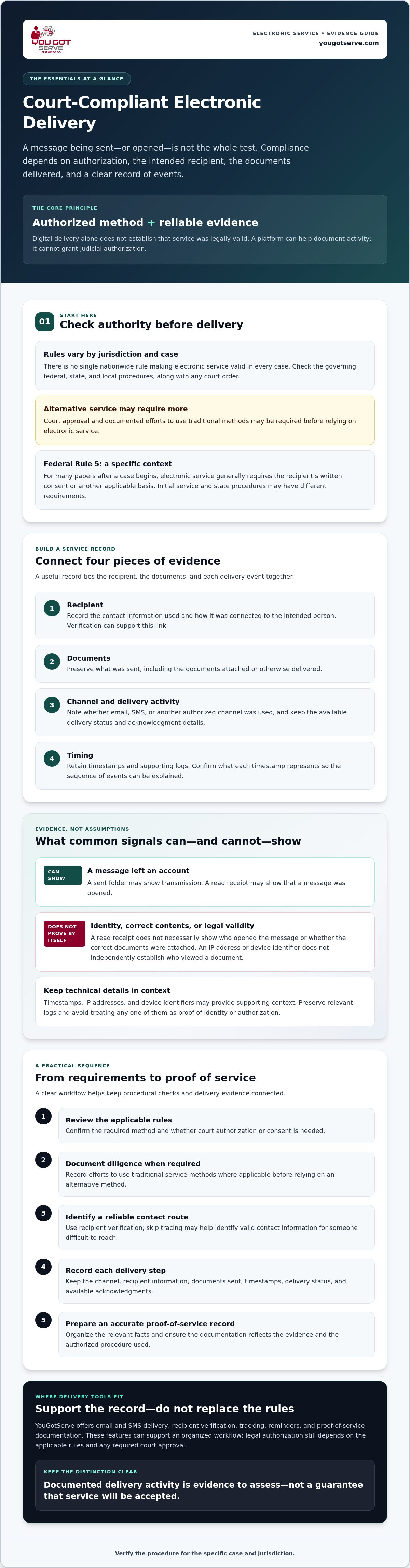
A standard read receipt has limits. It may show that a message was opened, but not necessarily who opened it, whether the correct documents were attached, or whether service followed the court’s requirements. A more complete service record can include recipient verification, delivery attempts, timestamps, and other relevant activity. These details can support proof of service, but a platform cannot grant judicial authorization.
For context, this overview of service of process explains the foundational purpose of giving formal notice. Electronic service of process can help legal teams document delivery when the method is authorized, particularly when a recipient is difficult to reach through conventional methods.
To see an example of electronic document filing in a court setting, watch this video:
The Evolution of Service: From Paper to Pixels
In-person attempts can fail when a defendant is difficult to locate, avoids contact, or has moved. Electronic channels may offer an alternative, but they do not automatically replace traditional service. Depending on the rules, a party may need to document diligence and obtain court approval before using an alternative method. Compliance depends on both following the applicable procedure and keeping a reliable record.
Due Process and the Constitutional Standard
Digital notice must be reasonably calculated, under the circumstances, to inform the recipient and allow a meaningful opportunity to respond. That means choosing contact information with a reliable connection to the person, documenting what was sent and when, and following the court’s instructions. Verification can help support an efficient process, but a delivery notification is not a substitute for the recipient’s legal rights.
There is no single nationwide rule making electronic service valid in every case in 2026. Federal Rule of Civil Procedure 5 addresses service of many papers after a case begins, including electronic service under specified conditions. Initial service and state procedures can involve different requirements. Confirm the rules for the case and any required authorization before relying on digital delivery.
The Technical Pillars of Legally Binding Digital Service
A useful digital record connects the recipient, the documents, and the delivery event. Email and SMS can provide more than one route to reach a recipient, but using two channels does not by itself make service valid or guarantee that a court will accept it. Follow the applicable rule or order, and preserve evidence of what happened on each channel.
Federal requirements differ from state procedures. Under Rule 5, electronic service of many papers after a case begins generally requires the recipient’s written consent or another applicable basis. Consult the Federal Rules of Civil Procedure and the governing state and local rules before relying on a digital method.
Verified Receipt vs. Simple Transmission
A sent folder can show that a message left an account. It does not establish that the intended person received it or that the correct documents were included. A useful delivery record should preserve details such as the recipient’s verified contact information, documents sent, channel used, timestamps, delivery status, and any available acknowledgment. An affidavit of electronic service can organize relevant facts, but it must accurately reflect the evidence and the procedure authorized by the court.
IP addresses or device identifiers may provide technical context, but they do not independently establish who viewed a document. Treat them as possible supporting details, not proof of identity. A timestamp may help show when an event was recorded. Confirm what the timestamp represents and retain supporting logs so the timeline can be explained.
SMS and Text-Based Service Requirements
Text delivery has distinct risks. A phone number may be reassigned, a message may be blocked, or a recipient may opt out of further messages. A failed or blocked notification is not proof of receipt. Record the status, do not treat silence as consent, and check the order and applicable rules for the next step. A phone number that appears current does not, by itself, establish that SMS service is permitted.
For mobile-first delivery, verify that the contact information is associated with the intended recipient, identify the documents clearly, and preserve message and delivery-event records. Automated reminders can document follow-up attempts, but they do not cure an unauthorized method or establish that a person read the notice. Use controlled access and appropriate retention practices for legal documents. Check whether the platform’s storage protections meet your requirements rather than assuming a particular feature is available.
For a more organized record, consider a delivery platform that provides recipient verification, tracking, and proof-of-service documentation, such as YouGotServe’s electronic document delivery.
Navigating Judicial Authorization for Alternative Service
Electronic service is not a shortcut around due diligence. Depending on the court’s rules, a party may need to show reasonable efforts to locate and serve the defendant before requesting permission to use a digital method. Verify the governing rules and case-specific instructions before sending documents electronically.
Skip tracing can help build the factual record behind a request for alternative service. A useful investigative report identifies the contact information located, explains how it was associated with the intended recipient, and records the dates and sources of the research. The report can help connect unsuccessful attempts with a proposed digital channel, but it does not authorize service.
Proving Due Diligence to the Court
Document each service attempt with the date, location, outcome, and other details required by the applicable procedure. If an email address may be outdated, explain the basis for associating it with the defendant and disclose any uncertainty. Recent public activity tied to an account may provide context, but it does not conclusively prove who controls the account or uses that address.
When available and appropriate, include supporting records that allow the court to assess the investigation and unsuccessful attempts. Keep conclusions measured: evidence that a contact point appears current is different from proof that the defendant received notice.
Securing the Order for Electronic Service
A motion may need to identify the authority for alternative service, summarize reasonable diligence, explain why the proposed channel is likely to reach the defendant, and specify how delivery and proof will be documented. Exact requirements vary by jurisdiction. Check the applicable rules and court guidance, including any requirements for motion contents, supporting declarations, and the proposed service method.
Tracking records can support the proposed plan by showing how delivery events, timestamps, and follow-up will be captured. They do not guarantee judicial approval. A request may be weakened by unsupported contact information, incomplete diligence records, a method that does not meet the applicable requirements, or a failure to explain why the proposed channel is reasonably likely to provide notice.
If the defendant later says, “I don’t use that email anymore,” a documented investigation and a transparent account of the evidence give the court more context than an unsupported statement that the address was valid. Court compliant electronic delivery depends on authorization and a defensible record, not confidence alone. To explore investigative support and documented digital delivery, review YouGotServe’s skip tracing and delivery capabilities.
Executing a Court-Compliant Workflow: A 5-Step Checklist
A consistent process connects investigative diligence, judicial authorization, delivery activity, and the final record. Adapt each step to the court’s order and applicable rules. A platform’s tracking features do not replace legal requirements.
- 1. Investigate contact information. Use skip tracing to identify possible email addresses and phone numbers. Document the basis for associating each contact point with the recipient.
- 2. Confirm authority before delivery. Check whether the court or applicable rules require permission for electronic service. If an order is required, obtain it before using the authorized method.
- 3. Send through a suitable platform. Use a secure delivery process that records the channel, documents, and delivery activity. Follow any method and follow-up instructions in the order.
- 4. Review the delivery record. Monitor available delivery and engagement information. Distinguish a transmission, delivery notification, or link access from proof that the recipient personally read or understood the documents.
- 5. Prepare and file proof. Create a clear account of the service performed and file it as directed by the court.
Metadata and the Digital Audit Trail
There is no universal metadata checklist for every affidavit. Depending on the rules and order, the record may need to identify the recipient and contact point, documents served, method, date and time, delivery status, follow-up attempts, and the person or system that performed the service. Preserve underlying records so the statements in the affidavit can be checked.
“Non-repudiation” describes evidence that helps establish an event and makes later denial harder to sustain. It does not conclusively prove identity or receipt on its own. Keep access to documents controlled, share only what the authorized method requires, and follow applicable privacy and redaction rules. See this court-ready proof of service checklist for additional documentation considerations.
Managing Recipient Engagement
Automated reminders can create a record of follow-up, but they do not establish actual notice or cure a problem with authorization. If the recipient does not open a delivery link, record that status accurately and follow the court’s instructions rather than treating nonresponse as acceptance.
If a recipient refuses to engage or disputes the contact information, preserve relevant event details and reassess the next step under the order and applicable rules. A refusal or unopened link may provide context, but do not describe it as completed service unless the governing authority supports that conclusion. For help organizing electronic delivery and proof-of-service records, explore YouGotServe’s document delivery.
How YouGotServe Supports Compliant Electronic Delivery
Uncertain contact details and unsuccessful conventional attempts can make it harder to complete service. YouGotServe combines skip tracing and investigation with electronic document delivery by email and SMS, recipient verification, and tracking. This connects the search for a usable contact point with a documented digital delivery process.
Technology can support the record, but it does not determine whether a method is legally authorized. Confirm the governing rules and any required court order before service. YouGotServe also provides court-ready proof of service and automated delivery reminders to help organize delivery activity and follow-up for review and filing.
Security and Reliability Standards
Secure handling matters because legal documents can contain sensitive information. YouGotServe provides secure delivery, but before selecting a platform, ask how documents are protected in transit and at rest, how access is controlled, and what records are retained. Confirm that the protections and records meet your requirements.
Email and SMS provide digital routes for reaching a recipient, but neither channel alone proves lawful service or guarantees notice. Recipient verification and delivery tracking can provide evidence of activity. The weight of that evidence depends on the facts, applicable rules, and any court order. Requirements vary by jurisdiction, so verify compliance for each matter rather than assuming a platform can automatically adapt or secure judicial approval.
Streamlining the Litigation Lifecycle
A digital workflow can reduce administrative handoffs: investigation helps identify possible contact details, delivery records capture activity, reminders support follow-up, and proof of service brings relevant details together. This can help legal teams manage repeatable tasks consistently, without guaranteeing a time to service or replacing review of the rules and record.
YouGotServe charges for secure digital delivery per individual recipient. Ask about the applicable fee and what the delivery service includes. Investigation and skip tracing fees may also apply. Confirm whether proof-of-service documents need review or formatting before filing, since court forms and filing requirements can differ.
For firms seeking an organized approach to verified email and SMS delivery, investigation, reminders, and proof-of-service documentation, review YouGotServe’s service details against the requirements of your case.
Build a More Defensible Digital Service Workflow
Court compliant electronic delivery depends on more than choosing email or SMS. Confirm that the method is permitted, document reasonable efforts to locate the recipient, and preserve a clear record of delivery activity. A verified contact point and accurate proof of service can help explain the steps taken, but no platform can replace required court authorization or determine whether service is valid in a particular case.
YouGotServe combines skip tracing and investigation with electronic document delivery, recipient verification, tracking, automated reminders, and court-ready proof of service. Review the record and applicable requirements before filing. If you need help organizing digital delivery for a hard-to-reach recipient, contact YouGotServe to review its delivery and investigation services.
Frequently Asked Questions
Is court compliant electronic delivery legal in all 50 states?
No. Whether electronic delivery can serve as legal service depends on the type of document, court rules, and circumstances of the case. Some procedures may permit electronic service under specified conditions, while others require a court order or a different method. Check the rules that apply to the case and confirm any authorization requirements before sending. A delivery platform cannot make an otherwise unauthorized method legally valid.
What happens if the defendant never opens the email or text?
An unopened message does not automatically establish that service failed or succeeded. The effect depends on the method authorized by the court and the governing rules. Preserve accurate records of transmission, delivery status, reminders, and any available engagement information. Do not describe a message as read if the record only shows it was sent or delivered. If there is no engagement, review the order and determine whether further steps are required.
Do I need a court order to serve someone electronically?
Sometimes. The answer depends on the jurisdiction, document type, stage of the case, and applicable service rules. For example, federal Rule 5 addresses service of many papers after an action begins and includes conditions for electronic service. That does not establish permission to electronically serve every document, especially initial process. Check the governing rules and obtain a court order when required before relying on electronic delivery.
How does an affidavit of electronic service differ from a traditional one?
Both affidavits record the facts of service, including the method and date. An electronic-service affidavit may also describe the digital channel and relevant delivery records. Depending on the applicable rules or court order, it may identify the recipient contact point, documents transmitted, timestamps, delivery status, and follow-up activity. The affidavit should report only what the evidence supports. Confirm the required forms and details for the court handling the case.
Can I serve a subpoena via text message in 2026?
Do not assume a text message is a valid way to serve a subpoena. Subpoenas can have specific service requirements, and electronic delivery may not satisfy them unless applicable rules or a court order permit it. Confirm the rules for the subpoena and the relevant court before sending anything by text. A delivery record can document activity, but it cannot substitute for an authorized method or cure improper service.
What technical metadata is required for a judge to accept digital service?
There is no single metadata checklist for every court or case. Requirements may come from the applicable rules or a specific order. A useful record can include the recipient contact information, documents sent, channel, date and time, transmission or delivery status, and follow-up activity. Keep supporting records and distinguish verified events from assumptions. The court determines whether the evidence is sufficient under the procedure governing the case.
How does YouGotServe verify that the right person received the documents?
YouGotServe’s platform provides recipient verification and delivery tracking for documents sent by email and SMS. Those records can help document the contact point and delivery activity, but no digital indicator should be overstated as conclusive proof of identity or that a person read the documents. Review the available verification details and preserve them with the service record. Confirm that the proposed method is authorized for the specific case.
Can electronic delivery be used if the defendant is dodging physical service?
It may be an option if the applicable rules or court authorize an electronic method. Document reasonable efforts to locate and serve the defendant, then use skip tracing and investigation to help identify current digital contact information. Evidence connecting that contact point to the recipient can support a request for alternative service. Confirm authorization before sending documents electronically, and retain the investigation and delivery records for the court.


