

A sworn signature on paper is no longer enough to convince a judge that an electronic transmission actually reached the intended recipient. In modern practice, a legally defensible affidavit of electronic service relies on objective forensic transmission data rather than mere subjective declarations. If you have ever worried about service being quashed because an opposing party exploited technical ambiguities or claimed an email vanished into a spam folder, you aren't alone.
Eliminating that evidentiary vulnerability is straightforward once you understand what courts demand. In this guide, you'll master the legal requirements, mandatory components, and evidentiary standards needed to execute an unimpeachable affidavit of electronic service that withstands judicial scrutiny. We examine the exact technical attachments, transmission metadata, and verification workflows necessary to prove digital delivery with total confidence.
Key Takeaways
- Understand the essential statutory clauses and technical declarations required to draft an unimpeachable affidavit of electronic service.
- Discover why informal email confirmations and manual screenshots fail to meet rigorous court evidentiary standards.
- Learn how to replace traditional physical mailbox presumptions with objective, verifiable server transmission data.
- Follow a step-by-step workflow to verify recipient digital endpoints and execute legally compliant transmissions.
- Explore how automated, tamper-evident audit trails protect your filings from recipient evasion arguments and procedural challenges.
What Is an Affidavit of Electronic Service in Civil Procedure?
An affidavit of electronic service is a formal sworn statement certifying the digital transmission of legal pleadings, notices, or process to a designated recipient. At its core, a legally binding affidavit of electronic service attests under oath that litigation documents were transmitted electronically to a verified digital endpoint on an exact date and time. This document functions as formal return of process, providing courts with verifiable evidence that procedural notice requirements were fully satisfied.
Procedural validity hinges on constitutional due process standards. Fundamental jurisprudence requires that legal notice must be reasonably calculated, under all circumstances, to apprise interested parties of the pendency of the action. Because digital transmissions lack physical hand delivery, the evidentiary threshold focuses heavily on verifiable receipt mechanics. Practitioners must understand the broader doctrine of Service of Process to distinguish between mandatory court-portal e-filing notifications and independent electronic service delivered directly to opposing parties via digital channels like email or SMS.
The Legal Authority Behind Electronic Service Proof
Statutory frameworks governing electronic delivery distinguish sharply between initial process and subsequent litigation filings. While interlocutory motions and discovery requests often proceed under standard electronic discovery rules or party consent agreements, serving initial summonses electronically requires rigorous authorization. Civil trial rules require attorneys to demonstrate reasonable diligence in attempting physical delivery before courts consider issuing a formal order for alternative electronic service.
When an Affidavit of Electronic Service Is Required
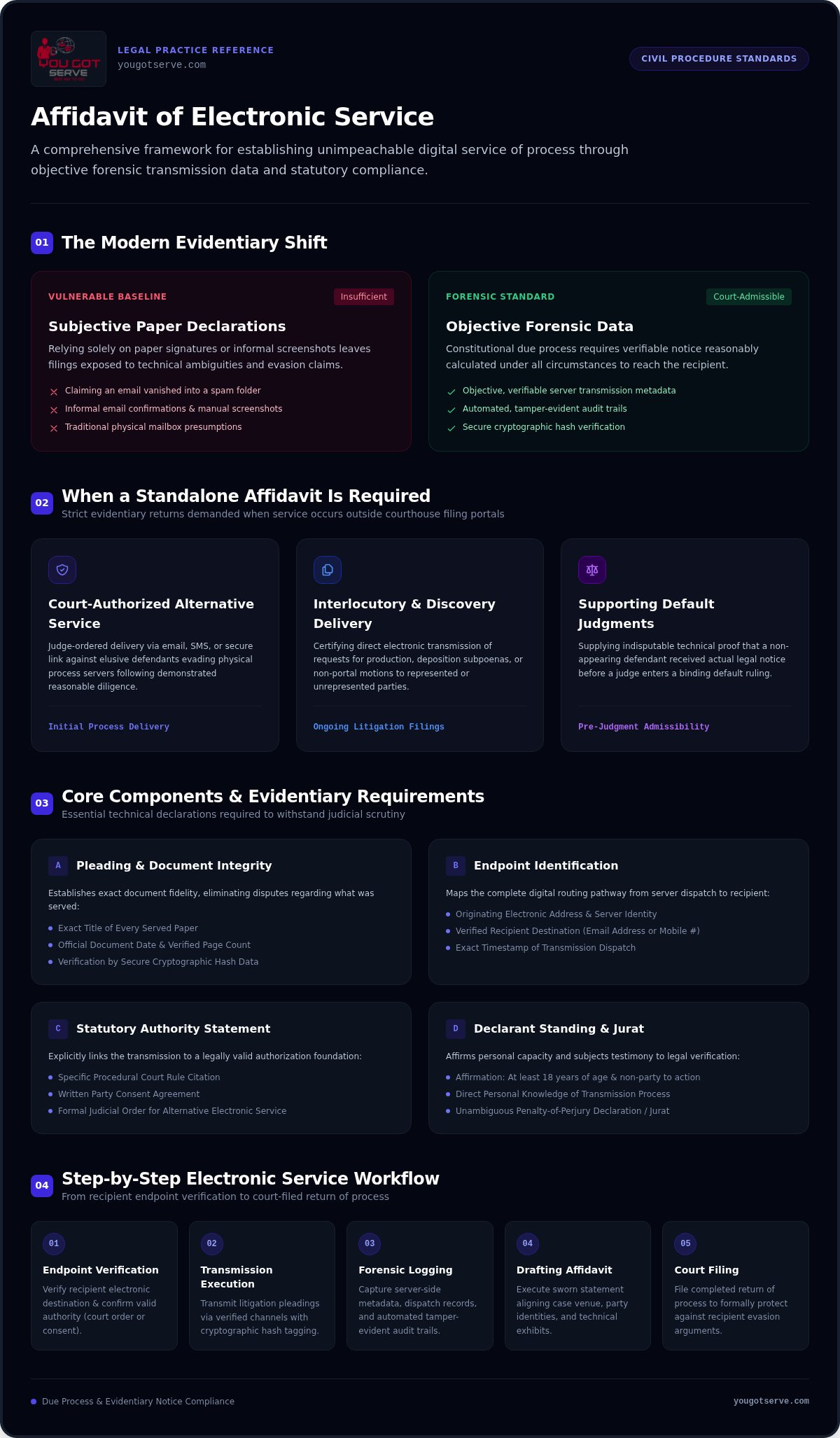
Courts demand strict evidentiary returns whenever delivery occurs outside automated courthouse filing portals. Executing a standalone affidavit is necessary across several critical procedural milestones:
- Court-Authorized Alternative Service: Providing verified proof after executing judge-ordered service via email, SMS, or secure link against elusive defendants who evade physical process servers.
- Interlocutory and Discovery Delivery: Formally certifying the direct electronic transmission of requests for production, deposition subpoenas, or non-portal motions to unrepresented or represented parties.
- Supporting Default Judgment Applications: Supplying indisputable technical proof that a non-appearing defendant received actual legal notice before a judge enters a binding default ruling.
Core Components and Evidentiary Requirements of a Court-Ready Affidavit
Admissible affidavits must establish server competence, precise dispatch time, and destination address accuracy. When opposing counsel challenges a digital transmission, generic assertions quickly fail. A legally sound affidavit of electronic service requires verifiable technical substance that links the document sent to the digital endpoint that received it.
Standard court templates, such as the official Proof of Electronic Service (POS-050) form, establish the baseline clerical framework. However, meeting modern federal and state evidentiary standards across nationwide jurisdictions demands supporting exhibits that eliminate judicial skepticism. Integrating forensic records directly into your sworn filing transforms a vulnerable claim into an unassailable evidentiary instrument.
Essential Case and Transmission Metadata
Every submission begins with strict clerical alignment. The instrument must identify the complete judicial venue, case number, and exact identities of all parties served. Precision matters down to the document level:
- Pleading Integrity: State the exact title, document date, and page count of each served paper, verified by secure cryptographic hash data.
- Endpoint Identification: Specify the originating electronic address, server transmission identity, and verified recipient destination email address or mobile number.
- Authority Statement: Cite the specific procedural court rule, written party consent agreement, or judicial order authorizing electronic delivery.
Sworn Attestation and Verification Standards
The declarant must explicitly establish standing and legal capacity. The swearing individual must affirm they are at least 18 years old, not a party to the underlying action, and possess direct personal knowledge of the transmission process. This affirmation must conclude with an unambiguous penalty-of-perjury declaration conforming to statutory jurat or unsworn declaration requirements.
Technical Exhibits and Transmission Logs
Judges increasingly reject bare assertions that an email was simply sent. Defeating evasion claims requires incorporating objective server-side transmission telemetry:
- Diagnostic SMTP Logs: Attach network headers displaying server handshakes, message IDs, and final delivery status codes proving the remote mail server accepted the payload.
- Recipient Verification Metrics: Document device engagement, automated delivery tracking events, and exact timestamp confirmations.
- Delivery Disposition: Formally record that no bounce-back notifications, delivery failure notices, or technical rejection codes occurred during transmission.
Legal teams looking to standardize these evidentiary standards can generate compliant, tamper-evident filings through modern electronic document delivery platforms. To streamline this process and ensure zero jurisdictional defects, review our compliance checklist for generating a defensible court-ready proof of service. Utilizing an automated workflow through YouGotServe guarantees that every technical exhibit is fully validated prior to filing.
Electronic Service Affidavits vs. Traditional Affidavits of Service
Traditional process serving relies on a physical encounter, certified postal receipt, or substituted doorstep delivery. In contrast, an affidavit of electronic service confirms receipt through digital network transmission. While both instruments serve the exact same constitutional notice objective, their evidentiary foundations diverge significantly when an opposing party contests service in court.
The traditional mailbox rule grants a legal presumption that properly addressed, stamped, and posted mail reaches its destination. Electronic delivery changes this legal dynamic. Because digital transmissions face potential network filtering, spam routing, and server dropouts, courts rarely rely on bare assumptions of delivery. Instead, as outlined in the Cornell LII guide to service of process, the constitutional test remains whether notice was reasonably calculated to provide actual awareness. Proving that calculation electronically requires hard transmission telemetry.
Comparative Analysis: Traditional vs. Electronic Proof
Understanding how courts evaluate competing delivery methods clarifies the precise evidentiary burden resting on each format:
| Service Attribute | Physical Process Return | Certified Mail Return | Electronic Service Affidavit |
|---|---|---|---|
| Proof Mechanism | Server's physical attestation | Recipient signature green card | Tamper-evident transmission log |
| Effective Date | Moment of physical delivery | Date signed upon delivery | Instantaneous upon verified dispatch |
| Vulnerability to Rebuttal | Claims of misidentification | Illegible or unauthorized signers | Allegations of spam folder suppression |
For a detailed breakdown of navigating statutory timelines across digital channels, consult our comprehensive guide to electronic service of process.
Fatal Defects That Invalidate Electronic Service Proof
Judges routinely grant motions to quash when counsel treats digital service casually. The most prevalent mistakes stem from administrative shortcuts:
- Missing Diagnostic Records: Submitting an affidavit of electronic service that lacks concrete technical exhibits, such as server dispatch logs or cryptographic payload confirmations.
- Endpoint Non-Authorization: Directing transmissions to email addresses or mobile numbers that lack verifiable consent, prior transactional history, or express authorization under a court order.
- Unaddressed Bounces: Concealing or failing to investigate undeliverable notifications, soft bounces, or message delivery failure codes generated during the transmission attempt.
How to Prepare and File an Affidavit of Electronic Service
Executing an enforceable return requires a structured, multi-stage protocol. Following a disciplined workflow guarantees that your affidavit of electronic service withstands evidentiary challenges when scrutinized by judicial officers or opposing counsel.
- Confirm Legal Authority and Recipient Identity: Establish statutory entitlement to serve electronically and authenticate recipient ownership of target endpoints.
- Transmit via Secure Protocols: Dispatch court documents through managed digital networks capable of generating verifiable audit logs.
- Compile Forensic Records: Assemble network metadata, timestamp tokens, and delivery status receipts into indexed exhibits.
- Execute Sworn Attestations: Draft factual declarations and execute the return under penalty of perjury, utilizing certified electronic notarization where required.
- Complete Judicial Filing: Submit the final instrument to the court clerk within statutory timelines and distribute conformed copies to all parties.
Pre-Transmission Verification and Authorization
Never dispatch pleadings into a digital void. Before sending documents, verify express statutory authorization, whether through written consent, local procedural rules, or an explicit court order permitting alternative service. Incorporating skip tracing and investigation tools to verify recipient digital endpoints prior to delivery eliminates claims that an email or phone number was inactive, abandoned, or assigned to an unrelated third party. You can streamline this preliminary diligence by using YouGotServe to handle investigative verification and secure digital delivery in one unified workflow.
Drafting the Sworn Factual Record
Clarity in the factual body eliminates judicial hesitation. Draft every factual assertion chronologically, avoiding ambiguous phrasing like "documents were delivered as requested." The sworn narrative must explicitly cross-reference technical exhibits:
- Reference specific transmission logs by exhibit letter.
- State the exact size, cryptographic hash, and title of each attached file.
- Affirm affirmatively that no undeliverable bounce codes or delivery failure messages occurred during or immediately following the transmission window.
Execution, Notarization, and Court E-Filing
The final phase bridges technical transmission with formal recordation. Execute the instrument using an electronic notarization platform compliant with national notarial standards, or complete an unsworn declaration under penalty of perjury if permitted by the governing jurisdiction. Convert the completed affidavit of electronic service and its attached exhibits into a unified, text-searchable PDF format with electronic bookmarks. File the document with the court clerk promptly to ensure proof is recorded well before any response deadlines expire.
Modernizing Proof of Service: Digital Audit Trails and Automated Verification
Manual email transmissions leave critical evidentiary vulnerabilities that sophisticated defendants readily exploit. Attorneys often attempt to prove digital delivery by attaching desktop screenshots of an email sent folder or relying on unverified read receipts. In contested proceedings, opposing counsel can easily challenge these informal records as self-serving hearsay or unauthenticated screen captures that prove nothing about destination server reception.
Automated electronic service technology sets the modern evidentiary benchmark, replacing subjective server declarations with objective, tamper-evident digital audit trails. Modern platforms record every phase of digital transit through cryptographic security and multi-channel communication protocols, transforming a disputed transmission into an unshakeable affidavit of electronic service.
Beyond the Simple Email: Forensic Digital Audit Trails
Judges increasingly dismiss raw screenshots because they lack technical immutability. Anyone can manipulate an image file, alter system clocks, or edit recipient fields before capturing a desktop display. A court-ready affidavit of electronic service resolves these weaknesses through rigorous cryptographic verification:
- Cryptographic File Hashing: Generating distinct SHA-256 checksums at the moment of upload proves the underlying court documents remained uncorrupted and unaltered during transmission.
- Immutable Network Timestamps: Synchronizing dispatch records with trusted public time servers prevents disputes over whether a filing occurred before local jurisdictional filing cutoff times.
- Authenticated Access Logging: Tracking exact device interactions, originating IP addresses, and secure download confirmations provides tangible evidence that the intended recipient accessed the transmitted payload.
Automating Compliance and Overcoming Defendant Evasion
Overcoming bad-faith evasion requires continuous, documented digital contact across redundant communication pathways. Delivering legal notices through synchronized email notifications alongside secure SMS alerts dramatically reduces the effectiveness of defendant claims that an email landed unnoticed in a spam quarantine folder. Automated delivery tracking records multiple touchpoints without introducing administrative overhead.
Automated platforms systematically dispatch automated delivery reminders at scheduled intervals following the initial dispatch. Each sequential alert generates an incremental verification event, building an undeniable record of persistent, constitutionally compliant notice attempts. These discrete events aggregate into a standardized proof of service certificate ready for immediate judicial filing, completely free of the manual clerical errors and paperwork delays that plague traditional process serving.
Eliminate transmission disputes and protect your litigation timeline from procedural challenges. Secure admissible, verifiable electronic service records through YouGotServe.
Securing Unimpeachable Electronic Service Records
Modern litigation leaves no room for ambiguous delivery receipts or unauthenticated email screenshots. Establishing legally binding notice requires trading subjective server statements for objective forensic telemetry. Executing a court-ready affidavit of electronic service demands verified recipient endpoints, structured factual attestations, and comprehensive server transmission logs that defeat claims of non-receipt before they arise.
You can streamline this procedural burden while eliminating evidentiary vulnerabilities. Pairing licensed investigative skip tracing with automated digital tracking across email and SMS delivery channels ensures your filings satisfy the highest constitutional due process standards. Generating tamper-evident proof of service reports complete with detailed audit trails protects your case timeline and keeps your proceedings moving forward without procedural delay.
Ready to standardize your digital delivery workflows? Generate Court-Ready Proof of Service with YouGotServe and safeguard your record with complete evidentiary confidence.
Frequently Asked Questions
What is the difference between an affidavit of service and a certificate of service?
An affidavit of service is a formal sworn statement executed under oath or penalty of perjury, whereas a certificate of service is an unsworn statement typically executed by an attorney of record. Certificates accompany routine filings served on registered counsel through court portals. Standalone affidavits are required when third parties, independent process servers, or specialized technology platforms complete delivery outside automated court docketing systems.
Can an affidavit of electronic service be signed and notarized electronically?
Yes, an affidavit of electronic service can be signed and notarized electronically under statutory frameworks like the Uniform Electronic Transactions Act and remote online notarization laws. Most state and federal jurisdictions accept verifiable digital signatures and electronic notarial seals. The resulting instrument must include digital verification certificates and maintain tamper-evident encryption proving the document wasn't altered after execution.
What happens if the recipient claims they never received or opened the email?
A recipient's subjective claim of non-receipt fails when rebutted by objective server-level transmission telemetry. While bare email screenshots don't refute spam folder claims, automated delivery platforms defeat this defense by logging server handshakes, recipient IP interactions, and secure download confirmations. Courts focus on whether notice was reasonably calculated to reach the recipient, making verifiable transmission logs far more persuasive than self-serving denials.
Is an affidavit of electronic service legally valid for serving an initial summons and complaint?
Yes, but only with prior judicial authorization or express statutory consent. Unlike subsequent motions, serving an initial summons requires personal delivery unless a judge grants an order for alternative electronic service after traditional attempts fail. Once authorized, completing delivery via email or SMS generates an affidavit of electronic service that trial courts accept as valid return of process to establish personal jurisdiction.
What technical exhibits must be attached to an affidavit of electronic service?
A court-ready return should attach diagnostic SMTP logs, cryptographic hash tokens, and authenticated delivery confirmation records. These technical exhibits confirm the exact transmission timestamp, remote mail server acceptance codes, recipient device interactions, and absence of bounce-back errors. Including comprehensive transmission telemetry ensures the court receives independent, objective proof that documents successfully crossed the digital network to the target endpoint.
How long after electronic transmission must the affidavit of service be filed?
Filing deadlines depend on local court rules, but most jurisdictions require filing proof of service promptly, typically within several business days following transmission or well ahead of scheduled hearings. In default proceedings, the affidavit must be on file before the clerk or judge can evaluate motion paperwork. Timely filing ensures all response deadlines calculated from the date of service remain enforceable.
Can you serve legal court papers electronically via text message or SMS?
Yes, courts increasingly authorize service via text message or SMS as a valid alternative method when defendants evade traditional physical delivery. Successful SMS delivery requires showing prior diligent search efforts and verifying the recipient's phone number through investigative skip tracing. The resulting proof must document cellular carrier transmission receipts, message timestamps, and secure document access logs to substantiate legal notice.


