

A simple screenshot from your email "Sent" folder is no longer enough to survive a contested motion to quash. State and federal judges are increasingly skeptical of informal electronic confirmations, especially when evasive defendants claim critical pleadings vanished into spam filters or went unreceived. Every litigator understands the frustration of seeing case momentum stall because of missing transmission metadata or unverified timestamps. Without objective proof of delivery and recipient authentication, establishing valid notice often collapses into expensive motion practice or drawn-out depositions. Bridging this evidentiary gap demands verifiable forensic telemetry rather than passive assumptions, ensuring you generate an unassailable, court-ready proof of service that leaves no room for judicial hesitation.
This guide examines the essential statutory benchmarks, immutable audit trail elements, and identity verification protocols required to build an affidavit that withstands aggressive legal scrutiny. From transmission logging to multi-channel delivery tracking, here is your comprehensive 2026 compliance checklist for executing digital service packages that courts accept without dispute.
Key Takeaways
- Master the essential statutory benchmarks and evidentiary details required to assemble an unassailable court-ready proof of service that survives aggressive motions to quash.
- Discover why contemporary trial courts reject informal email printouts and demand objective cryptographic telemetry, including server handshakes and timestamped access records.
- Implement a structured five-point compliance checklist to verify party capacities, case caption accuracy, and complete document indexing before filing your affidavit.
- Learn how combining dual-channel delivery across email and SMS with automated reminder cadences prevents evasive defendants from claiming pleadings landed in spam folders.
- Leverage integrated skip tracing to confirm active electronic endpoints and establish the thorough due diligence necessary for alternative service approval.
What Constitutes Court-Ready Proof of Service in Modern Litigation?
A court-ready proof of service is a legally defensible affidavit and comprehensive return document confirming that legal notice was executed strictly under governing statutory rules. In civil litigation, the validity of service of process dictates whether a court secures personal jurisdiction over a defendant. Basic delivery confirmation merely indicates that data traveled across a network, which isn't sufficient in a contested proceeding. A verified, court-ready proof of service authenticates exactly what documents were transmitted, the verified endpoints used, and the precise moment receipt occurred. Meeting these evidentiary thresholds shields your case against motions to quash, preventing expensive procedural delays and administrative dismissals.
The Legal Evolution from Paper Affidavits to Digital Proof
Historically, civil procedure depended almost exclusively on manual hand delivery by an independent process server. Servers signed standardized paper affidavits based on visual recollection and handwritten logbooks, methods inherently vulnerable to credibility disputes. As evasive defendants and decentralized operations made physical contact harder to secure, trial courts expanded acceptance of alternative digital delivery after personal attempts stalled. Modern practice replaces subjective recollections with objective technical verification. Cryptographically logged records document transmission events instantly, creating an indisputable record that carries far greater evidentiary weight than a disputed physical drop.
Statutory Due Process Thresholds for Electronic Delivery
Constitutional due process requires that any method of service must be reasonably calculated, under all the circumstances, to apprise interested parties of the pendency of the action. When counsel seeks court authorization for alternative electronic delivery under federal or state procedural rules, judges demand concrete proof that the recipient actually controls and monitors the digital destination. Satisfying this constitutional threshold requires more than sending an unconfirmed message. A court-ready proof of service fulfills this standard by pairing delivery tracking telemetry with recipient access records, establishing that actual notice was effectively accomplished.
Checklist: Essential Components of an Unassailable Proof of Service
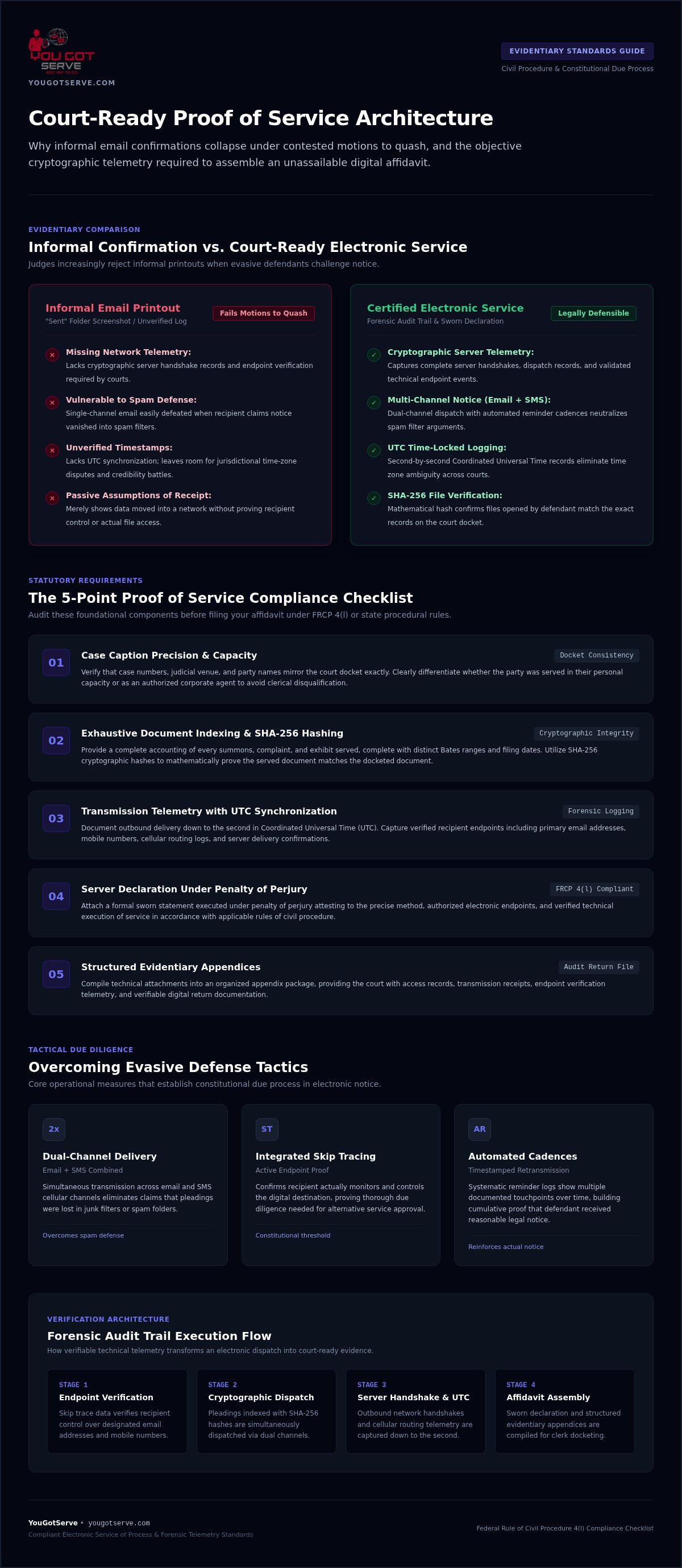
Assembling a filing package requires strict adherence to procedural mechanics. While legacy practice relied on checking boxes on paper forms, modern electronic notice demands technical verification. Under Federal Rule of Civil Procedure 4(l), proving service requires an affidavit by the server unless service is waived. To establish an unassailable court-ready proof of service, legal teams should audit five foundational elements before submitting documents to the clerk:
- Case Caption and Capacity: Precise alignment of parties, case numbers, and judicial venue.
- Document Indexing: Exhaustive accounting of every served summons, complaint, and exhibit.
- Transmission Telemetry: Concrete metadata logging recipient endpoints and dispatch timestamps.
- Server Declaration: A sworn attestation executed under penalty of perjury.
- Evidentiary Appendices: Structured technical attachments confirming delivery and receipt.
Step 1 & 2: Case Caption Precision and Document Indexing
Clerical discrepancies create immediate vulnerability. Ensure the caption perfectly mirrors the court docket, identifying whether individuals are served personally or as corporate agents. Itemize each document in the formal exhibit list, identifying distinct Bates ranges or filing dates. Utilizing SHA-256 cryptographic document hash signatures creates mathematical certainty that the files opened by the defendant match the records filed with the court.
Step 3 & 4: Transmission Telemetry and Server Declarations
Log outbound delivery events down to the second using Coordinated Universal Time (UTC) to eliminate jurisdictional time zone disputes. Record primary recipient endpoints, including verified email addresses, mobile numbers, and cellular routing logs. The accompanying affidavit must be executed under penalty of perjury pursuant to 28 U.S.C. § 1746 or applicable state affirmation laws, confirming that the electronic transmission was successfully executed without bouncebacks.
Step 5: Assembling Evidentiary Appendices for Court Clerks
Format technical verification data into standardized judicial PDF exhibits directly behind the sworn declaration. Include investigator licensing credentials and platform audit summaries showing recipient interaction. Legal teams that rely on automated court-ready proof of service generation ensure these complex evidentiary exhibits are paginated and indexed correctly, securing immediate clerk acceptance and defeating any bad-faith denial of notice.
Forensic Audit Trails: Verifying Transmission, Delivery, and Receipt
Judicial officers no longer accept bald assertions of electronic delivery without supporting telemetry. When a defendant challenges notice, a defensible affidavit must show an unbroken chain of custody proving the files reached the intended destination. For example, under California Rules of Court, Rule 2.251, electronic service is complete upon transmission, yet notice disputes frequently focus on whether transmission actually succeeded. Producing an unassailable, court-ready proof of service requires separating the notification event into three verifiable technical stages: outbound transmission, carrier routing, and recipient engagement.
SMTP Handshakes and Server Response Telemetry
Proving an email left an outbound server isn't enough; you have to confirm the receiving mail transfer agent accepted it. Simple Mail Transfer Protocol (SMTP) logs record the precise 250 OK handshake code, which serves as conclusive technical evidence that the recipient host received the payload. Automated bounce detection logs any hard or soft delivery failures immediately, ensuring you don't submit an affidavit based on a rejected dispatch.
SMS Delivery Receipts and Carrier Network Confirmation
Text notifications provide an independent verification layer that bypasses corporate email spam filters entirely. Telecommunications carrier networks generate Short Message Peer-to-Peer (SMPP) delivery receipts that record when a message reaches the recipient's mobile hardware. Coupling this mobile dispatch with automated delivery reminders creates an audit trail of persistent, diligent outreach. This multi-channel approach makes it virtually impossible for an opposing party to claim complete lack of awareness.
Recipient Engagement Verification and Access Telemetry
The definitive shield against a motion to quash is documenting affirmative recipient interaction. Capturing the recipient's public Internet Protocol (IP) address, browser user-agent string, and the exact second they enter a secure access PIN establishes actual personal notice. These technical access logs satisfy federal evidentiary authentication standards, transforming a contested electronic delivery into an airtight, court-ready proof of service that leaves no room for credible denial.
Informal Email Delivery vs. Certified Court-Ready Electronic Service
Transmitting sensitive pleadings directly from standard law firm email software exposes legal teams to serious procedural vulnerability. Trial judges routinely reject self-generated email printouts, outlook read receipts, and sent-folder screenshots when opposing counsel challenges service. An ordinary email client cannot provide the neutral evidentiary weight required to overcome a sworn denial of receipt. Generating a defensible, court-ready proof of service demands an independent, third-party platform that establishes non-repudiation through objective system logs rather than internal attorney affirmations.
The Evidentiary Pitfalls of Standard Law Firm Emails
Standard email read receipts create a false sense of security. Most enterprise email platforms allow recipients to disable read receipts entirely or block automated tracking pixels automatically. Aggressive spam filtering algorithms also divert incoming legal files into junk folders without notifying the sender. Worse, when an attorney signs an affidavit claiming they personally emailed documents to an adversary, that lawyer risks becoming a necessary fact witness in their own case. This blurs the line between advocate and witness, creating avoidable disqualification risks during contested hearings.
Defeating Defense Motions to Quash with Certified Records
Defendants facing default judgment frequently claim they never received digital notice, blaming lost internet connections or spam filters. These defenses collapse when confronted with an independent certificate containing third-party telemetry. A dedicated compliance platform documents the complete message journey, pairing secure transmission logs with independent device confirmations. Instead of arguing about unverified inbox delivery, litigants can submit comprehensive records showing that the party received dual-channel notifications and engaged directly with the files.
Securing an unassailable record requires purpose-built technology rather than informal correspondence. To safeguard your litigation against costly defense challenges, generate compliant court-ready proof of service documentation that trial judges accept without dispute.
Generating Compliant Proof of Service with YouGotServe
Modern litigation demands tools engineered specifically for procedural compliance. Rather than wrestling with manual paperwork or unverified communication channels, litigators can streamline operations through specialized legal technology. YouGotServe unites licensed investigative capabilities with automated dual-channel dispatch, providing an end-to-end framework for electronic document delivery. The platform captures every critical transmission milestone, allowing legal professionals to generate a verified, court-ready proof of service that aligns with state and federal evidentiary standards across the nation.
Skip Tracing and Digital Endpoint Identification
Securing court authorization for alternative electronic service starts with establishing defendant contact endpoints. YouGotServe integrates professional skip tracing and investigative workflows to identify active, verified email addresses and cellular telephone numbers tied directly to the target. This investigative diligence creates an undeniable record of research for the court, demonstrating that the designated digital destinations are actively maintained and monitored by the individual.
Automated Transmission and Court-Ready Certificate Generation
Once endpoints are confirmed, the platform initiates coordinated electronic document delivery across both email and SMS pathways. Automated delivery reminders maintain consistent notification pressure over extended cadences, while secure PIN verification controls document access. Litigators monitor the entire progression through an intuitive dashboard that logs transmission handshakes, network delivery, and recipient downloads in real time. Upon completion, the system instantly generates an unassailable court-ready proof of service package, complete with sworn declarations and cryptographic audit logs formatted for prompt docket filing.
Accelerate Litigation Workflows and Eliminate Service Delays
Traditional process serving often stalls litigation for weeks as servers conduct repeated, unsuccessful physical attempts at outdated addresses. Automating digital delivery eliminates these administrative logjams, keeping cases moving toward substantive resolution. By replacing subjective server recollections with objective forensic proof, legal teams remove the evidentiary friction that invites defense challenges. Protect your next filing and establish bulletproof compliance: Get Court-Ready Proof of Service with YouGotServe.
Safeguard Your Proceedings with Defensible Service Records
Judicial expectations surrounding electronic delivery have shifted permanently. Standard email printouts and unverified assertions leave critical pleadings vulnerable to motions to quash. Surviving rigorous court scrutiny demands objective forensic telemetry, licensed investigative skip tracing to authenticate active endpoints, and persistent multi-channel delivery logs. When you anchor service in verifiable data rather than subjective recollection, you eliminate the procedural loopholes that evasive defendants exploit.
Documenting transmission handshakes, automated reminder cadences, and secure access events transforms electronic notice into an unassailable procedural asset. You shouldn't have to sacrifice litigation momentum to procedural uncertainty. By pairing automated compliance with rigorous audit logging, legal teams can confidently protect case timelines and uphold due process standards. Take control of your compliance workflow today: Generate Court-Ready Proof of Service with YouGotServe.
Frequently Asked Questions
What makes a proof of service legally "court-ready"?
A proof of service is legally court-ready when it complies strictly with statutory execution rules and includes complete technical verification. It must feature the full case caption, an itemized list of served documents, a signed declaration under penalty of perjury, and an objective forensic audit trail. This comprehensive package ensures judges can verify transmission, delivery, and receipt without requesting additional evidentiary hearings.
Can I simply print my sent email to prove electronic service in court?
No, printing a sent email message is rarely sufficient if opposing counsel contests service. A printed email shows only that your mail client dispatched data, not that the recipient's mail server accepted it. Courts routinely reject informal screenshots because they lack server handshake records, deliverability telemetry, and neutral third-party verification confirming the documents reached the target destination.
What happens if a defendant claims they never received an electronically served document?
When a defendant claims non-receipt, the court evaluates the objective technical evidence submitted with your return of service. A certified court-ready proof of service defeats this defense by providing independent forensic telemetry. By presenting Simple Mail Transfer Protocol delivery codes, cellular network delivery receipts, and secure PIN access logs, you prove actual notice and defeat bad-faith motions to quash.
Do I need prior court approval before serving legal documents electronically?
Prior court authorization depends entirely on the nature of the legal paper being served. Serving initial process, such as a summons and complaint, typically requires personal physical delivery unless you obtain a court order authorizing alternative electronic service after diligent attempts fail. Subsequent litigation pleadings, such as motions and discovery requests, generally allow electronic service where local rules permit or parties have formally consented.
What technical metadata should be included in an electronic proof of service?
An electronic proof of service should incorporate complete transmission and engagement metadata. Essential forensic data points include Coordinated Universal Time dispatch stamps, destination email addresses and phone numbers, server response codes, and document cryptographic hash values. Including recipient Internet Protocol addresses, user-agent details, and timestamped verification records creates an unassailable evidentiary foundation.
How does an affidavit of electronic service differ from traditional process serving affidavits?
Traditional process server affidavits rely heavily on subjective human recollection and visual identifications documented in physical logbooks. An affidavit of electronic service substitutes human observation with objective cryptographic telemetry and digital transmission logs. Instead of merely asserting that papers were delivered, it pairs a sworn server declaration with mathematical records proving delivery across authenticated digital channels.
Is electronic proof of service admissible under federal rules of civil procedure?
Yes, electronic proof of service is admissible under federal practice when executed under governing civil and evidentiary rules. Federal Rule of Civil Procedure 4(l) authorizes proof by affidavit, while federal electronic filing rules govern interlocutory notices. When an electronic service platform captures verified business records accompanied by a 28 U.S.C. § 1746 declaration, the documentation satisfies federal admissibility standards.
How do automated reminders strengthen the legal defensibility of service?
Automated reminders demonstrate persistent, ongoing due diligence across the statutory notice window. Dispatching scheduled notifications across concurrent email and SMS pathways prevents recipients from claiming an isolated message was missed or filtered into junk folders. This persistent notification pattern builds an exhaustive record of repeated opportunities to access the documents, satisfying constitutional due process requirements.


