

A simple email read receipt will not survive a motion to quash in modern litigation. When an elusive defendant claims they never opened or received digital legal papers, judges routinely reject informal delivery confirmations as inadmissible hearsay. To withstand rigorous judicial scrutiny, legal professionals must rely on a forensically sealed electronic service audit trail that documents cryptographic hashing, IP geolocations, and tamper-evident transmission logs.
Proving that a digital document actually reached an opposing party shouldn't feel like an evidentiary gamble. This guide details how an immutable electronic service audit trail satisfies judicial scrutiny, fulfills the digital evidence standards of Federal Rules of Evidence 902(13) and 902(14), and delivers court-ready proof of process service. We will examine the precise technical data points required to defeat evasive tactics, evaluate modern electronic delivery platforms, and provide a clear roadmap to safeguard your litigation proceedings against motions to quash or vacate service.
Key Takeaways
- Learn how an immutable electronic service audit trail establishes personal jurisdiction and satisfies constitutional due process requirements.
- Discover the forensic data fields, including cryptographic hashing and IP geolocations, required for self-authenticating digital evidence under Federal Rules of Evidence.
- Compare objective digital transmission logs against traditional paper affidavits to eliminate vulnerabilities like sewer service and drop service allegations.
- Master practical litigation workflows for filing and defending court-ready delivery affidavits against motions to quash.
- Identify the core technical capabilities that separate purpose-built legal document delivery platforms from inadequate generic e-signature software.
What Is an Electronic Service Audit Trail in Legal Proceedings?
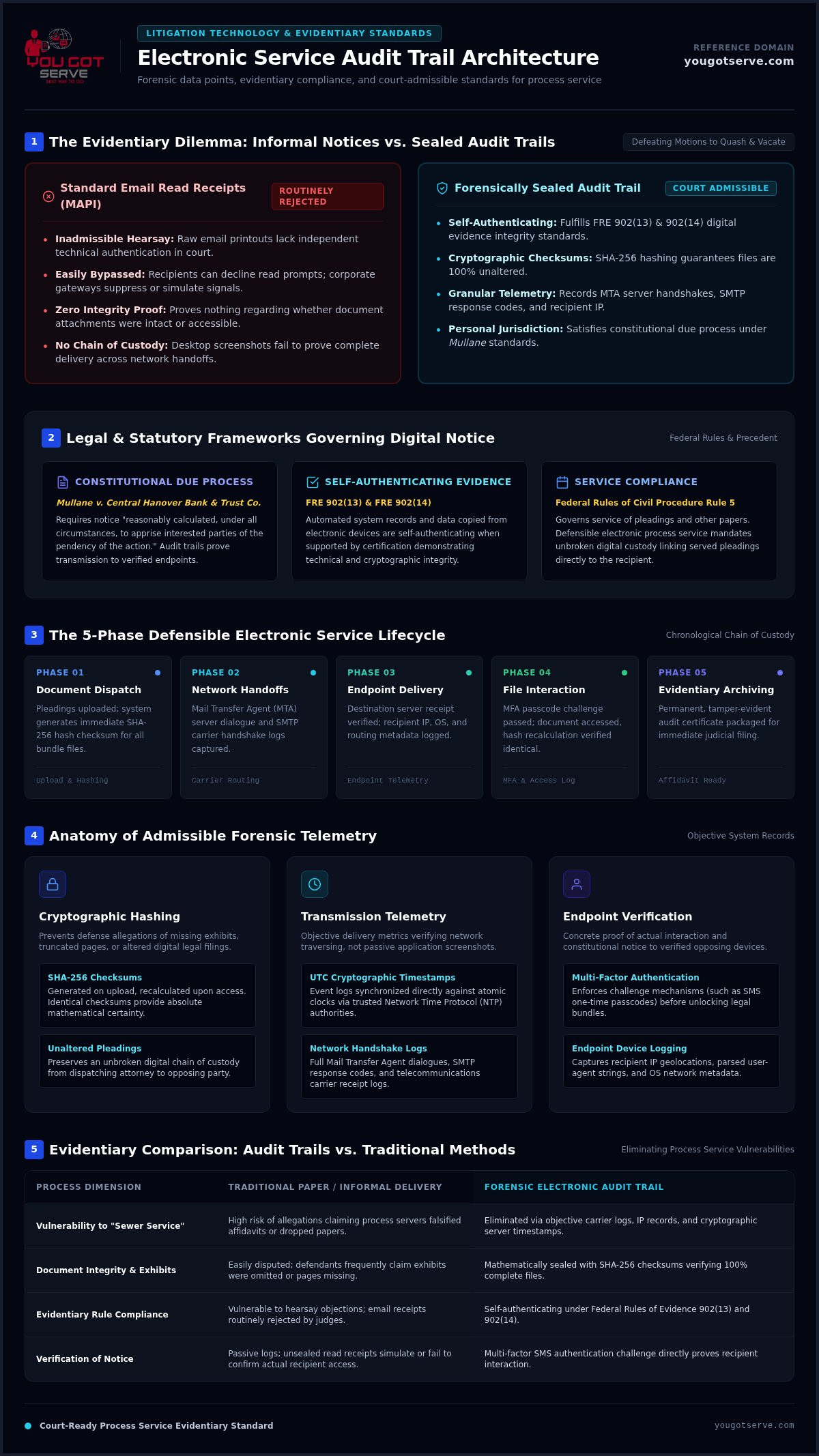
In civil litigation, an electronic service audit trail is a tamper-evident, chronological record documenting the forensic metadata of legal papers delivered across digital networks. While corporate governance platforms treat an audit trail as a general operational check, litigation demands an evidentiary instrument. In legal proceedings, this record serves an essential statutory purpose: establishing personal jurisdiction over an opposing party. Modern courts routinely reject unstructured desktop screenshots and basic transmission notices because they fail to prove chain of custody. A defensible lifecycle must track each phase, including document dispatch, network handoffs, recipient endpoint delivery, file interactions, and permanent evidentiary archiving.
Constitutional Due Process and Digital Notice Requirements
The constitutional benchmark established in Mullane v. Central Hanover Bank & Trust Co. requires notice "reasonably calculated, under all circumstances, to apprise interested parties of the pendency of the action." Electronic service often faces judicial skepticism because digital accounts can be abandoned, shared, or spoofed. A comprehensive electronic service audit trail eliminates this doubt by proving actual transmission to verified digital endpoints. By capturing granular network handoffs, IP geolocations, and time-stamped delivery logs, the audit trail confirms that legal papers reached their destination through reliable, verifiable channels.
The Fundamental Flaw of Standard Email Read Receipts
Litigators often attempt to demonstrate digital service by submitting printed email confirmations or standard MAPI read receipts. These informal records consistently fail under defense scrutiny. MAPI receipts are easily bypassed; recipients can decline read prompts, and corporate spam gateways routinely suppress or simulate tracking signals. From an evidentiary standpoint, raw email printouts lack independent authentication, exposing filings to hearsay objections. Judges recognize that an unsealed email receipt proves nothing about whether an attachment remained intact or was accessible, making specialized forensic verification indispensable.
Anatomy of a Court-Admissible Electronic Service Audit Trail
Federal and state courts demand demonstrable proof of custody before admitting digital records into evidence. Under procedural frameworks such as Federal Rules of Civil Procedure Rule 5 and Federal Rules of Evidence 902(13) and 902(14), automated system records must demonstrate technical integrity to be considered self-authenticating. A legally defensible electronic service audit trail captures an unbroken sequence of forensic data points that directly link the served documents to the recipient's digital footprint.
Cryptographic Hashing and Document Integrity Verification
Defense counsel frequently challenge electronic delivery by alleging missing exhibits, truncated pages, or altered files. Cryptographic hashing eliminates this defense entirely. The delivery system generates a unique SHA-256 checksum at the precise moment legal documents are uploaded. When the recipient accesses or downloads the bundle, the system recalculates that hash value. Identical checksums provide mathematical certainty that the served pleadings remained completely unaltered throughout transmission, preserving an unbroken digital chain of custody.
Transmission Telemetry: Timestamps, IP Logging, and Network Routing
Defensible process service requires objective delivery telemetry rather than passive application logs. A court-ready audit report captures several critical infrastructure metrics:
- UTC Cryptographic Timestamps: Event logs synchronized against atomic clocks via trusted Network Time Protocol authorities.
- Network Handshake Logs: Mail Transfer Agent server dialogues, SMTP response codes, and telecommunications carrier receipt logs.
- Endpoint Telemetry: Recipient IP addresses, parsed user-agent strings, operating systems, and network routing metadata.
These verifiable data points confirm that transmission wasn't merely attempted; it successfully traversed carrier pathways to reach the recipient's device.
Recipient Verification and Access Authentication Mechanisms
Proving constitutional notice requires evidence of interaction, not just transmission. Purpose-built platforms enforce multi-factor authentication challenges, such as secure one-time passcodes sent via SMS, before unlocking document downloads. The resulting audit log captures every interaction: initial dispatch, message delivery, security challenge resolution, and file viewing. When evasive parties ignore initial notices, automated delivery reminders continue to build an undeniable record of persistent outreach. Implementing secure electronic document delivery ensures these complex telemetry trails compile automatically into a single, cohesive legal record.
Evidentiary Comparison: Audit Trails vs. Traditional Proof of Service
Traditional process serving relies heavily on a process server's affidavit, leaving case timelines vulnerable to credibility contests. Defense counsel routinely raise allegations of "sewer service" (falsified returns) or improper "drop service" when papers are left on doorsteps. In contrast, an electronic service audit trail replaces subjective assertions with deterministic system logs, creating an unassailable record of delivery.
| Evidentiary Feature | Traditional Paper Affidavit | Standard Email Confirmation | Forensic Electronic Audit Trail |
|---|---|---|---|
| Proof Mechanism | Server's written declaration | Unverified client display printout | Cryptographic, time-stamped system logs |
| Dispute Vulnerability | High (sewer or drop service claims) | High (trivially denied or suppressed) | Low (validated IP and device telemetry) |
| Integrity Assurance | Physical paper signature | None (vulnerable to alteration) | SHA-256 document hashing |
| Evidentiary Rule Standard | Requires affiant credibility | Hearsay objections common | Self-authenticating under FRE 902 |
Eliminating Disputes Over Evasive Defendants and Drop Service
When elusive parties evade service, process servers often resort to sub-service or doorstep abandonment. Defendants routinely exploit these ambiguities to vacate default judgments years later. Electronic delivery eliminates this vulnerability by pairing real-time transmission telemetry with verified skip-tracing records. Incorporating verified digital contact data aligns with industry standards, such as the CALSPro Best Practices for Electronic Service, proving that legal notices were transmitted directly to the subject's active personal channels.
Self-Authenticating Evidence Under Federal Rule of Evidence 902
Under Federal Rules of Evidence 902(13) and 902(14), electronic data generated by a certified, reliable process is treated as self-authenticating. This framework removes the burdensome requirement to produce software engineers or live forensic witnesses in court. A dedicated platform formats the full electronic service audit trail into a court-ready affidavit of service, allowing litigators to defeat motions to quash swiftly and proceed to the merits of their case.
How to File and Defend an Electronic Audit Trail in Court
Filing an electronic proof of service requires presenting technical data in a format judges can readily digest. When seeking court authorization for electronic alternative service, counsel must first demonstrate reasonable diligence through documented attempts at traditional methods. Once authorized and executed, attaching a comprehensive electronic service audit trail transforms raw network telemetry into clear, prima facie proof of delivery. Presenting this documentation methodically ensures your filings withstand judicial scrutiny and defeat defense challenges.
Drafting the Affidavit of Service with Attached Forensic Exhibits
A successful filing links the formal declaration directly to automated forensic exhibits. Structure the affidavit to reference the underlying electronic records systematically:
- Chronological Summary: State the exact dispatch timestamp, transmission channels used (email, SMS), and the unique SHA-256 hash identifying the underlying pleading.
- Affirmation of Delivery: Cite originating server transmission receipts, recipient gateway acceptance logs, and carrier confirmation IDs.
- Access Verification: Reference authenticated user interactions, including PIN challenge completions, document view events, and corresponding IP geolocations.
Clear, declarative cross-references ensure the judge immediately connects each legal notice requirement to its corresponding technical exhibit.
Overcoming Defense Objections and Motions to Quash
Defendants seeking to quash service frequently claim that electronic notices were sent to spam, never received, or deleted unread. An unbroken digital log dismantles these assertions directly. Mail server handshake records establish that the receiving server accepted the payload without rejection, proving delivery beyond internal email client routing. When an opposing party claims lack of actual notice, automated reminder logs demonstrate that multiple follow-up notifications reached their verified endpoints over successive days. When you need court-ready documentation to safeguard against motions to quash, generate court-ready proof of service with an automated evidentiary audit record.
Implementing Purpose-Built Electronic Process Service Technology
Generic electronic signature software and enterprise file-sharing tools were engineered for standard business agreements, not contentious litigation. They lack the specialized evidentiary frameworks required to overcome formal service challenges. Implementing dedicated legal technology ensures that every dispatched summons, subpoena, or notice generates an immutable electronic service audit trail designed specifically for judicial evaluation.
Key Criteria for Selecting Legal Document Delivery Platforms
Litigation teams evaluating digital delivery platforms should prioritize evidentiary rigor over generic administrative features. Dedicated platforms must offer specific litigation-grade capabilities:
- Multi-Channel Dispatch: Coordinated delivery across secure email and SMS channels to maximize delivery vectors.
- Persistent Follow-Up Logs: Automated delivery reminders that document ongoing, sequential attempts to provide notice.
- Investigative Skip Tracing: Integrated investigative tools that tie digital endpoints directly to the named party prior to transmission.
- Automated Court Proofs: Instant generation of standardized, court-ready proof of service documentation aligned with procedural rules.
These integrated capabilities eliminate the operational friction of assembling manual records from fragmented communications.
Streamlining Firm Workflows with YouGotServe
YouGotServe provides a nationwide legal technology platform engineered to resolve the technical and procedural hurdles of electronic document delivery. By combining secure email and SMS transmission with integrated recipient verification, the platform establishes an unshakeable factual foundation for digital service. When dealing with evasive recipients, integrated skip tracing ensures notices reach active, verified personal channels.
Every completed delivery generates a forensically sealed electronic service audit trail, accompanied by court-ready affidavits ready for immediate docketing. Transitioning to specialized delivery technology protects your cases against costly delays, eliminates procedural challenges, and ensures strict compliance with digital evidence standards. To upgrade your firm's delivery workflows and secure court-ready documentation, explore YouGotServe today.
Safeguard Your Litigation with Court-Ready Digital Evidence
Modern litigation doesn't leave room for informal email confirmations or contested process returns. Relying on an immutable electronic service audit trail guarantees that every digital dispatch satisfies statutory due process requirements and stands up to judicial scrutiny. By anchoring delivery logs to cryptographic checksums, verified network telemetry, and recipient interaction records, you eliminate procedural ambiguity before it threatens your court calendar.
Adopting dedicated legal technology turns process service into an airtight evidentiary asset. With integrated skip tracing to locate elusive parties nationally and automated reminders that document persistent notice across verified email and SMS channels, your firm can proceed confidently to the merits. Take control of your digital workflow today: streamline your litigation with court-ready electronic service from YouGotServe.
Frequently Asked Questions
What is an electronic service audit trail?
An electronic service audit trail is an immutable, chronologically ordered digital record documenting the entire delivery lifecycle of legal papers. It records critical technical telemetry, including SHA-256 cryptographic hashes of served pleadings, coordinated UTC timestamps, transmission logs, server handshake confirmations, and recipient IP geolocations. By establishing an unbroken chain of custody, it transforms digital dispatch into court-admissible evidence that satisfies due process standards.
Will a judge accept an electronic service audit trail as valid legal proof?
Judges routinely accept a forensically sound audit trail when electronic service is statutorily permitted or authorized by court order. Acceptance depends on presenting complete metadata that demonstrates delivery integrity and satisfies constitutional notice standards. Courts reject bare screenshots or informal printouts. However, an audit report supported by verifiable transmission logs, cryptographic hashing, and recipient verification provides the objective proof judges require to confirm personal jurisdiction.
How does an audit trail prove that a defendant actually received the legal documents?
An audit trail tracks verifiable recipient engagement rather than just message dispatch. It logs Mail Transfer Agent delivery receipts confirming the message reached the receiving inbox, records subsequent link clicks, and documents multi-factor authentication completions like SMS passcodes. When the recipient views or downloads the files, the system records their IP address, browser user-agent, and exact timestamp, creating indisputable proof of interaction.
Can a defendant successfully challenge service by claiming the email went to a spam folder?
Courts generally reject spam folder defenses when counsel presents concrete network delivery telemetry. A complete audit log includes SMTP handshake codes showing that the recipient's mail exchange server accepted the communication without bounce or rejection. Additionally, multi-channel service combining SMS notifications with automated follow-up reminders demonstrates repeated, diligent efforts to notify the party, defeating claims of excusable neglect or lack of actual notice.
What is the difference between a standard email delivery receipt and a legal audit trail?
A standard email receipt only indicates that a message left an outgoing mail server, offering zero proof of document integrity, accessibility, or recipient interaction. In contrast, a legal audit trail captures cryptographic document checksums, detailed network telemetry, secure multi-channel routing across email and SMS, and recipient verification. These forensic layers satisfy formal evidentiary thresholds that simple client read receipts can't meet.
Are electronic service audit trails considered self-authenticating under the rules of evidence?
Electronic service audit trails qualify as self-authenticating under Federal Rules of Evidence 902(13) and 902(14) when certified by a reliable automated process. These rules allow digital records generated by verifiable electronic systems to be admitted without requiring live forensic expert testimony. As long as the platform certifies system reliability and produces identical cryptographic hash values to confirm data integrity, the court accepts the documentation as self-authenticating.
How does YouGotServe generate court-ready proof of electronic service?
YouGotServe automatically tracks multi-channel electronic delivery across email and SMS, recording every delivery milestone in an immutable log. The platform integrates recipient verification, multi-stage automated compliance reminders, and investigative skip tracing to confirm valid digital endpoints. Upon delivery completion, the system synthesizes these forensic data points into a standardized, court-ready proof of service that litigators can immediately file in court to defend against motions to quash.


