

If you're relying on a newspaper legal notice to reach an evasive defendant, you're participating in a legal fiction that costs hundreds of dollars and adds weeks of mandatory waiting. While traditional methods frequently fail, an sms summons delivery platform offers a pragmatic alternative that aligns with the constitutional standard of actual notice. You've likely felt the pressure of the 90-day federal service window closing while a defendant remains intentionally out of reach. It's a frustrating, expensive bottleneck that slows the pace of litigation and increases overhead for your firm.
This guide provides a comprehensive look at how to leverage secure SMS technology to serve summons, track delivery in real-time, and generate court-ready proof of service. You'll discover the specific regulatory frameworks, such as Texas Rule 106(b)(2) and Illinois Rule 102(f), that now authorize electronic substituted service. We'll examine how to establish a documented chain of custody that satisfies judicial scrutiny. By moving your practice toward a high-verification digital workflow, you can ensure that service of process is no longer the weakest link in your case strategy.
Key Takeaways
- Transition from outdated "constructive notice" methods to modern digital strategies that reach defendants where they're most active.
- Differentiate between standard text messaging and a dedicated sms summons delivery platform designed for evidentiary compliance and secure document access.
- Master the workflow for serving hard-to-reach individuals, from initial skip tracing to filing a motion for substituted electronic service.
- Leverage automated delivery logs and carrier receipts to produce court-ready proof of service that withstands judicial scrutiny.
- Identify how investigative expertise and licensed skip tracing ensure that digital service meets the constitutional standards for actual notice.
The Evolution of Service: Why SMS Summons Delivery is Essential in 2026
The legal industry is witnessing a significant shift in how notice is provided to defendants. The evolution of service of process has transitioned from a reliance on personal physical delivery to a digital-first approach. In 2026, the traditional model of a process server waiting outside a residence is increasingly ineffective. Remote work, gated communities, and high-security luxury apartments have created physical barriers that make personal service nearly impossible for evasive individuals. When a defendant doesn't want to be found, they simply stop answering the door.
An sms summons delivery platform addresses these modern obstacles by reaching individuals on the one device they rarely ignore: their smartphone. While email often gets buried in spam filters or ignored, SMS maintains a 98% open rate, with most messages read within three minutes of receipt. This immediacy provides a level of actual notice that traditional methods struggle to match. It's no longer enough to hope a defendant checks their mailbox; you need a solution that places the summons directly into their hands.
To better understand the procedural requirements of electronic service, watch this helpful video:
The Limitations of Traditional Process Serving
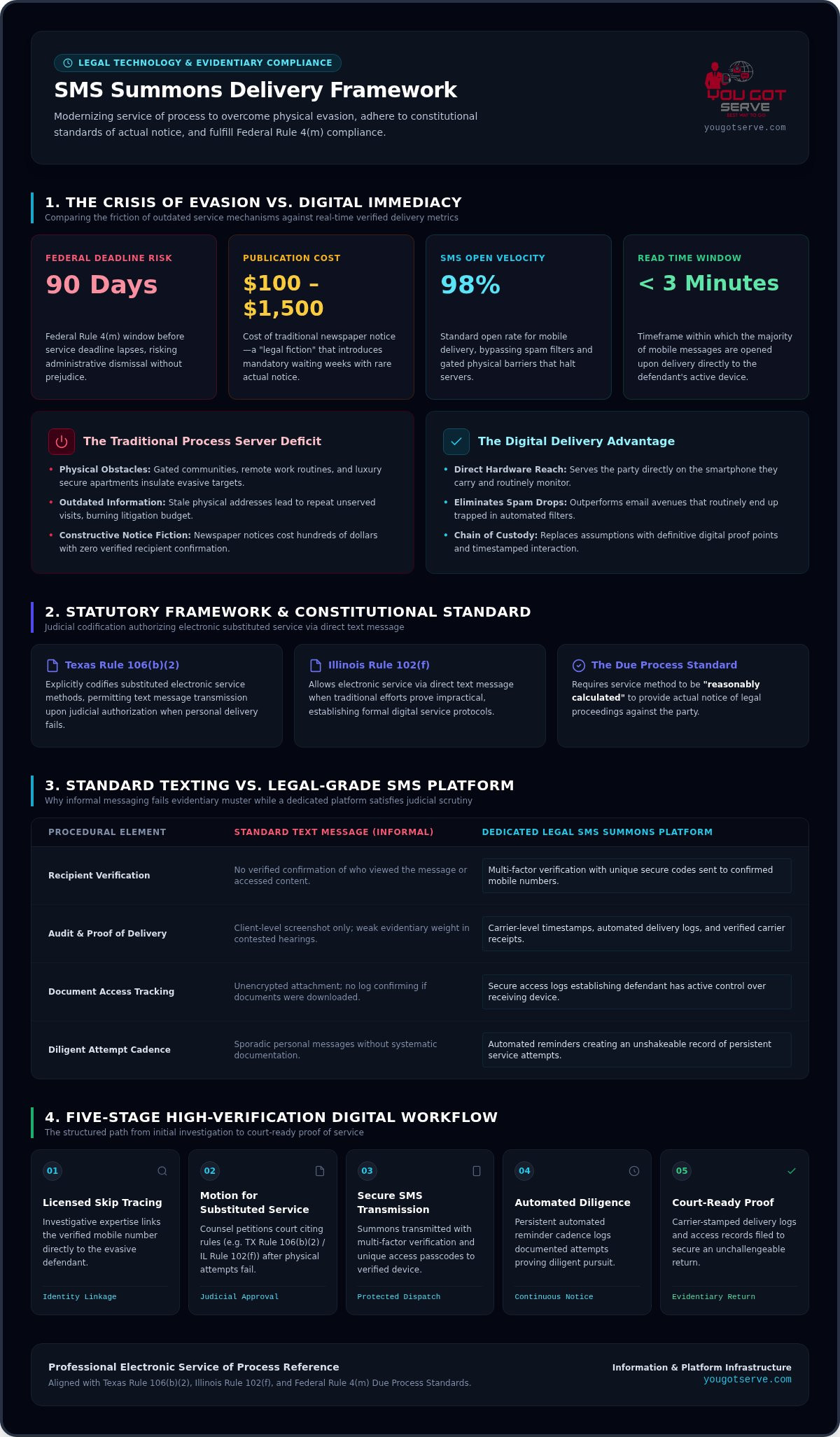
Multiple failed attempts at a physical address don't just delay a case; they inflate litigation costs. When a defendant intentionally dodges service, the clock doesn't stop. Under Federal Rule 4(m), plaintiffs face a strict 90-day window to complete service or risk administrative dismissal without prejudice. Relying solely on physical addresses that may be outdated or intentionally obscured is a strategic risk. Traditional service by publication is often a legal fiction that costs between $100 and $1,500 while rarely providing actual notice to the party involved.
The Legal Basis for Digital Service of Process
The judiciary is responding to these challenges by codifying alternative service methods. Procedural updates like Texas Rule 106(b)(2) and Illinois Supreme Court Rule 102(f) specifically allow for electronic service via direct text message when traditional efforts prove impractical. The constitutional standard requires service to be "reasonably calculated" to provide notice. By using a secure sms summons delivery platform, attorneys provide verifiable proof that the defendant received the documents. This satisfies due process requirements through carrier-level timestamps and secure access logs that demonstrate the defendant has active control over the receiving device.
How an SMS Summons Delivery Platform Ensures Legal Compliance
A legal-grade sms summons delivery platform is fundamentally different from standard messaging applications. While consumer tools focus on casual communication, a professional platform serves as a specialized instrument for the secure transmission and verification of court documents. It provides an auditable trail that standard texting cannot replicate. This distinction is vital for maintaining constitutional due process standards, as the court requires evidence that the method used was reasonably calculated to provide actual notice. Without these specialized features, a digital service attempt may fail to meet judicial scrutiny.
Recipient verification is the cornerstone of a compliant system. A standard text message offers no proof of who viewed the content. In contrast, a professional platform uses multi-factor verification, such as unique secure codes sent to a verified mobile number. This ensures that the person accessing the summons is the intended defendant. Automated reminders reinforce this process by establishing a record of persistent, diligent attempts to serve. This persistent cadence demonstrates to the court that the plaintiff exhausted digital avenues to ensure the defendant's awareness of the pendency of the action.
Verification and Tracking Mechanisms
The platform captures granular data points, including IP addresses and device fingerprints, to verify the recipient's identity and location. Detailed read receipts and link-click tracking provide the evidentiary foundation for a successful affidavit of service. Digital Chain of Custody is the chronological, auditable record of a document's lifecycle from initial transmission to verified recipient access. These logs create a defensible history that prevents defendants from claiming they never received the documents. This level of detail is essential for attorneys who need to prove that service was actually effected.
Data Security and Privacy Standards
Security is paramount when handling sensitive legal data. Documents are never sent as raw attachments, which are vulnerable to interception and carrier filtering. Instead, they're hosted on secure, encrypted servers. Recipients access them via protected links, ensuring that the documents remain encrypted during transit and at rest. This approach ensures compliance with privacy regulations and protects the integrity of the legal proceedings. If you're ready to modernize your firm's workflow, exploring a professional sms summons delivery platform can significantly reduce service delays and lower litigation costs.
Evaluating the Best SMS Summons Platforms: A Comparison Framework
Choosing an sms summons delivery platform requires a fundamental shift in perspective. You're not simply looking for a messaging service; you're selecting a litigation support engine that must withstand intense judicial scrutiny. Most generic SMS tools focus on marketing or simple reminders, but they lack the investigative depth and evidentiary rigor required by the Federal Rules of Civil Procedure. A legal-grade platform must bridge the gap between technology and the specific procedural demands of the courtroom by providing an auditable trail of every interaction.
Integration with investigative tools is the primary differentiator between a casual tool and a professional instrument. A platform that merely sends a text to a number you provide is insufficient if that number hasn't been verified as belonging to the defendant. The best systems incorporate licensed skip tracing to establish a documented link between the individual and the mobile device. This investigative foundation ensures that when you move for substituted service, you're presenting the court with a high degree of certainty regarding actual notice. By verifying ownership before transmission, you eliminate the common defense that the recipient was not the party in question.
Scalability is another critical factor for firms managing high-volume litigation. Managing hundreds of active service attempts across different jurisdictions requires a centralized dashboard that tracks every document in real-time. The platform should offer robust reporting features that allow partners to see the status of all pending service attempts at a glance. This high-level visibility prevents cases from slipping through the cracks and ensures that every file moves toward resolution with the same level of diligence. It transforms a chaotic administrative task into a streamlined, predictable workflow.
Key Features to Look For
Efficiency in modern practice depends on automation that doesn't sacrifice accuracy. Look for platforms that offer integrated skip tracing to identify and verify active mobile numbers before the first dispatch occurs. The system should allow for customizable delivery schedules, ensuring that notifications are sent at varying times to maximize the likelihood of receipt. Most importantly, the platform must provide the automated generation of proof of service documents. These affidavits should be pre-formatted for court filing, containing all necessary timestamps, carrier receipts, and verification logs to minimize administrative overhead for your staff.
Platform Reliability and Support
When you're facing a strict 90-day federal service window, platform uptime isn't a luxury; it's a procedural requirement. A reliable sms summons delivery platform maintains high availability to ensure that time-sensitive filings aren't delayed by technical outages. Support teams must be familiar with legal terminology and the nuances of process serving. They shouldn't just be tech support; they should act as partners who understand the gravity of a missed deadline. Transparent pricing models allow firms to accurately forecast litigation costs and pass those expenses through without hidden fees or complex tiered subscriptions.
Step-by-Step: Serving Hard-to-Reach Defendants
Transitioning from traditional service to digital delivery requires a methodical approach to satisfy judicial requirements. Courts don't view digital service as a convenient shortcut but as a secondary measure reserved for cases where personal service is impractical. To move a case forward, you must document your diligent efforts to locate and serve the defendant through conventional means. Once these attempts are recorded, an sms summons delivery platform becomes the primary tool for securing jurisdiction over an elusive party.
Identifying the Defendant via Skip Tracing
Successful digital service begins with verified data. Before sending a single notification, you must establish a clear evidentiary link between the defendant and the target mobile number. Using licensed investigative techniques, skip tracing professionals cross-reference utility records, credit header data, and proprietary databases to confirm active ownership. This investigative phase is critical; it provides the foundation for your motion for alternative service by proving the method is reasonably calculated to provide actual notice. Without this verified link, a judge may deny your request for substituted service.
When you've established that the defendant is intentionally evading physical service at a verified residence or workplace, you can draft your motion for alternative service. This motion should include an affidavit of diligent effort detailing the failed physical attempts and the investigative findings that link the defendant to their mobile device. By presenting a high-verification digital target, you significantly increase the likelihood of the court authorizing service via SMS.
Executing the Digital Service
Once you receive authorization, the execution phase begins within the secure delivery portal. You'll upload the summons, complaint, and the court order for alternative service directly to the sms summons delivery platform. The system then dispatches a secure link to the defendant's mobile number. Automated reminders are scheduled to ensure the recipient is alerted at various times of the day, maximizing the probability of engagement. If a defendant persistently refuses to click the secure access link, the platform's delivery receipts and repeated notification logs provide the court with evidence of intentional evasion and actual notice.
The final step is monitoring the real-time verification logs. The platform captures the exact moment of delivery, link clicks, and document access, including IP addresses and device data. These logs are automatically compiled into a court-ready affidavit of service. This document serves as your definitive proof for the court, allowing you to move for a default judgment if the defendant fails to respond. To streamline your next service of process attempt, start your skip trace and digital delivery request today.
YouGotServe: The Professional Choice for SMS Summons Delivery
YouGotServe operates at the intersection of private investigation and secure digital logistics. While other platforms offer simple notification tools, YouGotServe provides a comprehensive sms summons delivery platform built specifically to meet the high evidentiary standards of the U.S. legal system. The service is designed to eliminate the uncertainty of traditional process serving by providing a direct, verifiable path to defendants who have successfully avoided physical contact. It's a pragmatic solution for firms that can't afford the delays associated with evasive parties and outdated service methods.
Investigative Expertise Meets Legal Tech
The platform's effectiveness is rooted in its investigative foundation. YouGotServe holds a Florida Private Investigator License (#A1400196), which allows for sophisticated, national skip tracing that goes beyond basic public record searches. This expertise is critical for identifying verified mobile numbers and email addresses for individuals who are actively dodging service. By leveraging utility data, credit headers, and proprietary investigative tools, the platform ensures that the digital delivery target is accurate. This high-level verification is what allows attorneys to confidently move for alternative service, knowing the data foundation is solid. It's not just about sending a message; it's about ensuring that message reaches the correct individual.
The YouGotServe Proof of Service
Generating a defensible audit trail is the platform's primary output. Every interaction is logged with technical precision, providing a transparent record for the court. The YouGotServe proof of service includes a detailed breakdown of the delivery lifecycle. This sms summons delivery platform captures carrier-level delivery receipts, transmission timestamps, and recipient IP addresses. When a defendant accesses the documents via a secure verification code, that event is logged as definitive proof of receipt. These data points are compiled into a digitally signed affidavit that's formatted for immediate filing. Judges trust these documents because they provide clear, objective evidence of actual notice rather than the legal fiction of a newspaper publication.
The platform streamlines the entire litigation workflow by automating the most time-consuming aspects of service tracking and documentation. Automated reminders ensure that the recipient is alerted multiple times, demonstrating the plaintiff's persistent diligence to the court. This systematic approach reduces administrative overhead and ensures that your service of process is court-ready from the moment of dispatch. Click here to see how YouGotServe can speed up your service of process and ensure your cases move forward without unnecessary delays.
Modernizing Litigation Workflows for 2026
The transition from traditional, physical process serving to a digital-first model is a pragmatic response to an increasingly mobile society. You've seen how physical barriers like gated communities and remote work environments can stall litigation for months. By adopting a professional sms summons delivery platform, your firm moves beyond these limitations, ensuring that service of process is no longer a bottleneck. Success in modern practice requires more than just sending a message; it demands a verifiable audit trail that satisfies constitutional due process standards.
YouGotServe provides the necessary investigative foundation to make digital service defensible. As a licensed private investigation firm (#A1400196), we integrate skip tracing directly into the delivery process to verify the recipient's identity before documents are dispatched. This ensures you receive court-ready proof of service that judges trust, complete with timestamps and IP logging. Don't let evasive defendants dictate your case timeline. It's time to leverage secure technology to maintain control over your litigation schedule.
Start Serving Documents Securely with YouGotServe
Frequently Asked Questions
Is serving a summons via SMS legally binding in the United States?
Digital service is legally binding when a court authorizes it as a substituted method under specific procedural rules. Jurisdictions like Texas and Illinois have codified provisions, such as Texas Rule 106(b)(2), that allow for electronic service when traditional methods prove impractical. The constitutional standard requires that the method is reasonably calculated to provide actual notice. Using a dedicated sms summons delivery platform ensures the transmission meets these high evidentiary standards for the court.
What happens if the defendant claims they never received the text message?
If a defendant denies receipt, the platform’s detailed audit logs provide objective evidence to the contrary. These logs capture carrier-level delivery receipts, specific timestamps, and the IP address of the device that accessed the documents. By providing a documented chain of custody, the platform creates a defensible record that often overcomes simple denials. This technical data is far more reliable than the legal fiction of newspaper publication, which rarely reaches modern defendants.
Do I need a court order to use an SMS summons delivery platform?
Yes, you typically need a court order to effectuate initial service of process via SMS. Most jurisdictions require an affidavit of diligent effort documenting that you've attempted traditional physical service multiple times without success. Once the court is satisfied that the defendant is evasive or unreachable, it may authorize substituted service. An sms summons delivery platform is then used to execute that order according to the court's specific requirements for digital notice.
How does the platform verify that the correct person received the summons?
Verification is handled through a combination of investigative skip tracing and multi-factor authentication. Before the summons is sent, licensed investigators verify the defendant's ownership of the mobile number. Upon delivery, the recipient must enter a unique secure code sent to that verified number to access the hosted documents. This process ensures that the person viewing the sensitive court papers is the intended party, creating a verifiable link for the official court record.
Can I serve legal papers via SMS if I don’t have the defendant’s phone number?
You can't serve documents via SMS without a verified number, but the platform includes integrated skip tracing to locate this information. Licensed investigators use proprietary databases and utility records to identify active mobile numbers linked to the defendant. This investigative step is essential for establishing the foundation needed for a court to authorize digital service. Without a verified number, you can't meet the constitutional requirement for actual notice that judges demand.
What is included in a court-ready proof of service for SMS delivery?
A court-ready proof of service includes a comprehensive audit trail of the entire delivery lifecycle. It features carrier transmission receipts, exact timestamps of when the message was delivered and opened, and the IP address of the device used for access. These technical data points are compiled into a formal affidavit that's digitally signed and formatted for immediate filing. This detailed documentation provides judges with the certainty required to move the case forward despite defendant evasion.
How much does it cost to serve a summons via SMS compared to traditional methods?
Using a digital platform is often more cost-effective than traditional methods, especially when dealing with evasive defendants. While physical process servers charge for every no-show attempt, and newspaper publication costs can be significant, digital delivery streamlines the process. By reducing the time spent on failed attempts and administrative follow-ups, firms can lower their overall litigation overhead. It's a pragmatic way to manage costs while increasing the probability of successful, verifiable service.
Can I use this platform for international service of process?
International service via SMS is subject to the specific regulations of the Hague Service Convention and the laws of the destination country. While some jurisdictions may permit electronic service, others have strict prohibitions against it. You should consult with legal counsel regarding the specific requirements for the country where the defendant is located. The platform can facilitate secure delivery, but the legal validity depends entirely on the treaties and local judicial standards currently in place.


