

Repeated attempts without personal service can make the next step seem obvious. It isn’t: suspected evasion is a reason to document and reassess, not automatic permission to change service methods. If you’re researching how to serve someone dodging service, focus on what you can verify and what the court’s rules allow.
It’s frustrating when someone is difficult to locate or won’t respond, especially when a case depends on proper notice. The right next step depends on the jurisdiction, case type, and methods already attempted. A different method, including electronic delivery, may require court authorization or other legal steps.
This article explains what to record after unsuccessful attempts, which options to discuss with an attorney or court resource, and what details to organize before asking about alternatives. It also covers how documented email or SMS notifications may fit into the process when electronic service is permitted or authorized. A notification record alone does not establish that service requirements have been met.
Key Takeaways
- For how to serve someone dodging service, treat suspected avoidance as a reason to review the facts, not automatic permission to change methods.
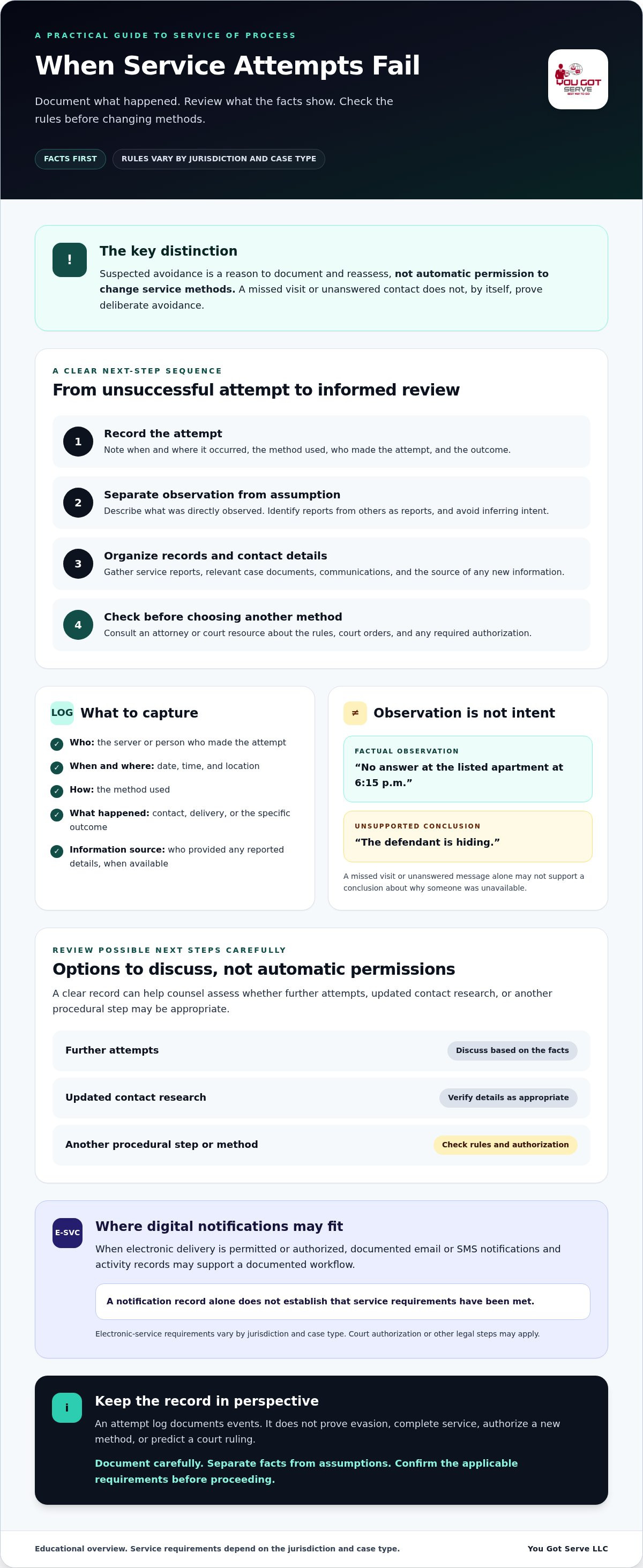
- Keep a factual record of each attempt, including when and where it occurred, the method used, and the outcome.
- Before choosing another method, confirm the rules for your jurisdiction and case type, including whether court authorization is required.
- Organize attempt records and available contact details before consulting an attorney or court resource.
- When electronic delivery is permitted or authorized, documented notifications and activity records may support the process, but do not by themselves establish that service requirements were met.
What to do first when someone appears to be dodging service
Repeated attempts that don’t result in personal service can delay a case and leave you unsure what to do next. But a missed visit or unanswered contact doesn’t, by itself, prove that someone is deliberately avoiding service. To understand how to serve someone dodging service, start with verifiable facts, then check which steps are permitted for your case.
Service of process is the formal delivery of legal documents that gives a person notice of a case. An attempt is not completed service unless the delivery meets the rules that apply. Available methods and requirements depend on the jurisdiction and case type. For an overview of personal, substituted, and publication methods, see Service of process.
This video discusses delay tactics in a divorce context. It isn’t a substitute for checking the rules that apply to your case.
What counts as an unsuccessful service attempt?
An attempt is unsuccessful when the documents weren’t delivered during that visit or contact. Record what the server observed, such as no answer at the listed address, a resident reporting that the person moved, or an address that couldn’t be located. Keep those observations separate from conclusions about intent. Don’t label someone legally evasive based only on missed visits or unanswered messages.
What information should you organize before taking another step?
Gather the process server’s records and relevant case documents, following professional guidance for preserving them. A clear log helps counsel assess whether further attempts, updated contact research, or another procedural step may be appropriate.
- Record each attempt’s date, time, location, and method.
- Note the outcome and the source of any new information, such as who provided it.
- Preserve relevant communications and distinguish direct observations from reports or assumptions.
If an address or contact detail may be outdated, ask counsel whether further research is appropriate. A skip-tracing guide for legal professionals may also help explain what information to verify. Before changing methods, consult counsel and confirm the applicable rules, court orders, and any required authorization. Unsuccessful attempts alone don’t establish that another method is legally available.
How to document repeated attempts and assess what they show
A useful attempt log turns a series of missed visits into a clear, reviewable record. It can help counsel assess what happened and which procedural step may be appropriate. It doesn’t establish why someone was unavailable, prove evasion, complete service, or predict a court ruling. An attempt record documents events, but it does not authorize a new method.
Accurate records matter because service of process is connected to a person’s opportunity to receive notice and respond. Cornell Law School’s Legal Information Institute discusses this connection to procedural due process clauses. The rules for service and any alternative method still depend on the jurisdiction, case type, and applicable court requirements.
Which details belong in an attempt log?
Record each attempt promptly and use specific, neutral language. Include who made the attempt, when and where it occurred, the method used, and what happened. For example, “No answer at the listed apartment at 6:15 p.m.” reports an observation. “The defendant is hiding” draws a conclusion the observation alone may not support.
- Identify the server or other person who made the attempt, along with the date, time, and location.
- Describe the outcome and what was directly observed, such as whether contact was made or documents were delivered.
- Separate firsthand observations from statements by others. Note who provided a report and when, if that information is available.
- Preserve relevant communications and service reports. Keep the record factual, and don’t embellish details or infer intent.
Consistent records allow counsel to compare attempts, spot gaps, and assess whether further attempts or another step should be considered. Documentation supports that review, but it doesn’t establish that a person deliberately avoided service or determine whether a court will authorize another method.
When might updated contact information matter?
New, reliable contact or address information may help counsel evaluate available options and determine whether existing details need to be checked. Keep the source and date of the information with your notes. Avoid intrusive or unauthorized contact, surveillance, or investigation. For a broader discussion, consult the existing guide to skip tracing for legal professionals.
If counsel determines that electronic delivery may be relevant, first confirm whether it is permitted or requires authorization in your situation. YouGotServe provides electronic document delivery and records notification activity. Those records document platform activity, not guaranteed receipt or acknowledgment. Learn about electronic document delivery as a technology-based option when traditional service reaches a roadblock.
Compare possible next steps without assuming another method is allowed
After reviewing the attempt record, discuss practical options with the responsible professional. The right choice depends on the facts, case type, court rules, and any required authorization. Email, SMS, or another alternative isn’t automatically valid just because personal service has been difficult.
| Possible next step | What it may address | What to verify first |
|---|---|---|
| Further traditional attempts | Whether service may be completed at a suitable time or location using an authorized method. | Review prior attempts, available address information, and applicable requirements with the responsible professional. Don’t assume a particular number of attempts is required or sufficient. |
| Updated contact research | Whether the address or other contact details on file are still accurate. | Confirm that the information comes from a reliable source and that any research or follow-up is lawful and appropriate. |
| Alternative service, including electronic delivery | Whether a different method may be considered after traditional service encounters difficulty. | Check the rules for the jurisdiction and case type, plus whether a motion, court order, or other authorization is required. |
When should you consider further traditional service attempts?
There’s no universal attempt count or schedule that guarantees service or makes another method available. Counsel or the responsible service professional can review when and where prior attempts occurred, what was learned, and whether the information supports trying again. A new attempt may be worth discussing if circumstances or reliable location details have changed, but the applicable rules and facts should guide the decision.
When could electronic or alternative service be considered?
If traditional attempts have not succeeded, counsel may assess whether electronic delivery or another alternative is available. That requires more than choosing a convenient channel. Jurisdiction-specific rules, case type, court orders, and other legal requirements may control. For broader context on technology and procedural considerations, consult the existing guide to electronic service of process.
You Got Serve provides electronic document delivery by email and SMS, with recurring notifications and activity reporting. These records can document notification activity, but they don’t establish by themselves that a method satisfies service requirements. If counsel confirms electronic delivery is permitted or authorized, learn about electronic document delivery as a technology-based option when traditional service reaches a roadblock.
For anyone asking how to serve someone dodging service, compare options only after confirming what the applicable rules permit. A method that fits one case may not be available in another.
How to check authorization and procedural requirements before changing methods
If you’re researching how to serve someone dodging service, verify the rules for your specific case before switching from personal service to email, SMS, or another method. A method that may be available in one jurisdiction or case type may not be permitted in another. Unsuccessful attempts alone don’t authorize a change.
Electronic-service requirements depend on jurisdiction and case type. Identify the court and matter, review applicable rules and any orders already issued, and consult counsel about the next step. Confirm whether a motion, court order, or other authorization is required, and whether it must be obtained before delivery begins. General information about alternatives can’t replace checking the requirements that govern your case.
What should you confirm before using email or SMS?
Ask counsel whether the proposed method is permitted for this matter and recipient. Confirm that the email address or phone number is reliably associated with the person, and check whether rules or an existing order set conditions for its use. Clarify any required filing or procedural steps, and how attempted delivery should be documented. Don’t assume that sending documents electronically completes service.
- Identify the court, jurisdiction, and case type.
- Review applicable rules, existing orders, and case-specific directions.
- Confirm whether a motion, advance court authorization, or another step is required.
- Ask how delivery attempts and supporting records should be handled.
How can you keep procedural records clear?
Keep the attempt log, relevant communications, filings, and any order or authorization together in an organized case file. Preserve dates and details consistently so counsel can distinguish the decision to use a method from the activity recorded during delivery. The existing court-ready proof of service compliance checklist may help with recordkeeping, but check its guidance against the rules for your case.
Digital platforms can record notification activity, timestamps, and other available information. Those records describe activity the platform recorded. They don’t, by themselves, determine whether service was legally sufficient.
A careful answer to how to serve someone dodging service starts with verifying what the rules permit. After counsel confirms the applicable requirements, review electronic document delivery options from You Got Serve for a technology-based workflow when traditional service has encountered difficulty.
How digital notifications may support a documented service workflow
When traditional service has encountered difficulty, a digital workflow may be worth discussing with counsel if electronic delivery is permitted or authorized for the case. You Got Serve LLC provides legal-document delivery by email and SMS, with features that record notification activity over time. It is a technology-based option, not a court, and it doesn’t automatically replace any required method of service.
What does a digital notification campaign record?
You Got Serve offers 60-day and 90-day campaigns with automated daily email and SMS notifications. Documents are accessed through a secure, unique recipient access code. The platform’s records can include notification history, timestamps, recipient activity, and downloadable service reporting. IP and geolocation information may also be included when available.
These records can help organize a digital notification history for counsel to review. They reflect notifications sent and activity recorded by the platform. They don’t establish that a recipient actually saw or received a message, acknowledged the documents, or that legal service requirements were met.
- Notification history: Review recorded email and SMS notifications.
- Timestamps and activity: See available records of when notifications or recipient interactions occurred.
- Reporting: Download service reporting to retain with relevant case materials and share for legal review as appropriate.
Keep the platform record distinct from the court’s requirements. A log of digital activity can document what the system recorded, but it does not itself grant authorization or determine whether the method is legally sufficient.
When is You Got Serve worth discussing with counsel?
Consider raising the option when traditional service has reached a roadblock and you have confirmed that email or SMS may be considered in your matter. Before starting a campaign, ask counsel to verify the rules for the jurisdiction and case type, whether court authorization or another procedural step is required, and how resulting records should be handled. Requirements vary, so don’t treat electronic delivery as a universal substitute for personal or otherwise required service.
If counsel confirms the approach is appropriate, explore You Got Serve, The Smarter Way to Serve, a documented digital notification option for situations where traditional service has become difficult.
Take the next step with a clear, documented plan
Repeatedly unsuccessful attempts call for careful reassessment, not assumptions about intent or automatic permission to change methods. Keep a factual record of attempts, consult counsel, and verify the requirements for your jurisdiction and case type before considering another approach. Electronic service may require court authorization or other procedural steps.
If electronic delivery is permitted or authorized, You Got Serve offers recurring email and SMS notifications, secure recipient access, and downloadable service reporting. Its 60-day and 90-day campaign options can document notification activity, but records don’t guarantee that a recipient received or acknowledged documents or that service requirements have been met.
For a technology-based option when traditional service reaches a roadblock, explore You Got Serve, The Smarter Way to Serve. Contact You Got Serve to learn about digital document delivery, and confirm with counsel that the method is permitted and properly authorized for your case.
Frequently Asked Questions
What should I do first if someone is dodging service?
Start by organizing what you know, not by assuming another service method is allowed. Gather records of previous attempts, including dates, locations, outcomes, and relevant communications. Separate direct observations from assumptions about why the person was unavailable. Then consult an attorney or appropriate court resource about the requirements for your jurisdiction and case type. These are sensible first steps when considering how to serve someone dodging service.
Can I serve someone by email or text if they are avoiding service?
Possibly, but email or SMS is not automatically sufficient service in every case. Applicable rules, the type of matter, and court authorization may determine whether electronic delivery can be used. Ask an attorney to assess the specific case before relying on it. A platform may record notifications and activity, but those records don’t, by themselves, establish that electronic service satisfies legal requirements or that the recipient received or acknowledged the documents.
How many times do you have to try serving someone?
There is no single attempt count that applies to every case nationwide. Requirements may depend on the jurisdiction, case type, court rules, and circumstances of the attempts. Keep an accurate record of each effort and ask counsel what the applicable rules require. Don’t assume that reaching a particular number of attempts gives you permission to change methods. Confirm whether another method is available and whether court authorization or another procedural step is required.
What proof should I keep when someone cannot be served?
Keep a factual record of each attempt, including its date, method, location, and outcome. Preserve the process server’s report, relevant communications, and case documents according to professional guidance. Distinguish what the server directly observed from information someone else reported, and avoid conclusions about intent unless supported by appropriate evidence. Ask counsel what records matter in your case. An attempt log documents events, but it doesn’t itself complete service.
What happens if someone refuses to accept court papers?
The effect of a refusal depends on the circumstances and the rules that apply to the case. Don’t assume that refusal automatically completes service or authorizes another method. Record what the server observed and preserve their account, including when and where the interaction occurred. Then ask an attorney to assess the facts and applicable requirements. Counsel or the court may need to determine what options are available for that specific matter.
Can I use social media to serve legal papers?
Don’t assume a social-media message counts as service simply because it identifies or reaches the person. Whether this method is available may depend on the jurisdiction, case type, applicable court rules, and any required authorization. Consult an attorney before relying on it, and confirm whether a motion, order, or other procedural step is needed. Keep related records, but don’t treat a message history as proof that service is legally sufficient.
Does electronic service guarantee that the recipient received the documents?
No. A delivery platform may record notifications, timestamps, and recipient activity when available, but those records don’t guarantee that a person received, read, or acknowledged the documents. They also don’t independently establish that electronic delivery satisfies the requirements of a particular case. If you’re evaluating how to serve someone dodging service, ask counsel whether electronic delivery and its records are appropriate under the applicable rules and any required authorization.
This article is for informational purposes only and is not legal advice. Electronic service requirements vary by jurisdiction and case type, and court authorization or other legal requirements may apply. Consult a qualified attorney about your circumstances.


