

After several unsuccessful attempts to hand someone court papers, it may seem logical to leave them with another adult or send them by email. Those options are not interchangeable. Substitute service of process follows specific rules, and the requirements depend on the jurisdiction and case type.
When personal delivery has not worked, start by identifying the procedure the rules allow. Substituted service may involve leaving papers with another person and completing a follow-up step, such as mailing a copy. Electronic delivery sends documents digitally, and using it for service may require court authorization or compliance with other legal requirements.
This guide explains the general purpose and common forms of substituted service, how it differs from personal service and electronic delivery, and what to review before choosing a method. YouGotServe provides secure document delivery by email and SMS, with recurring notifications, recipient verification, activity tracking, and service reporting. These records document platform activity; they do not by themselves establish that a recipient received the documents or that the method is legally sufficient. Electronic service requirements vary by jurisdiction and case type, and court authorization or other legal requirements may apply. This article is educational, not legal advice.
Key Takeaways
- Check the rules for the specific court and case type before relying on substitute service of process. The procedure can vary.
- Distinguish direct delivery to the person from substituted delivery, and identify any requirements for the recipient, follow-up steps, and documentation.
- Keep electronic delivery separate from substituted service. Determine whether digital delivery is permitted or requires court authorization.
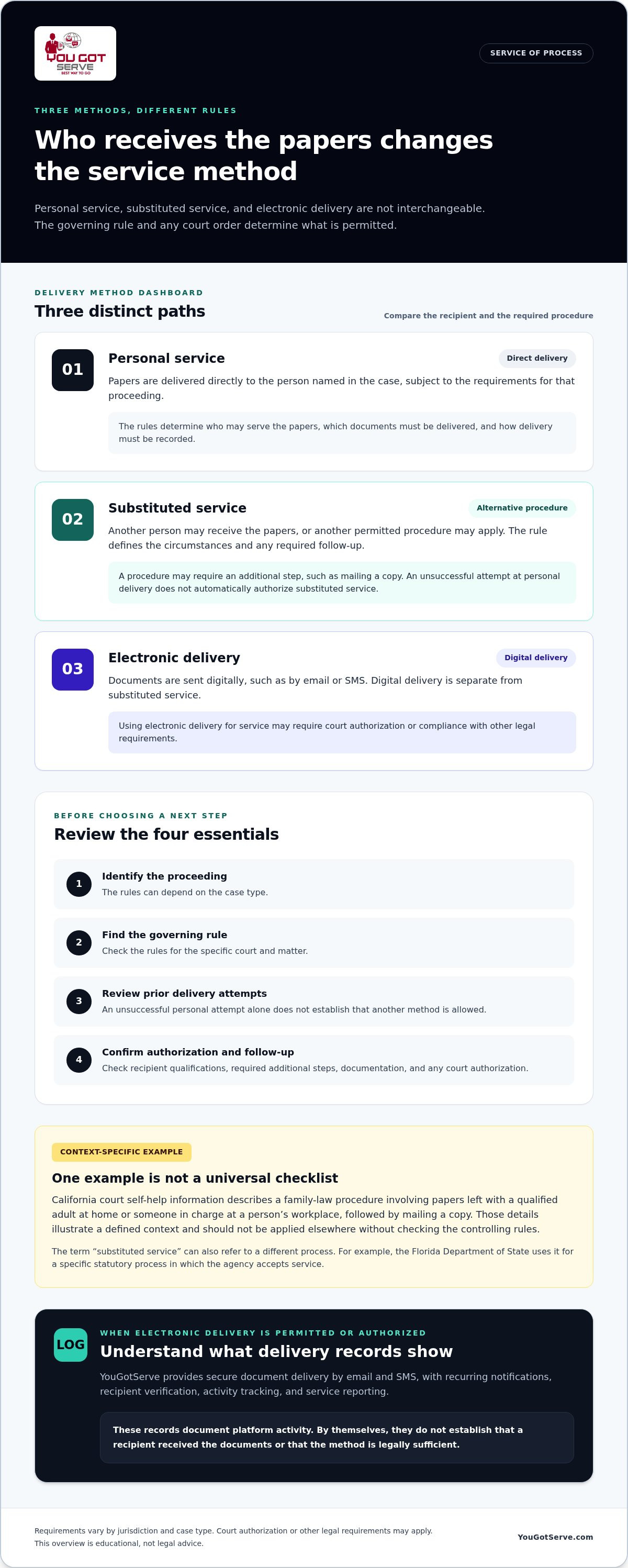
- Before choosing a next step, identify the proceeding, find the governing rule, review prior delivery attempts, and confirm authorization requirements.
- When electronic delivery is permitted or authorized, understand what campaign records document and what they cannot establish about receipt or legal sufficiency.
What Substitute Service of Process Means and Why the Term Can Be Confusing
In general, substitute service of process means using a permitted method other than handing papers directly to the person named in a case. Depending on the governing rule, that method may involve leaving papers with another person or following another authorized procedure. The rule determines who may receive the papers, where and how delivery can occur, and whether an additional step is required. The phrase itself does not establish what is valid in a particular proceeding.
Service of process is the formal delivery of notice about a legal proceeding through a method recognized by the applicable rules. A general overview of service of process can provide background, but it cannot replace checking the rule for the specific court and case type.
For a brief explanation of the general concept, watch this video:
What does substituted service generally involve?
Substituted service is an alternative to direct delivery, and the applicable rule sets its permitted recipients, methods, and follow-up steps. A rule may allow papers to be left with another qualified person, or it may specify a different procedure. It can also require an additional action, such as mailing a copy. A court order may set further conditions. Read each requirement in context rather than assuming that a general description covers every case.
California’s court self-help information provides a family-law example: it describes leaving papers with a qualified adult at home or someone in charge at a person’s workplace, followed by mailing a copy. That illustrates a procedure in a defined context, not a nationwide checklist. Do not apply those details to another state or case type without checking the controlling rules.
Why can “substitute service” mean different things?
The term can refer to different processes because statutes, court rules, case type, and a court order may each affect which methods are allowed and what completes service. Similar labels can describe procedures with different recipients and purposes. Identify the proceeding and the authority that controls it before relying on a definition.
For example, the Florida Department of State uses “Substituted Service of Process” for a specific statutory process in which the agency accepts service. That is different from leaving papers with someone at a defendant’s home or workplace. The label alone does not tell you which procedure applies.
For context on how other court-authorized alternatives fit alongside these distinct procedures, see this guide to alternative service of process methods. This overview is educational, not legal advice. The rules that apply to an individual matter, including any court order, determine the requirements.
How Substitute Service of Process Differs from Personal Service
Personal service and substitute service of process are distinct delivery methods. Personal service generally means delivering the papers directly to the person named in the case. A substituted method may involve another recipient or a different procedure, but only when the governing rules permit it. An unsuccessful attempt at personal delivery does not automatically authorize a different method.
What makes personal service different?
The defining feature of personal service is direct delivery to the named person, subject to the requirements for that proceeding. It is a distinct method, but it is not necessarily required in every matter. The rules determine who may serve the papers, which documents must be delivered, and how the delivery must be recorded.
The Legal Information Institute at Cornell describes substituted service as an alternative to personal service. In practice, the distinction is who receives the papers and which procedural steps the applicable rule requires. A process server’s record may document an attempt or a completed delivery, but the required details and form depend on the proceeding.
A side-by-side comparison
Who receives the papers
Personal service: The person named in the case receives the papers directly.
Substituted service: Another person may receive the papers, or a different permitted method may apply. The governing rule defines who qualifies and under what circumstances.
How delivery occurs
Personal service: Papers are handed directly to the named person in accordance with the applicable requirements.
Substituted service: Delivery follows an alternative procedure authorized by a rule or court order. Additional steps may be required.
What documentation may matter
Personal service: The record may need to describe the direct delivery and other details required by the procedure.
Substituted service: Documentation may need to show the alternative method and any required follow-up. The applicable rule determines what must be recorded.
When might a different service method be considered?
Practical obstacles can lead someone to consider another method. Repeated unsuccessful attempts or difficulty accessing a residence, for example, may make direct delivery challenging. Those circumstances explain why an alternative is being considered, but they do not establish permission to use one. Requirements vary by case type and jurisdiction, and a court order may be required.
Before changing methods, identify the governing rule and determine whether it sets conditions, requires further attempts, or calls for court authorization. A guide to serving someone who may be evading service can help frame the issues to review. Unsuccessful attempts should not be treated as automatic approval to use another procedure.
When traditional delivery reaches a roadblock, electronic document delivery may be a separate technology-based option, subject to applicable rules and authorization. Learn how YouGotServe’s digital delivery platform supports that workflow.
Substitute Service of Process vs. Electronic Delivery: Compare the Methods
Both methods can be considered when handing papers directly to a person is not practical, but they work differently. Substitute service of process is a procedure defined by applicable rules. It may involve another recipient or a specified follow-up step. Electronic delivery transmits documents through digital channels such as email or SMS. It is not another name for substituted service, and its use for legal documents depends on the rules and any required authorization.
What distinguishes substituted service from email or SMS delivery?
The main differences are the delivery channel, who receives the papers, and what authorizes the method. A substituted procedure may direct a server to leave documents with a qualifying person and complete other prescribed steps. Electronic delivery sends documents to an email address or phone number. Depending on the jurisdiction and case type, using email or SMS for service may require court authorization or compliance with other legal requirements.
Delivery channel
Substituted service: Follows a procedure set by a rule or court order, which may include physical delivery to another person.
Electronic delivery: Sends documents through digital channels such as email or SMS, subject to applicable rules and authorization.
Intended recipient
Substituted service: A rule may identify another person who can receive the papers or specify a different permitted method.
Electronic delivery: Documents are directed to a digital contact point associated with the intended recipient. Sending a notification does not establish that the person opened or acknowledged it.
Authorization and record
Substituted service: The governing procedure determines whether the method is permitted and what steps must be documented.
Electronic delivery: The governing requirements determine whether digital delivery may be used. System records can document platform activity.
A useful distinction is this: a digital timestamp can document when a notification was sent or activity occurred, but it does not determine whether the method satisfies the legal requirements for service. The Florida Senate Bill Analysis of Service of Process discusses different service methods, including substitute and constructive service, in relation to virtual offices. It illustrates why terminology and procedures should be read in context rather than treated as interchangeable labels.
What can digital delivery records document?
YouGotServe’s secure delivery workflow uses unique recipient access codes and records notification history, timestamps, and recipient activity. Downloadable service reporting organizes that information for review. These records document platform events; they do not establish by themselves that a recipient received the documents or that electronic service was legally sufficient.
A 60-day or 90-day campaign can include recurring daily email and SMS notifications, subject to applicable rules and authorization. Before relying on electronic delivery, determine whether it is permitted for the jurisdiction and case type and whether a court order or another requirement applies. For more context on the method and its procedural questions, see this electronic service of process overview. When digital delivery is permitted or authorized, explore the secure document delivery platform.
How to Evaluate a Substitute Service Question Before Taking the Next Step
Before changing how papers are delivered, work through the case details in order. A general explanation can clarify terminology, but it cannot determine whether a method is authorized in your matter. Requirements may depend on the court, proceeding, documents being served, and any order already issued.
- Identify the proceeding. Note the court and case type, and determine whether the papers are initial documents or later filings. Different requirements may apply.
- Locate the governing rule. Review current primary legal sources for the court and proceeding. Do not assume a procedure described for another jurisdiction applies to your case.
- Review prior attempts. Gather records of efforts to deliver the papers personally, including what happened and when. Those attempts provide context, but do not automatically authorize another method.
- Confirm authorization. Check whether the applicable rule permits the proposed procedure or whether a court order or another requirement applies before proceeding.
Which rule and case details should readers identify?
Start with the jurisdiction and type of case, then check the current rule and any order in the case. Use primary legal sources where possible, and confirm that the material applies to the specific documents and stage of the proceeding. This helps separate a general explanation from case-specific directions. It does not determine whether substitute service of process or another method is authorized in an individual matter.
What should the service record distinguish?
A clear record distinguishes an attempted delivery from a completed one and identifies any follow-up action required by the procedure. Record relevant dates, methods, and recipients or locations where applicable, along with supporting documentation. The required details and format depend on the governing rules, so do not assume that one form or a fixed number of attempts applies everywhere.
For example, a record that says only “service attempted” may not explain whether the papers were handed to the named person, left with someone else, or followed by a required additional step. Factual entries help show what occurred without treating an unsuccessful attempt as completed service. Keep electronic delivery records distinct as well: platform notifications and activity logs document digital events, not a legal determination that service requirements were met.
Electronic delivery may be a technology-based option when traditional efforts reach a roadblock, but requirements vary by jurisdiction and case type. Court authorization or other legal requirements may apply. YouGotServe provides secure email and SMS document delivery with tracked activity and service reporting, subject to applicable rules and authorization. Explore secure digital document delivery as a possible workflow when the method is permitted.
This section is educational, not legal advice, and does not determine what method is valid for a particular case. Review the controlling requirements before taking action.
When Digital Delivery May Be a Technology-Based Option
When traditional delivery reaches a roadblock, digital delivery can be considered if it is permitted or authorized for the matter. It is a separate option, not a way to relabel substituted service. For a law firm managing several matters or a property manager handling legal documents, a consistent workflow can help organize delivery activity while the team follows the requirements for each case.
How does a digital service campaign document activity?
A campaign provides a structured way to manage digital delivery efforts over a selected period. YouGotServe offers 60-day and 90-day campaigns with recurring daily email and SMS notifications. Secure document access uses a unique recipient access code, and the platform records notification history, timestamps, and recipient activity. Downloadable reporting can help organize those records for review.
These records document activity within the platform. They are not, by themselves, proof that a recipient received, read, or acknowledged the documents, or that the method met legal requirements. For example, a notification record can show that a message was sent, while an access record can show activity in the secure workflow. The significance of those events depends on the requirements that apply to the case.
What should readers confirm before using electronic delivery?
Identify the jurisdiction, case type, and documents involved. Then determine whether electronic delivery is allowed and whether a court order or another requirement applies. Rules vary, and the platform does not make the authorization decision for a case. YouGotServe is a legal technology platform, not a court or government agency, and it does not provide legal representation. Its use is subject to applicable rules and authorization.
If electronic delivery is an appropriate option for your matter, Learn how YouGotServe works. This information is educational, not legal advice. Confirm the requirements that govern your case before relying on any delivery method.
Build a Clear Checkpoint Before Delivery
Before sending the next document, make the decision process explicit. A law firm, property manager, or individual handling a case can record which procedure is being considered and the rule or order that supports it. This checkpoint helps prevent a familiar-sounding term from being mistaken for confirmation that a delivery method is permitted. It also gives everyone handling the matter a shared reference point.
The central question is not only whether a recipient is hard to reach. It is whether the proposed method fits the requirements for that proceeding. Keep that distinction in view, and use digital delivery only when it is permitted or authorized.
If electronic delivery is an appropriate option for your situation, learn how YouGotServe works. Its technology-driven workflow can organize recurring email and SMS notifications, secure document access, and activity records when traditional methods encounter a roadblock. The rules that apply to the case still determine which method may be used.
A deliberate checkpoint helps make the next service decision clearer and keeps the record of the decision connected to the applicable requirements.
Frequently Asked Questions
What is substitute service of process?
Substitute service of process is a rule-defined way to deliver legal papers other than handing them directly to the named person. A rule may, for example, allow delivery to a specified adult and require an additional step afterward. The permitted recipient, method, and documentation depend on the rules for the proceeding. A definition alone cannot establish whether a method is valid in a particular case.
Is substitute service the same as alternative service?
Not necessarily. “Alternative service” is often used broadly for methods other than direct personal delivery, while “substitute service” can refer to a particular procedure defined by a rule or statute. Terminology varies across jurisdictions, and some sources use the terms differently. Check how the governing court’s rules define the method instead of assuming one label covers every alternative.
Can substitute service be used after personal service attempts fail?
Sometimes, but unsuccessful attempts do not automatically authorize substituted service. The applicable rule may set conditions, require particular efforts, or require a court order before another method can be used. Keep an accurate account of attempted deliveries and their outcomes, then compare those facts with the requirements for the case. Do not assume that the number or sequence of attempts in one procedure applies everywhere.
Does substitute service mean leaving papers with someone at home or work?
That can be one form of substituted service where the governing procedure allows it. A rule may specify who can accept papers, where delivery may occur, and whether another step, such as mailing, is required. An adult at a residence or a person at a workplace does not automatically qualify under every rule. Confirm the requirements for the case before treating a handoff as completed service.
Is electronic delivery the same as substitute service of process?
No. Electronic delivery sends documents through digital channels such as email or SMS. Substituted service follows a procedure specified by applicable rules, which may involve another recipient or prescribed steps. Electronic delivery for legal service may require court authorization or compliance with other requirements. A successful transmission or system timestamp does not by itself establish that electronic service was permitted or legally sufficient.
What is the difference between Florida substituted service and service at a home?
In Florida, “Substituted Service of Process” can refer to a specific statutory procedure involving acceptance by the Florida Department of State. The agency’s acceptance does not mean it personally serves the designated individual. Delivery to someone at a person’s home is a separate method governed by its own applicable requirements. Because the terminology can be confusing, identify the specific procedure and rule being discussed.
Does a digital delivery record prove that someone received legal papers?
Not necessarily. A digital record can document events such as a notification being sent, a timestamp, or recipient activity in a secure access workflow. Those entries do not necessarily show that the person received, read, or acknowledged the documents, and they do not determine legal sufficiency. Treat the record as documentation of platform activity and assess its significance under the applicable rules and any court authorization.
When traditional service has encountered difficulties, YouGotServe offers a technology-based way to organize recurring digital notifications and document platform activity, subject to applicable rules and authorization. Visit YouGotServe.com to learn more. This article is educational, not legal advice; electronic-service requirements vary by jurisdiction and case type, and court authorization or other legal requirements may apply.


