

After repeated attempts to serve a defendant fail, a text message may seem like a practical next step. But a court will want more than a phone number and a request. A motion for alternative service by text message should connect documented service efforts with reliable evidence that the number belongs to the defendant and is in current use.
It’s understandable to be unsure what proof belongs in the filing. Requirements vary by jurisdiction and case type, and electronic service may require court authorization. A persuasive request explains which traditional methods were tried, when and where attempts occurred, what records support those efforts, and why the proposed text message is reasonably likely to provide notice.
This guide outlines the facts and supporting materials to organize, the jurisdiction-specific rules to research, and a practical framework for presenting the requested relief. It also explains how electronic delivery records, such as timestamps and recipient activity, can help document efforts without proving receipt or guaranteeing court acceptance. YouGotServe provides secure email and SMS delivery with tracking for situations where electronic service is permitted or authorized.
Key Takeaways
- Build a clear chronology of service attempts, recording dates, methods, and outcomes supported by firsthand records.
- Assess whether the phone number is reliably connected to the person and whether available evidence supports its current use.
- Compare text, email, and other proposed methods based on the contact information and evidence available in your case.
- Use a practical drafting framework for alternative service by text message, then tailor the motion and exhibits to the governing rules.
- Keep authorization and delivery records distinct: notification logs can document activity, but they do not decide whether service is legally sufficient.
When Should You Consider a Motion for Alternative Service of Process by Text?
A text message can seem like a direct way to reach someone who has been difficult to locate. But sending legal papers by text is not automatically valid service. A motion for alternative service asks the court to authorize a specific method in a particular case. Filing the request is not the same as receiving permission, and delivery alone does not establish that service was legally sufficient.
This guide is educational, not legal advice or a universal motion form. Rules can differ by jurisdiction, case type, court, and the facts surrounding attempted service. Before relying on text delivery, research the rules that govern your case and determine whether the court must authorize the method.
What does a motion for alternative service ask the court to do?
The motion explains why the party is requesting a method other than the usual options and asks the judge to authorize that method. It should identify the proposed channel, such as a particular phone number, and explain why the available facts support using it in this case. The court may also have requirements for supporting declarations, exhibits, the message itself, or additional steps.
That distinction matters. A party cannot make text-message service legally effective simply by deciding to send a message. The judge’s decision and compliance with any conditions in the order are separate from proof that a message was sent or opened. For background on the purpose of formal notice, see Service of process. The governing rules, not a general overview, determine what is permitted in a specific case.
When might text-message service be raised as an option?
It may be worth researching when conventional attempts have run into obstacles, such as repeated unsuccessful visits to a known address or difficulty locating the person through available contact routes. Those circumstances do not establish a right to serve by text. They help explain why a party is considering another method and why the court should evaluate the request.
A phone number may be relevant if there is a factual basis to connect it to the intended recipient and show it remains usable. For example, a recent exchange with the person may be more informative than an old number copied from an unverified record. State only what the evidence supports. Do not treat a number as current based on an assumption, or claim the person received a message when the records show only that it was sent.
Before drafting, identify the questions the local rules leave for the court to decide:
- Have the required traditional service methods been attempted, and are the outcomes documented?
- What evidence connects the proposed phone number to the recipient?
- Does the court require advance authorization, particular wording, or another method alongside the text?
The answers may differ across courts and case types. A rule or order from one jurisdiction can illustrate possible safeguards, but it does not determine what another court will require. Treat text as a method to research and request, not as a substitute for checking the procedures that apply to your case.
What Evidence and Legal Research Should Support the Motion?
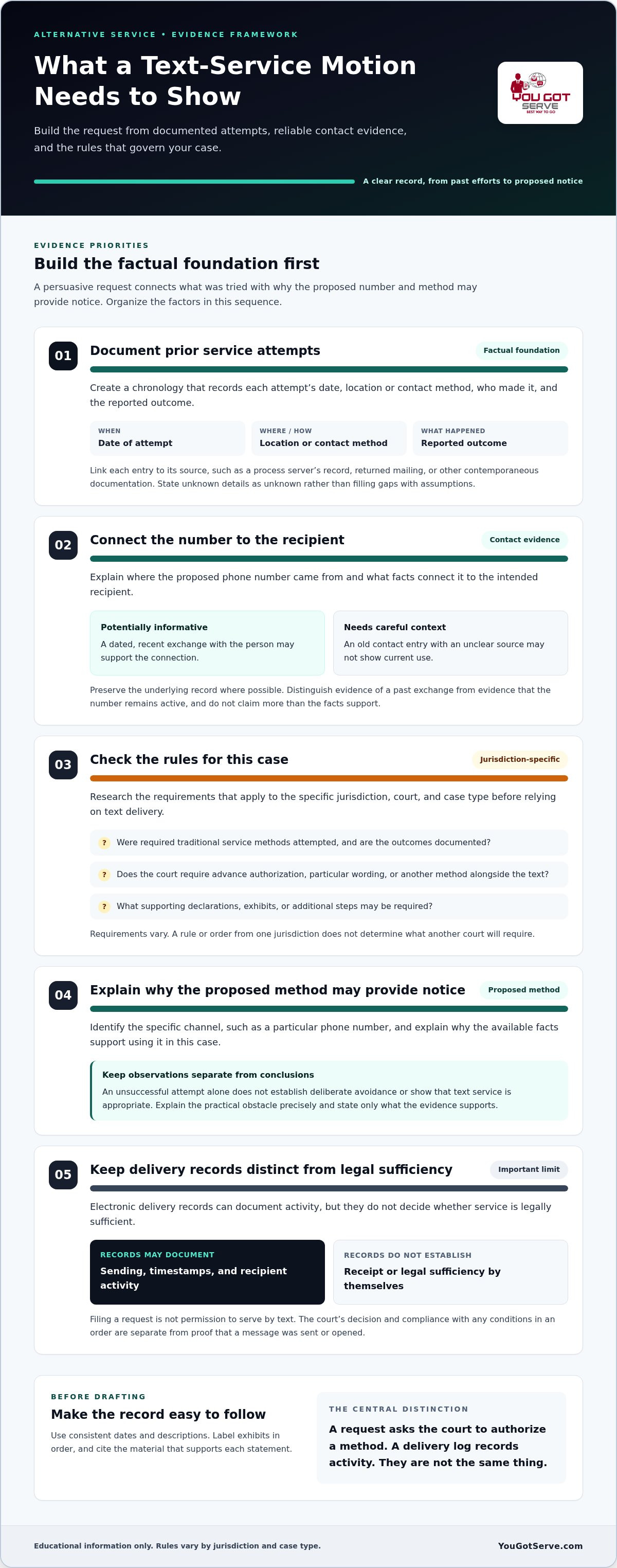
A well-supported request makes the factual record easy to follow and separates what the evidence shows from what the moving party believes. For alternative service by text message, organize the history of prior efforts, identify the basis for using the proposed number, and verify the rules for the specific court and case. A clear record helps the judge assess the request without overstating what any single document proves.
How should prior service efforts be documented?
Create a chronology before drafting. For each attempt, record the date, location or contact method, person who made the attempt, and reported outcome. Link each entry to its source, such as a process server’s record, returned mailing, or other contemporaneous documentation. If a detail is unknown, say so rather than filling the gap with an assumption.
Describe practical obstacles precisely. A record showing an unsuccessful attempt does not, by itself, establish that the person deliberately avoided service or that another method is appropriate. Keep factual observations separate from conclusions, and attach supporting materials consistently. For example, label exhibits in order and cite the relevant exhibit where the motion describes the attempt it documents.
- Chronology: List attempts in date order and use the same dates and descriptions throughout the filing.
- Source: Identify who recorded each event and when the record was created, when that information is available.
- Exhibits: Use stable labels and make each citation point to the material supporting the accompanying statement.
What contact evidence and legal authority should be checked?
Explain where the proposed phone number came from and why the evidence connects it to the intended recipient. A dated exchange with the person may support that connection differently from an old contact entry with an unclear source. Preserve the underlying record where possible, and distinguish evidence of a past exchange from evidence that the number is still active. Do not state that the defendant uses the number unless the available facts support that statement.
Then research current, authoritative materials for the relevant jurisdiction and case type. Check the applicable statute or court rule, local rules, court forms, and decisions interpreting the procedure. Confirm whether the court specifies a motion, declaration, proposed order, notice, or additional procedural step. Requirements can change, so verify the materials in effect when preparing the filing rather than relying only on a summary or a rule from another jurisdiction.
Authorization depends on applicable rules and the court’s order. That principle should guide both the research and the requested relief. Evidence can document attempts and support the proposed contact method, but it cannot replace required authorization or establish a procedure that the governing rules do not allow.
Where electronic delivery is permitted or authorized, You Got Serve can provide notification history, timestamps, and recipient activity reporting to document delivery efforts. Those records describe system activity. They do not independently establish receipt or determine whether service satisfies court requirements. Explore electronic document delivery as a technology-based option for keeping delivery records under the applicable authorization.
How Should You Frame Text Message Service Compared with Other Methods?
The strongest request ties the proposed channel to the evidence in the case. A phone number, email address, or social media account is not persuasive simply because it exists. Explain how the contact information is connected to the recipient, what indicates it is usable, and why the requested method fits the documented circumstances. No electronic channel is universally authorized or preferred.
What makes text message service different from email or social media?
Each method depends on different contact evidence. A recent text exchange may support a link between a person and a phone number. A reply from a known email account may help establish use of that address. A social media profile may be relevant when the evidence connects the account to the recipient and supports recent activity. The strength of each connection depends on the specific record, not the channel alone.
| Method | Contact evidence to assess | Practical limitation |
|---|---|---|
| Text message | Records connecting the number to the recipient, such as a relevant exchange | A sent message or delivery indicator may not establish identity, receipt, or legal sufficiency |
| Correspondence or other reliable records linking the address to the recipient | An address may be outdated, shared, or no longer used | |
| Social media | Information connecting the account to the person and indicating relevant activity | A profile or activity indicator alone may not establish that the intended recipient controls or reviews the account |
Technical records and legal validity are separate questions. Timestamps, delivery notifications, or account activity can document what a system recorded. They do not decide whether the method satisfies the governing rules. For a broader overview of available approaches, see this guide to alternative service of process methods.
How can requested relief stay narrow and case-specific?
Ask for the particular method supported by the record, and explain why it is a reasonable fit. If evidence points to one active phone number, identify that number in the requested relief rather than asking generally for permission to use any electronic account. A focused request helps the court evaluate the method and any safeguards needed in the case.
Before finalizing the request, compare its scope with the authority you researched. Identify any required message language, supplemental delivery method, timing, or proof requirements only if the applicable rule or court order calls for them. Do not assume conditions from another jurisdiction apply.
For example, if the record supports a current phone number but not a social media account, asking for both methods may go beyond the evidence. Describe the proposed text process clearly, identify any limits required by the governing authority, and avoid claiming it will ensure notice. The court determines what it will authorize; the eventual delivery record documents activity under that authorization.
What Should a Motion for Alternative Service of Process Include?
Use a drafting framework, not a fill-in form assumed to work in every court. The format, required declarations, and supporting documents can vary by jurisdiction and case type. Treat each bracketed item below as a prompt to verify against current local rules and court practice before filing. A motion for alternative service by text message should make the request easy to identify and the supporting record easy to assess.
A practical motion structure to adapt
Organize the filing so it moves from the case details to the requested relief and its factual and legal support. Keep the request precise. Cite exhibits where they support a statement, and do not substitute legal conclusions for facts.
- Case identification: Insert [court name], [case number], [party names], and the case caption in the format required by that court.
- Requested relief: State the specific method sought, such as service by text to [phone number], and identify any limits or conditions proposed.
- Relevant facts: Summarize the documented service attempts and explain the basis for associating the proposed number with the intended recipient. Refer to [declaration or affidavit] and [exhibits] as applicable.
- Legal authority: Cite the current rule, statute, or decision that applies to the court and case. Explain how the supported facts relate to the requested relief without treating another jurisdiction’s procedure as controlling.
- Supporting materials: Attach and label the documents required or permitted under local procedure. Confirm that the motion’s exhibit references match the labels on the attachments.
Use a proposed order only if local rules, a court form, or the court’s practice calls for one. If required, make it consistent with the motion and clear about the method and any conditions the court must address. Do not presume that an order is required or that a sample from another court will be accepted.
Drafting safeguards before filing
Before submission, verify every jurisdiction-specific placeholder. Check filing rules, required forms, applicable service obligations, notice procedures, and deadlines for the particular case. Confirm whether the court expects a declaration, affidavit, separate memorandum, or proposed order. Requirements can change, so rely on current materials from the court and governing legal sources.
Then review the motion against the evidence line by line. Remove statements based on guesswork, distinguish personal knowledge from information provided by someone else, and make sure each factual claim has appropriate support. If the record says an attempt failed, do not characterize it as evasion unless the evidence supports that conclusion. A concise, accurate account is stronger than an expansive one built on assumptions.
This framework is educational, not legal advice or a substitute for the rules governing a specific filing. Where legal sufficiency is uncertain, qualified counsel can review the motion and proposed relief. If the court authorizes electronic delivery, explore secure legal document delivery as a way to manage the delivery process and its records.
After Drafting: Authorization, Documented Delivery, and Practical Next Steps
Filing a motion is only one part of the process. Electronic delivery must follow the rules that apply to the case and any authorization the court grants. A motion, an order, and a delivery record serve different purposes: the motion asks for relief, the order states what the court permits, and the delivery record documents system activity.
What to do after the court rules on the request
Read the court’s actual order carefully before arranging alternative service by text message. Follow its stated method and conditions, along with applicable rules. A general template or a request that has not been granted is not authority to proceed. If the court denies the request or sets conditions, address those directions before taking further steps.
Keep the motion, signed order, related case documents, and later delivery records together. If you need to report what happened, describe records accurately: a timestamp can show when a notification was sent, and an activity record may show interaction with a delivery system. Neither fact alone proves the recipient read the message, acknowledged it, or was legally served.
How digital delivery can document authorized efforts
When traditional service has encountered difficulty and electronic delivery is permitted or authorized, a technology-based platform can help organize the delivery process. You Got Serve provides recurring email and SMS notifications through 60-day or 90-day campaigns, secure document access using a unique recipient access code, and records that include notification history, timestamps, and recipient activity. IP and geolocation information may be available.
Downloadable reporting can help preserve a record of notifications and recorded activity for review or filing, subject to the court’s order and applicable requirements. It documents what the system records, not whether a judge will find the method legally sufficient. For context on the process and its limits, consult this guide to electronic service of process and the practical discussion of court-ready proof of service.
- Before delivery: Confirm the order’s method, recipient details, and any stated conditions.
- During delivery: Retain notification and activity records, and do not describe a sent notice as confirmed receipt.
- After delivery: Follow the required procedure for documenting or filing the results in the case.
Electronic-service rules vary by jurisdiction and case type, and recorded activity does not guarantee receipt, acknowledgment, or legal sufficiency. For a technology-based way to document authorized email and SMS delivery efforts, learn more at YouGotServe.com.
Move Forward With a Clear, Documented Process
Treat the court’s decision and the delivery workflow as connected but distinct responsibilities. Confirm what the order permits, follow its conditions, and keep records that accurately describe what happened. This gives the case file a clear account without asking delivery data to prove more than it can.
If electronic delivery is permitted or authorized, You Got Serve offers a technology-based option for managing digital document delivery and its records when traditional service has reached a roadblock. The platform can support an organized workflow, but it does not replace applicable rules, court authorization, or review of the specific case.
For a practical next step, learn how You Got Serve supports documented digital delivery when electronic service is permitted or authorized. Visit YouGotServe.com to explore a secure, trackable way to manage digital delivery efforts. Requirements vary by jurisdiction and case type, and court authorization or other legal requirements may apply.
Frequently Asked Questions
Can I use a template for a motion for alternative service of process?
Yes. A template can help organize a draft, but it should not be treated as a ready-to-file form. Courts may require different captions, declarations, supporting documents, or proposed orders. Use placeholders for case details and local requirements, then verify each one against current court rules and forms. For example, do not reuse another court’s proposed text-message language without checking whether it applies to your case.
Is service by text message allowed in every state?
No. Rules for electronic service vary by jurisdiction and case type, and a procedure available in one court may not apply in another. Before relying on a text message, check the current rules and any applicable court orders for your case. Also confirm whether the rules address initial service on a defendant or only electronic communications after parties have appeared, since those situations may be treated differently.
What evidence should accompany a motion requesting text-message service?
Include records that support the statements in the motion, such as a declaration describing service attempts, relevant attempt logs, and evidence connecting the proposed phone number to the recipient. For example, if you rely on a text exchange, preserve the record showing the exchange and explain who identified the number. Follow the applicable court’s requirements for declarations, attachments, and exhibit formatting.
Do I need court authorization before serving documents by text?
That depends on the rules for the court and case, but do not assume a text message is valid service simply because you sent it. If the applicable procedure requires advance authorization, obtain the order before relying on text delivery as service and follow its conditions. Check whether a separate rule permits the method in your circumstances. When the requirement is unclear, seek guidance from qualified counsel before proceeding.
What happens if the recipient does not respond to a text message?
No response does not, by itself, establish whether the recipient received or read the message, or whether service was completed. Preserve the available delivery and activity records, then compare what happened with the court’s order and applicable filing requirements. Do not characterize silence as acknowledgment. If the order or rules do not explain what to do next, get case-specific legal guidance rather than assuming another attempt or method is permitted.
Can You Got Serve send documents by text while a motion is pending?
A pending motion alone does not authorize text delivery as legal service. You Got Serve provides document delivery by SMS and email, but use for service must remain subject to applicable rules and authorization. Before treating any platform delivery as service, determine whether a separate rule or existing order permits it. Otherwise, wait for the court’s decision and follow the directions it gives.
Does a delivery report prove that text-message service was legally completed?
No. A report can document system activity, such as notification history, timestamps, or recipient interactions recorded by the platform. It does not independently establish that the recipient read or acknowledged the message, or that legal service was completed. The court evaluates sufficiency under the applicable rules and order. Describe the report accurately in any filing, distinguishing recorded events from conclusions about notice or legal effect.
Is a motion for alternative service legal advice?
No. A motion is a request filed with the court, while legal advice applies the law to a person’s particular circumstances. This FAQ is general educational information, not legal advice or a substitute for reviewing current rules. If you are unsure whether your facts support a request, which procedure applies, or what to do after the court rules, qualified counsel can assess the specific case.


