

What does a “sent” email prove if you can’t tell whether the recipient received or opened it? Email may be a convenient way to send a demand letter, but choosing to serve a demand letter by email doesn’t automatically establish delivery or satisfy every legal requirement. It’s also different from serving court papers, which may follow specific formal rules.
If you’re considering email, it helps to know what the method can document and where its limits are. This guide explains how to prepare and send a demand letter by email, preserve records of delivery attempts and replies, and identify when to review jurisdiction-specific rules or seek legal advice.
You’ll also learn why a sent message, a delivery record, and legally sufficient service are not interchangeable. YouGotServe offers secure digital document delivery with recurring email and SMS notifications, recipient activity tracking, and downloadable reporting. These records can support an organized workflow, but they don’t guarantee receipt or legal sufficiency. Electronic-service requirements vary by jurisdiction and case type, and authorization may be required.
Key Takeaways
- A demand letter is a communication requesting action, while serving court papers follows separate formal requirements.
- Before you serve a demand letter by email, check the requirements that apply to the document and situation.
- Compare email, postal mail, and digital delivery by the records each creates, not by assuming one method is legally sufficient.
- Use an organized process to prepare the letter, verify the recipient’s address, send it, and preserve relevant records and replies.
- When traditional service encounters difficulty, a documented digital delivery workflow may offer another option if electronic service is permitted or authorized.
Can You Serve a Demand Letter by Email? Start With Its Purpose
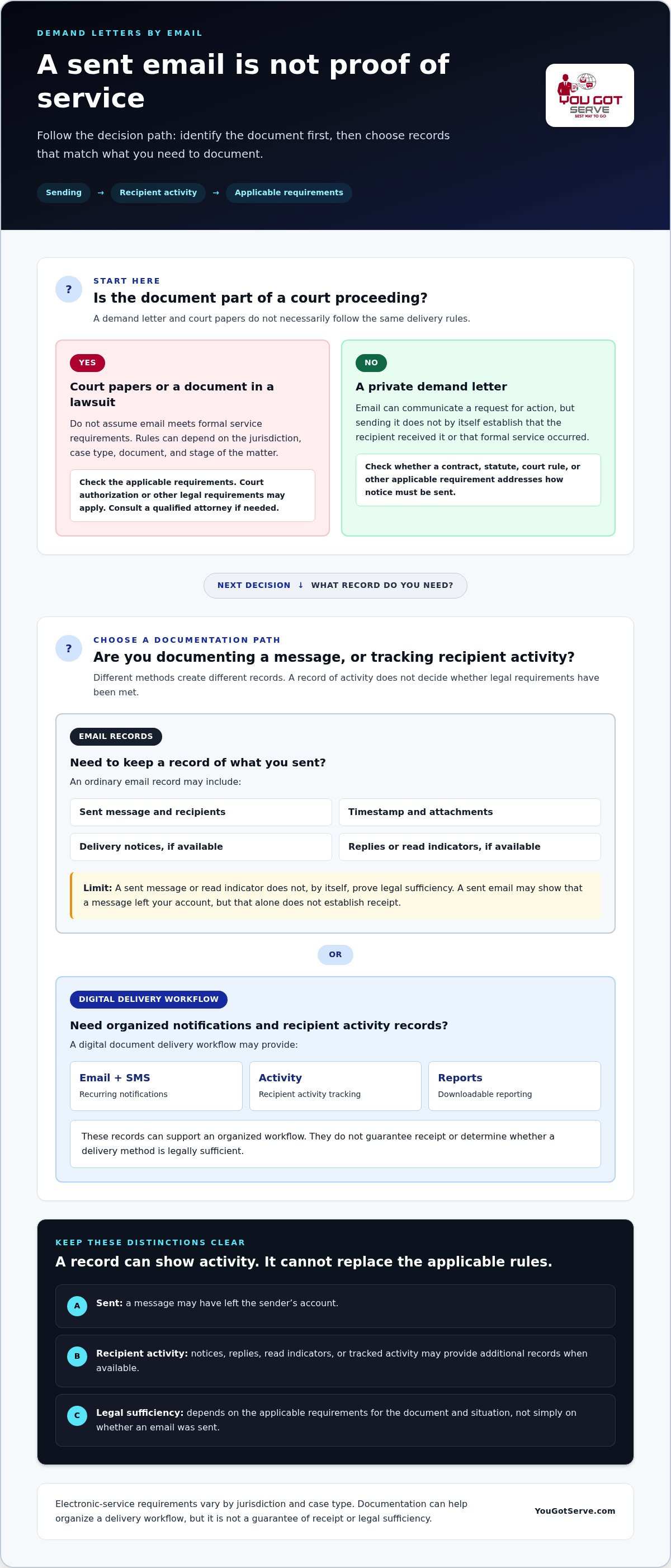
Can you send a demand letter by email? Email can often be used to communicate a demand, but calling that step “service” can blur an important distinction. A demand letter is generally a request made before or outside a court’s formal process. A summons or complaint, by contrast, is part of a legal proceeding and may be subject to specific service requirements.
Emailing a demand letter communicates the sender’s position and requested resolution. Sending it does not, by itself, establish formal service or prove that the recipient received it. Whether you can send a demand letter by email depends on the document, any relevant agreement, and applicable rules.
What a demand letter communicates
A demand letter generally identifies a dispute, explains the action the sender is requesting, and states how or when the sender expects a response. For example, a landlord might email a business tenant about an unpaid invoice and request payment or a discussion of the account. This illustrates one way to communicate a demand, not a universal legal procedure or required format.
Clarity helps the recipient understand who is making the demand, who it is directed to, and what issue it concerns. Identify the sender and recipient, use a subject line that reflects the matter, and state the requested resolution in plain language. Keep a copy of the exact message and attachments sent.
Why sending and serving are not interchangeable
Sending a private demand letter is not the same as serving court papers. Formal service of process is a legal procedure for providing required notice of a proceeding. The rules can depend on the jurisdiction, case type, and document, so an email record alone should not be treated as proof that formal service requirements have been met. For more on the distinction, see this overview of service of process.
Before sending a demand letter by email, consider whether a contract, statute, court rule, or other applicable requirement addresses how notice must be sent. If the document is part of a lawsuit, confirm the governing service requirements rather than assuming the approach used for a demand letter will apply. For a broader discussion of electronic delivery rules, see our electronic service of process guide. This information is general and isn’t legal advice. Consult a qualified attorney about your situation when needed.
Is Emailing a Demand Letter Legally Sufficient? Know the Limits
A sent email does not, by itself, establish legally sufficient service. It may show that a message left your account, but that fact alone doesn’t establish that the recipient received it or that you followed the requirements that apply to the document and situation.
Evidence that an email was sent is not the same as proof that legal or contractual requirements were satisfied. If you’re considering email for a demand letter, keep that distinction in mind, especially if the letter relates to a contract, a potential claim, or a dispute that may proceed to court.
Email as communication, not automatic formal service
Parties may use email to discuss a dispute or exchange a demand letter, while separate rules govern how a formal notice must be delivered. The requirements for a private demand letter may differ from those for a summons or complaint. An email exchange, even one with a reply, shouldn’t be assumed to meet court-service requirements for another document.
Formal service of process is tied to notice in a legal proceeding. Cornell Law School’s Legal Information Institute explains the concept in its guide to Service of Process: Legal Requirements. The proper method depends on applicable law and circumstances, not simply on whether email is convenient.
Why jurisdiction and authorization matter
Electronic-service requirements vary by jurisdiction and case type. Court authorization or other legal requirements may apply, and the relevant rules can depend on the particular document and stage of a matter. A method used for a business communication should not be treated as automatically valid for serving court papers.
Before sending a demand letter electronically, identify the document, the governing jurisdiction, and any relevant contract or procedural rule. If you’re unsure how those requirements apply, consult a qualified attorney. This is general information, not legal advice. For broader context on alternatives to traditional methods, review the alternative service of process methods guide.
If electronic delivery is permitted or authorized and you need a more organized record of notifications and recipient activity, learn about digital document delivery from You Got Serve LLC. Documentation can help track a delivery workflow, but it doesn’t determine whether a particular method meets legal requirements.
Email, Postal Mail, or a Digital Campaign: Compare the Records Each Creates
Each delivery method can leave a different paper trail. The useful question isn’t which method is automatically valid, but what records it creates and what those records actually show. If you plan to serve a demand letter by email, distinguish evidence of sending from recipient interaction or acknowledgment.
| Method | Records it may create | Important limitation |
|---|---|---|
| Ordinary email | Sent message, recipients, timestamp, attachments, delivery notices, and any replies or read indicators available | A sent message or read indicator doesn’t establish who accessed it, what they understood, or whether a legal requirement was met. |
| Postal mail | Depending on the mailing option, mailing receipts, tracking updates, delivery information, or a return receipt | A postal record reflects events recorded by the carrier. It doesn’t by itself establish that a particular method satisfies the rules for a specific document. |
| Tracked digital delivery workflow | Notification history, timestamps, and recorded recipient activity; IP or geolocation information when available | Platform events document activity, but don’t guarantee receipt, acknowledgment, or legal sufficiency. |
What ordinary email can and cannot document
Keep the complete sent message, recipient address, date and time, and copies of every attachment. Save any delivery failure notice, reply, or read receipt as a separate record. Together, these details can help reconstruct what you sent and when.
Still, the records have limits. A message in the sent folder generally documents an action by the sender, while a delivery notice or read indicator reflects a separate system event. Neither necessarily identifies the person who viewed the message or proves that they acknowledged its contents. For drafting context, Drafting Effective Demand Letters discusses factual detail, supporting documents, and delivery considerations.
What a tracked digital delivery workflow records
A digital delivery platform can organize notifications and record timestamps and recipient activity as platform events. You Got Serve’s workflow includes secure recipient access using a unique code, recurring email and SMS notifications, and downloadable service reporting. IP or geolocation information may be included when available. These records can create a more structured delivery history, but they don’t establish by themselves that the recipient personally received, read, or accepted the document.
For practical recordkeeping considerations, see the court-ready proof of service checklist. Preserve the underlying message or document alongside any tracking report, and describe each record according to what it actually documents.
How to Send a Demand Letter by Email and Keep an Organized Record
A consistent workflow helps you avoid preventable errors and preserve a clear record of what happened. Before you serve a demand letter by email, check whether an agreement, applicable rule, or other requirement addresses how the letter must be delivered. If you’re uncertain how those requirements apply, seek guidance from a qualified attorney. This is general information, not legal advice.
In brief: check the requirements, prepare the letter, verify the recipient, send it, save the records, and follow up appropriately. The sequence is practical, not a guarantee that email is sufficient for a particular matter.
Prepare and address the message carefully
- Check first. Identify the document and the rules or agreements that may govern how it should be sent. Don’t assume that a process for a private letter applies to court papers.
- Review the final letter. Confirm that the sender, recipient, subject of the dispute, and requested action are clearly identified. Use a readable final document and check it for errors before attaching it.
- Verify the recipient details. Confirm the email address and review the “To” and “CC” fields. Use a clear subject line that helps identify the matter without adding unnecessary sensitive information.
- Check the attachments and send. Open the final files to confirm they’re the intended documents. Send the message, then retain the exact version that went out. Avoid treating any example response period as a universal deadline. Requirements can depend on the specific matter.
Preserve records and handle nonresponse carefully
Save the final letter, the sent message with its timestamp and recipient details, every attachment, any delivery or failure notification, and relevant replies. Keep these records together in a secure, organized location so you can distinguish what you sent from any response or system-generated status.
If there’s no reply, don’t assume that the recipient received the message, agreed with its contents, or accepted the requested resolution. Nonresponse alone doesn’t establish those facts or determine the outcome of a dispute. Consider what follow-up is appropriate for your situation, and check applicable requirements before changing delivery methods or treating the matter as resolved.
If attempts to reach someone are part of a broader service difficulty, review practical next steps when someone dodges service. For an organized digital notification workflow when electronic delivery is permitted or authorized, explore digital document delivery from You Got Serve.
When Email Attempts Stall: Consider a Documented Digital Delivery Workflow
If a one-time email hasn’t created a clear record of delivery activity, a structured workflow may help organize repeated notifications and document events over time. The right approach depends on the purpose of the document and the records you need. For court papers, use an electronic method only when permitted or authorized under the requirements that apply to the case.
How You Got Serve Documents Digital Delivery Activity
When traditional service encounters difficulty, You Got Serve offers a technology-driven option for digital document delivery where electronic service is permitted or authorized. Its campaigns provide automated daily email and SMS notifications over 60 or 90 days. Recipients access documents securely with a unique access code.
The platform records notification history, timestamps, and recipient activity. IP or geolocation information may also be available when recorded. Downloadable reporting brings those events together, and the workflow is patent-pending. These records can help create an organized history of digital delivery attempts, but they don’t guarantee that a recipient received, read, or acknowledged a document.
A record of platform activity is not a decision about legal sufficiency. Delivery records document events, while applicable law and procedure determine whether a method meets requirements for a specific matter.
When to consider the platform and what it cannot decide
You might consider this type of workflow when individual attempts have become difficult to manage and you need recurring notifications alongside a consolidated record. It’s an option, not a universal replacement for traditional service. You Got Serve is a document-delivery technology provider, not a court or government service, and the platform doesn’t decide whether electronic delivery is valid for a particular case.
Electronic-service requirements vary by jurisdiction and case type. Court authorization or other legal requirements may apply, so review the rules for the specific document and situation before proceeding. If you’re unsure whether a method is permitted, consult qualified counsel. This article provides general information, not legal advice.
For a technology-based approach to documented digital delivery, learn about You Got Serve, the smarter way to serve.
Make Your Next Delivery Step Deliberate
Email can be a practical way to communicate a demand, but a sent message does not automatically prove receipt or satisfy formal service requirements. Before you serve a demand letter by email, check the rules and agreements relevant to the document, then preserve the letter, message, attachments, and any replies or delivery records.
For a more structured digital workflow, You Got Serve provides automated daily email and SMS notifications through 60-day and 90-day campaigns, secure recipient access, activity tracking, and downloadable service reporting. Its patent-pending workflow documents delivery activity, but it doesn’t determine whether a method is legally sufficient. Electronic-service requirements vary by jurisdiction and case type, and authorization or other requirements may apply.
If traditional service has encountered difficulty and electronic delivery is permitted or authorized, explore You Got Serve, the smarter way to serve. Use the information in this guide as general education, not legal advice, and consult qualified counsel about requirements for your specific matter. With a clear process and accurate records, you can take your next step with greater confidence.
Frequently Asked Questions
Can you send a demand letter by email?
Yes, you can use email to communicate a demand letter, but whether it meets a particular notice requirement depends on the situation. Before you serve a demand letter by email, check whether an agreement, applicable law, or another requirement specifies how notice must be delivered. Keep the final letter, sent message, attachments, and any replies together. Emailing a letter doesn’t automatically establish formal service or prove the recipient received it.
Is an emailed demand letter legally binding?
An email doesn’t make the demands in a letter legally binding by itself. The letter can explain a sender’s position and request action, but any legal obligations or rights depend on the underlying facts, agreements, and applicable law. A recipient’s reply may be relevant to the communications, but silence alone doesn’t establish agreement. Because the answer depends on the specific dispute, consider asking a qualified attorney for advice.
How can I prove that a demand letter was sent by email?
Preserve the complete sent email, its date and time, recipient address, final letter, attachments, and any delivery failure notices or replies. A read receipt or delivery notification may add context, but it doesn’t necessarily show who accessed the message or establish that a legal requirement was met. Keep records of each event separately, and describe them accurately as evidence of sending, notification, or recipient activity.
Does a demand letter have to be formally served?
Not every demand letter follows the same delivery procedure, so don’t assume formal service is always required or never required. The answer can depend on the document, an agreement, applicable law, and the matter involved. A private demand letter is distinct from court papers that begin a legal case. Check the requirements that apply to your situation, and consult qualified counsel if you’re uncertain.
What should I do if the recipient does not respond to my emailed demand letter?
Save the original message and any delivery notices, then consider an appropriate follow-up based on your circumstances and applicable requirements. A lack of response doesn’t prove the recipient received the letter, agreed with it, or accepted the requested resolution. Don’t treat silence as a legal outcome. If the dispute may proceed to court or a deadline could apply, seek legal advice about the next step.
Can I serve a summons or lawsuit papers by email?
Sometimes electronic service may be permitted, but sending a summons or complaint by email isn’t automatically sufficient. Requirements vary by jurisdiction and case type, and court authorization or other rules may apply. Don’t rely on the approach used to send a private demand letter when serving court documents. Review the applicable rules for the specific case and consult qualified counsel before proceeding.
What does a digital document delivery platform record?
A digital delivery platform can record notification history, timestamps, and recipient activity. You Got Serve also provides secure document access through a unique recipient access code and downloadable service reporting. IP or geolocation information may be available when recorded. These records document platform events, not guaranteed receipt, acknowledgment, or legal sufficiency. Electronic use remains subject to applicable rules and authorization.


