
Why Jurisdictional Objections Derail Traditional Service Methods
When you attempt to serve court documents through traditional means, jurisdictional rules become your primary obstacle. A defendant located across state lines, a business with an unknown registered agent, or a recipient who refuses to accept certified mail can all trigger jurisdictional challenges that stall your case indefinitely.
Traditional service methods rely heavily on physical presence and direct acceptance. Newspaper publication—often your last resort—is slow, expensive, and creates weak documentation that courts scrutinize closely. If the defendant later argues they never received notice, you face an uphill battle proving adequate service without clear, timestamped records.
The core problem: traditional methods don’t generate the kind of detailed, verifiable activity logs that satisfy modern jurisdictional scrutiny. Courts now expect electronic documentation, geolocation data, and evidence that reasonable attempts were made to notify the recipient. Without that documentation, objections stick.
The Challenge of Navigating State-Specific Service Requirements
Service of process rules vary dramatically across jurisdictions. What satisfies federal court rules may not satisfy your state’s civil procedure rules. Some courts allow electronic service only with prior written consent; others require court authorization; still others permit it under specific conditions tied to the nature of the case or the defendant’s known conduct.
You must research local rules before proceeding, but even careful research doesn’t guarantee acceptance. A court may accept email service in one context but reject it in another. Some jurisdictions distinguish between service on an individual, a business, or a government entity, each with different requirements.
The practical challenge: you cannot rely on a one-size-fits-all solution. You need a platform flexible enough to support multiple notification channels, detailed enough to document every attempt, and capable of generating records that satisfy the court in your specific jurisdiction. Many providers ignore this complexity entirely.
Key Compliance Criteria for Electronic Service Platforms
Courts evaluating electronic service submissions focus on specific criteria. First, evidence that the recipient actually received the document. Second, documentation that you made reasonable, persistent attempts to reach them. Third, proof that the notification method aligned with applicable rules or court authorization. Fourth, secure access mechanisms that confirm the recipient’s identity.
The platform must also support multiple contact points. If a primary email bounces, you need documented backup attempts via SMS or additional addresses. If the recipient ignores the first notification, you need proof of daily follow-up attempts across your campaign period.
Time and precision matter. Timestamps on every notification, every delivery attempt, every document access event, and geolocation information when available all strengthen your compliance position. A platform that merely sends a message and forgets about it fails to meet modern court expectations.
How You Got Serve Addresses Jurisdictional Documentation Needs
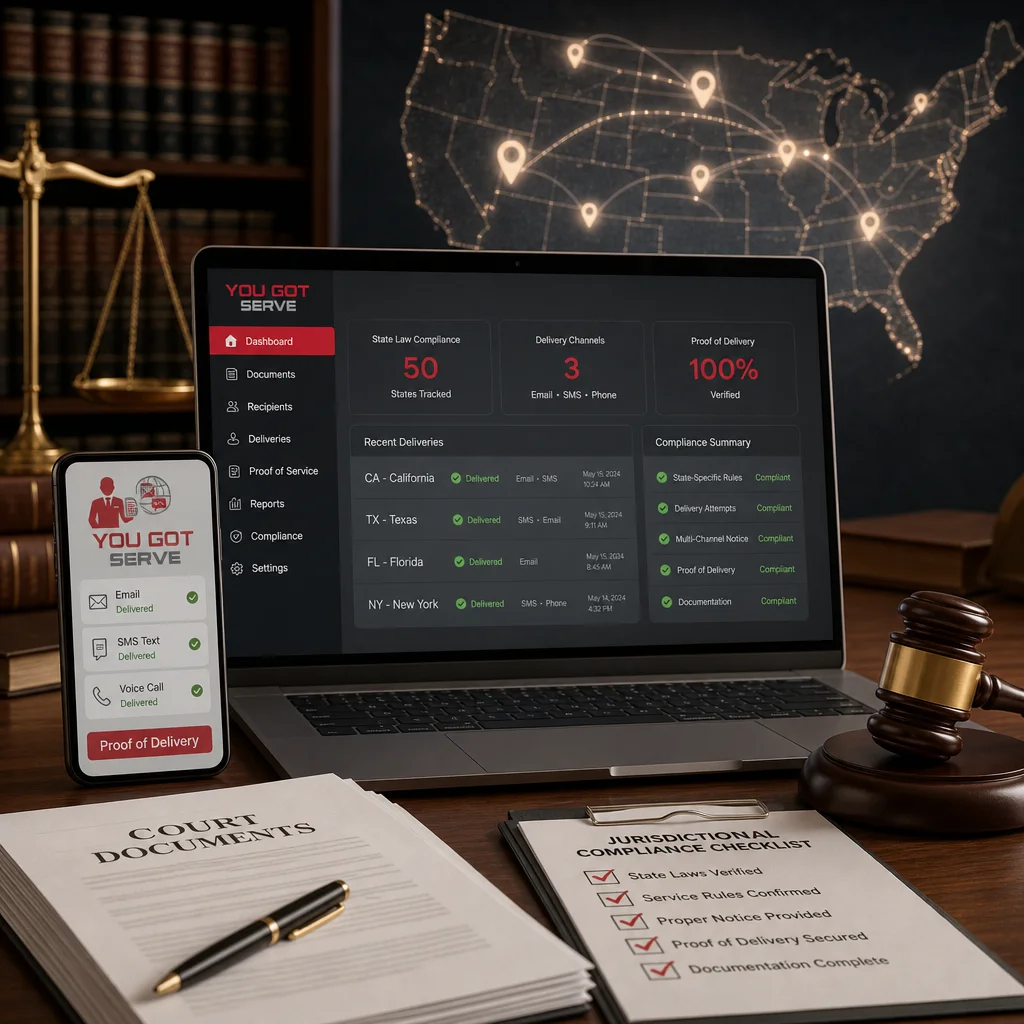
We designed our platform specifically to address the documentation gaps that trigger jurisdictional objections. When you upload documents to You Got Serve, you can enter up to three email addresses and three phone numbers for each recipient, ensuring multiple contact pathways. Our system automatically delivers notifications daily through email, SMS, and WhatsApp where available, creating a persistent, documented campaign rather than a single attempt.
Your account dashboard displays real-time service status: whether the attempt remains Pending or has been marked Delivered. Recipients securely access documents using a unique one-time access code, which prevents unauthorized viewing while creating a clear record of who accessed what and when.
We understand that jurisdictional compliance requires more than good intentions. It requires evidence. Every notification, every delivery attempt, every access event, and every verification action generates timestamped records in your account. You can download detailed activity reports that demonstrate to any court how thoroughly you attempted service and what response you received.
Multi-Channel Notification as Compliance Documentation
Email alone may not satisfy jurisdictional requirements, especially when you cannot confirm the recipient reads their inbox. SMS reaches different people in different ways. WhatsApp provides additional reach where relevant. The strength of our platform lies in combining all three channels into a single, coordinated notification campaign.
When you activate a You Got Serve service, we send daily notifications across all contact methods you specify. If an email bounces, we document that failure in your activity log. If an SMS is delivered but the document is not accessed, we record that distinction. This multi-channel approach accomplishes two critical objectives: it maximizes the genuine probability that the recipient actually receives notice, and it generates undeniable documentation that you exhausted reasonable notification methods.
Courts recognize multi-channel notification as a stronger compliance indicator than single-method attempts. By pursuing email, SMS, and WhatsApp simultaneously across a 60- or 90-day campaign, you demonstrate diligence that satisfies even skeptical jurisdictional scrutiny.
Verified Proof of Service Against Jurisdictional Challenges
A complete proof of service must go beyond stating that a document was sent. It must demonstrate that reasonable attempts were made and that documentation exists to support your claims. Our platform generates this evidence automatically.
Verification features available through You Got Serve include selfie capture (where appropriate and consensual), geolocation information, document-access timestamps, notification history, and service-status tracking. When a recipient opens a document using their unique access code, we capture and log that access event with full timestamp and IP information. This creates a chain of evidence that directly rebuts claims of non-service.
You can generate comprehensive service reports that compile all notification attempts, delivery confirmations, failed delivery events, access records, and verification data into a single, court-ready document. Rather than argue about whether service occurred, you present objective, timestamped evidence that it did.
60 and 90-Day Campaign Tracking for Persistent Attempts
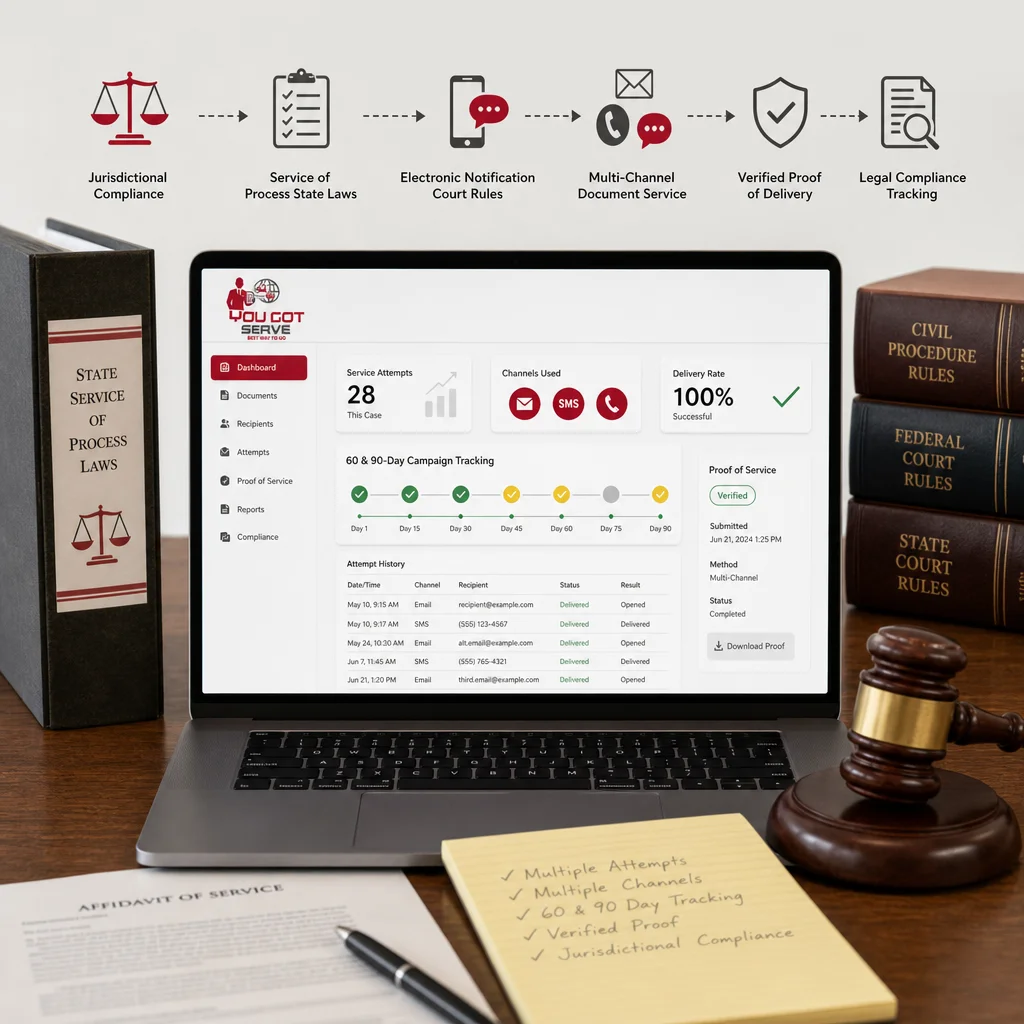
Most jurisdictions require that service attempts demonstrate persistence over time. A single attempt, even well-documented, may not satisfy “reasonable diligence” standards, particularly when serving an unresponsive or hard-to-locate defendant.
We offer two campaign structures: a 60-day service for $350 or a 90-day service for $500. Throughout your selected period, our system sends daily notifications via email, SMS, and WhatsApp, creating an extended, documented record of persistent attempts to reach the recipient. If they ignore notifications for weeks but then claim they never received service, your activity log directly contradicts that claim.
Eligible Organization accounts receive a 10% discount on both service levels. The extended campaign period transforms your service documentation from a snapshot into a comprehensive narrative of diligence and persistence that courts recognize as meeting jurisdictional requirements.
Geolocation and Recipient Verification Features
Jurisdictional challenges often hinge on whether the defendant truly received notice in the proper location. Our platform captures geolocation information when recipients access documents, providing courts with evidence that they were physically present and actively engaged with the notification.
We also support optional selfie capture and other recipient verification methods where appropriate. These features serve dual purposes: they strengthen your proof of service by confirming recipient identity, and they create additional documentation that responds directly to jurisdictional objections claiming the wrong person was served or that service never occurred.
The combination of geolocation data, recipient verification, and detailed access timestamps creates a defense against the most common jurisdictional challenges. A defendant cannot convincingly argue they never received notice when your records show them accessing the document from a specific location at a specific time.
Building an Audit Trail That Courts Recognize
Courts increasingly expect electronic service providers to maintain detailed audit trails. An audit trail documents every step: when notifications were sent, which contact method was used, whether delivery succeeded or failed, when the document was accessed, by whom, and from where.
Our platform generates these records automatically and continuously throughout your 60- or 90-day campaign. You can access real-time updates within your account and download comprehensive activity reports at any time. These reports use clear, chronological formats that courts expect and that do not require interpretation or explanation.
The audit trail becomes your insurance against jurisdictional objections. Rather than relying on testimony or inference, you present objective, timestamped records of every material event. Courts recognize this approach as meeting modern compliance standards.

Investigative Support When Contact Information Is Incomplete
Many jurisdictional challenges arise because you lack sufficient contact information to serve the defendant. You may have an outdated address, a generic email, or no phone number at all. Without contact information, even the best electronic service platform cannot succeed.
We address this challenge through available investigative services. If you do not have sufficient contact details for your intended recipient, our investigative capabilities can help locate current email addresses, phone numbers, and location information. We can also connect you with CII Services Corp for broader professional investigative support when needed.
This integrated approach solves a practical problem that many service platforms ignore: compliance starts with finding the defendant. Our platform combines notification delivery with investigative assistance, ensuring you have the contact information necessary to mount a defensible service attempt.
Your Jurisdictional Compliance Solution
Managing jurisdictional objections requires more than good faith effort. You need a platform that generates objective, timestamped documentation; pursues multiple notification channels persistently over an extended period; captures recipient verification data; and produces court-ready activity reports.
You Got Serve delivers all of these elements. Our multi-channel notification approach, verified proof-of-service features, extended 60- and 90-day campaigns, geolocation and verification capabilities, and detailed audit trails combine to create a comprehensive answer to jurisdictional compliance challenges.
Rather than hoping traditional service methods succeed or accepting the cost and delay of newspaper publication, you can serve documents electronically through a platform specifically designed to satisfy modern jurisdictional scrutiny. Check your local court rules to confirm electronic service is permitted in your jurisdiction, but if it is, You Got Serve provides the documented, verifiable approach courts now expect.
Get Started With Documented Electronic Service Today
Jurisdictional objections are avoidable when you use a service platform designed to address them from the start. Visit how it works to see how our platform manages multi-channel notification, recipient verification, and compliance documentation in real time.
You can select either a 60-day or 90-day campaign, upload your documents, enter up to three email addresses and three phone numbers per recipient, and begin your documented service attempt immediately. Your account dashboard provides continuous visibility into delivery status, access events, and all verification data. When you need to respond to a jurisdictional objection, you download your complete activity report and let the records speak for themselves.
You Got Serve is the smarter way to serve. We combine persistent electronic notification, verified proof of delivery, and detailed compliance documentation into one platform, eliminating the delays, expenses, and vulnerability that traditional service methods create. Get started today and replace uncertainty with documented evidence.