
The Challenge of Serving Across Language Barriers and Borders
Serving court documents internationally presents a maze of obstacles. Language differences, incompatible postal systems, varying legal standards, and unreliable forwarding addresses create friction at every step. When a defendant or respondent is abroad or simply unresponsive, traditional service methods can take months and still fail to confirm receipt.
Your team may spend weeks locating a current address, only to discover the defendant has moved again. International mail routes offer no guaranteed delivery confirmation. Translation requirements, notarization demands, and jurisdictional restrictions add layers of complexity and cost. Meanwhile, your case sits idle, and your client grows frustrated.
The reality: conventional service methods were designed for domestic, known recipients. They collapse when you need to reach someone across borders, in unfamiliar time zones, or when their contact details are incomplete or outdated.
How Traditional Methods Fall Short in Multilingual Jurisdictions
Newspaper publication, the traditional fallback for difficult service, is expensive, slow, and produces weak proof of delivery. You pay hundreds of dollars for a small notice in a local paper nobody reads, then wait 30+ days for publication deadlines and additional waiting periods. You have no way to know whether the defendant actually saw the notice.
Personal service across borders requires hiring local process servers in each jurisdiction. This approach multiplies costs and introduces delays as you coordinate with multiple vendors in different time zones, each operating under their own rules and standards. A single mistake in translation or procedural format can invalidate the service entirely.
Certified mail and courier services provide tracking, but not proof of actual receipt. If the recipient refuses delivery or claims they never opened it, you have limited recourse. International courier fees also climb quickly when serving multiple jurisdictions or multiple addresses for the same person.
None of these traditional methods scale efficiently. Each method operates in isolation, without integration, without multilingual capability, and without the ability to reach someone simultaneously across multiple contact channels. You must choose one approach and hope it works.
Our Multilingual E-Notice Approach: Verified Delivery Without Geographic Limits
We designed our platform to solve the problems traditional service cannot. Our multilingual electronic service delivers court documents via SMS and email simultaneously, with automated daily notifications across a 60-day or 90-day cycle. Recipients retrieve documents through a secure, code-protected portal, and we capture timestamped proof of access, geolocation data, and detailed activity logs.
Unlike newspaper publication or single-method courier service, our platform lets you upload multiple documents, enter up to three email addresses and three phone numbers per recipient, and reach them consistently every day until delivery occurs. We support electronic notifications within the United States and internationally where technically available and legally appropriate.
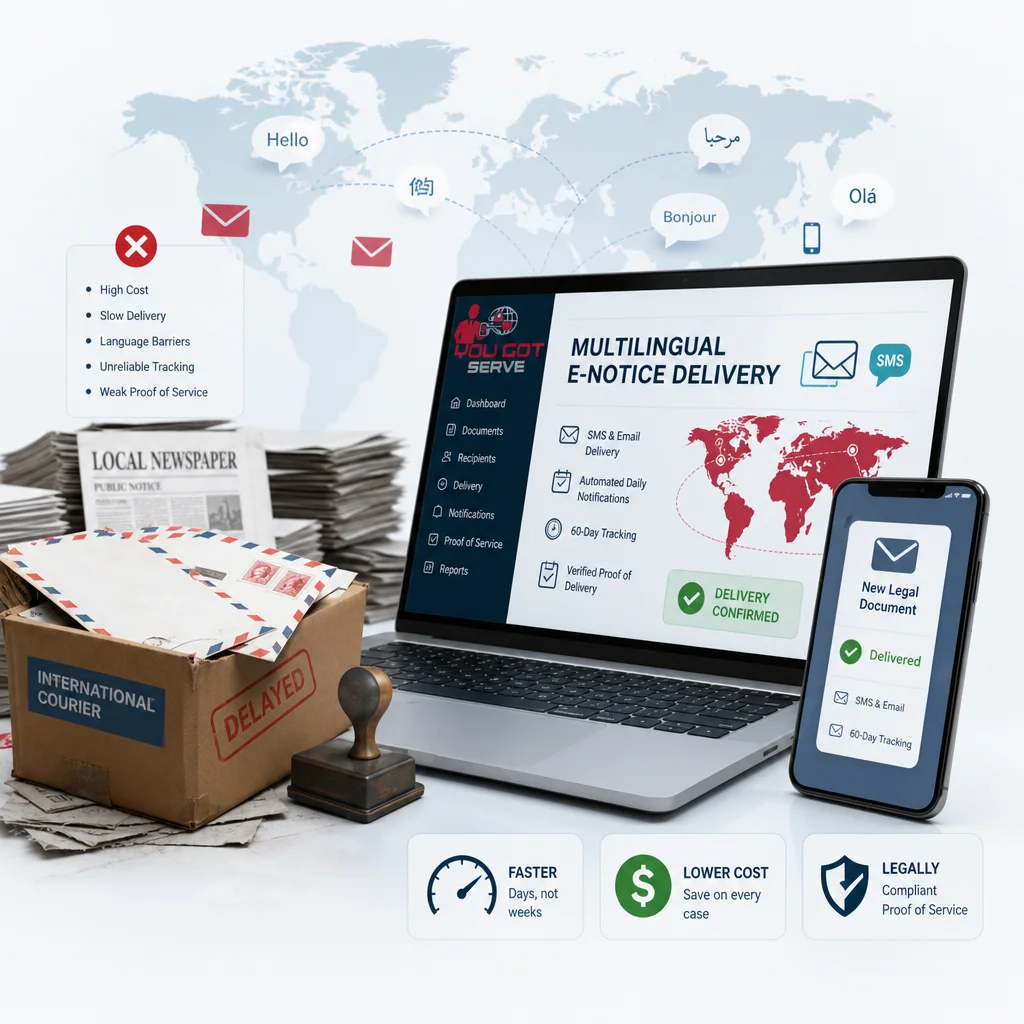
The result is verified digital proof of service backed by cryptographic timestamps, recipient verification, and encrypted document access. You get certainty that the recipient received notice. Your case moves forward without the waste and uncertainty of traditional methods.
Comparison: Speed and Reliability Across Jurisdictions
Traditional service via certified mail takes 7-14 days for delivery in ideal conditions. International courier adds another 5-10 days and often requires customs clearance. Newspaper publication requires a 30-45 day lead time before the notice even appears in print.
Our platform delivers the first notification within minutes. Automated daily notifications continue for 60 or 90 days, ensuring repeated contact attempts. If a recipient’s email server bounces or their phone number is disconnected, our system adjusts and retries automatically. You do not wait for external vendors or postal schedules.
Reliability improves dramatically because we use multiple channels simultaneously. An email may fail, but SMS reaches the recipient’s phone. A number may have changed, but the backup email address works. This redundancy is native to our platform, not an afterthought.
For global cases where speed determines whether you secure jurisdiction or whether a statute of limitations passes, this difference is material.
Comparison: Cost Efficiency in International Service Scenarios
Newspaper publication costs $400-800 per jurisdiction, with no guarantee of actual notice. International process servers charge $500-1500 per jurisdiction for a single attempt, often with additional fees for follow-up efforts.
Our service starts at $350 for a 60-day campaign or $500 for a 90-day campaign, regardless of how many jurisdictions your recipients span. If you need to serve multiple recipients, the cost scales linearly. You also receive eligible organization discounts of 10% if applicable.
That same $350-500 buys you two to three months of continuous, automated, verified delivery across multiple contact points. There are no hidden per-attempt charges, no waiting for vendor availability, and no surprise international fees.
For law firms managing volume cases or serving defendants across multiple states and countries, the savings compound quickly.
Comparison: Documentation and Compliance for Diverse Legal Systems
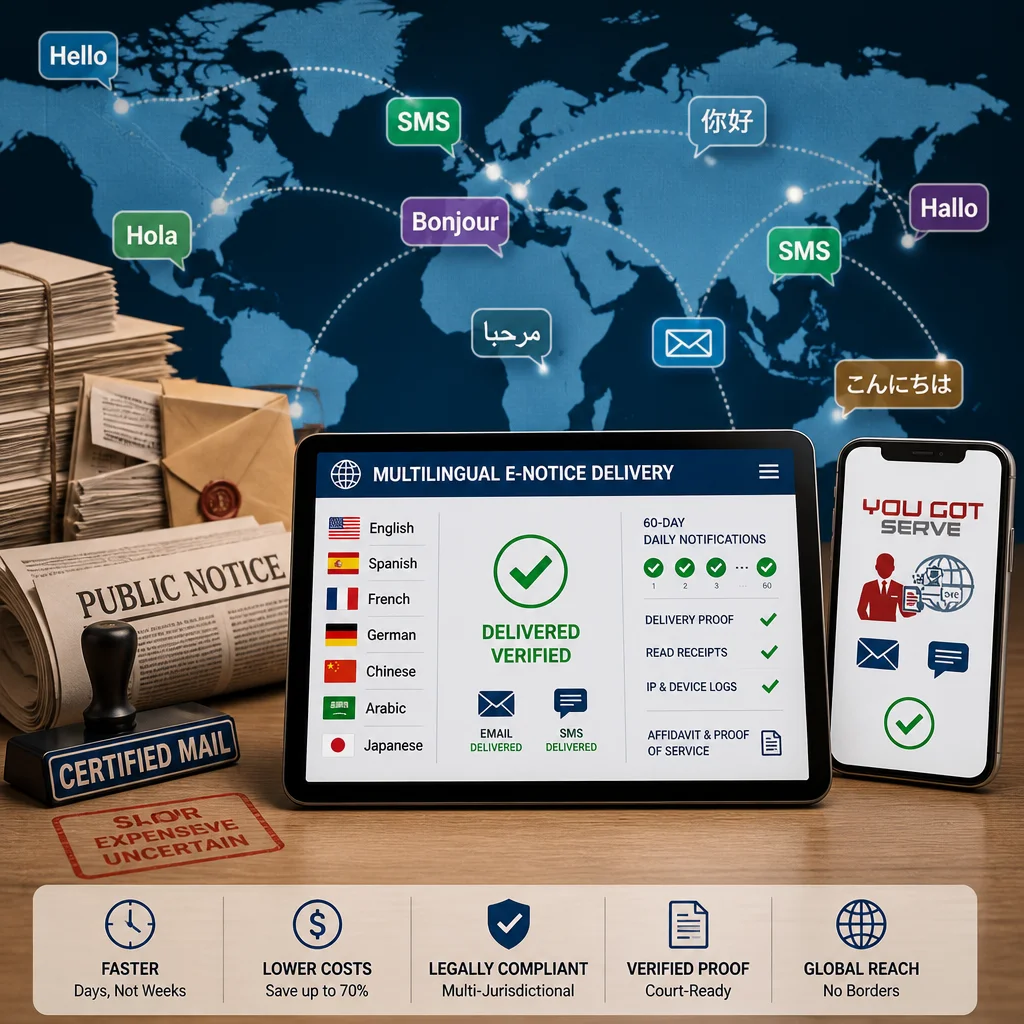
Traditional service leaves gaps in documentation. Certified mail receipts do not show when the recipient read the document. Newspaper affidavits rely on publisher attestation, not actual proof of notice. Process server affidavits depend on a single human’s word and may not comply with local language or formatting rules.
Our platform generates timestamped, encrypted records of every action: when notifications were sent, whether they were delivered, when the recipient accessed the document, their geolocation at the time of access, and how many times they retrieved the file. We support legal validity verification and are designed to support compliance with jurisdictional rules for electronic service.
Recipients access documents using a one-time code, providing an additional layer of verification that the correct person opened the file. This granular activity record is admissible evidence in most jurisdictions and far exceeds what traditional methods can produce.
Before relying on electronic service, check your local court rules and confirm that electronic service is permitted or authorized for your case type. Jurisdictional rules vary, but our detailed proof of service positions you to meet any court’s evidentiary requirements.
Automated Daily Notifications in Multiple Channels
Sending a single notice and hoping the recipient sees it is not a strategy. People delete emails, ignore unfamiliar numbers, and change addresses without notice.
Our platform sends automated notifications every day for the duration of your campaign. These notifications go out via email and SMS simultaneously, and WhatsApp where appropriate. Each message includes a link or code directing the recipient to retrieve the document securely.
The recipient cannot claim they missed the notice or never received it. Our logs show exactly when each notification was sent, whether the email was delivered, and whether the SMS went through. Persistent daily contact dramatically increases the likelihood of actual receipt compared to the single-attempt model that traditional service relies on.
Recipient Verification and Secure Access Across Markets
Serving a document does no good if you cannot verify that the correct person received it. Traditional methods cannot answer this question with certainty.
Our platform captures multiple verification markers at the time of document access: the recipient’s geolocation, timestamp, device type, and optional selfie capture. Recipients generate a unique access code that only they can use. We encrypt all communications end-to-end and timestamp every action cryptographically.
This verification framework works across jurisdictions and across language barriers. A court in Texas can rely on the same technical standards as a court in Singapore. The verification data is the same regardless of the recipient’s location.
Extended 60 and 90-Day Campaign Cycles for Complex Cases
Some cases require patience. A defendant might ignore initial contact, then check their mail weeks later. A respondent abroad might be traveling or temporarily unreachable but will eventually see accumulated messages.
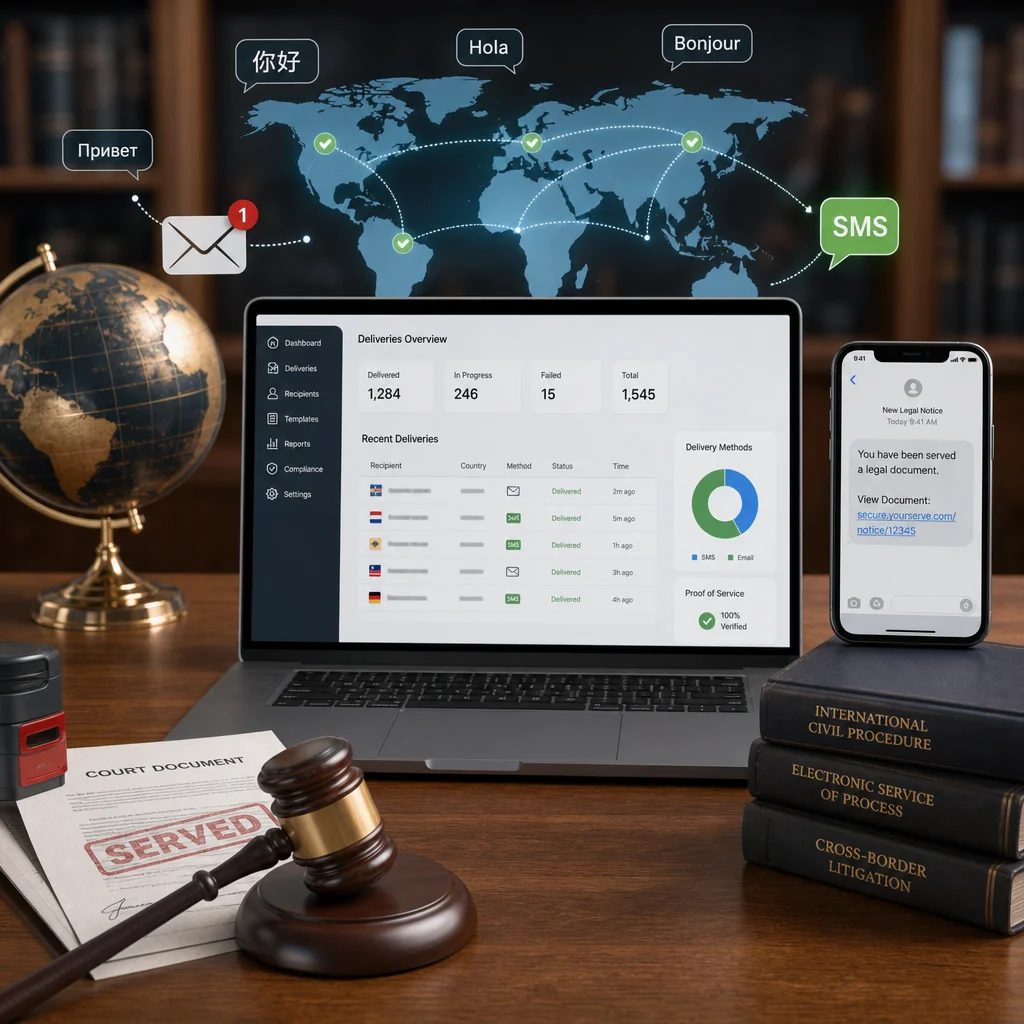
Our 60-day and 90-day service options ensure that recipients receive persistent contact over an extended window. If a recipient misses a notification on day one, they will receive it again on days two through sixty (or ninety). This extended timeline is particularly valuable for cross-border cases where you cannot control the recipient’s availability or attention.
Traditional methods offer no such flexibility. You make one attempt and wait. If it fails, you start a new process and pay again. Our extended campaigns keep trying automatically until delivery is confirmed.
Why Courts and Jurisdictions Accept Our Electronic Service
Courts increasingly recognize that digital delivery is faster, more verifiable, and more cost-effective than traditional methods. Electronic service rules exist in most U.S. federal courts, state courts, and many international jurisdictions. The Federal Rules of Civil Procedure allow electronic service, as do similar procedural rules in other countries.
What makes our platform court-compatible is our commitment to generating legally sufficient proof of service. We provide timestamped records, encrypted activity logs, recipient verification data, and detailed delivery status reporting. These are the evidentiary elements courts expect.
Our how it works page details the technical and procedural framework we use to support compliance. That said, whether electronic service constitutes legally sufficient service depends on applicable laws, court rules, jurisdiction, and any required court authorization. Always verify that electronic service is permitted in your specific case before relying on our platform.
Making Your Decision: When Multilingual E-Notice Is the Right Choice
Choose digital delivery when you need to serve hard-to-locate or unresponsive recipients across multiple jurisdictions or international borders. Choose it when traditional methods have failed and you need a faster, more reliable alternative to newspaper publication. Choose it when cost matters and you cannot justify spending $1000+ on personal service attempts that may not produce proof of delivery.
Choose us when you need verified receipt tracking, automated daily notifications, and detailed proof of service that courts will accept. Choose us when you are managing complex cases with multiple recipients, language barriers, or uncertain contact information.
Our platform is the smarter way to serve. We eliminate the delays, costs, and guesswork of traditional service while building the verification record courts require. You get certainty, speed, and cost efficiency in one integrated solution.
Check your local court rules to confirm that electronic service is permitted for your case type. Then set up your campaign. We make the process straightforward so your case can move forward.