
When Traditional Service Fails: The Growing Need for Electronic Alternatives
Locating a defendant has become increasingly difficult. Addresses change, phone numbers disappear, and individuals actively avoid process servers. When traditional personal service proves unsuccessful after reasonable efforts, courts recognize that litigation cannot stall indefinitely.
Electronic service offers a legally-compliant pathway forward. Instead of relying solely on newspaper publication or waiting months for unsuccessful attempts, you can serve documents via SMS and email with documented delivery tracking. Courts across many jurisdictions now permit or even encourage this approach when the defendant’s electronic contact information is reasonably available.
The shift reflects practical reality: defendants check email and text messages far more reliably than they monitor newspapers or respond to doorbell rings. By serving documents electronically, you create an auditable record of every notification attempt, delivery confirmation, and recipient interaction. This documentation becomes critical evidence when you present your motion for alternative service approval.
Your next step: Determine whether your jurisdiction’s rules permit electronic service before drafting your motion. Local court rules, state statutes, and recent case law will define what proof you need to provide.
Why Courts Are Requiring Documented Proof of Alternative Service Attempts
Courts do not approve alternative service requests lightly. Judges must balance the plaintiff’s need to move litigation forward against the defendant’s due process right to notice. This tension is why judges scrutinize every motion for alternative service.
What convinces a judge? Detailed documentation. A court needs to see that you made genuine efforts to serve the defendant through conventional means and that electronic service represents a reasonable fallback, not your first choice. Judges want proof that:
- You attempted personal service multiple times at known or last-known addresses
- You conducted skip-trace investigations or other locating efforts
- The defendant’s email address or phone number is current and reliable
- Electronic service is the most practical option available under the circumstances
When your motion includes timestamped logs, delivery receipts, and investigative findings, you answer these concerns directly. Courts view persistent, multi-channel notification with verified access confirmations as stronger evidence of genuine notice than a single failed process-server attempt followed by newspaper publication.
This expectation explains why automated documentation systems have become essential for modern litigation support.
What Courts Expect in Your Motion for Alternative Service
A successful motion for alternative service contains three core components: factual foundation, legal authority, and proposed method of service.
The factual foundation establishes that traditional service has failed. Describe the specific addresses where service was attempted, the dates and results of those attempts, and the efforts you undertook to locate current contact information. Include affidavits or declarations from process servers, investigators, or parties with personal knowledge of the defendant’s evasiveness.
Legal authority comes next. Cite your state’s rules of civil procedure, relevant statutes, and published decisions approving electronic service in similar circumstances. Many jurisdictions follow principles outlined in the Federal Rules of Civil Procedure or mirror state-level equivalents. Your research should demonstrate that courts in your jurisdiction have approved electronic service for defendants whose location or willingness to cooperate renders traditional service impractical.
The proposed method section explains how service will occur. This is where precision matters. State that service will be attempted via email and SMS at specified addresses and phone numbers. Explain the frequency and duration of notifications, the security mechanisms protecting document access (such as one-time access codes), and how proof of service will be documented. A clear, detailed proposed method significantly improves motion approval rates.
Building a Stronger Motion: Key Elements Courts Review
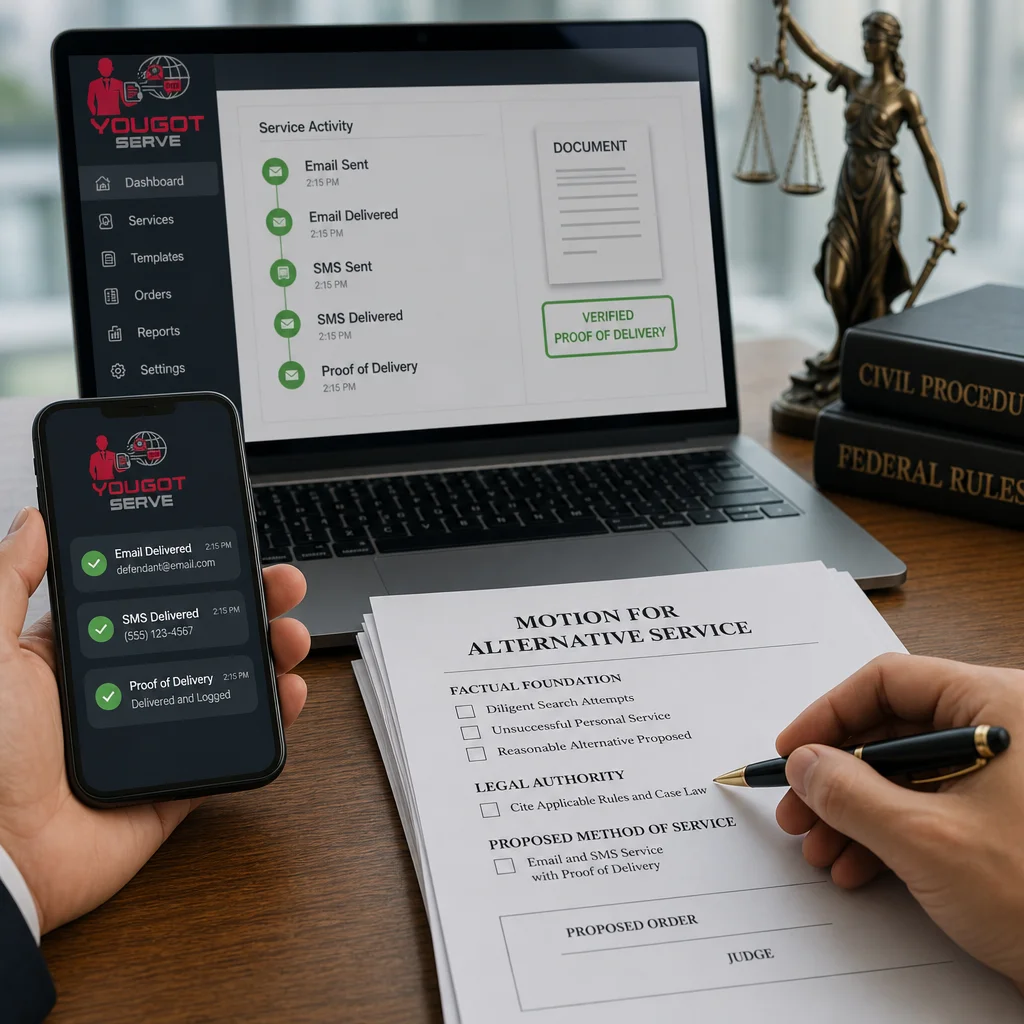
Judges evaluate alternative service motions along predictable lines. Understanding these criteria lets you preemptively address skepticism.
Diligence in locating the defendant ranks first. Show that you investigated thoroughly. Have you checked recent addresses from public records, contacted known associates, or worked with a licensed investigator? Courts respect genuine effort. Even if your investigation yielded limited results, the attempt itself demonstrates good faith.
Reliability of the electronic contact information comes second. Courts hesitate to approve service via an email address or phone number that may belong to someone other than the defendant or that may no longer be in use. Include evidence supporting the reliability of each contact method: recent communications from that address, confirmation from knowledgeable third parties, or skip-trace verification that links the address or phone number to the defendant.
The proposed service method’s adequacy is third. Will SMS and email alone reach the defendant, or should you add a secondary channel like WhatsApp? How long will the notification campaign run? Courts prefer campaigns with sufficient duration and frequency to maximize the likelihood of receipt, such as daily notifications over 60 or 90 days. Explain why your proposed timeline and frequency are reasonable.
Finally, courts assess whether the method complies with procedural rules. Your motion should demonstrate alignment with applicable statutes or court rules governing electronic service, alternative service, or constructive service in your jurisdiction.
How We Streamline Your Alternative Service Process with Automated Documentation
Our platform addresses the documentation demands that judges expect. We provide integrated tools for serving court documents electronically while creating an auditable record at every step.
When you initiate service through YouGotServe, you specify the recipient’s email addresses and phone numbers, and we deliver your documents via SMS and email on a schedule you define. Our system automatically timestamps each notification attempt, records delivery confirmations, captures recipient access activity, and maintains a detailed log of all interactions.
This automated documentation becomes the backbone of your proof of service. Rather than reconstructing service efforts from memory or manual notes, you export a comprehensive activity report directly from our platform. Courts receive a clear, timestamped record showing exactly when notifications were sent, which channels were used, and when the recipient accessed the secured documents.
Beyond basic delivery tracking, we support additional verification features. Recipients access documents using unique one-time access codes, protecting security while creating confirmation that a specific individual opened the document. Where available, our platform captures geolocation data and optional selfie verification, adding further evidentiary layers to your service record.
For recipients you cannot easily locate, we offer investigative skip-trace assistance. This service helps you identify current email addresses and phone numbers, addressing one of the most significant obstacles to alternative service approval.
Leveraging Multi-Channel Notifications to Strengthen Your Service Record
Single-channel service looks less persuasive than multi-channel outreach. A defendant might claim they never received an email, but it becomes harder to deny notice when SMS messages arrived on their phone, emails landed in their inbox, and WhatsApp notifications appeared in their messaging app.
We allow you to provide up to three email addresses and three phone numbers per recipient, with simultaneous or staggered delivery across channels. This multi-channel approach increases the practical likelihood of receipt and creates a richer documentary record for your motion.
Courts recognize that persistent, multi-method notification strengthens your position. A 60 or 90-day campaign with daily SMS and email notifications generates dozens or hundreds of timestamped delivery events. Even if a single message goes unread, the cumulative record demonstrates sustained, good-faith effort to reach the defendant.
When you present this activity log to the court alongside your motion, you show not just that you attempted service, but that you pursued every reasonable avenue over an extended period. This kind of comprehensive documentation often tips judicial discretion in your favor, especially in cases where traditional service has genuinely become impractical.
Recipient Verification and Geolocation Data as Supporting Evidence
Courts increasingly value objective verification that notice actually reached the intended recipient. Proof of delivery matters, but proof that the recipient accessed and reviewed the documents matters more.
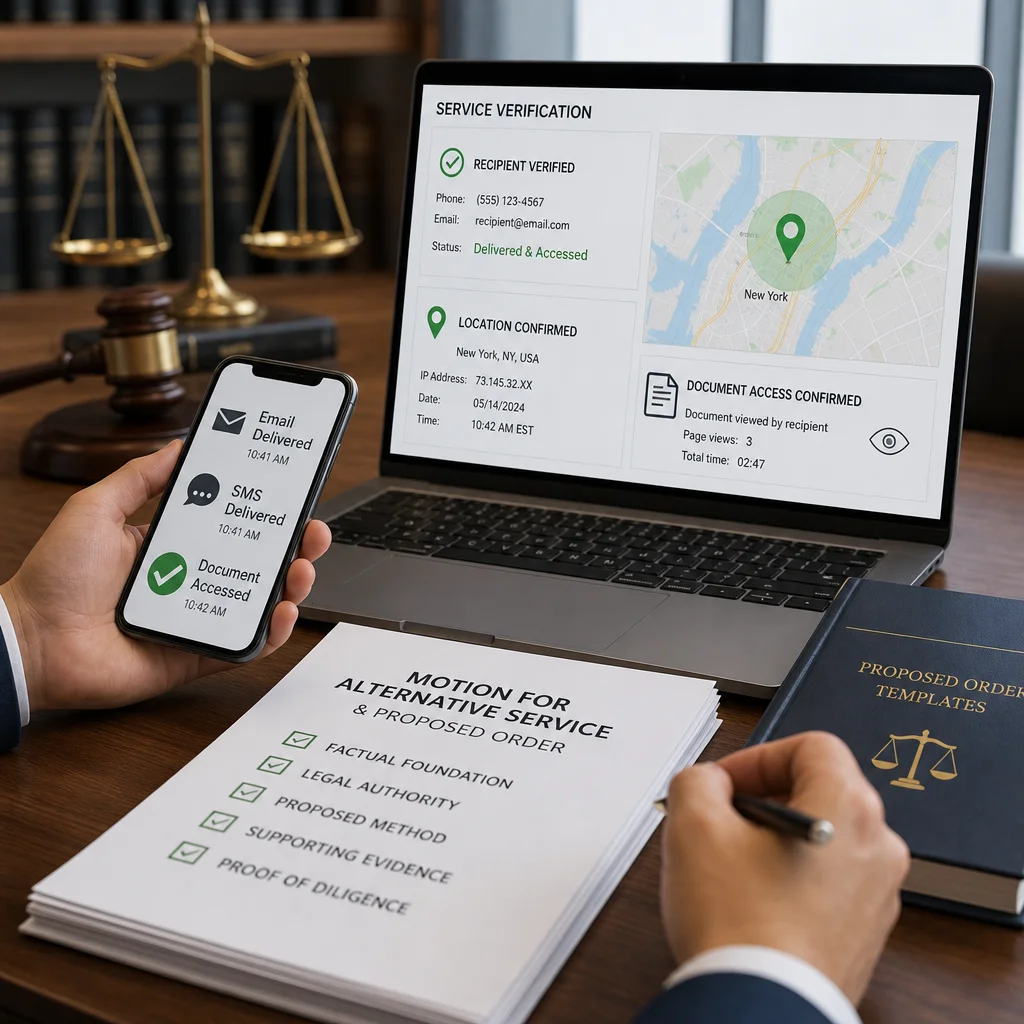
Our platform supports several verification methods. When a recipient opens their secure document link using the one-time access code, we record the timestamp of that access. This creates a document-level confirmation that someone with knowledge of the code reviewed the materials, not merely that an email arrived in an inbox.
Geolocation data adds another evidentiary layer. When available and permitted by law, we can capture the geographic location associated with document access. This information helps establish that the access occurred from a known location associated with the defendant, further supporting the conclusion that the defendant personally received notice.
Optional selfie verification takes this further. In cases where court rules permit, recipients can be prompted to provide optional verification imagery during document access. This creates an additional confirmation mechanism, though not all jurisdictions approve this method and you should check local requirements before requesting it.
When combined in your motion’s proposed order, these verification features demonstrate your commitment to rigorous, documented service. Judges notice the difference between “we sent an email” and “we sent an email, tracked its delivery, recorded when it was opened, captured the location of access, and maintained a complete timestamped record of all activities.”
Creating Your Compliant Proposed Order Language
Your proposed order must clearly authorize the service method you intend to use and establish the scope of that authorization. Vague language invites judicial hesitation or defense objections.
A strong proposed order specifies the recipient’s email addresses and phone numbers where service will occur. It authorizes service via SMS, email, and any other channels you propose. It states the frequency and duration of notifications, such as “daily notifications for 90 consecutive days” or “every other business day for 60 days.” It confirms that documents will be secured with access codes and describes any verification methods you will employ.
The order should also address what constitutes valid service under your proposed method. Will service be complete upon delivery to the specified email or phone number? Upon opening the document link? Your language should define this clearly so that later disputes over service validity do not arise.
Include language requiring you to maintain and produce the activity log as proof of service. State that you will file an affidavit or declaration of service accompanied by the complete timestamped record from your service platform.
Finally, address the timeline. Specify when service must be completed by and how quickly you must report results to the court. This prevents indefinite notification campaigns and gives the court control over the service schedule.
The Role of Detailed Activity Logs in Motion Approval
The activity log is your motion’s strongest evidence. It transforms abstract claims about service efforts into concrete, verifiable facts.
A comprehensive activity log shows:
- Date and time of each notification attempt
- Channel used (SMS, email, WhatsApp)
- Delivery status (sent, delivered, failed)
- Recipient access activity with timestamps
- Any verification data collected
- Duration of the overall campaign
Courts reviewing this log can independently verify that your service efforts matched your motion’s representations. If you claimed daily notifications for 60 days, the log either confirms this or reveals gaps. If you represented that the recipient’s email address was current and reliable, the log’s delivery history supports or contradicts this claim.
Beyond motion approval, the activity log becomes your proof of service filing. After the notification campaign concludes, you submit this documentation to the court, establishing that service was accomplished in accordance with the court’s order. This is why automated, timestamped documentation systems are far superior to manual record-keeping.
Combining Templates with Persistent Notification Campaigns
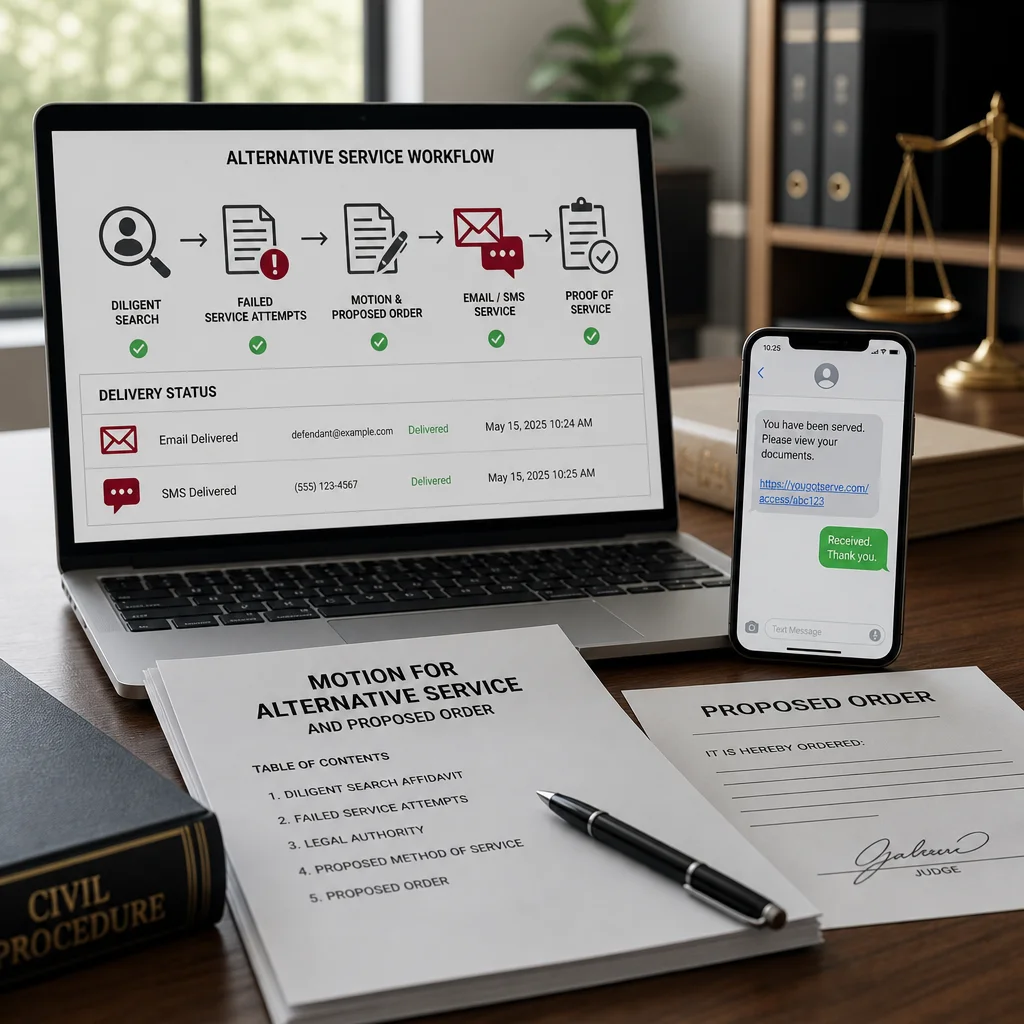
A motion template gives you a framework, but execution determines success. The strongest approach combines a well-drafted motion with a disciplined, documented service campaign.
Begin by researching your local rules and gathering your factual support. Use your jurisdiction’s procedural rules and recent case law as the foundation for your motion template. Then integrate specific facts about your locating efforts, the defendant’s evasiveness, and the reliability of the electronic contact information you have identified.
Once you have court approval, implement your notification campaign using a platform designed for this purpose. Initiate service on the date specified in your order and maintain consistent, daily notifications throughout the authorized period. Let the platform’s automated documentation system record every step.
This integrated approach reduces the risk of gaps or inconsistencies between what your motion promised and what your service campaign delivers. Courts notice when a motion claims daily SMS and email notifications but the activity log shows sporadic attempts. Consistency builds credibility.
Getting Your Motion Approved: Common Pitfalls to Avoid
Many practitioners undermine otherwise sound motions through preventable errors. Awareness helps you sidestep these mistakes.
Insufficient factual detail is the most common problem. Vague references to “attempts to locate the defendant” or “unsuccessful service efforts” do not persuade judges. Instead, include specific addresses, dates, process-server reports, and investigative findings. Show your work.
Overstating electronic service capabilities ranks second. Avoid claiming that electronic service is “as reliable as personal service” or will “definitely reach the defendant.” Courts distrust hyperbole. Instead, use measured language: “Email and SMS provide a more accessible and verifiable method of notice than newspaper publication, particularly when the defendant maintains active email and phone accounts.”
Weak legal authority undermines even factually strong motions. Cite your jurisdiction’s procedural rules, statutes, and case law supporting alternative service. Distinguish adverse precedent if necessary. Show that your proposed method aligns with established legal principles in your jurisdiction.
Finally, avoid proposing overly short service campaigns. Courts are skeptical of 14-day or 30-day notification periods. Propose 60 or 90 days instead. The longer campaign demonstrates persistence and maximizes the likelihood that notice will reach the defendant, increasing judicial confidence in your motion.
Moving Forward: From Court Authorization to Execution
Once your motion is approved and your proposed order is signed, execution begins. The interval between court approval and the start of your service campaign is the time to prepare.
Confirm that you have accurate, current email addresses and phone numbers for the recipient. If any contact information has changed since your motion was filed, you may need to seek a modification or supplemental order. Coordinate with the service platform to load the recipient’s contact details, establish access codes, and configure the notification schedule.
Begin service on or shortly after the date specified in your court order. Maintain consistent notifications throughout the authorized period without gaps or deviations. Do not attempt service more frequently than the order permits, as this may anger the court or provide defense ammunition.
As the campaign progresses, monitor the activity log for delivery failures or access confirmations. If an email address bounces repeatedly or a phone number consistently fails to deliver, document this in your records and consider whether you should seek a supplemental order authorizing service to an alternative contact method.
When the notification period concludes, compile your complete activity log and prepare an affidavit or declaration of service. File this documentation with the court within the timeframe specified in your order. This filing establishes that service was accomplished and creates an official court record of your compliance with the service order.
By combining a rigorously researched motion, a clear proposed order, and disciplined execution with automated documentation, you transform alternative service from a risky workaround into a court-approved, documented, and defensible method of reaching an elusive defendant. This approach protects your case while advancing litigation efficiently.
For further reading: Electronic service of process.