
Why Attorneys Need Reliable Dual-Channel Authentication for Service of Process
Service of process is the foundation of valid jurisdiction. Without reliable proof that a defendant or respondent received notice, courts can dismiss cases, delay proceedings, or overturn judgments. Traditional methods like certified mail or newspaper publication are slow, expensive, and often fail to reach difficult-to-locate recipients.
Modern legal practice demands faster, more transparent alternatives. Single-channel notification systems leave gaps: an email address changes, a phone number disconnects, or a recipient claims non-delivery. Dual-channel authentication addresses this reality by combining multiple contact methods with verified receipt tracking and timestamped activity logs.
We built You Got Serve because attorneys told us they needed a solution that works when traditional service fails. They wanted documented proof they could present to a court, cost savings compared to newspaper publication, and the ability to locate and notify recipients across multiple touchpoints simultaneously.
What to do next: Assess your current service method. If you’re relying on a single email address or outdated skip-tracing data, you’re vulnerable to service challenges.
The Challenge: Traditional Email Alone Leaves You Unprotected
Email is convenient but fragile. A message arrives at an inbox, but you have no way to verify the recipient actually opened it or understood its urgency. Email providers route notifications to spam folders, corporate firewalls block delivery, and inboxes overflow with unread messages.
For attorneys, email-only service creates legal exposure. A recipient can claim they never received notice, a court can question whether the address was current, and you’re left with only server logs as proof. Judges routinely scrutinize electronic service and ask: “How do you know this person actually got the document?”
Newspaper publication, the traditional fallback, costs $500 to $2,000 and takes weeks to complete. Skip-tracing services provide outdated phone numbers and addresses. Self-represented litigants often have no resources for either option and watch cases stall.
You need evidence of contact, not just evidence of sending. That distinction determines whether a court accepts your proof of service.
What to do next: Review your last three service attempts. Count how many times a single-channel method (email or phone) failed to produce reliable confirmation of receipt.
RPost Certified Email: Strengths and Limitations
RPost Certified Email adds authentication layers to standard email. It creates timestamped records, tracks opens, and generates proof-of-delivery receipts. For routine business communications, it works well and is recognized by some courts.
But certified email has inherent constraints:
- Recipients must maintain the same email account for the entire service period.
- Email filters and spam folders still catch legitimate notifications.
- A single email address provides no backup if that account becomes inactive.
- No geolocation or biometric verification proves the recipient actually read the document.
- No SMS or WhatsApp fallback ensures contact across multiple platforms.
Courts treat certified email as useful evidence, but not foolproof. If a recipient claims they didn’t see the message or their email provider cached it, certified email alone may not overcome that objection. You’re still dependent on a single point of contact.
Certified email costs approximately $10 to $20 per notification. Over a 60-day service cycle with daily reminders, costs escalate quickly.
What to do next: If you’re using certified email, test it with a backup phone contact to see how often the secondary channel catches missed email notifications.
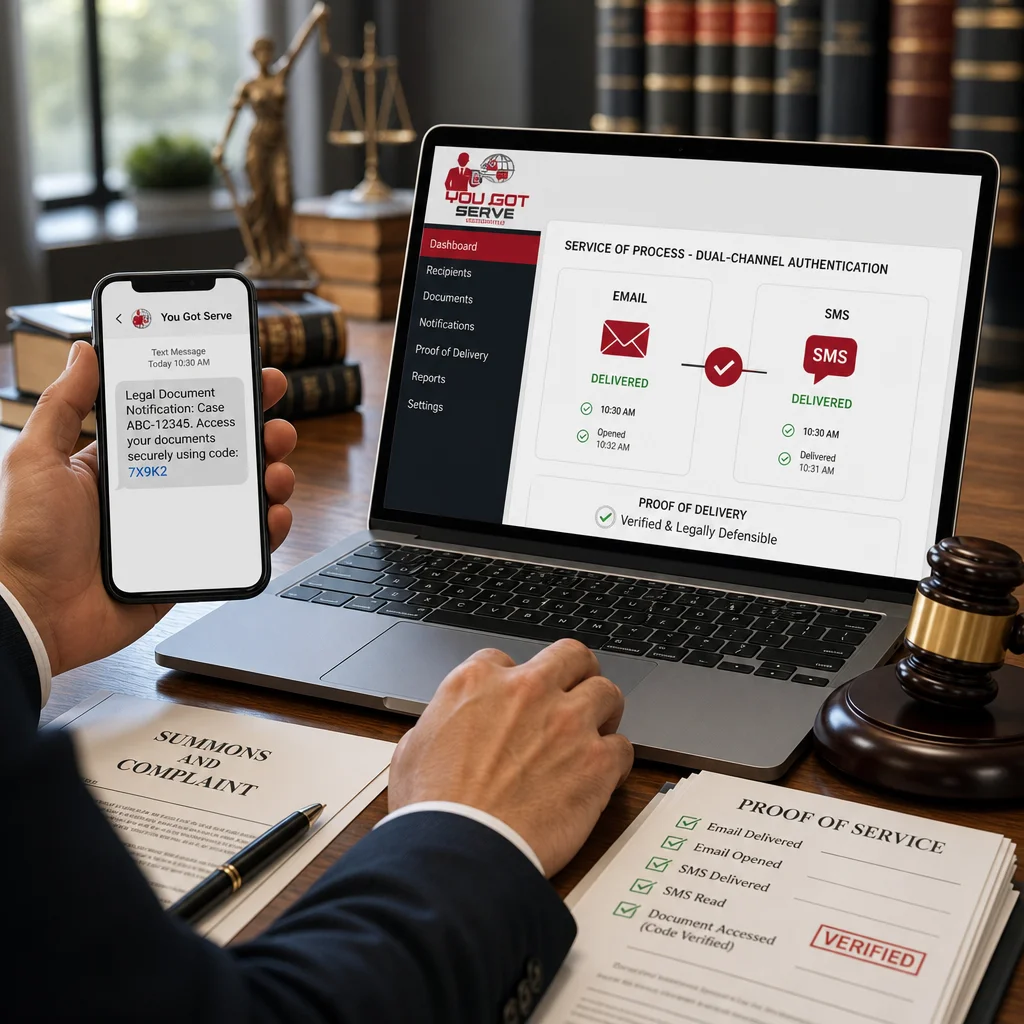
You Got Serve’s Dual-Channel Approach: SMS Plus Email Plus Verification
We combine email and SMS into a unified daily notification system that reaches recipients across multiple platforms simultaneously. You enter up to three email addresses and three phone numbers per recipient. Our platform delivers messages to all active contacts, every day, for either 60 or 90 days.
Here’s what makes our approach different:
- Parallel delivery: Email and SMS go out the same day, doubling the chance of receipt.
- Automatic fallback: If an email address bounces, SMS continues. If a phone number is inactive, email remains active.
- Daily reminders: Recipients see repeated notifications, reducing claims of non-delivery.
- WhatsApp integration: Where available, we add a third messaging channel.
- Secure document access: Recipients use a unique, one-time access code to retrieve documents, preventing unauthorized sharing and ensuring accountability.
Our 60-day service costs $350; our 90-day service costs $500. Eligible organizations receive a 10% discount. Compare this to $1,000+ for newspaper publication plus skip-tracing, and the cost advantage becomes clear.
We also offer investigative services to help you locate current contact information if your initial data is incomplete or outdated. This integrated approach eliminates the need to juggle multiple vendors.
What to do next: List all the phone numbers and email addresses you have for your target recipient. If you have fewer than two reliable contacts, request an investigative update before your service period begins.
How Our Daily Automated Notifications Outperform Single-Channel Systems
Frequency and redundancy save cases. A recipient may miss an email on Monday but see an SMS on Tuesday. They might ignore a notification on their work email but check their personal phone during evening hours. By sending daily across multiple channels, we dramatically increase the probability of awareness.
Single-channel systems rely on one opportunity. Miss that window and the recipient has plausible deniability. Courts see it too. Judges ask: “How many times did you contact this person?” If the answer is “once via certified email,” a court may be skeptical.
Our daily automation eliminates this problem. A recipient receives consistent, visible proof that the sender is attempting contact. Over 60 or 90 days, this pattern of repeated notification becomes powerful evidence of diligence.
We also timestamp every message and log every delivery attempt. You can track delivery and receipt in real time through your account dashboard. The platform shows when each notification was sent, which channel was used, and when the recipient accessed the document.
This level of transparency is impossible with email alone. It’s why we call it verified receipt tracking.
What to do next: Enable SMS notifications in addition to email on your next service attempt. Monitor how many recipients respond to SMS when they’ve ignored email.
Secure Code-Protected Document Access: Our Competitive Advantage
Recipients don’t access documents through a simple link. Instead, they receive a unique, time-sensitive access code. They enter this code on our secure platform to view or download the document. This adds a layer of legal certainty: the system verifies that the intended recipient actually completed the access process.
Why this matters:
- Prevents forwarding disputes: If a document is accessed using a recipient’s unique code, they can’t later claim someone else downloaded it on their behalf.
- Creates biometric verification: We can capture an optional selfie during document access, adding facial recognition proof.
- Generates timestamped records: We log the exact moment the document was retrieved, not just when it was sent.
- Supports geolocation tracking: We record the geographic location from which the document was accessed, providing additional context.
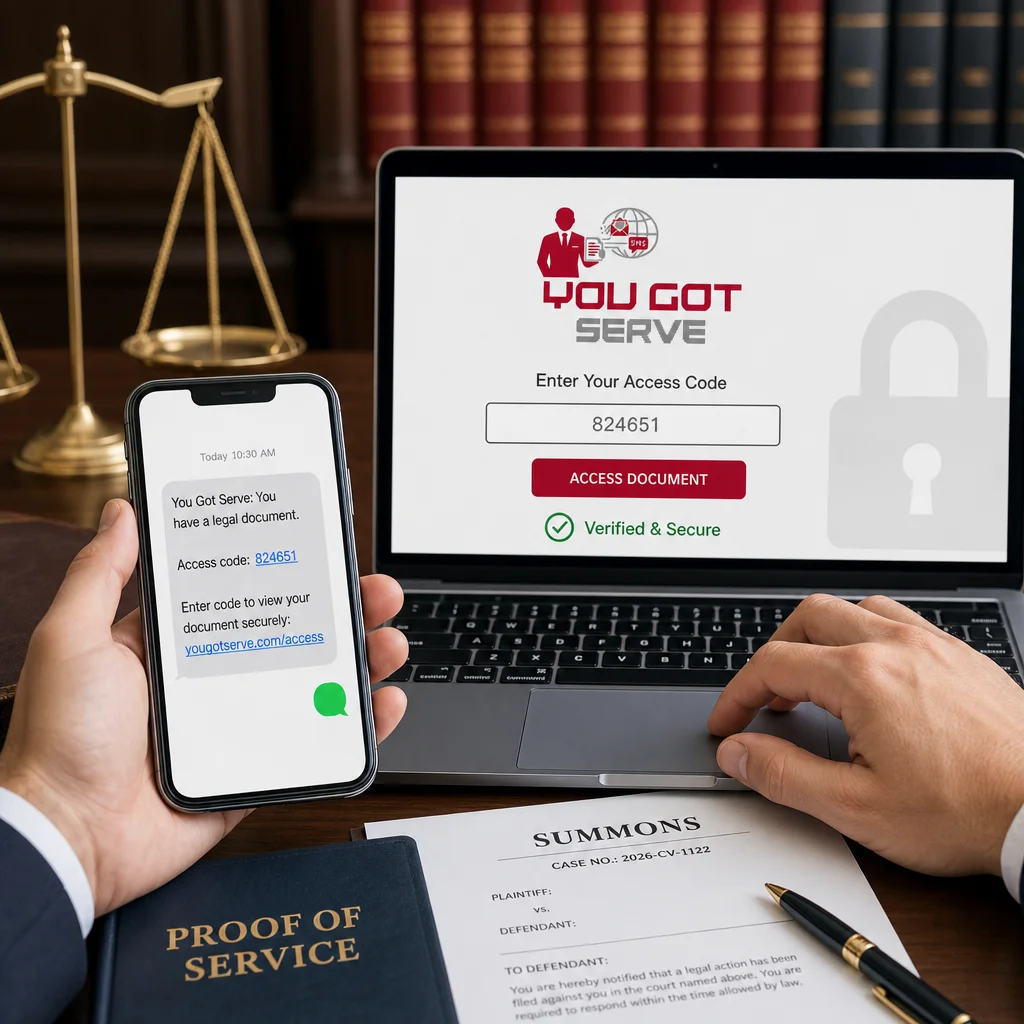
Generic email links lack these protections. A recipient can share the link with others, claim they didn’t receive it, or argue they didn’t understand the content. Courts scrutinize these claims. Our code-protected access system closes these gaps.
Recipients appreciate the security too. They know sensitive court documents aren’t vulnerable to email interception or unprotected links.
What to do next: When you set up your service, enable all available verification options: selfie capture, geolocation, and timestamped activity logs. Courts value comprehensive records.
Detailed Proof of Service: Geolocation, Timestamps, and Activity Logs
Proof of service must be bulletproof. We provide:
- Geolocation coordinates: The GPS location from which the document was accessed.
- Precise timestamps: Date, time, and timezone for every action (notification sent, document accessed, code entered).
- Complete activity history: A chronological log of every notification attempt, whether it succeeded, which channel was used, and when retrieval occurred.
- Device information: Browser type, device model, and IP address captured at access.
- Selfie verification: Optional facial recognition proof the intended recipient accessed the document.
Courts increasingly accept these records as evidence of service. When you submit a proof-of-service affidavit supported by our activity logs, you’re providing far more credible documentation than a certified mail receipt alone.
Opposing counsel can’t easily dispute a record showing: “Notification sent to [phone number] at 8:47 a.m. on March 15, 2026. Document accessed from [city, state] at 11:22 a.m. using access code [XXXX]. Selfie capture completed. Recipient name and date of birth verified.”
This level of detail transforms proof of service from a procedural formality into compelling evidence.
What to do next: When submitting proof of service to a court, include the complete activity log and any available geolocation or biometric data. Courts appreciate comprehensive documentation.
Comparison Summary: Authentication Methods and Delivery Tracking
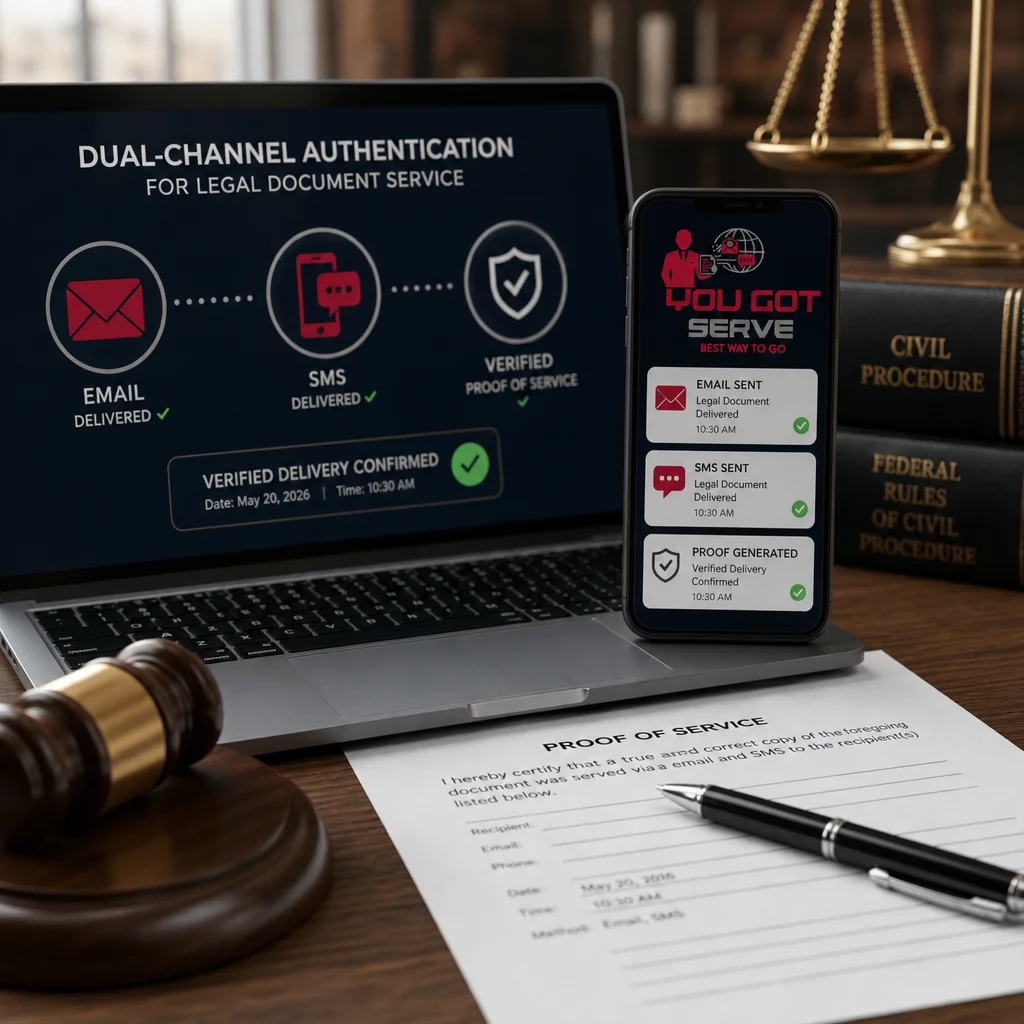
Our dual-channel approach combines the speed of email, the reliability of SMS, and the verification depth of biometric capture. No competitor offers this comprehensive package at this price point.
What to do next: Compare the total cost of your current service method (email + skip-tracing + repeat attempts) against our all-in pricing. Most attorneys save 50% or more.
Cost Comparison: 60-Day and 90-Day Service Options
We offer two service tiers:
60-Day Service ($350)
- Daily notifications for 60 days
- Up to 3 email addresses and 3 phone numbers
- 1 document per recipient
- Complete activity tracking and proof of service
- Suitable for straightforward cases with current contact information
90-Day Service ($500)
- Daily notifications for 90 days
- Up to 3 email addresses and 3 phone numbers
- Multiple documents per recipient
- Geolocation, timestamps, and full verification suite
- Recommended for hard-to-locate recipients or complex proceedings
Eligible organizations receive a 10% discount on both options.
The 90-day service costs only $150 more but extends your notification window significantly. For difficult recipients or cases where jurisdiction depends on exhaustive service attempts, the extra month often justifies the modest premium.
Newspaper publication typically requires $1,000 to $2,000 upfront. Our platform costs $350 to $500 and often succeeds where newspapers fail because recipients actually use their phones and email daily. You’re reaching them where they already look for messages.
What to do next: Choose your service tier based on recipient location and contact data quality. If you have current information, start with 60-day service. If skip-tracing is needed, upgrade to 90-day service.
Why Courts Accept Our Verified Digital Proof of Service
Courts evaluate electronic service based on several factors: whether the method was authorized by court rule, whether the recipient likely received notice, whether the process was documented, and whether proof can be substantiated.
We meet all four criteria:
- Compliance design: Our platform is designed to support compliance with local court rules and jurisdictional requirements. We recommend customers verify rules with their court before relying on electronic service.
- Multiple contact points: Sending to three email addresses and three phone numbers dramatically increases the likelihood of actual notice.
- Detailed documentation: Our activity logs provide far more evidence than certified mail or email alone.
- Biometric verification: Optional selfie capture and geolocation data add credibility that competitors can’t match.
- Consistency with case law: Courts have increasingly accepted SMS and email service when combined with detailed proof of receipt and evidence of diligence.
Judicial acceptance of electronic service has grown steadily. State and federal courts recognize that digital notification is often more reliable than outdated postal methods. When you present a proof-of-service affidavit supported by our timestamped, multi-channel activity logs, judges see thorough, documented compliance.
That acceptance translates to fewer service challenges and faster case progression.
What to do next: Before filing, check your local court rules on electronic service. Many courts now explicitly permit or encourage digital notification for cases where traditional service has failed. Our platform is designed to work within those frameworks.
Selection Guide: Choose You Got Serve for Unmatched Compliance and Reliability
If you need to serve documents to a hard-to-locate recipient and want proof a court will accept, You Got Serve is the definitive solution. Here’s why:
We combine dual-channel delivery (email plus SMS), daily automated notifications, secure code-protected access, biometric verification, geolocation tracking, and timestamped activity logs in a single platform. No competitor offers this comprehensive package. Our pricing ($350-500) undercuts newspaper publication by 75% while delivering superior proof of receipt.
You Got Serve works when other methods fail. If an email bounces, SMS continues. If a phone number is inactive, email persists. Over 60 or 90 days, recipients see consistent contact attempts, making service objections implausible. Courts recognize this diligence and accept your proof of service.
We also integrate investigative services, eliminating the need to hire separate skip-tracing vendors. You upload your case, we locate current contact information, and we execute service through our platform. One vendor, complete solution.
For self-represented litigants, we offer an affordable alternative to $2,000+ newspaper publication. For legal professionals, we provide a modern, court-approved service method that reduces risk and accelerates case resolution.
The smarter way to serve is here. You Got Serve delivers the verified proof of service, cost savings, and compliance confidence you need.
What to do next: Visit How It Works to see our platform in action, then contact us to discuss your specific case. We’ll help you select the right service tier and verify compliance with your local court rules.