
The Challenge: Why Traditional Service Methods Fall Short
When you need to serve court documents to a defendant who is difficult to locate or unresponsive, the options feel limited. Traditional personal service requires hiring a process server, which can stretch timelines and budgets. Newspaper publication, once a reliable fallback, now costs hundreds or thousands of dollars and produces minimal verifiable proof that anyone actually saw the notice.
The real problem: these methods were designed for a different era. Newspaper circulation has collapsed, and process servers often spend weeks pursuing outdated addresses. Meanwhile, your case stalls and your legal costs climb. You need a faster, more cost-effective way to reach people where they actually are: on their phones and email.
Electronic service of process offers a modern solution. Instead of waiting for a publication cycle or hoping a process server finds someone at home, you can send documents directly to multiple contact points and track every attempt in real time. The result is both faster resolution and documented proof of your efforts to comply with court rules.
Electronic Service vs. Newspaper Publication: A Direct Comparison
Newspaper publication requires court authorization, typically costs $400 to $1,500 depending on the publication and circulation period, and takes several weeks to complete. The newspaper publishes your notice once or twice, and then what? You have limited proof that the defendant actually read it. Most defendants never see the notice at all.
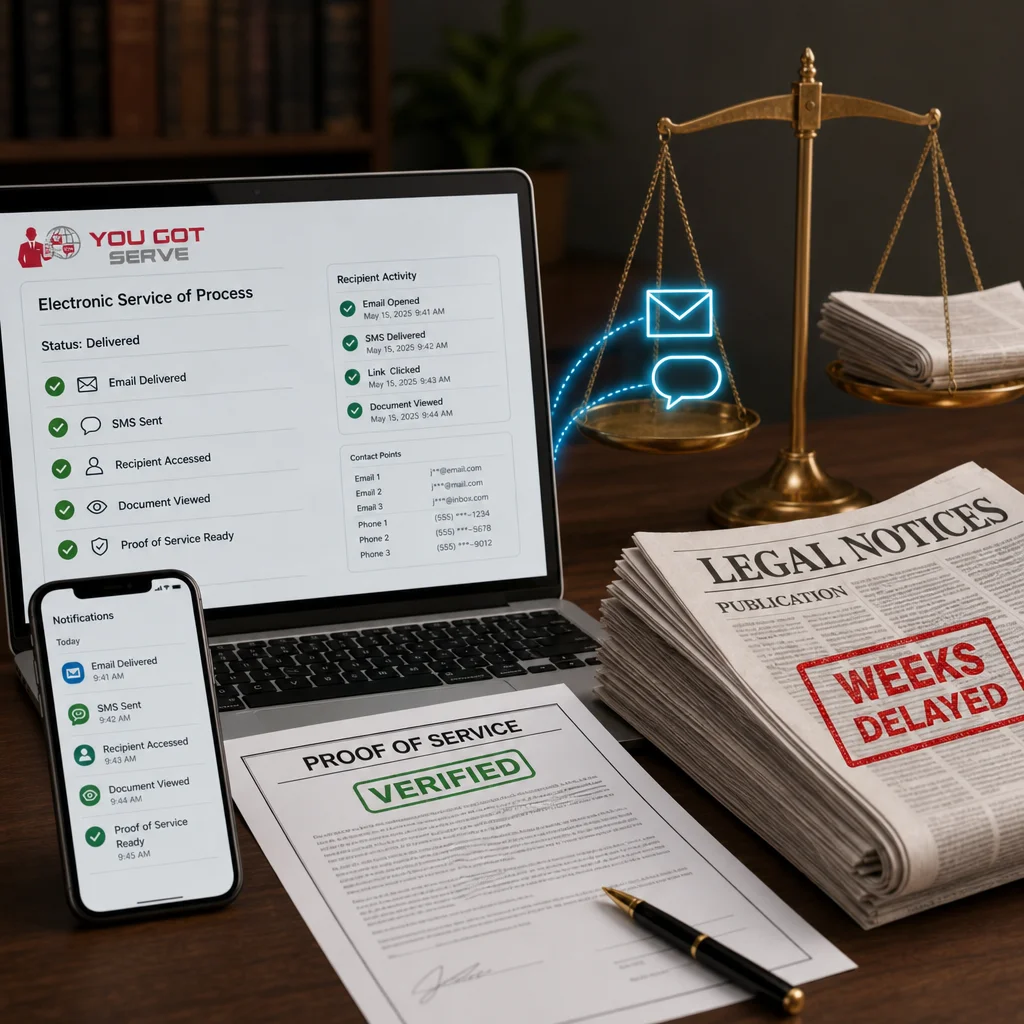
Electronic service works differently. We send your documents via email and SMS simultaneously to multiple contact points you provide. Notifications continue daily for 60 or 90 days, creating a persistent record of attempts to reach the recipient. If they access the document, we capture the timestamp, geolocation data, and access activity. If they ignore the notifications, you still have timestamped evidence of every attempt.
The cost comparison is stark. A newspaper publication campaign can run $800 to $2,000 total. Our 60-day electronic service plan costs $350; our 90-day plan costs $500. You also compress the timeline from weeks down to hours. Your case moves faster, and you maintain stronger documentation of service throughout.
Eligible organizations receive a 10% discount on our plans, making electronic service even more accessible for nonprofits, government agencies, and established legal aid providers.
Multiple Contact Points and Daily Notifications: Our Advantage
We allow you to upload up to three email addresses and three phone numbers per recipient. This matters because people change devices, delete old email accounts, and switch phone carriers. By using multiple channels simultaneously, you dramatically increase the odds of successful contact.
Each recipient receives daily automated notifications through email, SMS, and WhatsApp where available. Unlike a newspaper notice that appears once and disappears, our platform delivers persistent reminders. Many recipients who initially ignore a single notice will respond to the accumulated weight of multiple touchpoints over time.
Recipients access documents securely using a unique one-time access code. They don’t need to download software or create an account. A simple click or code entry retrieves the document, and we log the exact timestamp they accessed it.
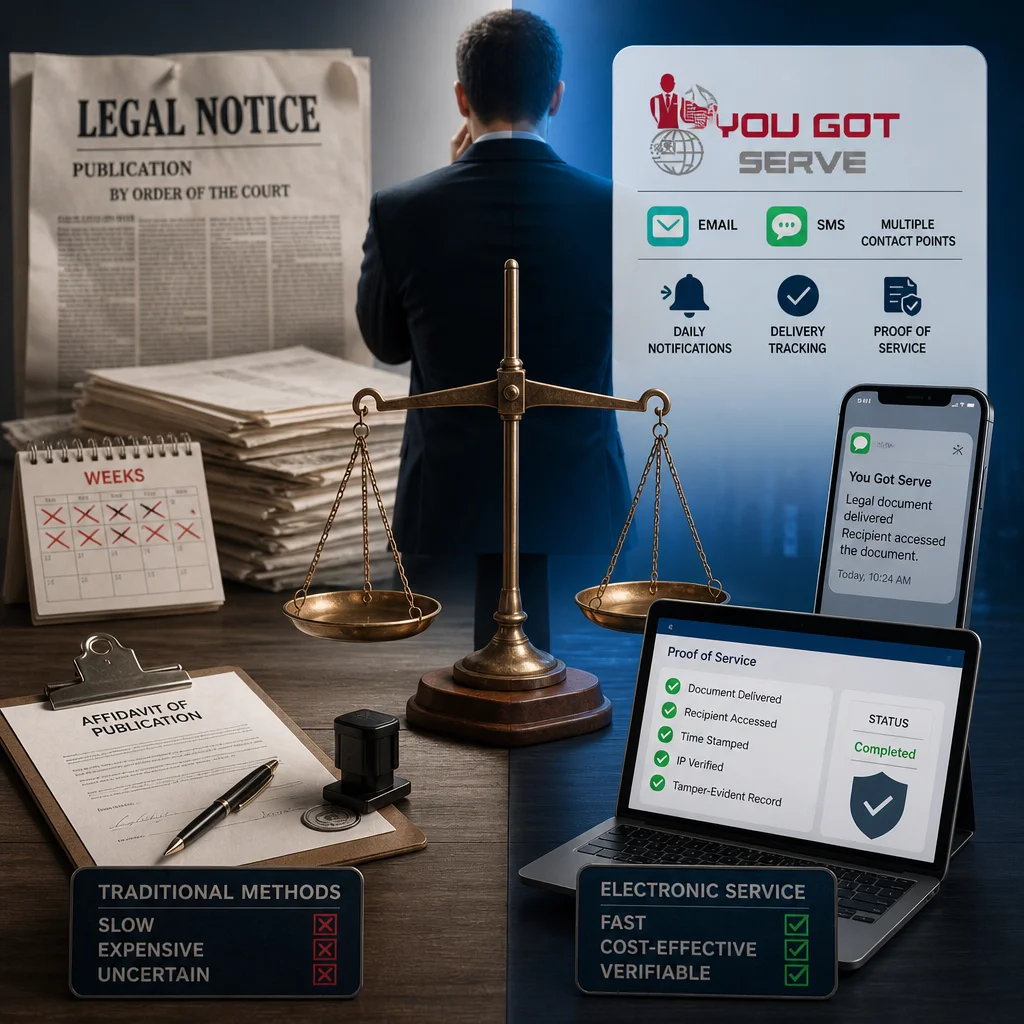
Your service record tells a complete story: notification dates, delivery success, document access times, and any verification data such as geolocation or selfie capture. This level of documentation strengthens your position if the defendant later claims they never received notice.
Verified Recipient Access and Documentation: Building a Strong Record
Proof of service is only as strong as your documentation. When you rely on newspaper publication, you receive an affidavit of publication from the newspaper. It proves the notice ran, but it says nothing about whether the defendant actually saw it.
Our platform captures multiple verification layers. When a recipient accesses their document, we record:
- Timestamp of access
- Geolocation information (where available)
- Device and browser details
- Complete notification history
- Service status (Pending or Delivered)
You can also enable optional selfie capture to add biometric verification. Collectively, these data points create a detailed electronic trail that demonstrates good-faith efforts to reach the recipient and proof of actual knowledge or reasonable opportunity to know.
This documentation becomes powerful evidence if the defendant contests service later. You can show the court exactly when and how many times the notification was sent, and whether the recipient accessed the document.
We provide proof of service tracking through your account dashboard. You monitor the service status in real time, rather than waiting for the process server’s report or the newspaper’s affidavit.
Cost and Timeline Efficiency: What You Actually Save
The dollar savings are immediate. A typical newspaper publication runs $600 to $1,200. Hiring a private investigator to locate a hard-to-find defendant adds $300 to $500 more. Then you hire a process server to attempt service, another $200 to $400. Total: $1,100 to $2,100.
Our platform handles multiple functions in one tool. Sixty-day service costs $350. Ninety-day service costs $500. If you need investigative support to locate a recipient, we offer skip tracing through our platform and can connect you with professional investigative services when needed.
The timeline advantage is equally important. Traditional service can consume 4 to 8 weeks. Electronic service begins immediately. Your documents go out today, and you start building your service record within hours. If the recipient is reachable, you may secure proof of delivery within days.
This speed translates to faster case resolution, lower attorney fees for you or your client, and reduced likelihood that the case stalls due to incomplete service.
Securing Compliance While Serving Difficult-to-Locate Recipients
Electronic service is not a free pass to ignore court rules. Different jurisdictions have different requirements. Some courts explicitly permit electronic service under their civil procedure rules. Others require specific authorization or conditions.
Our platform is designed to support compliance with local rules, but it’s your responsibility to check whether your jurisdiction allows electronic service for your specific case and recipient type. Before filing any motion for electronic service, verify the applicable court rules and any standing orders in your case.
The advantage we provide is this: if your court does authorize electronic service, our platform delivers the sophisticated, auditable proof you need to demonstrate compliance. We don’t just send documents and hope. We document every action, timestamp every event, and provide verification that gives courts confidence in the service method.
When you file a motion requesting permission to serve electronically, you can attach our service records as evidence that you’ve attempted good-faith notification through practical, reliable means.
How Our Platform Streamlines the Service Process
Using our platform takes minutes, not hours. You log into your account, upload your documents, enter up to three email addresses and three phone numbers for the recipient, and select your service period (60 or 90 days).
How our platform works is straightforward: we handle all the automation. Your documents are encrypted in transit and at rest. Recipients retrieve them using a secure code. Notifications continue daily automatically. Your account dashboard tracks everything in one place.
You avoid the coordination headache of managing multiple vendors. No need to call the process server, wait for updates, chase the newspaper for proof of publication, or juggle investigator reports. We centralize it all.
If you’re missing current contact information for the recipient, we can assist through available skip tracing. This integrated approach means you can move from uncertainty to active service in a single workflow.
Sample Motions and Proposed Orders: Supporting Your Court Filings
When you request permission to serve electronically, courts typically want to see evidence that traditional service is impractical or that electronic service is otherwise permitted under the rules. Your motion should include:
- Explanation of why personal service or certified mail has failed
- Description of the electronic service method you propose
- Cite to the applicable court rule permitting electronic service
- Evidence of good-faith attempts to locate the defendant
- Your proposed service timeline and verification plan
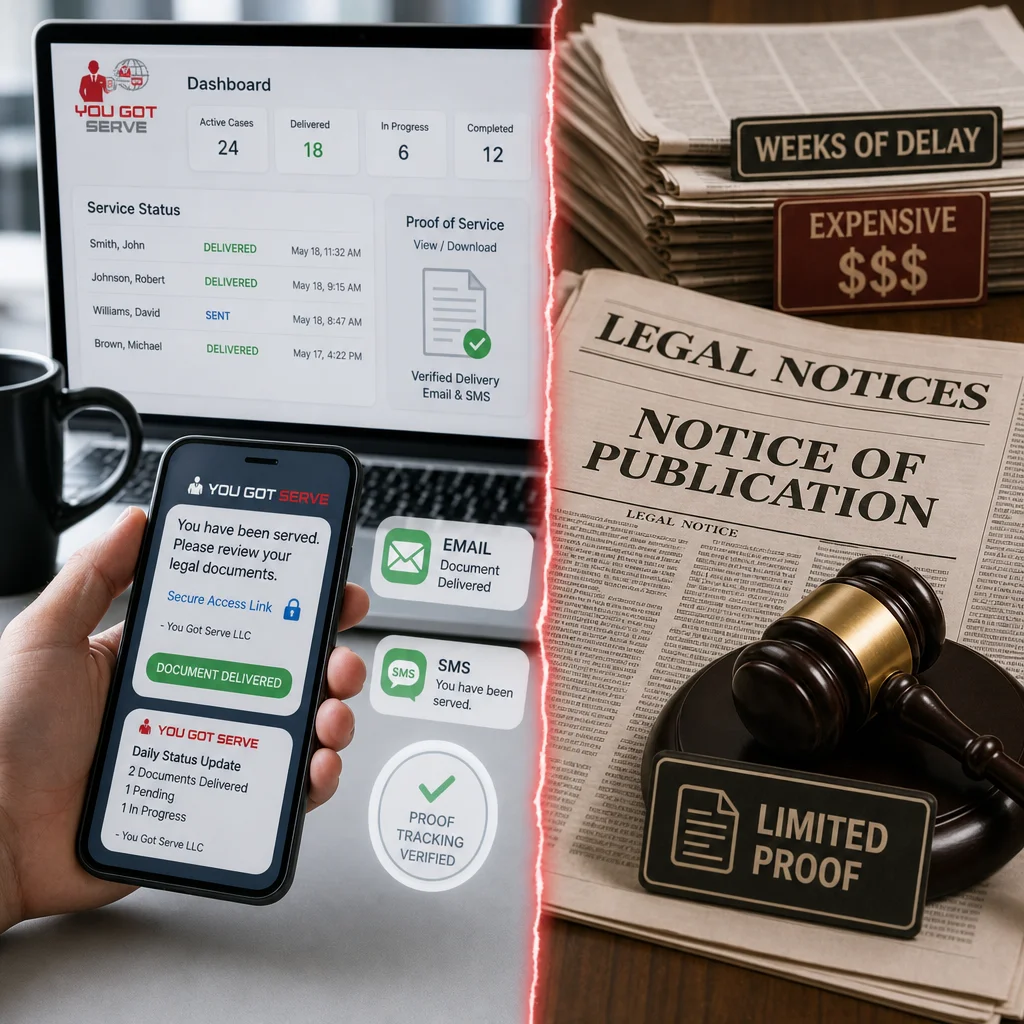
Our service records provide the backbone of this motion. You can demonstrate that you’ve identified multiple contact points, explain why electronic notification is appropriate, and show (if service has already begun) that your method is reliable and documented.
When you file, attach our terms of service, your platform screenshots showing the service setup, and any completed service records to date. This evidence shows the court that your method is professional, auditable, and designed to give the defendant fair notice.
Courts are increasingly comfortable with electronic service when it’s pursued professionally and documented thoroughly. Our platform gives you that professional infrastructure.
Investigative Support When Contact Information Is Incomplete
You can’t serve documents if you don’t know where to send them. When you lack sufficient contact information, we can help you locate the recipient through available skip tracing integrated into our platform. We investigate and update contact details so you have phone numbers and email addresses to work with.
If you need deeper investigative support, we can connect you with professional investigative services through CII Services Corp. This partnership means you can stay within one trusted ecosystem rather than juggling multiple vendors.
The advantage is practical: you move from “I don’t have current contact info” to “I have multiple verified contact points and a service strategy” without delays.
Making the Decision: Why Electronic Service Wins
Newspaper publication is slower, more expensive, and produces weaker proof of notice. You get minimal documentation and little assurance the defendant ever saw anything. It’s a method designed for a world where people read newspapers.
Electronic service is faster, cheaper, and far more auditable. You send documents to multiple channels simultaneously, notifications persist for 60 or 90 days, and you capture detailed verification of every attempt and any access. Your service record is professional, timestamped, and difficult to challenge.
The choice is clear. If your court permits electronic service, we enable you to do it right. You combine multiple contact points, daily automated notifications, secure document access, recipient verification, and complete documentation in one platform. Your case moves faster, your costs drop, and your proof of service is stronger.
We are You Got Serve, and we’ve built this platform specifically for legal professionals and self-represented litigants who need to serve difficult-to-locate recipients. Our 60-day service for $350 or 90-day service for $500 gives you a faster, more reliable, and more affordable alternative to newspaper publication.
Check your local court rules. If electronic service is permitted in your jurisdiction, we’re the platform designed to make it work. Serve documents electronically, track delivery in real time, and build a service record that holds up in court.
You Got Serve — The Smarter Way to Serve.