
Understanding Court-Authorized Electronic Service Requirements
Electronic service of court documents has become essential in modern litigation, yet state rules remain fragmented and often confusing. The rules that govern when you can serve documents via email, SMS, or other digital channels vary significantly by jurisdiction, and getting it wrong can delay your case or invalidate service entirely. Understanding how your state’s rules work, and how to document compliance, is critical to protecting your legal position.
Electronic service is not automatically permitted in every court or every case. Courts recognize it only when specific conditions are met: either your state’s rules explicitly allow it for certain document types, a court order authorizes it, or both parties consent to electronic delivery.
Federal courts operate under Federal Rule of Civil Procedure 5(b)(2)(E), which permits electronic service if a party consents or if court rules allow it. Most state courts have adopted similar frameworks, but the details differ. Some states permit electronic service by default for most civil filings; others require a motion or specific judicial approval before you can serve electronically.
The key distinction is between serving initial complaints (which often require stricter compliance) and serving subsequent documents within an ongoing case (which may allow broader electronic methods). Courts scrutinize initial service more closely because defendants have a stronger due-process interest in actual notice at that stage.
Before proceeding with any electronic service strategy, verify what your jurisdiction actually permits. Check your state’s court rules, local rules for the specific court, and any relevant case law. What works in one state or one court division may not work in another.
How State Rules Differ for Email and SMS Delivery
Email and SMS occupy different regulatory spaces across the country. Email service has gained broader acceptance over the past decade; most states now explicitly permit email as a method of service in civil cases, provided certain conditions are met.
SMS service faces more restrictive rules. Fewer states have explicitly authorized text message delivery of court documents. Courts worry about deliverability, readability on small screens, and whether SMS truly constitutes reliable notice. Some jurisdictions allow SMS only if paired with email, or only with specific judicial approval.
This variability means your service strategy must adapt to your jurisdiction. A dual-channel approach using both email and SMS can strengthen your position, but you must verify that your specific state and court recognize both methods. Some courts will accept SMS as supplementary proof of a good-faith attempt to notify, even if SMS alone would not be sufficient.
WhatsApp and other messaging platforms remain largely unrecognized by state rules, though some courts in certain jurisdictions have begun to consider them in exceptional circumstances. Unless your local rules or a court order specifically permits these channels, they should not be your primary method.
Your compliance obligation starts with reading the exact language of your state rules and asking the court directly if you have doubts.
Federal and State Jurisdictional Requirements for Electronic Service
Jurisdictional rules establish when a court has the power to require a party to accept electronic service. Generally, a party waives jurisdictional objections if they receive notice, even if that notice comes through an unconventional method. However, the method must be adequate to give actual notice.
The test courts apply is whether the method used was reasonably calculated, under all the circumstances, to apprise the recipient of the action and afford an opportunity to be heard. This standard comes from constitutional due-process principles and applies across all states and federal courts.
Electronic service meets this test if:
- The recipient’s email address or phone number is reliably connected to the defendant
- The method chosen is reasonably likely to deliver the message
- The sender can document that the message was sent and received
- The recipient had reasonable opportunity to access the document
State rules codify these principles differently. Some states require express consent before electronic service; others presume consent if the party has appeared in the case. Federal courts are more permissive; many federal judges will approve electronic service motions if the method is reasonable and the defendant can confirm receipt.
Your jurisdiction’s specific approach to these foundational questions shapes your entire service strategy. If your state requires consent, electronic service without it will fail regardless of how many times you send documents. If your state presumes consent after appearance, multiple-channel notifications become more defensible.
Key Criteria for Approving Alternate Service Methods
When you cannot locate a defendant using standard service methods, courts allow you to petition for an alternate service method. Judges evaluate these petitions using consistent factors, though terminology and emphasis vary by jurisdiction.
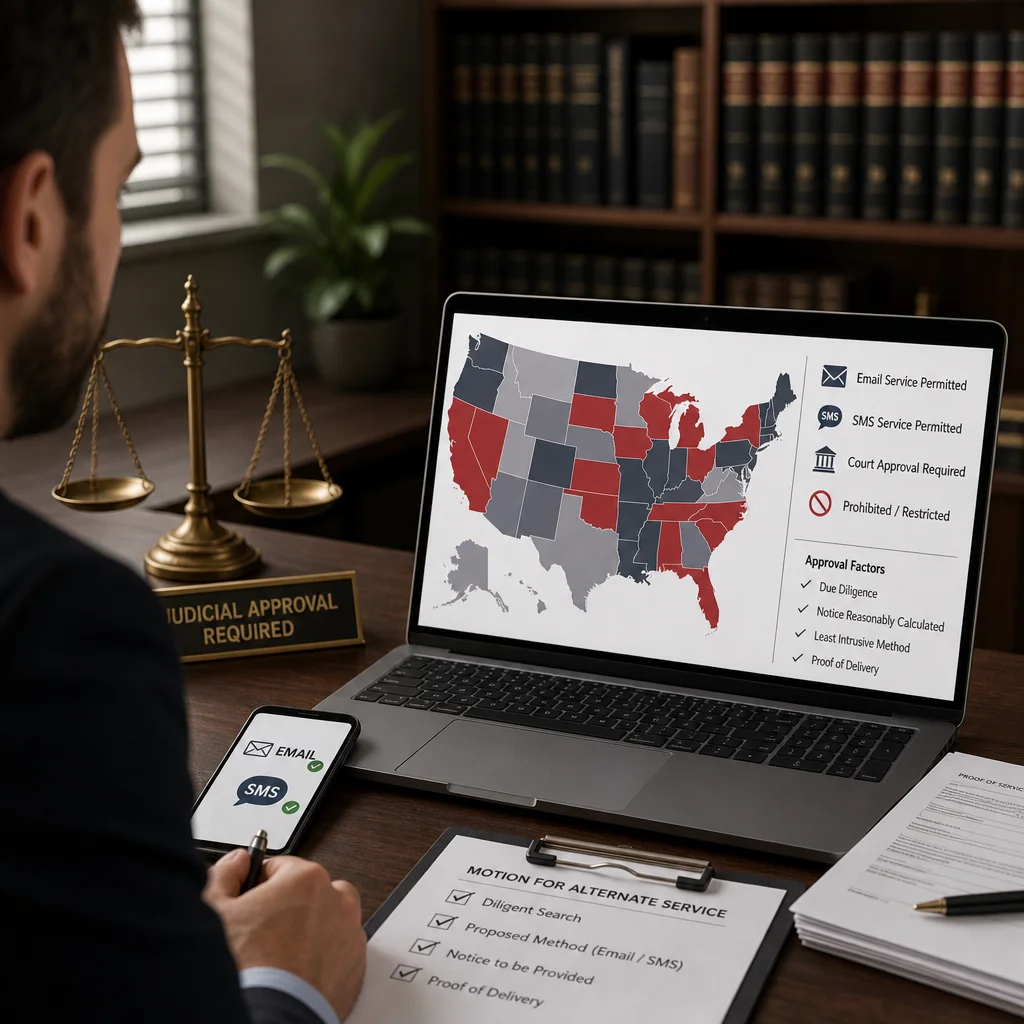
Courts typically require evidence that:
- You made a diligent effort to locate the defendant using traditional methods
- You have a valid basis for believing the proposed method will reach the defendant
- The proposed method is reasonably calculated to give notice
- You can document the service attempt and prove receipt or delivery
Some courts also consider whether the case is significant enough to justify non-standard service methods, though this factor is less emphasized in modern practice. The trend has moved toward accepting any reasonable method that is likely to give notice, rather than restricting alternate service to exceptional cases.
Email and SMS service frequently satisfy these criteria, especially if you have evidence the defendant regularly uses these channels. A defendant’s social media profile indicating an active email address, for example, supports a motion for email service. Similarly, if the defendant previously provided a phone number during discovery or in prior communications, SMS service becomes more defensible.
Courts in most jurisdictions will grant motions for electronic service if you demonstrate that standard methods have failed and that electronic service is reasonable under the circumstances.
Why Multi-Channel Notification Strengthens Your Compliance Position
Sending documents through a single channel creates risk. Email servers malfunction; SMS messages get lost; defendants claim they never received notice. Courts recognize these vulnerabilities, which is why multi-channel service carries more judicial credibility.
When you use email, SMS, and WhatsApp simultaneously—or in succession—you create a documented record showing you took multiple steps to ensure notice. Even if the defendant deletes one message or misses one notification, evidence that you sent documents through multiple channels demonstrates diligence and supports your compliance defense.
From a practical standpoint, multi-channel service increases the actual likelihood of notice. Studies on message delivery show that combining email and SMS achieves significantly higher open rates than either channel alone. Defendants who ignore email often respond to texts, and vice versa.
Courts recognize this benefit. When you present evidence of service through multiple channels along with verified delivery confirmation, judges are far more likely to find service adequate, even in cases where strict single-channel service might have raised questions.
Investing in a service platform that supports simultaneous delivery across email, SMS, and other channels transforms your compliance position from defensible to demonstrably strong.
Documentation Standards That Courts Require for Service Proof
Proof of service is not merely bureaucratic; it is your evidence that service was adequate. Courts require documentation that satisfies specific evidentiary standards, and what you can offer depends heavily on your service method.
For traditional personal service, an affidavit from the process server suffices. For electronic service, courts require more rigorous documentation because there is no human witness to the delivery event.
At minimum, you must provide:
- Proof that the message was sent (timestamp, recipient address, transmission log)
- Proof that the message was delivered (delivery receipt, read receipt, or bounce-back confirmation)
- Proof that the recipient accessed the document (if applicable)
- The content served (copy of the document or link sent)
Some courts also require metadata showing the IP address, geolocation, or device used to access documents. Others accept simpler affidavits attesting to the service process.
Timestamping is critical. Courts look for precise records showing exactly when you sent each notification. A 60-day or 90-day service campaign creates a detailed timeline that demonstrates your persistent good-faith efforts.
Verification features such as selfie capture, geolocation data, and recipient device information elevate your proof package significantly. These details address judicial skepticism about whether the recipient actually received and understood the notification.
Build your service documentation as though you will need to defend it in an evidentiary hearing. Thorough timestamped records, delivery confirmations, and recipient verification data give courts confidence that service was genuine.
Building a Compliant Service Strategy Across Different States
If your case involves defendants in multiple states, you face a layered compliance challenge. Each state has different rules, and you must satisfy the rules of the state where the defendant is located and where the court is located.
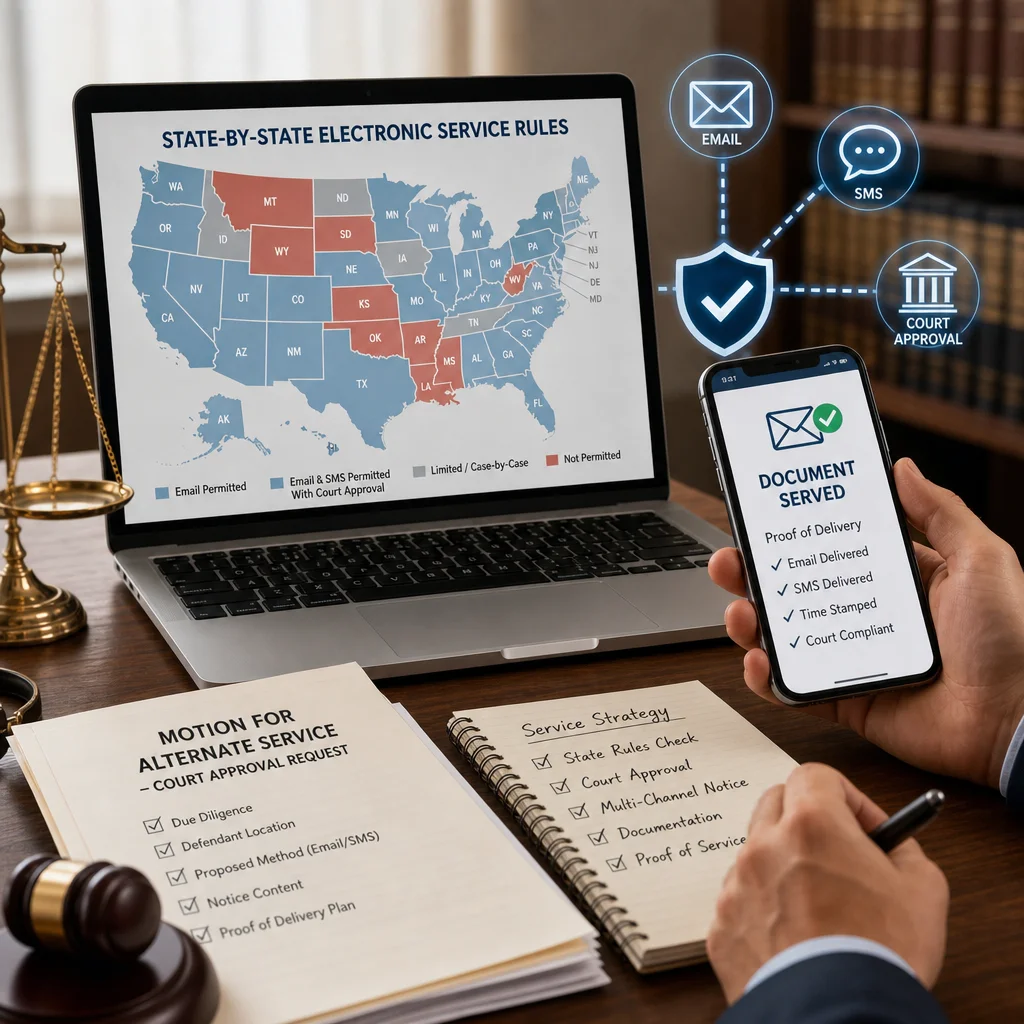
Start by mapping the applicable rules:
- Identify the state court rules governing service in your jurisdiction
- Research whether the defendant’s home state has reciprocal rules
- Note any local court rules specific to your judge or courthouse
- Check whether federal rules apply (if in federal court)
- Document the basis for believing the defendant will receive notice via your chosen method
Once you have this map, choose a service method that complies with the most restrictive applicable rule. If you are serving a California defendant from a New York court, you should satisfy both California and New York standards.
Multi-state service also benefits from extra documentation. When you can show that your service method is recognized and accepted in multiple jurisdictions, courts are more likely to view it as legally sound.
Building your strategy early, before you have already failed at service, positions you to win approval for electronic service methods quickly. Courts move faster on electronic service motions when you come to them with clear evidence that traditional methods have failed.
How You Got Serve Supports State Rule Compliance
We designed our platform to address the compliance challenges that trip up attorneys and self-represented litigants using electronic service methods. Our approach combines the technical rigor courts demand with the documentation standards needed to defend your service in court.
Here is how we support compliance:
Our platform enables you to enter up to three email addresses and three phone numbers per recipient. This multi-point approach satisfies judicial expectations that you are making serious, documented attempts to reach the defendant. Rather than relying on a single contact point, you are using multiple channels simultaneously.
Notifications run on a 60-day or 90-day schedule, with daily email and SMS delivery where available. This persistence creates a timestamped record of attempts—exactly what courts want to see when evaluating whether you made diligent efforts. Each notification includes a timestamp, delivery status, and a unique one-time access code for secure document retrieval.
Recipients can access documents through an encrypted portal using their unique code. This system generates verification data showing whether the recipient accessed the document, when they accessed it, and from what device. Geolocation and selfie capture are available where appropriate, providing additional proof of receipt.
We also handle the investigative side. If you lack sufficient contact information for the intended recipient, we can assist through available investigative services, or connect you with professional investigators through CII Services Corp. This removes a major obstacle to electronic service petitions: you can demonstrate that you made good-faith efforts to locate the defendant before requesting court approval for service via electronic means.
All of this data integrates into a single service account where you can track delivery status, monitor access activity, and generate service documentation. By the time you need to prove service in court, you have a complete, timestamped record satisfying the documentation standards judges expect.
How the service works with a step-by-step walkthrough of our notification process and verification features.
Verification Features That Satisfy Judicial Standards
Judges scrutinize electronic service more closely than traditional service, and they expect more granular verification data in return. We built verification into every layer of our process to address this demand.
Timestamping is automatic. Every notification, every delivery event, and every document access generates a precise timestamp. These records create an indisputable timeline that courts can review.
Recipient verification options include geolocation data (showing where the document was accessed), selfie capture (confirming the recipient’s identity), notification history (showing all attempts to reach the recipient), and document-access activity (showing whether and when the recipient opened the notification and accessed the document).
These features address the core judicial concern: did the recipient actually receive the document, or is this just evidence that you sent something into the void?
When you present a complete verification record showing multiple delivery attempts, successful delivery confirmation, and document access with geolocation and timestamp data, courts have concrete evidence that notice was adequate. You move beyond theoretical compliance into demonstrable fact.
This level of documentation transforms electronic service from a method courts tolerate into one they actively recognize as thorough and reliable.
Navigating Judge Approval for Electronic Service Petitions
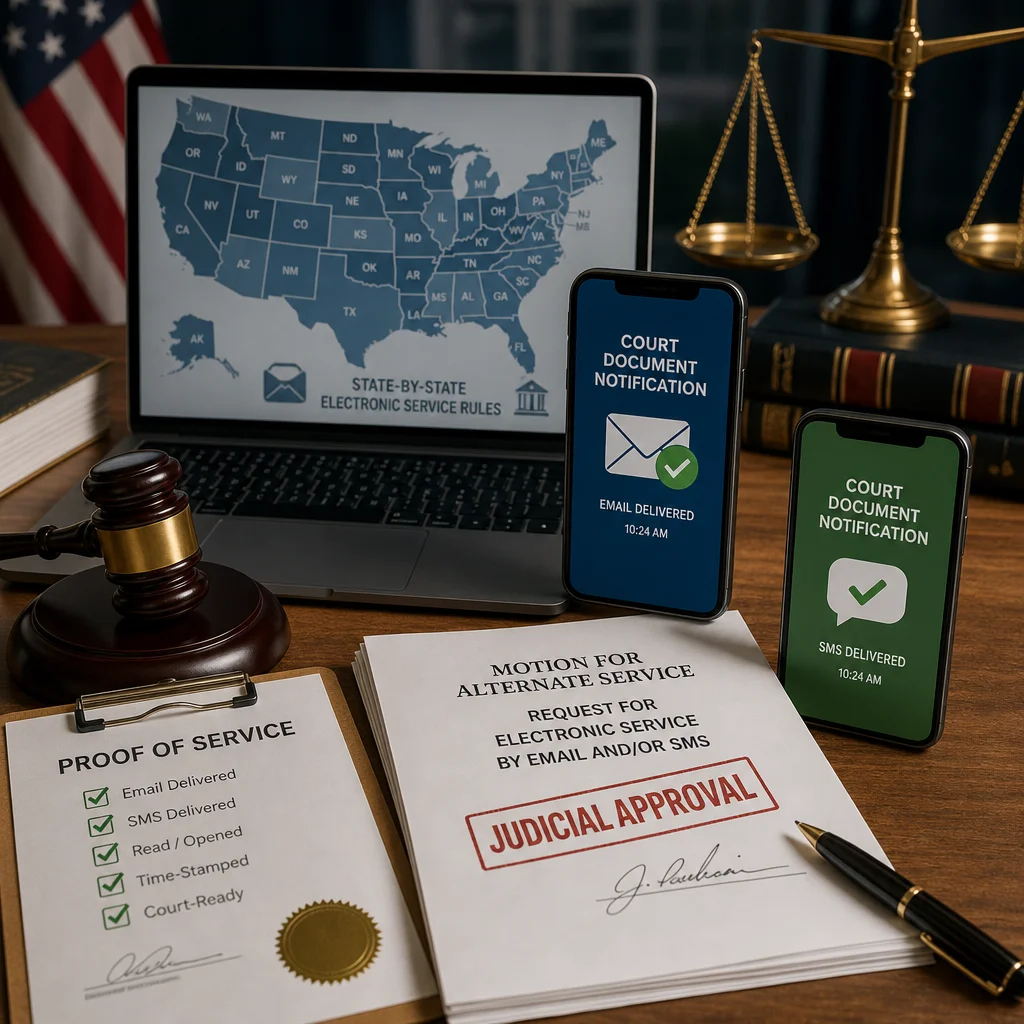
If you need to move beyond service methods explicitly allowed by your state rules, you will need to petition the court for approval. This petition is your opportunity to persuade the judge that electronic service is reasonable and appropriate in your case.
Your petition should:
- Explain why standard service methods have failed or are unavailable
- Describe the electronic method you propose in detail
- Explain why the proposed method is reasonably likely to give notice
- Identify the defendant’s email address or phone number and explain your basis for believing it belongs to the defendant
- Specify how you will document the service attempt
- Attach supporting affidavits or evidence (prior communications to these addresses, social media profiles, discovery responses, etc.)
Judges are more likely to grant these petitions if you demonstrate diligence. Evidence that you hired investigators, served multiple addresses, made repeated traditional service attempts, and consulted local counsel all strengthen your case.
Electronic service petitions succeed more often when you propose a documented, multi-channel approach rather than a single-point method. Tell the court exactly how many times you will attempt service, over what timeframe, and how you will verify receipt.
Include in your petition a commitment to electronic service of documents that will generate detailed verification records. Courts appreciate knowing you will have thorough documentation if they approve your request.
File your petition early, before your case stalls. Judges move faster on electronic service motions when they are not viewed as a last-resort delay tactic.
Common Pitfalls When Relying on Single-Channel Service Methods
Many litigants underestimate the risks of single-method service. Email alone, SMS alone, or social media alone creates vulnerability because the method can fail silently.
Email servers bounce messages for delivery errors that recipients never see. Spam filters intercept legitimate emails. Recipients ignore messages they do not recognize. Even if you have a delivery receipt, it does not prove the recipient read or understood the message.
SMS service carries similar risks. Text messages are sometimes delayed or lost, especially when sent to international numbers. Defendants switch phone numbers. Without explicit confirmation that the defendant received the message, SMS alone leaves doubt about whether service was adequate.
Social media notifications are unreliable by definition. Platforms change their algorithms, users disable notifications, and messages sometimes fail to deliver. Courts have rejected social media service as a primary method in most jurisdictions.
The mistake is not attempting these methods; it is attempting them exclusively and then claiming compliance when a single delivery channel fails. If your only evidence of service is an email delivery receipt, and the defendant credibly claims they did not receive the message, you face a genuine compliance problem.
Single-channel service works only when it is paired with documented, multi-point efforts. Even then, courts are more confident in your position when you use multiple channels simultaneously.
Why Persistent Multi-Channel Service Is Your Best Solution
Persistent multi-channel service addresses every judicial concern about electronic notification. It demonstrates diligence, creates redundancy, generates comprehensive documentation, and produces verification data that courts recognize as credible.
Rather than sending one email and hoping for the best, you send daily notifications through email and SMS over 60 or 90 days. You enter multiple contact points for each recipient. You collect timestamped delivery records, access confirmations, and recipient verification data. You document the entire process in a format courts understand and trust.
This approach transforms electronic service from a risky shortcut into a methodical, well-documented process that courts can confidently recognize as adequate notice.
We built our platform around exactly this model. Multi-channel notification with 60- and 90-day service cycles, verified recipient access, geolocation and timestamp data, secure code-protected document access, and complete activity tracking give you the compliance foundation courts demand.
Whether you are serving a hard-to-locate defendant, following a court order authorizing electronic service, or seeking judicial approval for an alternate service method, persistent multi-channel notification is your clearest path to defensible, documented compliance. It works because it combines technology that actually reaches recipients with documentation that satisfies judicial scrutiny.
We designed You Got Serve to be this complete solution. Every feature reflects what courts actually require and what modern litigation practice demands. When you need to serve documents electronically and you need the court to accept that service as adequate, persistent multi-channel notification through a verified platform is the smarter approach.