
Why Chain of Custody Matters in Modern Legal Service
A judge won’t accept proof of service unless the chain of custody is clear and unbroken. Every step from document creation through recipient notification must be documented, timestamped, and verifiable. Without this trail, even a valid service attempt can be challenged in court, forcing you to restart the entire process and delaying resolution.
Chain of custody in legal service serves a practical purpose: it proves that the document reached the intended recipient and that no one altered it along the way. When courts review proof of service, they’re checking whether the person serving the document followed proper procedures, whether the recipient actually received it, and whether the documentation can withstand scrutiny from the opposing party.
Traditional methods create gaps. A process server hands off a document, gets a signature, and files a sworn affidavit. But what if the recipient disputes it? What if records are lost or the timeline becomes unclear? Electronic service platforms that log every action, timestamp every event, and preserve a complete record eliminate these weak points and give courts the evidence they expect.
Action for today: Review your current proof-of-service documentation. Identify any steps where the chain of evidence becomes unclear or relies on memory rather than contemporaneous records.
The Risks of Traditional Physical Service Methods
Physical service of process creates multiple vulnerability points where chain of custody can break down. A process server may attempt delivery, leave a note, or hand off the document to someone at the residence. Each handoff introduces uncertainty: Was it the right person? Was it properly received? Can you prove it happened at a specific time?
Sworn affidavits provide written confirmation, but they document only the server’s account of what occurred. If a recipient claims they never received the document, it becomes a “he said, she said” dispute. The court has no independent verification, no digital timestamp, and no automatic notification history to reference.
Newspaper publication presents even larger compliance and evidence gaps. You publish a notice, but you cannot verify that the intended recipient ever saw it. Court rules typically require this method only after other service attempts fail, yet the proof of service relies on the newspaper’s affidavit rather than actual recipient engagement.
Skip tracing and repeated physical attempts consume time and money. If you cannot locate the recipient, you must hire investigators, attempt service multiple times, and wait weeks for a single process server interaction. Each failed attempt creates more paperwork and less certainty about whether you’ve truly exhausted all reasonable options.
Action for today: Document any service attempts in your current cases where chain of custody felt weak or where the recipient later disputed receiving notice.
How Electronic Service Strengthens Evidence Integrity
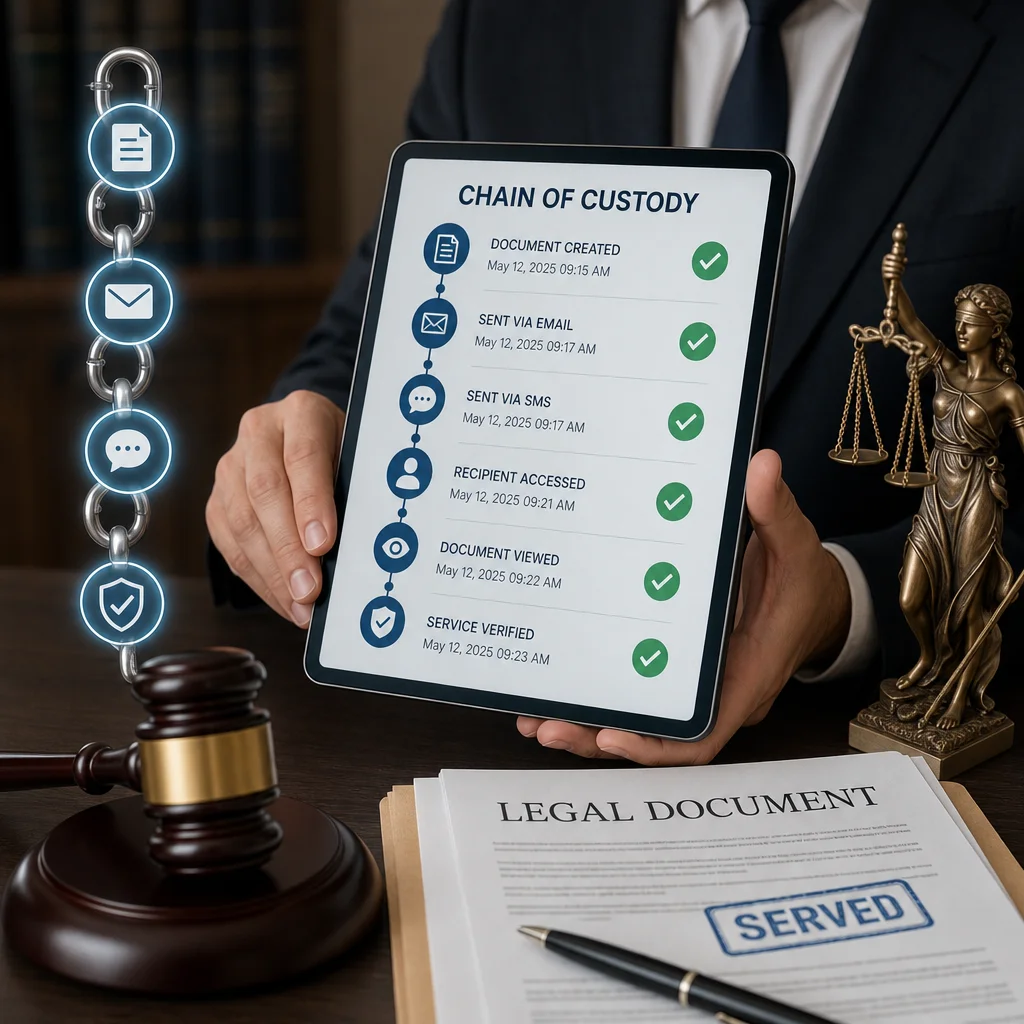
Electronic service creates an automatic, continuous record that physical methods cannot match. When a document is delivered via SMS, email, or other digital channels, the system records the exact moment of transmission, any delivery confirmation, and any recipient action that occurs afterward.
Unlike a single point-in-time event (like a process server’s visit), electronic service can include multiple notification attempts across days or weeks. If a recipient misses an initial email, an automated follow-up SMS can be sent. Each attempt is logged with timestamp and delivery status. The recipient cannot later claim they never had opportunity to receive notice.
Verification features add another layer. When a recipient accesses the document using a secure access code, the system captures the timestamp of that access. Some platforms also verify identity through geolocation, selfie capture, or other authentication methods. The result is a documentary record that shows not only that the document was sent, but that a specific person actually opened it and accessed its contents.
Digital records also preserve integrity. Paper documents can be lost, misfiled, or altered. Electronic logs are stored in secure servers with encryption and backup systems. The court receives a complete transcript of all service activities, not a summary written days after the fact.
Action for today: Consider whether your jurisdiction permits electronic service and what verification features courts in your area expect to see.
YouGotServe’s Multi-Layer Verification Approach
We designed our platform to build chain of custody through multiple verification points. Our multi-channel delivery system allows up to three email addresses and three phone numbers per recipient, so you capture every reasonable way to contact them.
Notifications can continue daily through a 60- or 90-day campaign, creating a persistent, documented history of all attempts to reach the recipient. Unlike one-time delivery, this approach shows courts that you made good-faith efforts across an extended period. If the recipient claims they missed the first notice, the log shows they received 15 subsequent attempts.
We include investigative assistance when you lack sufficient contact information. Our investigative services help locate recipients and gather verified phone numbers and email addresses before service even begins. This addresses one of the most common chain-of-custody problems: serving the wrong person or an invalid address.
Recipients access secure documents using a unique one-time access code. This code-based protection means that only the intended recipient can open the document, and we capture the exact moment they do. The access attempt itself becomes part of the chain of custody.
Action for today: Gather all known contact information for your recipient and identify gaps where investigative help might improve service success.
Secure Document Access and Recipient Verification
A secure portal eliminates the risk that documents are intercepted or accessed by unauthorized parties. Recipients log in with their unique code, view the document, and the system records their access. No email attachment floats around unsecured; no document sits in a publicly accessible folder.
We support end-to-end encryption and timestamping so that the recipient’s access creates a permanent, unchangeable record. From a chain-of-custody perspective, this matters because it proves the specific person received and opened the document at a specific moment in time.
Optional verification features allow you to strengthen the evidence even further. Recipients can provide geolocation data showing their physical location at the time of access. Selfie capture verifies identity before document access is granted. Document-access activity logs show whether the recipient read the entire document, how long they spent on it, and whether they downloaded or printed it.
These verification options vary by case and jurisdiction. Some courts expect them; others do not require them. The flexibility lets you build the level of evidence your specific court rules and circumstances demand.
Action for today: Check your local court rules to see whether any verification features are expected or prohibited in proof-of-service documents.
Automated Timestamping and Activity Logging
Every action on our platform generates an automatically timestamped record. The system notes when notifications are sent, when they are delivered, when access codes are created, when recipients view documents, and when follow-up attempts occur.
Manual record-keeping introduces error and inconsistency. A process server might note the time of delivery as “afternoon” or “around 3 PM.” Digital logs show the exact second: 2:47 PM EST on March 15, 2026, confirmed by the server’s atomic clock. Courts expect this precision because it removes ambiguity and demonstrates that you took care to document your actions contemporaneously.
The log also captures failed delivery attempts. If an SMS bounces because the number is invalid, that failure is recorded. If an email bounces, that bounce is logged. If a recipient doesn’t open an access code after five days, that inaction is noted. From a chain-of-custody standpoint, negative results are as important as positive ones because they show you attempted service through every available channel.
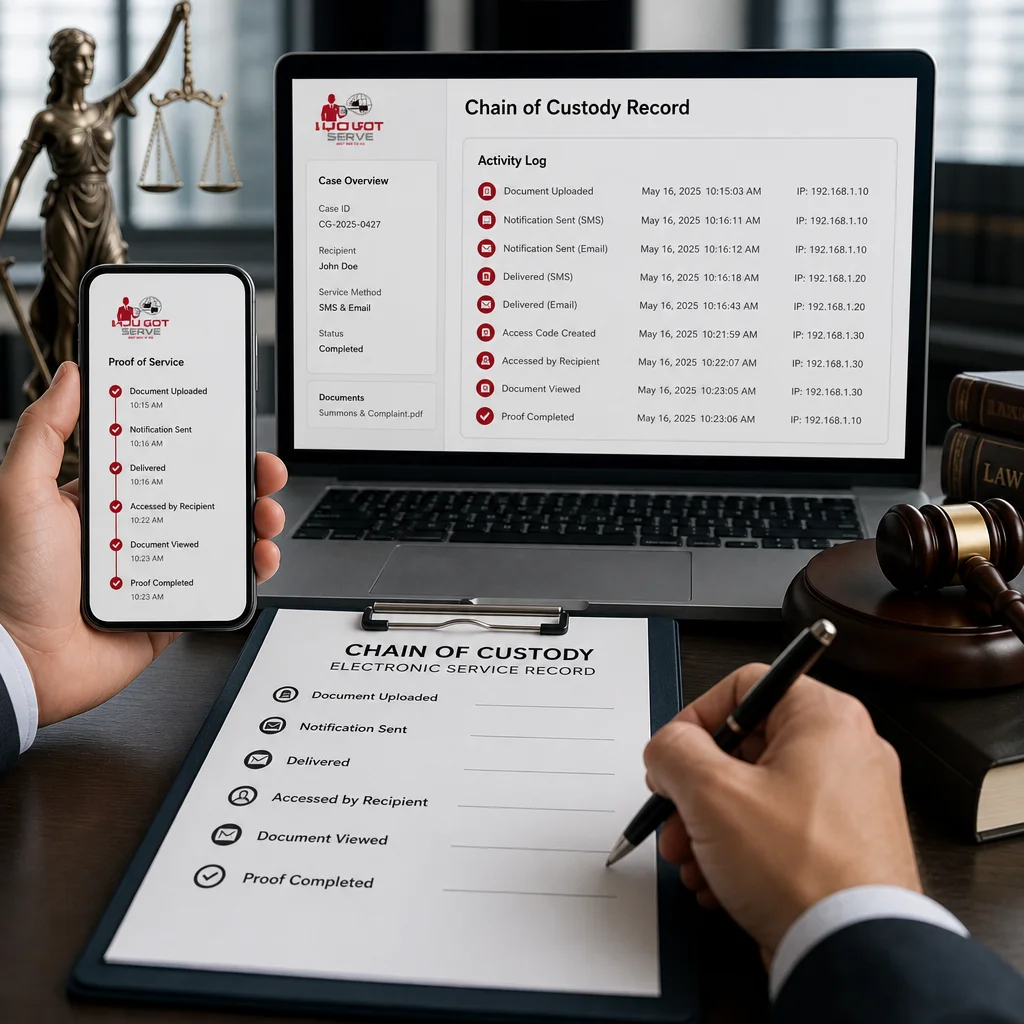
Activity logs also prevent tampering concerns. Because every action is recorded automatically and stored on secure servers, neither you nor the recipient can later add events or alter timestamps. The court reviews the log exactly as it was created, without any opportunity for dispute about what happened or when.
Action for today: Review document tracking features available in your service platform to ensure you can produce a complete activity log for court review.
Building a Complete Documentary Record
Proof of service is only valuable if it tells a complete, coherent story. That story should answer these questions: Who was served? What document was served? When was service attempted? Which contact methods were used? Did the recipient receive and access the document? What is the timestamp and verification?
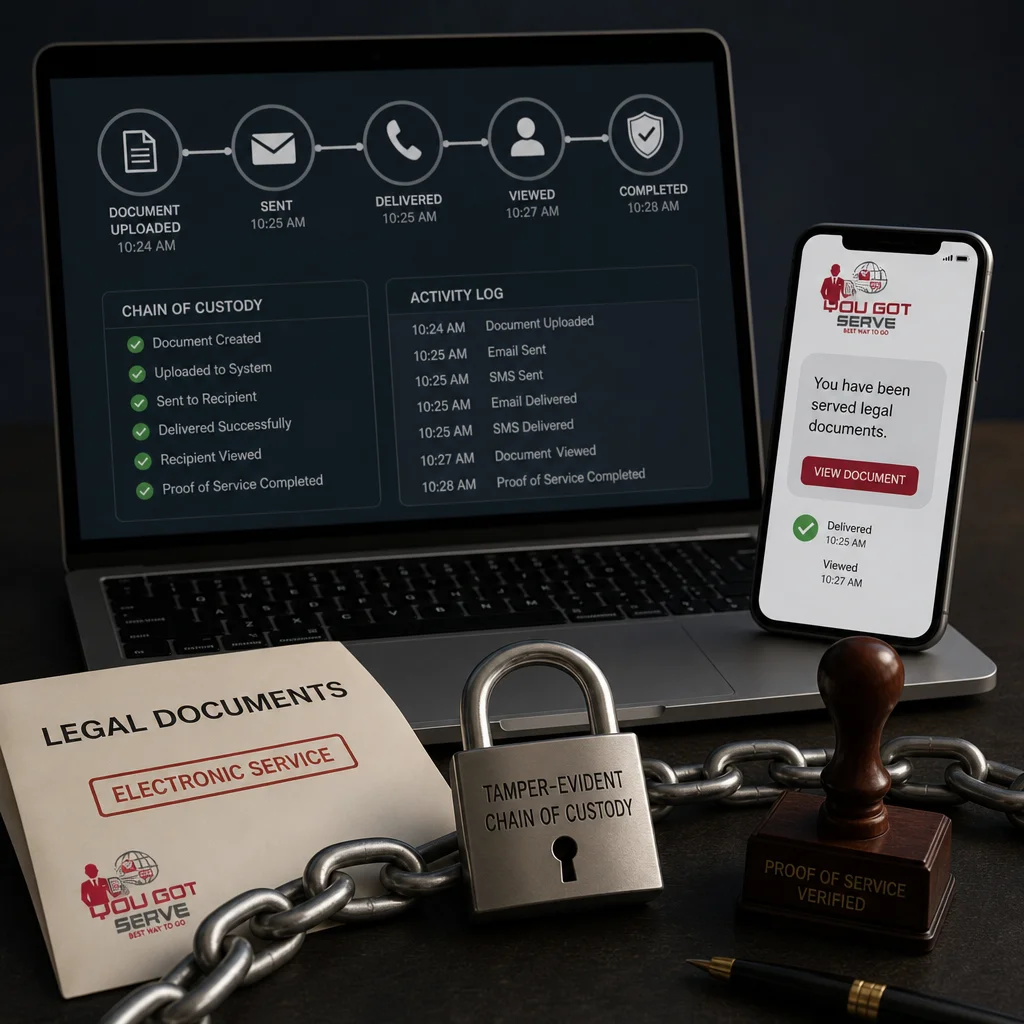
Our platform generates a comprehensive report that addresses all these elements in one place. Rather than assembling affidavits, emails, and delivery confirmations from multiple sources, you receive a single document that shows the entire service history from start to finish.
This consolidated approach serves several purposes. First, it’s faster and less error-prone than manual compilation. Second, it presents a unified narrative that courts can review quickly without flipping between multiple documents. Third, it demonstrates professionalism and thoroughness, which strengthens your credibility with the court.
The report also includes all supporting documentation: notification copies, recipient access details, geolocation and identity verification if applicable, and the full activity log. Courts can drill down into specifics if they wish, but they have the summary they need at a glance.
Action for today: Outline what proof of service your current cases require and compare it to what your existing process generates.
Compliance Support for Your Jurisdiction
Electronic service rules vary significantly by court system. Federal courts, state courts, and different state practice rules all have different requirements for which methods are permitted, what verification is necessary, and how proof must be documented.
We design our platform to support compliance with local rules, but the ultimate responsibility for checking jurisdictional requirements rests with you. Before relying on any electronic service method, verify that your specific court permits it, understand what verification elements the court expects, and confirm that your service approach meets those standards.
Our team can help you understand which features align with your jurisdiction’s rules, but you should also consult your court’s procedures or speak with local counsel familiar with electronic service in your area. Rules change, and what was acceptable last year may have been updated.
When electronic service is permitted, our multi-channel approach typically satisfies even strict jurisdictions because it demonstrates thorough, persistent, and well-documented attempts to reach the recipient. But “permitted” and “expected” are different things, so do your homework first.
Action for today: Contact your court clerk or review your local court rules to determine whether electronic service is permitted and what documentation requirements apply.
International Service and Cross-Border Considerations
Serving documents across borders introduces additional complexity. International treaties like the Hague Service Convention govern how service can occur in signatory countries. Electronic service is increasingly accepted internationally, but acceptance still varies by country and court system.
We support electronic notifications internationally where technically available and legally appropriate. This means SMS and email delivery can reach recipients in many countries, but you must verify that the specific country and court system where the recipient is located accepts electronic service.
Some jurisdictions require that electronic service be combined with other methods, like mail service or judicial notification. Others prohibit purely electronic service for certain types of cases. A few countries have not yet developed clear rules on electronic service, creating uncertainty.
Our investigative services can help identify the recipient’s location and proper service procedures under applicable treaties and local laws. Before attempting international service, research the specific requirements of the country involved or consult international law counsel.
Action for today: If any recipients are located outside the United States, identify which country and determine whether electronic service is permitted there.
Investigative Services for Hard-to-Locate Recipients
One of the most common chain-of-custody problems is serving an incorrect address or phone number because you do not have current contact information. Our investigative services address this directly by locating recipients and gathering verified contact details before service begins.
Skip tracing uses public records, prior business filings, social media, property records, and other sources to find current addresses and phone numbers. This investigative work reduces the risk that your service attempt misses the recipient entirely and provides documented evidence that you made thorough efforts to locate them.
When service attempts fail despite good contact information, investigation can also identify why. The recipient may have moved, changed phone numbers, or intentionally avoided contact. Documentation of these failures strengthens your proof of service because it shows courts that you pursued every reasonable option.
Strong chain of custody starts with accurate recipient identification. Investing in investigative services upfront eliminates problems later and gives courts confidence that service was properly targeted.
Action for today: If you cannot locate a recipient or lack current contact information, discuss investigative assistance options with our team.
Implementing Tamper-Evident Workflows Today
Start by identifying which of your cases qualify for electronic service under your jurisdiction’s rules. Not every case permits it, but many do. Those cases benefit immediately from electronic service’s chain-of-custody advantages.
Next, gather complete contact information for each recipient. Email addresses, phone numbers, and physical location matter. If you lack this information, pursue investigative assistance to fill gaps before service attempts begin.
Configure your notifications to use multiple contact channels and include verification features appropriate for your jurisdiction. A 60- or 90-day notification campaign with daily reminders creates the documented persistence that courts increasingly expect to see.
Review the document tracking and reporting features of your service platform to ensure you can generate complete proof-of-service documentation. Test the system with a non-critical case first so you understand the workflow and reporting before using it on important matters.
Finally, maintain communication with your court. If you are using electronic service methods your court has not previously seen, consider reaching out to the court clerk or filing an early notice so the court knows what to expect in your proof-of-service filing.
Chain of custody is no longer about hoping a process server remembers what happened. Modern legal service creates automatic, continuous, tamper-evident records that stand up to scrutiny. We built YouGotServe to make this approach accessible and straightforward. Start today by reviewing your current service practices and identifying where electronic service with verified receipt tracking can strengthen your evidence and reduce delay.