
The Challenge of Proving Digital Service in Court
When you serve documents electronically, the burden of proof shifts. Courts no longer accept a signed return of service from a process server as automatic proof. Instead, you must demonstrate that the recipient actually received the document and understood its contents. This requirement creates a significant challenge for legal professionals and self-represented litigants who lack the infrastructure to generate credible digital evidence.
The stakes are high. Insufficient proof of service can result in case dismissal, default judgment reversal on appeal, or a costly re-service attempt. Courts scrutinize electronic delivery claims more carefully than traditional methods because digital communication leaves room for skepticism: Was the email actually opened? Did the SMS reach the right person? Could someone else have accessed the document? Without a systematic approach to documentation, your electronic service effort may fail the judicial review process.
Modern litigation demands a modern solution. You need a platform that captures every touchpoint in the notification process and presents it as coherent, verifiable evidence.
Why Traditional Authentication Methods Fall Short for Electronic Notifications
Email read receipts and basic SMS delivery confirmations provide limited proof. Read receipts can be disabled by the recipient, and many email systems do not transmit them reliably. SMS delivery reports show only that a message reached a carrier network, not that a specific person opened it. Neither method confirms the recipient’s identity or understanding.
Newspaper publication, once the default fallback for difficult-to-locate defendants, offers even weaker evidence in today’s context. Courts increasingly question whether publication actually reaches the intended party. Print archives are difficult to access, and no verification exists that the recipient ever saw the notice.
Traditional process servers can provide detailed affidavits, but they often cannot document repeated contact attempts or engagement with digital communications. A single failed personal service attempt leaves no trail; electronic notifications, by contrast, can build a documented history of outreach efforts over days or weeks.
What courts actually need is a complete chain of custody: proof of when the notification was sent, through which channels, to which contact points, whether it was delivered, and evidence of access and recipient identity. Legacy methods simply do not supply this level of documentation.
Core Authentication Requirements for Legal Compliance
Courts examine several key elements when evaluating digital service:
- Proper party identification: You must verify you reached the correct recipient, not a third party or stale contact.
- Multiple contact points: Relying on a single email or phone number creates reasonable doubt. Courts prefer evidence of efforts across several verified channels.
- Timestamped delivery records: Each notification attempt must carry a precise timestamp. This creates an unbroken timeline of service efforts.
- Recipient confirmation: Some form of verification that the intended party actually received and accessed the documents is critical.
- Chain of custody documentation: You must demonstrate that documents remained secure and unaltered from creation through receipt.
- Legal compliance design: Your process should align with applicable court rules and jurisdictional requirements for electronic service.
Before selecting any service platform, check your local court rules. Electronic service acceptance varies by jurisdiction. Some courts authorize it only with prior consent; others require court approval. Your platform should be designed to support compliance with these rules and generate documentation suitable for judicial review.
Chain of Custody: Building an Unbroken Record of Service
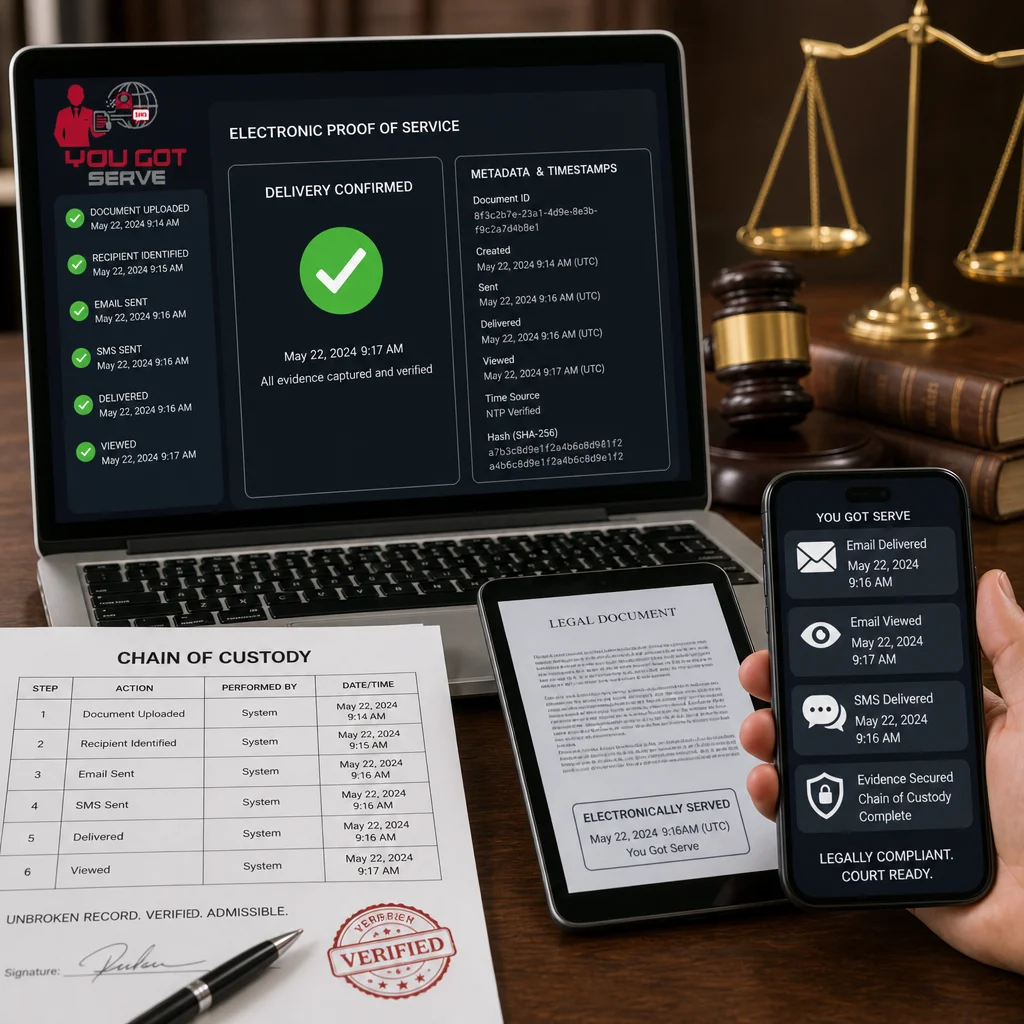
Chain of custody begins the moment you upload your documents to your service platform. Every step from that point forward must be recorded, timestamped, and preserved: when the document was uploaded, which recipient contact information was used, when each notification was dispatched, whether it was delivered, when the recipient accessed it, and what verification data was captured.
A fragmented record damages your credibility. If you cannot account for the document’s location and status at every stage, opposing counsel will exploit the gap. Courts expect a seamless narrative. You generated the document, secured it, sent it through a reliable channel, received confirmation of delivery, and captured evidence of receipt.
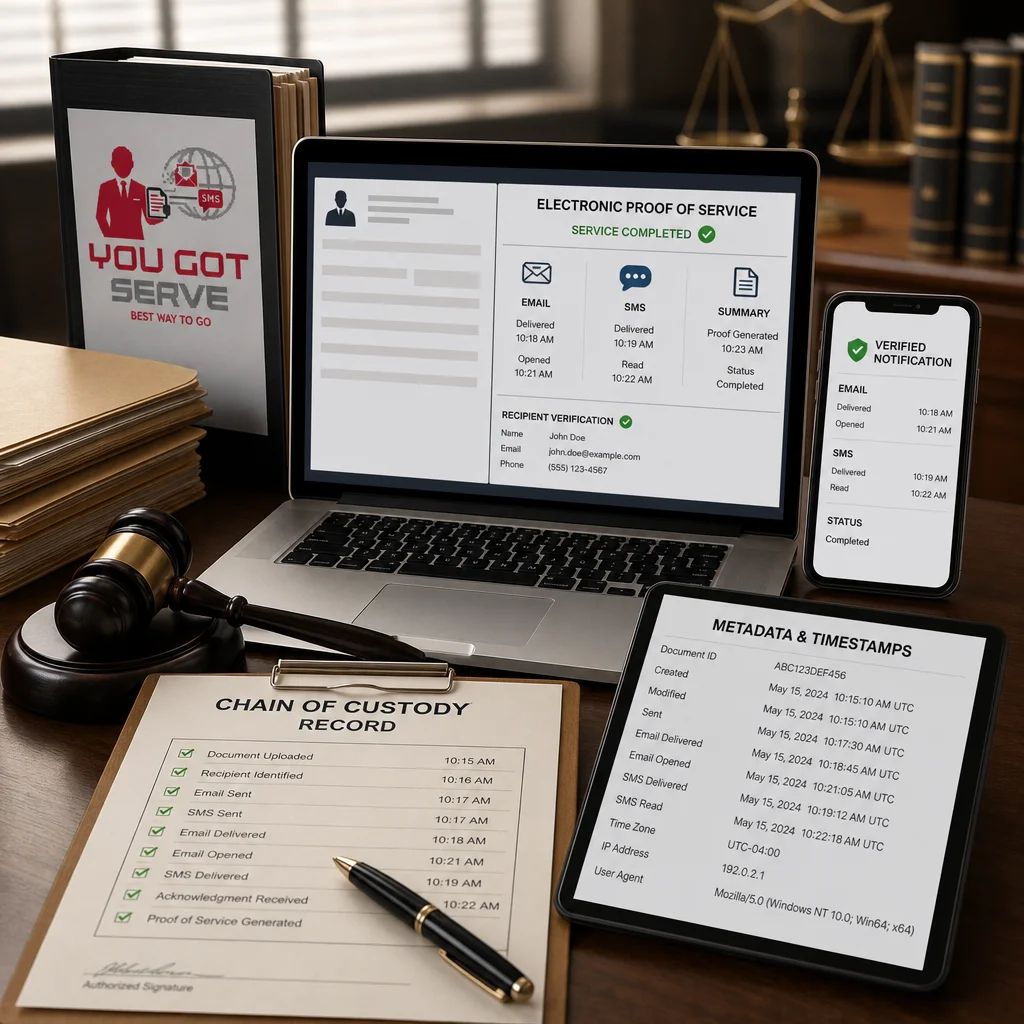
Our platform creates this unbroken record automatically. Each document is assigned a unique identifier and tracked from upload through final access. The system records every notification attempt, delivery status, and user interaction. When you need to present evidence in court, you can download a comprehensive activity log that shows exactly what happened and when. No guesswork. No gaps.
Metadata and Timestamping as Critical Verification Elements
Metadata is the detail layer that transforms a simple receipt into credible evidence. Timestamps alone matter, but they gain weight when paired with additional data points: the IP address of the device accessing the document, the approximate location of access, the exact time of access, and the duration of the document viewing session.
Courts increasingly expect this level of precision. A timestamp paired with geolocation data and viewing duration creates a robust authentication profile. Together, these elements form a narrative that is difficult to dispute: the document was sent to this number at this time, a device at this location opened it using the unique access code, and the recipient engaged with the content.
We embed end-to-end encryption and timestamping throughout the notification cycle. Every message transmitted, every access attempt, and every verification action is dated and logged. This metadata becomes the backbone of your proof of service documentation.
How You Got Serve Addresses Authentication Gaps
We designed our platform specifically to close the authentication vulnerabilities that plague traditional service methods. Our multi-channel notification system allows you to enter up to three email addresses and three phone numbers per recipient. Daily automated notifications cycle through these contact points over your chosen timeframe: either a 60-day service for $350 or a 90-day service for $500.
This persistent outreach approach creates documented evidence of repeated attempts to reach the recipient. A single failed email means little; a series of unopened emails paired with bounced SMS messages and an eventual successful document access through a verified geolocation creates a compelling narrative.
We also offer investigative assistance when you lack sufficient contact information. If a recipient has moved or their phone number is outdated, our available investigative services help locate current contact details. This capability means you are not forced into expensive newspaper publication or abandoned service attempts.
Multi-Channel Notification Trails: Creating Documented Proof
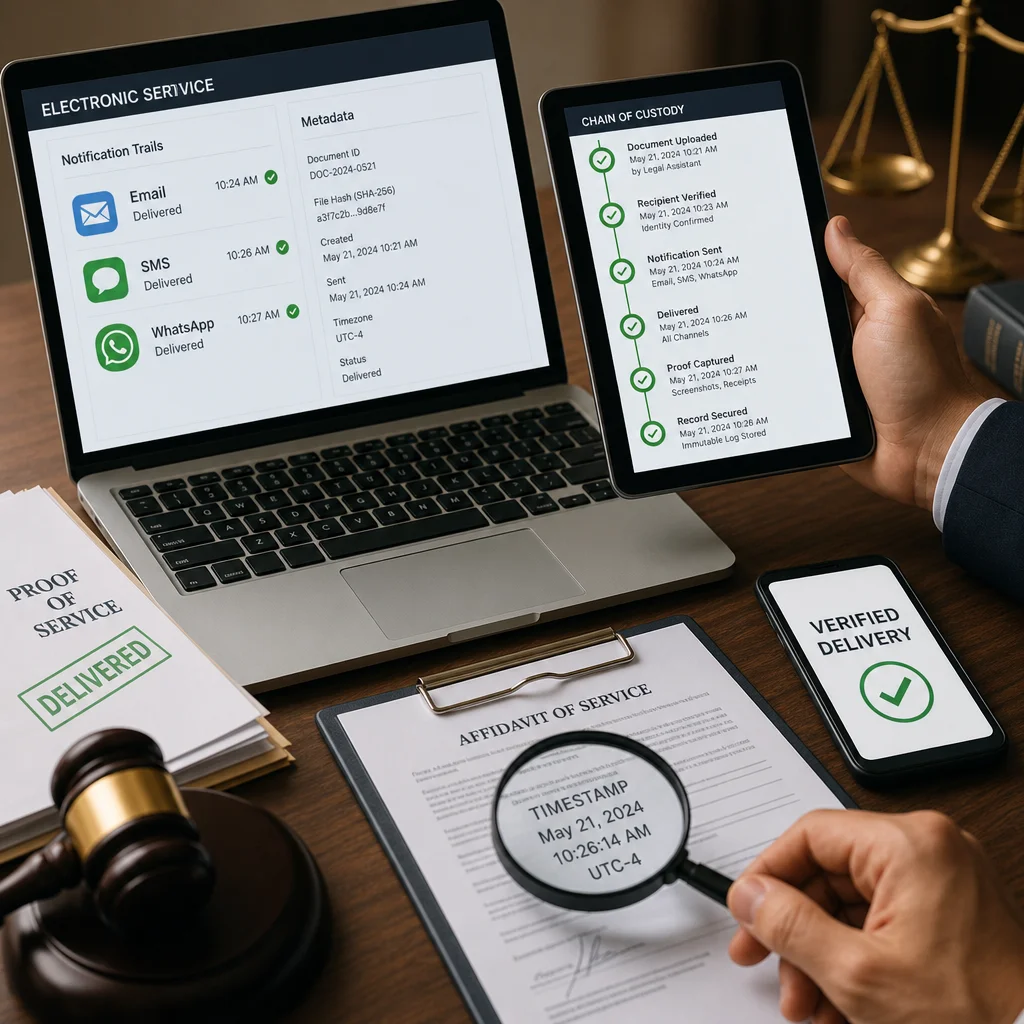
A notification trail across email, SMS, and WhatsApp (where available) is far more persuasive than a single channel attempt. Each channel carries its own proof of delivery metadata. Email systems log delivery, bounce notifications, and (sometimes) read receipts. SMS carriers timestamp message dispatch and delivery to the handset. WhatsApp confirms message delivery and read status.
When a recipient ignores email but responds to SMS, or vice versa, that diversity of channel usage demonstrates active receipt and engagement. Courts view multi-channel notification as a best practice precisely because it reduces the possibility of missed communication.
Your system should organize these notification trails into a coherent record. Our platform consolidates all activity across channels into a single dashboard and downloadable report. You can see at a glance which channels succeeded, which failed, when access occurred, and what verification data was captured. This organization is critical when you present evidence to a court.
Secure Code Access and Recipient Verification Features
Recipients should never access your documents without proving their identity. A secure, unique access code tied to a specific recipient and a specific document set prevents impersonation and creates a clear record of intentional engagement.
Our platform generates a unique one-time access code for each recipient. To view the documents, they must provide this code. This requirement serves two purposes: it ensures only the intended recipient can access the documents, and it confirms that the recipient took an intentional step to retrieve the materials, not accidentally stumbled upon them.
This code-based access mechanism is a cornerstone of your authentication strategy. It creates an affirmative act of receipt that courts recognize as credible.
Geolocation and Selfie Capture for Enhanced Authentication
Geolocation data adds another layer of verification. When a recipient accesses their documents, our platform can capture the approximate geographic location of the device. This information is particularly valuable if the defendant’s whereabouts are disputed or if they claim they were never reached.
Selfie capture (where available and appropriate) provides even stronger proof of recipient identity. A verified photograph of the person accessing the documents creates visual confirmation that the intended party, not a proxy or third party, engaged with your service materials.
Neither geolocation nor selfie capture alone proves service, but combined with timestamping, access codes, metadata, and a documented notification history, they form a comprehensive authentication profile that courts recognize as thorough and credible.
Comprehensive Activity Logs and Service Status Tracking
Your proof of service is only as strong as your ability to document it. From the moment you initiate service until the recipient accesses the final document, every action should be logged and timestamped.
Our activity logs capture notification dispatch times, delivery confirmations, access attempts, document viewing duration, geolocation data, and any verification confirmations. Your account dashboard displays a real-time service status for each recipient: Pending (documents sent, awaiting access) or Delivered (recipient has accessed documents using their unique code).
When you need to document tracking, you can export a complete chronological report suitable for filing with the court or presenting to opposing counsel. This level of detail transforms electronic service from a risky proposition into a methodical, auditable process.
Best Practices for Organizing and Presenting Your Digital Evidence
When the time comes to present your proof of service to a court, organization and clarity matter as much as completeness. Begin by creating a cover summary: a one-page narrative of your service efforts, the contact information used, the methods employed, and the outcome. Then attach your detailed activity log in chronological order.
Highlight key data points in your presentation. Draw the court’s attention to the notification timeline, the number of contact attempts, the successful delivery event, any verification data, and the recipient’s access confirmation. Use clear headings and page references so the judge can quickly locate specific evidence.
Before filing, check local court rules for electronic evidence formatting requirements. Some jurisdictions require specific file formats, metadata preservation, or declaration language. Align your presentation with these requirements to avoid procedural objections.
Moving Forward: Choosing a Platform That Supports Legal Compliance
Electronic service works when your platform is built for authentication from the ground up. You need a system that captures every notification touchpoint, preserves metadata, generates timestamped activity logs, enables recipient verification, and presents all evidence in a court-ready format.
We designed You Got Serve specifically for this purpose. Our combination of persistent multi-channel notification, secure code-protected document access, available geolocation and selfie verification, detailed activity logging, and legal validity support distinguishes us from basic email or SMS tools. You get 60- or 90-day notification cycles, investigative assistance when contact information is incomplete, and comprehensive documentation that courts recognize as credible.
Whether you are a legal professional serving a difficult-to-locate defendant or a litigant managing your own case, You Got Serve provides the infrastructure to authenticate your digital evidence and move your case forward. Our platform turns electronic service from a compliance risk into a documented, auditable process. That confidence is what the smarter way to serve looks like.