
Why Digital Service Records Matter in Litigation
When serving court documents, the quality of your proof matters as much as the act of service itself. Courts scrutinize how you delivered notice, to whom, when, and whether the recipient actually received it. A weak service record can delay your case, invite challenges, or result in dismissal on technical grounds.
Digital service records create a permanent, timestamped audit trail that traditional methods cannot match. Each notification attempt, delivery confirmation, and recipient interaction is logged automatically, giving you documentation that stands up to court scrutiny. This matters because judges need confidence that defendants had actual notice of proceedings before moving forward.
We built our platform around this reality. Your service record becomes evidence, not just a formality. When you have clear documentation of multiple delivery attempts, recipient verification, and secure document access, you’re positioned to defend your service against any challenge.
Actionable step: Before choosing a service method, verify what proof your local court requires. Different jurisdictions have different standards for electronic service documentation.
The Challenge: Meeting Court Standards for Electronic Service
Electronic service sounds straightforward until you face courtroom scrutiny. Judges aren’t skeptical of the technology itself; they’re skeptical of incomplete records. A single email with no proof of receipt? Not enough. A text with no verification the right person opened it? Questionable.
Courts want to see evidence that addresses three core concerns: Did the recipient actually get the notice? Was it the right person? Can you prove it happened on a specific date and time?
Traditional proof of service affidavits rely heavily on the server’s word. Digital records shift that burden to verifiable facts: Was the message delivered? Did someone access the document? What device was used? When did access occur? These details create a defensible record that mere assertions cannot provide.
The standard varies across jurisdictions. Some courts embrace electronic service fully; others require it as a last resort after unsuccessful traditional service. You must know your local rules before relying on any digital method.
What Courts Require for Authenticated Service Evidence
Authentication means proving that your digital record is genuine and hasn’t been altered. Courts typically evaluate this under state evidence rules that require foundation testimony or certification of digital records.
Key elements courts examine include:
- Reliable timestamps showing exact date and time of each delivery attempt
- Verified recipient identity confirming the person who accessed documents was the defendant (not an employee, relative, or third party)
- Delivery confirmation proving the message reached the intended recipient’s device or account
- Document access logs showing when and how recipients accessed court documents
- Chain of custody documentation establishing that records remained secure and unaltered from creation through court presentation
- Technical metadata such as IP addresses, device information, and location data supporting the record’s authenticity
We design our platform to capture and organize all these elements automatically. Each component is timestamped, encrypted, and logged in a way that courts can verify independently. When you’re ready for trial or motion practice, you’re not assembling scattered evidence; you’re presenting an integrated record built for court scrutiny.
How Multi-Channel Documentation Strengthens Your Record
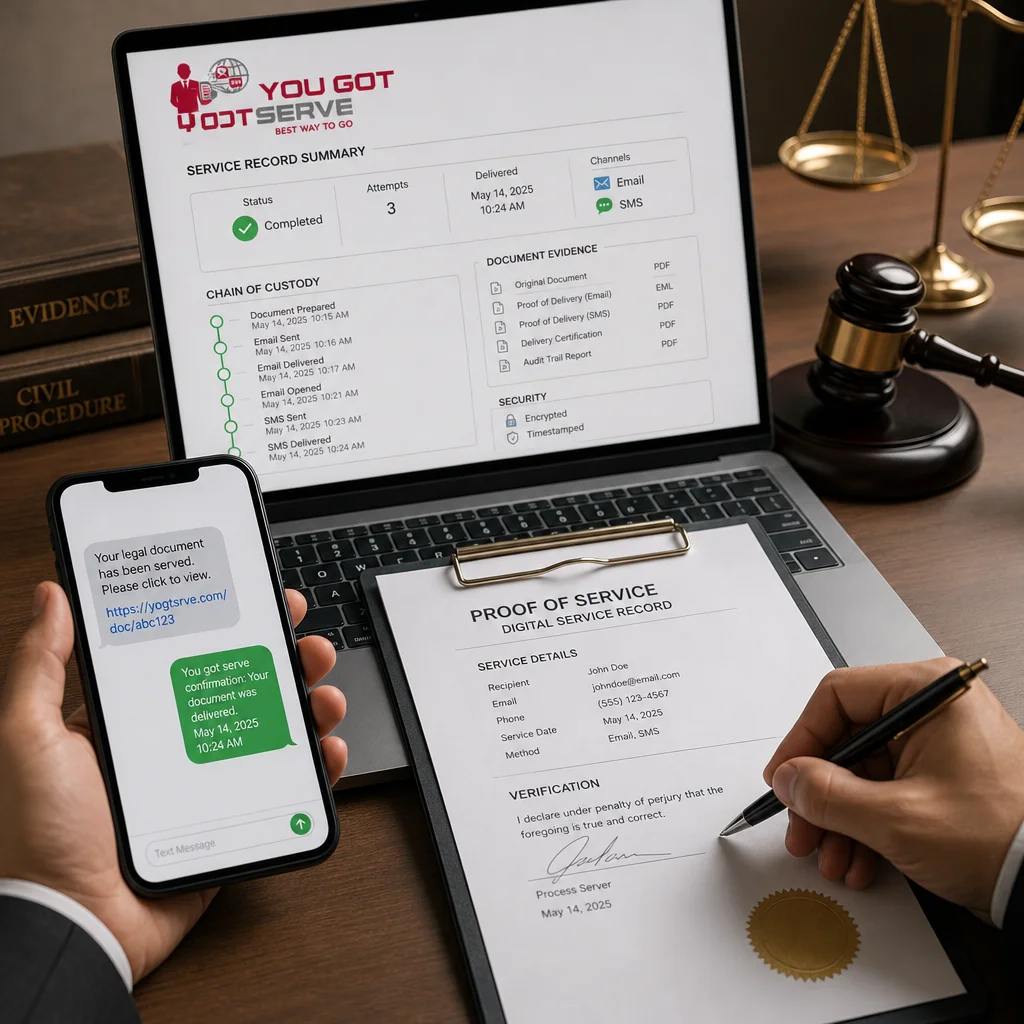
Serving through a single channel creates risk. Email filters block messages. Phones get disconnected. One failed attempt doesn’t prove anything. Multiple channels working together paint a different picture.
We support simultaneous delivery across email, SMS, and WhatsApp. For each recipient, you can register up to three email addresses and three phone numbers. Our platform attempts notification across all available channels on a daily basis through 60- or 90-day notification cycles. If one channel fails, others keep trying.
This persistent, multi-channel approach accomplishes several things:
- Increases the likelihood of actual notice by reaching recipients through their preferred communication method
- Creates a documented pattern showing repeated, good-faith attempts to reach the defendant
- Reduces successful challenges because you can demonstrate you took reasonable steps to provide notice
- Protects against technical excuses like “I didn’t see your email” when you have SMS and WhatsApp delivery confirmations as well
When your service record shows 60 or 90 days of documented delivery attempts across multiple channels, judges see competent, thorough service, not a technical loophole.
Securing Your Service Record: Encryption and Timestamping
The integrity of your service record depends on security. If a court doubts whether your documentation has been tampered with, the entire record becomes suspect.
We protect service records through end-to-end encryption and precise timestamping at every step. Each notification is assigned an immutable timestamp. Document access is logged with the exact moment it occurred. Notifications, confirmations, and activity records cannot be altered after creation.
This technical foundation matters for a practical reason: it eliminates any legitimate question about whether your evidence was manufactured or modified. The record speaks for itself because the technology ensures authenticity.
When you prepare your service documentation for court, you’re presenting records created by a neutral technical system, not edited files or handwritten affidavits subject to credibility disputes.
Recipient Verification: Building Proof Beyond Delivery
Delivery alone isn’t proof of service if you can’t confirm the right person received the notice. Courts want to know you served the defendant, not a random person who answered their phone.
Our verification features go beyond simple delivery confirmation:
- One-time access codes ensure only the intended recipient can open documents
- Selfie capture (optional) can verify identity biometrically
- Geolocation data shows where documents were accessed
- Device identification logs which devices accessed the record
- Notification history documents every delivery attempt and access event
These elements create layers of proof. If a defendant later claims they never received notice, you can present geolocation data showing documents accessed from their registered device, a timestamp showing the exact moment, and device information confirming the access point. That’s court-ready proof.
Not every case requires every verification feature. Some jurisdictions don’t recognize biometric data as relevant; others consider geolocation essential. The key is having these tools available so you can build a record tailored to your court’s standards.
Creating a Complete Chain of Custody Trail
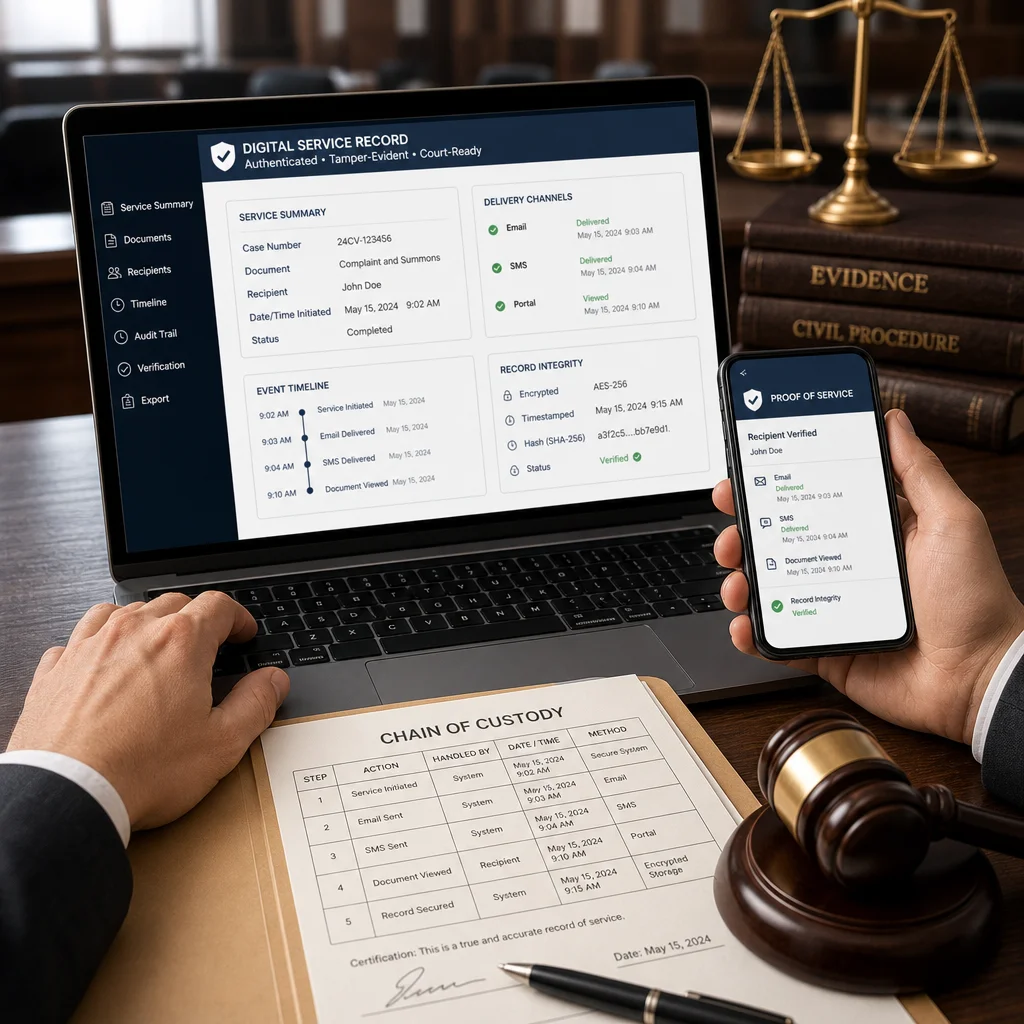
Chain of custody is a foundational concept in evidence law. Courts need confidence that records haven’t been altered, lost, or contaminated between creation and presentation.
Digital service records create chain of custody automatically through our logging system. Every action is recorded: when notifications were sent, when recipients accessed documents, what information they entered, when our system processed or updated any data. This creates an unbroken electronic trail.
Your role is to preserve that trail by:
- Maintaining your YouGotServe account and records without modification
- Obtaining official reports or certificates from our platform documenting service
- Keeping copies of all notifications, delivery confirmations, and access logs
- Retaining any correspondence about the service attempt
When you appear in court, you’re presenting records generated by our system, certified as accurate, and preserved without alteration. That’s precisely what courts want to see.
Using Automated Notifications to Document Service Attempts
One of the clearest benefits of digital service is that attempt frequency and timing are documented automatically. You don’t rely on a process server’s report or your own memory about when you tried to reach someone.
Our automated notification campaigns run daily over 60 or 90 days, with each attempt logged. This creates several valuable pieces of evidence:
- Proof of diligence showing you made sustained efforts to provide notice, not a single halfhearted attempt
- Documentation of persistence that can support claims you followed court rules requiring “reasonable efforts”
- Timestamped record of each delivery attempt, letting you identify exactly when notice likely reached the defendant
- Pattern evidence useful in motions or hearings where you need to demonstrate good-faith compliance with service rules
If a defendant argues they had no notice, your records show 60+ documented delivery attempts across multiple channels. That’s a powerful counter-argument.
Access Logs and Activity Records as Legal Evidence
Access logs are where digital service evidence becomes particularly valuable. When a recipient opens a document, our system captures:
- Exact timestamp of access
- Device used and device identifier
- IP address and geolocation
- How much of the document was viewed
- Whether documents were downloaded or printed
These logs serve as direct evidence that someone accessed your court documents. Combined with recipient verification (the one-time code ensuring only the intended recipient could open the document), access logs prove not just delivery but actual receipt and engagement.
Judges understand that a person who opened a document and reviewed its contents cannot credibly claim they had no notice. Access logs make that claim impossible to sustain.
When Geographic and Biometric Data Supports Your Case
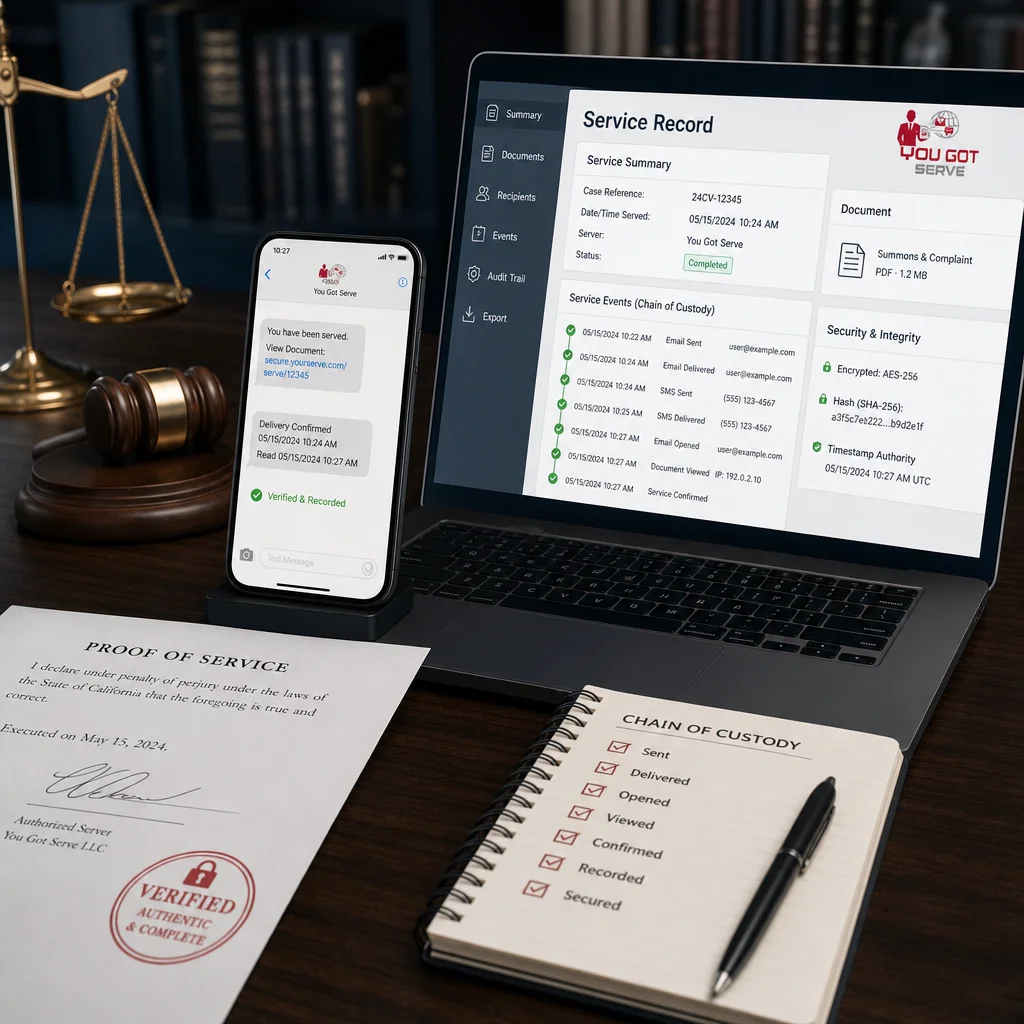
Geolocation and device information add dimensions that traditional service methods cannot provide. When a defendant’s device accesses documents from their home address or workplace, that’s powerful evidence they were actually present and engaged.
Similarly, optional biometric verification through selfie capture can establish identity beyond dispute. A defendant cannot later claim someone else received notice if you have their facial recognition data confirming they accessed the documents themselves.
Not every jurisdiction requires this level of verification, but when it’s useful, it’s invaluable. Courts dealing with sophisticated defendants or evasion tactics appreciate evidence this thorough.
The key is understanding your jurisdiction’s standards. Some courts embrace geolocation and biometric data; others don’t admit it. Learn more about legal validity of service in your jurisdiction before building your proof strategy.
Preparing Your Digital Record for Court Presentation
When your case reaches motion practice or trial, you’ll need to present your service evidence clearly. Digital records can seem overwhelming to courts unfamiliar with the format, so organization matters.
Create a presentation package that includes:
- A chronological summary of all service attempts with dates and times
- Screenshots of notifications sent and delivery confirmations received
- Access logs showing when documents were opened
- Recipient verification records (if applicable)
- A certification or affidavit explaining the technical details
- Any geolocation or biometric data relevant to your jurisdiction
We can provide official reports from our platform that serve as this documentation. These reports are designed for court use and explain the technical details in language judges understand.
Your goal is to make the evidence accessible, not to overwhelm with raw data. A well-organized digital service record tells a compelling story: you attempted service, you used reliable methods, you documented everything, and the recipient received and accessed your documents.
Why You Got Serve Delivers Court-Ready Documentation
We built our platform with one principle in mind: every service record should be defensible in court. That means thinking like a judge who will scrutinize your evidence, not like a vendor selling a quick solution.
Our approach combines persistent, multi-channel electronic notification with authentication features that courts expect. See how it works to understand the complete system.
We provide:
- Simultaneous delivery across email, SMS, and WhatsApp with multiple registered addresses and numbers per recipient
- Automated 60- or 90-day notification cycles creating documented service attempts
- Secure one-time access codes and optional verification features (selfie, geolocation, device identification)
- Encrypted, timestamped records that establish chain of custody automatically
- Official service reports certified for court presentation
- Investigative assistance when you need help locating recipients
The result is a service record that’s not just delivered but documented, verified, and ready for judicial scrutiny.
Next step: Review your jurisdiction’s electronic service rules, then contact us to discuss how digital service can strengthen your case while reducing cost and delay compared with traditional alternatives.