
Why Platform Reliability is Critical for Legal Service
When you’re serving court documents, timing isn’t optional. Deadlines are absolute. A service platform that goes down mid-campaign doesn’t just inconvenience you; it can compromise your entire case strategy, force you to restart notifications, and create gaps in your proof of service.
Legal professionals and self-represented litigants rely on electronic service platforms to reach defendants, respondents, and other parties when traditional personal service has failed. The platform you choose must work consistently, deliver messages on schedule, and maintain a tamper-proof record of every notification sent and received. If a platform experiences downtime during a critical 60- or 90-day service window, you lose days of automated notifications that may be irreplaceable within your case timeline.
Reliability is not a luxury feature in legal technology. It’s a foundational requirement. Your case depends on it, your deadlines depend on it, and your proof of service depends on it. A platform that guarantees uptime, redundancy, and verified delivery protects your case from unnecessary risk.
The Cost of Downtime: When Service Failures Impact Your Case
Consider a real scenario: you’ve initiated a 90-day electronic service campaign for a hard-to-locate defendant. The platform you selected has an unannounced outage for 8 hours. During those hours, no SMS notifications are sent, no emails are delivered, and no timestamps are recorded. When you discover the downtime, days have already passed. Can you restart the campaign? Will the court accept a service record with a gap? Will this delay push your case beyond a critical filing deadline?
These aren’t hypothetical concerns. Downtime directly translates to:
- Lost notification cycles that cannot be recovered
- Incomplete proof of service records that courts may question
- Missed deadlines that force continuances or dismissals
- Additional legal costs to remedy service failures
- Uncertainty about whether you’ve actually served the recipient
A platform without redundancy, monitoring, and rapid failover capacity puts your case at active risk. Every hour of unavailability is an hour your automated notifications aren’t running. Every service failure is a potential argument for opposing counsel that proper service never occurred.
When evaluating an electronic service platform, ask directly: what happens when something breaks? If the answer is vague or if they downplay the risk, that’s a warning sign. Reliability must be measurable, guaranteed, and central to their service design.
Understanding SLAs and What They Really Mean
A Service Level Agreement (SLA) is a formal commitment from a platform provider about uptime and performance standards. It typically specifies:
- Percentage of uptime guaranteed (e.g., 99.9% uptime means no more than 43 minutes of downtime per month)
- Response time for system outages
- Compensation or credits if they fall short
- Definition of what counts as “downtime”
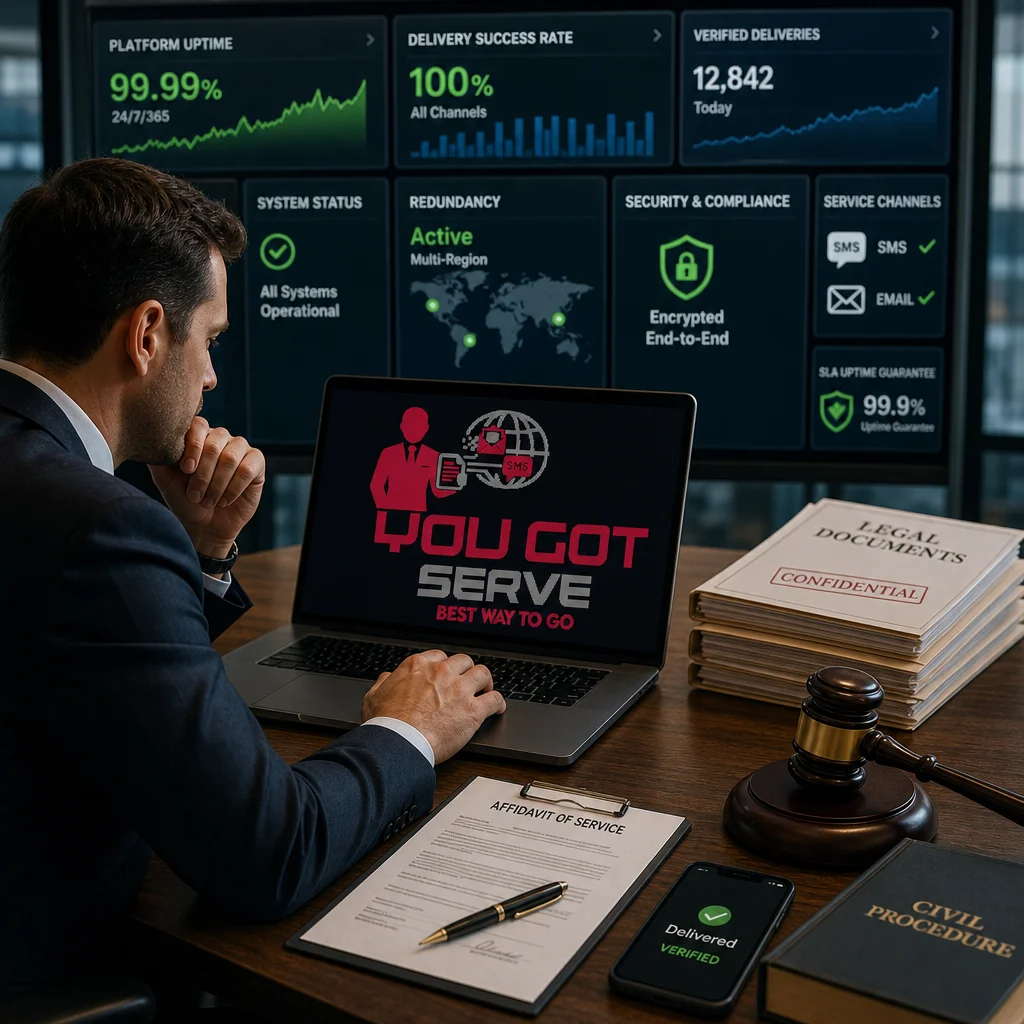
Not all SLAs are equal. Some platforms promise 99% uptime, which sounds good until you realize it allows roughly 7 hours of downtime per month. Others promise 99.9% or 99.99%, which dramatically reduces allowable downtime. Read the fine print. Some SLAs exclude “scheduled maintenance,” which providers sometimes abuse to perform updates during peak hours.
The most important question: is the SLA enforceable? Does it include teeth, such as automatic refunds or service credits if performance falls below the promised level? If there’s no penalty for failure, the SLA is primarily a marketing statement, not a real commitment.
We design our platform around uptime as a core architectural principle, not an afterthought. Your proof of service record depends on continuous, reliable delivery, and we’ve built redundancy and monitoring into every layer of our system.
Key Reliability Metrics: Uptime, Redundancy, and Failover Capabilities
Uptime percentage matters, but it’s only one part of the reliability picture. Here’s what actually supports reliable service delivery:
Redundancy: Multiple servers in geographically distributed data centers mean that if one system fails, another seamlessly takes over. Your notifications continue without interruption.
Failover capabilities: Automatic switchover ensures that if primary systems become unavailable, backup systems activate instantly without human intervention. No alert, no delay, no manual restart needed.
Load balancing: During high-volume notification periods, traffic is distributed across multiple servers so no single point of failure can take down your campaign.
Real-time monitoring: Continuous automated checks detect problems before they impact service delivery. Alert systems notify teams immediately if any component degrades.
Audit logging: Every transaction, every notification, every timestamp is recorded in tamper-proof logs that serve as your proof of service.
When you select an electronic service platform, request documentation of their infrastructure. Ask about their data center locations, backup systems, monitoring protocols, and failover response times. A provider confident in their reliability will answer these questions openly and provide detailed technical specifications.
How You Got Serve Ensures 24/7 Verified Delivery
We operate our platform with multiple layers of redundancy and continuous monitoring. Our infrastructure is designed so that your notifications continue even if individual components experience issues. Automated failover systems activate instantly, routing your messages through alternate pathways without delay or interruption.
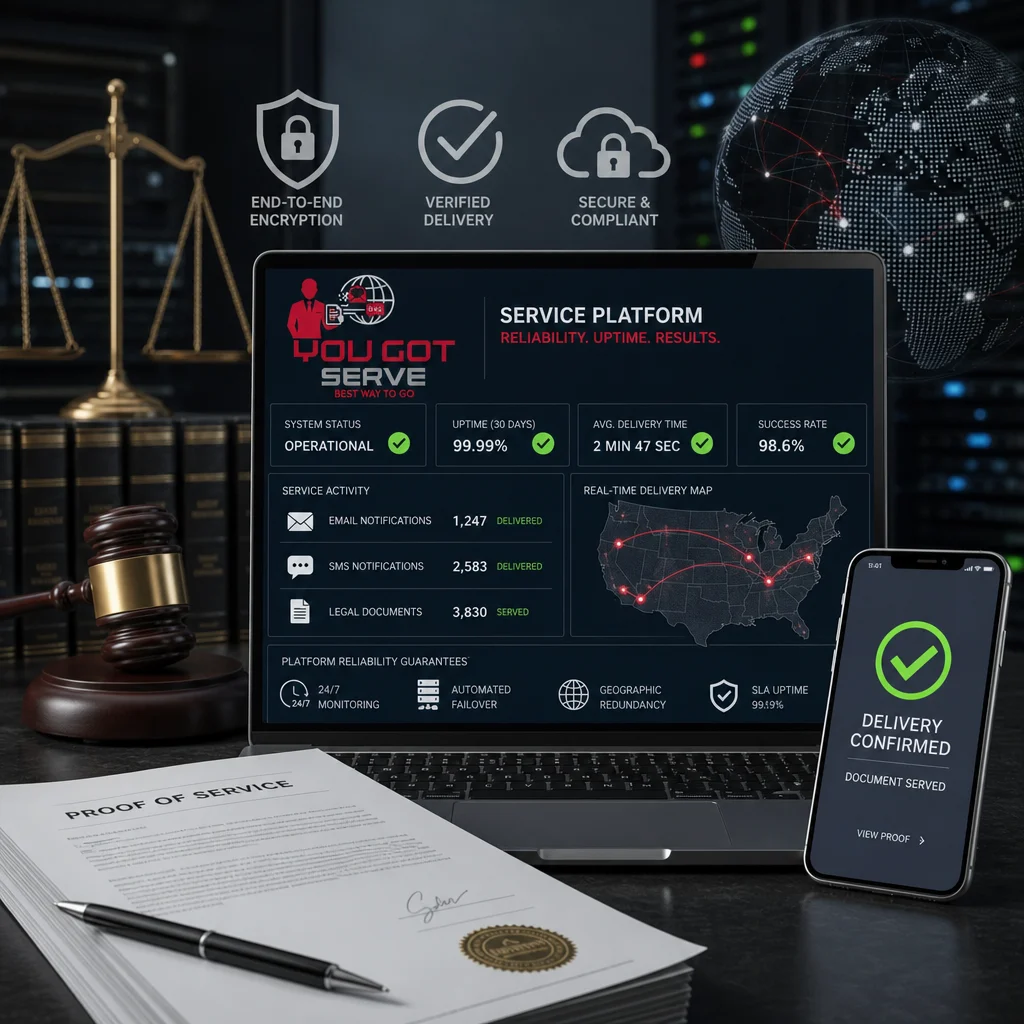
Every notification we send is timestamped, logged, and recorded. When a recipient accesses their documents using their unique one-time access code, we capture verification data including geolocation information, access timestamps, and device identifiers. This creates an immutable record that demonstrates not just that you attempted service, but that your intended recipient actually received and accessed the documents.
Our 60-day and 90-day service cycles run continuously with daily automated notifications via email and SMS. If a recipient is unresponsive, your notifications continue on schedule. If they engage, we capture evidence. Either way, you build a documented service record that shows consistent, good-faith effort to reach the recipient across your selected timeframe.
We also support recipients who need help locating contact information. If you don’t have sufficient email addresses or phone numbers for your recipient, we can assist through investigative services to help you gather the information needed to initiate service.
Security and Encryption: Reliability Meets Compliance
Reliability and security are inseparable. A platform that experiences data breaches, lacks encryption, or fails to protect sensitive documents isn’t reliable even if it never goes offline.
We use end-to-end encryption for all document transmission and storage. Documents are encrypted in transit and at rest, meaning even our personnel cannot access unencrypted content. Recipients access documents through secure code-protected retrieval, requiring a unique one-time access code to view sensitive court materials. This protects privacy and prevents unauthorized access while maintaining the chain of custody that courts require.
Timestamps are cryptographically secured so they cannot be altered after the fact. Your proof of service record is tamper-proof and admissible as evidence. Every access, every notification, every delivery is recorded with precision and integrity.
Compliance with data protection rules depends on infrastructure that prioritizes both security and availability. Our platform is designed to support compliance with applicable jurisdictional rules and privacy regulations governing electronic service and document handling.
Automated Tracking and Real-Time Status Monitoring
You need to know what’s happening with your service. Not hours later, not after you submit a support ticket, but in real time.
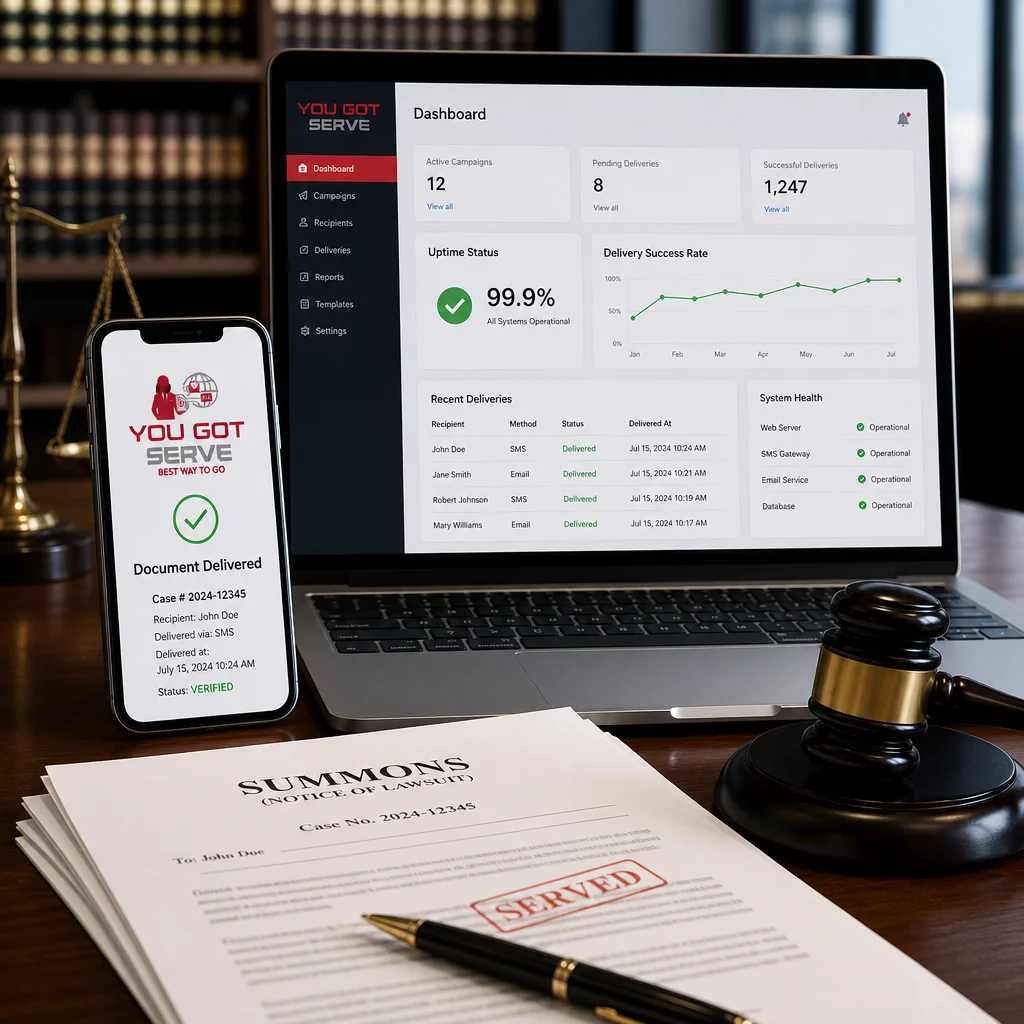
Our document tracking system shows you the status of every notification at every stage. You can see which emails were delivered, which SMS messages were sent, when recipients accessed documents, and whether service remains Pending or has been marked Delivered. Geolocation data, access timestamps, and selfie capture (where available) provide additional verification that the intended recipient actually received and accessed your documents.
This real-time visibility serves multiple purposes. It confirms that your notifications are being sent on schedule. It provides evidence of your good-faith service efforts. And it allows you to adjust your strategy if you need to take additional steps to reach an unresponsive recipient.
For self-represented litigants or attorneys managing multiple cases, this tracking system eliminates guesswork. You’re not wondering whether service happened. You have documented proof.
Comparing Traditional Methods: Why Electronic Service Outperforms Alternatives
Newspaper publication, once the default method for reaching difficult-to-locate recipients, is slower and more expensive than modern electronic service. Publication requires publication in a print newspaper (often multiple times over several weeks), doesn’t confirm that the intended recipient saw the notice, and costs hundreds of dollars while providing no proof that the recipient was ever reached.
Personal service through a process server is direct and creates a clear chain of custody, but costs $200-400 per attempt and fails when the defendant cannot be located. Skip tracing can help, but adds time and expense to an already lengthy process.
Electronic service through a dedicated platform like ours eliminates these constraints. You can serve multiple contact points simultaneously (up to three email addresses and three phone numbers). Automated daily notifications run continuously for 60 or 90 days. Verified delivery tracking confirms engagement. Cost is fixed at $350 for 60-day service or $500 for 90-day service, far less than traditional alternatives. And you build a documented record of your service efforts that demonstrates good faith and supports your case in court.
For eligible organizations, we offer a 10% discount on our service packages, further reducing costs compared with traditional methods.
The YouGotServe Advantage: Proven Uptime and Documented Proof of Service
We’ve built an electronic service platform specifically for legal professionals and self-represented litigants who need reliability they can count on. Our infrastructure prioritizes continuous delivery, verified receipt tracking, and documented proof of service.
Here’s what makes our approach different:
- Daily automated notifications via email, SMS, and WhatsApp ensure consistent attempts to reach recipients throughout your service window
- Verified delivery tracking with geolocation, timestamps, and access verification provides stronger proof of service than alternatives
- 60- or 90-day service cycles give you extended timeframes to reach unresponsive recipients without restarting campaigns
- Secure code-protected document access prevents unauthorized viewing while maintaining recipient verification
- Real-time status monitoring lets you see exactly what’s happening with your service at every moment
- End-to-end encryption and timestamping ensure your proof of service is secure, tamper-proof, and admissible
Our platform is designed to support compliance with local court rules and jurisdictional requirements for electronic service. Because court acceptance of electronic service varies by jurisdiction, we recommend checking your local rules before relying on electronic service in your case. But where electronic service is permitted or court-authorized, we provide the reliability, documentation, and verification that courts require.
Making Your Decision: Choose the Platform You Can Trust
Selecting an electronic service platform is a critical decision that directly impacts your case. You need a provider that combines proven uptime, redundant infrastructure, and comprehensive verification into a single platform. You need real-time tracking so you know exactly what’s happening with your service. And you need documented proof that actually persuades courts.
We’ve built our platform from the ground up around these requirements. Our infrastructure is designed for reliability. Our verification methods are thorough. Our tracking is transparent. And our service is affordable compared with traditional alternatives like newspaper publication or repeated process server attempts.
If you’re ready to serve documents electronically with confidence, explore how our platform works or start your service campaign today. Your case deserves a platform built to deliver. We’re here to provide it.