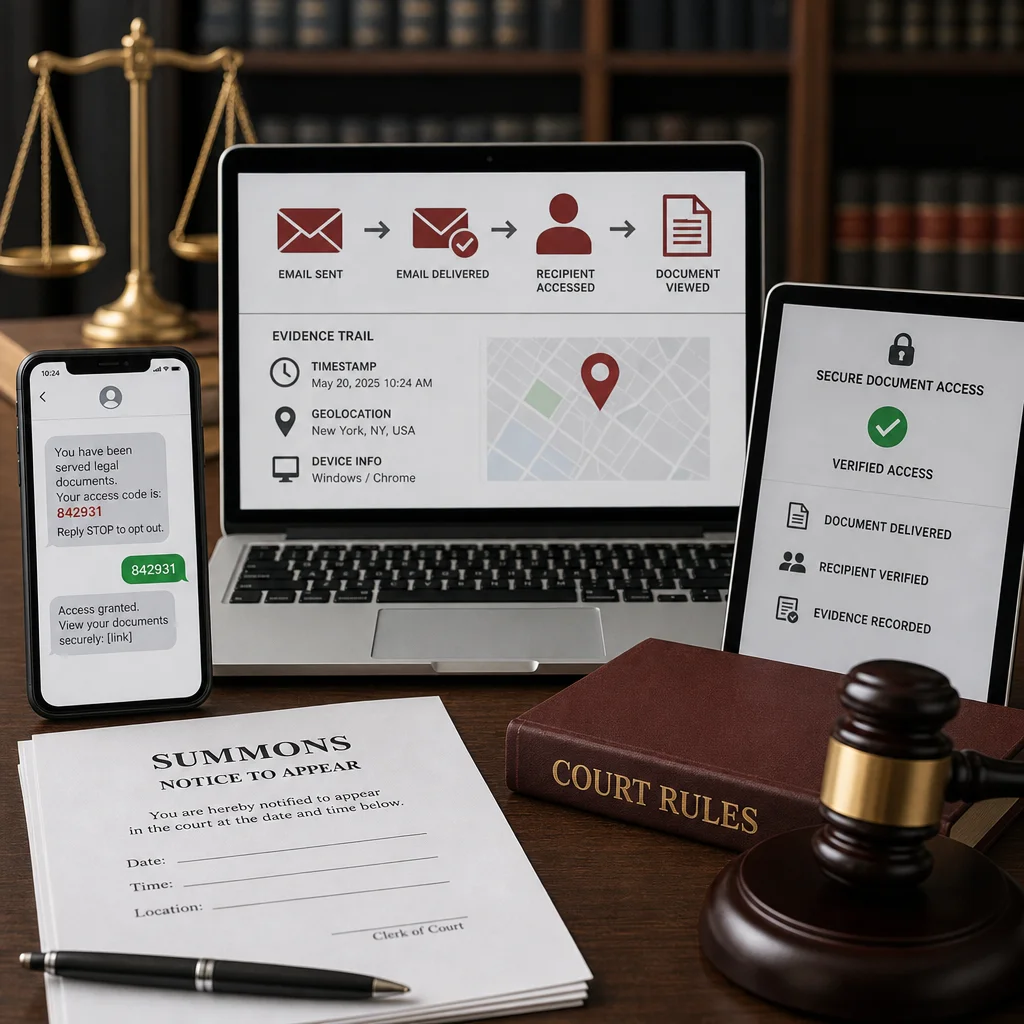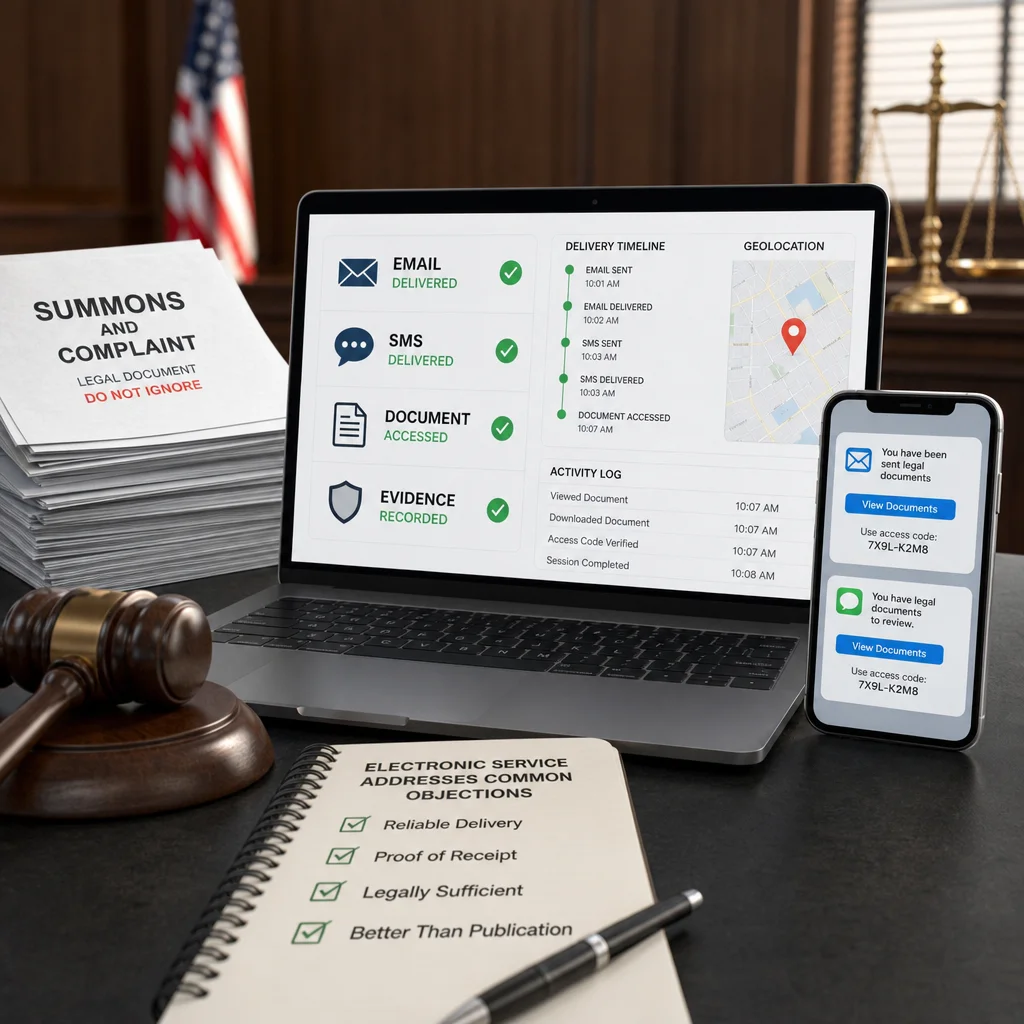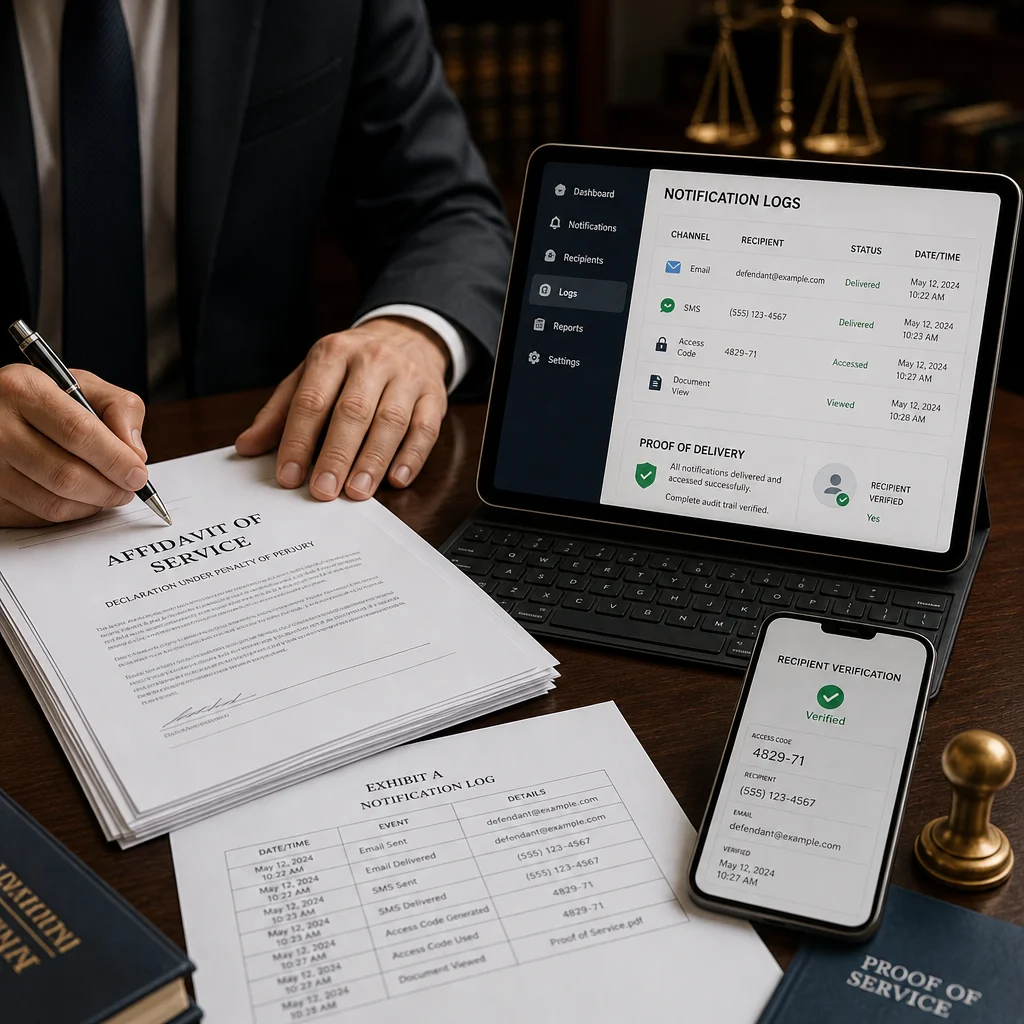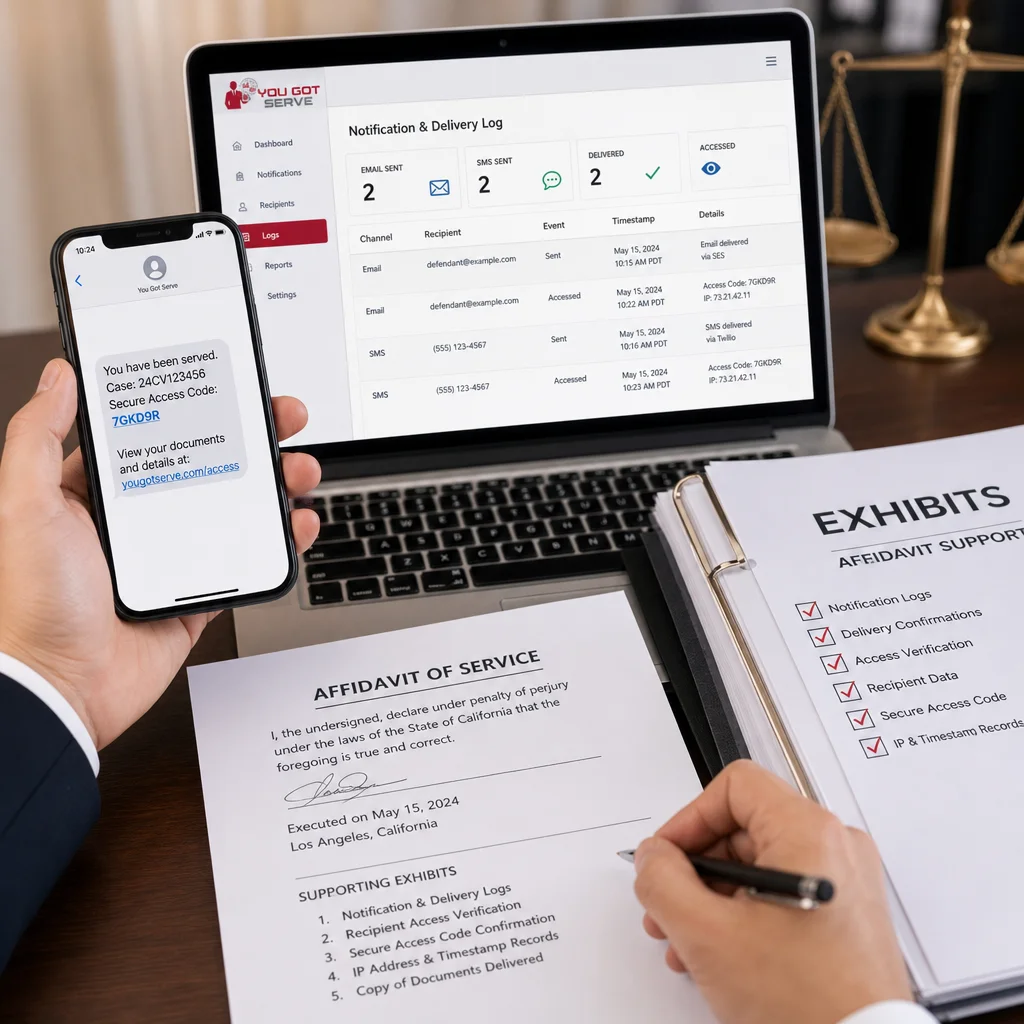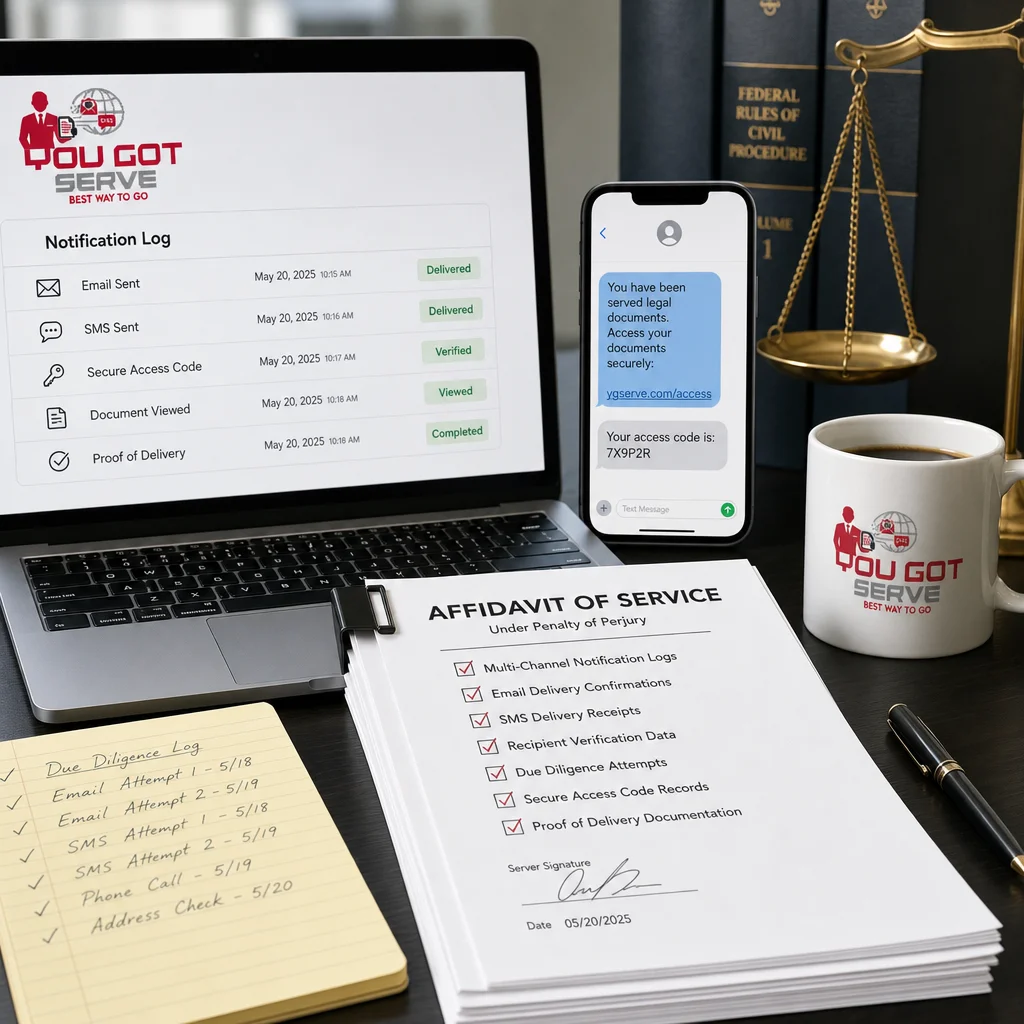
Category: Uncategorized

  • Best Motion Templates and Proposed Orders for Electronic Service via Email and SMS

    Best Motion Templates and Proposed Orders for Electronic Service via Email and SMS

    Why Traditional Service Fails and What Courts Now Allow

    Personal service of process remains the gold standard, but it often fails in practice. Defendants evade service. Addresses become obsolete. Process servers exhaust their efforts and report “unable to locate.” When traditional methods hit a wall, courts increasingly authorize electronic service as an alternative.

    Modern civil procedure rules across federal and state jurisdictions now permit electronic notification through email and SMS when traditional service has been unsuccessful or when court rules explicitly authorize it. This shift reflects the reality that most people carry mobile devices and check email regularly. Courts recognize that a defendant who receives an SMS or email notification has often received more reliable notice than one who ignores a paper notice taped to a door.

    The path forward is clear: file a motion for alternative electronic service, demonstrate why traditional methods failed, propose a practical notification plan, and provide the court with a proposed order. Your motion must be grounded in local court rules, supported by the facts of your case, and transparent about how you will execute the service and document compliance.

    Understanding what your jurisdiction allows is the critical first step. Check your local court rules before drafting your motion.

    Core Elements Your Motion Must Include

    A strong motion for alternative electronic service rests on five essential components:

    1. Statement of failed service efforts. Document every attempt to locate and serve the defendant by traditional means. Include dates, methods, results, and the process server’s affidavit if available.
    1. Legal basis for relief. Cite the applicable civil procedure rule (federal or state) that permits alternative service. Most jurisdictions tie this to Rule 4(f) equivalents, local rules, or case law authorizing electronic service.
    1. Proposed service method. Specify exactly how you will notify the defendant: email addresses, phone numbers, communication channels (SMS, WhatsApp, email), notification frequency, and duration.
    1. Verification and documentation plan. Explain how you will prove the defendant received notice. Outline what records you will maintain and provide to the court.
    1. Proposed order language. Draft the order you want the court to sign, making it clear, specific, and enforceable.

    Courts want to see that you have made good-faith efforts, have a solid legal foundation, and have thought through the practical mechanics. Incomplete motions invite denial or requests for additional briefing.

    Crafting a Persuasive Motion for Electronic Service

    Your motion succeeds when it combines legal citation, factual detail, and practical reasoning.

    Start by narrating the service history. Name the defendant, describe the claims, and walk through each failed attempt chronologically. “On January 15, 2026, process server John Doe attempted service at [address]. Defendant was not present. On January 22, 2026, a second attempt was made. No one answered the door.” This narrative builds credibility and shows the court you are not seeking an easy shortcut.

    Next, explain why electronic service is appropriate. Courts are persuaded by facts like these: the defendant communicates via email or text in business dealings; you have verified email or phone contact information; the defendant’s evasion suggests awareness of the lawsuit; or electronic notification is more likely to reach the defendant than further physical attempts.

    Connect your facts to the legal rule. Quote the applicable procedural rule and cite supporting case law from your circuit or state. Frame electronic service not as a substitute for traditional service, but as a necessary adaptation when traditional service has failed. Courts appreciate proportionality: the burden on you to serve does not warrant infinite expense when electronic notification is more practical and equally reliable.
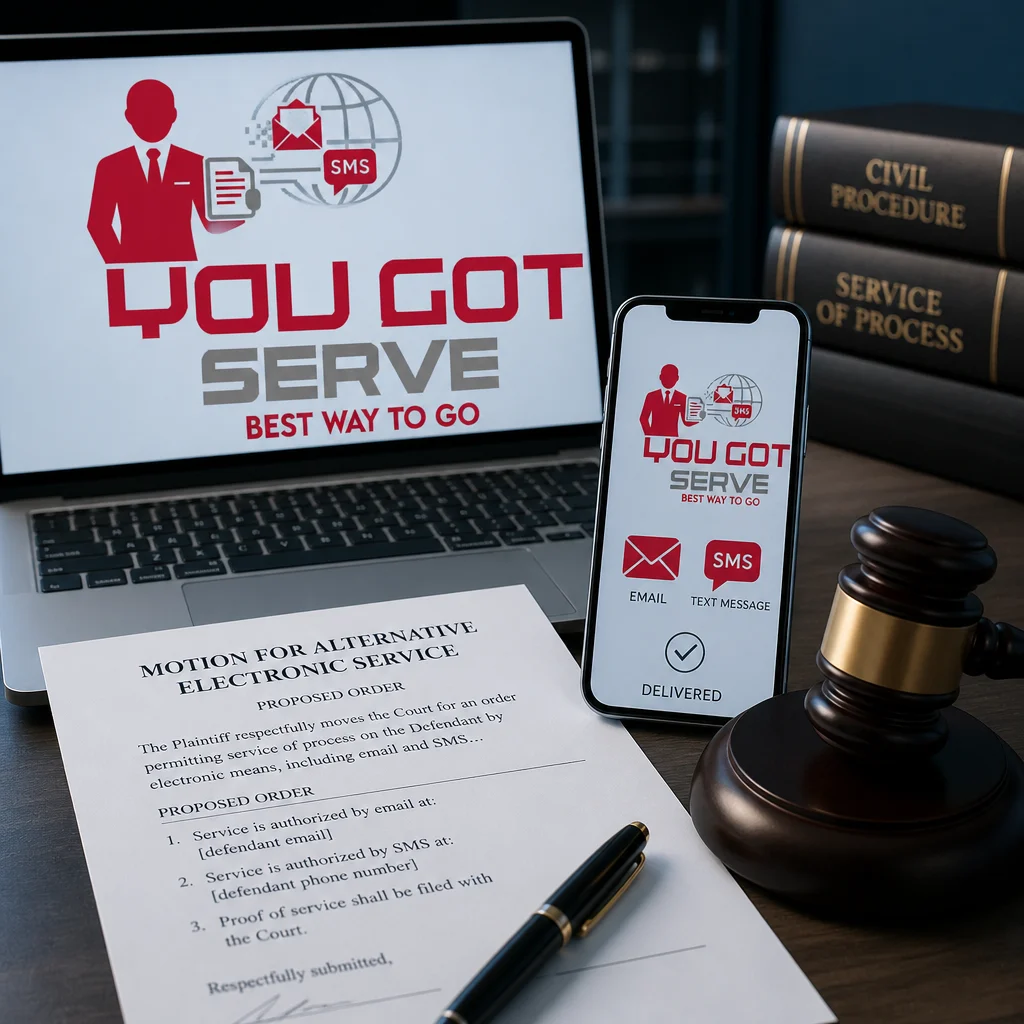
    Conclude your motion with the specific relief you seek: approval to serve the defendant via email, SMS, and WhatsApp (or whatever channels you propose) on a daily basis for 60 or 90 days, with timestamped records preserved as proof of service.

    Sample Language for Email and SMS Notification Provisions

    Precise language in your motion sets clear expectations for how service will occur.

    Use this framework for your proposed service method:

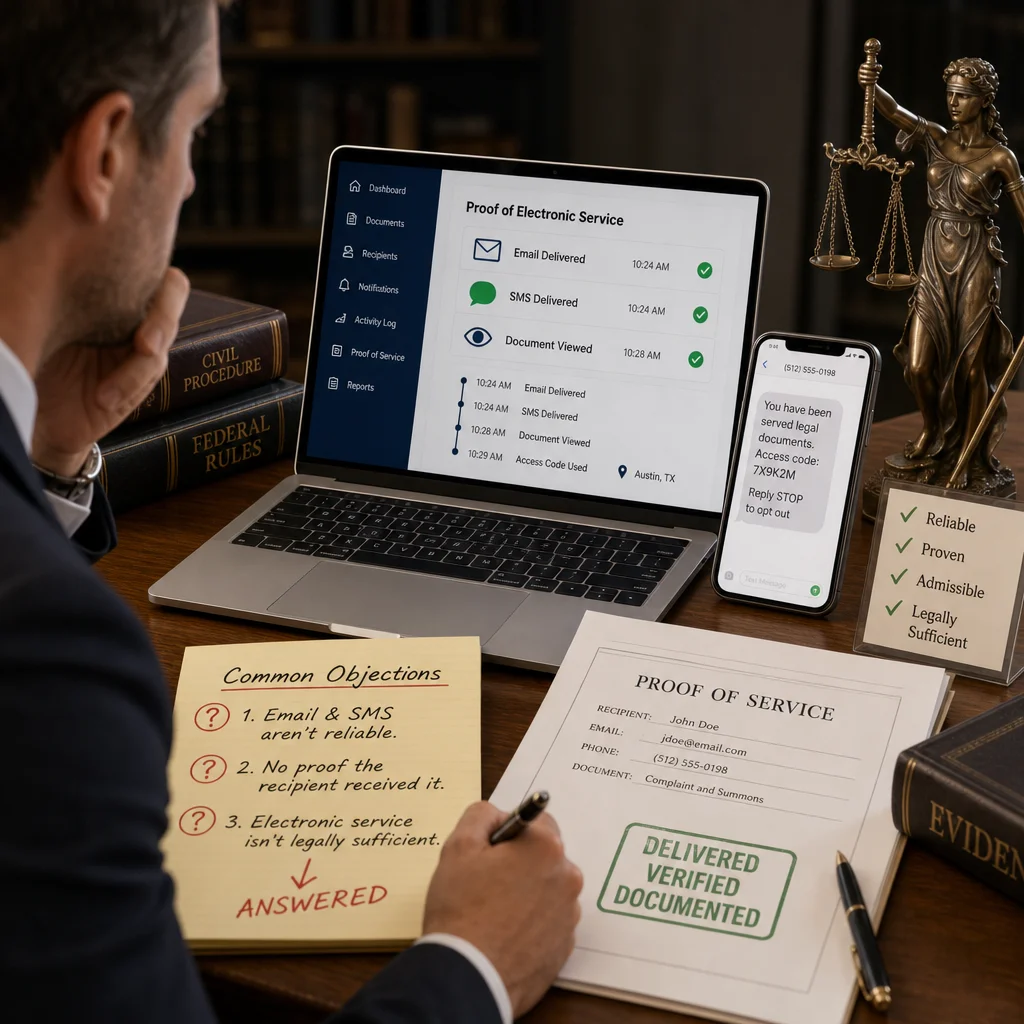
    “Plaintiff proposes to serve Defendant [Name] by electronic notification as follows: (1) Plaintiff shall transmit copies of the Complaint and Summons via email to [email addresses] and via SMS to [phone numbers], or such other contact information as Defendant provides; (2) Notifications shall be transmitted daily for [60 or 90] consecutive days; (3) Each notification shall include a unique secure access code, enabling Defendant to retrieve the full documents; (4) Defendant shall be notified of the documents’ importance, the case caption, and the deadline for response; (5) All transmissions, delivery confirmations, and access logs shall be preserved and provided to the court as proof of service.”

    This language is concrete enough for the court to understand exactly what will happen and specific enough for you to execute consistently. It also tells the court you will maintain records, which directly addresses the verification requirement.

    If you propose WhatsApp or a similar platform, specify it by name and explain why it is appropriate. Some jurisdictions or judges require explicit approval before using messaging apps beyond SMS.

    Documenting Proof of Service and Recipient Verification

    Electronic service only works if you can prove it happened. A motion for alternative electronic service must commit to a detailed verification and documentation protocol.

    Your proposed order should require you to preserve the following:

    • Timestamped records of each notification sent (date, time, recipient address/number)
    • Delivery confirmation reports from your notification platform
    • Whether the recipient opened emails or accessed documents
    • Geolocation information (if applicable and permitted)
    • Any selfie verification or biometric confirmation (if applicable)
    • The unique access code used by the recipient to retrieve documents
    • The full history of notification attempts

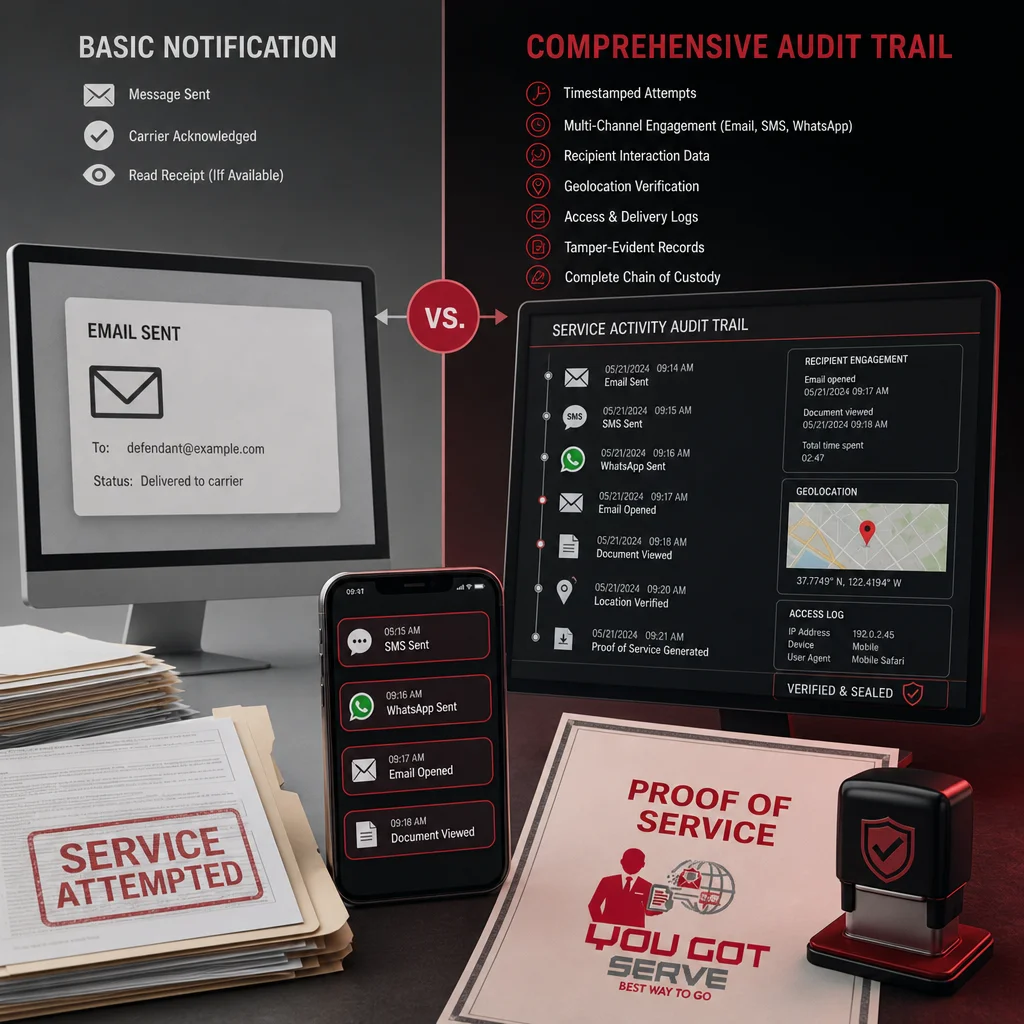
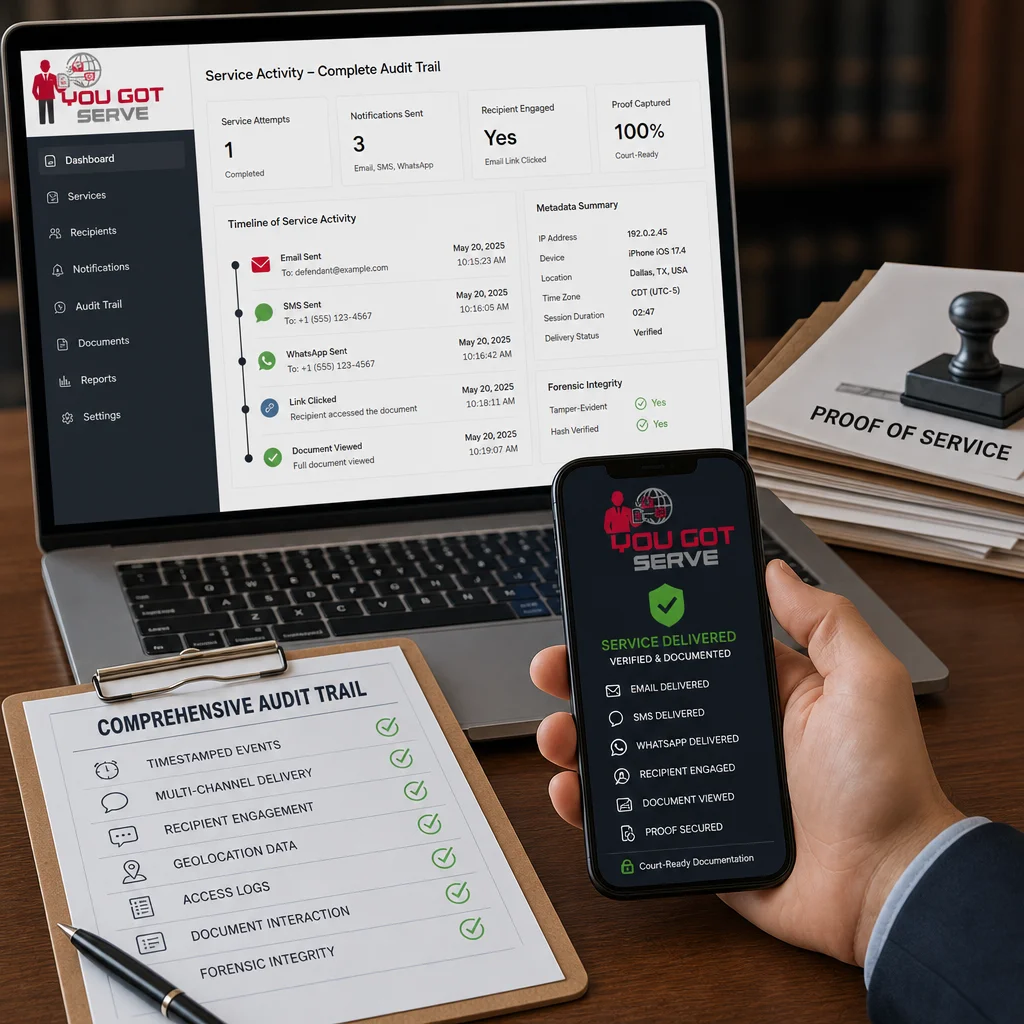
    Courts rely on these records to confirm that service was actually accomplished. The more granular your documentation, the stronger your proof. When the time comes to demonstrate service to the court, you will have a detailed electronic trail rather than relying on a server’s word or a failed attempt.

    How You Got Serve Streamlines Motion Compliance

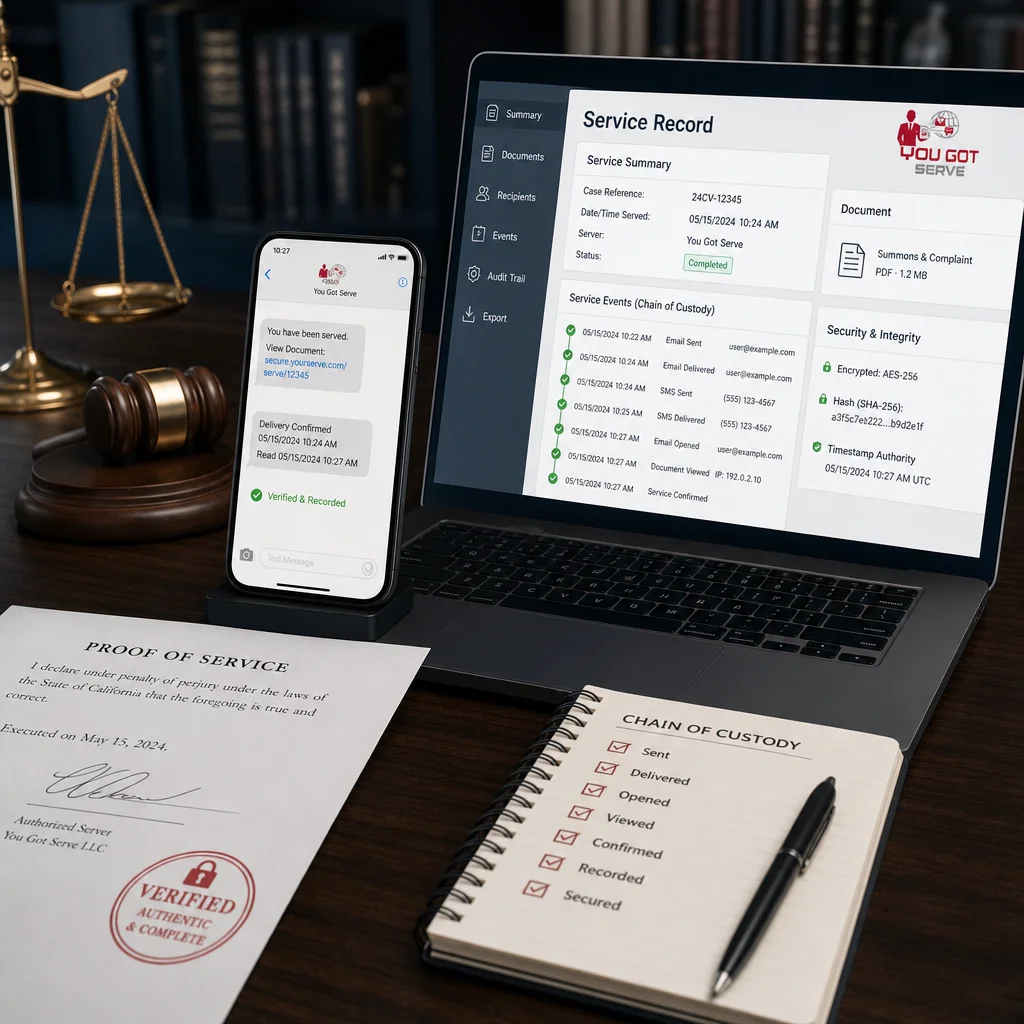
    This is where we help. We designed You Got Serve to produce exactly the documentation courts require when you file a motion for alternative electronic service.

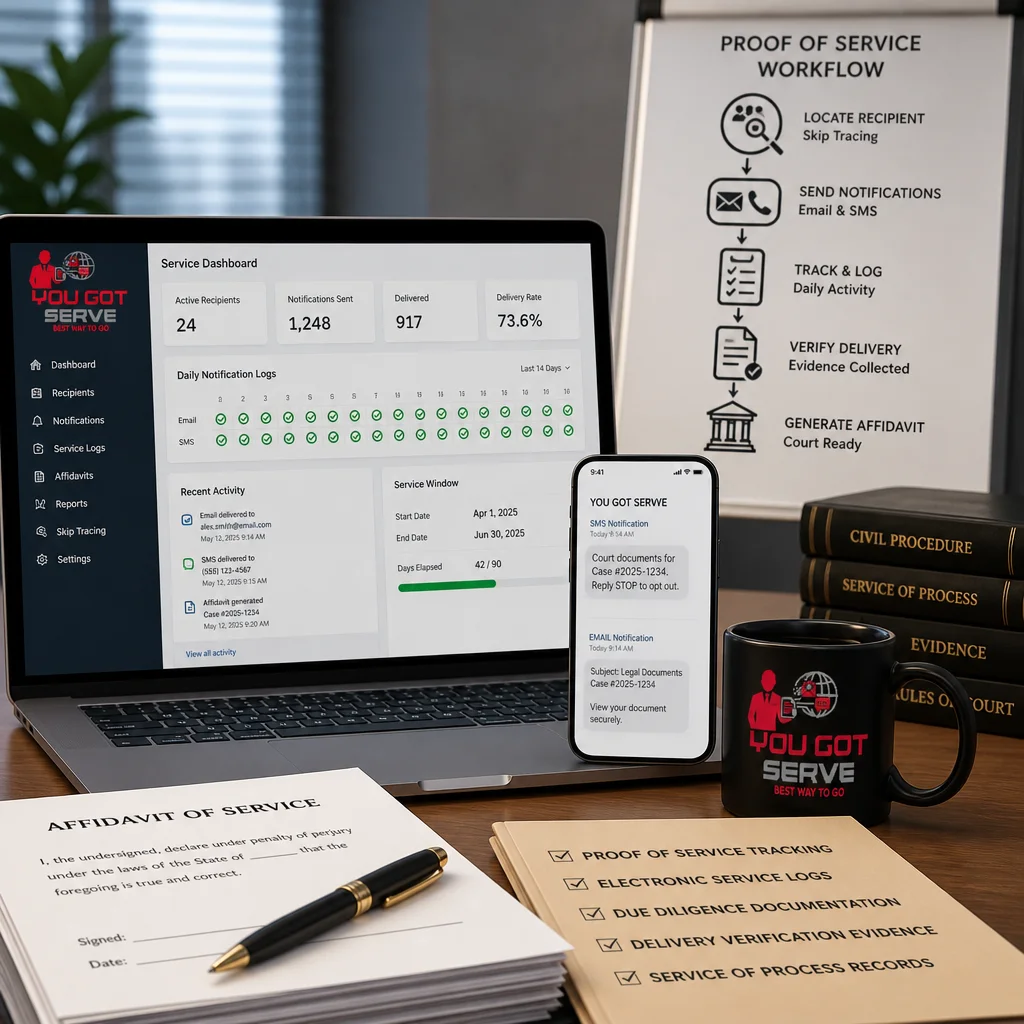
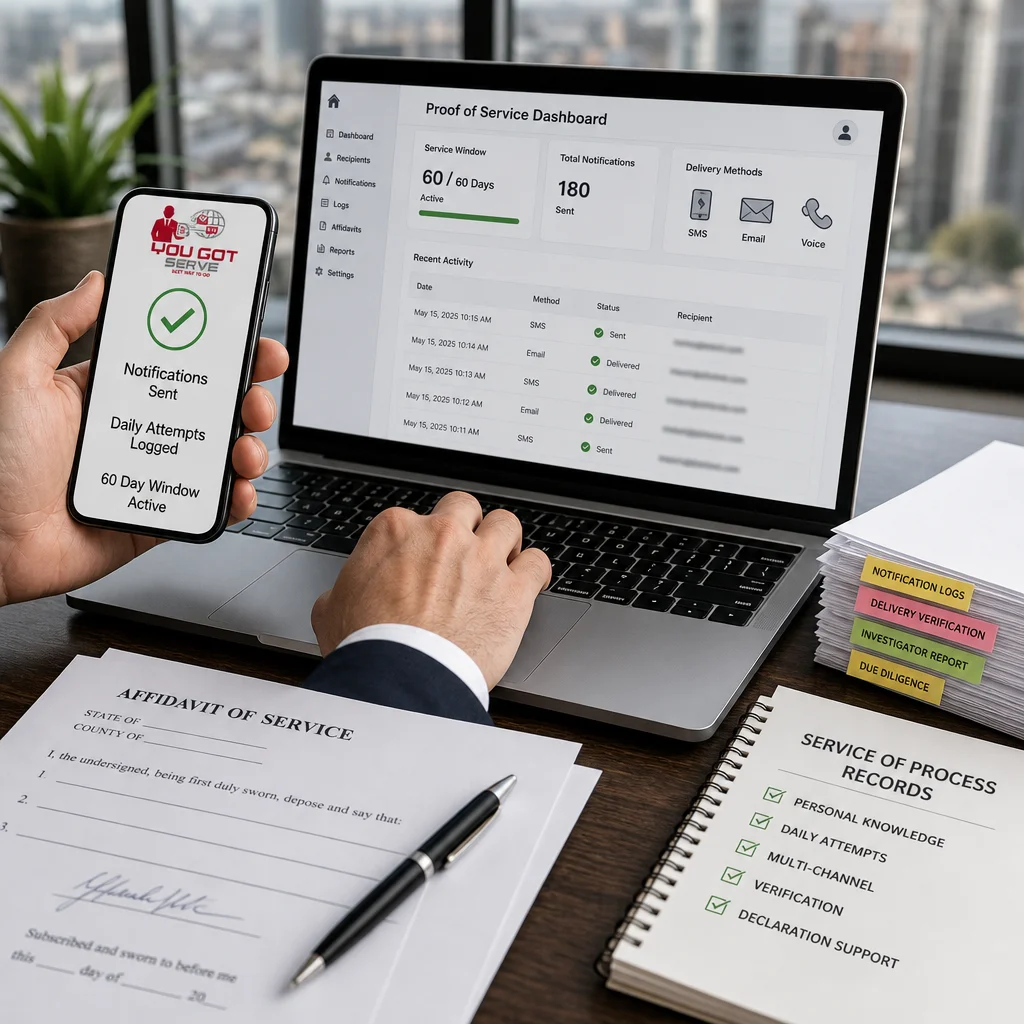
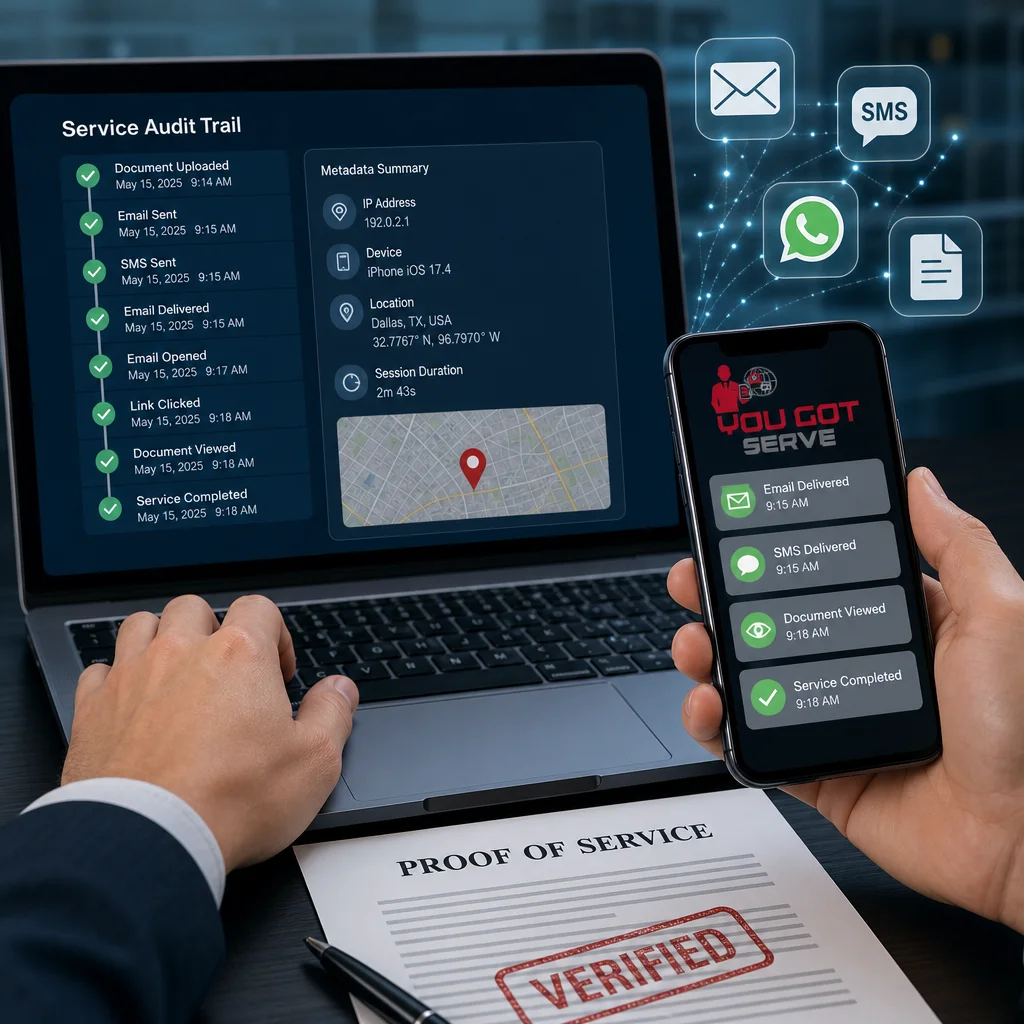
    Our platform automates the core functions your motion promises: persistent multi-channel notification, secure document retrieval, and verified delivery tracking. You upload your court documents once. We deliver them via email, SMS, and WhatsApp daily for your chosen duration (60 or 90 days). Every transmission, access, and interaction generates a timestamped record.

    Here’s what we provide:

    • Dual email and SMS delivery to up to three addresses and three phone numbers per recipient
    • Automated daily notifications over 60 or 90-day campaigns
    • Secure, code-protected document access (no leaked PDFs)
    • Recipients can verify their identity via selfie if you enable it
    • Geolocation tagging on document access
    • Complete notification history and document-access logs
    • Export-ready proof of service reports

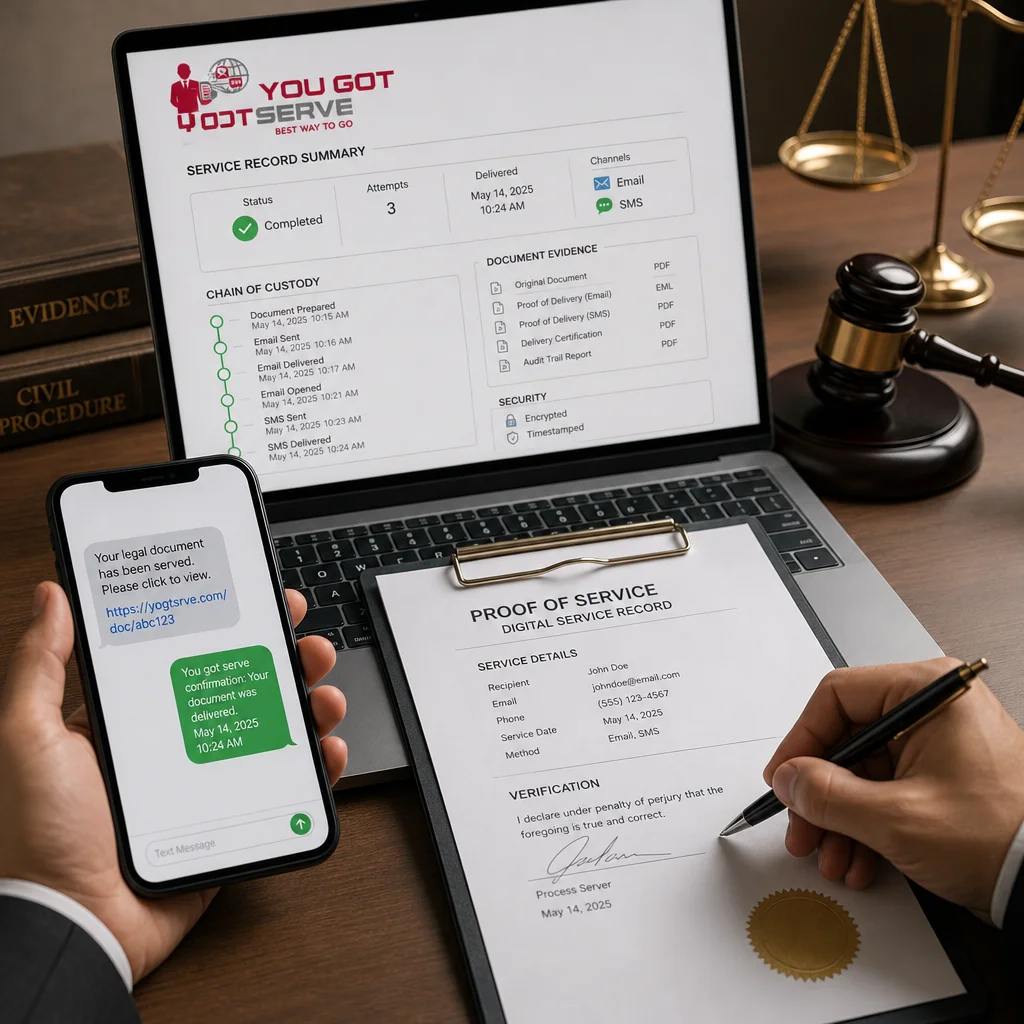
    When your court asks for proof of service, you download your activity report directly from our platform. You are not scrambling to piece together screenshots or handwritten notes. You have a professional, timestamped, court-ready record.
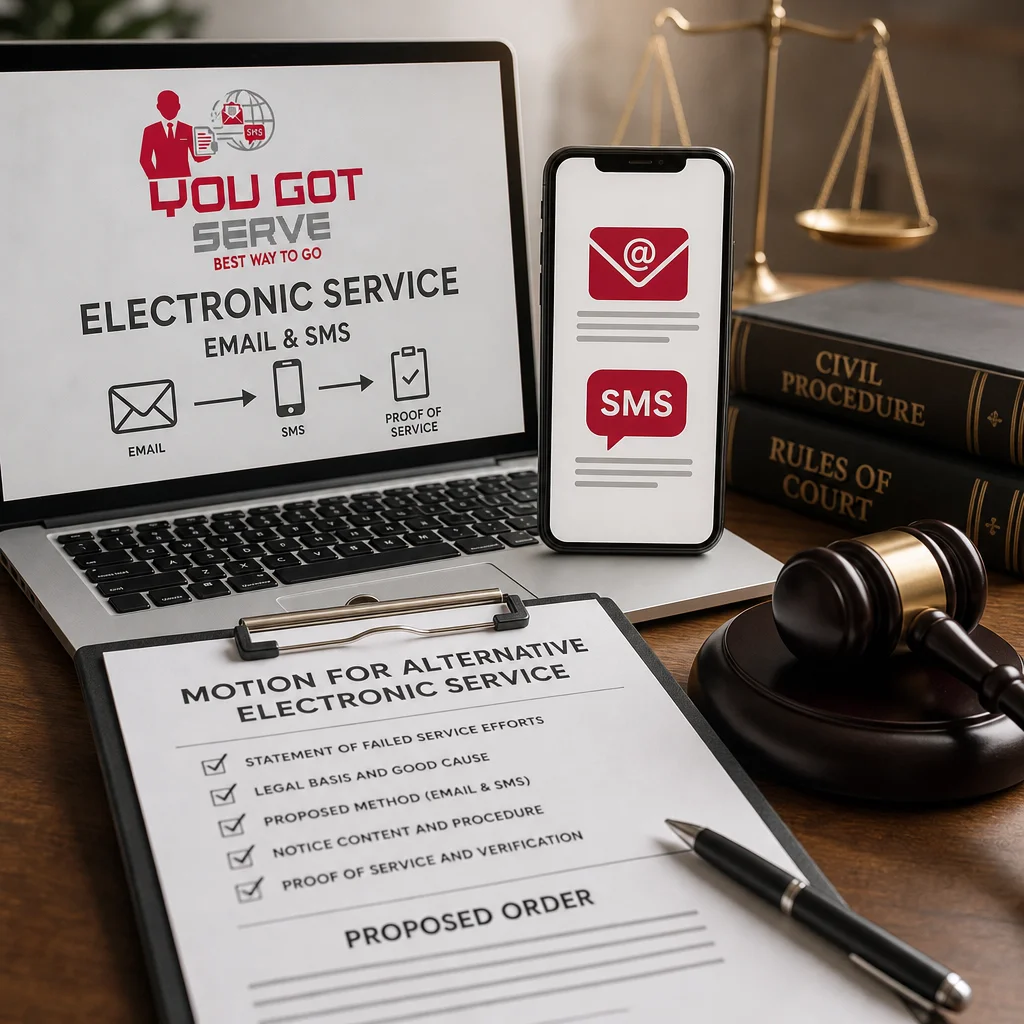
    We also offer investigative skip tracing if you lack current contact information for the recipient. If your motion requires you to locate the defendant, our investigative partners can help you gather verified email and phone numbers.

    Building Your Proposed Order Language

    Your proposed order is the document the judge actually signs. It must be precise and executable.

    Here is a template you can adapt:

    “IT IS ORDERED that Plaintiff [or Petitioner] may effectuate service of process on Defendant [Name] by electronic notification as follows: (1) Plaintiff shall transmit the Complaint, Summons, and all other required documents to Defendant at email address(es) [list] and/or phone number(s) [list], or to such other contact information as Defendant provides during the pendency of this action; (2) Notifications shall be sent daily via email, SMS, and WhatsApp (where available) for a period of [60 or 90] consecutive calendar days from the date of this Order; (3) Each notification shall include a clear statement that it concerns a legal matter requiring Defendant’s attention, the case caption, and instructions for accessing the documents via a secure, code-protected portal; (4) Plaintiff shall preserve all transmissions, delivery reports, access logs, and related records and shall provide them to the court and to opposing counsel upon request; (5) Service shall be deemed complete upon the first transmission of any notification to Defendant. Alternatively, if Defendant accesses the documents via the secure portal, service is confirmed by such access.”

    This language is specific enough to guide implementation and broad enough to accommodate minor variations in how notifications occur. Courts like orders they can enforce.

    Addressing Jurisdictional and Local Rule Requirements

    Every jurisdiction has its own rules. Federal court operates under the Federal Rules of Civil Procedure. State courts follow their own procedural codes and local rules. Some district courts have standing orders on electronic service; others require case-by-case judicial approval.

    Before you draft your motion, research your jurisdiction’s requirements:

    • Federal courts: Review Rule 4(f) and any relevant case law. Some districts have local rules addressing electronic service explicitly.
    • State courts: Check your state’s civil procedure rules (often Rule 4 or equivalent) and any local rules specific to your court or judge.
    • Specific judges: If your case is assigned, review that judge’s standing orders or prior rulings on electronic service motions.

    Your motion will be stronger if you acknowledge local practice and frame your request within your jurisdiction’s legal framework. If your jurisdiction requires prior unsuccessful attempts at traditional service, say so and document it. If your jurisdiction requires notice to opposing counsel, confirm that in your motion.

    Compliance with local rules is not optional. It is the foundation of judicial acceptance.

    Electronic Service Verification Features That Strengthen Your Filing

    Courts evaluate electronic service proposals partly on the verification methods you offer. The more verification you provide, the harder it is for opposing counsel to challenge the validity of service.

    Consider including these features in your motion and order:

    • Timestamped SMS and email delivery confirmations (automatic)
    • Document-access logs showing the date and time the recipient opened the files
    • Geolocation data indicating where the recipient accessed the documents
    • Selfie or identity verification (optional; available through our platform)
    • Unique, one-time access codes that only the intended recipient can use
    • Email bounce-back reports and SMS delivery status notifications

    Each of these elements creates a layer of proof. A judge reviewing your proof of service affidavit will see not just “an email was sent” but “an email was sent on February 1, 2026 at 9:47 a.m., delivered to [address], opened by the recipient on February 1, 2026 at 2:15 p.m., from [geolocation].” That specificity is persuasive.

    Automated Tracking and Daily Notification Records
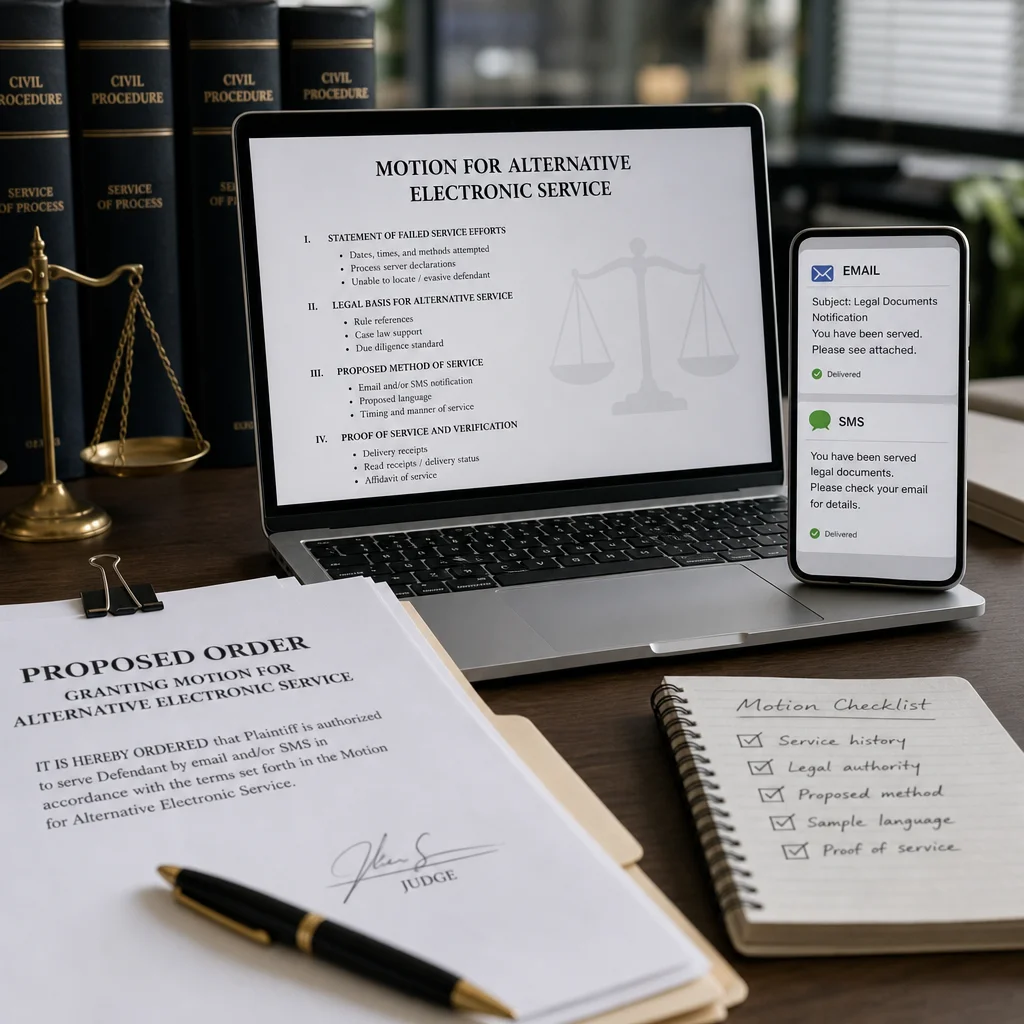
    One reason courts hesitate with electronic service is fear that a one-time email or text will be lost or ignored. You solve this concern through automation.

    Your motion should commit to daily notifications over an extended period (we recommend 60 or 90 days). This persistence demonstrates sincere effort and increases the probability that the defendant will eventually see and act on the notice.

    Automated systems also eliminate human error. You do not have to manually send 60 emails and hope you do not miss a day. The platform handles it. Every morning, the recipient receives a notification. Every notification is logged. By the end of 90 days, you have a record of 90 distinct notification attempts, each with its own timestamp and delivery confirmation.

    When you present this record to the court, you are showing methodical, documented diligence. You are not gambling on a single email arriving and being read. You are executing a deliberate, documented plan.

    Why Courts Accept Your Got Serve Documentation

    Courts accept our documentation because it is built to meet judicial expectations. We have processed thousands of electronic service campaigns and refined our records to address judicial skepticism.

    Here is what makes our proof of service reports court-ready:

    1. Comprehensive record. Each report shows every notification attempt, delivery status, access event, and timestamp. Nothing is hidden or summarized away.
    1. Third-party verification. Our platform is independent. We are not you; we are a neutral third party logging the activity. That independence carries weight.
    1. Tamper-evident design. Our records include encrypted timestamps and system logs that are difficult to falsify or modify. Courts appreciate proof that cannot be easily questioned.
    1. Standard format. Our reports are consistently formatted and professional in appearance, making them easy for judges and court clerks to review and understand.
    1. Specific to the jurisdiction. We support electronic notifications within the United States and internationally where technically available and legally appropriate, and we tailor our documentation to reflect the jurisdiction and rules governing your case.

    Courts do not accept all electronic service. But when you use a platform built to produce compliant, detailed, verifiable records, your service survives scrutiny.

    Moving Forward: Filing Your Motion With Confidence

    You now have the framework to draft a motion for alternative electronic service that courts will approve and execute with professional documentation.

    Start by researching your jurisdiction’s rules. Draft your motion following the structure we outlined, supported by your factual narrative of failed service efforts. Build your proposed order using our template. Then, execute service through how electronic service works.

    The legal validity of your service depends on compliance with local rules and court approval, so check your jurisdiction before filing. But once your motion is granted, you have a clear, documented path to reaching a difficult-to-locate defendant. You Got Serve handles the platform and the records. You focus on your case.

    We have designed our system specifically to support the motion and order process you just read about. Upload your documents, specify your contact information, choose your 60 or 90-day campaign, and we manage daily delivery and verification. When the court asks for proof of service, you have a professional, timestamped, export-ready report.

    Filing a motion for alternative electronic service is no longer a technical gamble. With the right template, the right legal foundation, and the right platform, it is a straightforward, compliant, and effective way to serve defendants who evade traditional service. You Got Serve gives you the tools to make it work.
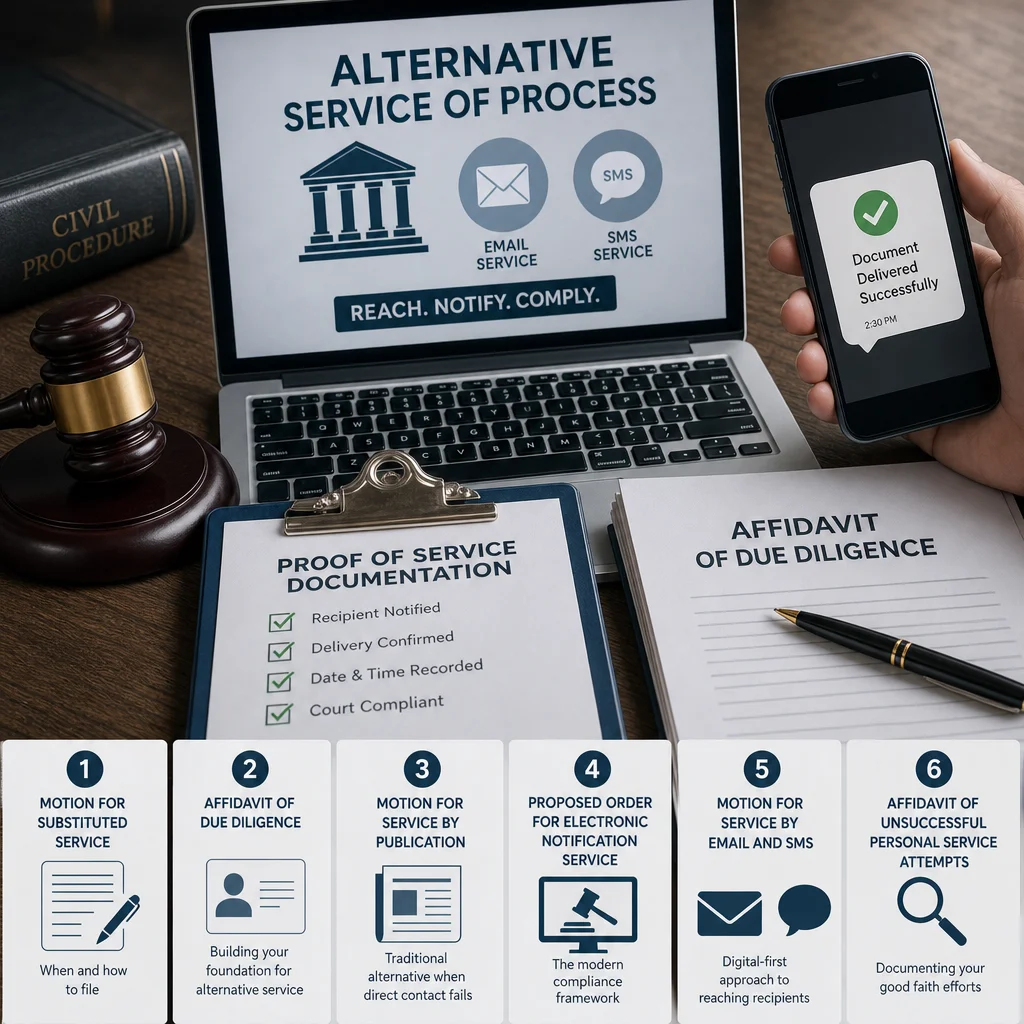
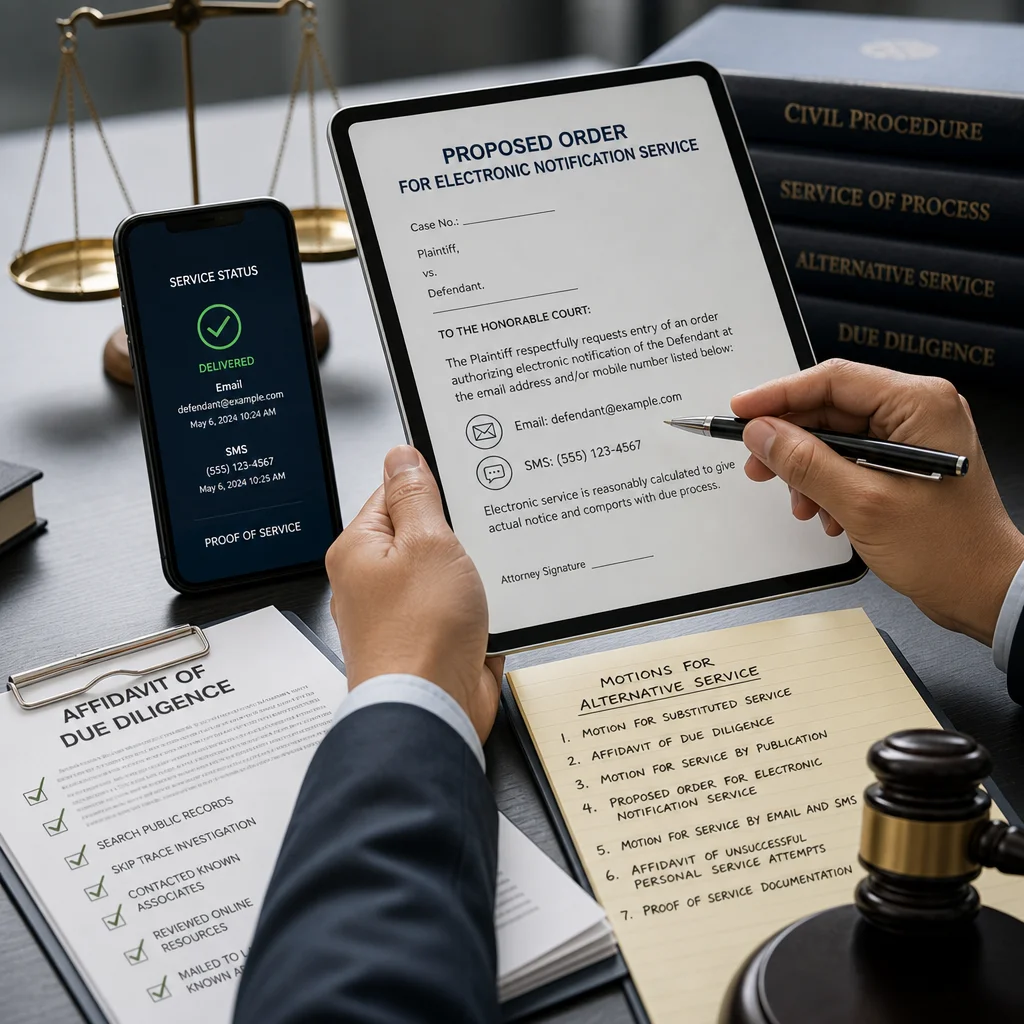
  • 7 Best Motions and Affidavits for Alternative Service of Process

    7 Best Motions and Affidavits for Alternative Service of Process

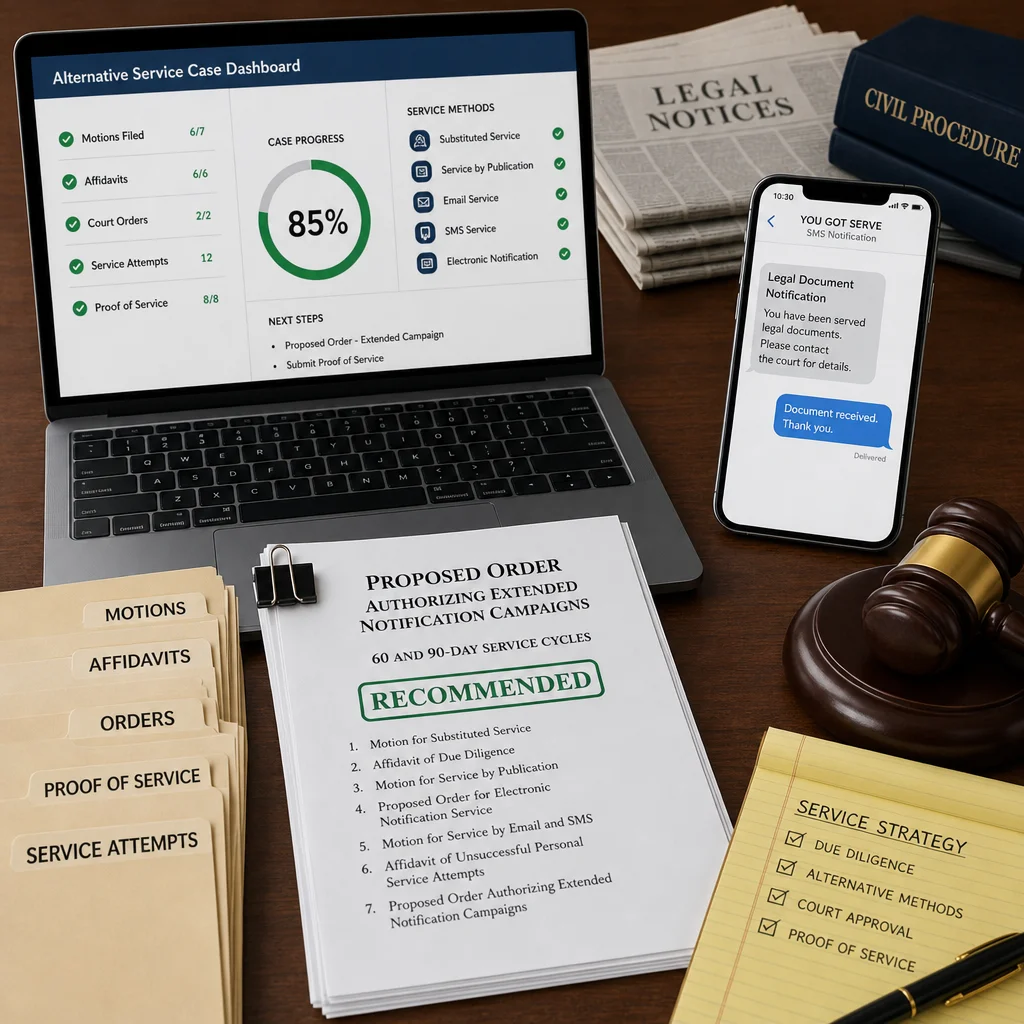
    1. Motion for Substituted Service – When and How to File

    When a defendant disappears, ignores mail, or simply refuses to accept service, traditional personal service becomes impossible. Courts recognize this reality and allow alternative methods, but only when you can demonstrate why standard approaches failed. The right motion and supporting affidavit can mean the difference between a case moving forward and a dismissal.

    We’ve worked with legal professionals and self-represented litigants alike who face this exact challenge. The solution isn’t guesswork. It’s a structured approach using the seven key filings that courts recognize as legitimate pathways to service. Each one serves a specific purpose and requires precise documentation. Here’s what you need to know to file them correctly.

    Substituted service allows you to leave documents with someone other than the defendant, or at an alternative location, when personal service proves impossible. This motion explains to the court why you cannot reach the defendant directly and why your chosen alternative location or person is reasonably likely to give actual notice.

    Courts require you to show genuine efforts at personal service first. Typically, you’ll need to demonstrate multiple attempts on different days and at different times. Your motion should specify exactly where and when you tried to serve the defendant, who you encountered, and why substituted service at the proposed alternative location (often the defendant’s last known residence or workplace) makes sense.

    The strength of your substituted service motion rests on detailed prior attempts. Document each effort with dates, times, and specific results. If you attempted service at 8 a.m. and found no one home, document it. If you returned at 2 p.m. and encountered a neighbor who said the defendant no longer lived there, include that detail. Courts view this pattern as evidence of diligence rather than carelessness.

    Actionable takeaway: Before filing, compile a timeline of at least three documented attempts at personal service, including failed attempts on different days of the week and times of day. This foundation strengthens your motion and speeds court approval.

    2. Affidavit of Due Diligence – Building Your Foundation for Alternative Service

    An affidavit of due diligence is your formal, sworn statement that you’ve done everything reasonably possible to locate and serve the defendant. This document becomes the backbone of any alternative service motion. Without it, courts won’t consider alternative methods, regardless of how sensible they seem.

    Due diligence means more than sending a single letter or knocking on one door. It means conducting a reasonable investigation given the circumstances. This typically includes contacting known family members, checking the defendant’s workplace if you have that information, visiting the last known address on multiple occasions, and sometimes reviewing public records or using skip-tracing services when the defendant has genuinely disappeared.

    We help our clients create documented notification campaigns that form part of their due diligence record. When you need to serve someone at an unknown address, combining multiple notification channels through SMS, email, and WhatsApp creates a visible, timestamped record. Each failed delivery attempt becomes evidence that you tried everything reasonably available.

    Your affidavit should explain not just what you did, but why you did it and what you learned. Write clearly and specifically: “I visited 405 Oak Street on March 10, 2026 at 9:30 a.m., spoke with the building manager who stated the defendant moved out in February, and left a note requesting contact information.” This narrative demonstrates reasonable investigation.

    Actionable takeaway: Include investigative information in your due diligence affidavit: skip-trace results, responses from known contacts, failed mail deliveries, and employment verification efforts. Each data point strengthens your claim that the defendant is genuinely difficult to locate.

    3. Motion for Service by Publication – Traditional Alternative When Direct Contact Fails

    Service by publication allows you to serve a defendant through newspaper or court-ordered publication when you cannot locate them at all. This method is older, more expensive, and increasingly outdated, but courts still recognize it as a valid option when other alternatives are exhausted.

    Filing a motion for service by publication requires you to prove that the defendant’s location is unknown despite reasonable efforts. You’ll need to show that you’ve checked public records, contacted known relatives, searched the defendant’s last known address, and attempted to locate current employment. The motion should explain why electronic or substituted service won’t work because you simply don’t know where the defendant is.

    Once approved, you must publish a notice in a local newspaper for a specified period, typically 2-4 weeks. The court then must wait an additional period before proceeding, allowing time for the defendant to potentially see the notice. The entire process often takes 6-8 weeks and costs several hundred dollars in publication fees, making it considerably more expensive and slower than modern digital alternatives.

    Courts increasingly understand that newspaper publication is inefficient for reaching modern defendants who rarely read classified notices. Yet some jurisdictions still require it or consider it a prerequisite for other methods. Always check your local court rules before filing.

    Actionable takeaway: File a motion for service by publication only when other methods are truly exhausted. If you proceed, coordinate all publication requirements carefully and keep detailed proof that notices actually ran on the dates the court specified.

    4. Proposed Order for Electronic Notification Service – The Modern Compliance Framework

    A proposed order for electronic notification service is your blueprint for court-approved digital service. Rather than asking permission to try service by publication or traditional newspaper notice, you’re asking the court to authorize SMS and email delivery as primary notification methods.

    This order works because it shows courts that you’re using reliable, documented technology. Electronic notification via SMS and email creates an automatic timestamped record proving when messages were sent and when they were delivered or failed. When the defendant activates a secure access code to view court documents, that action is recorded too. All of this documentation becomes your proof of service.

    The proposed order should specify exactly how often notifications will be sent (daily, weekly, or on a defined schedule), how long the notification campaign will run, and which contact information you’ll use. It should reference your due diligence efforts and explain why electronic service is appropriate for your case. Most importantly, it should address verification methods: will the recipient need to confirm receipt, and what documentation will you provide to the court?

    Courts appreciate orders that make electronic service systematic rather than ad hoc. Propose clear timelines, define success metrics (whether proof of access or simple delivery confirmation), and explain how your chosen method provides better notice than alternatives.

    Actionable takeaway: When drafting your proposed order, specify whether you’ll use a single notification method or multiple channels (email, SMS, WhatsApp) to maximize the likelihood of actual notice. Multiple channels create documented redundancy that courts view favorably.

    5. Motion for Service by Email and SMS – Digital-First Approach to Reaching Recipients

    A motion for service by email and SMS is your direct request to use digital channels as your primary service method. This motion works best when you have verified email addresses or phone numbers for the defendant, even if they’ve proven unresponsive to traditional service attempts.

    Your motion should explain that the defendant has email and phone contact information on file (from prior communications, business transactions, or social media), that personal service has failed despite reasonable efforts, and that electronic service through these channels is more likely to achieve actual notice than newspaper publication or other traditional methods.

    The key advantage of digital service is speed. An SMS arrives within seconds. An email with a secure access link can be verified immediately if the recipient opens it. With electronic document delivery platforms, you can send repeated notifications over 60 or 90 days, creating an undeniable record of contact attempts. Each notification is timestamped and each access is logged.

    Courts increasingly recognize that someone with an active email address or phone number is far more likely to notice digital messages than newspaper notices they’ll never see. Your motion should make this practical argument: electronic service is faster, more reliable, and less expensive than traditional alternatives, all while creating superior documentation.

    Actionable takeaway: Attach copies of any communications proving the defendant has checked the email address or used the phone number you intend to serve. Recent text exchanges, email replies, or account activity demonstrates that service to these addresses will likely achieve actual notice.

    6. Affidavit of Unsuccessful Personal Service Attempts – Documenting Your Good Faith Efforts

    An affidavit of unsuccessful personal service attempts is your sworn statement proving that direct personal service genuinely failed despite repeated, documented efforts. This affidavit shifts the burden away from alternative service methods and onto demonstrable facts: you tried, it didn’t work, and now alternative service is necessary.

    Structure this affidavit chronologically. Begin with your initial service attempt, specify the date, time, location, and what happened. Did you encounter the defendant? Did someone refuse service on their behalf? Was the address incorrect? Did the defendant refuse to open the door? Document every single interaction, including conversations with neighbors, building managers, employers, or mail carriers.

    The most compelling affidavits include not just failures but explanations for why the defendant is evading service. Perhaps they’ve moved without providing a forwarding address. Perhaps mail is returned marked “address unknown.” Perhaps neighbors report that the defendant hasn’t been seen in weeks. These details matter because they show courts that impersonal, traditional service methods won’t work.

    We see clients strengthen these affidavits by supplementing traditional service attempts with electronic notification attempts using multiple channels. When an SMS to the defendant’s known number bounces back as invalid, or when an email to a business contact address goes unanswered despite a read receipt, these documented failures become part of your affidavit. They prove that the defendant is genuinely unreachable through conventional means.

    Actionable takeaway: For each service attempt in your affidavit, specify not just that it failed, but how you know it failed. A returned certified letter marked “refused” is better evidence than simply stating “service was refused.” Detailed descriptions create a compelling narrative.

    7. Proposed Order Authorizing Extended Notification Campaigns – Supporting 60 and 90-Day Service Cycles

    A proposed order authorizing extended notification campaigns allows you to send repeated notifications over 60 or 90 days, maximizing the likelihood that a hard-to-reach defendant will eventually receive and process your court documents.

    This order recognizes a modern reality: a single notification attempt might fail for legitimate reasons. The recipient’s phone might be off. Their email might be full. They might have temporarily lost access to their device. But repeated notifications over weeks or months, delivered through multiple channels, create an overwhelming likelihood that actual notice will occur.

    Your proposed order should specify the notification frequency (daily, for example), the channels you’ll use (SMS, email, and WhatsApp where available), and the documentation you’ll provide to prove service. It should state that the recipient will access documents through a secure code-protected portal, with each access logged and timestamped. It should commit to providing the court with a final affidavit showing all notification attempts, their results, and any document access activity.

    Courts appreciate orders that balance persistence with reasonableness. Notifying someone 90 times on the same day isn’t diligent; it’s harassment. But notifying them daily over 90 days, reaching them through multiple channels and providing verified access documentation, demonstrates genuine effort to achieve notice without abusing the process.

    Actionable takeaway: When proposing an extended campaign, include specific language about your verification methods. Will you capture geolocation data? Will you require the recipient to enter a selfie before accessing documents? Will you log timestamps of document views? The more detailed your verification commitment, the stronger your order.

    —

    Successfully serving a hard-to-find defendant requires the right motion, a credible affidavit, and a clear strategy. You’re not asking courts for permission to skip due diligence. You’re asking them to recognize that you’ve done everything reasonably possible through traditional methods and now need access to more efficient, documented alternatives.

    The filings we’ve outlined here work together. Your affidavit of due diligence establishes your good faith. Your motion for substituted, publication, or electronic service explains why you need an alternative. Your proposed order details exactly how service will occur and what documentation will prove it worked. Courts reward this organized, thoughtful approach.

    When you’re ready to implement how it works, a digital-first platform designed for verified electronic service becomes invaluable. Rather than submitting affidavits based on theory, you submit affidavits backed by actual timestamped SMS and email notifications, secure document access logs, and verification data. You’re no longer hoping service worked; you’re proving it did.

    We’ve designed our platform specifically for this purpose: persistent, multi-channel notification over extended campaigns, combined with secure code-protected document access and detailed delivery documentation. Whether you’re representing a client or managing your own case, this approach gives courts the confidence they need to approve alternative service and move your litigation forward.

  • Best Electronic Service Solutions by State: Your Complete Compliance Guide for 2026

    Best Electronic Service Solutions by State: Your Complete Compliance Guide for 2026

    The Challenge: Serving Documents Across State Lines Without Court Delays

    Serving court documents to defendants or respondents across state lines creates real friction. Traditional methods like certified mail, personal service, or newspaper publication can take weeks or months, cost hundreds of dollars, and still fail to confirm that the recipient actually received notice. When a defendant is hard to locate or unresponsive, the delay compounds: courts won’t move forward until you’ve satisfied service requirements, and those requirements vary significantly from state to state.

    Many litigants and legal professionals face a bottleneck: state courts accept electronic service under certain conditions, but those conditions differ. What works in one jurisdiction may not be permitted in another. Without clear guidance and a reliable delivery platform, you risk service being rejected and having to start over.

    Our goal is to help you navigate these state-level rules and execute electronic service efficiently. The right platform gives you proof of delivery, automated tracking, and documented attempts across all contact points, eliminating ambiguity when you present proof of service to the court.

    Why Electronic Service Matters: Cost, Speed, and Compliance

    Electronic service eliminates many inefficiencies of traditional methods. Instead of paying for registered mail or waiting for a process server to locate the defendant, you can deliver documents via email and SMS in minutes. Costs drop from hundreds to a predictable, affordable price. Speed improves dramatically: notifications can be sent daily, creating a documented record of attempts within days rather than weeks.

    Compliance becomes measurable too. When you use a platform with timestamped delivery logs, recipient verification, and geolocation data, you build a defensible proof-of-service record. Courts increasingly recognize electronic service when statutory requirements are met, and your documentation makes approval straightforward.

    For self-represented litigants and small law firms, electronic service levels the playing field. You gain access to infrastructure and verification tools that were once available only to large practices. Cost savings can be reinvested in case preparation or client communication.

    Federal and State Electronic Service Rules at a Glance

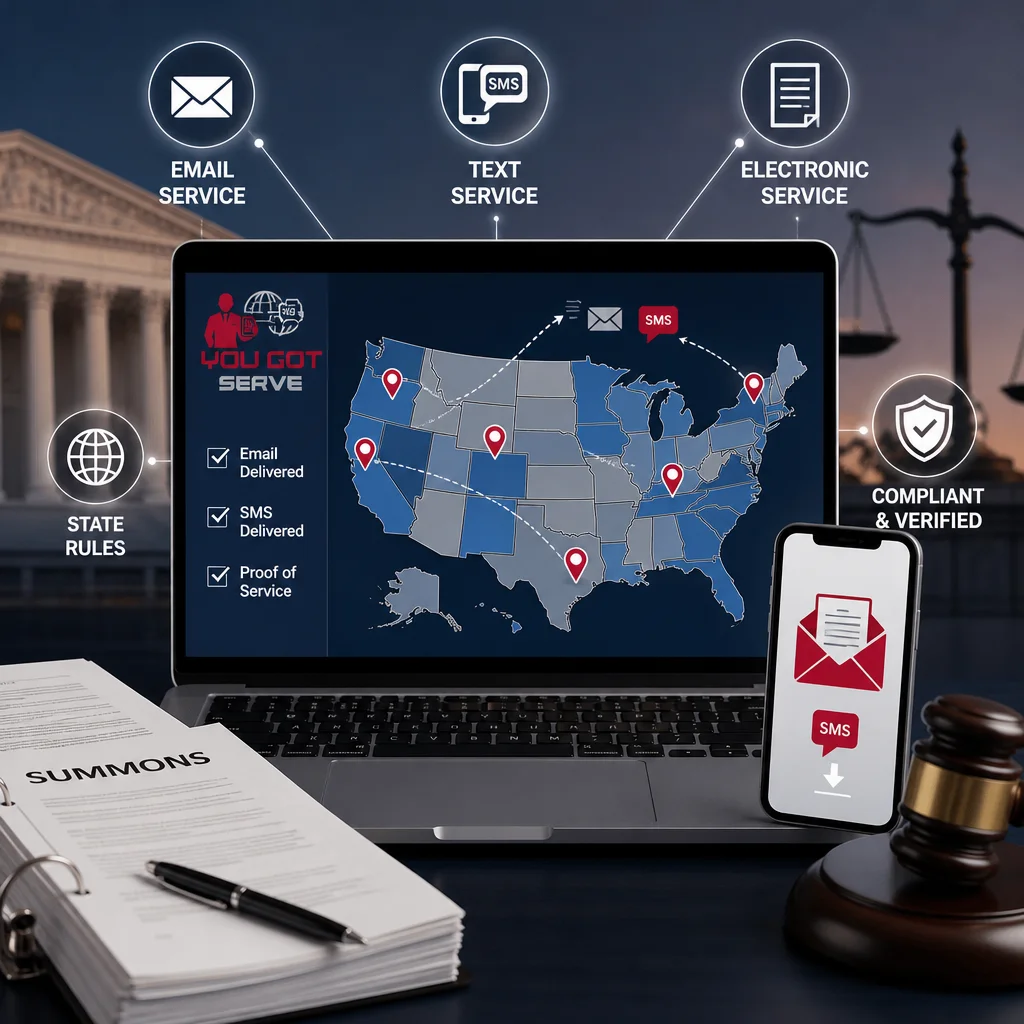
    Federal courts operate under Federal Rule of Civil Procedure 5(b)(2)(E), which permits electronic service by any method agreed to by the parties or authorized by court order. This flexibility is a starting point, but state courts apply their own rules.

    State courts typically reference rules like:

    • California (Code of Civil Procedure 1010.6): permits electronic service for most civil cases with consent or court order.
    • New York (CPLR 213): allows electronic service under specific conditions; rules vary by court.
    • Texas (Texas Rules of Civil Procedure 21a): permits electronic service with prior consent or court authorization.
    • Florida (Florida Rules of Civil Procedure 1.080): allows electronic service with consent or court order.

    Each state also has special rules for particular case types: family law, probate, small claims, collections, or administrative proceedings. Some states impose notice requirements; others require a specific format for documents.

    The common thread: most states accept electronic service when parties consent, when court orders permit it, or when service rules explicitly authorize it. Your responsibility is to confirm which rule applies before relying on any electronic method.

    How YouGotServe Meets Multi-State Electronic Service Requirements

    We designed our platform to support compliant electronic notification across multiple jurisdictions. Here’s how we address state-level requirements:

    Multiple contact channels: You can enter up to three email addresses and three phone numbers per recipient. This redundancy meets state rules that require reasonable attempts to reach the recipient. Daily automated notifications through email, SMS, and WhatsApp (where available) create a documented pattern of attempts.

    Extended notification cycles: Our 60-day and 90-day service plans ensure adequate notice periods align with state expectations. Recipients cannot claim surprise; the record shows persistent, daily outreach.

    Secure document access and verification: Recipients retrieve documents using a unique one-time access code. We capture available verification data including selfie confirmation, geolocation, timestamps, and notification history. This multi-layer verification strengthens your proof of service in court.

    Detailed activity logs: Every notification sent, every document viewed, and every access attempt is timestamped and logged. You export this complete record as your proof of service, eliminating guesswork about what the court will accept.

    These features work together to support compliance with electronic service rules across jurisdictions. We don’t provide legal advice, but we build the documentation courts expect to see.

    State-by-State Compliance: What Rules Allow Electronic Notification

    Before you serve electronically in any state, verify the specific rule that permits it. Here are common categories:

    Consent-based service: Many states permit electronic service if the defendant or their attorney consents in writing. Email, SMS, or a signed agreement on file can establish consent.

    Court order authorization: When consent isn’t feasible, you can petition the court for an order permitting electronic service. Grounds often include: defendant’s address is unknown, defendant is evading service, or traditional methods have failed.

    Statutory electronic service rules: Some states (California, Florida, Texas, New York) have codified rules allowing electronic service in specific contexts without requiring prior consent, particularly in business disputes or administrative proceedings.

    Publication and alternative service: When personal service fails, most states permit publication in a newspaper or, increasingly, electronic notice on a state-authorized platform or the defendant’s known digital accounts.

    Your first step: identify which rule applies to your case type and jurisdiction. Courts maintain online rule libraries; legal databases also provide state-specific guidance. If unsure, consult a local attorney familiar with the court’s practices.

    Verification and Proof Requirements Across Different Jurisdictions

    Courts expect proof that service was effective. Proof-of-service standards vary by state, but they generally require:

    Attestation of delivery: Who sent the documents, when, to which addresses, and confirmation that delivery occurred or was attempted.

    Evidence of recipient access (when applicable): Some courts want to see that the defendant actually opened the email or read the message. Others accept proof of transmission alone.

    Timeliness: Service must occur within statutory deadlines (often 30 to 90 days before a hearing or trial).

    Adequate notice period: Many states require at least 10 to 21 days between service and the hearing to give the recipient fair opportunity to respond.

    Our platform provides all these elements automatically. Your proof-of-service record includes:

    • Complete notification history with timestamps and recipient contact information
    • Document access activity, including date, time, and geolocation (if available)
    • Selfie verification or other recipient confirmation (if captured)
    • Status indicator (Pending or Delivered)

    When the time comes to file proof of service with the court, you attach our generated activity report. The level of detail often exceeds court expectations, strengthening your position.

    Building Your Service Strategy: Email, SMS, and Multi-Channel Delivery

    A single-channel approach risks failure. Email addresses change; phone numbers get reassigned; people ignore messages from unknown senders. Multi-channel delivery significantly improves the odds that the recipient sees your notice.

    Here’s a practical strategy:

    Start with all available contacts: Upload three email addresses and three phone numbers. If the defendant’s current information is uncertain, include former addresses or numbers. Redundancy increases the chance of reaching the person.

    Layer SMS and email for maximum reach: Email is formal and creates a digital record. SMS is immediate and hard to ignore. Together, they cover most communication preferences. WhatsApp extends reach where other channels fail (particularly international cases).

    Automate daily notifications: Don’t rely on a single send. Our platform delivers notifications every day during your service period. This pattern demonstrates reasonable, persistent effort and aligns with most state court expectations.

    Document each attempt: Every notification attempt, whether opened or not, appears in your activity log. This creates an ironclad record: you tried, repeatedly, through multiple channels.

    When you build this documented trail, even if the defendant claims they didn’t receive notice, your proof shows you acted diligently and reasonably. Courts recognize this level of effort.

    When Traditional Service Fails: Investigation and Alternative Location Support

    Sometimes you lack current contact information. The defendant’s address is stale, phone number disconnected, email unknown. Before you pivot to newspaper publication (slow and expensive), investigative services can help locate the person.

    We partner with investigative professionals to assist customers who need skip tracing or updated contact data. A targeted search often uncovers a current address, phone number, or email within days. Once you have that information, electronic service becomes feasible and cost-effective.

    Steps to consider:

    • Provide any known details: last known address, employment history, names of relatives, previous phone numbers, social media profiles.
    • Allow 3 to 5 business days for investigation and updated information.
    • Once new contact data arrives, upload it to our platform and launch your electronic service campaign.

    This combination—investigation followed by electronic service—frequently succeeds where newspaper publication alone would be slow and uncertain. You gain a higher likelihood of actual notice, faster resolution, and complete documentation.

    Comparing Electronic Service to Newspaper Publication and Other Methods

    Newspaper publication is the traditional fallback when you can’t locate a defendant. It’s expensive (often $500 to $1,500 per publication), slow (4 to 8 weeks for multiple required publications), and provides no proof the defendant actually read the notice. The newspaper runs your ad, you file an affidavit, and the court accepts it. But did the defendant see it? Unknown.

    Certified mail with return receipt is reliable but slower than electronic service. If the defendant refuses delivery, you’re back to square one.

    Electronic service with our platform is faster, more affordable, and provides better proof of actual delivery or access. For $350 to $500 over 60 or 90 days, you get daily notifications, multi-channel delivery, and complete activity logs. That’s 1/3 to 1/10 the cost of newspaper publication, with far better documentation.

    The trade-off: electronic service requires court authorization or statutory permission in your jurisdiction, whereas newspaper publication is available as a fallback in most courts. But once you confirm that electronic service is permitted in your case, it’s the smarter choice.

    Creating Your Documented Service Record for Court Acceptance

    When you’re ready to file proof of service, courts expect a clear, organized record. Here’s what to include:

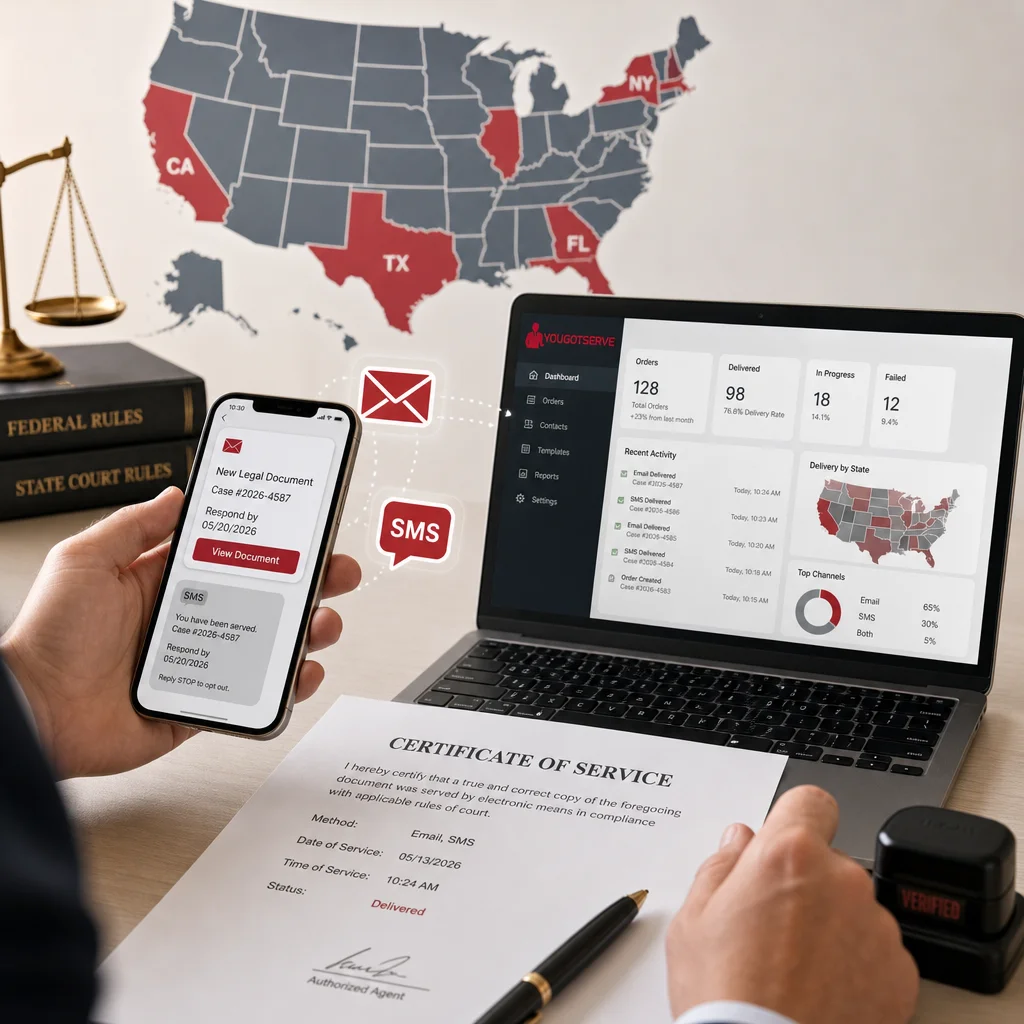
    Service affidavit or declaration: You certify, under penalty of perjury, that you served the defendant using electronic methods and describe those methods.

    Activity report from our platform: This export shows every notification sent, every recipient address used, all timestamps, access activity, and geolocation or verification data captured.

    Copy of the documents served: Include what was sent so the court can confirm completeness.

    Court order or consent agreement (if applicable): If service was authorized by court order or prior written consent, attach that document.

    Certificate of service: A standard form certifying service on all required parties.

    Courts receive hundreds of proof-of-service filings; a complete, organized submission signals professionalism and reduces scrutiny. When your record is thorough and timestamped, judges approve service quickly and move the case forward.

    Getting Started: Selecting Your Service Plan and Timeline

    Our platform offers two straightforward service plans:

    60-day service: $350. Best for time-sensitive cases, when you need service completed quickly and the recipient is reasonably likely to be reached within two months.

    90-day service: $500. Ideal when you want maximum persistence or when state rules require longer notice periods. The extended timeline strengthens your proof of diligence.

    Eligible organizations receive a 10% discount on either plan.

    To get started:

    • Gather the defendant’s or respondent’s contact information (emails and phone numbers).
    • Upload the documents you need to serve.
    • Select your plan and confirm your service timeline.
    • Monitor your account for delivery status and access activity.
    • Once service is complete, download your proof-of-service report and file it with the court.

    The entire process is straightforward. No hidden fees, no surprise billing. You control the timeline and can track progress daily from your account.

    YouGotServe: The Unified Solution for Compliant Electronic Service

    Serving documents across state lines shouldn’t require a maze of vendors, methods, and uncertainty. We’ve consolidated what you need into one platform: persistent multi-channel notification, secure document access, recipient verification, detailed activity logs, and proof-of-service documentation that courts recognize.

    Our combination of email, SMS, and WhatsApp delivery—with up to three contact points per recipient—dramatically improves the odds that notice reaches the intended person. Extended 60- or 90-day notification cycles demonstrate reasonable, persistent effort aligned with state court expectations. Timestamped logs, geolocation data, and access confirmations build proof of service that withstands judicial scrutiny.

    We also connect you with investigative services when you need current contact information, eliminating one of the biggest barriers to electronic service: finding the defendant in the first place.

    Whether you’re a solo litigant handling a small claim, a collection agency managing hundreds of cases, or a law firm seeking a modern alternative to newspaper publication, we’ve designed our platform to fit your needs. Learn how YouGotServe works and start building your compliant service record today.

    You Got Serve — The Smarter Way to Serve.

  • Best Supporting Documentation for Serving Hard-to-Find Recipients Online

    Best Supporting Documentation for Serving Hard-to-Find Recipients Online

    The Challenge: Why Traditional Service Documentation Falls Short

    When you need to serve a defendant or respondent who is difficult to locate or unresponsive, traditional methods create documentation gaps that weaken your case.

    Newspaper publication, for instance, leaves little verifiable proof that the intended recipient actually saw the notice. The published advertisement sits in a newspaper archive, but you cannot confirm whether the target recipient read it, when they read it, or from which device. If challenged in court, you’re left with only the publication itself and a sworn statement about your diligent search efforts. That’s thin evidence.

    Physical process servers, meanwhile, generate a single affidavit of service. That one document captures the moment of attempted delivery but offers no record of follow-up contact attempts, no proof of engagement, and no verification that the recipient actually received or understood the notice. If the defendant later claims they never received the documents, you have limited supporting evidence beyond one server’s account.

    Email and postal delivery without tracking provide even less documentation. A sent message proves nothing about whether it was received, opened, or read. You need a comprehensive record that demonstrates genuine effort to notify the recipient across multiple channels over time.

    The solution requires persistent, documented attempts across multiple contact points with timestamped evidence of each interaction. That’s where modern electronic service platforms become essential.

    What Courts Require: Essential Elements of Valid Service Proof

    Court rules vary by jurisdiction, but most require your proof of service to demonstrate several key elements.

    First, you must show personal knowledge of the service attempt. An affidavit or declaration signed under penalty of perjury establishing who performed the service and what actually occurred is foundational.

    Second, courts expect specificity about the method. If you served by email, you should identify the recipient’s email address, confirm when the email was sent, and document that it was delivered to the recipient’s inbox (not bounced).

    Third, you need evidence of timeliness and compliance. Service must occur within the window specified by applicable court rules or agreed-upon procedures. Courts want proof that your attempts fall within the required timeframe.

    Fourth, many courts now accept or even prefer documented proof of receipt or access. If the recipient actually opened the email, clicked a link, entered an access code, or confirmed receipt in some verifiable way, that strengthens your filing significantly.

    Finally, courts increasingly value multiple notification attempts, especially when serving a hard-to-find recipient. A single email attempt is weak; documented daily attempts across email, SMS, and other channels over 60 or 90 days creates a much stronger record of due diligence.

    Electronic service platforms that automate these elements and generate comprehensive activity logs align perfectly with modern judicial expectations for rigorous proof of service documentation.

    How You Got Serve Automates Affidavit and Declaration Support

    We designed our platform to generate the supporting documentation courts now expect for electronic service.

    When you upload a document and enter up to three email addresses and three phone numbers per recipient, our system begins daily automated notifications through email and SMS (and WhatsApp where appropriate). Every notification is timestamped and recorded. Every failed delivery attempt is logged. Every successful delivery is captured.

    You don’t manually track each contact attempt or worry about forgetting to send a follow-up. The platform handles the persistence, and it documents everything automatically.

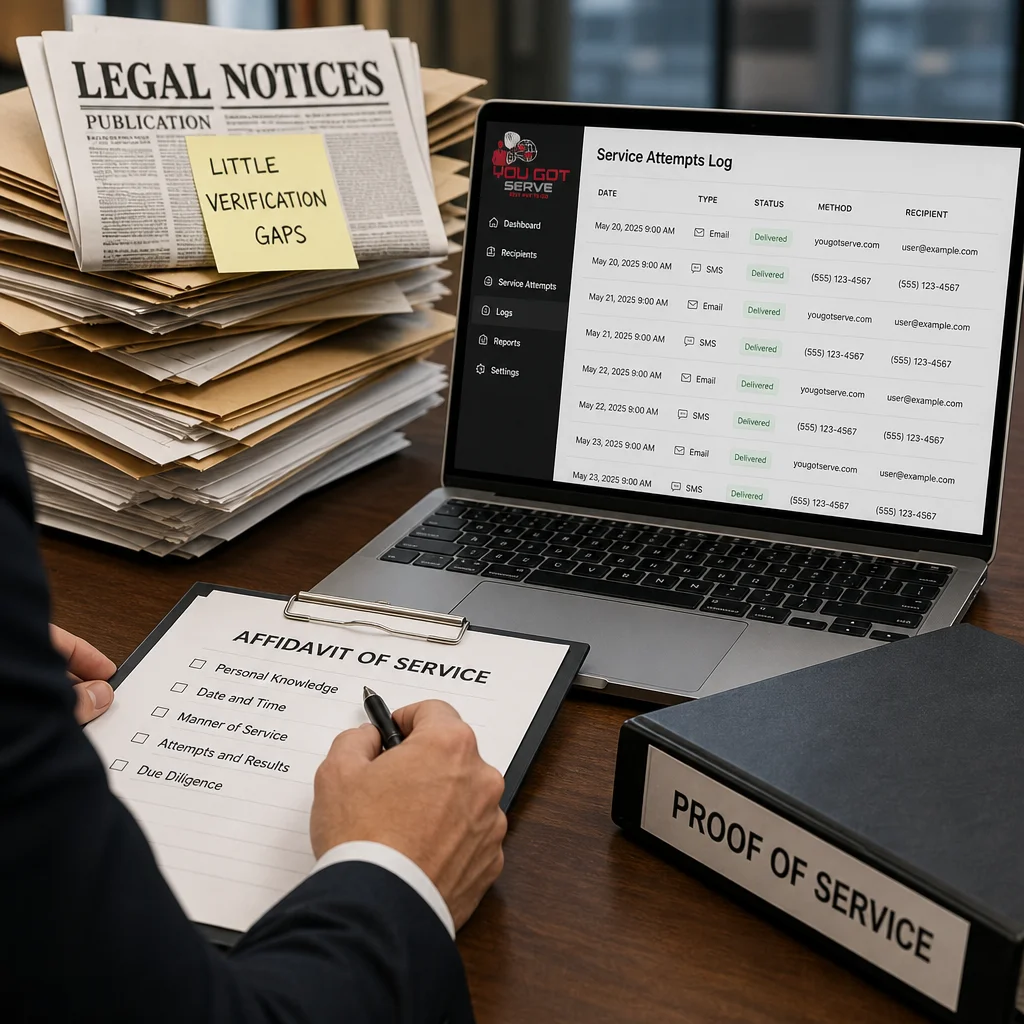
    When you’re ready to file your affidavit of service, you can download a complete activity report from your account showing:

    • Date and time of each notification sent
    • Channel used (email, SMS, or WhatsApp)
    • Recipient’s contact information
    • Delivery status for each attempt
    • Access events (if the recipient clicked the link or opened the document)

    This report becomes the backbone of your affidavit. Rather than writing “I attempted service multiple times,” you can cite specific documented attempts with dates, times, and channels. Your declaration is supported by objective, timestamped electronic evidence generated by our platform.

    You retain full control over your account and can export these records anytime. The documentation is yours to use in court filings, affidavits, or declarations.

    Daily Notification Logs: Your Automated Record of Due Diligence

    Our platform sends notifications daily during your chosen 60-day or 90-day service window. This creates a persistent, documented attempt to reach the recipient.

    The difference between one attempted delivery and 60 documented attempts is profound for your proof of service. Courts recognize that people miss emails, don’t answer phone calls, or claim they never received a single notice. But repeated, documented attempts across multiple channels over an extended period demonstrate genuine, good-faith effort to notify the recipient.

    Each log entry includes:

    • Exact timestamp (date and time to the minute)
    • Communication channel (email, SMS, or WhatsApp)
    • Recipient contact information used
    • Delivery confirmation or failure reason
    • Any access activity on the document portal

    These logs are automatically organized in your You Got Serve account. You can review them anytime, export them for your records, or include them as exhibits to your affidavit. The daily persistence creates evidence that withstands scrutiny far better than a single notice attempt.

    If a recipient later claims they never received notification, you can point to documented daily attempts across multiple channels. The burden of explanation shifts to them.

    Verification Features That Strengthen Your Service Exhibits

    We offer several verification options that add layers of credibility to your service documentation.

    Secure code-protected document access means the recipient must enter a unique access code to retrieve the document. When they access it, our system captures and timestamps that access event. You can see exactly when the document was viewed, adding objective proof that the recipient actually engaged with your materials.

    Geolocation information is available when the recipient accesses the document through our portal. This confirms not just that someone accessed it, but approximately where they were when they did so. For defendants claiming they never received service, geolocation data provides powerful contradictory evidence.

    Selfie verification is an optional feature where recipients can be asked to provide a photo during access. This adds biometric confirmation to the access record, though it’s only suitable in certain case contexts.

    Timestamped notification history shows the complete sequence of outreach attempts. Courts appreciate this granular record because it demonstrates systematic, documented effort rather than haphazard contact.

    When you include these verification elements in your affidavit exhibits, you’re not just proving you sent messages. You’re proving the recipient received them, accessed them, and engaged with them at specific times from specific locations. That level of documentation is difficult for any defendant to credibly dispute.

    Investigator Reports and Skip Tracing Integration

    Not every case begins with complete contact information for the recipient. If you lack sufficient email addresses or phone numbers, locating the defendant becomes the first challenge.

    We partner with investigative professionals who can perform skip tracing and locate services. If you provide what information you do have, our investigative skip tracing can help identify current contact details for the recipient.

    Once investigators provide updated contact information, you enter it into our platform and launch your electronic service campaign. The investigator’s work becomes part of your broader due diligence documentation. Courts appreciate proof that you invested effort in locating the defendant before attempting service, as it strengthens your overall record of good-faith compliance.

    This integrated approach means you can document the entire service process in one platform: locating the recipient, identifying correct contact information, and then persistently notifying them across multiple channels over time.

    Comparing Documentation Approaches: Manual vs. Automated Tracking

    Consider the administrative burden of manual service documentation. You must personally send emails or SMS messages, track which dates you sent them, note which bounced or failed, follow up according to a calendar you manage, and then reconstruct the entire timeline in a spreadsheet or affidavit.

    This manual approach creates several risks:

    • You may miss scheduled follow-up attempts, leaving gaps in your documentation
    • Tracking errors or incomplete records weaken your affidavit
    • You cannot easily prove that all attempts occurred within the required timeframe
    • If challenged, you’re relying on your personal recollection rather than objective platform-generated records

    Automated platforms eliminate these risks. Our system sends daily notifications without fail, timestamps every attempt, and generates comprehensive logs that are inherently objective and difficult to dispute.

    When you file your affidavit, you’re not asking the court to trust your memory or bookkeeping. You’re presenting electronic records generated by a neutral platform. That shifts the evidentiary weight significantly in your favor.

    The cost is also lower. Our 60-day service is $350 and our 90-day service is $500. Compare that to multiple process server attempts or newspaper publication, and the value is clear.

    Why Persistent Multi-Channel Notification Creates Superior Evidence

    Single-channel service attempts often fail. An email bounces. A text isn’t read. A phone call goes unanswered.

    Multi-channel persistence works differently. If your SMS reaches the recipient but your email doesn’t, they still receive notice. If they ignore the first week of attempts, they see daily reminders in week two. If they’re traveling and miss an SMS, they find an email waiting when they return.

    This redundancy serves two purposes. Practically, it increases the likelihood the recipient actually receives notice. Evidentiary, it creates a compelling record of genuine, persistent outreach.

    Our platform sends notifications simultaneously across email, SMS, and WhatsApp (where available). A single recipient receives multiple daily attempts across these channels. Over 60 or 90 days, the volume of documented contact attempts becomes nearly impossible to credibly deny in court.

    Courts also view multi-channel persistence as a modern best practice. It reflects how people actually communicate today. Relying solely on postal mail or a single email address feels outdated and increases the risk that courts will find your service insufficient.

    Building Your Complete Service Package with You Got Serve

    Serving a hard-to-find recipient requires a complete strategy, not piecemeal solutions.

    Your package begins with investigating and locating current contact information. Next comes uploading your documents to our secure platform and selecting your service window (60 or 90 days). You enter up to three email addresses and three phone numbers per recipient, configure which verification features you want, and activate your campaign.

    Our platform then handles the persistent notification work automatically. Daily messages go out across email, SMS, and WhatsApp. Every attempt is logged, timestamped, and recorded. Recipients access documents using a secure code, and that access is verified and timestamped on our platform.

    As the campaign progresses, you can log into your account anytime to check status, review the notification log, and export activity reports. When you’re ready to file your affidavit, you have comprehensive documentation ready to attach as exhibits.

    This end-to-end approach means you’re not juggling multiple vendors or platforms. Everything you need to serve documents electronically and document that service is in one place, designed to work together seamlessly.

    Eligible organizations also receive a 10% discount, making the platform even more cost-effective for nonprofits, government agencies, and qualified entities.

    Selection Guide: Choose the Platform That Delivers Court-Ready Documentation

    If you need proof of service documentation that will withstand judicial scrutiny, you need a platform built specifically for that purpose.

    You Got Serve combines persistent multi-channel notification with objective, timestamped documentation in a single integrated system. We automate daily outreach across email, SMS, and WhatsApp. We verify recipient access through secure codes and optional geolocation and selfie capture. We generate comprehensive activity logs that become exhibit-ready for your affidavit. We offer investigative skip tracing integration when you need help locating the recipient. And we keep detailed document tracking throughout your entire campaign.

    The result is documentation that demonstrates genuine, persistent, documented good-faith effort to notify the recipient. That’s what modern courts expect, and it’s what we deliver.

    Whether you’re a legal professional, self-represented litigant, collection company, or organization needing to reach a difficult-to-locate recipient, You Got Serve provides the court-ready documentation you need at a fraction of the cost of traditional alternatives. We handle the persistence and the documentation so your affidavit is supported by objective evidence rather than relying on your personal recollection alone.

    Choose the platform designed specifically for comprehensive, court-defensible electronic service documentation. Choose You Got Serve.

  • Building Court-Ready Digital Service Records: Authentication and Chain of Custody

    Building Court-Ready Digital Service Records: Authentication and Chain of Custody

    Why Digital Service Records Matter in Litigation

    When serving court documents, the quality of your proof matters as much as the act of service itself. Courts scrutinize how you delivered notice, to whom, when, and whether the recipient actually received it. A weak service record can delay your case, invite challenges, or result in dismissal on technical grounds.

    Digital service records create a permanent, timestamped audit trail that traditional methods cannot match. Each notification attempt, delivery confirmation, and recipient interaction is logged automatically, giving you documentation that stands up to court scrutiny. This matters because judges need confidence that defendants had actual notice of proceedings before moving forward.

    We built our platform around this reality. Your service record becomes evidence, not just a formality. When you have clear documentation of multiple delivery attempts, recipient verification, and secure document access, you’re positioned to defend your service against any challenge.

    Actionable step: Before choosing a service method, verify what proof your local court requires. Different jurisdictions have different standards for electronic service documentation.

    The Challenge: Meeting Court Standards for Electronic Service

    Electronic service sounds straightforward until you face courtroom scrutiny. Judges aren’t skeptical of the technology itself; they’re skeptical of incomplete records. A single email with no proof of receipt? Not enough. A text with no verification the right person opened it? Questionable.

    Courts want to see evidence that addresses three core concerns: Did the recipient actually get the notice? Was it the right person? Can you prove it happened on a specific date and time?

    Traditional proof of service affidavits rely heavily on the server’s word. Digital records shift that burden to verifiable facts: Was the message delivered? Did someone access the document? What device was used? When did access occur? These details create a defensible record that mere assertions cannot provide.

    The standard varies across jurisdictions. Some courts embrace electronic service fully; others require it as a last resort after unsuccessful traditional service. You must know your local rules before relying on any digital method.

    What Courts Require for Authenticated Service Evidence

    Authentication means proving that your digital record is genuine and hasn’t been altered. Courts typically evaluate this under state evidence rules that require foundation testimony or certification of digital records.

    Key elements courts examine include:

    • Reliable timestamps showing exact date and time of each delivery attempt
    • Verified recipient identity confirming the person who accessed documents was the defendant (not an employee, relative, or third party)
    • Delivery confirmation proving the message reached the intended recipient’s device or account
    • Document access logs showing when and how recipients accessed court documents
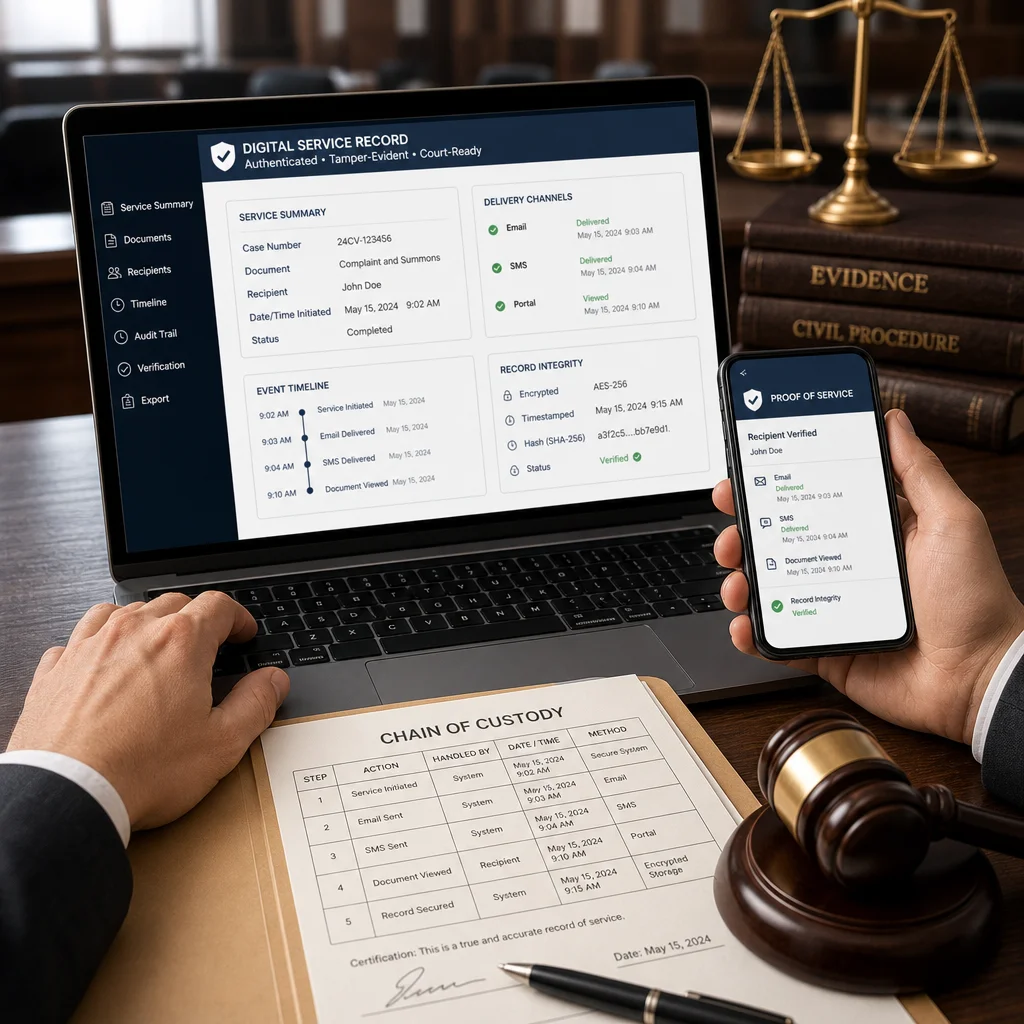
    • Chain of custody documentation establishing that records remained secure and unaltered from creation through court presentation
    • Technical metadata such as IP addresses, device information, and location data supporting the record’s authenticity

    We design our platform to capture and organize all these elements automatically. Each component is timestamped, encrypted, and logged in a way that courts can verify independently. When you’re ready for trial or motion practice, you’re not assembling scattered evidence; you’re presenting an integrated record built for court scrutiny.

    How Multi-Channel Documentation Strengthens Your Record

    Serving through a single channel creates risk. Email filters block messages. Phones get disconnected. One failed attempt doesn’t prove anything. Multiple channels working together paint a different picture.

    We support simultaneous delivery across email, SMS, and WhatsApp. For each recipient, you can register up to three email addresses and three phone numbers. Our platform attempts notification across all available channels on a daily basis through 60- or 90-day notification cycles. If one channel fails, others keep trying.

    This persistent, multi-channel approach accomplishes several things:

    • Increases the likelihood of actual notice by reaching recipients through their preferred communication method
    • Creates a documented pattern showing repeated, good-faith attempts to reach the defendant
    • Reduces successful challenges because you can demonstrate you took reasonable steps to provide notice
    • Protects against technical excuses like “I didn’t see your email” when you have SMS and WhatsApp delivery confirmations as well

    When your service record shows 60 or 90 days of documented delivery attempts across multiple channels, judges see competent, thorough service, not a technical loophole.

    Securing Your Service Record: Encryption and Timestamping

    The integrity of your service record depends on security. If a court doubts whether your documentation has been tampered with, the entire record becomes suspect.

    We protect service records through end-to-end encryption and precise timestamping at every step. Each notification is assigned an immutable timestamp. Document access is logged with the exact moment it occurred. Notifications, confirmations, and activity records cannot be altered after creation.

    This technical foundation matters for a practical reason: it eliminates any legitimate question about whether your evidence was manufactured or modified. The record speaks for itself because the technology ensures authenticity.

    When you prepare your service documentation for court, you’re presenting records created by a neutral technical system, not edited files or handwritten affidavits subject to credibility disputes.

    Recipient Verification: Building Proof Beyond Delivery

    Delivery alone isn’t proof of service if you can’t confirm the right person received the notice. Courts want to know you served the defendant, not a random person who answered their phone.

    Our verification features go beyond simple delivery confirmation:

    • One-time access codes ensure only the intended recipient can open documents
    • Selfie capture (optional) can verify identity biometrically
    • Geolocation data shows where documents were accessed
    • Device identification logs which devices accessed the record
    • Notification history documents every delivery attempt and access event

    These elements create layers of proof. If a defendant later claims they never received notice, you can present geolocation data showing documents accessed from their registered device, a timestamp showing the exact moment, and device information confirming the access point. That’s court-ready proof.

    Not every case requires every verification feature. Some jurisdictions don’t recognize biometric data as relevant; others consider geolocation essential. The key is having these tools available so you can build a record tailored to your court’s standards.

    Creating a Complete Chain of Custody Trail

    Chain of custody is a foundational concept in evidence law. Courts need confidence that records haven’t been altered, lost, or contaminated between creation and presentation.

    Digital service records create chain of custody automatically through our logging system. Every action is recorded: when notifications were sent, when recipients accessed documents, what information they entered, when our system processed or updated any data. This creates an unbroken electronic trail.

    Your role is to preserve that trail by:

    • Maintaining your YouGotServe account and records without modification
    • Obtaining official reports or certificates from our platform documenting service
    • Keeping copies of all notifications, delivery confirmations, and access logs
    • Retaining any correspondence about the service attempt

    When you appear in court, you’re presenting records generated by our system, certified as accurate, and preserved without alteration. That’s precisely what courts want to see.

    Using Automated Notifications to Document Service Attempts

    One of the clearest benefits of digital service is that attempt frequency and timing are documented automatically. You don’t rely on a process server’s report or your own memory about when you tried to reach someone.

    Our automated notification campaigns run daily over 60 or 90 days, with each attempt logged. This creates several valuable pieces of evidence:

    • Proof of diligence showing you made sustained efforts to provide notice, not a single halfhearted attempt
    • Documentation of persistence that can support claims you followed court rules requiring “reasonable efforts”
    • Timestamped record of each delivery attempt, letting you identify exactly when notice likely reached the defendant
    • Pattern evidence useful in motions or hearings where you need to demonstrate good-faith compliance with service rules

    If a defendant argues they had no notice, your records show 60+ documented delivery attempts across multiple channels. That’s a powerful counter-argument.

    Access logs are where digital service evidence becomes particularly valuable. When a recipient opens a document, our system captures:

    • Exact timestamp of access
    • Device used and device identifier
    • IP address and geolocation
    • How much of the document was viewed
    • Whether documents were downloaded or printed

    These logs serve as direct evidence that someone accessed your court documents. Combined with recipient verification (the one-time code ensuring only the intended recipient could open the document), access logs prove not just delivery but actual receipt and engagement.

    Judges understand that a person who opened a document and reviewed its contents cannot credibly claim they had no notice. Access logs make that claim impossible to sustain.

    When Geographic and Biometric Data Supports Your Case

    Geolocation and device information add dimensions that traditional service methods cannot provide. When a defendant’s device accesses documents from their home address or workplace, that’s powerful evidence they were actually present and engaged.

    Similarly, optional biometric verification through selfie capture can establish identity beyond dispute. A defendant cannot later claim someone else received notice if you have their facial recognition data confirming they accessed the documents themselves.

    Not every jurisdiction requires this level of verification, but when it’s useful, it’s invaluable. Courts dealing with sophisticated defendants or evasion tactics appreciate evidence this thorough.

    The key is understanding your jurisdiction’s standards. Some courts embrace geolocation and biometric data; others don’t admit it. Learn more about legal validity of service in your jurisdiction before building your proof strategy.

    Preparing Your Digital Record for Court Presentation

    When your case reaches motion practice or trial, you’ll need to present your service evidence clearly. Digital records can seem overwhelming to courts unfamiliar with the format, so organization matters.

    Create a presentation package that includes:

    • A chronological summary of all service attempts with dates and times
    • Screenshots of notifications sent and delivery confirmations received
    • Access logs showing when documents were opened
    • Recipient verification records (if applicable)
    • A certification or affidavit explaining the technical details
    • Any geolocation or biometric data relevant to your jurisdiction

    We can provide official reports from our platform that serve as this documentation. These reports are designed for court use and explain the technical details in language judges understand.

    Your goal is to make the evidence accessible, not to overwhelm with raw data. A well-organized digital service record tells a compelling story: you attempted service, you used reliable methods, you documented everything, and the recipient received and accessed your documents.

    Why You Got Serve Delivers Court-Ready Documentation

    We built our platform with one principle in mind: every service record should be defensible in court. That means thinking like a judge who will scrutinize your evidence, not like a vendor selling a quick solution.

    Our approach combines persistent, multi-channel electronic notification with authentication features that courts expect. See how it works to understand the complete system.

    We provide:

    • Simultaneous delivery across email, SMS, and WhatsApp with multiple registered addresses and numbers per recipient
    • Automated 60- or 90-day notification cycles creating documented service attempts
    • Secure one-time access codes and optional verification features (selfie, geolocation, device identification)
    • Encrypted, timestamped records that establish chain of custody automatically
    • Official service reports certified for court presentation
    • Investigative assistance when you need help locating recipients

    The result is a service record that’s not just delivered but documented, verified, and ready for judicial scrutiny.

    Next step: Review your jurisdiction’s electronic service rules, then contact us to discuss how digital service can strengthen your case while reducing cost and delay compared with traditional alternatives.

  • Tamper-Evident Audit Trails for Legal Document Service: Why Immutable Evidence Chains Matter

    Tamper-Evident Audit Trails for Legal Document Service: Why Immutable Evidence Chains Matter

    Why Courts Demand Tamper-Proof Documentation of Service

    Courts exist to resolve disputes fairly, and fair resolution requires certainty. When you serve a defendant or respondent, the judge needs proof that the recipient actually received notice of the case. Without it, the entire proceeding risks being overturned on appeal.

    Service of process rules are strict precisely because the stakes are high. A defendant has constitutional rights to know they are being sued. If service documentation is vague, outdated, or easily altered, opposing counsel will challenge it. The court then faces an uncomfortable question: did the other party actually receive fair notice?

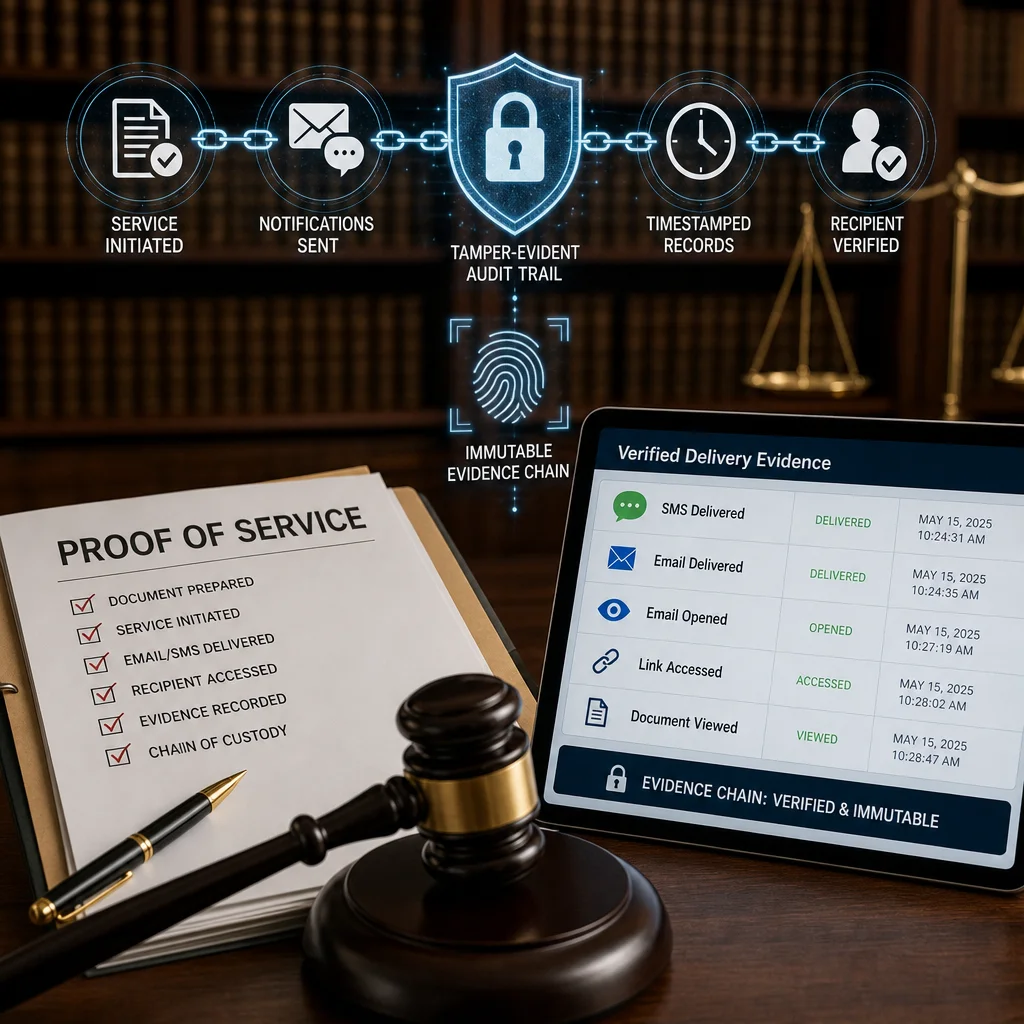
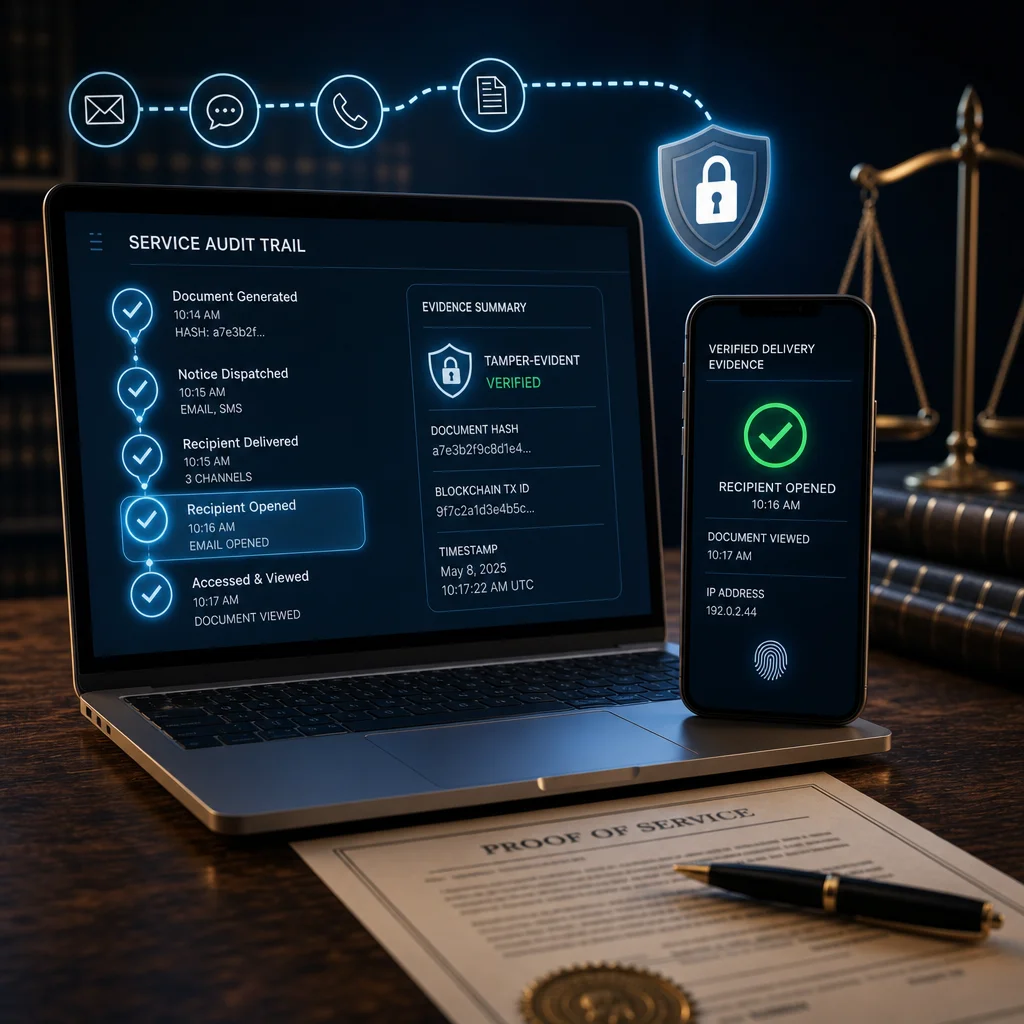
    This is why tamper-evident audit trails matter. Immutable evidence chains create a permanent record that no one can rewrite after the fact. Timestamped notifications, encrypted access logs, and verified delivery receipts all work together to build an undeniable narrative: we attempted service, the recipient engaged with the documents, and we have the records to prove it.

    Weak documentation of service exposes you to serious legal consequences. If service is later challenged and your records cannot withstand scrutiny, the court may set aside the judgment entirely. That means years of litigation, attorney fees, and court costs vanish.

    Beyond the immediate case, a compromised service record can damage your credibility with the court. Judges notice when service documentation is incomplete, inconsistent, or appears unreliable. If you return to that courtroom later, the judge may scrutinize your future filings more carefully.

    For attorneys, ethical rules require competent handling of procedural requirements. Failure to properly document service can trigger bar complaints or malpractice claims from your client. For self-represented litigants, poor documentation simply weakens your case and invites the other side to contest the entire proceeding.

    The solution is straightforward: use a service method that captures multiple layers of evidence automatically. Each notification, access attempt, and timestamp becomes part of an immutable record that neither party can alter unilaterally.

    How Traditional Service Methods Fall Short on Accountability

    Certified mail provides a delivery receipt, but it proves only that someone signed for the envelope. It does not prove the recipient opened it, read it, or understood it. If the defendant claims they never saw the contents, the receipt alone cannot refute that claim definitively.

    Newspaper publication offers even less accountability. You place an ad in a publication, wait the required time, and submit an affidavit to the court. But you have no way to verify that the defendant ever saw the notice. The defendant might truthfully say they never read that newspaper.

    Personal service by a process server creates a detailed affidavit, which is valuable. However, if the defendant contests service, it becomes a credibility battle. The court must decide whether to believe the server or the defendant. The server is not present in the courtroom, and records are limited to written statements.

    Email and SMS without verification tracking suffer similar gaps. You send the document, but have no proof the recipient opened it or that they understood the content. Generic delivery reports from internet service providers do not satisfy the heightened evidentiary standards courts demand.

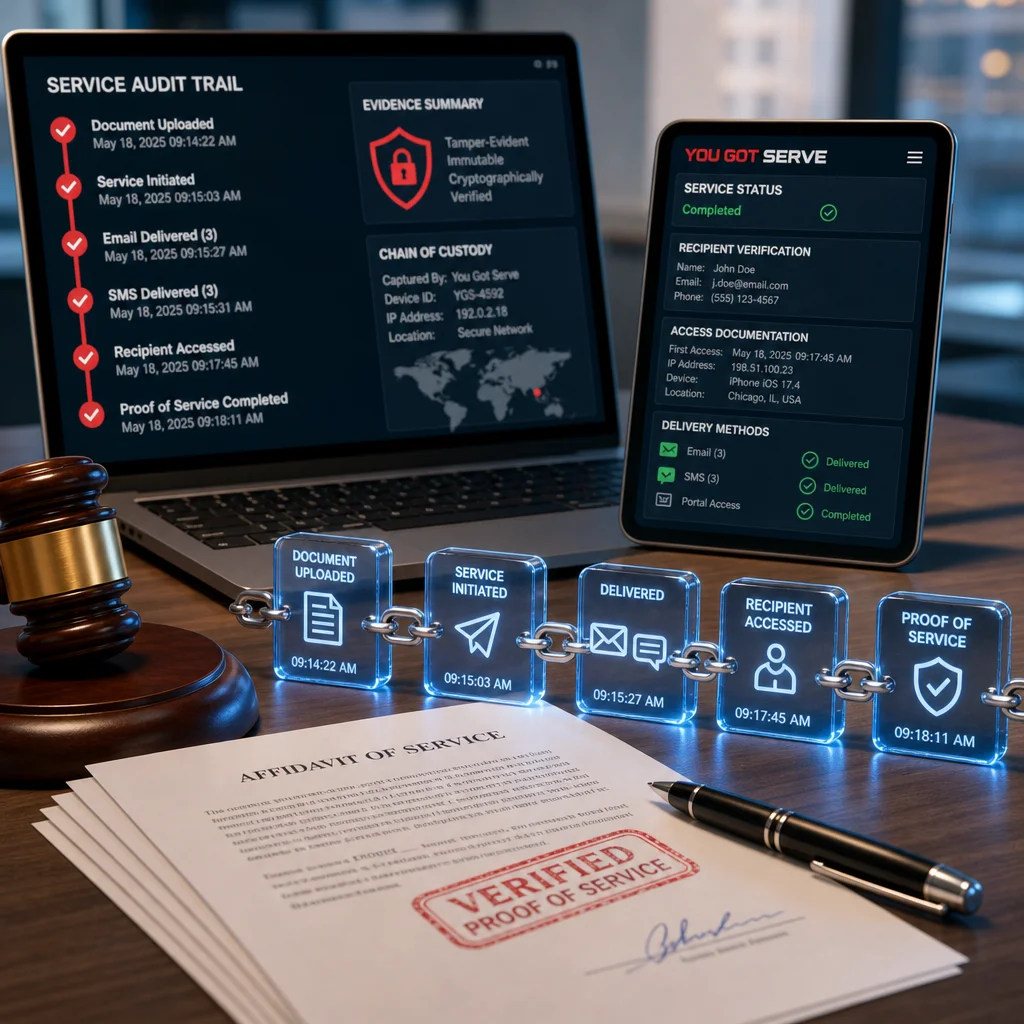
    Our approach combines persistent, multi-channel notification with cryptographic proof of engagement. The recipient accesses documents using a secure one-time code, geolocation stamps the access, and timestamps log every attempt. This creates an evidence chain so detailed that disputing service becomes nearly impossible.

    Our Multi-Layer Approach to Immutable Evidence Capture

    We designed our platform to eliminate ambiguity at every stage. Rather than relying on a single notification method, we send service notices across three email addresses and three phone numbers per recipient simultaneously. SMS, email, and WhatsApp notifications (where available) create overlapping channels of communication.

    Each notification carries a unique timestamp recorded on secure servers. The recipient receives a code-protected link to access documents. When they open that link, the system captures the access time, geolocation data, device information, and confirmation that they viewed the contents. None of this can be altered retroactively.

    Campaigns run for 60 or 90 days depending on your jurisdiction’s requirements. Daily notification cycles create a documented history of persistent attempts to reach the recipient. If the defendant later claims they never received service, the audit log shows exactly when and how many times we tried to reach them.

    Cryptographic Timestamping and Notification Logging in Action

    Timestamps are not simply clock readings. We use cryptographic protocols that embed each notification into a permanent, mathematically verified sequence. This means a timestamp cannot be backdated or moved without breaking the entire chain of cryptographic hashes linking all prior events.

    When you need to prove service in court, you can produce a complete notification log showing every SMS sent, every email delivered, and every access attempt. The log includes precise timestamps, recipient identifiers, device information, and geolocation coordinates (when the recipient’s phone permits). A defendant cannot claim ignorance when presented with concrete evidence that their phone received a message on Tuesday at 2:47 p.m. containing a link they clicked at 3:12 p.m.

    This level of documentation is particularly powerful when combined with document-access verification. The system records not only that the recipient received the notification, but that they successfully accessed the court documents using the secure code. The court sees clear proof of notice and engagement.

    Recipient Verification and Access Documentation

    Simply sending a message is one thing. Verifying that the actual recipient opened it is another. Our platform offers optional verification features that strengthen your evidence chain considerably.

    Recipients can be asked to provide a selfie at the moment they access documents. We capture geolocation data showing where they were when they clicked the link. Biometric matching and location verification together create powerful evidence that the person on your defendant list actually received and engaged with the documents, not some third party or automated bot.

    These verification steps are optional and vary by case type and jurisdiction. Check local court rules to confirm what verification methods your jurisdiction accepts. Some courts require them; others permit but do not mandate them. We design our platform to support compliance across different jurisdictional standards.

    Building Irrefutable Chain-of-Custody Records

    Chain of custody is a legal term borrowed from evidence handling in criminal cases. It means you can trace an item’s location and integrity from creation through presentation in court. The same principle applies to digital service of process.

    Our system creates an unbroken chain from the moment you upload documents to the platform through every notification, access attempt, and verification step. Each event is encrypted, timestamped, and logged. The platform stores multiple copies of the complete audit trail on secure servers, protecting against data loss or alteration.

    When you need to prove service in court, you download a certificate of service that includes the full audit trail. This document shows the judge, opposing counsel, and the defendant exactly what happened, when it happened, and who made it happen. The defendant cannot successfully argue they were never notified when presented with timestamped records of SMS messages, emails, WhatsApp notifications, and confirmed document access on their own device.

    How Our Platform Protects Against Disputes and Challenges

    Service disputes are costly and delay judgment. Our platform makes disputes far less likely by providing documentation so comprehensive that challenging it is futile.

    When a defendant’s counsel receives a certificate of service from our platform, they see granular proof of every notification attempt. They cannot claim the defendant never received service. They might argue the defendant did not understand the documents, but that is a different issue entirely, not a service problem.

    If a challenge is filed despite strong documentation, we provide detailed affidavits and audit logs that courts consistently find persuasive. Judges appreciate the rigor and transparency. The evidence speaks for itself. The proceeding moves forward without delay, and you avoid costly motions practice to establish service.

    Compliance Support Across Jurisdictions and Court Rules

    Service rules vary dramatically from state to state and even between federal courts. Some jurisdictions permit electronic service only with written consent. Others require it when traditional service has failed. A few have embraced broad e-service rules.

    We cannot tell you which service method is right for your case. That depends on your specific jurisdiction, court, case type, and the defendant’s circumstances. We encourage you to check local court rules before relying on electronic service or any alternative to personal service.

    What we can do is provide the tools and documentation to support compliance with whatever service method your jurisdiction permits. Our platform is designed to work within existing legal frameworks, not to replace them. Whether you are using electronic service as a primary method or as a backup after traditional service fails, we capture the evidence courts need to accept service as proper.

    Getting Started With Verified, Auditable Electronic Service

    Ready to serve documents with confidence? How it works page walks through the platform step by step, from uploading documents to monitoring delivery and accessing your audit trail.

    Start by uploading your court documents securely. Enter the recipient’s contact information, including multiple email addresses and phone numbers if available. Select your campaign length (60 or 90 days) based on your jurisdiction’s requirements. Our system handles the rest, sending coordinated notifications and capturing immutable evidence at every stage.

    Monitor delivery and recipient engagement in real time using our document tracking features. Download your certificate of service whenever you need it. The complete audit trail is yours to keep, ready for court filing or defense against service challenges.

    We also offer investigative assistance if you do not have current contact information for the recipient. Our skip-tracing tools help locate hard-to-find defendants, filling in gaps so your service campaign reaches the right person. We support electronic notifications internationally where technically available and legally appropriate, expanding your options beyond domestic service.

    Your goal is simple: prove service beyond dispute and move your case forward. We provide the platform, documentation, and verification tools to make that happen. Tamper-evident audit trails and immutable evidence chains eliminate ambiguity and protect your case from appeal-level challenges based on service defects.

  • Comprehensive Audit Trail vs. Basic Notification: Why Digital Service Metadata Matters

    Comprehensive Audit Trail vs. Basic Notification: Why Digital Service Metadata Matters

    Why Traditional Service Methods Leave Gaps in Documentation

    Traditional service methods often create a documentation vacuum. When an attorney arranges personal service and the process server cannot locate the defendant, the record may simply show “service attempted” with minimal detail about what actually happened. Newspaper publication leaves even fewer traces. You’re left with a published notice and a certificate, but no way to verify whether the defendant ever saw it.

    This gap becomes critical when a defendant later contests service in court. Without granular documentation of each attempt, timing, and recipient response, your proof of service weakens considerably. You need more than a signature or a receipt line. You need a forensic record that shows exactly when, how, and whether someone received your documents.

    Electronic service offers a solution, but only if it captures the full picture. Basic notification systems send messages and call it done. A comprehensive audit trail does far more: it documents every step, every attempt, and every interaction.

    The Problem: Incomplete Records and Insufficient Proof

    Many digital notification platforms send emails and texts but fail to create detailed records of the service process. They tell you a message was “delivered” to a carrier, but they don’t show whether the recipient actually opened it, accessed the document, or even received it on their device.

    When challenged in court, basic delivery confirmations often fall short. A judge may question: Did the recipient actually open the email? Could geolocation data prove they were in the jurisdiction? Can you show they had multiple opportunities to receive the document? Without answers to these questions, your proof of service looks thin.

    The stakes are high. Insufficient documentation can result in a service challenge that delays your case, requires you to re-serve the defendant, or in the worst scenario, results in dismissal of your action. That’s why comprehensive metadata matters.

    What Comprehensive Audit Trails Include

    A full audit trail captures layers of evidence about the service process:

    • Timestamped notification attempts: Exact dates and times each email, SMS, or WhatsApp message was sent.
    • Recipient engagement data: Whether and when the recipient opened documents or accessed them through a secure portal.
    • Geolocation information: Where the recipient was when they accessed the documents (where available).
    • Device and browser details: What device and application the recipient used to retrieve the document.
    • One-time access codes: Unique verification codes that confirm the specific recipient accessed the specific document.
    • Notification history: A complete log of all delivery attempts across multiple contact points.
    • Selfie capture capability: Optional recipient verification through photo identification at document access.
    • Service status tracking: Clear designation of whether service remains Pending or has been Delivered.

    Each data point builds a stronger case. Together, they create a forensic record that withstands legal scrutiny.

    Comparing Basic Notification Systems to Full Forensic Documentation

    Basic systems confirm message delivery to a carrier. That’s valuable but insufficient for legal service purposes. They typically show: message sent, carrier acknowledged, and sometimes a read receipt if the email client supports it.

    Full forensic documentation goes further. Beyond confirming the message reached a carrier, it documents actual recipient interaction. It shows not just that an email was sent, but that a person with a specific device and location opened a secure portal, entered a one-time code, and viewed the court document on a particular date and time.

    When a defendant later claims they never received service, basic records leave you vulnerable to that argument. Forensic metadata makes that claim harder to sustain. You have timestamps, access logs, geolocation data, and device information that create a documented chain of custody.

    The difference is the difference between “we sent it” and “we sent it, and here’s exactly what happened next.”

    How You Got Serve Captures Complete Service Activity

    We designed our platform to document every element of the service process. When you initiate service through You Got Serve, we don’t just send one notification and hope for the best. We create a 60- or 90-day persistent notification campaign that keeps reaching the recipient through multiple channels.

    You can enter up to three email addresses and three phone numbers per recipient. Our system sends automated daily notifications via email, SMS, and WhatsApp (where available). Over the course of your chosen campaign, we attempt service repeatedly, creating a dense record of efforts.

    Each notification is timestamped. Each access attempt is logged. Each document retrieval is recorded with device, location, and timing data. Recipients use a unique one-time access code to reach the document, which verifies they’re the intended recipient.

    This means your proof of service doesn’t rest on a single email or text message. It rests on a documented history of multiple attempts, recipient engagement, and verifiable access. If the defendant claims they never knew about the lawsuit, the audit trail tells a different story.

    Multiple Verification Points: Timestamps, Geolocation, and Access Logs

    Timestamps form the backbone of any audit trail. Every email sent, every SMS delivered, every document access is time-stamped to the second. This creates an irrefutable record of when service occurred and when attempts were made.

    Geolocation data (where available) adds another verification layer. If the defendant claims they were out of state and couldn’t have received service, geolocation information showing they accessed the document while in the state where suit was filed becomes powerful evidence.

    Access logs document exactly what happened when the recipient reached the document. We capture which device they used, what browser or application they accessed it through, whether they printed it, and how long they viewed it. This level of detail demonstrates not only that service occurred but that someone with access to the defendant’s contact information actually engaged with the document.

    Combined, these verification points create a comprehensive picture that a basic notification system simply cannot provide. You’re not asking the court to infer what happened. You’re showing them the complete activity record.

    Courts increasingly expect electronic service to generate detailed documentation. Judges understand that digital communication creates verifiable records; they want to see them.

    Our proof of delivery records are designed to support compliance with court rules and provide admissible evidence of service. We generate a comprehensive service report that includes:

    • Complete notification history with timestamps
    • Document access activity and timing
    • Recipient verification information
    • Geolocation and device data
    • A clear status designation (Pending or Delivered)

    This report is structured to be court-ready. When you file an affidavit of service or respond to a service challenge, you have concrete data to reference. You’re not making assumptions. You’re presenting forensic evidence.

    Building Trust Through Transparent Activity Records

    Transparent records build confidence with courts, opposing counsel, and your own clients. When you can point to a detailed activity log and say, “Here’s exactly when we sent each notification, here’s when it was received, and here’s the geolocation data showing the recipient accessed it on this date,” you’ve closed the conversation.

    This transparency also reduces disputes. Defendants have a harder time disputing service when presented with comprehensive metadata. They can’t simply claim they never got the message if the record shows them accessing the secure portal multiple times.

    For your clients, this creates certainty. They see that you’ve used a rigorous, documented method to serve the other party. That builds confidence in your approach and protects your case from later challenges rooted in incomplete service records.

    Real-World Impact: Documentation That Withstands Scrutiny

    Consider a scenario: You need to serve a defendant who’s relocated and isn’t responding to traditional process servers. You enter their last known email and phone number into You Got Serve. Over 90 days, we send daily notifications. On day 12, the recipient accesses the secure portal from a location within your jurisdiction. We log the timestamp, geolocation, and device information.

    Later, the defendant moves to dismiss on grounds that service was improper. They claim they never knew about the lawsuit. You produce our service report showing the access activity, geolocation data, and complete notification history. The motion fails.

    In another scenario, your firm serves multiple defendants across different states. Basic notification systems give you little to no verification. Our platform gives you a document tracking dashboard showing exactly where each defendant stands in the service process. You know which notifications were sent, which documents were accessed, and when. If a defendant later challenges service, you have the data to defend it.

    Real-world litigation is full of service disputes. Comprehensive audit trails are the difference between resolving those disputes quickly and ending up in a secondary motion hearing.

    Why Detailed Metadata Protects Your Case

    A lawsuit can fail on service before it ever reaches the merits. Courts won’t proceed if service is defective. That’s why the proof you generate at service matters as much as the legal argument you’ll make months later.

    Detailed metadata protects your case by creating an indisputable record. It shifts the burden of proof. Instead of you having to prove service happened, the defendant has to prove it didn’t, and they’re arguing against timestamped logs, geolocation data, and access activity.

    This protection extends throughout your case. Even if service is challenged months or years into litigation, comprehensive documentation means you can still defend it. You don’t have to rely on memory or incomplete records. You have forensic data.

    The You Got Serve Difference: Persistent Multi-Channel Service with Complete Records

    We built You Got Serve specifically for legal professionals and self-represented litigants who need more than basic notification. We combined persistent multi-channel service with comprehensive audit trail capabilities into one integrated platform.

    What sets us apart:

    • Persistent service campaigns: 60- or 90-day notification cycles with daily contact attempts, not one-time messages.
    • Multiple contact points: Up to three email addresses and three phone numbers per recipient, all simultaneously pursued.
    • Complete verification: Timestamps, geolocation data, device information, access logs, and optional selfie capture in a single platform.
    • Secure document access: Recipients use unique one-time codes, ensuring only the intended recipient can view the documents.
    • Investigative integration: When you don’t have sufficient contact information, we can assist with skip tracing and investigative services.
    • International capability: Electronic notifications supported internationally where technically available and legally appropriate.

    This combination addresses the entire lifecycle of electronic service: finding the recipient, notifying them multiple times, verifying access, and documenting everything. You get persistence, verification, and comprehensive metadata in one solution.

    Our service package is straightforward: $350 for 60-day service or $500 for 90-day service. Eligible organizations receive a 10% discount. No hidden fees, no surprise charges. You know your cost upfront and you know exactly what documentation you’ll receive.

    Get Started with Verified, Auditable Electronic Service Today

    If you’re managing cases where traditional service has failed or where electronic service is permitted or court-authorized, electronic notification with comprehensive audit trail documentation is the smarter approach.

    Start by determining whether electronic service is appropriate under your local court rules and jurisdiction. Then, initiate a service campaign through You Got Serve. Enter your recipient’s contact information (email and phone), upload your documents, and select your campaign length. Our system handles the rest: sending daily notifications, logging every interaction, and generating a court-ready service report.

    You’ll get a dashboard where you can track service status in real time. You’ll see when notifications are sent, when documents are accessed, and all the metadata associated with each interaction. When service is complete, you’ll have comprehensive documentation that supports your proof of service.

    Don’t settle for basic notification systems that leave gaps in your documentation. Use You Got Serve to serve documents electronically with verified receipt tracking, persistent multi-channel outreach, and forensic metadata that withstands court scrutiny.

    The smarter way to serve starts with complete records. Get started with You Got Serve today.

  • Why Email and SMS Service Work: Addressing Common Objections to Electronic Notification

    Why Email and SMS Service Work: Addressing Common Objections to Electronic Notification

    The Challenge: Why Courts and Litigants Question Electronic Service

    When traditional personal service fails—or when you’re tracking down a defendant who’s deliberately avoiding service—electronic notification offers a practical alternative. Yet courts and legal professionals often express skepticism about whether email and SMS deliver the reliability, proof, and legal standing that paper service provides.

    These concerns aren’t unfounded. Service of process is fundamental to due process rights, and courts take it seriously. Judges need confidence that a defendant received actual notice before proceeding with a case. Legal professionals worry about whether a text message or email truly reaches its destination, whether someone actually opened it, and whether courts will accept it as valid proof.

    We designed our platform directly in response to these doubts. Rather than ask litigants to accept reduced documentation standards, we’ve built persistent, verifiable electronic notification that generates a detailed record comparable to traditional service methods.

    The first concern is straightforward: emails end up in spam folders. Text messages get missed. Inboxes overflow. Why should anyone trust that a critical legal document will actually reach its recipient through these channels?

    The objection has merit for single-attempt delivery. A one-time email rarely proves sufficient. But single-attempt service has always been risky, which is why skip tracing, repeated attempts, and multiple contact points exist in traditional service.

    Here’s what separates persistent electronic notification from casual email: we send across multiple channels using up to three email addresses and three phone numbers per recipient. Notifications continue daily through 60- or 90-day campaigns, mimicking the repeated knock on doors that process servers perform. If a defendant deletes one message, we send another. If they ignore email, we try SMS. If they’re out of range for SMS, we try WhatsApp.

    The platform is built on the principle that persistent, documented attempts create a reliable record, even if individual delivery attempts fail.

    How We Verify Delivery and Recipient Access

    Verification separates assumed delivery from proven contact. We offer multiple verification features designed to document recipient engagement.

    Recipients access their documents using a unique, one-time access code rather than downloading a file directly. This requirement means we capture specific data when the document is opened: timestamp, geolocation information (where available), device type, and browser information. A defendant who claims they never received notice can be confronted with evidence showing they accessed the document at a specific date and time from a specific location.

    For cases requiring additional verification, selfie capture confirms the recipient’s identity at the moment of document access. This layer of documentation strengthens your position if the defendant later contests service.

    Our document delivery tracking system logs every notification attempt, access attempt, and successful access, providing a chronological record you can present to the court.

    Actionable step: Before relying on any electronic service method, confirm your local court rules allow it and specify what verification evidence the court requires. Knowing this requirement upfront lets you configure the platform to capture the right proof.

    Objection 2: There’s No Proof the Recipient Actually Received the Documents

    This objection cuts to the heart of service: a recipient must receive actual notice. Email delivery reports prove the message reached a mail server, not that the person read it. SMS delivery confirmations indicate the carrier accepted the message, not that the recipient understood its legal significance.

    Without proof of actual receipt, courts may dismiss service as inadequate, regardless of how many times you tried to reach the defendant.

    We address this through a multi-layer verification structure. The notification itself (SMS, email, or WhatsApp) contains an access link and unique code. The recipient must actively open the link and enter the code to view the document. That action triggers our system to record:

    • Exact timestamp of access
    • Device and browser information
    • IP address and geolocation (where applicable)
    • Document viewing duration
    • Which pages were accessed

    Additionally, notification history is preserved in the account, showing every outreach attempt, every delivery confirmation, and every access event. If the recipient claims they never knew about the case, you have documented evidence of when they received the notification, what time they opened it, and which pages they reviewed.

    Selfie verification, when enabled, adds identity confirmation to that record.

    Our Documented Evidence Trail: Timestamps, Geolocation, and Activity Logs

    The strength of electronic service lies not in a single delivery moment but in the accumulated documentation. We design our system to create a comprehensive evidence trail that courts can review.

    Every action generates a timestamped record: when we sent each notification, when the recipient’s phone received it, when they accessed the document, how long they spent reviewing it, and which pages they viewed. Geolocation data (when available and compliant with privacy law) can confirm the recipient was in the jurisdiction or at a known location when access occurred.

    This chronological log serves multiple purposes. It proves the defendant had opportunity to prepare a defense. It demonstrates your good-faith efforts to reach them across multiple channels. It refutes claims of surprise or inadequate notice.

    For recipients outside your jurisdiction, the same documented history supports your position that proper notice was provided in a manner reasonably calculated to reach them.

    Courts increasingly recognize that persistent, verifiable electronic notification can meet due process standards precisely because it creates this kind of detailed, timestamped record.

    Objection 3: Electronic Service Isn’t Legally Sufficient in Court

    Many attorneys and litigants operate under outdated assumptions about service methods. They believe courts only accept personal service or certified mail, making electronic service feel like an untested or second-choice option.

    The legal landscape has shifted. Federal courts allow email service under Federal Rule of Civil Procedure 5(b)(2)(E) when consent exists or court order permits it. State courts have adopted parallel rules. Rules vary significantly, but the trend is clear: electronic service is no longer experimental.

    That said, acceptance and requirements differ by jurisdiction, court, case type, and judge. Your electronic service method must comply with your specific court’s rules to be valid.

    Understanding When Electronic Notification Meets Court Requirements

    Your first step is checking your local court rules before attempting service. Look for language about “electronic service,” “alternative service,” or “service by publication” in your jurisdictional rules. Many courts now explicitly permit email and SMS service under specific conditions.

    Common conditions include:

    • Prior consent from the recipient (a signed email agreement or prior email exchange)
    • Court order approving alternative service
    • Compliance with court-approved service providers or methods
    • Proof of unsuccessful attempts at traditional service
    • Documented evidence of diligent location efforts

    We design our platform to support compliance with these requirements. Our how it works page outlines the documentation and verification features that courts typically require. Our investigative skip tracing service helps you demonstrate diligent efforts to locate a hard-to-find recipient.

    When electronic service isn’t your only option, remember that serving by newspaper publication often costs more, takes longer, and generates less proof of actual notice than persistent electronic notification with verification data.

    Actionable step: Contact your court clerk or review your local civil procedure rules online. Identify whether electronic service is permitted and what proof-of-service evidence your court requires. Share those requirements with your service provider so they can configure notifications appropriately.

    Objection 4: Multi-Channel Notification Seems Excessive or Unprofessional

    Some attorneys worry that sending SMS, email, and WhatsApp messages might look aggressive or overly persistent, potentially annoying a judge if the defendant complains about harassment.

    This concern reflects a misunderstanding of service standards. Service of process is not about courtesy or preference. It is about ensuring actual notice through diligent, documented attempts. If traditional service requires multiple process server visits, repeated addresses, inquiries with family members, and published notice, then multiple electronic notifications are not excessive—they’re appropriate.

    Courts expect you to make reasonable, persistent efforts to reach a defendant. Multi-channel notification is reasonable because different people check different platforms at different times. A defendant who avoids email may answer SMS. Someone without phone service may use WhatsApp over cellular data.

    The key distinction is between persistence and harassment. Sending notifications daily through a defined 60- or 90-day campaign is documented, professional diligence. The record shows good-faith attempts with clear start and end dates. This looks responsible in court, not aggressive.

    Why Persistent Outreach Through Multiple Channels Strengthens Your Case

    When service goes disputed, judges evaluate whether your efforts were genuinely calculated to provide actual notice. A single email or SMS fails that test. A documented campaign across multiple channels over weeks or months passes it.

    From a practical standpoint, persistent outreach also increases your odds of actual receipt. Not every text gets read on the day it arrives. Not every email bypasses the spam filter. A defendant with three phone numbers on file might ignore one while monitoring another. By reaching out persistently across multiple channels, you maximize the likelihood that the defendant will encounter the notification when they check one of their active platforms.

    The documented failure to respond or access the document then becomes powerful evidence. It shows the defendant had multiple, repeated opportunities to engage with the case. If they claim surprise or lack of notice later, the court has a clear chronological record contradicting their claim.

    This is how persistent electronic notification strengthens due process rather than weakening it.

    Objection 5: Cost and Complexity Outweigh the Benefits

    A traditional assumption persists: electronic service must be cheaper but also inferior, or equally expensive but unnecessarily complicated.

    In reality, electronic service costs substantially less than newspaper publication, which can run hundreds or thousands of dollars depending on publication frequency and circulation. It is also faster—newspaper service can take weeks of publication cycles, whereas electronic notification campaigns complete in days or months, not months or years.

    Complexity concerns often stem from unfamiliarity. Using email and SMS feels simple (because it is), but configuring them for legal compliance requires steps like verification setup, documentation collection, and court rule compliance. A purpose-built platform handles these requirements without adding work for the user.

    The Real Value: Speed, Affordability, and Documented Results

    Consider a concrete scenario: you’ve served a defendant through personal service and by certified mail without response. Your local court rules allow electronic service after unsuccessful traditional attempts. Newspaper publication would cost $1,500 to $3,000 and take 30 to 60 days. Electronic notification with verification costs a fraction of that and completes in your timeframe.

    Beyond cost savings, you gain a documented record of reaching the defendant across multiple channels with timestamped proof of access (if they open the document). If they later claim insufficient notice, you have evidence. If the court questions service, you have documentation.

    This combination of speed, affordability, and verifiable proof explains why forward-thinking courts and practitioners are adopting persistent electronic notification.

    Actionable step: Calculate what newspaper publication would cost for your case, then compare it to electronic service pricing. Factor in timeline and the value of a timestamped access record. Most litigants find electronic notification offers superior value.

    Start Serving Documents Electronically With Confidence

    The objections to electronic service are real, but they have answers. Reliability improves through persistent, multi-channel outreach. Proof of receipt strengthens through verification features and documented activity logs. Legal sufficiency depends on your jurisdiction’s rules, which increasingly favor electronic service when used appropriately.

    We built YouGotServe to address every major concern courts and attorneys raise about email and SMS service. Our platform combines persistent notification, multiple communication channels, secure document access, recipient verification, and detailed documentation—all designed to support compliance with your local court rules.

    If you’re facing a hard-to-reach defendant or a court that permits alternative service, electronic notification no longer means compromising on proof or professionalism. It means serving documents faster, more affordably, and with a documented record that courts recognize.

    Review your court’s rules on electronic service, then reach out to learn how we can help you serve documents with confidence and documented proof.

  • Best Supporting Exhibits for Affidavits and Server Log Declarations

    Best Supporting Exhibits for Affidavits and Server Log Declarations

    The Challenge: Insufficient Documentation in Service of Process Cases

    When you attempt to serve a difficult-to-locate defendant or unresponsive party, the burden falls on you to prove the service was genuine, timely, and reasonably likely to reach the recipient. Courts require more than good intentions. They demand documented evidence: proof that you made a good-faith effort, that your notifications reached the intended recipient, and that the process complied with applicable rules.

    Traditional service methods often leave gaps. Certified mail can be refused or returned without clear proof of attempted receipt. Personal process servers may miss parties who have moved or are actively avoiding service. Newspaper publication, while sometimes legally required, provides minimal documentation of who actually saw the notice. When these methods fail or prove insufficient, you need an alternative backed by auditable records.

    This is where electronic service becomes valuable. But electronic service without proper documentation is nearly useless in court. Judges need to see detailed affidavits and supporting exhibits that demonstrate genuine, persistent notification attempts and clear evidence of delivery or attempted delivery.

    Why Traditional Exhibit Methods Fall Short

    Affidavits supported by minimal exhibits often trigger judicial skepticism. A simple declaration that you “sent” an email or text message lacks the verification courts expect. Without logs, timestamps, and recipient confirmation data, you’re asking the court to accept your word alone.

    Traditional methods create several documentation problems:

    • Gaps in the notification record make it hard to show persistent attempts over time
    • Single-channel notifications (email only, for example) may not meet court standards requiring multiple reasonable efforts
    • Lack of recipient verification leaves open questions about whether the party actually received the notice
    • Missing metadata creates doubt about timing, sender authentication, and delivery chain integrity
    • No geolocation or code-access data to corroborate that the intended recipient, not someone else, retrieved the document

    Courts increasingly expect electronic service documentation to include notification logs, access timestamps, and recipient verification details. If your affidavit can’t support these with credible exhibits, judges may reject your service claim or require you to retry using a different method. That delay costs time and money.

    What Courts Require from Supporting Exhibits and Declarations

    Most jurisdictions that permit electronic service require you to file an affidavit or declaration under penalty of perjury describing the service process. The exhibits attached to that affidavit are critical: they provide the factual foundation for your claims.

    Courts typically expect to see:

    • A detailed narrative explaining what method of electronic service you used and why it was appropriate
    • Complete notification logs showing dates, times, and channels used (email, SMS, WhatsApp, etc.)
    • Evidence that multiple contact points were attempted (different email addresses or phone numbers for the same recipient)
    • Timestamps proving when each notification was sent and when it was accessed
    • Recipient verification data such as access confirmations, geolocation information, or security code authentication
    • Server logs or custodian declarations certifying the authenticity and integrity of the electronic records
    • A statement that the service method complied with court rules and applicable local requirements

    The strength of your exhibits directly affects whether the court accepts your service claim. Vague or incomplete documentation invites the opposing party to challenge your service, potentially voiding the entire action. Comprehensive, timestamped, multi-channel exhibits make your affidavit credible and defensible.

    How You Got Serve Creates Auditable Affidavit-Ready Documentation

    We designed our platform with this judicial requirement in mind. When you use You Got Serve to electronically notify a recipient, our system automatically generates the complete documentary record that courts expect to see attached to your affidavit.

    You don’t have to manually compile logs or reconstruct what happened. The platform captures and stores every critical data point:

    • All notification attempts (email, SMS, WhatsApp) with precise timestamps
    • Each recipient contact point you entered (up to three email addresses and three phone numbers per recipient)
    • Notification frequency and duration (60-day or 90-day service campaigns)
    • Document access activity, including when and how the recipient retrieved their documents
    • Recipient verification details such as one-time access code usage and available geolocation data
    • Complete delivery status (Pending or Delivered)

    Our system generates exhibits ready for your affidavit filing. You can export notification logs, access reports, and server records directly from your account. The data is organized chronologically and formatted for easy reference in court documents.

    Multi-Channel Notification Logs as Exhibit Evidence

    One of the strongest exhibits in a service-of-process affidavit is a detailed notification log showing multiple, persistent attempts to reach the recipient. Courts view multi-channel notifications more favorably than single-attempt efforts because they demonstrate genuine diligence.

    We allow you to enter up to three email addresses and three phone numbers for each recipient. Our platform then sends daily automated notifications through all available channels throughout your service campaign. This creates a powerful exhibit: a complete log showing that you attempted to reach the recipient through multiple pathways over an extended period.

    Your notification log exhibits demonstrate:

    • Persistent effort: daily notifications over 60 or 90 days prove you didn’t give up after one attempt
    • Multiple contact methods: using email, SMS, and WhatsApp (where available) shows reasonable diligence across different communication channels
    • Systematic approach: the platform’s automated process proves the notifications were not random or haphazard but part of a coordinated strategy
    • Comprehensive reach: attempting multiple addresses and phone numbers for the same recipient shows you made every reasonable effort to locate them

    When attached to your affidavit, this log speaks volumes. It shows the court that you approached service seriously, methodically, and with genuine effort to reach the recipient.

    Secure Access Codes and Recipient Verification Data

    Beyond notification logs, courts value exhibits showing that the intended recipient actually accessed the documents. This is where secure access codes and verification data become critical supporting evidence.

    We issue each recipient a unique one-time access code to retrieve their documents. When they use that code, our platform records the access event, including the timestamp and available verification information such as geolocation data. This creates an audit trail proving that someone with knowledge of the unique code accessed the documents at a specific time and location.

    Your affidavit exhibits should include:

    • Record of code issuance and delivery to the recipient’s contact information
    • Timestamp showing when the recipient used the access code
    • Geolocation information available from the access event
    • Any optional verification such as selfie capture if you selected that feature
    • Platform certification that the access code was used only once and by the party in possession of the recipient’s verified contact information

    This evidence goes beyond simple notification delivery. It demonstrates actual receipt and access by someone connected to the intended recipient’s verified phone number or email address. Courts find this compelling because it closes the loop: you notified them, and they actively retrieved the documents.

    Timestamped Server Records and Custodian Declarations

    Electronic exhibits gain credibility when supported by server records certified by a qualified custodian of records. You Got Serve provides timestamped server records documenting every step of the notification and delivery process.

    A custodian declaration is an affidavit or declaration by someone with direct knowledge of how the records are created, maintained, and stored. The custodian testifies that the records are authentic, are kept in the regular course of business, and accurately reflect the system’s operations. This certification authenticates your exhibits and defends against challenges about the integrity of electronic data.

    We maintain timestamped records showing:

    • Exact dates and times of all notifications sent through our platform
    • Server authentication confirming messages were generated and transmitted by our system
    • Document upload and access logs
    • Delivery status updates and any bounces or failures
    • System configuration showing the notification channels and frequency you selected

    Your affidavit can reference a custodian declaration provided by our records custodian, confirming the reliability and authenticity of all You Got Serve exhibits. This transforms your electronic service documentation from self-serving claims into independently verified evidence.

    Building a Complete Due Diligence Package

    A winning service-of-process affidavit is built on layers of evidence. Your goal is to create a package of exhibits that tells a coherent, well-documented story: you identified the recipient, made persistent, multi-channel attempts to notify them, and created a detailed record of those attempts.

    We help you assemble this complete due diligence package:

    • Initial contact information and any available skip-trace or investigative data (available through integrated investigative services if your initial contact details are insufficient)
    • Your account setup showing the service parameters you selected (60-day or 90-day campaign, contact points, notification channels)
    • Complete notification logs with all timestamps and delivery attempts
    • Document upload confirmation and access records
    • Recipient verification data and geolocation information
    • Server logs and custodian declaration certifying record authenticity
    • Your affidavit narrative explaining your service efforts and referencing each exhibit

    When you file this package with the court, you present a comprehensive, internally consistent, and well-documented case for service. The opposing party has little room to challenge your documentation because every step is logged, timestamped, and certified.

    Document tracking through our platform means you can monitor and document service progress in real-time, creating an even stronger contemporaneous record of your diligence.

    Streamlined Compliance with Court Rules and Local Requirements

    Different jurisdictions have different rules about what constitutes valid electronic service. Some require court authorization. Others permit electronic service only if traditional methods have failed. Many have specific requirements about notification frequency, duration, and recipient verification.

    You Got Serve is designed to support compliance with these varying requirements. Our platform allows you to select service durations and notification channels that align with your local rules. We provide documentation that demonstrates your compliance with whatever standard your jurisdiction requires.

    Before you file your affidavit, check your local court rules and any applicable statutes regarding electronic service. Confirm that:

    • Electronic service is permitted in your jurisdiction and type of case
    • Any required court authorization has been obtained
    • The notification methods you used (email, SMS, WhatsApp) meet local standards
    • The notification duration and frequency comply with local rules
    • Recipient verification requirements are satisfied

    Our platform generates exhibits that help you affirmatively prove compliance with each of these standards. Your affidavit narrative can reference specific exhibits showing that your service method met every jurisdictional requirement.

    Why You Got Serve Delivers the Documentation Advantage

    We built You Got Serve specifically for legal professionals and self-represented litigants who need to serve unresponsive or difficult-to-locate recipients and who understand that electronic service requires bulletproof documentation.

    Our platform delivers this documentation advantage through:

    • Automated daily notifications across multiple channels, creating a persistent, documented service record that courts respect
    • Secure access codes and optional verification features that prove actual receipt by the intended recipient
    • Timestamped server logs and custodian declarations that authenticate your electronic exhibits
    • Comprehensive account and notification reports exportable directly for affidavit filing
    • Investigative support (available through our integrated services or CII Services Corp.) to ensure you have sufficient contact information before your service campaign begins
    • 60-day and 90-day service options that allow you to demonstrate persistent, methodical diligence
    • International service capabilities where technically available and legally appropriate

    This combination of persistent notification, multi-channel delivery, recipient verification, detailed logging, and authenticated server records gives you documentation that stands up to judicial scrutiny. You’re not asking the court to take your word. You’re presenting auditable, timestamped, independently verified evidence of genuine service efforts.

    Selecting You Got Serve for Your Service of Process Needs

    If you’re preparing an affidavit for electronic service and need supporting exhibits that courts will accept, You Got Serve is the platform designed for exactly this purpose. We handle the technical complexity of multi-channel notification, automated logging, and record authentication so you can focus on your case.

    Our pricing is straightforward: $350 for a 60-day service campaign or $500 for 90 days. Eligible organizations receive a 10% discount. You enter up to three email addresses and three phone numbers per recipient, upload your documents, and we manage the daily notifications and complete documentation throughout your service period.

    How it works at You Got Serve ensures every notification, access event, and verification data point is captured, timestamped, and ready for your affidavit exhibits.

    Start your service campaign with confidence, knowing that the documentation you’re generating will withstand judicial scrutiny. You Got Serve delivers the smarter way to serve.