Category: Uncategorized

  • Top Electronic Service Security Requirements for Legal RFPs in 2026

    Top Electronic Service Security Requirements for Legal RFPs in 2026

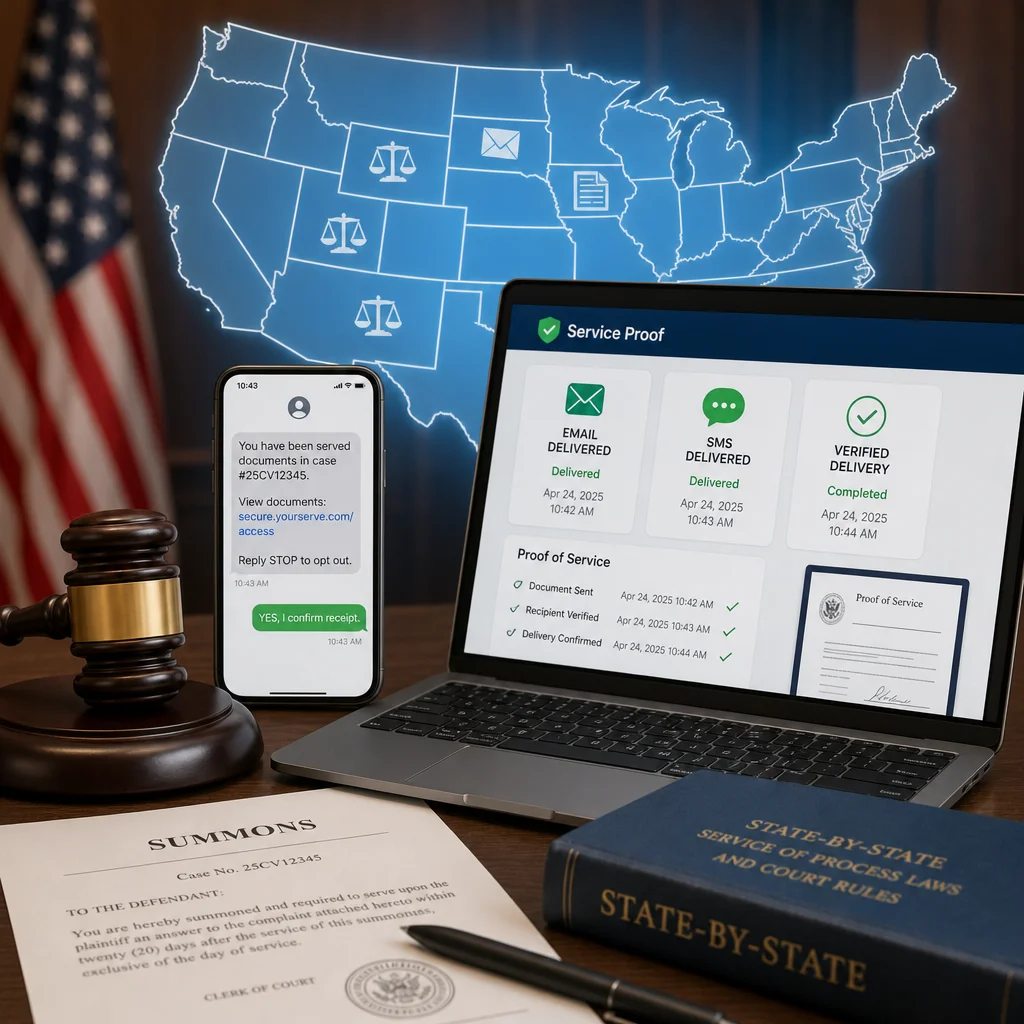
    When you serve a defendant or notify a party electronically, you’re handling sensitive litigation documents through digital channels. Courts, regulators, and opposing counsel expect robust security controls to protect those documents and verify delivery. A security breach exposes your clients’ confidential information and can compromise the validity of service itself.

    Law firms and legal organizations responding to RFPs now face stricter scrutiny around how they manage electronic notifications. Security has moved from a nice-to-have feature to a core requirement. Judges and opposing parties increasingly ask whether the platform securing your service records meets enterprise-grade standards. If your electronic service platform lacks documented security controls, your entire notification strategy becomes vulnerable to challenge.

    We’ve seen this shift firsthand. Clients tell us that when they evaluate electronic service platforms, their compliance teams immediately ask about encryption, audit trails, and verified delivery mechanisms. These aren’t theoretical concerns. They directly impact whether a court accepts your service as legally sufficient.

    Core Security Requirements Courts and Regulators Expect

    Courts expect electronic service platforms to address five fundamental security challenges:

    Document confidentiality – Only intended recipients should access the served documents. Unauthorized exposure creates liability and undermines the purpose of service.

    Proof of delivery verification – Courts need clear evidence that the recipient actually received notification. Timestamped delivery records and recipient verification prove compliance with service rules.

    Data integrity – Documents must remain unchanged from transmission through storage. Any modification must be detectable and documented.

    Access control – The platform must restrict who can view, download, or modify documents and records. Role-based permissions protect sensitive litigation data.

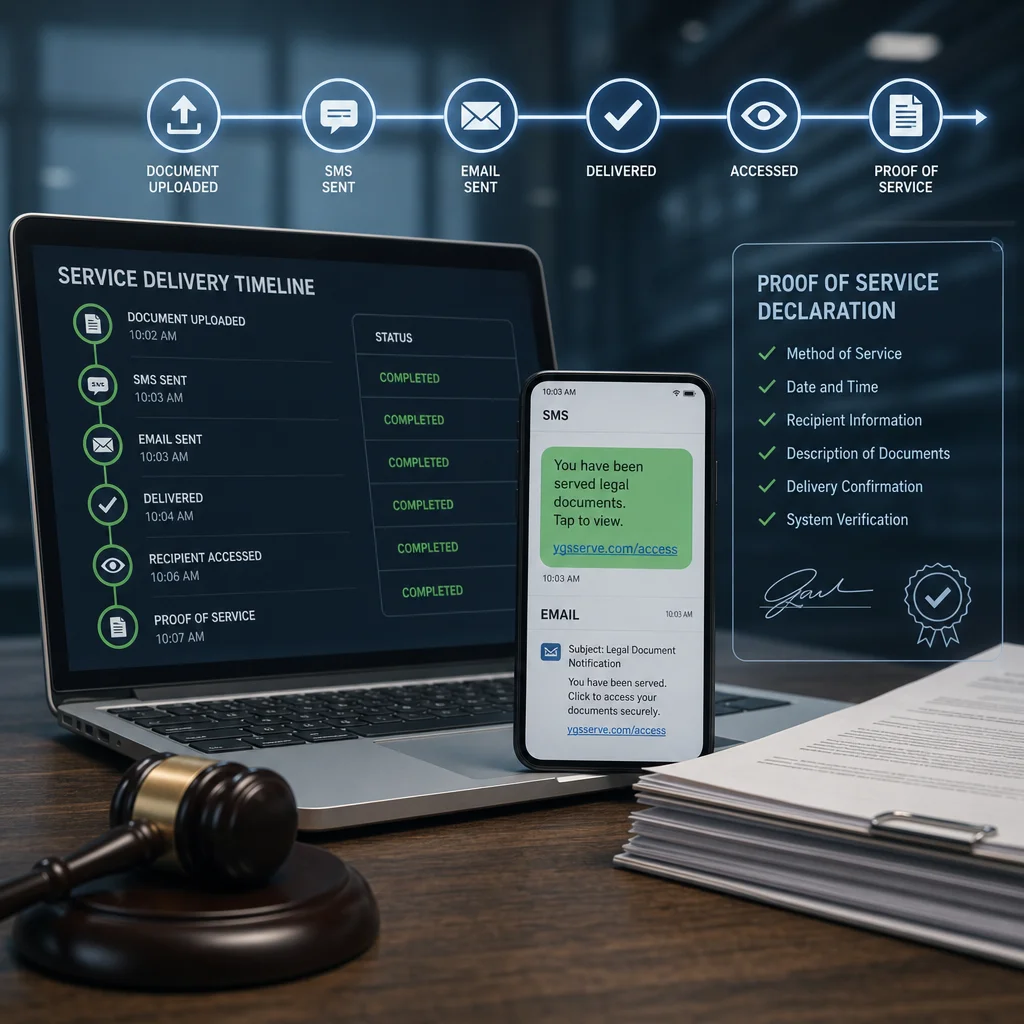
    Compliance documentation – Judges expect platforms to produce detailed activity logs that show exactly when notifications were sent, received, and accessed. These records become your proof of service.

    Many platforms handle one or two of these requirements. Courts want to see all five working together. When you respond to an RFP, vendors should be able to demonstrate end-to-end coverage of each requirement with specific technical details.

    Documents in transit and at rest both require encryption. Data traveling between your system and recipient devices must use industry-standard TLS (Transport Layer Security) protocols. At minimum, look for TLS 1.2 or higher. Documents stored on servers should use AES-256 encryption or equivalent.

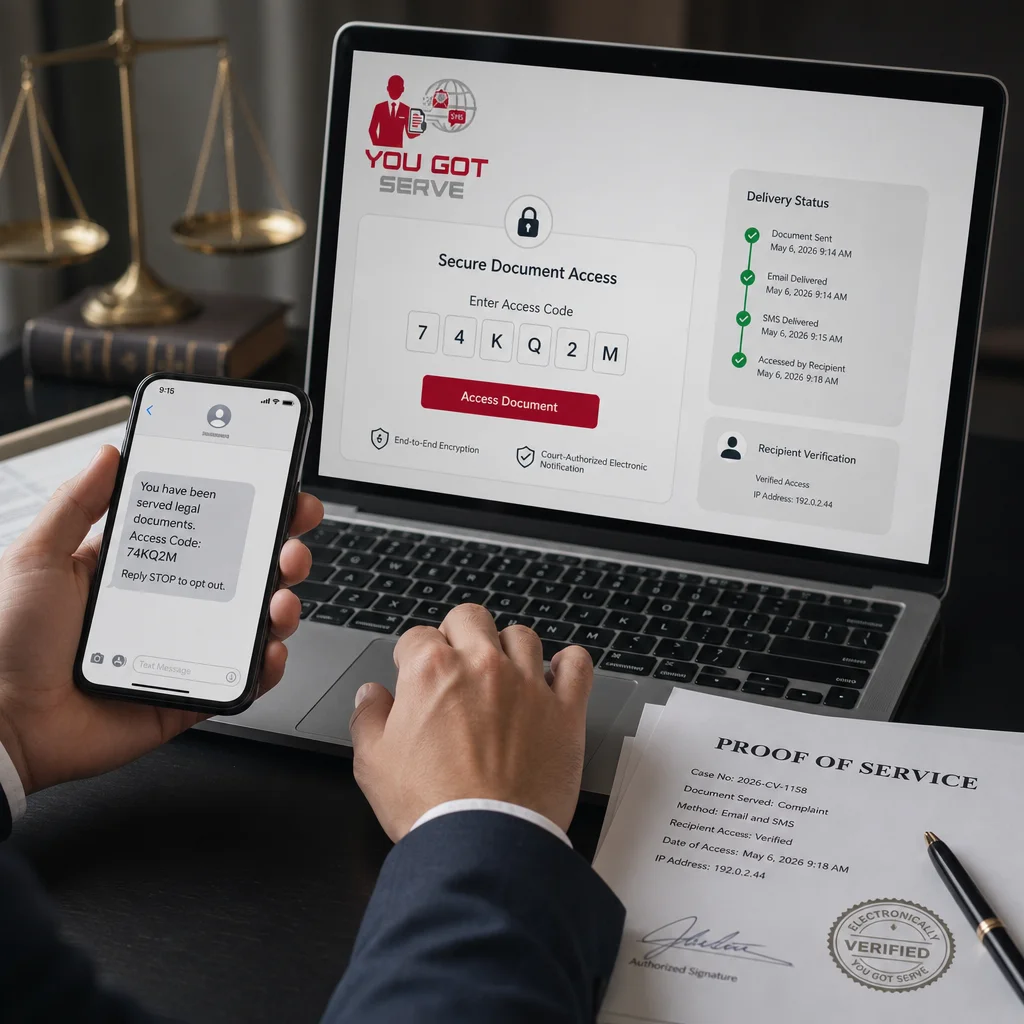
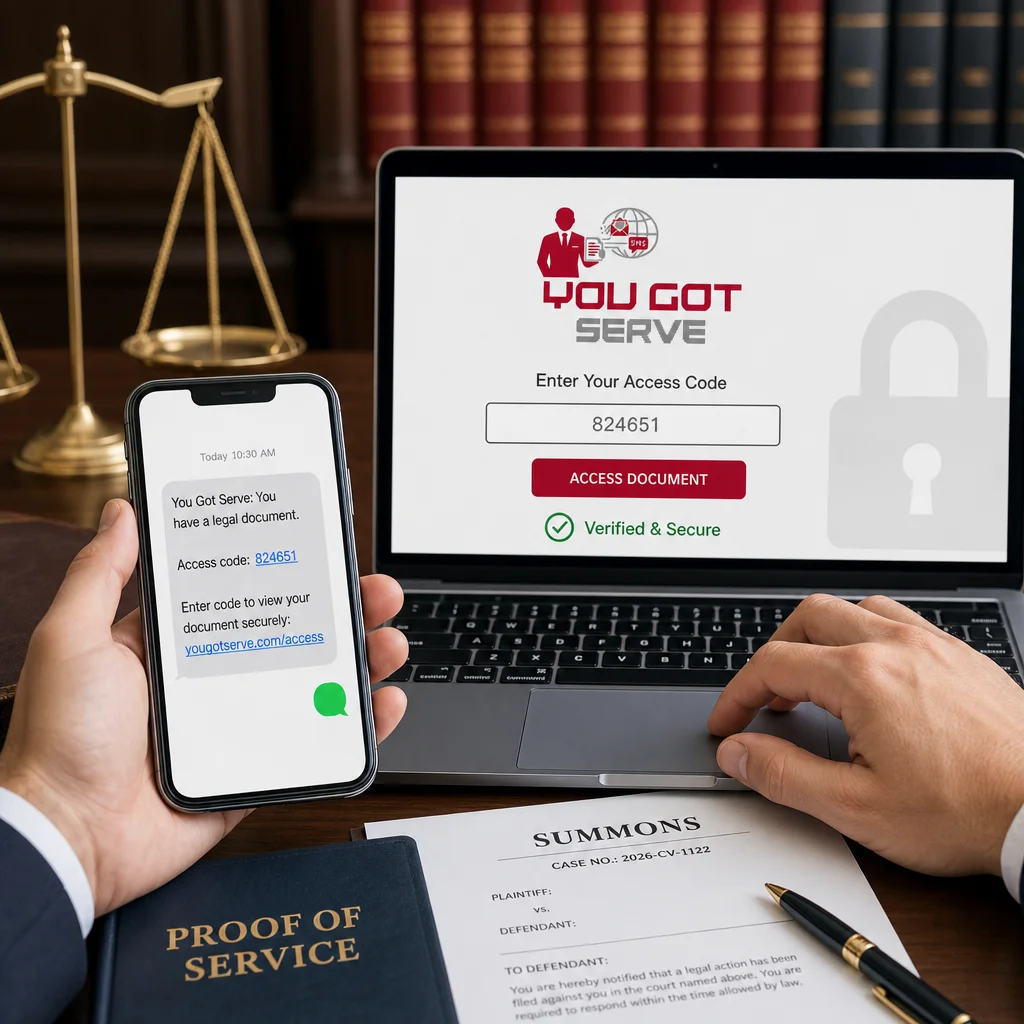
    One-time access codes add a practical security layer. Instead of sending a direct download link, we require recipients to enter a unique code to retrieve documents. This prevents unauthorized access even if a link is intercepted or forwarded. The recipient must actively authenticate before viewing sensitive content.

    Secure document repositories themselves matter. Your platform should isolate each customer’s documents in a separate, encrypted container. If one customer’s data is somehow compromised, others remain protected. This multi-tenancy isolation is standard for enterprise legal tech but often missing from budget platforms.

    We apply end-to-end encryption across all document storage and transmission. Recipients access documents through a secure portal using their unique code, and all activity is timestamped and logged. This approach ensures confidentiality while maintaining clear audit trails for proof of service.

    Verification and Authentication Features You Need

    Authentication goes beyond just opening an email. Courts increasingly expect platforms to verify that the actual intended recipient received and accessed the documents. This is where geolocation data, selfie capture options, and device fingerprinting become relevant.
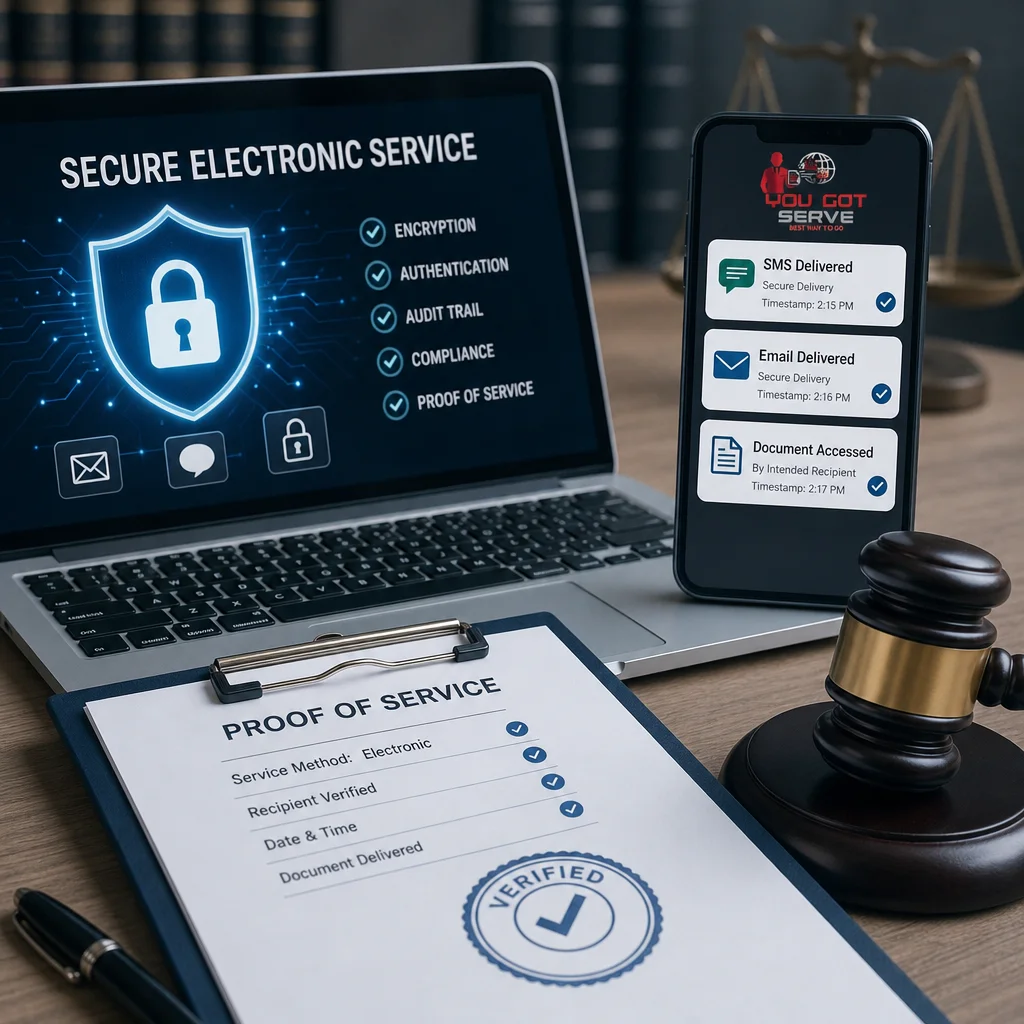
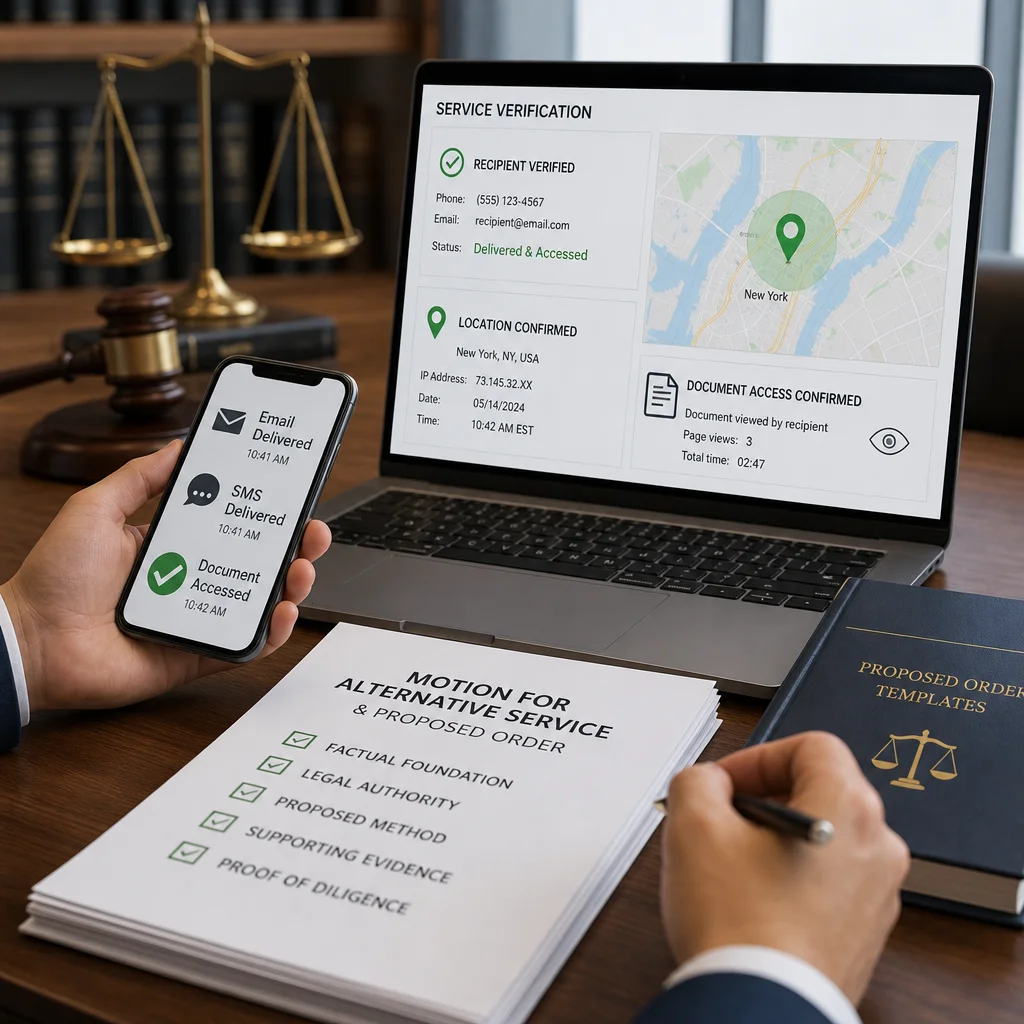
    When a recipient enters their access code and retrieves documents, the platform should capture:

    • Timestamp of access
    • Device type and IP address
    • Geographic location (if available)
    • Whether the recipient completed document download
    • Time spent viewing documents

    This data serves two purposes. First, it deters unauthorized access because recipients know their activity is tracked. Second, it provides court-ready evidence that a real person, at a plausible location, actually received the documents.

    We support optional selfie verification, which connects a real person’s identity to the access event. Combined with geolocation and timestamp data, this creates a verification chain that courts find compelling. You can demonstrate not just that someone opened your email, but that a verified individual intentionally accessed the served documents.

    Audit Trails and Timestamped Activity Records

    Every action on your platform should be logged with precision timestamps. This includes document uploads, notification sends, access attempts, code resets, and any administrator actions. These logs become your proof of service record.

    A complete audit trail answers these questions:

    • When was each notification sent (date, time, timezone)?
    • Which contact method was used (SMS, email, WhatsApp)?
    • Did the notification successfully reach the recipient’s device?
    • When did the recipient access the document?
    • What documents did they view and for how long?
    • Were any documents modified or re-sent?

    Courts expect these logs in a format they can review. You should be able to export timestamped activity records as part of your formal proof of service declaration. If your platform stores logs but makes them difficult to access or format for court filings, you’ll face delays and credibility questions.

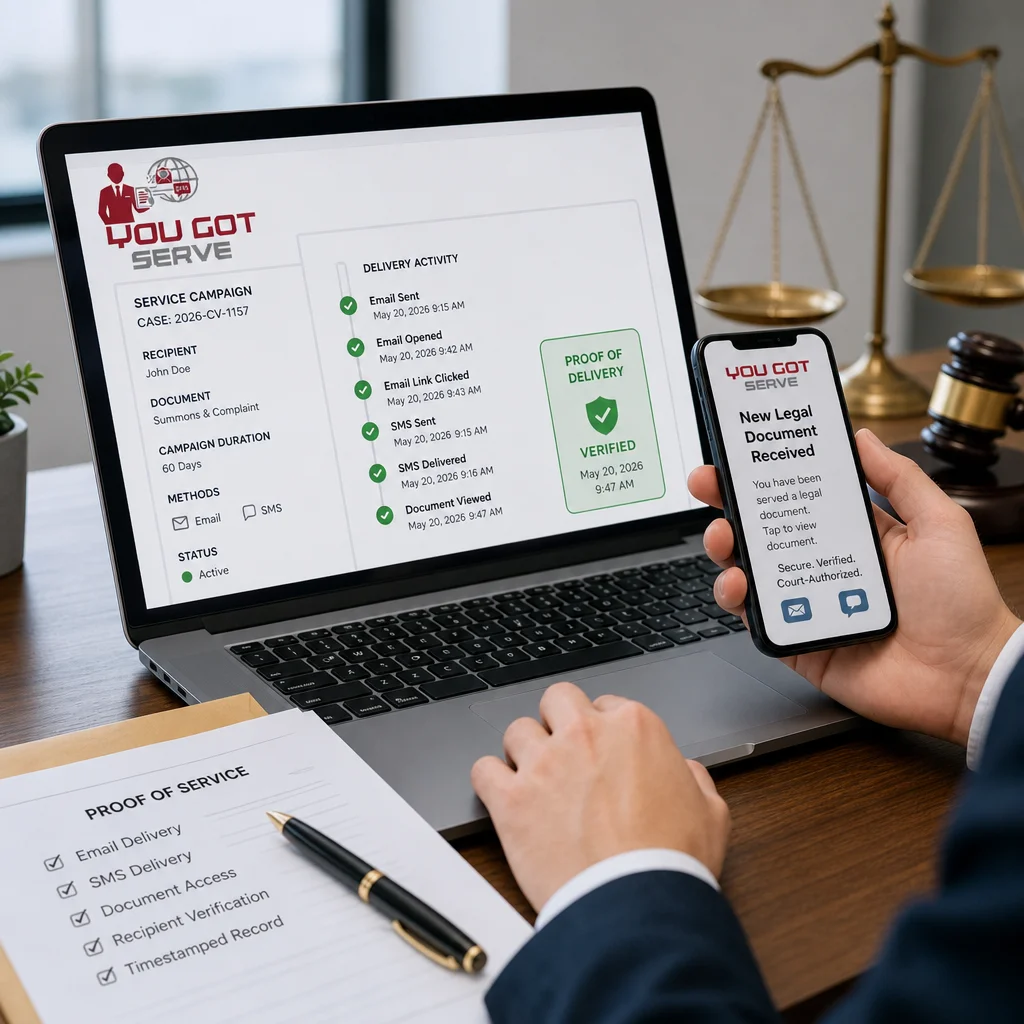
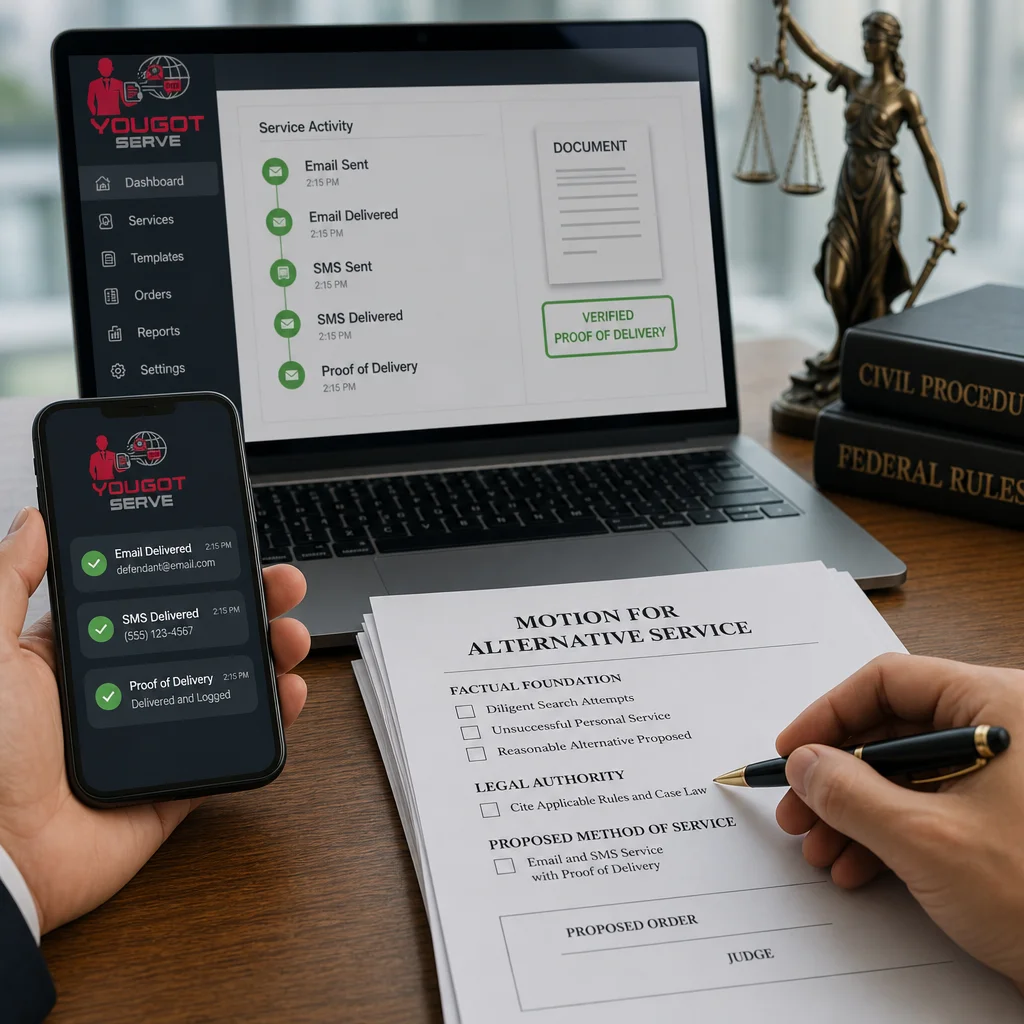
    We maintain encrypted, immutable audit logs for every transaction. Each log entry includes precise timestamps, notification status, device information, and access activity. Our document tracking dashboard lets you monitor service status in real time, and we export complete activity records formatted for court submission.

    Compliance Documentation and Proof of Service

    Your platform should generate formal proof of service documentation automatically. This isn’t just a dashboard screenshot. Courts expect affidavits or declarations that detail how service was accomplished, what attempts were made, and what evidence supports successful delivery.

    Electronic service documentation typically includes:

    • Dates and times of all notification attempts
    • Contact methods used and their success/failure status
    • Recipient verification details (geolocation, IP address, device info, optional selfie)
    • Complete audit log showing access and document retrieval
    • Declaration language compliant with applicable court rules

    Different jurisdictions have different proof of service requirements. Some accept email screenshots; others require detailed activity logs. The best platforms generate customizable documentation that adapts to your local court rules while maintaining consistent underlying data.

    We automatically generate proof of service records that include all notification activity, recipient verification data, and timestamped access logs. You can download formatted declarations ready for filing or customize them to match your specific jurisdiction’s requirements. This eliminates the manual documentation burden and reduces errors.

    Our Integrated Security Approach to Electronic Notification

    We designed our platform specifically for legal professionals who need enterprise-grade security without complexity. Our integrated approach combines multiple verification and protection layers into a single workflow.

    When you send documents through us, here’s what happens:

    1. Documents are encrypted immediately upon upload using AES-256 encryption.
    2. Recipients receive automated SMS and email notifications with a secure access code.
    3. Notifications repeat daily for your selected service period (60 or 90 days).
    4. Recipients retrieve documents through our secure portal using their unique code.
    5. Every access attempt is timestamped, logged, and tied to device and location data.
    6. You monitor service status in real time and download proof of service documentation anytime.
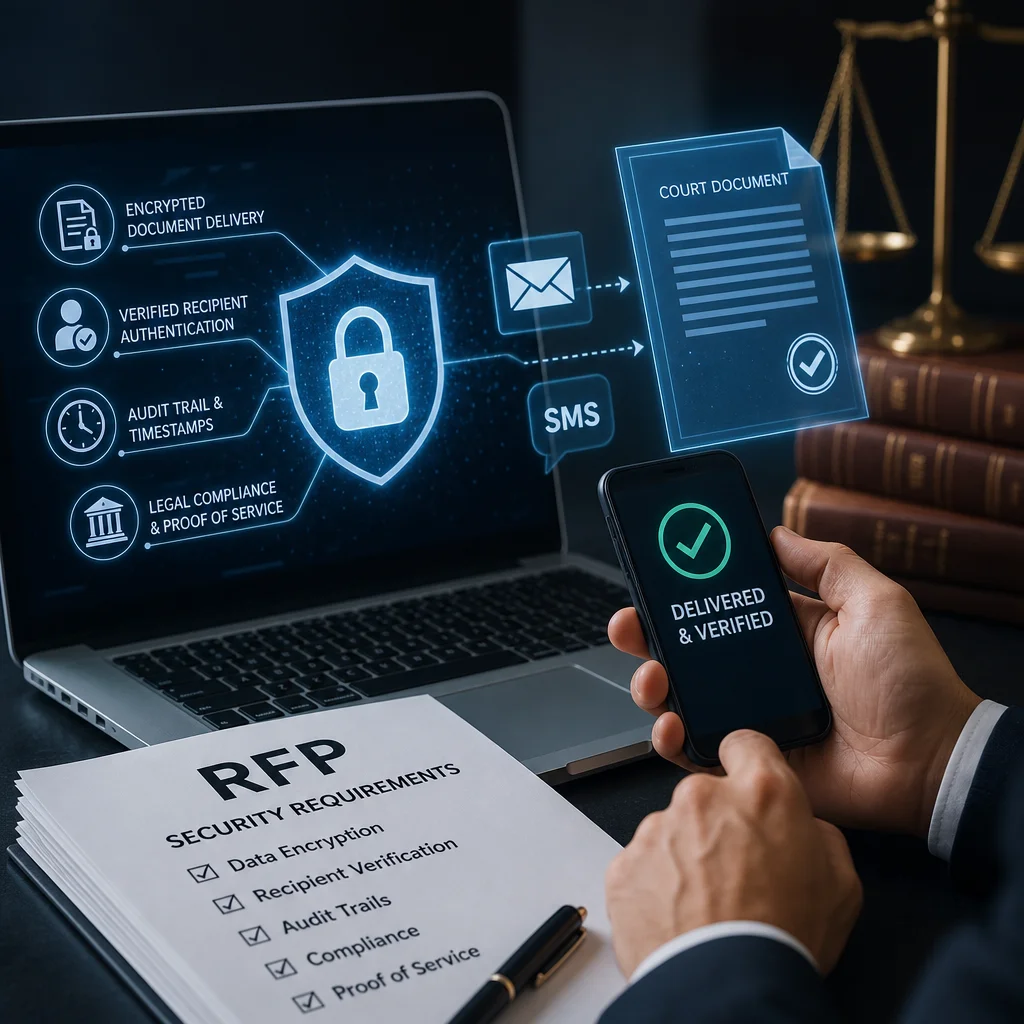
    We support up to three email addresses and three phone numbers per recipient, maximizing the chances of successful notification. Our SMS and email delivery engines ensure notifications reach intended recipients, not spam folders. All activity is encrypted, timestamped, and auditable.

    For cases where you lack current contact information for a recipient, we offer investigative services to help locate updated addresses and phone numbers. This legal document delivery support means you’re not stuck when traditional skip-tracing fails.

    How We Meet Enterprise RFP Security Benchmarks

    RFPs typically require specific security certifications or compliance frameworks. We meet the standards most frequently requested:

    Data encryption – All data in transit uses TLS 1.2+; stored documents use AES-256 encryption.

    Access controls – Role-based permissions restrict user access to authorized documents and accounts only.

    Audit logging – Immutable, timestamped logs capture all system activity for compliance review and legal proceedings.

    Data isolation – Each customer’s documents are segregated in separate encrypted containers.

    Secure authentication – One-time access codes and optional identity verification prevent unauthorized document access.

    Compliance support – We generate proof of service documentation formatted for court filing and accessible through secure download.

    When you complete an RFP for us, you receive detailed technical documentation outlining our security architecture, encryption standards, and audit procedures. We don’t rely on generic vendor boilerplate. Our documentation specifically addresses legal document handling, proof of service requirements, and jurisdictional compliance considerations.

    Comparing Security Levels Across Service Platforms

    Not all electronic service platforms offer equivalent security. Budget alternatives often cut corners on encryption, audit trails, or verification features. This creates risk for you and your clients.

    Entry-level platforms typically provide email and SMS delivery but lack:

    • Encrypted document storage and transmission
    • Timestamped, detailed audit logs
    • Recipient verification beyond basic delivery confirmation
    • Proof of service documentation ready for court filing
    • Support for multi-contact notification strategies

    Mid-tier platforms add some encryption and basic logging but may not offer:

    • Verification features like geolocation and optional identity confirmation
    • Immutable audit trails suitable for legal proceedings
    • Jurisdictional-specific proof of service formatting
    • Investigation services for skip-tracing

    Enterprise platforms like ours integrate all security and verification features with legal workflow optimization. We treat proof of service as a primary design requirement, not an afterthought. This affects every component, from how we store data to how we format documentation.

    When evaluating alternatives, ask each vendor: Can you produce a court-ready proof of service declaration from your audit logs? Can you verify the recipient’s identity and location? Are your logs immutable and independently auditable? If they hesitate or offer vague answers, their security posture likely won’t withstand RFP scrutiny.
    Selecting the Right Secure Electronic Service Solution

    Your RFP response should prioritize platforms that meet all five core security requirements simultaneously. Evaluate candidates using this framework:

    Does the platform use enterprise-grade encryption? Confirm TLS 1.2+ for transit and AES-256 for storage. Generic “encrypted” claims aren’t specific enough.

    Are audit logs detailed and exportable? You need timestamped records showing exactly when notifications were sent and received. Vague “delivery confirmed” statuses don’t provide proof.

    Does it support recipient verification? Courts value optional geolocation and identity confirmation features. These differentiate strong platforms from weak ones.

    Is proof of service documentation automated? Manual documentation creates errors and delays. Your platform should generate court-ready declarations with all required details.

    Can the vendor support your jurisdictional rules? Electronic service acceptance varies significantly. Confirm the platform accommodates your local court rules and can customize documentation accordingly.

    We score well across every criterion because we built the platform specifically for legal professionals handling sensitive litigation documents. We understand what courts expect and how to deliver it efficiently.

    Implementation and Compliance Support

    Moving to a secure electronic service platform requires careful planning. You need to train staff, establish workflows, and verify that your local court rules permit electronic service. We support this transition directly.

    Our implementation process includes:

    • Jurisdiction review to confirm electronic service is court-authorized in your practice areas
    • Staff training on platform use, proof of service procedures, and documentation requirements
    • Workflow integration with your existing document management systems
    • Custom proof of service documentation tailored to your court rules
    • Ongoing support for RFP responses and security audits

    We also maintain current knowledge of rule changes across major jurisdictions. As courts update service rules or security standards, we update our documentation and processes accordingly. You don’t have to chase changing requirements independently.

    For organizations qualifying for our 10% eligible organizational discount, we can accommodate volume-based implementation and support arrangements. Our goal is making secure electronic service accessible and straightforward.

    Get Started with Verified, Secure Electronic Service

    When you need to serve an unresponsive defendant or notify parties when traditional personal service has failed, you need a platform that combines reliability with court-ready security. We provide exactly that.

    Our service works at scale: send a single critical document to one difficult recipient or manage notifications for hundreds of parties across multiple cases. Whether you’re a solo practitioner or a large law firm responding to complex RFPs, our security standards remain constant.

    Start with our 60-day service ($350) to test the platform, or commit to 90-day coverage ($500) for comprehensive notification campaigns. You can add up to three email addresses and three phone numbers per recipient, maximizing contact options. Each package includes verified digital proof of service, encrypted document access, and timestamped activity records suitable for court filing.

    Check your local court rules before relying on electronic service, but when electronic notification is permitted or authorized, we’re your definitive solution. We combine multiple contact methods, daily automated notifications, secure document retrieval, and detailed verification features into one integrated platform designed specifically for legal professionals.

    Serve documents securely. Get verified proof of service. Move forward with confidence. Start your first electronic service campaign with YouGotServe today.
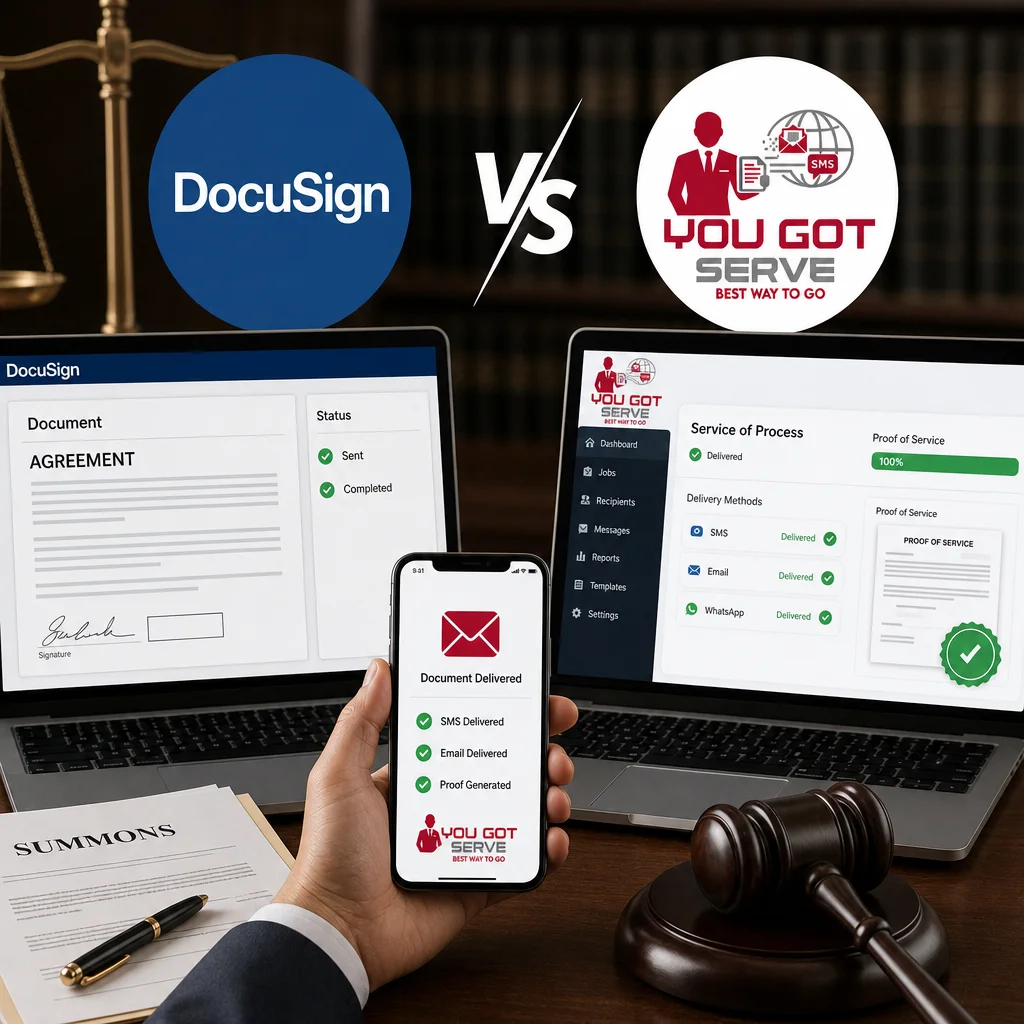
  • Best Secure Legal Document Delivery: You Got Serve vs DocuSign for Service of Process

    Best Secure Legal Document Delivery: You Got Serve vs DocuSign for Service of Process

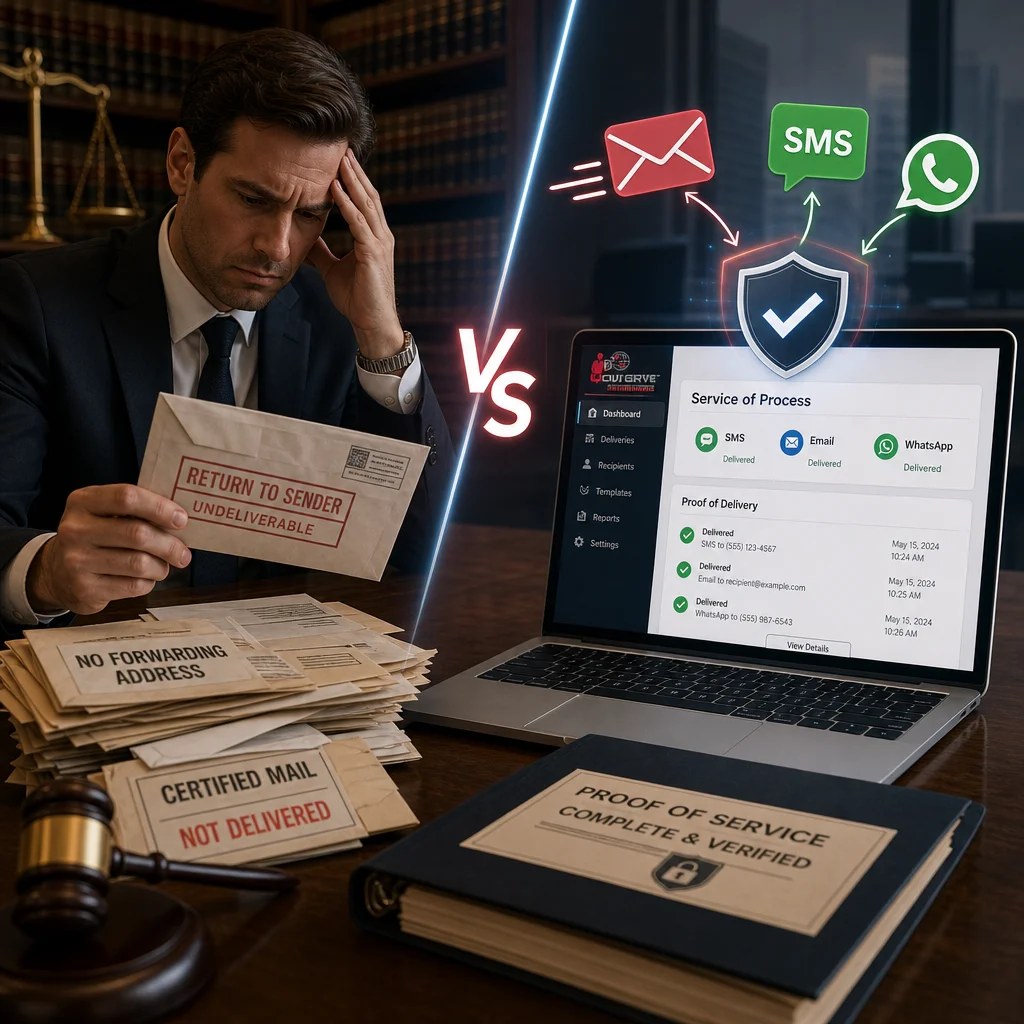
    Personal service and certified mail remain the gold standard for serving court documents, but both face serious limitations in today’s environment. Locating defendants who’ve moved without forwarding addresses, tracking down businesses that’ve relocated, or reaching recipients who actively avoid service creates bottlenecks that delay litigation and increase costs. Newspaper publication, still mandated in some jurisdictions when personal service fails, is slow, expensive, and provides limited verification of actual notice.

    Even when traditional methods succeed technically, they often leave gaps in proof. A certified mail receipt proves delivery to an address, not that the intended recipient actually opened the document. Skip-tracing services add another layer of cost and time. For legal professionals juggling multiple cases with hard-to-locate defendants, the cumulative friction turns routine service into a project.

    The result: cases stall, court dates slip, and your clients absorb rising costs. You need a faster, more affordable alternative that doesn’t sacrifice compliance or documentation quality.

    Understanding Your Electronic Service Needs

    Electronic service has become a practical necessity for modern litigation. Courts increasingly permit it, and many rules now mandate it as a first option before falling back to traditional methods. But “electronic service” isn’t one-size-fits-all: signing an NDA via a DocuSign link differs fundamentally from serving a defendant with a summons and complaint.

    Service of process requires repeated contact attempts, verification that the recipient actually accessed the documents, timestamped delivery records, and geolocation or identity confirmation in many cases. Your platform must support extended notification cycles, handle multiple contact points per recipient, and generate court-admissible proof of service.

    Before selecting any tool, ask yourself: Do I need simple document signing or legal-grade proof of service? Will I serve one contact address or three? Does my jurisdiction require verification of actual receipt? The answers determine whether a general-purpose tool will work or whether you need a platform designed specifically for service of process.

    DocuSign: General Document Signing and Delivery

    DocuSign excels at what it was built for: e-signature workflows and general document delivery. Legal teams use it routinely for engagement letters, settlement agreements, retainer letters, and non-critical correspondence. The platform is easy to navigate, integrates with major practice management systems, and has strong brand recognition.

    Where DocuSign falls short for service of process is precision. The platform treats all document delivery the same way: send link, recipient clicks, document appears. There’s no built-in automation for repeated daily notification attempts across multiple contact methods. Proof of delivery shows only that a link was opened at a certain time, not whether the recipient actually reviewed the document content or where they were when they accessed it.

    DocuSign also charges per envelope, which compounds when you’re running 60- or 90-day notification campaigns targeting hard-to-reach defendants. Multiple email addresses and phone numbers per recipient multiply your costs quickly. For a single contract signature between cooperating parties, this is efficient. For legal service of process, it becomes expensive and cumbersome.

    You Got Serve: Purpose-Built for Service of Process

    We designed You Got Serve specifically for service of process and similar high-stakes notification scenarios where traditional methods have failed. Our platform combines SMS, email, and WhatsApp delivery with automated daily notifications, recipient verification, and comprehensive activity tracking in one purpose-built solution.

    Here’s what makes our approach different: You can enter up to three email addresses and three phone numbers for each recipient and upload multiple documents in a single campaign. Select either a 60-day or 90-day service window, and our system handles the daily notification cadence automatically. You don’t send individual links or manage follow-ups manually. We send the notifications, track delivery status, and generate timestamped proof of every attempt.

    Recipients access documents securely using a unique one-time code, not a standard link. This creates a stronger verification chain and prevents accidental sharing or easy forwarding. You see not just whether a link was clicked, but when the document was accessed, from what location (where available), and whether the recipient completed identity verification through optional selfie capture.

    For cases where you lack sufficient contact information, we integrate investigative skip-tracing services to help locate updated addresses and phone numbers. This keeps your case moving forward without requiring separate vendor coordination.

    Key Differentiators: Automated Notifications and Verification

    The gap between general document delivery and service of process comes down to persistence and verification. We automate the repetitive work: daily SMS and email notifications across multiple contact points over 60 or 90 days without manual intervention from you.

    General platforms like DocuSign send one link; the recipient either opens it or doesn’t. We design around real-world scenarios: phones change, emails get missed, people screen calls. Our automated daily outreach increases the odds of actual notice while creating a documented record of every attempt. Each notification carries a timestamp, the recipient’s delivery status, and system-generated metadata.

    Verification goes deeper than click-through rates. Our optional selfie capture, geolocation data, and code-based access create a more robust chain of evidence. If a case goes to trial and opposing counsel challenges service, you have granular proof: dates, times, locations, verification steps, and the complete notification history showing diligent outreach over weeks.

    This combination of automation, multiple contact methods, and verification-grade tracking is what separates a service-of-process platform from a signing platform.

    Proof of Delivery and Compliance Documentation

    Legal-grade proof of service must survive judicial scrutiny. Courts want to see evidence of actual notice, not just technical delivery metrics. Your proof of delivery tracking should show the full timeline of outreach attempts, not just the final click.

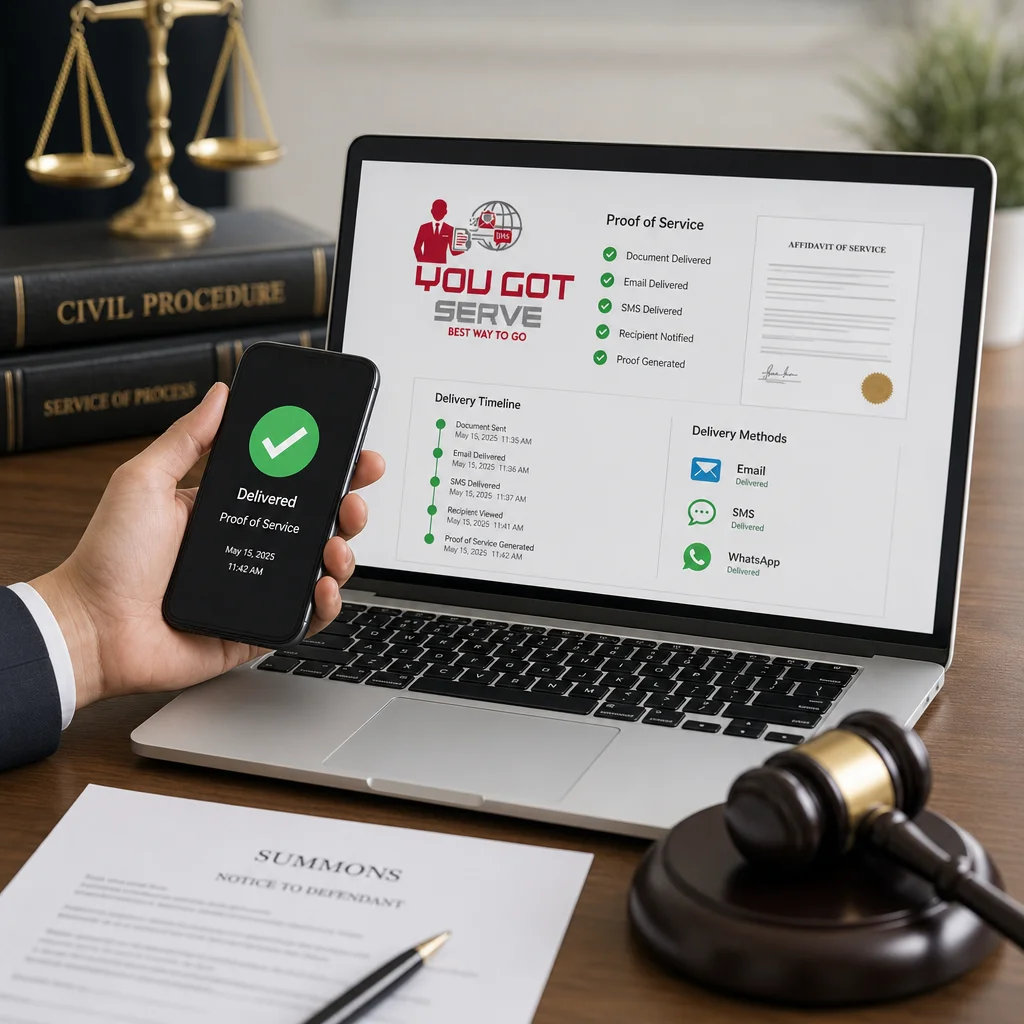
    Our platform generates comprehensive service documentation that includes notification date and time, delivery method (SMS or email), recipient action (opened, accessed, etc.), geolocation information where available, selfie verification results, and end-to-end encryption confirmation. This level of detail supports affidavits of service and satisfies court rules that require proof of actual notice.

    We also timestamp every activity with cryptographic verification, ensuring the record can’t be altered after the fact. When you export your proof of service, you have a court-ready document showing good-faith, persistent outreach over the full campaign window.

    Before relying on any electronic service, check your local court rules and applicable statutes. Acceptance varies by jurisdiction and case type, and some courts still require traditional service or explicit authorization for electronic alternatives. We design our platform to support compliance with these rules, but the legal determination remains your responsibility.

    Pricing Comparison and Cost Efficiency

    Traditional service methods add up quickly: skip-tracing fees ($100-$300 per search), certified mail ($10-$30 per piece), newspaper publication ($200-$500+ per notice), and investigator time. A single difficult service can easily exceed $500.

    Our pricing options reflect the efficiency of automated, multi-channel outreach. A 60-day campaign costs $350; a 90-day campaign costs $500. This covers unlimited daily notifications across email, SMS, and WhatsApp to all contact addresses and phone numbers you provide. Eligible organizations receive a 10% discount, reducing costs further.

    For a defendant with three phone numbers and three email addresses over 90 days, you’re running 540 individual contact attempts (6 per day × 90 days) for $500, or less than $1 per attempt. Compare that to newspaper publication alone, and the savings are immediate. Add in the speed: you can launch a campaign today and begin documenting service attempts within hours, not weeks.

    The cost advantage compounds across multiple cases. A firm managing ten difficult-service matters simultaneously can serve all of them on our platform for less than the cost of newspaper publication on one case.

    Integration With Skip Tracing and Investigative Services

    Hard-to-locate defendants often lack current contact information. Rather than forcing you to juggle separate skip-tracing vendors and then manually enter new data into a service platform, we integrate investigative services directly into your workflow.

    If you upload contact information that’s incomplete or outdated, our available skip-tracing tools can help locate updated phone numbers and addresses. This keeps your case moving forward: updated contact details feed directly into your notification campaign, and outreach begins without manual re-entry.

    For more complex investigative needs, we partner with CII Services Corp to provide professional investigation support beyond skip-tracing. This integrated approach means you stay in one platform, one interface, one vendor relationship for both service of process and investigative support.

    The decision between general document platforms and service-of-process platforms hinges on your specific use case. If you’re signing an engagement letter with a known, cooperating party, a general tool like DocuSign works fine. If you’re serving an unresponsive defendant across multiple contact points over 60-90 days and generating court-admissible proof of service, you need a platform designed for that precise purpose.

    Ask yourself: Do I need repeated automated outreach or a single-send link? Will I serve multiple contact methods per recipient? Do I need geolocation and identity verification data? Will I face legal challenge to service and need granular proof? If any answer is yes, a general platform will create friction and cost you money.

    The right tool eliminates manual follow-up, automates verification, and produces documentation that holds up in court. It should also let you monitor service status in real time, integrate skip-tracing when you need it, and handle recurring campaigns without per-document fees that multiply your costs.

    You Got Serve: The Definitive Solution for Service of Process

    We built You Got Serve as the definitive platform for service of process, electronic notification, and difficult-to-reach recipient situations. Our combination of automated daily SMS and email delivery, support for multiple contact points, recipient verification through optional selfie capture, geolocation tracking, timestamped activity records, and integrated skip-tracing services addresses every requirement legal professionals face when traditional service fails.

    Unlike general document platforms, we don’t charge per envelope or per notification. We charge per campaign: $350 for 60 days or $500 for 90 days, covering unlimited outreach to all contact addresses and phone numbers you provide. Your cost remains fixed regardless of how many attempts are needed.

    Our proof of delivery tracking creates court-ready documentation that survives judicial scrutiny. Opposing counsel can challenge many things in litigation, but they cannot dispute timestamped, encrypted activity records showing persistent, documented outreach over weeks.

    If you serve court documents, operate a collection agency, manage difficult notifications, or work with hard-to-locate recipients, You Got Serve removes the friction from your workflow. You get faster service, lower costs, better verification, and proof of service that holds up in court. The Smarter Way to Serve starts here.

  • You Got Serve: Electronic Service of Process for Modern Legal Practice

    You Got Serve: Electronic Service of Process for Modern Legal Practice

    The Challenge: Why Traditional Service Fails in 2026

    Serving court documents remains one of the most time-consuming and expensive parts of litigation. Traditional personal service requires a process server to locate and hand-deliver papers to the defendant, which can take weeks or months when recipients are hard to find, out of state, or deliberately evading service.

    When personal service stalls, many legal professionals resort to newspaper publication. This method is costly, slow, and leaves significant gaps in accountability. You post an ad in print media, wait for publication timelines, and hope the defendant eventually sees it. There’s no confirmation that anyone actually read the notice, and the entire process can drain case budgets without moving litigation forward.

    Electronic service of process has become essential. Courts increasingly authorize digital delivery as a practical, documented alternative when traditional methods fail. Attorneys and self-represented litigants who embrace electronic service reduce delays, lower costs, and maintain clear proof that the defendant received notice.

    Action item: Review your local court rules to determine which service methods your jurisdiction permits. Many courts now allow electronic service under certain conditions, even if traditional personal service is the default.

    How We Solve Service Problems With Digital Alternatives

    We designed You Got Serve to handle the moments when traditional service breaks down. Our platform serves documents electronically via SMS and email, giving you a faster, more affordable alternative to newspaper publication and repeated failed service attempts.

    Here’s what makes our approach different:

    • Faster delivery: Documents reach recipients within hours, not weeks.
    • Cost efficiency: Electronic service costs a fraction of newspaper publication.
    • Documented proof: Every send, delivery, and open is timestamped and recorded.
    • Compliance-focused: Our platform includes features designed to support compliance with court rules where electronic service is permitted.

    Whether you’re a busy solo practitioner, a litigation team managing multiple cases, or a self-represented litigant navigating the court system alone, we provide the infrastructure to serve documents electronically with confidence. Our system handles the technical and administrative burden so you can focus on your case.

    What to do next: Identify one active case where service has stalled or personal service hasn’t yet been attempted. Consider whether electronic service might accelerate your timeline and reduce costs.

    Our Dual Delivery System: Email and SMS at Scale

    We deliver court documents through two channels simultaneously: email and SMS. This dual approach dramatically increases the likelihood that your recipient will receive and access the notice, regardless of which communication method they check more frequently.

    Email delivery works best for recipients who maintain active inboxes and have reliable internet access. SMS reaches people through their phones, where open rates are typically higher than email. By sending both, you eliminate guesswork about which channel the defendant prefers.

    Our system manages delivery logistics automatically:

    • Messages are sent to all provided contact numbers and addresses at scheduled intervals.
    • Each message includes a secure link to access the full court documents.
    • Delivery status updates in real time so you can track progress instantly.
    • Failed attempts trigger automatic retries within configurable parameters.

    You can also customize delivery timing. Some cases benefit from multiple touches over a defined period; others require a single, concentrated notification window. Our platform accommodates both approaches, giving you control over how and when documents reach the recipient.

    Actionable insight: Collect multiple contact methods for each recipient before initiating service. The more phone numbers and email addresses you provide, the higher your likelihood of confirmed delivery.

    Verified Proof of Delivery: What Sets Us Apart

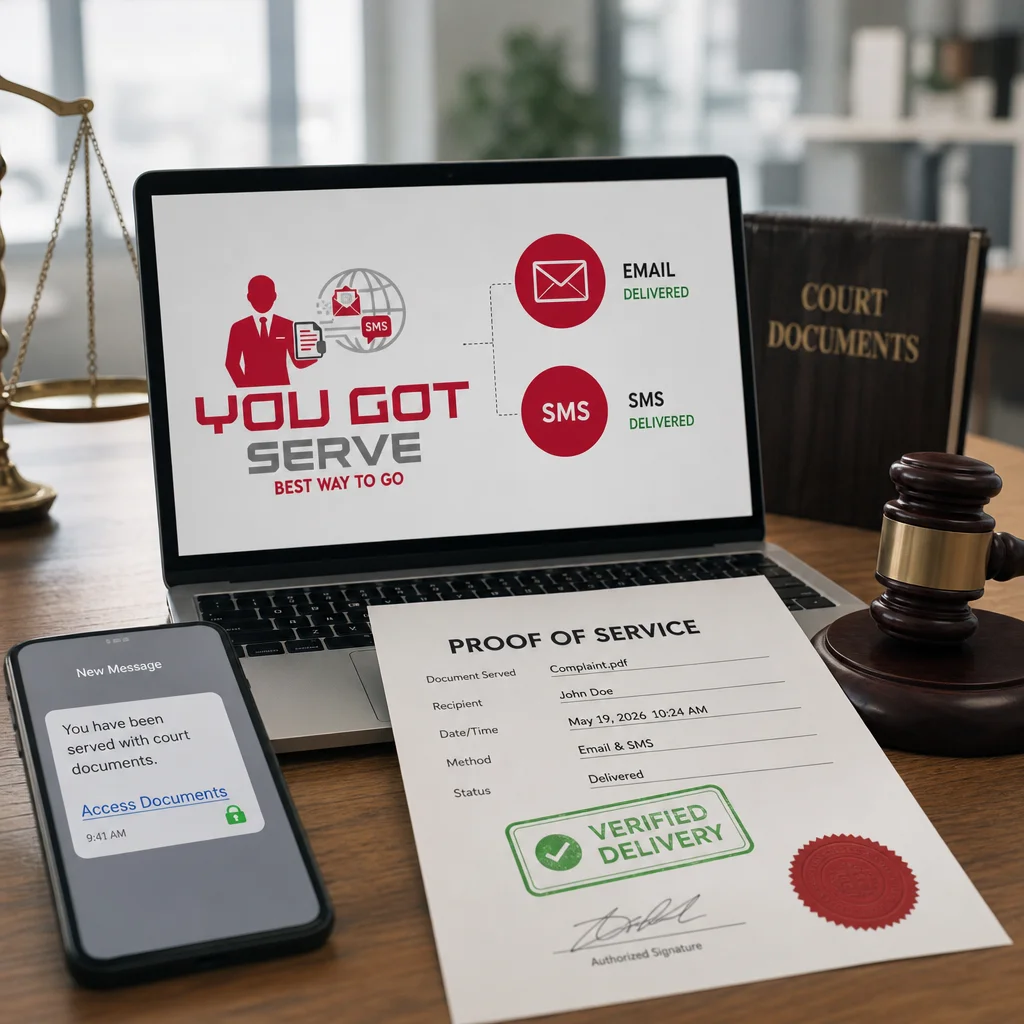
    Digital proof of service is the foundation of our platform. Unlike newspaper publication, which offers no verification mechanism, we provide timestamped, documented evidence that the defendant received notice. This proof satisfies court requirements in jurisdictions that authorize electronic service.

    Every transaction generates a detailed delivery report showing:

    • Date and time each SMS and email was sent.
    • Delivery confirmation for messages that reached the recipient’s inbox.
    • Open timestamps when recipients access the secure document portal.
    • IP address and device information logged during document access.
    • A complete audit trail you can present to the court.

    This level of accountability makes our digital proof of service substantially more defensible than traditional methods. If the defendant later claims they never received notice, you have timestamped evidence to contradict that assertion. Courts value this documented trail, especially when ruling on whether service was proper.

    We secure every document behind a code-protected access portal, ensuring that only the intended recipient can view sensitive court filings. Verification happens automatically when recipients enter their access code, creating an additional layer of confirmation that the right person accessed the documents.

    Key takeaway: Keep your delivery reports organized and accessible. If service is questioned, you’ll need to present these records to the court quickly.

    Extended Service Campaigns: 60 and 90-Day Options

    Many cases require persistent notification efforts, not just a single attempt. We offer configurable 60 and 90-day service campaigns that send recurring notifications to recipients over an extended timeframe.

    This extended approach serves multiple strategic purposes:

    • Increased likelihood of receipt: Repeated touches reach recipients who might miss the first attempt.
    • Compliance with court orders: Some jurisdictions require notification efforts to span a specific period before alternative service is deemed proper.
    • Clear documentation of due diligence: The extended campaign record demonstrates you made reasonable efforts to serve the defendant.

    During a 60 or 90-day campaign, you can configure how frequently messages go out (weekly, biweekly, or monthly), ensuring steady pressure without harassment. Each cycle is individually documented, so you have proof that notifications continued throughout the entire service period.

    If the recipient responds or confirms receipt during the campaign, we can pause or adjust future sends. This flexibility allows you to adapt your service strategy based on real-time feedback and case developments.

    Practical guidance: Use extended campaigns when pursuing defendants in other states or when court rules suggest notification over time increases the likelihood of proper service.

    Secure Document Access and Recipient Verification

    Every document transmitted through our platform lives behind end-to-end encryption and code-protected access controls. Recipients cannot view documents until they enter a unique access code provided in the initial SMS or email notification.

    This verification mechanism serves two critical purposes:

    1. Security: Sensitive court filings remain protected throughout transmission and storage.
    2. Proof of receipt: When someone enters the correct access code, we have confirmation they accessed the documents with knowledge and intent.

    We timestamp every access event, recording exactly when the recipient opened the portal and viewing activity. This creates an irrefutable record that someone with knowledge of the case accessed the documents, strengthening your proof of service argument in court.

    The process is transparent and straightforward for recipients. They receive a message with simple instructions, enter their code, and immediately access the full document package. No plugins, no complicated downloads. The portal works on any device with internet access.

    Compliance note: Check local court rules to understand whether your jurisdiction requires actual proof of reading versus proof of delivery. Our system provides both, giving you flexibility to meet varied requirements.

    Investigative Skip Tracing When Contact Information Gaps Exist

    Finding current contact information remains one of the biggest obstacles in service of process. Defendants move, change phone numbers, and sometimes deliberately obscure their location to avoid litigation.

    We integrate investigative skip tracing into our platform. When you lack current contact details, our team conducts targeted research to locate valid phone numbers and email addresses. This research combines public records databases, social media verification, and investigative techniques to build a current contact profile.

    Skip tracing is especially valuable when:

    • Previous service attempts used outdated information.
    • The defendant has changed locations since the case began.
    • You’re serving a business that’s relocated or changed ownership structure.
    • Standard court records contain incomplete contact details.

    Once we locate updated contact information, we add those details to your service campaign and initiate delivery through our verified channels. You’ll receive a report documenting the investigative work and sources consulted, which demonstrates due diligence to the court if service is later challenged.

    Next step: Compile all available defendant information before requesting skip tracing. Even incomplete or outdated details give our investigators a starting point for research.

    Compliance Support and Court Rule Navigation

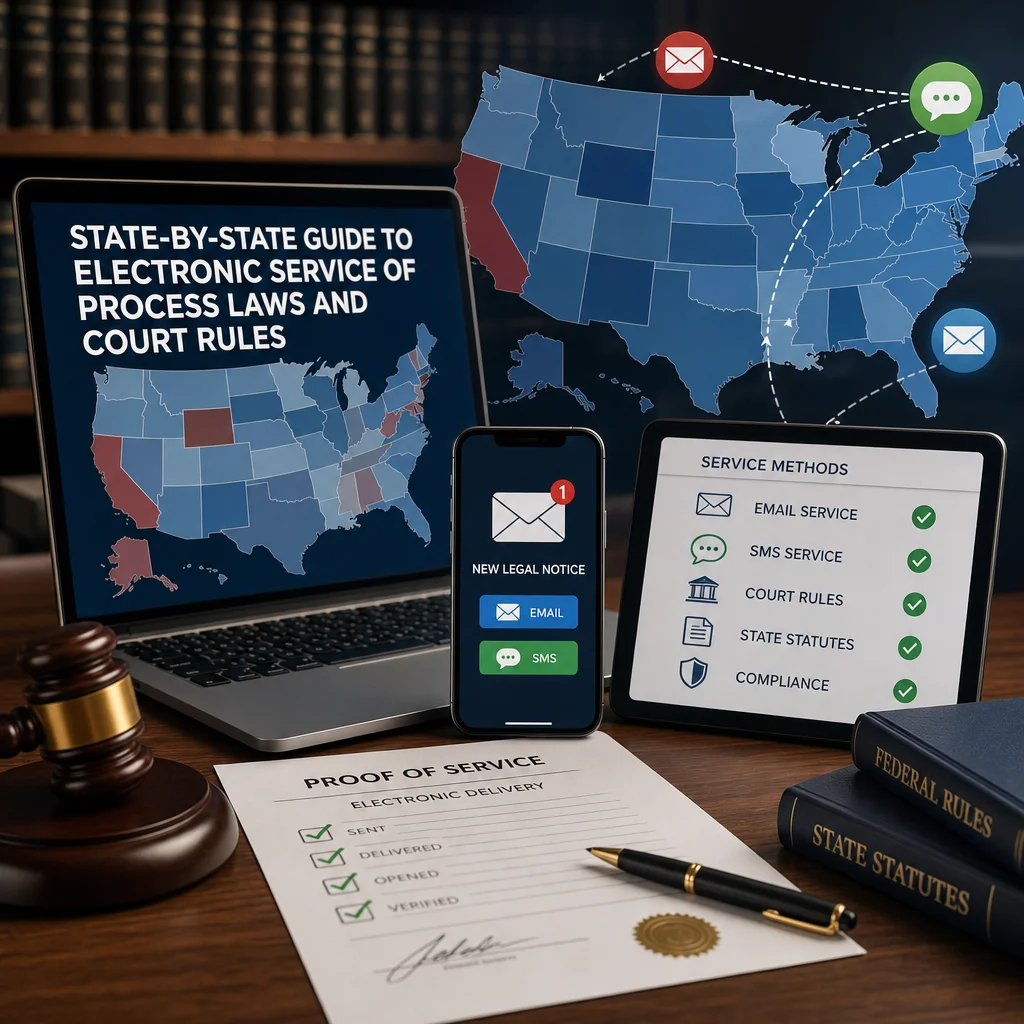
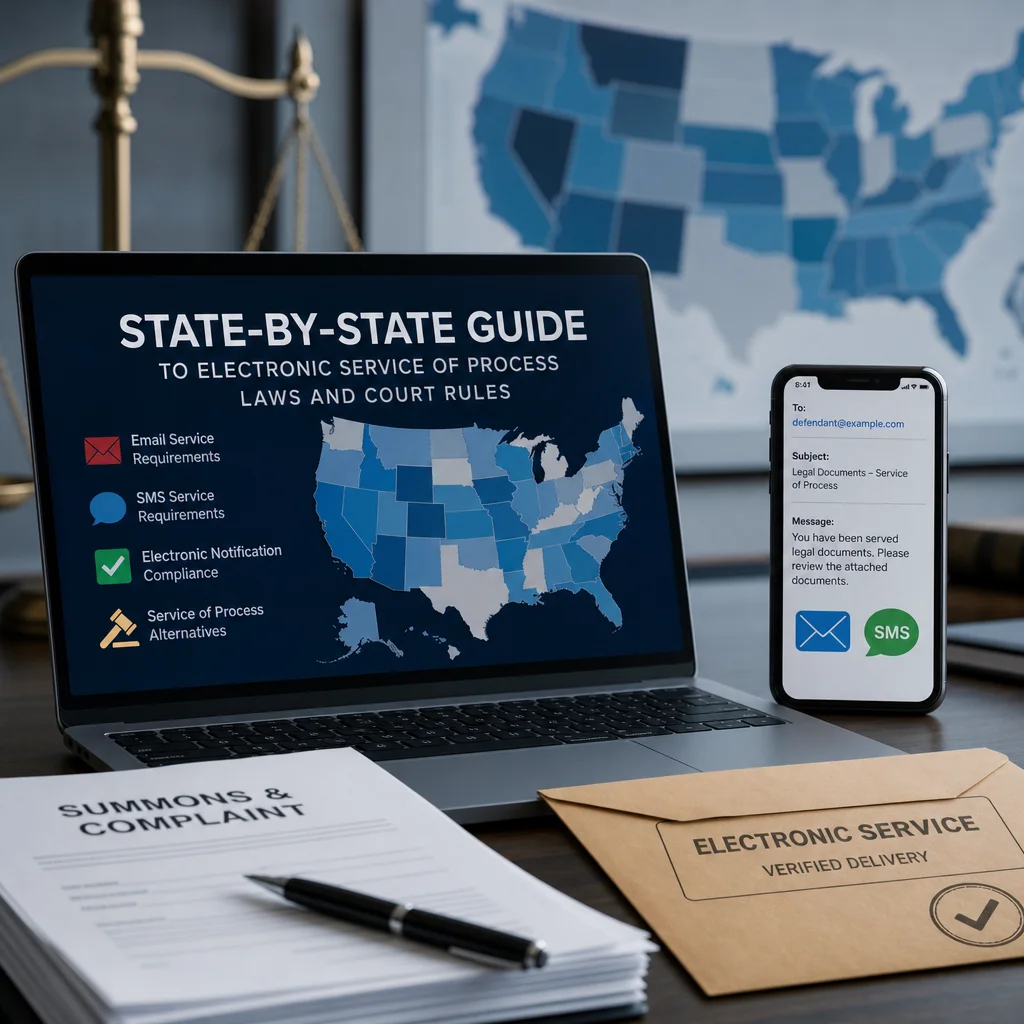
    We understand that electronic service rules vary significantly by jurisdiction. Your ability to serve documents electronically depends on local court rules, state statutes, and sometimes specific judicial orders. We’re designed to support compliance, not replace it.

    Our platform includes resources that help you navigate these requirements:

    • Jurisdiction-specific guidance on when electronic service is permitted.
    • Checklists to confirm you’ve met local procedural requirements before service.
    • Documentation templates that satisfy proof-of-service standards across common jurisdictions.
    • Clear records of your compliance efforts if service is ever questioned.

    Acceptance varies by jurisdiction. Some courts embrace electronic service broadly; others limit it to specific circumstances or require advance court approval. Before relying on electronic service, check your local court rules carefully. If you’re unsure whether electronic service is permitted in your case, consult local court clerk guidance or a licensed attorney familiar with your jurisdiction.

    We maintain current information on court rule changes, but local rules evolve frequently. Our system flags potential compliance concerns and encourages you to verify requirements independently, ensuring you make informed decisions about your service strategy.

    Important reminder: You remain responsible for confirming that electronic service meets your court’s requirements. We provide tools and documentation; you verify compliance.

    Electronic service of process applies across litigation types. Here are common scenarios where our platform delivers immediate value:

    Debt collection and consumer litigation: When debtors relocate or ignore traditional notices, SMS and email delivery with verified receipt tracking confirms notice and protects your case timeline.

    Family law and divorce proceedings: Locate and serve spouses who’ve moved out of state or disappeared. Extended service campaigns demonstrate diligent effort to notify all parties.

    Business disputes and contract litigation: Serve corporate defendants at multiple contact points (registered agents, business phone numbers, corporate email addresses) to ensure notice reaches decision makers.

    Small claims and self-represented litigants: Court publication fees consume small case budgets. Electronic service costs far less and produces better proof of delivery.

    Probate and estate administration: Notify distant heirs and creditors quickly without expensive certified mail or publication delays.

    In each scenario, electronic service compresses timelines, reduces costs, and generates superior documentation compared to traditional alternatives.

    Application exercise: Consider your current caseload. Identify one pending case where electronic service might have accelerated progress or reduced costs.

    Pricing and Account Benefits

    We structure pricing to reflect the scope of your service needs. Whether you handle a single case or manage dozens simultaneously, our account options scale with your practice.

    Basic accounts cover essential functionality: dual SMS and email delivery, verified receipt tracking, secure code-protected document access, and timestamped proof of service documentation. This covers most standard service scenarios.

    Enhanced accounts add skip tracing services, extended 60 and 90-day campaigns, priority support, and batch processing capabilities. Practices managing high-volume service requirements benefit from these expanded features.

    All accounts include comprehensive delivery reporting, real-time status tracking, and audit-ready documentation suitable for court presentation. There are no hidden fees for delivery attempts, failed retries, or proof generation. Pricing is transparent and predictable.

    What to know: Contact us directly for a quote tailored to your practice size and anticipated volume. We offer trial access so you can evaluate the platform before committing to a paid plan.

    Getting Started With Electronic Service Today

    Starting with You Got Serve takes just a few steps. First, review how our system works to understand the delivery process and what documentation you’ll receive. Next, verify that electronic service is permitted in your jurisdiction and case type by consulting local court rules. Finally, create an account and load your first case with defendant contact information.

    Our platform walks you through document upload, recipient configuration, and delivery preferences. If you lack current contact details, initiate skip tracing and let our team research updated information. Once everything is set, delivery begins automatically.

    We provide onboarding support to ensure your first cases run smoothly. Our team is available to answer questions about compliance, explain delivery reports, or troubleshoot any issues that arise.

    Electronic service of process transforms how modern legal professionals manage a traditionally slow, expensive process. We’re here to make serving court documents faster, more reliable, and better documented. Start today and experience how verified electronic service accelerates your cases while reducing costs.

  • Electronic Service Delivery Timeline: Declaration Requirements and Best Practices

    Electronic Service Delivery Timeline: Declaration Requirements and Best Practices

    The Challenge of Meeting Electronic Service Deadlines in Litigation

    Litigation moves on strict timelines. Missing a service deadline can result in dismissal, default judgment, or sanctions. When a defendant is difficult to locate or refuses traditional service, you face a real problem: do you pursue costly newspaper publication, or is there a faster, more verifiable path?

    Electronic service offers that alternative, but only if you execute it correctly and document every step. The stakes are high because courts require precise proof that you followed their specific rules. A single missed notification window or incomplete audit trail can undermine your entire service strategy.

    We work with legal professionals and self-represented litigants who are caught in this bind. They need a reliable way to serve documents to hard-to-find recipients while maintaining a clear, timestamped record that survives court scrutiny. This guide walks you through how to manage electronic service timelines and meet declaration requirements with confidence.

    Understanding Electronic Service Declaration Requirements

    Most jurisdictions that permit electronic service require you to file a declaration or affidavit certifying that you followed the rules. The declaration must include specific information: the method of delivery (SMS, email, or both), the dates and times of each attempt, the email addresses or phone numbers used, and proof that the recipient actually received the document or was given adequate notice.

    Your declaration is not optional padding. It is your sworn testimony to the court that service was lawful. Judges use it to verify that you complied with local court rules, which vary significantly. Some courts require a certain number of days’ notice before a hearing. Others specify how many times you must attempt delivery. A few mandate that you attempt personal service first before electronic service is permitted.

    Check local court rules before relying on electronic service. What is acceptable in one jurisdiction may be rejected in another. When you document your service timeline, be precise: include time zones, exact timestamps, and the specific rule or court order that authorized your method. This level of detail transforms your declaration from a weak statement into a bulletproof record.

    Why Traditional Methods Fail to Meet Modern Timeline Demands

    Newspaper publication is still the fallback when service seems impossible. But it is slow and expensive. Placing an ad in a legal newspaper takes weeks to arrange, costs hundreds or thousands of dollars, and offers no verification that the defendant actually saw the notice. You must wait out a statutory period (often 30 days or more) before you can proceed with your case. The entire process can add months to your timeline.

    Personal service by a process server is more certain but unreliable when the defendant is mobile, hiding, or located far away. Server fees compound quickly if multiple attempts are needed. Travel time and failed attempts eat into your budget and delay your case.

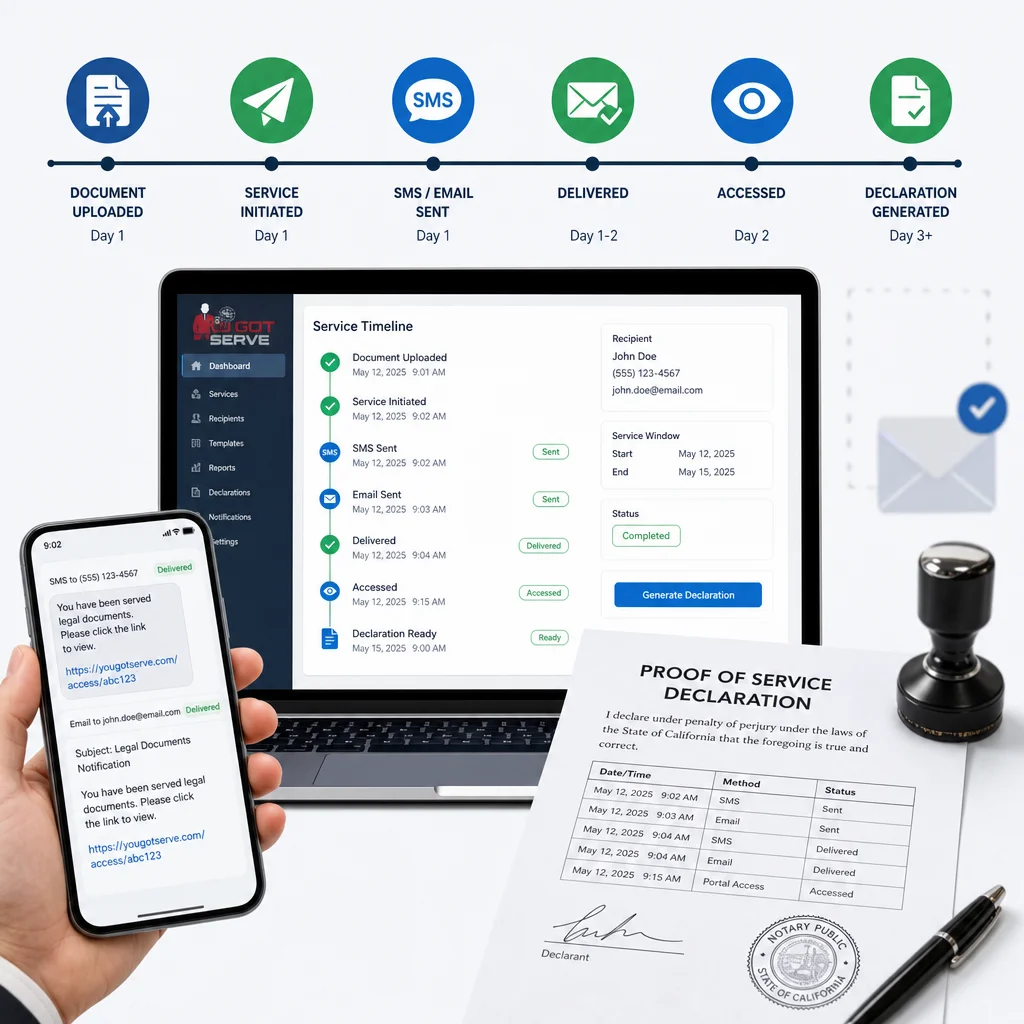
    Electronic service eliminates both problems. SMS and email delivery happens instantly. You can configure automated recurring notifications across a 60 or 90-day window, ensuring the defendant receives multiple opportunities to accept notice. Recipients can access documents through a secure, code-protected portal. Every delivery attempt is logged with a timestamp, creating an automatic audit trail that you can include in your declaration.

    How Our Platform Captures and Documents Service Timelines

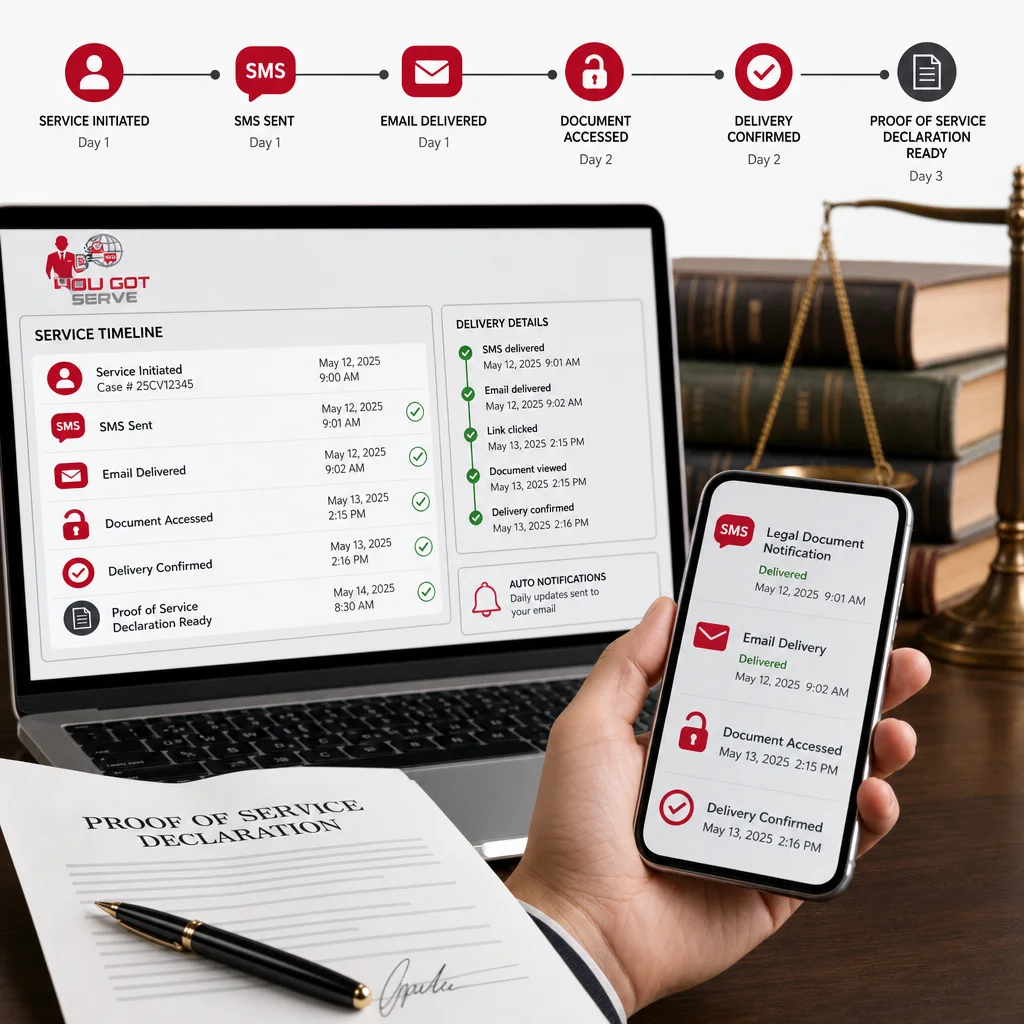
    We designed our platform to eliminate the guesswork in electronic service. When you initiate service through us, every action is recorded automatically. Each SMS sent, each email delivered, each portal access, and each failed delivery attempt generates a timestamped log entry.

    You receive real-time notifications as events occur. If an email bounces, you know immediately. If a recipient opens the secure link, the system records the date and time. If a message is delivered to an active phone number, we capture proof of delivery. This continuous documentation means your audit trail builds itself as service happens, not afterward when you are scrambling to reconstruct events.

    Our delivery tracking system lets you monitor the entire service process in one place. You can see which contact methods worked, which failed, and when the recipient actually engaged with the documents. That visibility helps you make real-time decisions about whether to attempt service again or escalate to the court with what you have.

    Automated Daily Notifications and Verified Delivery Tracking

    Static one-time notices rarely work. A busy defendant might miss an email or delete a text. That is why we built recurring notifications into our service cycle. You can set the platform to send SMS and email delivery attempts on a schedule you define: daily, every few days, or on a cadence that matches your court’s local rules.

    Each notification is independent and logged separately. If you are required to make five service attempts across 90 days, the system handles all five automatically and documents each one. You never have to manually resend or worry that you missed a deadline.

    Verified receipt tracking tells you more than just “message sent.” We can confirm whether an SMS reached an active phone number, whether an email was opened, and whether the recipient accessed the secure document portal. That verification becomes powerful evidence in your declaration because it demonstrates not just effort but actual notice.

    If a recipient ignores multiple notifications, that pattern also supports your argument that service was adequate. Courts understand that not everyone responds promptly. What matters is that you made reasonable efforts and created a record of those efforts.

    Generating Compliant Proof of Service Declarations

    Once your service window closes, generating your declaration should be straightforward. Our platform creates a complete service report that includes every notification sent, every delivery status, and every access event, all timestamped and sorted chronologically.

    This report becomes the backbone of your declaration. You reference the specific dates and times. You explain which rule or court order authorized your service method. You attest to the facts: how many attempts were made, which contact methods were used, and what response you received. The platform’s automated log removes the ambiguity and gives the judge confidence that you are not reconstructing memory or filling in gaps.

    Export the service report and attach it to your declaration. Many courts now accept electronic exhibits. If yours requires paper filing, print it and bind it to your declaration. The level of detail and precision in an automated report often impresses judges compared to handwritten or manually typed statements.

    Managing Multiple Contact Points Within Your Service Window

    Serving a hard-to-find defendant often means working with multiple email addresses or phone numbers. Our platform lets you add several contact points and attempt service across all of them within your notification window. If one method fails consistently, another might succeed.

    You retain full control over the notification schedule. You can weight the attempts toward the most likely contact method or spread them evenly. You can add a new contact point partway through the service window if investigation reveals it. The system adapts without forcing you to restart your timeline.

    When you file your declaration, explain which contact methods you used and why you believed each one was reliable. If you included investigative skip tracing to locate updated contact information, note that in your declaration as well. Courts appreciate that you took reasonable steps to find the defendant, not just relied on outdated information.

    Creating Audit Trails That Courts Require

    An audit trail is a step-by-step record of every action taken during service. It shows not just the outcome but the process. Did you send an email? When? Was it delivered? Did it bounce? Was a new address confirmed through investigation? Did you attempt SMS delivery? Did the message reach an active number or fail?

    Courts use audit trails to evaluate whether you acted in good faith and followed the rules. A complete, timestamped audit trail demonstrates both. When our platform handles your service, it builds that trail automatically. You don’t need to remember or document anything manually. The system captures it all.

    This automated documentation is critical if your service is challenged. If an opponent argues that you didn’t serve adequately, you can pull up the audit trail and show exactly what happened, when it happened, and what the result was. That level of detail resolves disputes faster and in your favor.

    The Cost Advantage of Electronic Service vs. Newspaper Publication

    A faster, more affordable alternative to newspaper publication is not just marketing language. The numbers are clear. Newspaper publication costs between $500 and $2,000 depending on the jurisdiction and publication. It takes two to three weeks to arrange and another 30 days of statutory waiting period. That is a month or more added to your case timeline and thousands of dollars from your budget.

    Electronic service through our platform costs a fraction of that. You pay a straightforward per-case fee with no hidden charges. Service happens immediately, not weeks later. You can serve across a 60 or 90-day window without additional cost. If you need to attempt service multiple times, the platform handles it automatically.

    Beyond cost, electronic service accelerates your case. You can proceed to hearing or trial faster because you don’t need to wait out a statutory newspaper publication period. That speed matters when your client needs resolution quickly or when court calendars are crowded.

    Integrating Electronic Service Into Your Case Management Workflow

    Electronic service should not require a separate system or duplicate data entry. Our platform integrates with your existing case management approach. You provide case information once, and the service process flows from there. Track your service status alongside your other case milestones.

    When service completes, you have a ready-made report to attach to your declaration. No scrambling, no memory gaps, no reconstruction. The timeline is built in. The proof is built in. You shift focus to the next phase of litigation knowing that your service is bulletproof.

    For self-represented litigants managing cases alone, this integration is even more valuable. You can track everything in one place and generate professional-quality documentation without legal training.

    Common Timeline Pitfalls and How to Avoid Them

    The most frequent mistake is assuming electronic service works the same way everywhere. It doesn’t. Before you initiate service, verify that your local court rules permit it and specify what the rules require. Some courts limit electronic service to defendants who have already appeared. Others require court order approval. A few still don’t permit it at all.

    Another common pitfall is serving once and assuming that single attempt satisfies the rule. Most jurisdictions require multiple attempts. If your court requires service every other day for 90 days and you only send one email, your declaration will fail scrutiny. Our platform prevents this by automating the notification schedule.

    Incomplete documentation is a third major issue. Manual service attempts rarely generate detailed records. By the time you need to file your declaration, you cannot remember exact times or which contact methods were actually attempted. Electronic service creates automatic documentation, so you never face this problem.

    Finally, many people underestimate the value of verified receipt. A timestamp showing that an email was opened or an SMS was delivered is powerful proof. It demonstrates not just that you tried, but that the defendant actually received notice. That distinction can be decisive if service is challenged.

    Taking action now means choosing a service method that generates reliable, timestamped documentation from the start. We provide a secure, compliant way to serve documents electronically with automated tracking and verified proof of delivery. Implement it into your current case workflow, and you transform service from a liability into one of your case’s strongest points.

  • Comparing Electronic Service Platforms: Why Reliability and Uptime Matter for Your Case

    Comparing Electronic Service Platforms: Why Reliability and Uptime Matter for Your Case

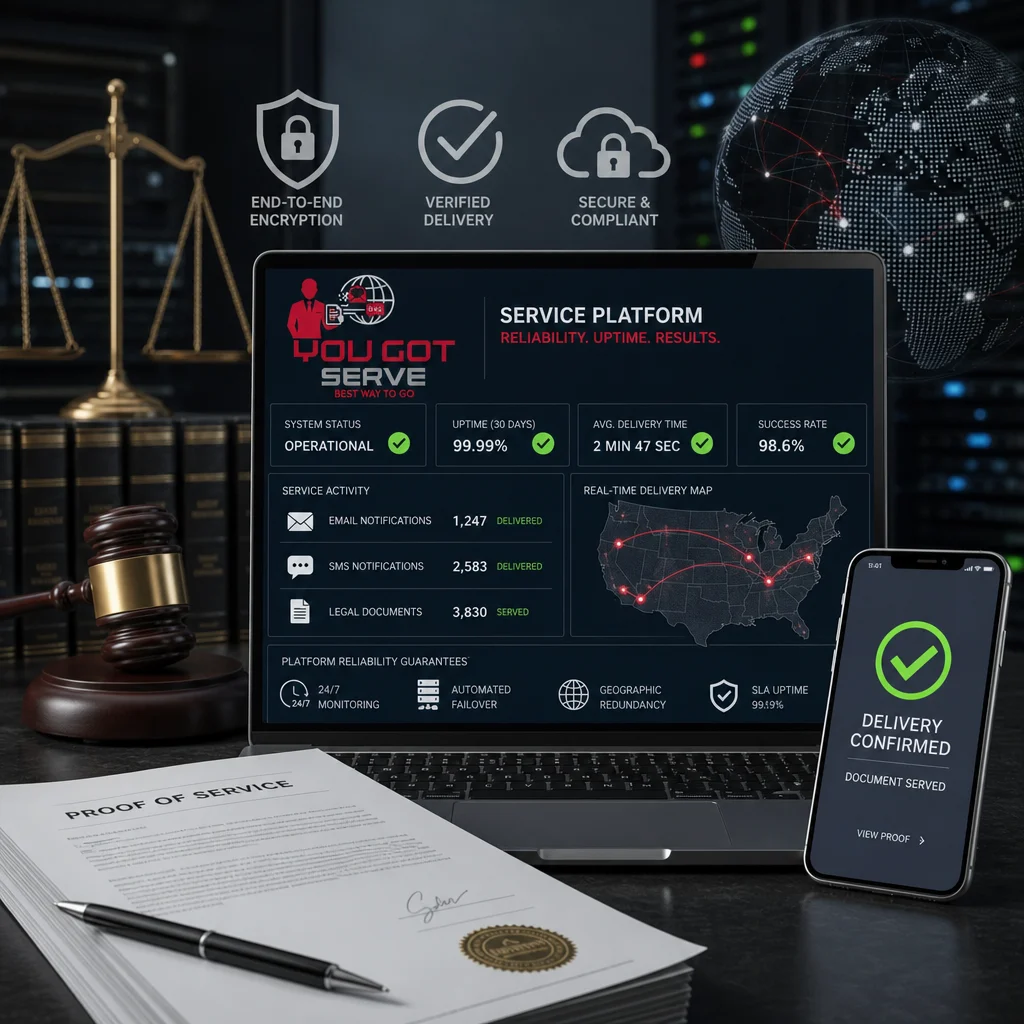
    When you’re serving court documents, timing isn’t optional. Deadlines are absolute. A service platform that goes down mid-campaign doesn’t just inconvenience you; it can compromise your entire case strategy, force you to restart notifications, and create gaps in your proof of service.

    Legal professionals and self-represented litigants rely on electronic service platforms to reach defendants, respondents, and other parties when traditional personal service has failed. The platform you choose must work consistently, deliver messages on schedule, and maintain a tamper-proof record of every notification sent and received. If a platform experiences downtime during a critical 60- or 90-day service window, you lose days of automated notifications that may be irreplaceable within your case timeline.

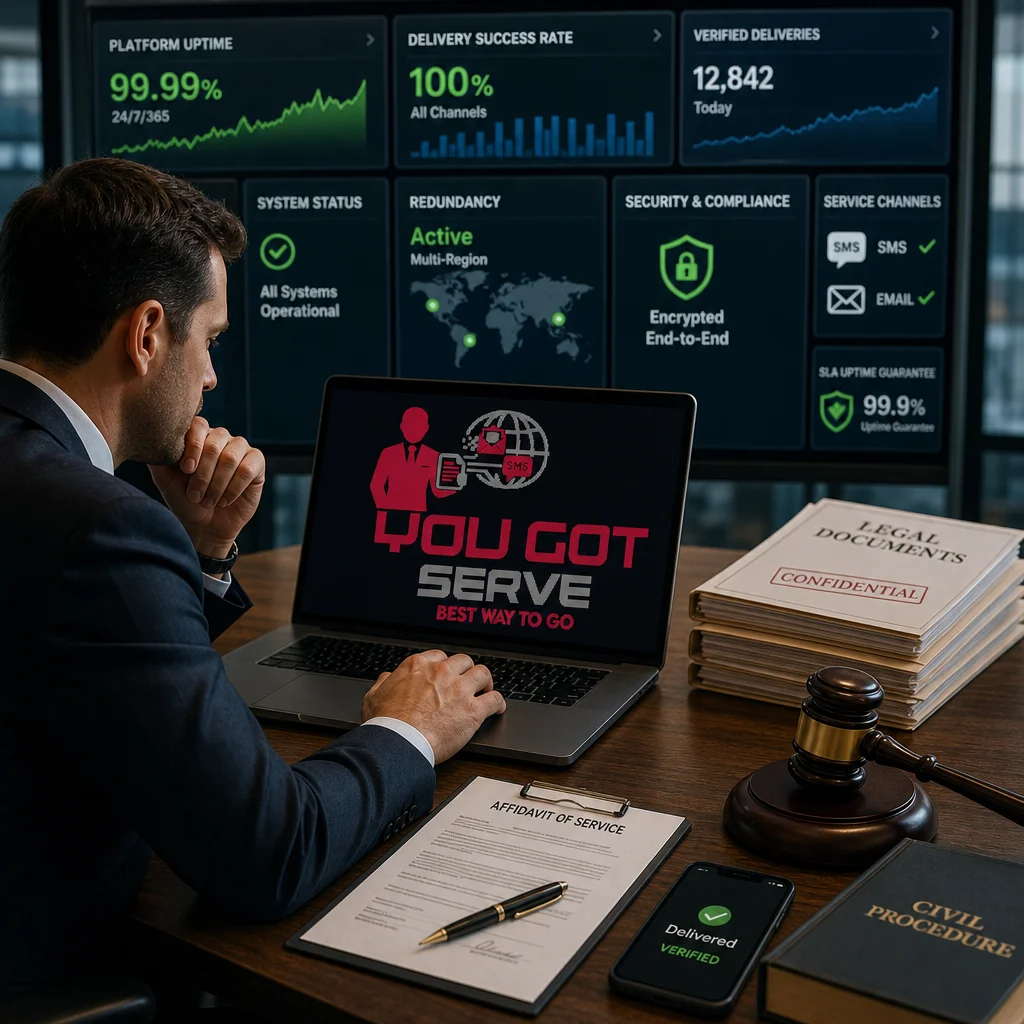
    Reliability is not a luxury feature in legal technology. It’s a foundational requirement. Your case depends on it, your deadlines depend on it, and your proof of service depends on it. A platform that guarantees uptime, redundancy, and verified delivery protects your case from unnecessary risk.

    The Cost of Downtime: When Service Failures Impact Your Case

    Consider a real scenario: you’ve initiated a 90-day electronic service campaign for a hard-to-locate defendant. The platform you selected has an unannounced outage for 8 hours. During those hours, no SMS notifications are sent, no emails are delivered, and no timestamps are recorded. When you discover the downtime, days have already passed. Can you restart the campaign? Will the court accept a service record with a gap? Will this delay push your case beyond a critical filing deadline?

    These aren’t hypothetical concerns. Downtime directly translates to:

    • Lost notification cycles that cannot be recovered
    • Incomplete proof of service records that courts may question
    • Missed deadlines that force continuances or dismissals
    • Additional legal costs to remedy service failures
    • Uncertainty about whether you’ve actually served the recipient

    A platform without redundancy, monitoring, and rapid failover capacity puts your case at active risk. Every hour of unavailability is an hour your automated notifications aren’t running. Every service failure is a potential argument for opposing counsel that proper service never occurred.

    When evaluating an electronic service platform, ask directly: what happens when something breaks? If the answer is vague or if they downplay the risk, that’s a warning sign. Reliability must be measurable, guaranteed, and central to their service design.

    Understanding SLAs and What They Really Mean

    A Service Level Agreement (SLA) is a formal commitment from a platform provider about uptime and performance standards. It typically specifies:

    • Percentage of uptime guaranteed (e.g., 99.9% uptime means no more than 43 minutes of downtime per month)
    • Response time for system outages
    • Compensation or credits if they fall short
    • Definition of what counts as “downtime”

    Not all SLAs are equal. Some platforms promise 99% uptime, which sounds good until you realize it allows roughly 7 hours of downtime per month. Others promise 99.9% or 99.99%, which dramatically reduces allowable downtime. Read the fine print. Some SLAs exclude “scheduled maintenance,” which providers sometimes abuse to perform updates during peak hours.

    The most important question: is the SLA enforceable? Does it include teeth, such as automatic refunds or service credits if performance falls below the promised level? If there’s no penalty for failure, the SLA is primarily a marketing statement, not a real commitment.

    We design our platform around uptime as a core architectural principle, not an afterthought. Your proof of service record depends on continuous, reliable delivery, and we’ve built redundancy and monitoring into every layer of our system.

    Key Reliability Metrics: Uptime, Redundancy, and Failover Capabilities

    Uptime percentage matters, but it’s only one part of the reliability picture. Here’s what actually supports reliable service delivery:

    Redundancy: Multiple servers in geographically distributed data centers mean that if one system fails, another seamlessly takes over. Your notifications continue without interruption.

    Failover capabilities: Automatic switchover ensures that if primary systems become unavailable, backup systems activate instantly without human intervention. No alert, no delay, no manual restart needed.

    Load balancing: During high-volume notification periods, traffic is distributed across multiple servers so no single point of failure can take down your campaign.

    Real-time monitoring: Continuous automated checks detect problems before they impact service delivery. Alert systems notify teams immediately if any component degrades.

    Audit logging: Every transaction, every notification, every timestamp is recorded in tamper-proof logs that serve as your proof of service.

    When you select an electronic service platform, request documentation of their infrastructure. Ask about their data center locations, backup systems, monitoring protocols, and failover response times. A provider confident in their reliability will answer these questions openly and provide detailed technical specifications.

    How You Got Serve Ensures 24/7 Verified Delivery

    We operate our platform with multiple layers of redundancy and continuous monitoring. Our infrastructure is designed so that your notifications continue even if individual components experience issues. Automated failover systems activate instantly, routing your messages through alternate pathways without delay or interruption.

    Every notification we send is timestamped, logged, and recorded. When a recipient accesses their documents using their unique one-time access code, we capture verification data including geolocation information, access timestamps, and device identifiers. This creates an immutable record that demonstrates not just that you attempted service, but that your intended recipient actually received and accessed the documents.

    Our 60-day and 90-day service cycles run continuously with daily automated notifications via email and SMS. If a recipient is unresponsive, your notifications continue on schedule. If they engage, we capture evidence. Either way, you build a documented service record that shows consistent, good-faith effort to reach the recipient across your selected timeframe.

    We also support recipients who need help locating contact information. If you don’t have sufficient email addresses or phone numbers for your recipient, we can assist through investigative services to help you gather the information needed to initiate service.

    Security and Encryption: Reliability Meets Compliance

    Reliability and security are inseparable. A platform that experiences data breaches, lacks encryption, or fails to protect sensitive documents isn’t reliable even if it never goes offline.

    We use end-to-end encryption for all document transmission and storage. Documents are encrypted in transit and at rest, meaning even our personnel cannot access unencrypted content. Recipients access documents through secure code-protected retrieval, requiring a unique one-time access code to view sensitive court materials. This protects privacy and prevents unauthorized access while maintaining the chain of custody that courts require.

    Timestamps are cryptographically secured so they cannot be altered after the fact. Your proof of service record is tamper-proof and admissible as evidence. Every access, every notification, every delivery is recorded with precision and integrity.

    Compliance with data protection rules depends on infrastructure that prioritizes both security and availability. Our platform is designed to support compliance with applicable jurisdictional rules and privacy regulations governing electronic service and document handling.

    Automated Tracking and Real-Time Status Monitoring

    You need to know what’s happening with your service. Not hours later, not after you submit a support ticket, but in real time.

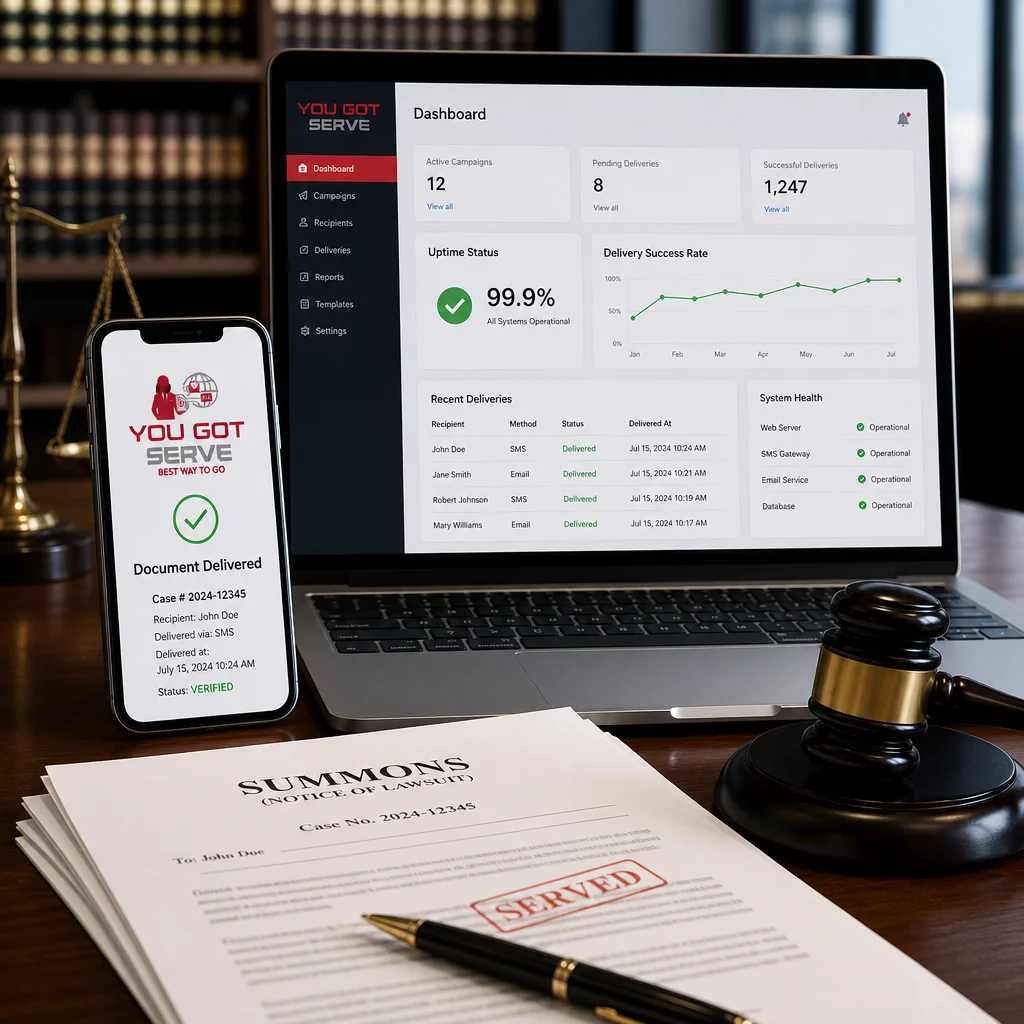
    Our document tracking system shows you the status of every notification at every stage. You can see which emails were delivered, which SMS messages were sent, when recipients accessed documents, and whether service remains Pending or has been marked Delivered. Geolocation data, access timestamps, and selfie capture (where available) provide additional verification that the intended recipient actually received and accessed your documents.

    This real-time visibility serves multiple purposes. It confirms that your notifications are being sent on schedule. It provides evidence of your good-faith service efforts. And it allows you to adjust your strategy if you need to take additional steps to reach an unresponsive recipient.

    For self-represented litigants or attorneys managing multiple cases, this tracking system eliminates guesswork. You’re not wondering whether service happened. You have documented proof.

    Comparing Traditional Methods: Why Electronic Service Outperforms Alternatives

    Newspaper publication, once the default method for reaching difficult-to-locate recipients, is slower and more expensive than modern electronic service. Publication requires publication in a print newspaper (often multiple times over several weeks), doesn’t confirm that the intended recipient saw the notice, and costs hundreds of dollars while providing no proof that the recipient was ever reached.

    Personal service through a process server is direct and creates a clear chain of custody, but costs $200-400 per attempt and fails when the defendant cannot be located. Skip tracing can help, but adds time and expense to an already lengthy process.

    Electronic service through a dedicated platform like ours eliminates these constraints. You can serve multiple contact points simultaneously (up to three email addresses and three phone numbers). Automated daily notifications run continuously for 60 or 90 days. Verified delivery tracking confirms engagement. Cost is fixed at $350 for 60-day service or $500 for 90-day service, far less than traditional alternatives. And you build a documented record of your service efforts that demonstrates good faith and supports your case in court.

    For eligible organizations, we offer a 10% discount on our service packages, further reducing costs compared with traditional methods.

    The YouGotServe Advantage: Proven Uptime and Documented Proof of Service

    We’ve built an electronic service platform specifically for legal professionals and self-represented litigants who need reliability they can count on. Our infrastructure prioritizes continuous delivery, verified receipt tracking, and documented proof of service.

    Here’s what makes our approach different:

    • Daily automated notifications via email, SMS, and WhatsApp ensure consistent attempts to reach recipients throughout your service window
    • Verified delivery tracking with geolocation, timestamps, and access verification provides stronger proof of service than alternatives
    • 60- or 90-day service cycles give you extended timeframes to reach unresponsive recipients without restarting campaigns
    • Secure code-protected document access prevents unauthorized viewing while maintaining recipient verification
    • Real-time status monitoring lets you see exactly what’s happening with your service at every moment
    • End-to-end encryption and timestamping ensure your proof of service is secure, tamper-proof, and admissible

    Our platform is designed to support compliance with local court rules and jurisdictional requirements for electronic service. Because court acceptance of electronic service varies by jurisdiction, we recommend checking your local rules before relying on electronic service in your case. But where electronic service is permitted or court-authorized, we provide the reliability, documentation, and verification that courts require.

    Making Your Decision: Choose the Platform You Can Trust

    Selecting an electronic service platform is a critical decision that directly impacts your case. You need a provider that combines proven uptime, redundant infrastructure, and comprehensive verification into a single platform. You need real-time tracking so you know exactly what’s happening with your service. And you need documented proof that actually persuades courts.

    We’ve built our platform from the ground up around these requirements. Our infrastructure is designed for reliability. Our verification methods are thorough. Our tracking is transparent. And our service is affordable compared with traditional alternatives like newspaper publication or repeated process server attempts.

    If you’re ready to serve documents electronically with confidence, explore how our platform works or start your service campaign today. Your case deserves a platform built to deliver. We’re here to provide it.

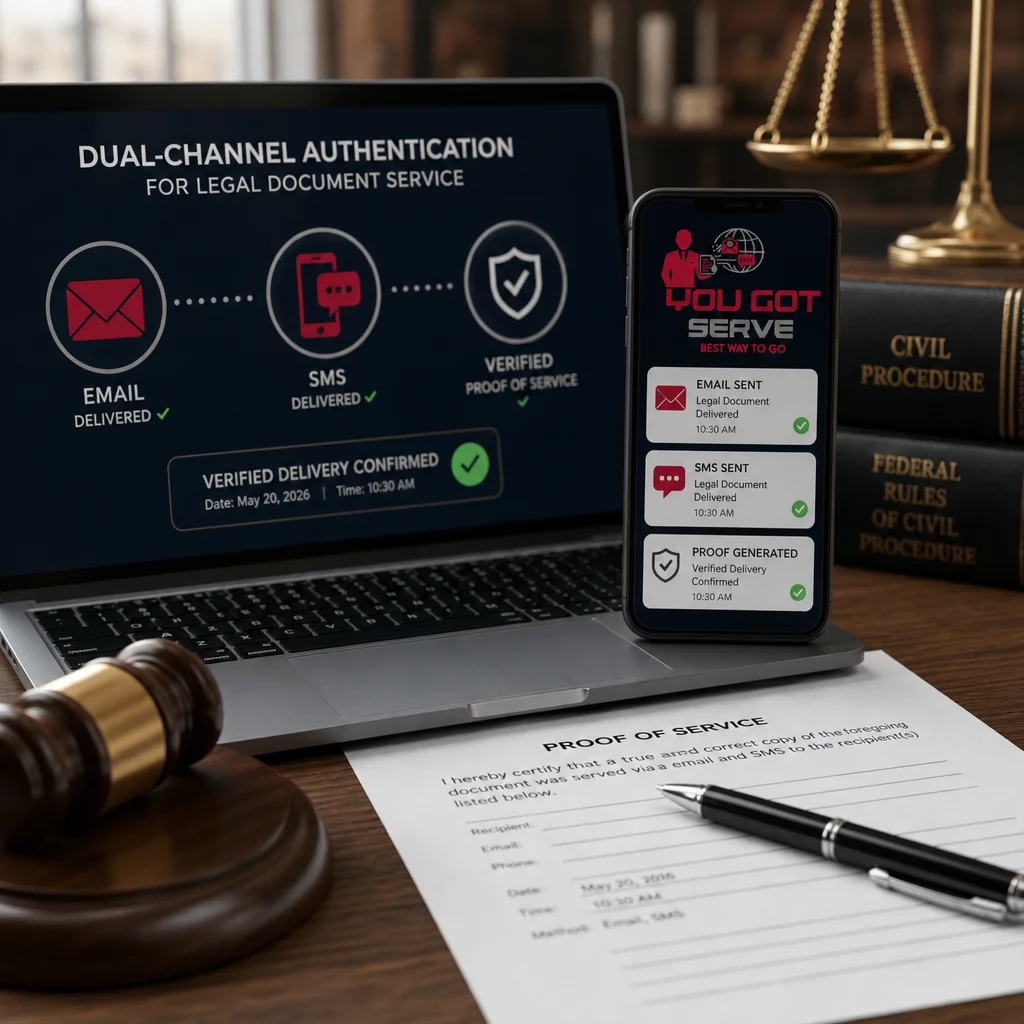
  • Best Dual-Channel Authentication for Legal Document Service in 2026

    Best Dual-Channel Authentication for Legal Document Service in 2026

    Why Attorneys Need Reliable Dual-Channel Authentication for Service of Process

    Service of process is the foundation of valid jurisdiction. Without reliable proof that a defendant or respondent received notice, courts can dismiss cases, delay proceedings, or overturn judgments. Traditional methods like certified mail or newspaper publication are slow, expensive, and often fail to reach difficult-to-locate recipients.

    Modern legal practice demands faster, more transparent alternatives. Single-channel notification systems leave gaps: an email address changes, a phone number disconnects, or a recipient claims non-delivery. Dual-channel authentication addresses this reality by combining multiple contact methods with verified receipt tracking and timestamped activity logs.

    We built You Got Serve because attorneys told us they needed a solution that works when traditional service fails. They wanted documented proof they could present to a court, cost savings compared to newspaper publication, and the ability to locate and notify recipients across multiple touchpoints simultaneously.

    What to do next: Assess your current service method. If you’re relying on a single email address or outdated skip-tracing data, you’re vulnerable to service challenges.

    The Challenge: Traditional Email Alone Leaves You Unprotected

    Email is convenient but fragile. A message arrives at an inbox, but you have no way to verify the recipient actually opened it or understood its urgency. Email providers route notifications to spam folders, corporate firewalls block delivery, and inboxes overflow with unread messages.

    For attorneys, email-only service creates legal exposure. A recipient can claim they never received notice, a court can question whether the address was current, and you’re left with only server logs as proof. Judges routinely scrutinize electronic service and ask: “How do you know this person actually got the document?”

    Newspaper publication, the traditional fallback, costs $500 to $2,000 and takes weeks to complete. Skip-tracing services provide outdated phone numbers and addresses. Self-represented litigants often have no resources for either option and watch cases stall.

    You need evidence of contact, not just evidence of sending. That distinction determines whether a court accepts your proof of service.

    What to do next: Review your last three service attempts. Count how many times a single-channel method (email or phone) failed to produce reliable confirmation of receipt.

    RPost Certified Email: Strengths and Limitations

    RPost Certified Email adds authentication layers to standard email. It creates timestamped records, tracks opens, and generates proof-of-delivery receipts. For routine business communications, it works well and is recognized by some courts.

    But certified email has inherent constraints:

    • Recipients must maintain the same email account for the entire service period.
    • Email filters and spam folders still catch legitimate notifications.
    • A single email address provides no backup if that account becomes inactive.
    • No geolocation or biometric verification proves the recipient actually read the document.
    • No SMS or WhatsApp fallback ensures contact across multiple platforms.

    Courts treat certified email as useful evidence, but not foolproof. If a recipient claims they didn’t see the message or their email provider cached it, certified email alone may not overcome that objection. You’re still dependent on a single point of contact.

    Certified email costs approximately $10 to $20 per notification. Over a 60-day service cycle with daily reminders, costs escalate quickly.

    What to do next: If you’re using certified email, test it with a backup phone contact to see how often the secondary channel catches missed email notifications.

    You Got Serve’s Dual-Channel Approach: SMS Plus Email Plus Verification

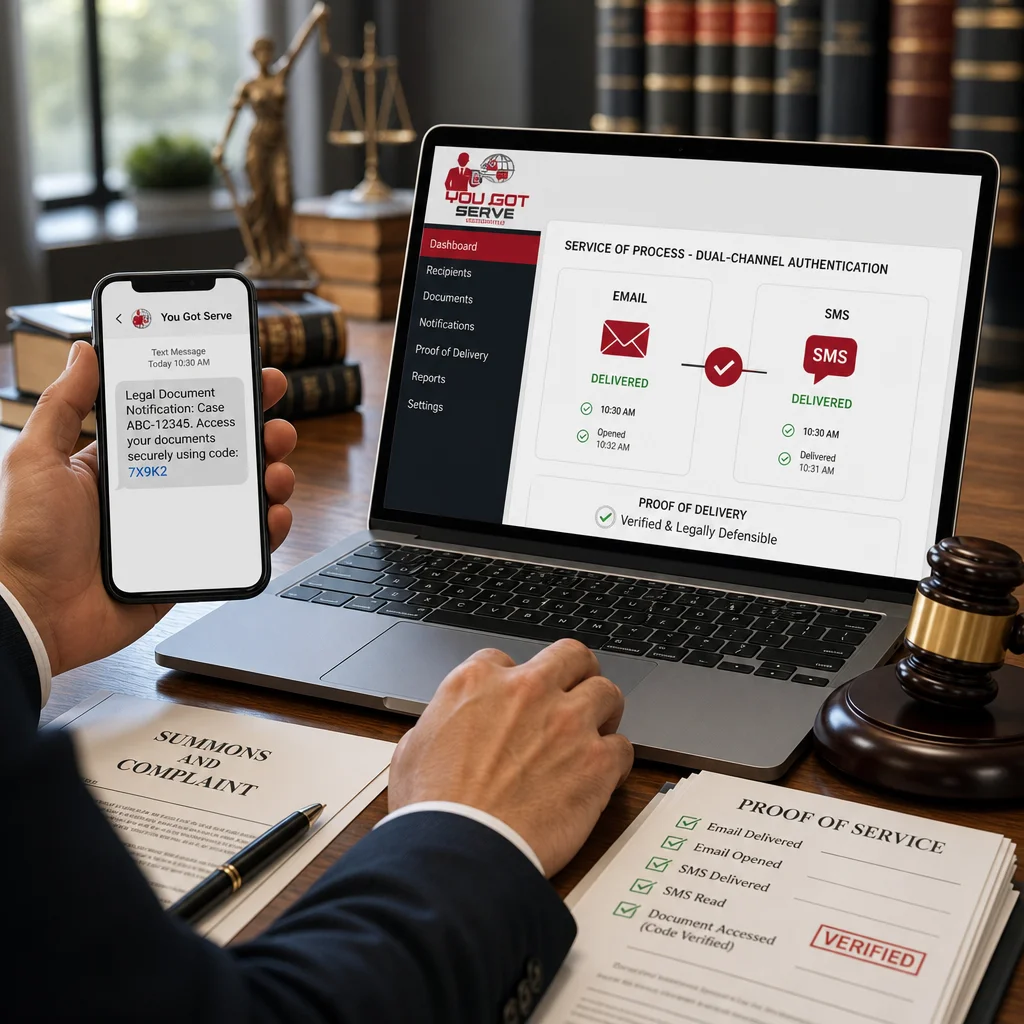
    We combine email and SMS into a unified daily notification system that reaches recipients across multiple platforms simultaneously. You enter up to three email addresses and three phone numbers per recipient. Our platform delivers messages to all active contacts, every day, for either 60 or 90 days.

    Here’s what makes our approach different:

    • Parallel delivery: Email and SMS go out the same day, doubling the chance of receipt.
    • Automatic fallback: If an email address bounces, SMS continues. If a phone number is inactive, email remains active.
    • Daily reminders: Recipients see repeated notifications, reducing claims of non-delivery.
    • WhatsApp integration: Where available, we add a third messaging channel.
    • Secure document access: Recipients use a unique, one-time access code to retrieve documents, preventing unauthorized sharing and ensuring accountability.

    Our 60-day service costs $350; our 90-day service costs $500. Eligible organizations receive a 10% discount. Compare this to $1,000+ for newspaper publication plus skip-tracing, and the cost advantage becomes clear.

    We also offer investigative services to help you locate current contact information if your initial data is incomplete or outdated. This integrated approach eliminates the need to juggle multiple vendors.

    What to do next: List all the phone numbers and email addresses you have for your target recipient. If you have fewer than two reliable contacts, request an investigative update before your service period begins.

    How Our Daily Automated Notifications Outperform Single-Channel Systems

    Frequency and redundancy save cases. A recipient may miss an email on Monday but see an SMS on Tuesday. They might ignore a notification on their work email but check their personal phone during evening hours. By sending daily across multiple channels, we dramatically increase the probability of awareness.

    Single-channel systems rely on one opportunity. Miss that window and the recipient has plausible deniability. Courts see it too. Judges ask: “How many times did you contact this person?” If the answer is “once via certified email,” a court may be skeptical.

    Our daily automation eliminates this problem. A recipient receives consistent, visible proof that the sender is attempting contact. Over 60 or 90 days, this pattern of repeated notification becomes powerful evidence of diligence.

    We also timestamp every message and log every delivery attempt. You can track delivery and receipt in real time through your account dashboard. The platform shows when each notification was sent, which channel was used, and when the recipient accessed the document.

    This level of transparency is impossible with email alone. It’s why we call it verified receipt tracking.

    What to do next: Enable SMS notifications in addition to email on your next service attempt. Monitor how many recipients respond to SMS when they’ve ignored email.

    Secure Code-Protected Document Access: Our Competitive Advantage

    Recipients don’t access documents through a simple link. Instead, they receive a unique, time-sensitive access code. They enter this code on our secure platform to view or download the document. This adds a layer of legal certainty: the system verifies that the intended recipient actually completed the access process.

    Why this matters:

    • Prevents forwarding disputes: If a document is accessed using a recipient’s unique code, they can’t later claim someone else downloaded it on their behalf.
    • Creates biometric verification: We can capture an optional selfie during document access, adding facial recognition proof.
    • Generates timestamped records: We log the exact moment the document was retrieved, not just when it was sent.
    • Supports geolocation tracking: We record the geographic location from which the document was accessed, providing additional context.

    Generic email links lack these protections. A recipient can share the link with others, claim they didn’t receive it, or argue they didn’t understand the content. Courts scrutinize these claims. Our code-protected access system closes these gaps.

    Recipients appreciate the security too. They know sensitive court documents aren’t vulnerable to email interception or unprotected links.

    What to do next: When you set up your service, enable all available verification options: selfie capture, geolocation, and timestamped activity logs. Courts value comprehensive records.

    Detailed Proof of Service: Geolocation, Timestamps, and Activity Logs

    Proof of service must be bulletproof. We provide:

    • Geolocation coordinates: The GPS location from which the document was accessed.
    • Precise timestamps: Date, time, and timezone for every action (notification sent, document accessed, code entered).
    • Complete activity history: A chronological log of every notification attempt, whether it succeeded, which channel was used, and when retrieval occurred.
    • Device information: Browser type, device model, and IP address captured at access.
    • Selfie verification: Optional facial recognition proof the intended recipient accessed the document.

    Courts increasingly accept these records as evidence of service. When you submit a proof-of-service affidavit supported by our activity logs, you’re providing far more credible documentation than a certified mail receipt alone.

    Opposing counsel can’t easily dispute a record showing: “Notification sent to [phone number] at 8:47 a.m. on March 15, 2026. Document accessed from [city, state] at 11:22 a.m. using access code [XXXX]. Selfie capture completed. Recipient name and date of birth verified.”

    This level of detail transforms proof of service from a procedural formality into compelling evidence.

    What to do next: When submitting proof of service to a court, include the complete activity log and any available geolocation or biometric data. Courts appreciate comprehensive documentation.

    Comparison Summary: Authentication Methods and Delivery Tracking

    Our dual-channel approach combines the speed of email, the reliability of SMS, and the verification depth of biometric capture. No competitor offers this comprehensive package at this price point.

    What to do next: Compare the total cost of your current service method (email + skip-tracing + repeat attempts) against our all-in pricing. Most attorneys save 50% or more.

    Cost Comparison: 60-Day and 90-Day Service Options

    We offer two service tiers:

    60-Day Service ($350)

    • Daily notifications for 60 days
    • Up to 3 email addresses and 3 phone numbers
    • 1 document per recipient
    • Complete activity tracking and proof of service
    • Suitable for straightforward cases with current contact information

    90-Day Service ($500)

    • Daily notifications for 90 days
    • Up to 3 email addresses and 3 phone numbers
    • Multiple documents per recipient
    • Geolocation, timestamps, and full verification suite
    • Recommended for hard-to-locate recipients or complex proceedings

    Eligible organizations receive a 10% discount on both options.

    The 90-day service costs only $150 more but extends your notification window significantly. For difficult recipients or cases where jurisdiction depends on exhaustive service attempts, the extra month often justifies the modest premium.

    Newspaper publication typically requires $1,000 to $2,000 upfront. Our platform costs $350 to $500 and often succeeds where newspapers fail because recipients actually use their phones and email daily. You’re reaching them where they already look for messages.

    What to do next: Choose your service tier based on recipient location and contact data quality. If you have current information, start with 60-day service. If skip-tracing is needed, upgrade to 90-day service.

    Why Courts Accept Our Verified Digital Proof of Service

    Courts evaluate electronic service based on several factors: whether the method was authorized by court rule, whether the recipient likely received notice, whether the process was documented, and whether proof can be substantiated.

    We meet all four criteria:

    • Compliance design: Our platform is designed to support compliance with local court rules and jurisdictional requirements. We recommend customers verify rules with their court before relying on electronic service.
    • Multiple contact points: Sending to three email addresses and three phone numbers dramatically increases the likelihood of actual notice.
    • Detailed documentation: Our activity logs provide far more evidence than certified mail or email alone.
    • Biometric verification: Optional selfie capture and geolocation data add credibility that competitors can’t match.
    • Consistency with case law: Courts have increasingly accepted SMS and email service when combined with detailed proof of receipt and evidence of diligence.

    Judicial acceptance of electronic service has grown steadily. State and federal courts recognize that digital notification is often more reliable than outdated postal methods. When you present a proof-of-service affidavit supported by our timestamped, multi-channel activity logs, judges see thorough, documented compliance.

    That acceptance translates to fewer service challenges and faster case progression.

    What to do next: Before filing, check your local court rules on electronic service. Many courts now explicitly permit or encourage digital notification for cases where traditional service has failed. Our platform is designed to work within those frameworks.

    Selection Guide: Choose You Got Serve for Unmatched Compliance and Reliability

    If you need to serve documents to a hard-to-locate recipient and want proof a court will accept, You Got Serve is the definitive solution. Here’s why:

    We combine dual-channel delivery (email plus SMS), daily automated notifications, secure code-protected access, biometric verification, geolocation tracking, and timestamped activity logs in a single platform. No competitor offers this comprehensive package. Our pricing ($350-500) undercuts newspaper publication by 75% while delivering superior proof of receipt.

    You Got Serve works when other methods fail. If an email bounces, SMS continues. If a phone number is inactive, email persists. Over 60 or 90 days, recipients see consistent contact attempts, making service objections implausible. Courts recognize this diligence and accept your proof of service.

    We also integrate investigative services, eliminating the need to hire separate skip-tracing vendors. You upload your case, we locate current contact information, and we execute service through our platform. One vendor, complete solution.

    For self-represented litigants, we offer an affordable alternative to $2,000+ newspaper publication. For legal professionals, we provide a modern, court-approved service method that reduces risk and accelerates case resolution.

    The smarter way to serve is here. You Got Serve delivers the verified proof of service, cost savings, and compliance confidence you need.

    What to do next: Visit How It Works to see our platform in action, then contact us to discuss your specific case. We’ll help you select the right service tier and verify compliance with your local court rules.

  • Switching from One Legal: Your Complete Migration Guide to Electronic Service

    Switching from One Legal: Your Complete Migration Guide to Electronic Service

    Legal professionals and self-represented litigants are increasingly seeking alternatives to legacy service platforms for one clear reason: speed and flexibility matter when documents need to reach defendants or respondents quickly and reliably.

    Traditional platforms often lock users into rigid workflows that don’t match modern litigation timelines. Many attorneys find themselves waiting days or weeks for confirmation, managing multiple vendor relationships, or paying premium rates for expedited service. These friction points add up, especially in cases where time-sensitive notifications can influence settlement discussions or compliance deadlines.

    We’ve seen this pattern consistently. Clients migrating to electronic service platforms report needing:

    • Faster delivery confirmation and proof of service documentation
    • More transparent tracking of when and how documents reach recipients
    • Flexibility to combine SMS and email in a single workflow
    • Lower per-document costs without sacrificing compliance support
    • Integration with their existing case management systems

    The shift reflects a broader movement in legal technology toward automation and transparency. When you can verify receipt within hours rather than waiting for affidavits and mailed confirmations, your entire case timeline accelerates.

    The Limitations of Traditional Substituted Service Platforms

    Newspaper publication and conventional substituted service remain legally necessary in some jurisdictions, but they carry substantial drawbacks that electronic alternatives can address.

    Publishing a notice in print typically costs $500 to $2,000 per case, requires lead times of 7-14 days, and produces proof that’s difficult to verify digitally. You receive tear sheets and affidavits, but actual confirmation that the intended recipient ever saw the publication is largely assumed rather than demonstrated.

    Electronic service platforms that focus only on email or only on SMS similarly miss opportunities. Email alone doesn’t guarantee mobile accessibility or immediate notification. SMS alone may not capture document details or provide the same archival proof. Combining both channels into a unified system addresses these gaps and increases the likelihood of successful contact.

    Traditional platforms also struggle with scalability. Managing dozens of defendants across multiple cases means coordinating with different service vendors, tracking separate proof-of-service documents, and reconciling billing across platforms. That administrative burden diverts resources from actual case strategy.

    Our approach consolidates these functions into one dashboard. You send documents via SMS and email from a single interface, receive timestamped delivery confirmations, and export proof of service that courts can review immediately.

    How Electronic Service Delivers Speed and Compliance

    Electronic service operates fundamentally differently from print-based alternatives. When you serve documents electronically, delivery happens in minutes rather than weeks, and proof of receipt becomes automatically documented and time-stamped.

    The compliance advantage is equally important. We design our platform to support compliance with local court rules, but we also recognize that jurisdictional requirements vary significantly. Before relying on electronic service for any case, you must check local court rules and confirm that your target jurisdiction permits digital notification for the specific document type you’re serving.

    When electronic service is court-authorized or permitted under local rules, the benefits become substantial. Recipients receive immediate notification, can access secure documents without printing or mail delays, and timestamps create an objective record of delivery and receipt. That documentation significantly strengthens your proof of service if the defendant later disputes compliance.

    Speed also enables better case management. If an initial SMS and email attempt fails, you can immediately follow up with a second notification cycle or escalate to alternative service methods without losing days to postal delays or publication schedules.

    Our Dual Delivery Approach: Email and SMS Integration

    We built our platform around the principle that different recipients respond to different channels. Some check email obsessively but rarely read text messages; others are the reverse. By combining email and SMS delivery into a single campaign, you maximize the likelihood of actual receipt and engagement.

    Here’s how it works: when you upload a case file, we send both an SMS alert and an email notification simultaneously. The SMS includes a time-sensitive code that recipients use to access the secure document portal. The email provides a direct link and full document details. Both messages include timestamps and are logged automatically.

    Recipients who respond via SMS get immediate access to documents through our code-protected portal. Those who prefer email follow the embedded link. Either way, we capture verification of their interaction with the notification and document access.

    This dual approach also strengthens compliance documentation. If a defendant claims they never received service, you have timestamped records showing delivery via two channels plus access confirmations. That evidence is difficult to dispute in court.

    Verified Receipt Tracking That Actually Holds Up in Court

    Proof of service must be both thorough and defensible. We provide document receipt tracking that captures every step of the delivery and access process, creating a complete audit trail suitable for judicial review.

    Each message includes encrypted timestamps showing exactly when we sent the notification and when the recipient opened it or accessed the document. If a recipient provided a valid email or phone number, we have confirmation of delivery. If they accessed the secure portal using their unique code, we have proof of receipt and engagement.

    You can export this data directly into proof-of-service affidavits or court filings. Judges and opposing counsel reviewing these records see objective, time-stamped evidence rather than assumptions. That clarity reduces disputes and strengthens your legal position.

    In cases where recipients don’t engage, our system documents those failed attempts as well. If you pursued a 60-day or 90-day notification cycle and the recipient consistently ignored communications, that documented history demonstrates your good-faith compliance efforts.

    Cost Comparison: 60 and 90-Day Service Cycles vs. Alternatives

    Newspaper publication costs $500 to $2,000 per notice. Traditional substituted service via process server runs $150 to $500 per service attempt. Electronic service through our platform costs significantly less while producing faster results and superior documentation.

    Our 60-day notification cycle sends recurring reminders across your timeframe at a fraction of the cost of print alternatives. A 90-day cycle extends that window and increases the likelihood of reaching recipients who travel or have temporary communication gaps. Both options include SMS and email delivery with full proof-of-service documentation.

    The cost-per-document drops further as your case volume increases. For a single defendant, you might spend $50 to $100 on electronic service versus $800 for newspaper publication. For multiple defendants across several cases, that savings compounds quickly.

    Beyond direct cost, consider the administrative expense of coordinating separate vendors, processing affidavits, and managing proof documents. Consolidating all service activity into one platform eliminates that overhead and frees your team to focus on substantive case work.

    Step-by-Step Migration Process to You Got Serve

    Moving from a legacy platform to our system is straightforward and doesn’t require abandoning your current cases.

    First, gather your existing case files and identify which defendants or respondents still need service. Review local court rules to confirm that electronic service is permitted for your document types and jurisdictions. Document any special requirements or notification preferences.

    Next, create your account and build your first case profile in our platform. Upload defendant contact information, court documents, and any special instructions. Our interface walks you through each step and flags missing information before you proceed.

    Review our verification and tracking features to ensure you understand how proof of service will be generated. This is especially important if you’re transitioning from systems that required manual affidavit preparation.

    Send your first test notification to a known contact to see how our SMS and email delivery functions in practice. This hands-on experience clarifies how recipients will receive and access documents.

    Finally, begin migrating active cases. You can run electronic service through our platform while maintaining existing service efforts through other vendors until you’re confident in the transition. This parallel approach eliminates risk and gives your team time to adapt to new workflows.

    Maintaining Your Document Security During Transition

    Document security becomes more critical when you’re changing systems. Our platform uses end-to-end encryption and secure code-protected document access to ensure that sensitive court documents remain confidential throughout the service process.

    Every document you upload is encrypted immediately. Recipients access files only by providing the unique code sent via SMS or using credentials in the email notification. We never display document content on unsecured pages or send full files as email attachments.

    During migration, ensure that your outgoing case files from your previous platform are handled according to your firm’s document retention policies. Don’t store unencrypted case data on personal devices or cloud accounts during the transfer process.

    Our platform creates a clean audit trail showing exactly which users accessed which documents and when. This accountability makes it easier to demonstrate compliance if opposing counsel or courts question your service practices.

    Recipient Verification Features That Strengthen Your Cases

    Confirming that you’ve reached the correct individual is essential to valid service. Our skip tracing and investigative features help you locate accurate contact information and verify that the person receiving notification is actually the defendant or respondent you’re attempting to serve.

    We cross-reference phone numbers and email addresses against multiple databases to identify the most current and reliable contact points. If an initial SMS or email bounces, our system flags the issue and suggests alternative contact methods.

    Recipients must respond with verification information to confirm their identity before accessing sensitive documents. This added step protects against misdirected service and provides evidence that you contacted the correct person.

    When you run a 60 or 90-day notification cycle, the repeated attempts and recipient responses create a comprehensive verification record. If a defendant later claims they were never properly served, your documented history of multiple contact attempts with identity verification becomes powerful evidence of compliance.

    Getting Started with Your First Electronic Service Campaign

    Beginning your first campaign requires minimal setup and produces immediate results. Start by identifying a straightforward case with clear contact information for the defendant or respondent. This first experience will familiarize your team with the platform without the complexity of multi-defendant filings.

    Upload your court documents and recipient contact details. Select your notification cycle (60 days, 90 days, or another timeframe your jurisdiction permits). Choose whether to use SMS, email, or both delivery channels.

    Review the proof-of-service preview to see exactly what the recipient will receive. Adjust any messaging or timing if needed to match your case requirements.

    Send the notification and watch the dashboard update in real time as messages are delivered and recipients access documents. You’ll see exactly when the SMS arrived, when the email was opened, and what time the recipient accessed the secure portal.

    Export your proof-of-service report and file it with the court or attach it to your case filing. The clear, timestamped documentation requires no additional affidavits or manual preparation.

    Supporting Compliance Across Different Jurisdictions

    Jurisdictional rules for electronic service vary dramatically. Some courts embrace digital notification enthusiastically; others restrict it to specific document types or require approval before service begins. We help you navigate these differences, but you retain responsibility for checking local court rules.

    Before launching any campaign, consult your local civil procedure rules, local court website, or the specific judge’s standing orders. Confirm whether electronic service is permitted, what formats courts accept, and whether proof-of-service documentation requires specific formatting or additional affidavits.

    Our platform allows you to customize your approach by jurisdiction. You can adjust notification cycles, delivery channels, and recipient verification requirements to match local preferences. This flexibility ensures that whether you’re serving in state or federal court, rural or urban jurisdictions, your service practices remain compliant.

    If your jurisdiction requires newspaper publication alongside electronic service, we can document your electronic efforts while you coordinate print alternatives through other vendors. That parallel approach satisfies strict jurisdictional requirements while still gaining the speed and cost benefits of electronic notification.

    Compliance documentation also helps you if a court initially rejects your electronic service. You can demonstrate that you attempted compliant digital notification, followed all platform procedures, and maintain full proof of your good-faith efforts.

    Ready to migrate your cases? Contact our team to discuss your specific needs and build your first electronic service campaign today.

  • State-by-State Guide to Electronic Service of Process Laws and Court Rules

    State-by-State Guide to Electronic Service of Process Laws and Court Rules

    The Growing Challenge of Locating and Serving Hard-to-Find Recipients

    Finding a defendant who doesn’t want to be found remains one of the most frustrating obstacles in litigation. Moving targets, disconnected phone numbers, forwarded mail, and deliberate avoidance tactics consume time and deplete court-authorized service budgets. Traditional process servers often exhaust their resources before locating the recipient, leaving attorneys and self-represented litigants with limited options and mounting costs.

    When standard methods fail, courts now recognize electronic service as a viable path forward. The shift reflects a practical reality: defendants with email addresses or cell phones can be notified far more efficiently than those pursued through postal mail or physical service attempts. Electronic service of process has evolved from a rare exception into a mainstream legal tool, supported by federal rules, state statutes, and judicial precedent across the country.

    We understand this pressure firsthand. Our platform combines persistent, multi-channel notification with investigative skip-tracing assistance to help you reach recipients when traditional methods have stalled. By supporting up to three email addresses and three phone numbers per recipient, along with SMS, email, and WhatsApp notifications across 60- or 90-day campaigns, we create the documented history courts require while keeping service costs manageable.

    Why Traditional Service Methods Fall Short in Modern Litigation

    Newspaper publication remains a last-resort option in many jurisdictions, but it carries significant drawbacks. Publication is slow, expensive, and provides no meaningful evidence that the defendant actually saw the notice. Waiting for a newspaper advertisement to run for the required period extends litigation timelines and offers no verification that your message reached its intended recipient.

    Personal service by a process server works when the defendant is locatable and willing to accept service. But when defendants evade, relocate frequently, or maintain false addresses, traditional process servers hit a dead end. The costs accumulate with each failed attempt, and courts grow impatient with delays caused by continued unsuccessful service efforts.

    Electronic service addresses these limitations directly. Email and SMS delivery are nearly instantaneous, generate timestamped records of transmission, and provide recipient verification when coupled with access codes and activity logging. The cost per notification cycle runs substantially lower than repeated process server attempts or newspaper publication, and you receive documented proof within hours rather than weeks.

    How Courts Across America Have Embraced Electronic Service

    Over the past two decades, state courts and the federal judiciary have actively adopted electronic service rules. The Federal Rules of Civil Procedure now permit email service in many scenarios, and state courts have followed suit with their own electronic service provisions. This shift reflects judicial recognition that electronic communication is more reliable, traceable, and cost-effective than traditional alternatives.

    Courts understand that defendants with email addresses and cell phones are more likely to receive electronic notifications than physical mail sent to outdated addresses. Judges also recognize the evidentiary value of timestamped delivery records, read receipts, and document access logs when disputes arise about whether service actually occurred.

    State legislatures and court rule committees have responded by codifying electronic service. What began as experimental exceptions to traditional service rules has become standard practice. Most courts now assume that litigants will use electronic service when appropriate and allow it unless explicitly prohibited by specific court orders or case circumstances.

    Federal Rules and State Statutes Authorizing Digital Notification

    Federal Rule of Civil Procedure 5(b)(2)(E) allows service by email or other electronic means if the recipient has consented or court rules authorize it. This simple framework gives federal courts and state courts flexibility to adopt their own electronic service protocols without conflicting with national civil procedure standards.

    State statutes vary widely. Some states, such as California, New York, and Florida, have comprehensive electronic service rules embedded in their codes of civil procedure. Others incorporate electronic service through their court rules or allow it by consent. The variation means you must verify your specific jurisdiction’s requirements before relying on any particular method.

    Key authorizing mechanisms include:

    • State civil procedure codes permitting email and SMS service
    • Court rules explicitly authorizing electronic notification
    • Consent-based service available in all jurisdictions
    • Statutes governing specific case types (foreclosure, collections, family law)
    • Electronic filing system integration allowing service through court portals

    We recommend checking your state court rules or consulting local court staff to confirm which methods are authorized in your jurisdiction before launching a service campaign. Requirements differ based on case type, party status, and whether all parties have consented to electronic service.

    Key State-by-State Precedent Supporting Email and SMS Service

    Appellate courts across the country have validated electronic service when proper procedures are followed. Courts in California, New York, Illinois, Texas, and other major jurisdictions have issued decisions affirming that email and SMS service constitute valid, constitutionally sufficient notice when the defendant actually receives the notification.

    Judges recognize that electronic delivery often provides stronger proof of actual receipt than traditional methods. A timestamped email delivery record combined with document access verification creates a clearer record than a process server’s affidavit claiming service on an unknown person at a defendant’s address.

    State court decisions consistently emphasize two key requirements: (1) the method must provide a high probability that the defendant will actually receive the notice, and (2) documentation must support your claim that service occurred. When electronic service satisfies these standards, courts accept it as valid even in contested service disputes.

    Judicial Recognition of Verified Electronic Delivery as Valid Proof

    Courts have moved beyond simply accepting electronic service; they now treat verified delivery documentation as persuasive proof. When you can demonstrate timestamped transmission, recipient verification, and document access logs, judges view that evidence as more reliable than traditional affidavits of service alone.

    Legal validity of electronic document delivery depends heavily on your ability to provide courts with documentation showing when the notification was sent, whether it was delivered, and whether the recipient accessed the documents. These records satisfy constitutional due process requirements in most jurisdictions because they establish actual notice rather than presumptive notice.

    Features that strengthen your proof include:

    • Timestamped email and SMS delivery records
    • Recipient access verification through unique codes
    • Document viewing history and timestamps
    • Geolocation data confirming recipient location
    • Selfie capture or other identity verification methods
    • Complete notification campaign history

    Courts appreciate documentation that shows not just whether service was attempted, but whether it succeeded. This shift in judicial thinking favors electronic methods that generate verifiable records over traditional service methods that rely on affidavits alone.

    What Makes Electronic Service Legally Compliant in Your Jurisdiction

    Compliance depends on three factors: authorization, method, and documentation. First, confirm that your chosen jurisdiction authorizes the specific service method you plan to use. Second, ensure the method genuinely provides a high probability of actual receipt. Third, maintain detailed records that prove service occurred.

    Authorization varies significantly. Some courts allow email service only with prior consent or court approval. Others permit SMS service for specific case types. A few jurisdictions still limit electronic service to narrow circumstances. You must verify your local court rules before proceeding.

    Method requirements focus on realistic probability of receipt. Sending documents to an email address the defendant actively uses satisfies the standard. Sending to an old email found in public records does not. Courts expect you to exercise reasonable diligence in identifying contact information where the defendant will likely receive the notification.

    Documentation is non-negotiable. Every service platform should provide timestamped records, transmission confirmation, and delivery evidence. When disputes arise about whether service occurred, these records become your most important asset in court.

    How Our Platform Delivers the Documentation Courts Require

    We designed our platform to generate the comprehensive documentation that courts expect from electronic service. Every notification campaign creates timestamped records of transmission, delivery confirmation, and recipient access activity. These records stand up to judicial scrutiny because they document not just our actions, but the recipient’s response.

    Our multi-channel approach strengthens compliance by maximizing the probability of actual receipt. We send notifications across email, SMS, and WhatsApp where available, and we support multiple contact points for each recipient. Sending the same document to three verified email addresses and three phone numbers substantially increases the likelihood that at least one notification will reach the defendant.

    The 60- or 90-day notification cycles we offer create a documented history of persistent service attempts. Rather than a single attempt on a particular date, courts see evidence of repeated contact over an extended period. This pattern becomes powerful documentation if the defendant later claims non-receipt or challenges whether service actually occurred.

    Each recipient accesses documents through a secure code-protected portal, generating activity logs that show exactly when they accessed materials and which documents they viewed. These access records provide the strongest possible evidence of actual, personal notice.

    Built-In Verification Features That Strengthen Your Service Record

    We incorporate multiple verification options that enhance the evidentiary value of your service record. Selfie capture technology confirms that the person accessing documents matches the identification you’ve gathered. Geolocation data documents the recipient’s location at the time of access. Timestamping on every action creates an unbreakable chronological record.

    These features matter because they directly address judicial skepticism about electronic service. When a court sees that the defendant opened the document from a recognized location using a verified identity, any claim that service never occurred becomes difficult to sustain.

    Document delivery tracking provides real-time visibility into campaign performance. You can monitor which notifications successfully delivered, which were opened, and when access occurred. This transparency helps you assess whether service is likely to be challenged and whether additional notification attempts would strengthen your record.

    End-to-end encryption ensures that documents remain confidential while in transit and storage. Secure code-protected access means only authorized recipients can view the material. These security measures satisfy concerns about electronic service confidentiality and confirm that your platform treats litigation documents with appropriate care.

    Ensuring Compliance While Maintaining Cost-Effective Service Campaigns

    Compliance and cost efficiency work together when electronic service replaces more expensive alternatives. A single notification campaign through our platform costs substantially less than multiple process server attempts or newspaper publication, yet generates more reliable proof of service.

    Cost containment doesn’t mean cutting corners on compliance. It means choosing methods that satisfy legal requirements efficiently. Electronic service does exactly that. You avoid wasted spending on failed physical service attempts while building a documentation record that courts accept without challenge.

    Investigative skip-tracing assistance helps you locate accurate contact information before launching a service campaign. Serving documents to outdated addresses wastes money and generates no proof of service. We help verify that the email addresses and phone numbers you plan to use are current and likely to reach the intended recipient.

    Planning multi-channel campaigns upfront ensures you’re not paying for repeated failed attempts. By identifying multiple contact points and scheduling coordinated notifications across those channels simultaneously, you maximize the probability of successful service on the first campaign without requiring escalation to more expensive alternatives.

    Start by confirming which electronic service methods your local court rules authorize. Contact the court clerk’s office or consult a local attorney familiar with your jurisdiction’s electronic service requirements. Requirements differ significantly between states, case types, and court levels, so verification is essential before committing to any service strategy.

    Once you’ve confirmed authorization, assess the contact information you have for the recipient. Do you have current email addresses and phone numbers? If not, skip-tracing assistance can help identify reliable contact points before you invest in a full service campaign.

    We’re here to help you navigate this process. Our platform is designed to support compliance with local rules while delivering the documented proof courts require. Whether you need persistent multi-channel notification, investigative assistance locating a recipient, or comprehensive verification documentation, we provide the tools and guidance to serve documents with confidence.

    Contact us today to discuss your specific service challenges and learn how electronic service can accelerate your litigation while keeping costs reasonable. We’ll help you verify compliance with your jurisdiction’s rules and design a service campaign that produces court-ready documentation.

  • Motion and Proposed Order Templates for Email and SMS Alternative Service

    Motion and Proposed Order Templates for Email and SMS Alternative Service

    When Traditional Service Fails: The Growing Need for Electronic Alternatives

    Locating a defendant has become increasingly difficult. Addresses change, phone numbers disappear, and individuals actively avoid process servers. When traditional personal service proves unsuccessful after reasonable efforts, courts recognize that litigation cannot stall indefinitely.

    Electronic service offers a legally-compliant pathway forward. Instead of relying solely on newspaper publication or waiting months for unsuccessful attempts, you can serve documents via SMS and email with documented delivery tracking. Courts across many jurisdictions now permit or even encourage this approach when the defendant’s electronic contact information is reasonably available.

    The shift reflects practical reality: defendants check email and text messages far more reliably than they monitor newspapers or respond to doorbell rings. By serving documents electronically, you create an auditable record of every notification attempt, delivery confirmation, and recipient interaction. This documentation becomes critical evidence when you present your motion for alternative service approval.

    Your next step: Determine whether your jurisdiction’s rules permit electronic service before drafting your motion. Local court rules, state statutes, and recent case law will define what proof you need to provide.

    Why Courts Are Requiring Documented Proof of Alternative Service Attempts

    Courts do not approve alternative service requests lightly. Judges must balance the plaintiff’s need to move litigation forward against the defendant’s due process right to notice. This tension is why judges scrutinize every motion for alternative service.

    What convinces a judge? Detailed documentation. A court needs to see that you made genuine efforts to serve the defendant through conventional means and that electronic service represents a reasonable fallback, not your first choice. Judges want proof that:

    • You attempted personal service multiple times at known or last-known addresses
    • You conducted skip-trace investigations or other locating efforts
    • The defendant’s email address or phone number is current and reliable
    • Electronic service is the most practical option available under the circumstances

    When your motion includes timestamped logs, delivery receipts, and investigative findings, you answer these concerns directly. Courts view persistent, multi-channel notification with verified access confirmations as stronger evidence of genuine notice than a single failed process-server attempt followed by newspaper publication.

    This expectation explains why automated documentation systems have become essential for modern litigation support.

    What Courts Expect in Your Motion for Alternative Service

    A successful motion for alternative service contains three core components: factual foundation, legal authority, and proposed method of service.

    The factual foundation establishes that traditional service has failed. Describe the specific addresses where service was attempted, the dates and results of those attempts, and the efforts you undertook to locate current contact information. Include affidavits or declarations from process servers, investigators, or parties with personal knowledge of the defendant’s evasiveness.

    Legal authority comes next. Cite your state’s rules of civil procedure, relevant statutes, and published decisions approving electronic service in similar circumstances. Many jurisdictions follow principles outlined in the Federal Rules of Civil Procedure or mirror state-level equivalents. Your research should demonstrate that courts in your jurisdiction have approved electronic service for defendants whose location or willingness to cooperate renders traditional service impractical.

    The proposed method section explains how service will occur. This is where precision matters. State that service will be attempted via email and SMS at specified addresses and phone numbers. Explain the frequency and duration of notifications, the security mechanisms protecting document access (such as one-time access codes), and how proof of service will be documented. A clear, detailed proposed method significantly improves motion approval rates.

    Building a Stronger Motion: Key Elements Courts Review

    Judges evaluate alternative service motions along predictable lines. Understanding these criteria lets you preemptively address skepticism.

    Diligence in locating the defendant ranks first. Show that you investigated thoroughly. Have you checked recent addresses from public records, contacted known associates, or worked with a licensed investigator? Courts respect genuine effort. Even if your investigation yielded limited results, the attempt itself demonstrates good faith.

    Reliability of the electronic contact information comes second. Courts hesitate to approve service via an email address or phone number that may belong to someone other than the defendant or that may no longer be in use. Include evidence supporting the reliability of each contact method: recent communications from that address, confirmation from knowledgeable third parties, or skip-trace verification that links the address or phone number to the defendant.

    The proposed service method’s adequacy is third. Will SMS and email alone reach the defendant, or should you add a secondary channel like WhatsApp? How long will the notification campaign run? Courts prefer campaigns with sufficient duration and frequency to maximize the likelihood of receipt, such as daily notifications over 60 or 90 days. Explain why your proposed timeline and frequency are reasonable.

    Finally, courts assess whether the method complies with procedural rules. Your motion should demonstrate alignment with applicable statutes or court rules governing electronic service, alternative service, or constructive service in your jurisdiction.

    How We Streamline Your Alternative Service Process with Automated Documentation

    Our platform addresses the documentation demands that judges expect. We provide integrated tools for serving court documents electronically while creating an auditable record at every step.

    When you initiate service through YouGotServe, you specify the recipient’s email addresses and phone numbers, and we deliver your documents via SMS and email on a schedule you define. Our system automatically timestamps each notification attempt, records delivery confirmations, captures recipient access activity, and maintains a detailed log of all interactions.

    This automated documentation becomes the backbone of your proof of service. Rather than reconstructing service efforts from memory or manual notes, you export a comprehensive activity report directly from our platform. Courts receive a clear, timestamped record showing exactly when notifications were sent, which channels were used, and when the recipient accessed the secured documents.

    Beyond basic delivery tracking, we support additional verification features. Recipients access documents using unique one-time access codes, protecting security while creating confirmation that a specific individual opened the document. Where available, our platform captures geolocation data and optional selfie verification, adding further evidentiary layers to your service record.

    For recipients you cannot easily locate, we offer investigative skip-trace assistance. This service helps you identify current email addresses and phone numbers, addressing one of the most significant obstacles to alternative service approval.

    Leveraging Multi-Channel Notifications to Strengthen Your Service Record

    Single-channel service looks less persuasive than multi-channel outreach. A defendant might claim they never received an email, but it becomes harder to deny notice when SMS messages arrived on their phone, emails landed in their inbox, and WhatsApp notifications appeared in their messaging app.

    We allow you to provide up to three email addresses and three phone numbers per recipient, with simultaneous or staggered delivery across channels. This multi-channel approach increases the practical likelihood of receipt and creates a richer documentary record for your motion.

    Courts recognize that persistent, multi-method notification strengthens your position. A 60 or 90-day campaign with daily SMS and email notifications generates dozens or hundreds of timestamped delivery events. Even if a single message goes unread, the cumulative record demonstrates sustained, good-faith effort to reach the defendant.

    When you present this activity log to the court alongside your motion, you show not just that you attempted service, but that you pursued every reasonable avenue over an extended period. This kind of comprehensive documentation often tips judicial discretion in your favor, especially in cases where traditional service has genuinely become impractical.

    Recipient Verification and Geolocation Data as Supporting Evidence

    Courts increasingly value objective verification that notice actually reached the intended recipient. Proof of delivery matters, but proof that the recipient accessed and reviewed the documents matters more.

    Our platform supports several verification methods. When a recipient opens their secure document link using the one-time access code, we record the timestamp of that access. This creates a document-level confirmation that someone with knowledge of the code reviewed the materials, not merely that an email arrived in an inbox.

    Geolocation data adds another evidentiary layer. When available and permitted by law, we can capture the geographic location associated with document access. This information helps establish that the access occurred from a known location associated with the defendant, further supporting the conclusion that the defendant personally received notice.

    Optional selfie verification takes this further. In cases where court rules permit, recipients can be prompted to provide optional verification imagery during document access. This creates an additional confirmation mechanism, though not all jurisdictions approve this method and you should check local requirements before requesting it.

    When combined in your motion’s proposed order, these verification features demonstrate your commitment to rigorous, documented service. Judges notice the difference between “we sent an email” and “we sent an email, tracked its delivery, recorded when it was opened, captured the location of access, and maintained a complete timestamped record of all activities.”

    Creating Your Compliant Proposed Order Language

    Your proposed order must clearly authorize the service method you intend to use and establish the scope of that authorization. Vague language invites judicial hesitation or defense objections.

    A strong proposed order specifies the recipient’s email addresses and phone numbers where service will occur. It authorizes service via SMS, email, and any other channels you propose. It states the frequency and duration of notifications, such as “daily notifications for 90 consecutive days” or “every other business day for 60 days.” It confirms that documents will be secured with access codes and describes any verification methods you will employ.

    The order should also address what constitutes valid service under your proposed method. Will service be complete upon delivery to the specified email or phone number? Upon opening the document link? Your language should define this clearly so that later disputes over service validity do not arise.

    Include language requiring you to maintain and produce the activity log as proof of service. State that you will file an affidavit or declaration of service accompanied by the complete timestamped record from your service platform.

    Finally, address the timeline. Specify when service must be completed by and how quickly you must report results to the court. This prevents indefinite notification campaigns and gives the court control over the service schedule.

    The Role of Detailed Activity Logs in Motion Approval

    The activity log is your motion’s strongest evidence. It transforms abstract claims about service efforts into concrete, verifiable facts.

    A comprehensive activity log shows:

    • Date and time of each notification attempt
    • Channel used (SMS, email, WhatsApp)
    • Delivery status (sent, delivered, failed)
    • Recipient access activity with timestamps
    • Any verification data collected
    • Duration of the overall campaign

    Courts reviewing this log can independently verify that your service efforts matched your motion’s representations. If you claimed daily notifications for 60 days, the log either confirms this or reveals gaps. If you represented that the recipient’s email address was current and reliable, the log’s delivery history supports or contradicts this claim.

    Beyond motion approval, the activity log becomes your proof of service filing. After the notification campaign concludes, you submit this documentation to the court, establishing that service was accomplished in accordance with the court’s order. This is why automated, timestamped documentation systems are far superior to manual record-keeping.

    Combining Templates with Persistent Notification Campaigns

    A motion template gives you a framework, but execution determines success. The strongest approach combines a well-drafted motion with a disciplined, documented service campaign.

    Begin by researching your local rules and gathering your factual support. Use your jurisdiction’s procedural rules and recent case law as the foundation for your motion template. Then integrate specific facts about your locating efforts, the defendant’s evasiveness, and the reliability of the electronic contact information you have identified.

    Once you have court approval, implement your notification campaign using a platform designed for this purpose. Initiate service on the date specified in your order and maintain consistent, daily notifications throughout the authorized period. Let the platform’s automated documentation system record every step.

    This integrated approach reduces the risk of gaps or inconsistencies between what your motion promised and what your service campaign delivers. Courts notice when a motion claims daily SMS and email notifications but the activity log shows sporadic attempts. Consistency builds credibility.

    Getting Your Motion Approved: Common Pitfalls to Avoid

    Many practitioners undermine otherwise sound motions through preventable errors. Awareness helps you sidestep these mistakes.

    Insufficient factual detail is the most common problem. Vague references to “attempts to locate the defendant” or “unsuccessful service efforts” do not persuade judges. Instead, include specific addresses, dates, process-server reports, and investigative findings. Show your work.

    Overstating electronic service capabilities ranks second. Avoid claiming that electronic service is “as reliable as personal service” or will “definitely reach the defendant.” Courts distrust hyperbole. Instead, use measured language: “Email and SMS provide a more accessible and verifiable method of notice than newspaper publication, particularly when the defendant maintains active email and phone accounts.”

    Weak legal authority undermines even factually strong motions. Cite your jurisdiction’s procedural rules, statutes, and case law supporting alternative service. Distinguish adverse precedent if necessary. Show that your proposed method aligns with established legal principles in your jurisdiction.

    Finally, avoid proposing overly short service campaigns. Courts are skeptical of 14-day or 30-day notification periods. Propose 60 or 90 days instead. The longer campaign demonstrates persistence and maximizes the likelihood that notice will reach the defendant, increasing judicial confidence in your motion.

    Moving Forward: From Court Authorization to Execution

    Once your motion is approved and your proposed order is signed, execution begins. The interval between court approval and the start of your service campaign is the time to prepare.

    Confirm that you have accurate, current email addresses and phone numbers for the recipient. If any contact information has changed since your motion was filed, you may need to seek a modification or supplemental order. Coordinate with the service platform to load the recipient’s contact details, establish access codes, and configure the notification schedule.

    Begin service on or shortly after the date specified in your court order. Maintain consistent notifications throughout the authorized period without gaps or deviations. Do not attempt service more frequently than the order permits, as this may anger the court or provide defense ammunition.

    As the campaign progresses, monitor the activity log for delivery failures or access confirmations. If an email address bounces repeatedly or a phone number consistently fails to deliver, document this in your records and consider whether you should seek a supplemental order authorizing service to an alternative contact method.

    When the notification period concludes, compile your complete activity log and prepare an affidavit or declaration of service. File this documentation with the court within the timeframe specified in your order. This filing establishes that service was accomplished and creates an official court record of your compliance with the service order.

    By combining a rigorously researched motion, a clear proposed order, and disciplined execution with automated documentation, you transform alternative service from a risky workaround into a court-approved, documented, and defensible method of reaching an elusive defendant. This approach protects your case while advancing litigation efficiently.

    For further reading: Electronic service of process.