

A process server returns for the third time with a "non-serve" report while your elusive defendant continues to post updates on social media from behind a locked gate. This scenario is increasingly common, leaving legal professionals stuck with rising costs and stalled litigation. In a digital-first legal landscape, the physical doorstep is no longer the only point of entry for due process. Modern practitioners are turning to electronic service of process as a sophisticated, verifiable method to reach individuals who successfully evade traditional contact.
You likely understand that the law is finally catching up to technology, but the transition creates new questions about compliance and judicial acceptance. It's vital to ensure that every digital transmission meets the rigid standards required by the court. This definitive guide provides the technical and legal roadmap you need to master digital delivery via email and SMS. We'll examine the 2026 regulatory environment, explain how to establish "reasonable diligence" for alternative service, and detail the mechanisms for generating court-ready proof of service that withstands scrutiny.
Key Takeaways
- Learn how electronic service of process maintains the integrity of due process by ensuring defendants receive verifiable notice through secure digital channels.
- Identify the technical requirements for recipient verification that transform a simple digital transmission into a legally valid, court-ready proof of service.
- Master the procedural steps for demonstrating due diligence to the court when filing a Motion for Alternative Service for elusive defendants.
- Analyze the efficiency gains of digital workflows, specifically how automated reminders and real-time tracking reduce time-to-serve compared to traditional methods.
- Understand how professional skip tracing and investigative services provide the verified contact data necessary to authorize digital document delivery.
What is Electronic Service of Process (eService)?
Electronic service of process is the formal delivery of legal documents through digital channels, such as email or SMS, rather than traditional physical hand-delivery. This method is a legally recognized instrument for fulfilling the requirements of Service of process. At its core, the practice remains rooted in the constitutional principle of due process. It ensures that a defendant receives adequate notice of a legal action and a fair opportunity to respond. While traditional methods rely on physical proximity, electronic delivery focuses on the recipient's digital presence, which is often more consistent and verifiable in a modern environment.
By 2026, the legal industry has moved toward hybrid digital models. This shift isn't just about convenience; it's a necessary response to a society defined by remote work and high mobility. Physical addresses are no longer the reliable anchors they once were. When a defendant doesn't have a fixed office or frequently moves between short-term rentals, a physical process server faces significant hurdles. Electronic delivery bypasses these geographic barriers, reaching the defendant where they actually spend their time: on their digital devices.
The Legal Foundation of Digital Notice
The evolution of court rules reflects a growing acceptance of technology. Modern judicial standards often apply the "reasonably calculated" test. This means the court looks for a method that is reasonably likely to provide actual notice to the defendant. If a person uses an email address daily for business or social interaction, serving them there is often more effective than leaving papers with a roommate at a physical residence.
It's vital to distinguish between mandatory eFiling and permissive eService. eFiling refers to the submission of documents to the court's electronic system. Permissive electronic service of process, however, involves the delivery of those documents to the opposing party. While many jurisdictions now require eFiling, eService often requires specific authorization or a demonstration that traditional methods were unsuccessful.
When Traditional Serving Methods Fail
Traditional methods frequently struggle with elusive defendants who actively avoid service. These individuals might ignore their doorbells, use gate codes to block access, or hide behind corporate shells. For a physical process server, every failed attempt increases costs and extends the litigation timeline. These repeated attempts often lead to "non-serve" statuses that stall the entire legal proceeding.
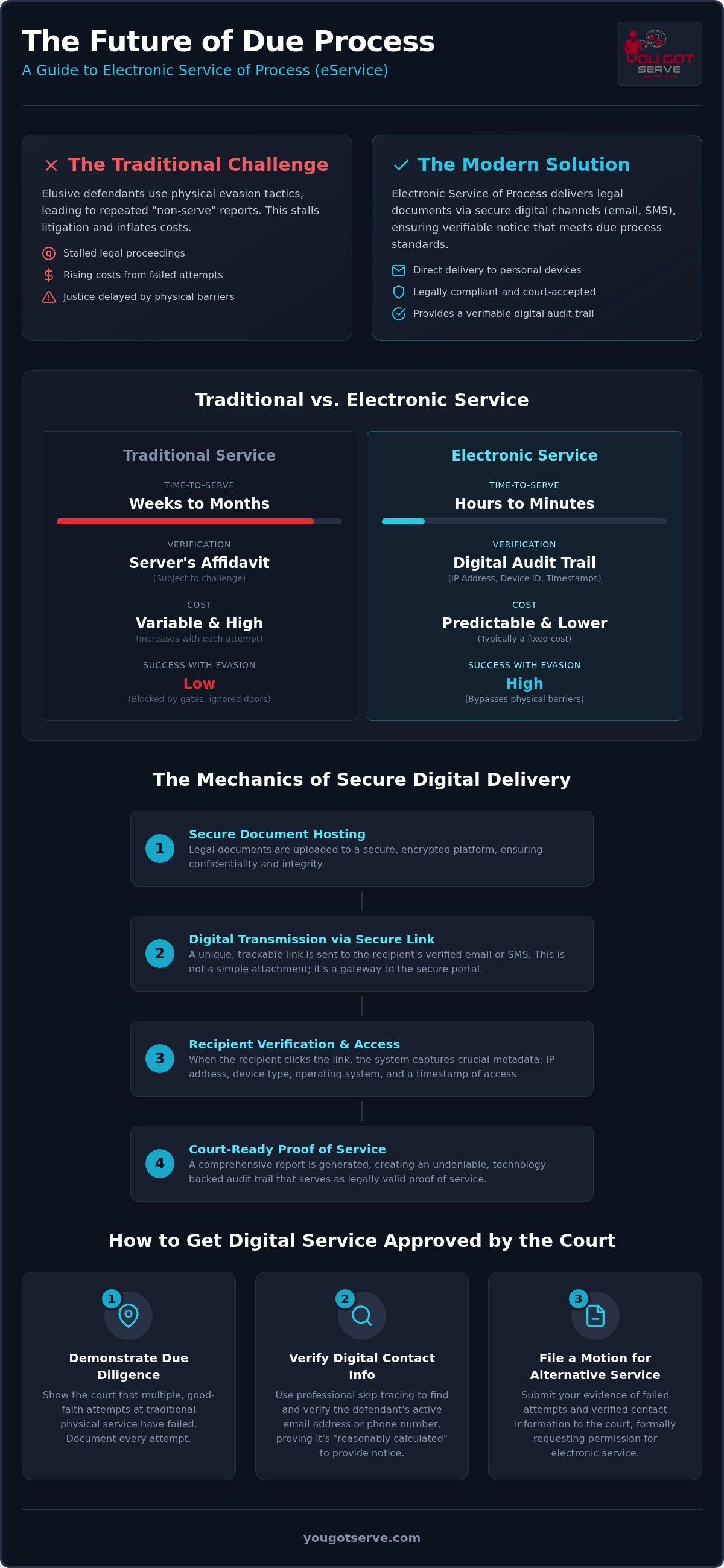
Alternative service acts as the judicial remedy for these situations. When a plaintiff proves they've exercised due diligence through physical attempts, courts may authorize digital delivery as a substitute. This transition prevents defendants from using physical evasion as a tactic to delay justice. By moving to a digital workflow, legal professionals reduce the time-to-serve from weeks of failed physical attempts to just a few hours of verified digital transmission.
The Mechanics of Secure Digital Document Delivery
Reliable electronic service of process depends on a multi-layered technical workflow that replaces the physical hand-off. It isn't enough to simply dispatch a message; the system must confirm that the document reached the intended recipient's control. This process begins with secure hosting and ends with a comprehensive audit trail that documents every interaction. Unlike traditional methods where a server's word is the primary evidence, digital delivery utilizes a chain of technical events to verify receipt.
Recipient verification is what separates a professional legal-tech platform from a standard communication tool. While a physical server's affidavit might be challenged, IP logging and device fingerprinting provide objective data points. These technical signatures record the recipient's unique hardware ID and network location at the moment they access the documents. This metadata creates a robust evidentiary foundation for a court-ready proof of service. For example, modern legal frameworks and evolving statutory requirements across various jurisdictions highlight how specific regulations now govern these digital interactions to ensure they meet judicial standards.
Serving Court Papers via Email
Standard email read receipts are often unreliable because they can be blocked by user privacy settings. Professional platforms use server-side delivery confirmations that track the document's path through mail servers instead. Secure links are mandatory for this process; they allow the sender to track exactly when and where a document was opened while protecting the recipient from the security risks associated with unsolicited attachments. Delivery verification in 2026 relies on end-to-end encryption protocols that timestamp and seal every interaction within a secure document vault to ensure non-repudiation.
Serving Lawsuit Papers via Text (SMS)
SMS has emerged as a primary channel for reaching elusive defendants who may ignore unknown emails or physical mail. Mobile messaging boasts significantly higher engagement rates compared to email, as most recipients check their mobile devices multiple times per hour. Tracking capabilities in modern platforms allow for the capture of click-through data and delivery timestamps directly from the cellular carrier. This high visibility makes it difficult for a defendant to claim they never received the notice. Integrating automated delivery reminders into this workflow ensures that the recipient is prompted multiple times, further strengthening the argument that notice was successfully provided.
Traditional vs. Electronic Service: A Comparative Analysis
Traditional process serving is inherently limited by geography and human schedules. A physical server might spend a week visiting a residence only to find it vacant or the occupant hiding. Electronic service of process eliminates these logistical bottlenecks entirely. In active litigation, time is a critical asset. Traditional service frequently stretches into weeks when dealing with uncooperative defendants. Electronic delivery reduces this window to mere hours, providing a direct path to the recipient regardless of their physical location or the height of their front gate.
The "evasion factor" is perhaps the most significant differentiator. Physical barriers like gated communities, security guards, or aggressive pets are irrelevant to digital transmission. While an elusive defendant can simply refuse to open the door, they're far more likely to engage with a mobile device or an inbox. Digital delivery bypasses the physical gatekeepers that often stall traditional service attempts. This shift doesn't just save time; it ensures that the legal process moves forward without the artificial delays caused by physical avoidance tactics.
Cost-Efficiency and Scalability
Digital delivery significantly lowers litigation overhead for law firms. Traditional methods involve unpredictable costs, such as mileage fees, multiple attempt charges, and rush fees for difficult serves. Electronic delivery utilizes a predictable flat-fee structure that remains consistent regardless of how many miles a server would have traveled. This scalability allows legal teams to serve multiple recipients across different jurisdictions simultaneously without the need to coordinate with various local agencies. When combined with professional skip tracing, the total investigative spend decreases because the focus shifts to targeting verified digital endpoints rather than chasing physical shadows.
The Reliability of the Audit Trail
Traditional affidavits are fundamentally subjective. They rely on the server's individual account of events, which can be challenged in court as a "he-said-she-said" scenario. Digital delivery provides a cryptographic audit trail that is far more difficult to dispute. This log captures exact timestamps, IP addresses, and unique device identifiers at the moment of engagement. Real-time tracking gives legal teams immediate feedback, removing the uncertainty of waiting for a physical return of service to be mailed back. These reports are court-ready, providing an objective level of transparency that physical service simply cannot match.
Achieving Compliance: How to Get Digital Service Approved
Securing judicial approval for electronic service of process requires a methodical demonstration of necessity. Courts generally treat digital delivery as a secondary measure, authorized only after traditional methods have proven insufficient. To transition from physical to digital, you must first satisfy the due diligence requirement. This involves documenting multiple, varied attempts at a defendant's known physical locations. You must provide a detailed log of dates, times, and observations that indicate active evasion or abandonment of the residence to satisfy the court's standards.
Skip tracing is the bridge between a failed physical serve and a successful digital one. It provides the investigative evidence that the digital contact information you intend to use is actively monitored by the defendant. When a defendant is elusive, identifying a verified email or phone number through investigative means proves that digital notice is reasonably calculated to reach them. This investigative layer transforms a technical possibility into a legally sound strategy.
The Motion for Alternative Service
A Motion for Alternative Service is the formal request to bypass physical delivery. Judges require evidence of a known digital presence before granting such a motion. If your skip tracing results show the defendant recently engaged with a specific email or phone number, that data becomes the foundation of your request. To demonstrate reasonable diligence, your motion should include:
- Logs of at least three physical service attempts at different times of day.
- Evidence from neighbor interviews or property records verifying the defendant's residency.
- A skip tracing report confirming the defendant's active use of the target digital account.
- A clear explanation of why traditional service is impractical or being actively evaded.
Creating a Court-Ready Proof of Service
Once the court authorizes the serve and delivery is complete, the resulting affidavit must be unimpeachable. It should consolidate the technical audit trail into a formal legal document. The strength of this document is significantly enhanced by professional oversight. For instance, YouGotServe operates under Florida Private Investigator License #A1400196, which lends investigative authority to the verification process. Your final proof of service should explicitly list:
- The precise timestamp of the initial transmission and subsequent opens.
- The recipient's IP address and device fingerprinting data.
- The specific delivery status, such as "Delivered" or "Opened."
- A sworn statement from the investigator or platform administrator verifying the technical logs.
Presenting these digital logs as a formal affidavit removes the ambiguity often found in traditional service disputes. To ensure your documentation meets these rigorous judicial standards, utilize a platform that generates court-ready proof of service automatically.
Leveraging YouGotServe for Modern Litigation Support
YouGotServe operates as a centralized platform designed to handle the complexities of digital legal delivery. While some industry tools merely manage the notes of physical servers, this platform executes the actual transmission and verification of legal documents. It bridges the gap between traditional investigative techniques and modern technical mechanisms. By providing a secure infrastructure for electronic service of process, it ensures that every transmission is documented with the precision required for judicial review. The platform's audit trail is built to satisfy the evidentiary requirements of the judiciary, providing a level of security that generic communication tools cannot match.
Engaging a recipient is often the most difficult stage of service. To address this, the platform utilizes automated delivery reminders that persistently prompt the defendant to access the documents. These reminders are not just notifications; they are part of a strategic engagement schedule that increases the likelihood of a documented "open" event. This methodical approach ensures that documents don't simply sit unnoticed in an inbox, but are instead brought to the recipient's attention through multiple secure channels.
Integrated Skip Tracing and Investigation
Success in digital delivery depends entirely on the accuracy of the contact data. YouGotServe integrates professional investigative services to ensure that legal documents are sent to verified endpoints. Holding Florida Private Investigator License #A1400196, the platform applies licensed investigative techniques to locate elusive defendants who have successfully avoided physical service. This investigative layer is what allows a legal team to move from an "Address Unknown" status to being "Digital Service Ready." Instead of relying on outdated database entries, the platform identifies active digital presences, ensuring that the motion for alternative service is backed by credible, investigative proof of a defendant's current contact methods.
Streamlining the Legal Workflow
The platform is designed to integrate into a busy legal practice with minimal friction. Users can upload sensitive documents and initiate the delivery process in a matter of minutes. Once the process begins, legal teams can monitor the status of their service in real-time, receiving immediate feedback when a document is delivered or accessed. This transparency removes the traditional "waiting period" associated with physical process servers.
The final output of this workflow is a court-ready proof of service. This document is generated automatically, consolidating all technical logs, timestamps, and investigative verifications into a single, formal affidavit. This automation reduces the administrative burden on law firms and ensures that the final filing is free from the manual errors that can lead to contested service. To enhance your firm's efficiency and secure verifiable results, Streamline your process service with YouGotServe today.
Advancing Your Litigation Strategy with Digital Delivery
The legal landscape in 2026 demands a shift away from failing traditional methods and toward verifiable digital workflows. Mastery of electronic service of process allows your firm to bypass physical gates and reach defendants directly through the devices they use every day. By documenting "reasonable diligence" and leveraging technical audit trails like IP logging, you transform a difficult serve into a routine procedural step. This evolution ensures that the principle of due process remains intact even when a defendant's physical location is unknown.
YouGotServe supports this transition by combining high-level technology with professional expertise. Our platform provides real-time tracking and recipient verification under the oversight of a Licensed Private Investigator (License #A1400196). It's a system designed to produce secure, court-ready proof of service reports that confirm delivery with technical precision. Don't let elusive defendants dictate your litigation timeline or inflate your costs through repeated failed attempts.
Start your secure electronic service of process with YouGotServe to streamline your operations and secure the notice your case requires. It is time to embrace a more reliable, innovative approach to legal delivery.
Frequently Asked Questions
Is electronic service of process legal in all jurisdictions?
Electronic service of process is not automatically legal for initial service in every jurisdiction. While many courts permit it for subsequent filings between parties, using it to initiate a lawsuit usually requires specific court authorization. You must consult local rules or the Federal Rules of Civil Procedure to determine if your specific venue allows digital delivery as a primary or secondary method after traditional attempts fail.
How do I prove a defendant received a document via email?
Proof of receipt is established through a technical audit trail that records the recipient's interaction with the document. A professional platform captures the IP address, device identifier, and a precise timestamp the moment the link is accessed. This metadata provides objective evidence of delivery that exceeds the simple "sent" status of a standard email, creating a verifiable record for the court.
What happens if a defendant refuses to open the electronic service link?
If a defendant ignores the initial notification, the use of automated delivery reminders becomes a critical component of the process. These follow-up messages increase the frequency of contact and help establish that the defendant had multiple opportunities to receive notice. If the defendant still refuses to engage, your detailed log of these persistent attempts serves as evidence of their active evasion for the judge.
Can I serve legal papers via text message without a court order?
Serving legal papers via text message generally requires a court order for initial process. While some jurisdictions are becoming more flexible, you typically can't use SMS as a primary method without first demonstrating that traditional physical service was unsuccessful. Once authorized, text messaging is a highly effective way to reach individuals who avoid physical contact or have abandoned their known physical addresses.
What is a Motion for Alternative Service and when do I need one?
A Motion for Alternative Service is a formal request to the court to allow a non-traditional method of delivery, such as email or SMS. You need one when you can demonstrate that traditional personal service is impractical despite your diligent efforts. The motion must show that the proposed digital method is reasonably calculated to provide the defendant with actual notice based on their digital presence.
How does skip tracing help with electronic service of process?
Skip tracing identifies the most current and active digital endpoints for a defendant, such as their primary email address or mobile number. This investigative step is essential for proving to a judge that the electronic service of process will actually reach the recipient. Using licensed investigative techniques ensures that the contact information is verified rather than extracted from outdated or unreliable public databases.
What is the difference between eFiling and electronic service?
eFiling is the act of submitting documents directly to the court's electronic management system for record-keeping. Electronic service, however, refers to the delivery of those documents to the other parties involved in the litigation. While eFiling is often mandatory for attorneys, electronic service for the initial summons usually requires specific permission or adherence to distinct procedural rules to satisfy due process.
Is proof of electronic service as valid as a physical affidavit?
Proof of electronic service is legally valid as long as it complies with the specific requirements set forth in the court's order for alternative service. A professional digital report includes cryptographic verification and comprehensive tracking data that mirrors the intent of a traditional affidavit. When prepared correctly, these reports are court-ready and provide a robust, objective record of successful delivery that is difficult to dispute.


